Solutions
Learning points of section
 Definitions and Types of solutions
 Colloidal solution
 General properties of solutions
Solution
It is a mixture formed when one solute or more dissolved in a solvent.
Classification of solutions
According to the size of the dissolved particles (solutes)
Crystalloid
solutions
(true solution)
Colloidal solutions Suspensions
The diameter of the molecules and ions of the dispersed phase (solute) is
less than 1 millimicrone (nm).
 It is homogenous solution (solutes completely dissolved and distributed).
Examples
 Sugar solution
 Sodium chloride in water
1.True or crystalloid solutions
True or crystalloid solutions
2. Colloidal solutions (sols)
The diameter of the molecules lies between 1-200 millimicrone
 Colloidal solutions are known as sols
 Soles which have became jelly like are called gels
Examples
 Starch in water
 Proteins in water
Colloidal Solutions
3. Suspensions
The diameter of the particles is larger than 200 millimicrone.
Examples
 Charcoal in water
 Sand in water
Suspensions
Colloidal solutions
Colloidal solutions stability
Stability:
It means colloidal particles are remaining suspended in solution and not occur
aggregation and sedimentation of particles.
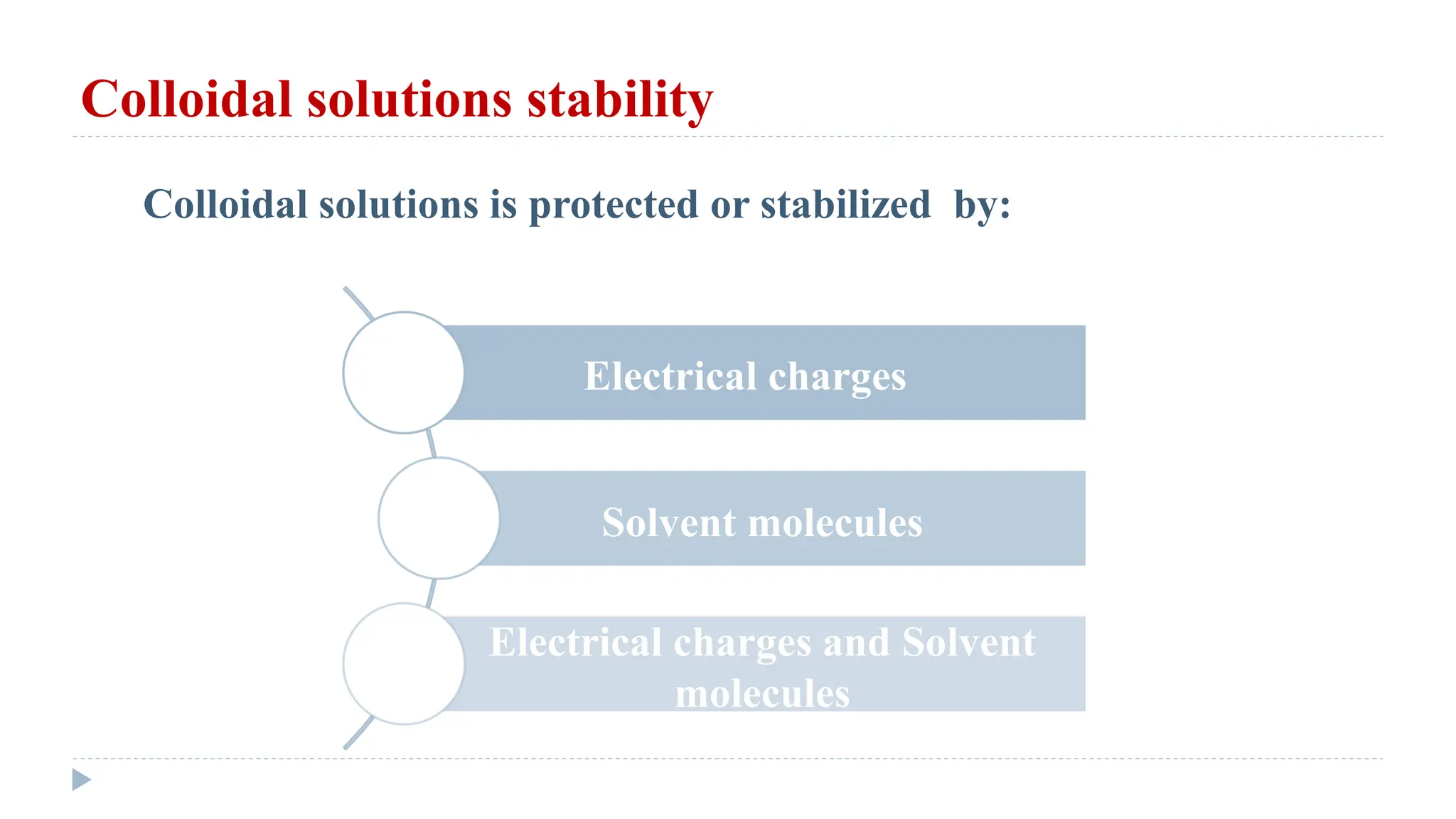
Colloidal solutions is protected or stabilized by:
Electrical charges
Solvent molecules
Electrical charges and Solvent
molecules
Colloidal solutions stability
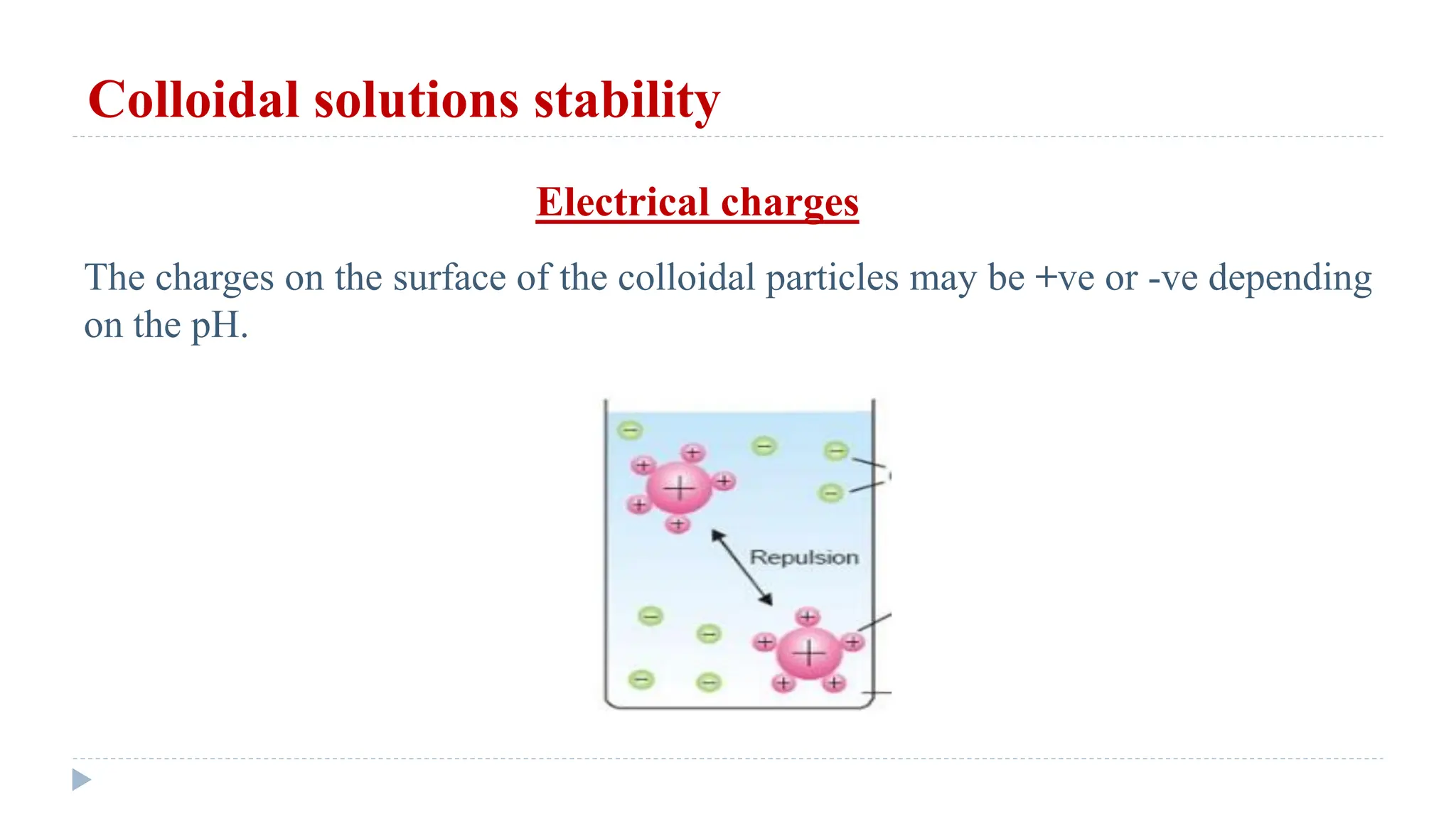
The charges on the surface of the colloidal particles may be +ve or -ve depending
on the pH.
Colloidal solutions stability
Electrical charges
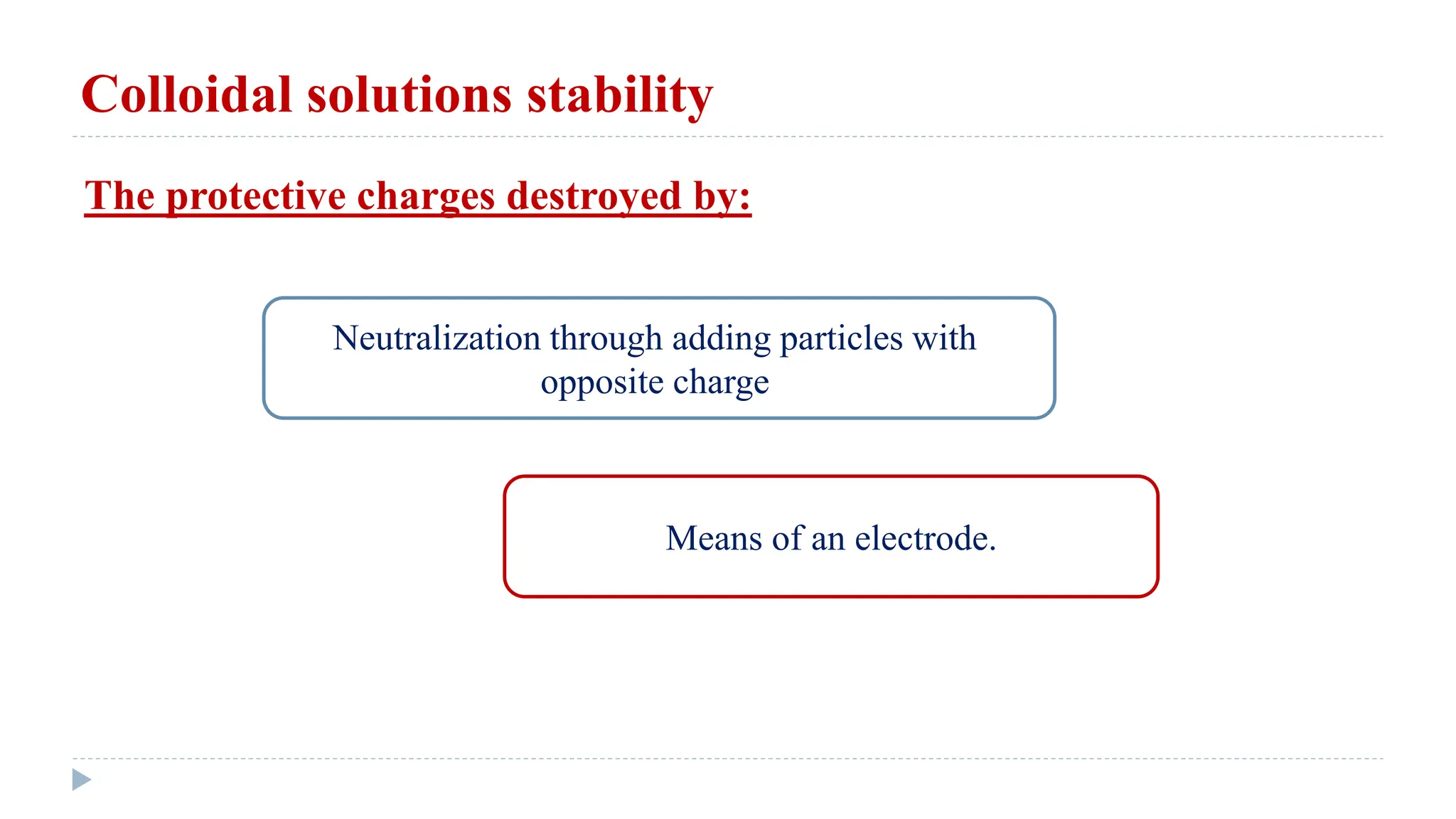
The protective charges destroyed by:
Colloidal solutions stability
Neutralization through adding particles with
opposite charge
Means of an electrode.
 The solvent may stabilize the colloidal particles by acting like a protective
coat preventing the particles from coming together, coalescing & p.p.t
Colloidal solutions stability
Solvent molecules
Colloidal solutions stability
The protective coat destroyed by:
Simply removing the solvent by heating
Changing the solvent by adding another solvent
Salting out by adding a salt (ammonium sulfate)
that absorbs the protective coating
Colloidal solutions stability
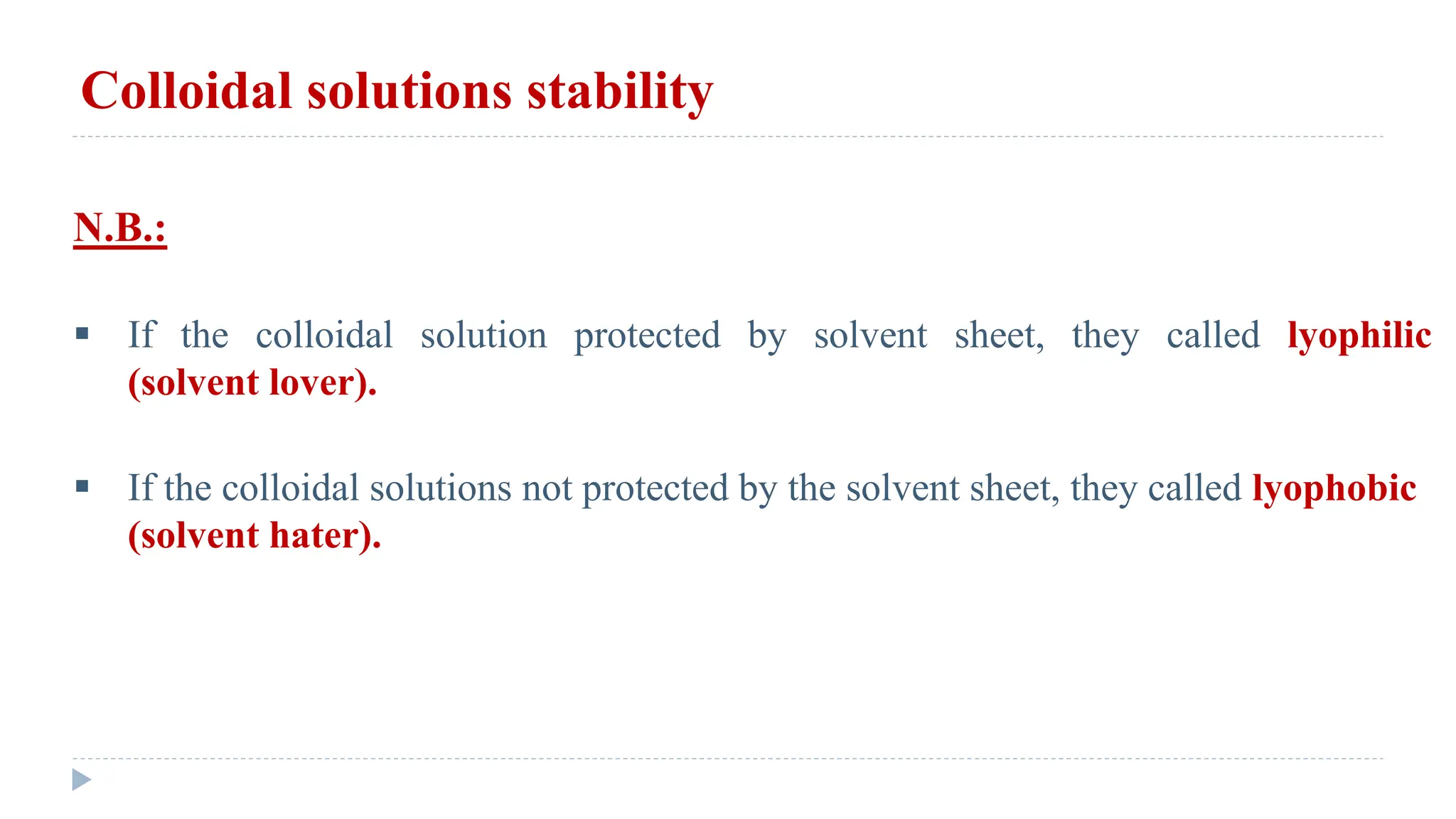
N.B.:
 If the colloidal solution protected by solvent sheet, they called lyophilic
(solvent lover).
 If the colloidal solutions not protected by the solvent sheet, they called lyophobic
(solvent hater).
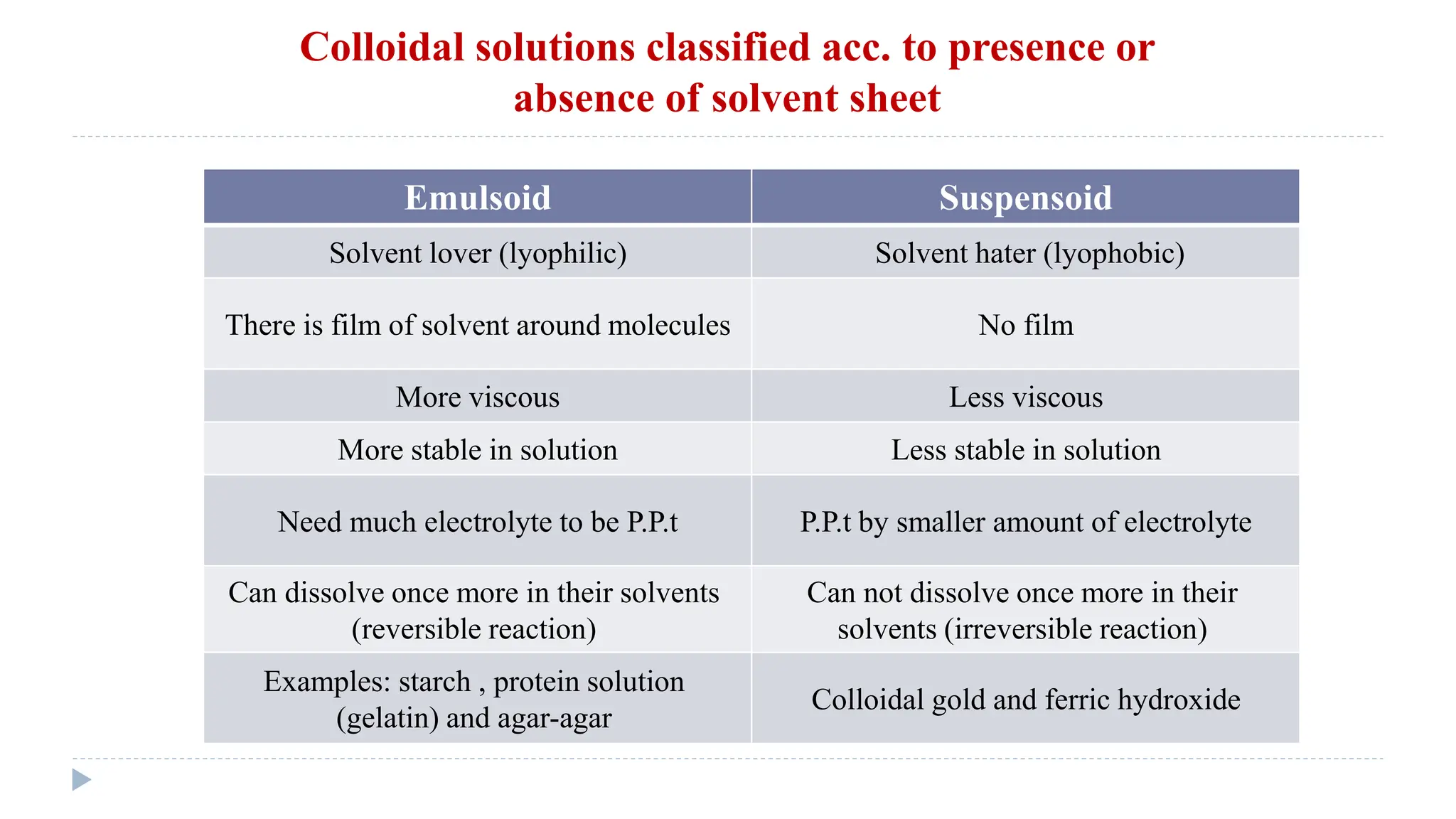
Colloidal solutions classified acc. to presence or
absence of solvent sheet
Colloidal solution
Emulsoid Suspensoid
Suspensoid
Emulsoid
Solvent hater (lyophobic)
Solvent lover (lyophilic)
No film
There is film of solvent around molecules
Less viscous
More viscous
Less stable in solution
More stable in solution
P.P.t by smaller amount of electrolyte
Need much electrolyte to be P.P.t
Can not dissolve once more in their
solvents (irreversible reaction)
Can dissolve once more in their solvents
(reversible reaction)
Colloidal gold and ferric hydroxide
Examples: starch , protein solution
(gelatin) and agar-agar
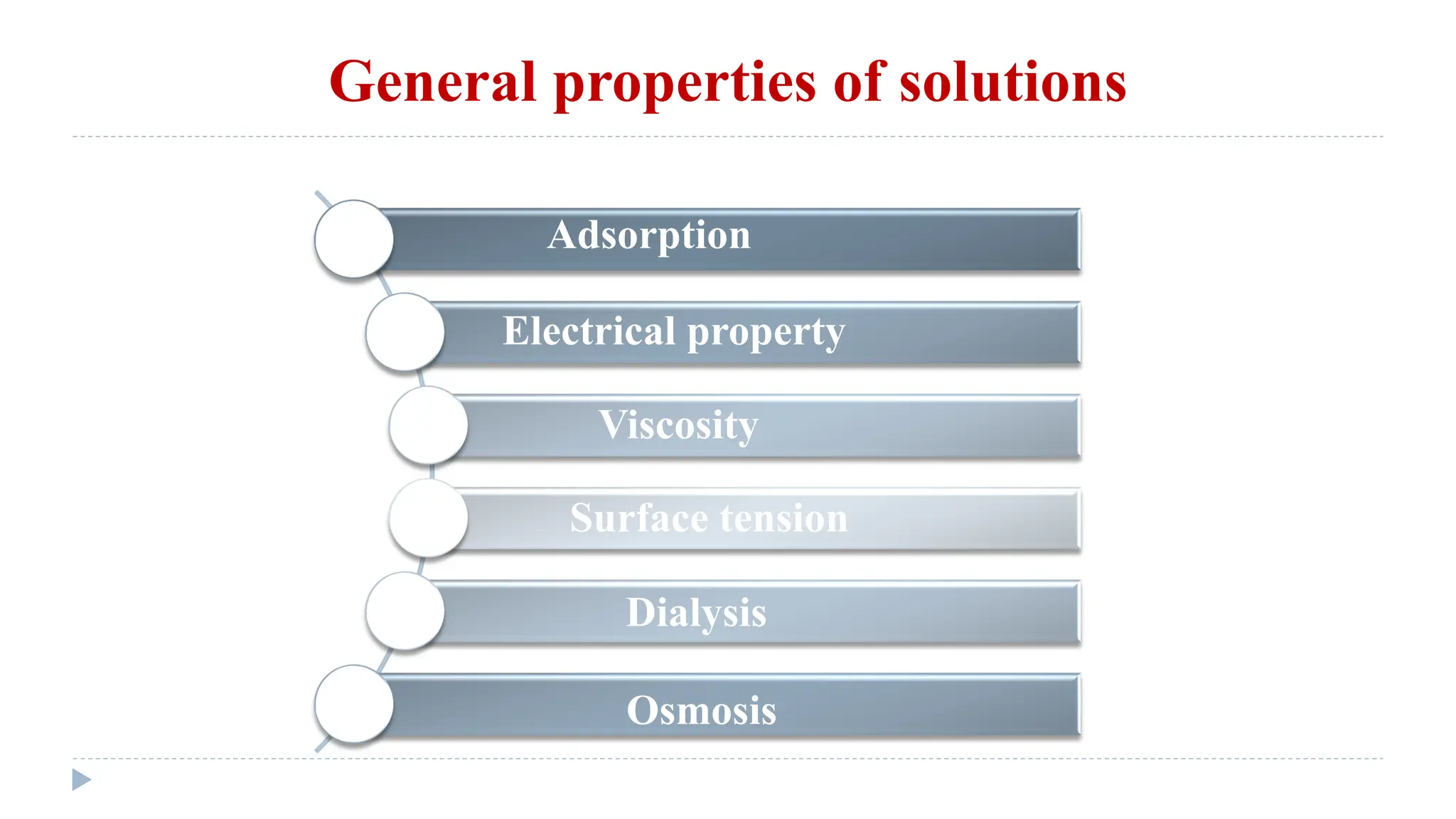
General properties of solutions
Adsorption
Electrical property
Viscosity
Surface tension
Dialysis
Osmosis
1. Adsorption
It is the adherence of small particles (molecules, atom or ions) on the surface of
larger particles
It depends on :
A. The charges carried by both the adsorped and the adsorping particles.
B. The surface area of the adsorbing particles .
Adsorption vs. Absorption
:
Colloidal particles are excellent adsorbents
 Charged colloidal particles
 large surface area.
N.B.:
 Activated charcoal is commonly used to purification processes as air purification
and water purification.
 It is indicated for primary elimination of the toxin in moderate to severe cases of
poisoning.
1. Adsorption
2. Electrical properties
All colloidal particles are charged
If the particles are positively charged (cation), they migrate to cathode (-ve) and
if particles are negatively charged (anion) migrate to anode (+ve).
Electrophoresis:
Is the migration of charged colloidal particles to the opposite electrode when
placed in an electric field.
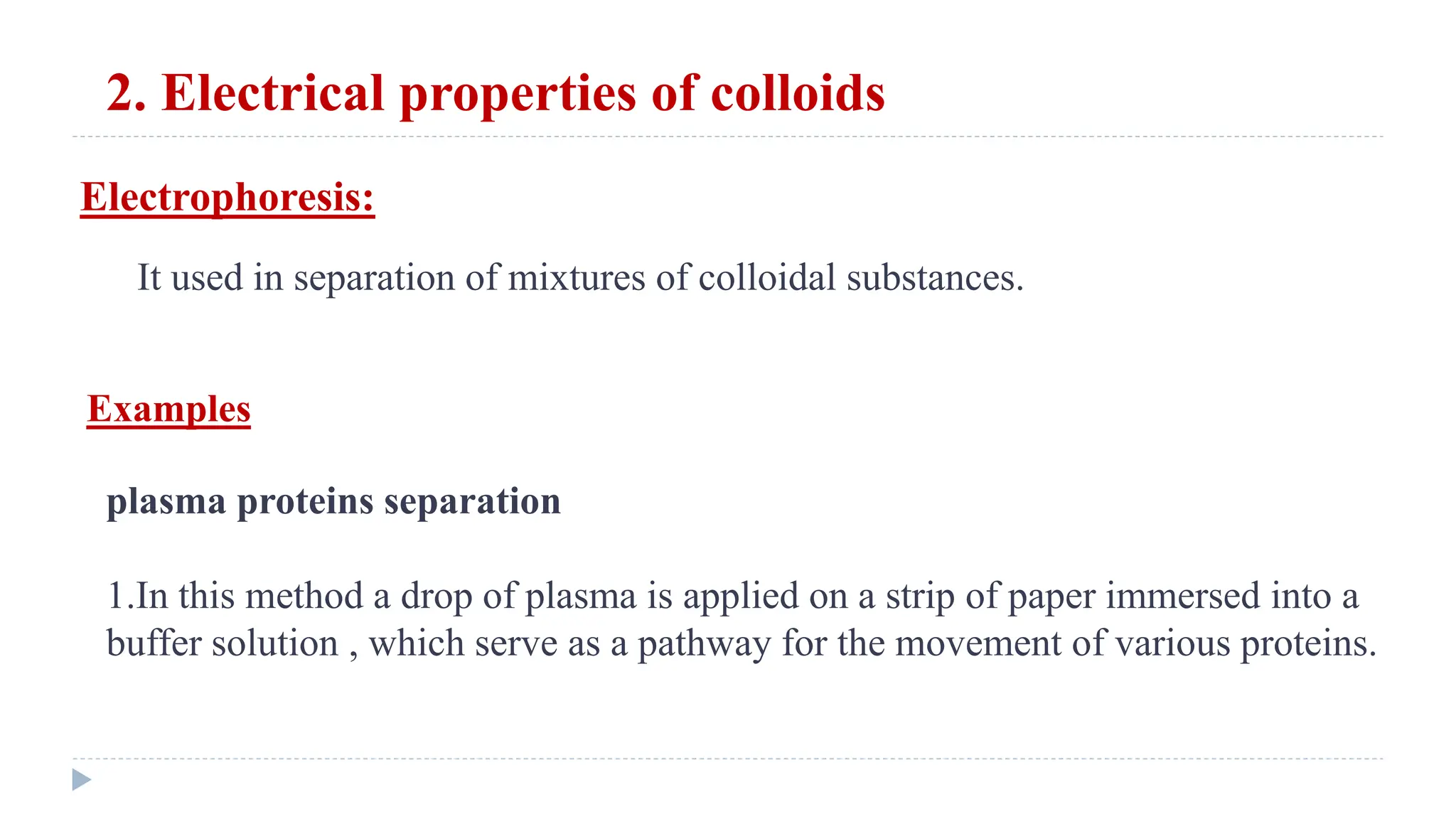
2. Electrical properties of colloids
Electrophoresis:
It used in separation of mixtures of colloidal substances.
plasma proteins separation
1.In this method a drop of plasma is applied on a strip of paper immersed into a
buffer solution , which serve as a pathway for the movement of various proteins.
Examples
2. Electrical properties of colloids
Electrophoresis:
2.After passing in electric current for a certain time , the paper is dried to
denature and fix the positions of the proteins to be estimated.
Plasma proteins can be classified by electrophoresis into:
 Albumin
 α1 globulins
 α2 globulins
 β globulins
 γ globulins
 Fibrinogen
Electrophoresis
3.Viscosity
Is the resistance of solution to flow over each other, as a result of the forces of
attraction and internal friction between the molecules.
The viscosity is affected by:
 Temperature
 Solute concentration
The viscosity decrease with rise of temperature, increase with solute
concentration.
Example:
 Viscosity of blood is due to RBCs and WBCs and it is very important in
maintaining the blood pressure.
4. Surface tension
Is a force by which the surface molecules are held together.
The molecules within the liquid are attracted equally in all directions, while those
at the surface are attracted inwards and side wards .
Examples of substances decrease surface tension
 Bile salts
 Soap
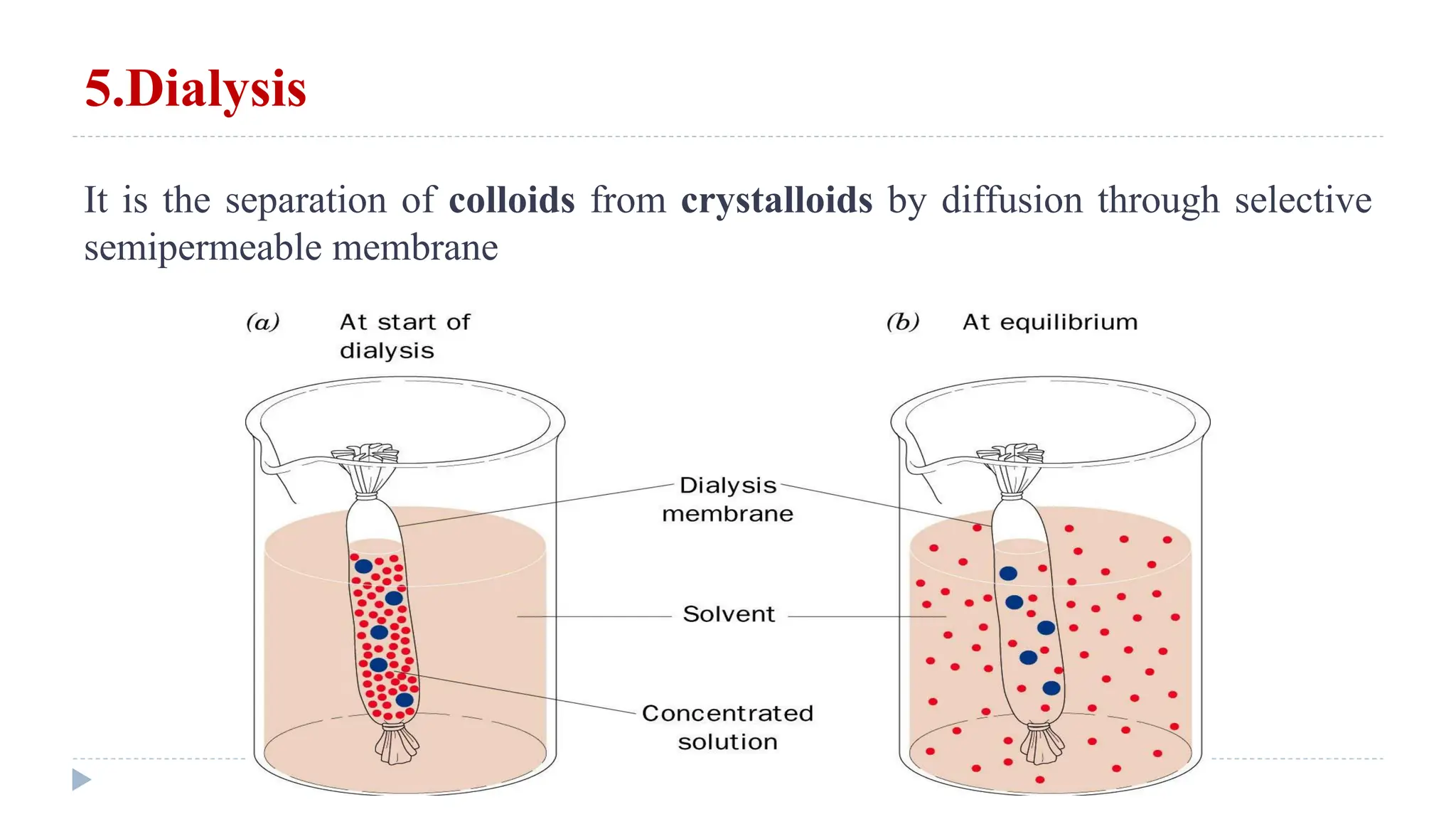
5.Dialysis
It is the separation of colloids from crystalloids by diffusion through selective
semipermeable membrane
Examples:
 Colloids are non dialyzable.
This method used practically to separate colloidal proteins from inorganic salts.
5.Dialysis
6. Osmosis
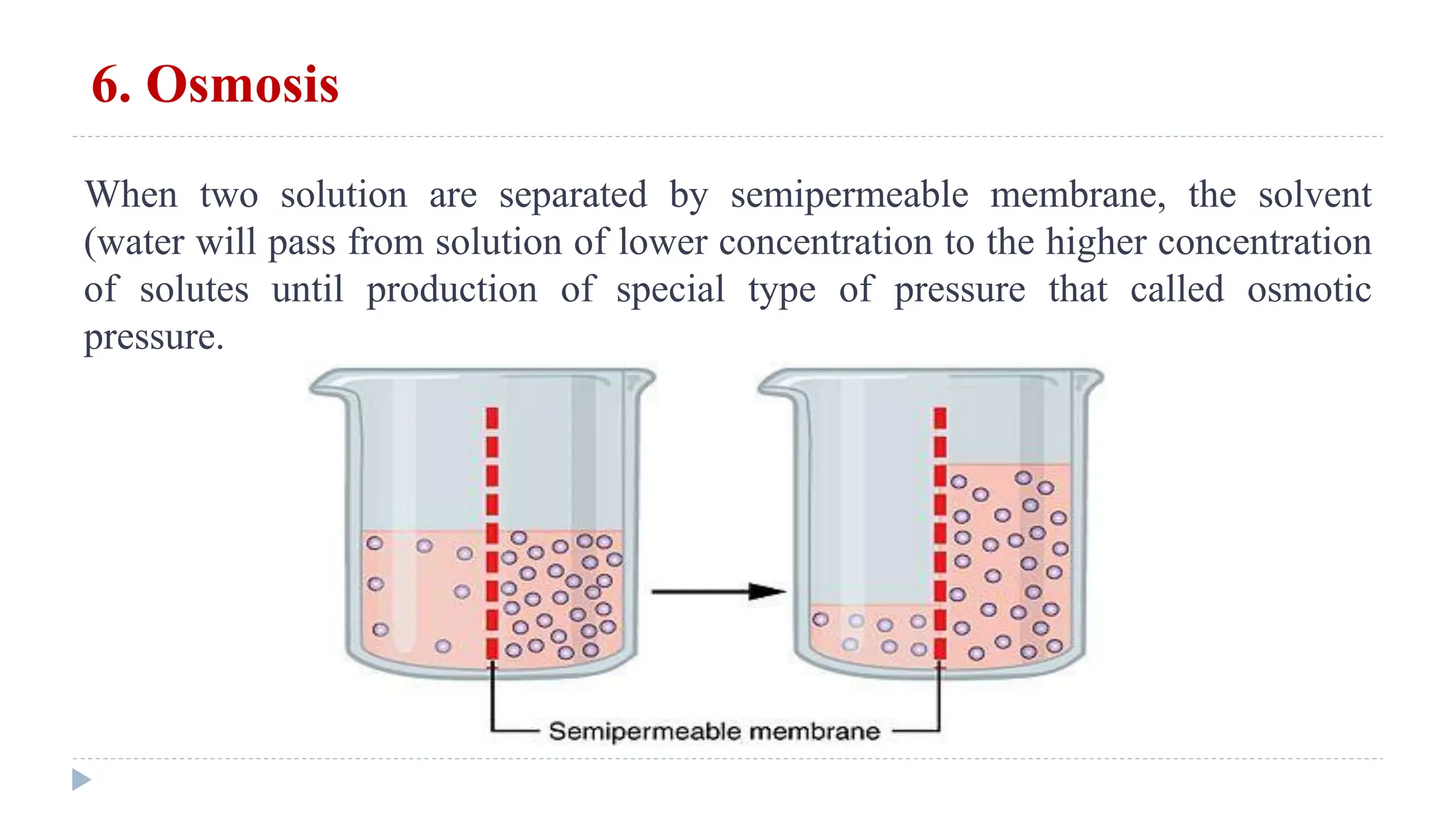
When two solution are separated by semipermeable membrane, the solvent
(water will pass from solution of lower concentration to the higher concentration
of solutes until production of special type of pressure that called osmotic
pressure.
Osmotic pressure
6. Osmosis
Is pressure required to prevent osmosis , this osmotic pressure is due to unequal
bombardment of the membrane on its opposite side by the solvent molecules .
Oncotic pressure
Is the osmotic pressure of plasma proteins .
 It is important for urine formation and exchange of materials between
arterial and venous blood .
 It is equals about 30 mmHg.
6. Osmosis
The passage of water in and out of cells is an important biological function .
The usual conc. of ions in the body fluids is about 0.9% NaCl this is called
physiological saline or isotonic solution.
Importance of Osmosis in the body:
From previous, the salt concentration are of high importance in determining
the distribution of body water.
Classification of solutions acc. to osmosis
Hypertonic
solution
Isotonic solution Hypotonic solution
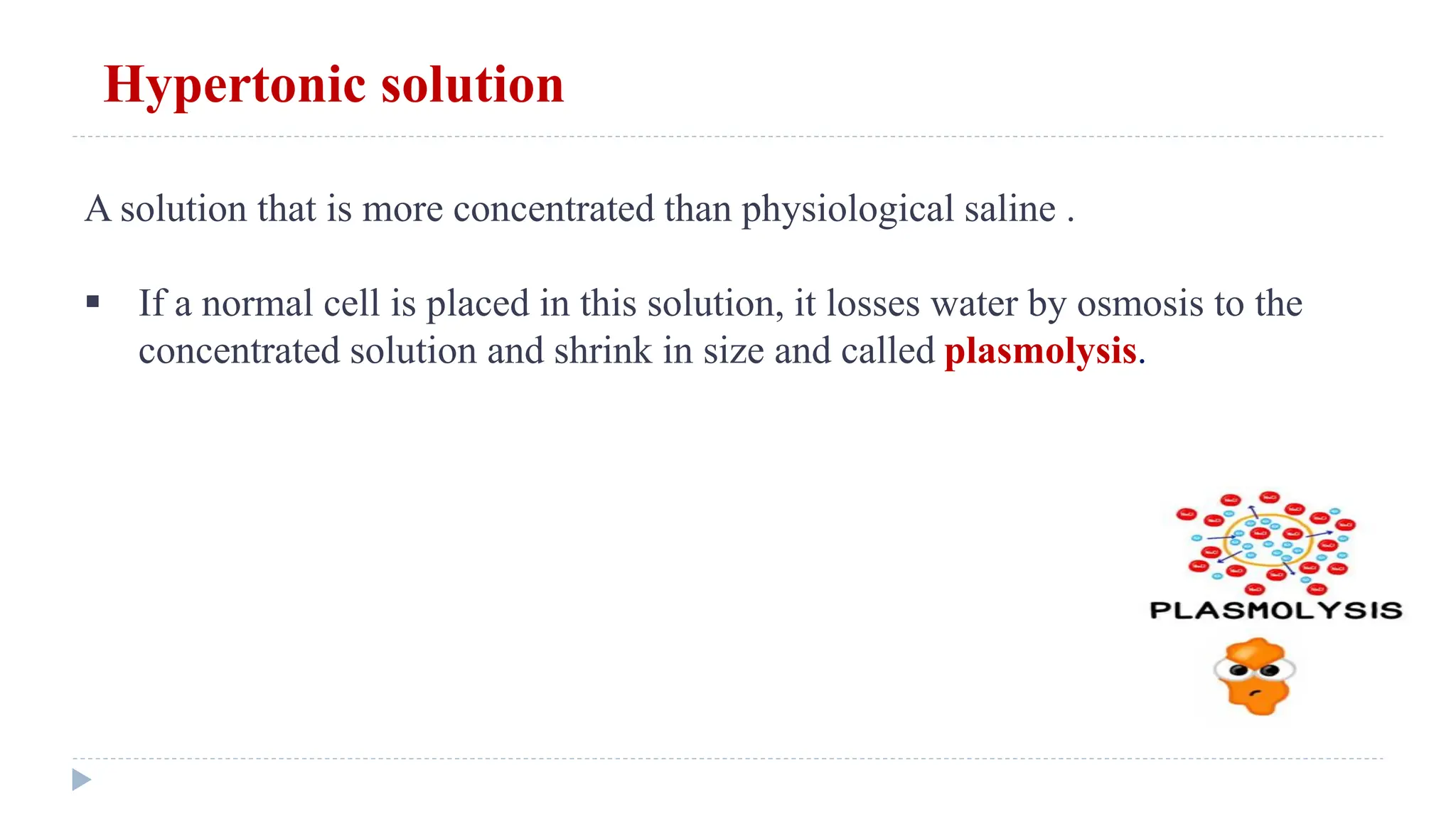
Hypertonic solution
A solution that is more concentrated than physiological saline .
 If a normal cell is placed in this solution, it losses water by osmosis to the
concentrated solution and shrink in size and called plasmolysis.
Hypotonic solution
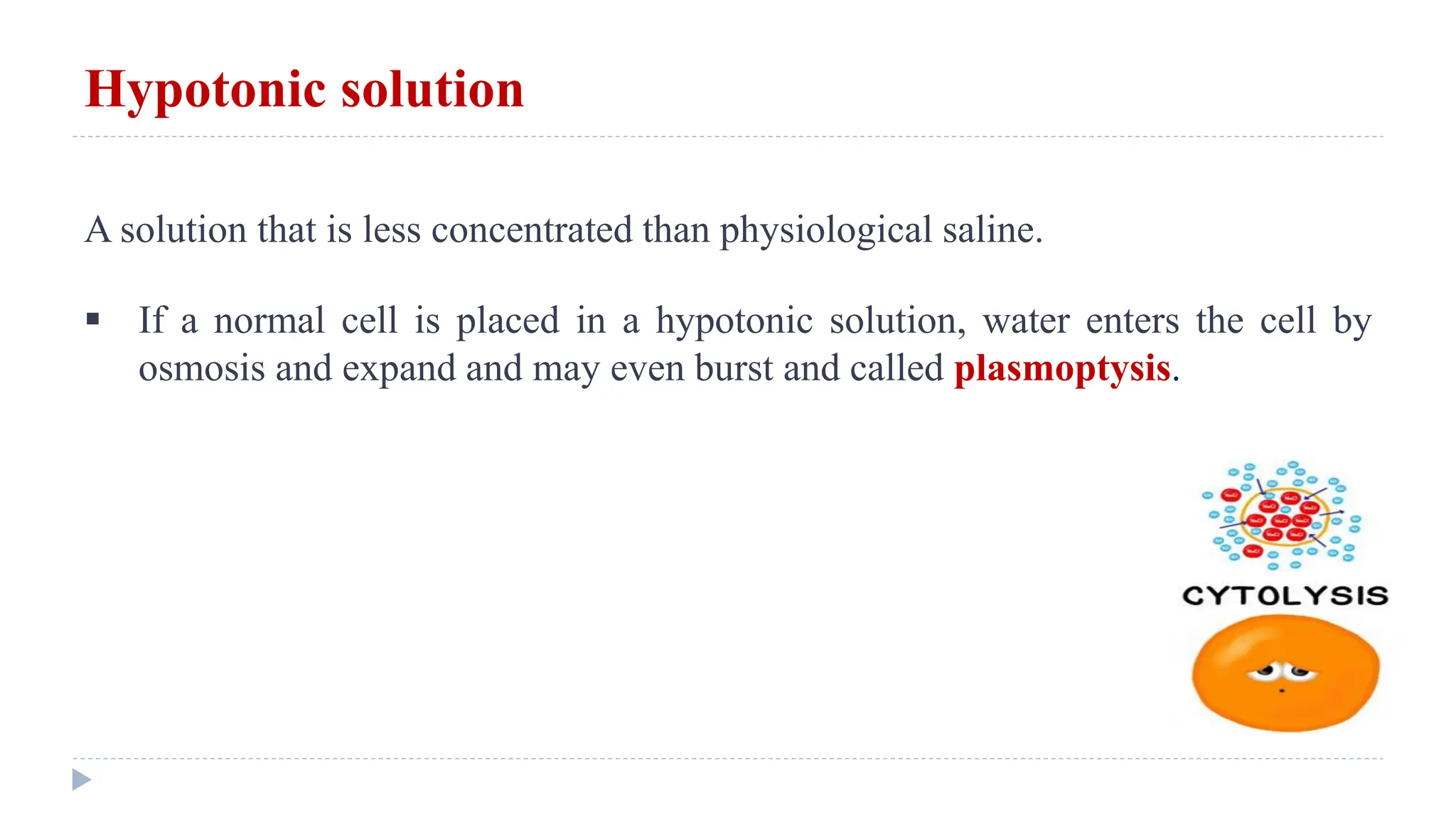
A solution that is less concentrated than physiological saline.
 If a normal cell is placed in a hypotonic solution, water enters the cell by
osmosis and expand and may even burst and called plasmoptysis.
Physiological significance of osmotic pressure
It is the rupture of red blood cells with the liberation of their hemoglobin content.
If we put RBCs in hypotonic solution, they absorb water, swell and finally
rupture of its wall.
 Normally RBCs is in isotonic solution (0.9 g% NaCl) hemolysis start at
concentration of 0.45 g % and is completed at 0.32 -0.34 g % NaCl.
1.Hemolysis
Physiological significance of osmotic pressure
Causes of hemolysis
Physical causes
Chemical causes
Biological causes
Causes of hemolysis
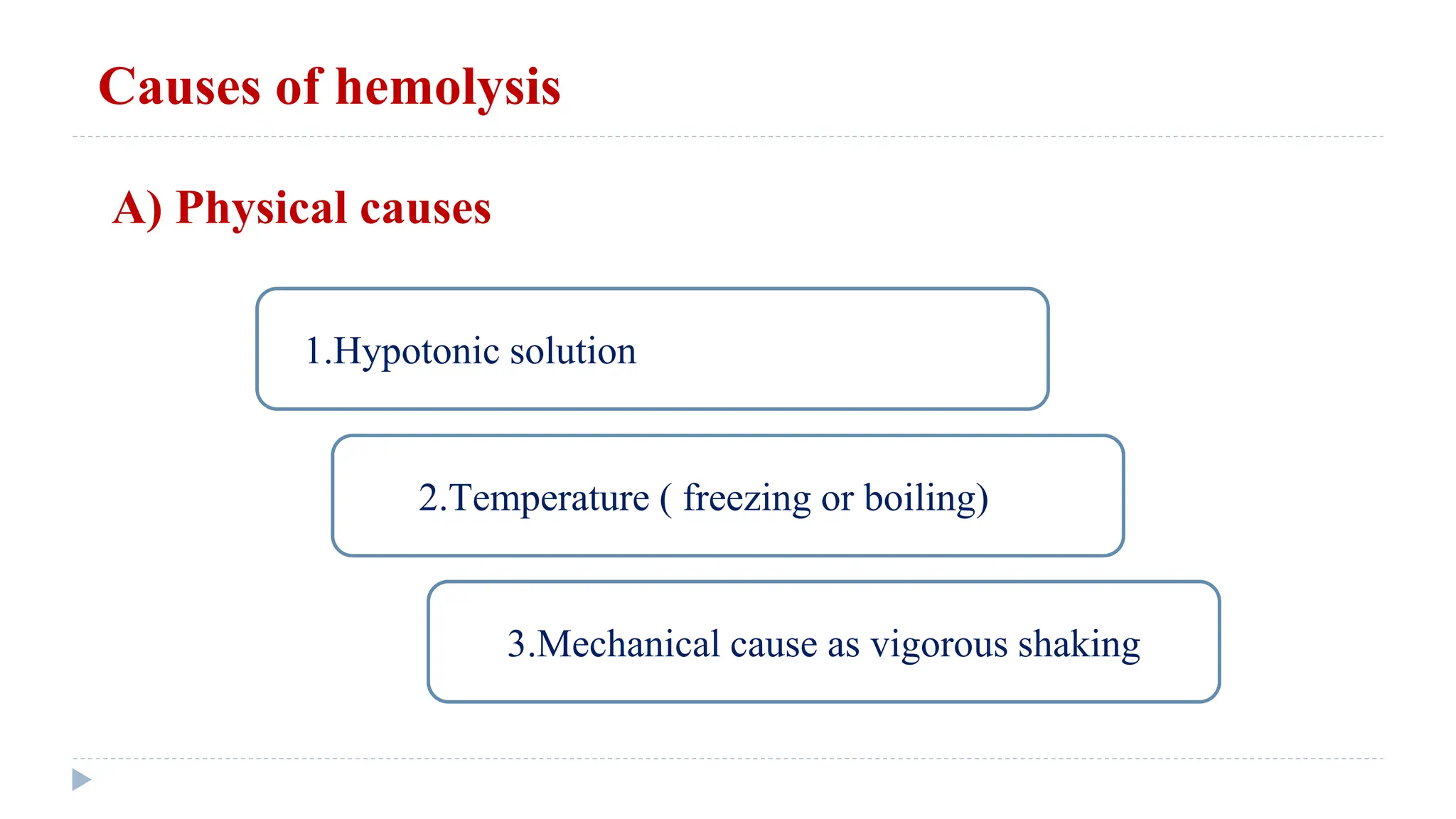
A) Physical causes
1.Hypotonic solution
2.Temperature ( freezing or boiling)
3.Mechanical cause as vigorous shaking
Causes of hemolysis
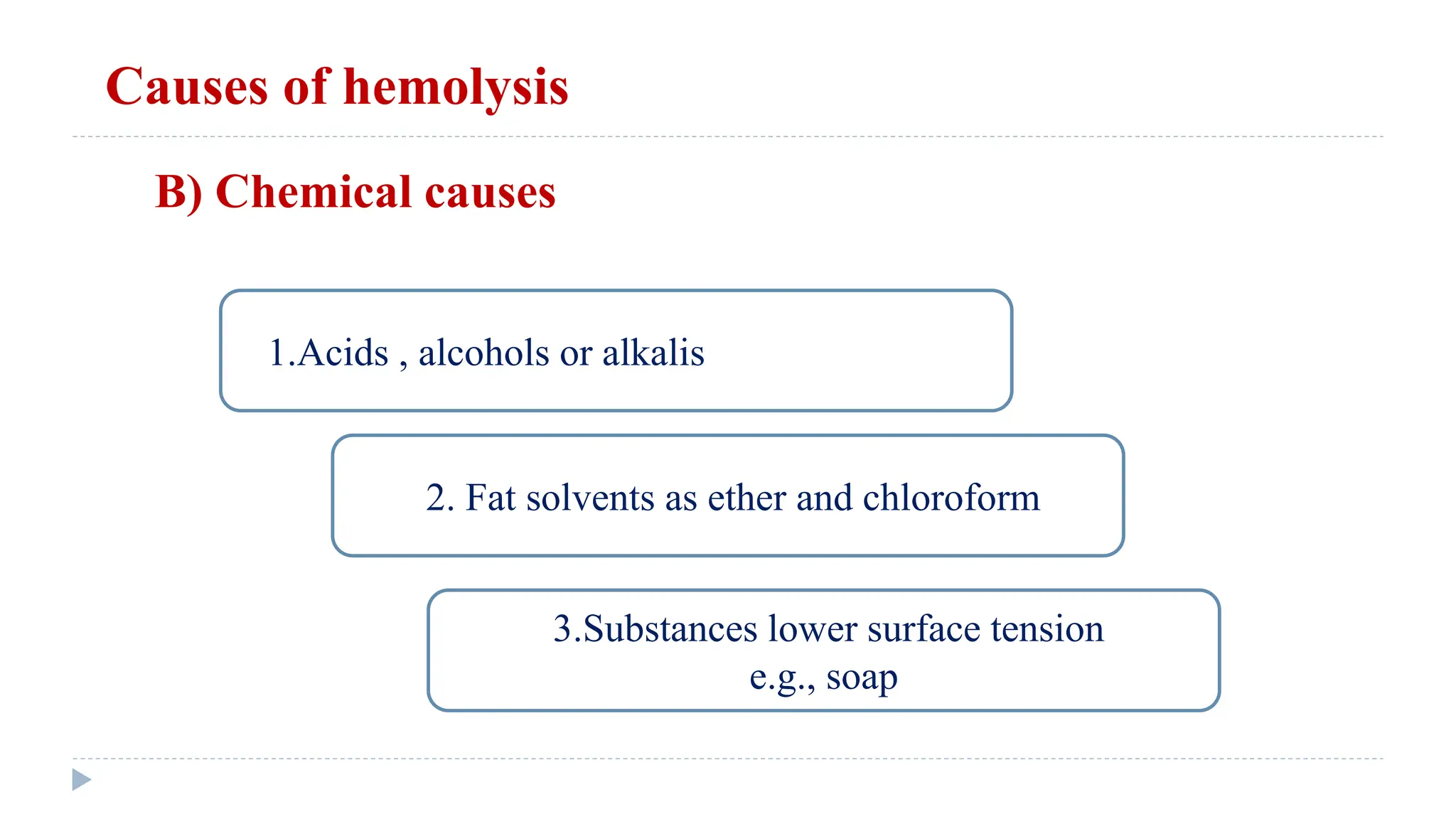
B) Chemical causes
1.Acids , alcohols or alkalis
2. Fat solvents as ether and chloroform
3.Substances lower surface tension
e.g., soap
Causes of hemolysis
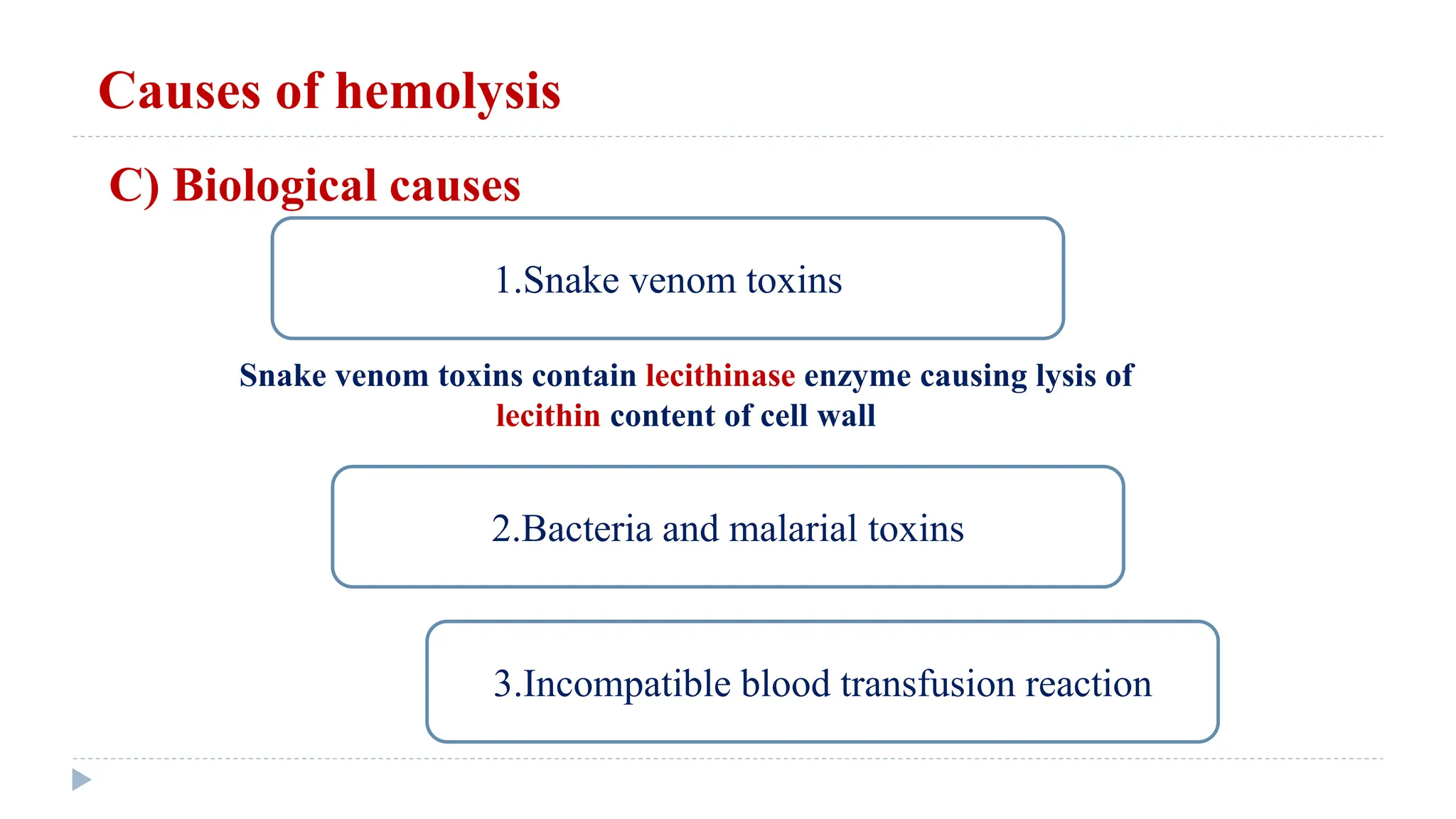
C) Biological causes
1.Snake venom toxins
2.Bacteria and malarial toxins
3.Incompatible blood transfusion reaction
Snake venom toxins contain lecithinase enzyme causing lysis of
lecithin content of cell wall
Physiological significance of osmotic pressure
2. Formation and reabsorption of interstitial fluids:
The interstitial fluid is formed by filtration of the blood plasma at the arterial end
of the blood capillaries and is reabsorbed at the venous end.
This process is governed by:
 Capillary blood pressure
 Osmotic pressure of the plasma proteins
2. Formation and reabsorption of interstitial fluids:
Physiological significance of osmotic pressure
3. Volumes of body fluids:
The body regulates the volumes of the various body fluids according to their
content of solutes to maintain their osmotic pressure constant.
As in case of Na+ deficiency, we get reduction of the extracellular fluid and blood
volumes while in case of K+ deficiency, we get reduction of intracellular fluid
volumes.
Physiological significance of osmotic pressure
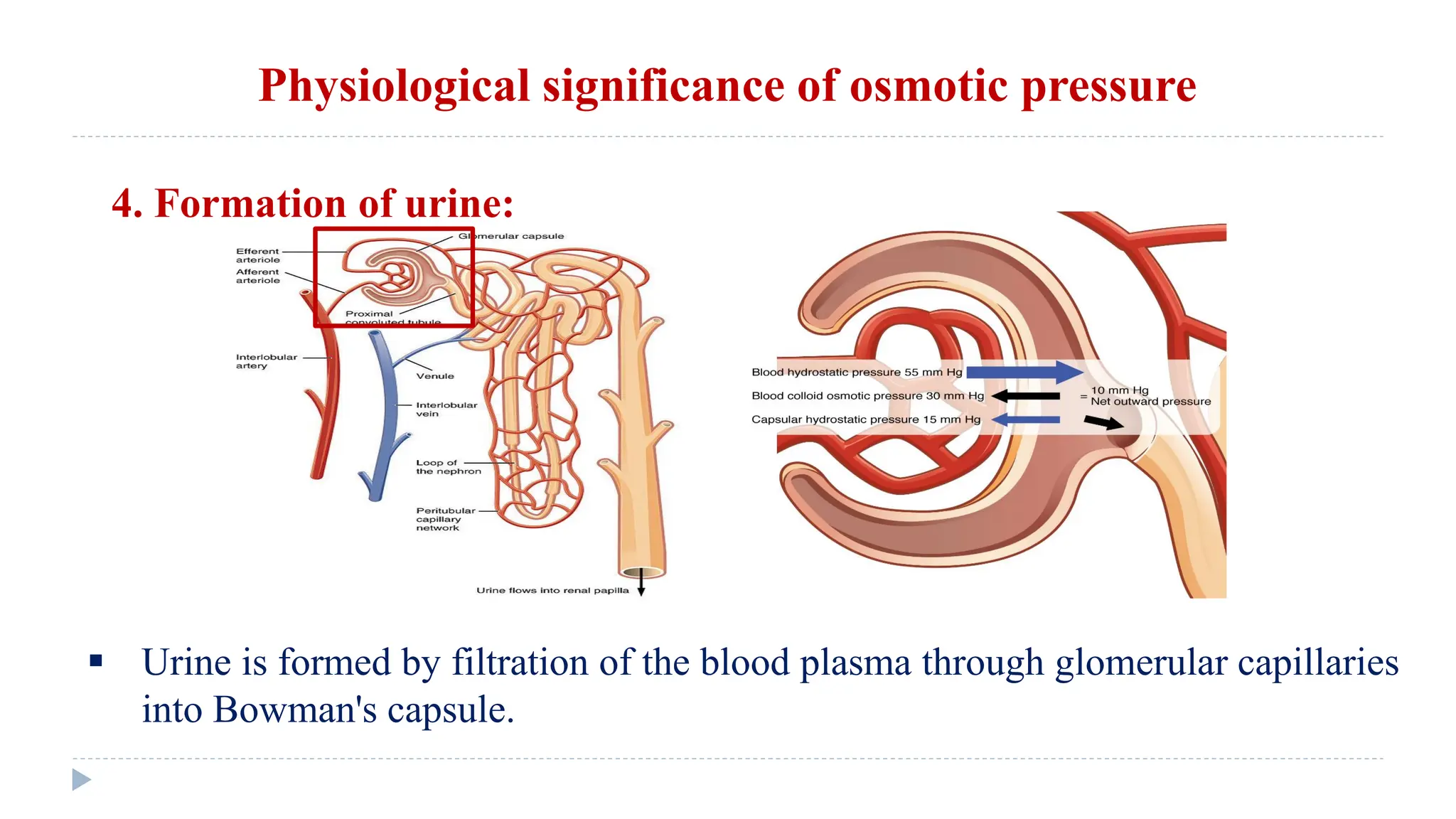
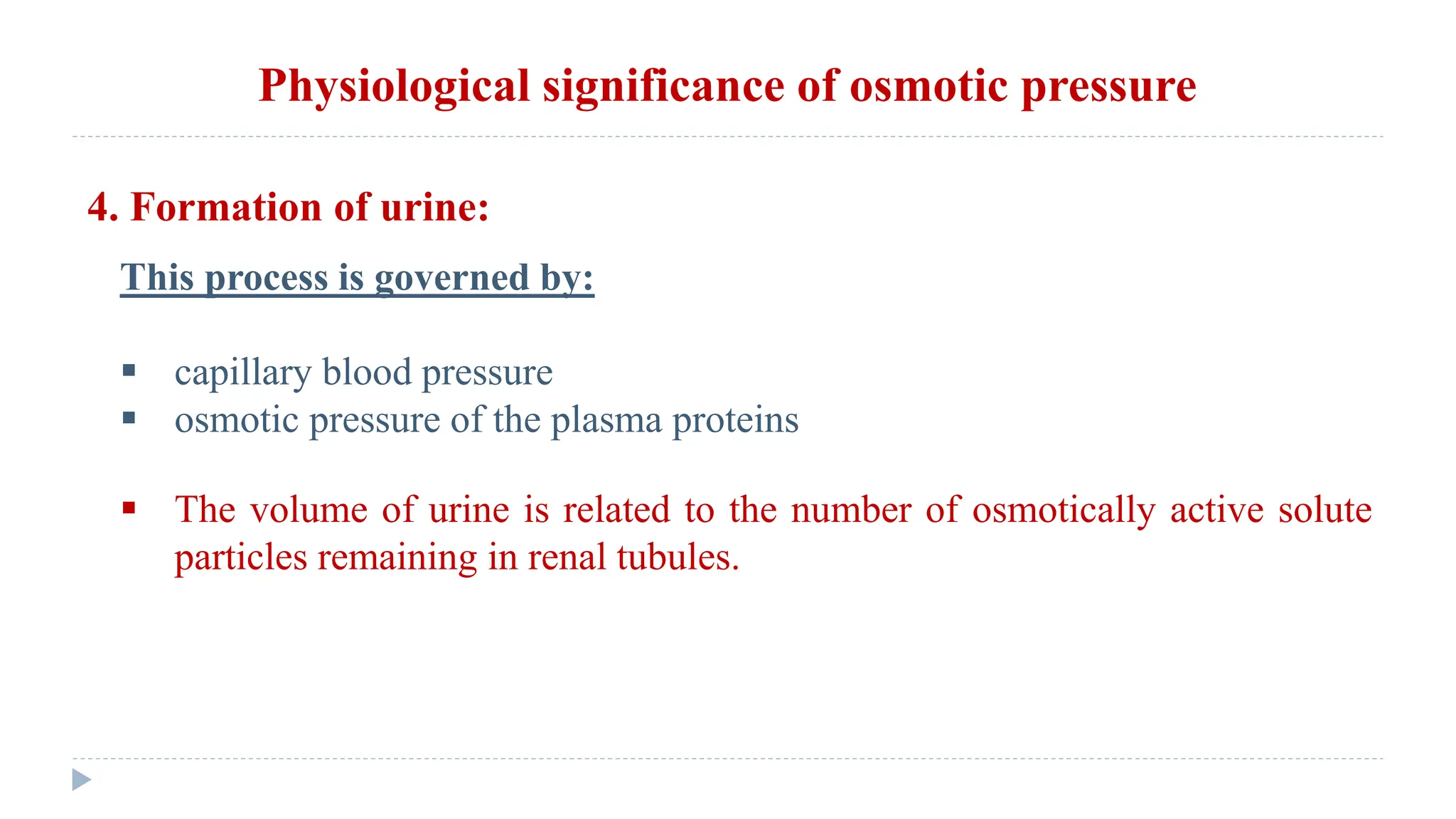
4. Formation of urine:
 Urine is formed by filtration of the blood plasma through glomerular capillaries
into Bowman's capsule.
Physiological significance of osmotic pressure
4. Formation of urine:
This process is governed by:
 capillary blood pressure
 osmotic pressure of the plasma proteins
 The volume of urine is related to the number of osmotically active solute
particles remaining in renal tubules.
Solutions.pdf

Solutions.pdf

  • 1.
  • 2.
    Learning points ofsection  Definitions and Types of solutions  Colloidal solution  General properties of solutions
  • 3.
    Solution It is amixture formed when one solute or more dissolved in a solvent.
  • 4.
    Classification of solutions Accordingto the size of the dissolved particles (solutes) Crystalloid solutions (true solution) Colloidal solutions Suspensions
  • 5.
    The diameter ofthe molecules and ions of the dispersed phase (solute) is less than 1 millimicrone (nm).  It is homogenous solution (solutes completely dissolved and distributed). Examples  Sugar solution  Sodium chloride in water 1.True or crystalloid solutions True or crystalloid solutions
  • 6.
    2. Colloidal solutions(sols) The diameter of the molecules lies between 1-200 millimicrone  Colloidal solutions are known as sols  Soles which have became jelly like are called gels Examples  Starch in water  Proteins in water Colloidal Solutions
  • 7.
    3. Suspensions The diameterof the particles is larger than 200 millimicrone. Examples  Charcoal in water  Sand in water Suspensions
  • 8.
  • 9.
    Colloidal solutions stability Stability: Itmeans colloidal particles are remaining suspended in solution and not occur aggregation and sedimentation of particles.
  • 10.
    Colloidal solutions isprotected or stabilized by: Electrical charges Solvent molecules Electrical charges and Solvent molecules Colloidal solutions stability
  • 11.
    The charges onthe surface of the colloidal particles may be +ve or -ve depending on the pH. Colloidal solutions stability Electrical charges
  • 12.
    The protective chargesdestroyed by: Colloidal solutions stability Neutralization through adding particles with opposite charge Means of an electrode.
  • 13.
     The solventmay stabilize the colloidal particles by acting like a protective coat preventing the particles from coming together, coalescing & p.p.t Colloidal solutions stability Solvent molecules
  • 14.
    Colloidal solutions stability Theprotective coat destroyed by: Simply removing the solvent by heating Changing the solvent by adding another solvent Salting out by adding a salt (ammonium sulfate) that absorbs the protective coating
  • 15.
    Colloidal solutions stability N.B.: If the colloidal solution protected by solvent sheet, they called lyophilic (solvent lover).  If the colloidal solutions not protected by the solvent sheet, they called lyophobic (solvent hater).
  • 16.
    Colloidal solutions classifiedacc. to presence or absence of solvent sheet Colloidal solution Emulsoid Suspensoid Suspensoid Emulsoid Solvent hater (lyophobic) Solvent lover (lyophilic) No film There is film of solvent around molecules Less viscous More viscous Less stable in solution More stable in solution P.P.t by smaller amount of electrolyte Need much electrolyte to be P.P.t Can not dissolve once more in their solvents (irreversible reaction) Can dissolve once more in their solvents (reversible reaction) Colloidal gold and ferric hydroxide Examples: starch , protein solution (gelatin) and agar-agar
  • 17.
    General properties ofsolutions Adsorption Electrical property Viscosity Surface tension Dialysis Osmosis
  • 18.
    1. Adsorption It isthe adherence of small particles (molecules, atom or ions) on the surface of larger particles It depends on : A. The charges carried by both the adsorped and the adsorping particles. B. The surface area of the adsorbing particles .
  • 19.
  • 20.
    : Colloidal particles areexcellent adsorbents  Charged colloidal particles  large surface area. N.B.:  Activated charcoal is commonly used to purification processes as air purification and water purification.  It is indicated for primary elimination of the toxin in moderate to severe cases of poisoning. 1. Adsorption
  • 21.
    2. Electrical properties Allcolloidal particles are charged If the particles are positively charged (cation), they migrate to cathode (-ve) and if particles are negatively charged (anion) migrate to anode (+ve). Electrophoresis: Is the migration of charged colloidal particles to the opposite electrode when placed in an electric field.
  • 22.
    2. Electrical propertiesof colloids Electrophoresis: It used in separation of mixtures of colloidal substances. plasma proteins separation 1.In this method a drop of plasma is applied on a strip of paper immersed into a buffer solution , which serve as a pathway for the movement of various proteins. Examples
  • 23.
    2. Electrical propertiesof colloids Electrophoresis: 2.After passing in electric current for a certain time , the paper is dried to denature and fix the positions of the proteins to be estimated. Plasma proteins can be classified by electrophoresis into:  Albumin  α1 globulins  α2 globulins  β globulins  γ globulins  Fibrinogen
  • 24.
  • 25.
    3.Viscosity Is the resistanceof solution to flow over each other, as a result of the forces of attraction and internal friction between the molecules. The viscosity is affected by:  Temperature  Solute concentration The viscosity decrease with rise of temperature, increase with solute concentration. Example:  Viscosity of blood is due to RBCs and WBCs and it is very important in maintaining the blood pressure.
  • 26.
    4. Surface tension Isa force by which the surface molecules are held together. The molecules within the liquid are attracted equally in all directions, while those at the surface are attracted inwards and side wards . Examples of substances decrease surface tension  Bile salts  Soap
  • 27.
    5.Dialysis It is theseparation of colloids from crystalloids by diffusion through selective semipermeable membrane
  • 28.
    Examples:  Colloids arenon dialyzable. This method used practically to separate colloidal proteins from inorganic salts. 5.Dialysis
  • 29.
    6. Osmosis When twosolution are separated by semipermeable membrane, the solvent (water will pass from solution of lower concentration to the higher concentration of solutes until production of special type of pressure that called osmotic pressure.
  • 30.
    Osmotic pressure 6. Osmosis Ispressure required to prevent osmosis , this osmotic pressure is due to unequal bombardment of the membrane on its opposite side by the solvent molecules . Oncotic pressure Is the osmotic pressure of plasma proteins .  It is important for urine formation and exchange of materials between arterial and venous blood .  It is equals about 30 mmHg.
  • 31.
    6. Osmosis The passageof water in and out of cells is an important biological function . The usual conc. of ions in the body fluids is about 0.9% NaCl this is called physiological saline or isotonic solution. Importance of Osmosis in the body: From previous, the salt concentration are of high importance in determining the distribution of body water.
  • 32.
    Classification of solutionsacc. to osmosis Hypertonic solution Isotonic solution Hypotonic solution
  • 33.
    Hypertonic solution A solutionthat is more concentrated than physiological saline .  If a normal cell is placed in this solution, it losses water by osmosis to the concentrated solution and shrink in size and called plasmolysis.
  • 34.
    Hypotonic solution A solutionthat is less concentrated than physiological saline.  If a normal cell is placed in a hypotonic solution, water enters the cell by osmosis and expand and may even burst and called plasmoptysis.
  • 36.
    Physiological significance ofosmotic pressure It is the rupture of red blood cells with the liberation of their hemoglobin content. If we put RBCs in hypotonic solution, they absorb water, swell and finally rupture of its wall.  Normally RBCs is in isotonic solution (0.9 g% NaCl) hemolysis start at concentration of 0.45 g % and is completed at 0.32 -0.34 g % NaCl. 1.Hemolysis
  • 37.
    Physiological significance ofosmotic pressure Causes of hemolysis Physical causes Chemical causes Biological causes
  • 38.
    Causes of hemolysis A)Physical causes 1.Hypotonic solution 2.Temperature ( freezing or boiling) 3.Mechanical cause as vigorous shaking
  • 39.
    Causes of hemolysis B)Chemical causes 1.Acids , alcohols or alkalis 2. Fat solvents as ether and chloroform 3.Substances lower surface tension e.g., soap
  • 40.
    Causes of hemolysis C)Biological causes 1.Snake venom toxins 2.Bacteria and malarial toxins 3.Incompatible blood transfusion reaction Snake venom toxins contain lecithinase enzyme causing lysis of lecithin content of cell wall
  • 41.
    Physiological significance ofosmotic pressure 2. Formation and reabsorption of interstitial fluids: The interstitial fluid is formed by filtration of the blood plasma at the arterial end of the blood capillaries and is reabsorbed at the venous end. This process is governed by:  Capillary blood pressure  Osmotic pressure of the plasma proteins
  • 42.
    2. Formation andreabsorption of interstitial fluids:
  • 43.
    Physiological significance ofosmotic pressure 3. Volumes of body fluids: The body regulates the volumes of the various body fluids according to their content of solutes to maintain their osmotic pressure constant. As in case of Na+ deficiency, we get reduction of the extracellular fluid and blood volumes while in case of K+ deficiency, we get reduction of intracellular fluid volumes.
  • 44.
    Physiological significance ofosmotic pressure 4. Formation of urine:  Urine is formed by filtration of the blood plasma through glomerular capillaries into Bowman's capsule.
  • 45.
    Physiological significance ofosmotic pressure 4. Formation of urine: This process is governed by:  capillary blood pressure  osmotic pressure of the plasma proteins  The volume of urine is related to the number of osmotically active solute particles remaining in renal tubules.