Colloidal State
Origin
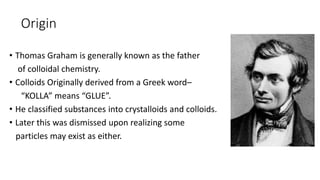
• Thomas Graham is generally known as the father
of colloidal chemistry.
• Colloids Originally derived from a Greek word–
“KOLLA” means “GLUE”.
• He classified substances into crystalloids and colloids.
• Later this was dismissed upon realizing some
particles may exist as either.
Definition
• A colloidal state is a type of dispersed system, so
that means it has a phase, which is a liquid in most
cases, with small insoluble particles dispersed in that
phase.
Image : Fog
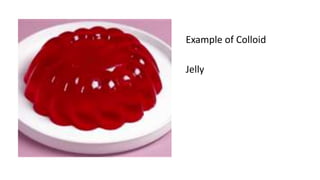
Example of Colloid
Example of Colloid
Jelly
Phases of colloid
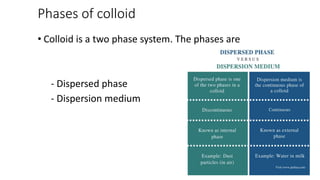
• Colloid is a two phase system. The phases are
- Dispersed phase
- Dispersion medium
Colloid, Solution and Suspension
Property Suspension Colloid Solution
Particle size >100 nm 1 to100 nm <100 nm
Visibility Particles can be seen
with low power
microscope
Particles can not be
seen with low power
microscope
Particles can not be
seen with low power
microscope
Nature Heterogeneous Homogeneous or
Heterogeneous
Homogeneous
Setting of particles Settle on their own Settle on centrifugation Do not settle
Appearance Opaque Varies from translucent
to opaque
Transparent
Filtration Possible Not possible Not possible
Brownian Movement May show Shows Doesn’t show
Example of Suspension
Chocolate milk
Example of colloid
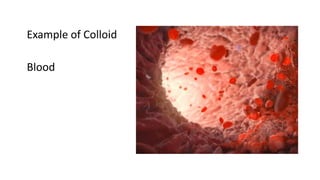
Example of Colloid
Blood
Example of Solution
Example of Solution
Lime juice
Is Colloid Homogenous or Heterogeneous
A mixture is made when two or more substances are combined, but
they are not combined chemically.
There are two type of mixture
• Homogenous
• Heterogamous
Colloids are generally considered heterogeneous mixture, but have
some qualities of homogenous mixture as well.
Properties of Colloids
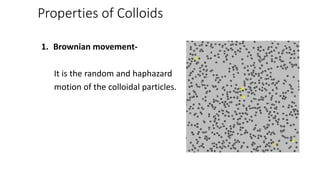
1. Brownian movement-
It is the random and haphazard
motion of the colloidal particles.
Properties of Colloids
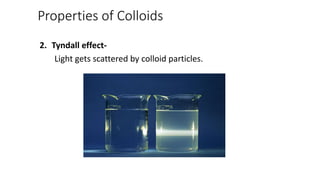
2. Tyndall effect-
Light gets scattered by colloid particles.
Example of Tyndall
effect
Sun ray can’t pass
through the dark cloud
for it being a colloid.
Properties of Colloid
3. Adsorption- Colloidal particles show a high tendency of adsorption.
Misty window is a real life example of adsorption of Colloid
Properties of Colloid
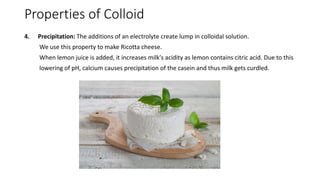
4. Precipitation: The additions of an electrolyte create lump in colloidal solution.
We use this property to make Ricotta cheese.
When lemon juice is added, it increases milk's acidity as lemon contains citric acid. Due to this
lowering of pH, calcium causes precipitation of the casein and thus milk gets curdled.
Properties of Colloid
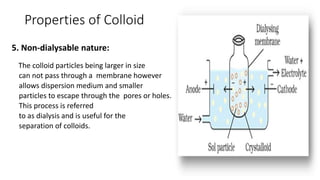
5. Non-dialysable nature:
The colloid particles being larger in size
can not pass through a membrane however
allows dispersion medium and smaller
particles to escape through the pores or holes.
This process is referred
to as dialysis and is useful for the
separation of colloids.
Properties of Colloid
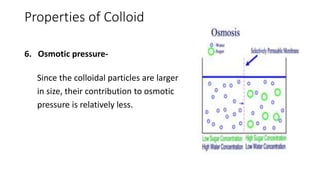
6. Osmotic pressure-
Since the colloidal particles are larger
in size, their contribution to osmotic
pressure is relatively less.
Properties of Colloid
7.Electrical Properties
The particles of colloidal solution carry
the same type of charge,
while the dispersion medium. Carries
an equal and opposite charge.
.
Properties of Colloid
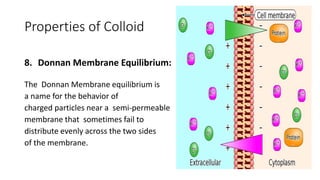
8. Donnan Membrane Equilibrium:
The Donnan Membrane equilibrium is
a name for the behavior of
charged particles near a semi-permeable
membrane that sometimes fail to
distribute evenly across the two sides
of the membrane.
Biological Importance
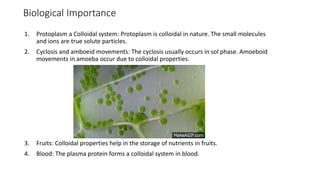
1. Protoplasm a Colloidal system: Protoplasm is colloidal in nature. The small molecules
and ions are true solute particles.
2. Cyclosis and amboeid movements: The cyclosis usually occurs in sol phase. Amoeboid
movements in amoeba occur due to colloidal properties.
3. Fruits: Colloidal properties help in the storage of nutrients in fruits.
4. Blood: The plasma protein forms a colloidal system in blood.
5. Blood coagulation: When blood clotting occurs, the sol is changed into gel.
Blood Clotting
Biological Importance
6. Cerebrospinal fluid : It’s a colloidal system.
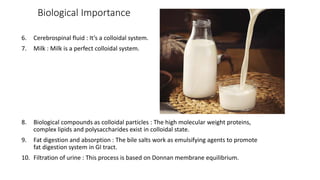
7. Milk : Milk is a perfect colloidal system.
8. Biological compounds as colloidal particles : The high molecular weight proteins,
complex lipids and polysaccharides exist in colloidal state.
9. Fat digestion and absorption : The bile salts work as emulsifying agents to promote
fat digestion system in GI tract.
10. Filtration of urine : This process is based on Donnan membrane equilibrium.
Colloidal state

Colloidal state

  • 1.
  • 2.
    Origin • Thomas Grahamis generally known as the father of colloidal chemistry. • Colloids Originally derived from a Greek word– “KOLLA” means “GLUE”. • He classified substances into crystalloids and colloids. • Later this was dismissed upon realizing some particles may exist as either.
  • 3.
    Definition • A colloidalstate is a type of dispersed system, so that means it has a phase, which is a liquid in most cases, with small insoluble particles dispersed in that phase.
  • 4.
  • 5.
  • 6.
    Phases of colloid •Colloid is a two phase system. The phases are - Dispersed phase - Dispersion medium
  • 7.
    Colloid, Solution andSuspension Property Suspension Colloid Solution Particle size >100 nm 1 to100 nm <100 nm Visibility Particles can be seen with low power microscope Particles can not be seen with low power microscope Particles can not be seen with low power microscope Nature Heterogeneous Homogeneous or Heterogeneous Homogeneous Setting of particles Settle on their own Settle on centrifugation Do not settle Appearance Opaque Varies from translucent to opaque Transparent Filtration Possible Not possible Not possible Brownian Movement May show Shows Doesn’t show
  • 8.
  • 9.
  • 10.
    Example of Solution Exampleof Solution Lime juice
  • 11.
    Is Colloid Homogenousor Heterogeneous A mixture is made when two or more substances are combined, but they are not combined chemically. There are two type of mixture • Homogenous • Heterogamous Colloids are generally considered heterogeneous mixture, but have some qualities of homogenous mixture as well.
  • 12.
    Properties of Colloids 1.Brownian movement- It is the random and haphazard motion of the colloidal particles.
  • 13.
    Properties of Colloids 2.Tyndall effect- Light gets scattered by colloid particles.
  • 14.
    Example of Tyndall effect Sunray can’t pass through the dark cloud for it being a colloid.
  • 15.
    Properties of Colloid 3.Adsorption- Colloidal particles show a high tendency of adsorption. Misty window is a real life example of adsorption of Colloid
  • 16.
    Properties of Colloid 4.Precipitation: The additions of an electrolyte create lump in colloidal solution. We use this property to make Ricotta cheese. When lemon juice is added, it increases milk's acidity as lemon contains citric acid. Due to this lowering of pH, calcium causes precipitation of the casein and thus milk gets curdled.
  • 17.
    Properties of Colloid 5.Non-dialysable nature: The colloid particles being larger in size can not pass through a membrane however allows dispersion medium and smaller particles to escape through the pores or holes. This process is referred to as dialysis and is useful for the separation of colloids.
  • 18.
    Properties of Colloid 6.Osmotic pressure- Since the colloidal particles are larger in size, their contribution to osmotic pressure is relatively less.
  • 19.
    Properties of Colloid 7.ElectricalProperties The particles of colloidal solution carry the same type of charge, while the dispersion medium. Carries an equal and opposite charge. .
  • 20.
    Properties of Colloid 8.Donnan Membrane Equilibrium: The Donnan Membrane equilibrium is a name for the behavior of charged particles near a semi-permeable membrane that sometimes fail to distribute evenly across the two sides of the membrane.
  • 21.
    Biological Importance 1. Protoplasma Colloidal system: Protoplasm is colloidal in nature. The small molecules and ions are true solute particles. 2. Cyclosis and amboeid movements: The cyclosis usually occurs in sol phase. Amoeboid movements in amoeba occur due to colloidal properties. 3. Fruits: Colloidal properties help in the storage of nutrients in fruits. 4. Blood: The plasma protein forms a colloidal system in blood.
  • 22.
    5. Blood coagulation:When blood clotting occurs, the sol is changed into gel. Blood Clotting
  • 23.
    Biological Importance 6. Cerebrospinalfluid : It’s a colloidal system. 7. Milk : Milk is a perfect colloidal system. 8. Biological compounds as colloidal particles : The high molecular weight proteins, complex lipids and polysaccharides exist in colloidal state. 9. Fat digestion and absorption : The bile salts work as emulsifying agents to promote fat digestion system in GI tract. 10. Filtration of urine : This process is based on Donnan membrane equilibrium.