Organocatalysis
1
M.Sc.(Chemistry) Ist Year
Asymmetric Organocatalysis
Reference: Albrecht Berkessel, Harald Groeger, Asymmetric Organocatalysis, 2005, Wiley-VCH,
p409-435.
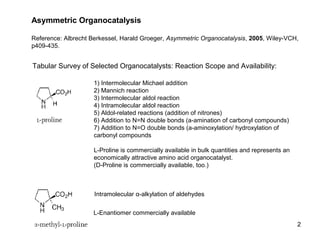
Tabular Survey of Selected Organocatalysts: Reaction Scope and Availability:
1) Intermolecular Michael addition
2) Mannich reaction
3) Intermolecular aldol reaction
4) Intramolecular aldol reaction
5) Aldol-related reactions (addition of nitrones)
6) Addition to N=N double bonds (a-amination of carbonyl compounds)
7) Addition to N=O double bonds (a-aminoxylation/ hydroxylation of
carbonyl compounds
L-Proline is commercially available in bulk quantities and represents an
economically attractive amino acid organocatalyst.
(D-Proline is commercially available, too.)
Intramolecular α-alkylation of aldehydes
L-Enantiomer commercially available
2
1) Intermolecular Michael addition
2) Intermolecular aldol reaction
3) [3+2]-Cycloadditions
4) Desymmetrization of meso-diols
5) Desymmetrization of meso-epoxides
Preparation starting from L-proline in
multi-step syntheses
Mannich reaction
Preparation starting from l-proline in
multi-step syntheses
1) Mannich reaction
2) Intermolecular aldol reaction [6.2.1]
Readily accessible, using L-penicillamine
as starting material
3
Intramolecular aldol reaction
Just as L-proline, L-phenylalanine is an
economically attractive amino acid organocatalyst,
readily available in bulk quantities.
1) Intermolecular Michael addition, including alkylation
of heterocyclic aromatics and aniline derivatives
2) [4+2]-Cycloadditions: Diels-Alder reactions
3) [3+2]-Cycloadditions: Nitrone-based reactions
Organocatalysts readily prepared from L-phenylalanine,
methylamine and acetone or piraldehyde
Intermolecular Michael addition
Prepared from L-phenylalanine, methylamine
and glyoxylic acid in a few steps
4
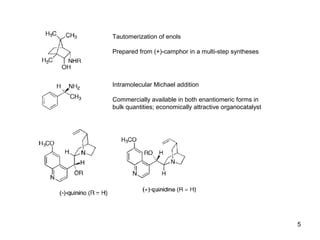
Tautomerization of enols
Prepared from (+)-camphor in a multi-step syntheses
Intramolecular Michael addition
Commercially available in both enantiomeric forms in
bulk quantities; economically attractive organocatalyst
5
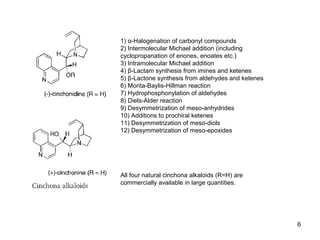
1) α-Halogenation of carbonyl compounds
2) Intermolecular Michael addition (including
cyclopropanation of enones, enoates etc.)
3) Intramolecular Michael addition
4) β-Lactam synthesis from imines and ketenes
5) β-Lactone synthesis from aldehydes and ketenes
6) Morita-Baylis-Hillman reaction
7) Hydrophosphonylation of aldehydes
8) Diels-Alder reaction
9) Desymmetrization of meso-anhydrides
10) Additions to prochiral ketenes
11) Desymmetrization of meso-diols
12) Desymmetrization of meso-epoxides
All four natural cinchona alkaloids (R=H) are
commercially available in large quantities.
6
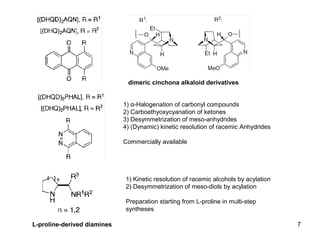
1) α-Halogenation of carbonyl compounds
2) Carboethyoxycyanation of ketones
3) Desymmetrization of meso-anhydrides
4) (Dynamic) kinetic resolution of racemic Anhydrides
Commercially available
dimeric cinchona alkaloid derivatives
L-proline-derived diamines
1) Kinetic resolution of racemic alcohols by acylation
2) Desymmetrization of meso-diols by acylation
Preparation starting from L-proline in multi-step
syntheses
7
8
Chapter 1. Introduction: Organocatalysis –
From Biomimetic Concepts to Powerful
Methods for Asymmetric Synthesis
Chapter 2. On the Structure of the Book,
and a Few General Mechanistic
Considerations
9
4.1.1. Intermolecular Michael Addition of C-nucleophiles
4.1.1.1 Chiral Bases and Phase-transfer Catalysis
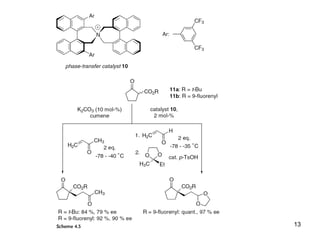
The first examples of asymmetric Michael additions of C-nucleophiles to enones
appeared in the middle to late 1970s. In 1975 Wynberg and Helder demonstrated in a
preliminary publication that the quinine-catalyzed addition of several acidic, doubly
activated Michael donors to methyl vinyl ketone (MVK) proceeds asymmetrically.
Enantiomeric excesses were determined for addition of a-tosylnitroethane to MVK (56%)
and for 2-carbomethoxyindanone as the pre-nucleophile (68%).
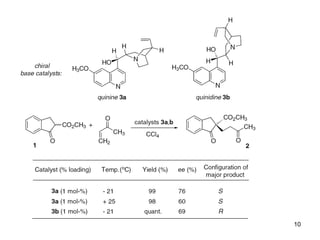
Later Hermann and Wynberg reported in more detail that 2-carbomethoxyindanone
(1, Scheme 4.3) can be added to methyl vinyl ketone with ca 1 mol% quinine (3a) or
quinidine (3b) as catalyst to afford the Michael-adduct 2 in excellent yields and with up to
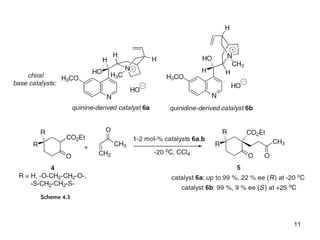
76% ee. Because of their relatively low basicity, the amine bases 3a,b do not effect the
Michael addition of less acidic pre-nucleophiles such as 4 (Scheme 4.3). However, the
corresponding ammonium hydroxides 6a,b do promote the addition of the substrates 4 to
methyl vinyl ketone under the same mild conditions, albeit with enantioselectivity not
exceeding ca 20%.
10
11
12
13
14
15
16
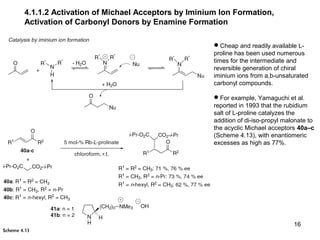
4.1.1.2 Activation of Michael Acceptors by Iminium Ion Formation,
Activation of Carbonyl Donors by Enamine Formation
Cheap and readily available L-
proline has been used numerous
times for the intermediate and
reversible generation of chiral
iminium ions from a,b-unsaturated
carbonyl compounds.
For example, Yamaguchi et al.
reported in 1993 that the rubidium
salt of L-proline catalyzes the
addition of di-iso-propyl malonate to
the acyclic Michael acceptors 40a–c
(Scheme 4.13), with enantiomeric
excesses as high as 77%.

Organocatalysis

  • 1.
  • 2.
    Asymmetric Organocatalysis Reference: AlbrechtBerkessel, Harald Groeger, Asymmetric Organocatalysis, 2005, Wiley-VCH, p409-435. Tabular Survey of Selected Organocatalysts: Reaction Scope and Availability: 1) Intermolecular Michael addition 2) Mannich reaction 3) Intermolecular aldol reaction 4) Intramolecular aldol reaction 5) Aldol-related reactions (addition of nitrones) 6) Addition to N=N double bonds (a-amination of carbonyl compounds) 7) Addition to N=O double bonds (a-aminoxylation/ hydroxylation of carbonyl compounds L-Proline is commercially available in bulk quantities and represents an economically attractive amino acid organocatalyst. (D-Proline is commercially available, too.) Intramolecular α-alkylation of aldehydes L-Enantiomer commercially available 2
  • 3.
    1) Intermolecular Michaeladdition 2) Intermolecular aldol reaction 3) [3+2]-Cycloadditions 4) Desymmetrization of meso-diols 5) Desymmetrization of meso-epoxides Preparation starting from L-proline in multi-step syntheses Mannich reaction Preparation starting from l-proline in multi-step syntheses 1) Mannich reaction 2) Intermolecular aldol reaction [6.2.1] Readily accessible, using L-penicillamine as starting material 3
  • 4.
    Intramolecular aldol reaction Justas L-proline, L-phenylalanine is an economically attractive amino acid organocatalyst, readily available in bulk quantities. 1) Intermolecular Michael addition, including alkylation of heterocyclic aromatics and aniline derivatives 2) [4+2]-Cycloadditions: Diels-Alder reactions 3) [3+2]-Cycloadditions: Nitrone-based reactions Organocatalysts readily prepared from L-phenylalanine, methylamine and acetone or piraldehyde Intermolecular Michael addition Prepared from L-phenylalanine, methylamine and glyoxylic acid in a few steps 4
  • 5.
    Tautomerization of enols Preparedfrom (+)-camphor in a multi-step syntheses Intramolecular Michael addition Commercially available in both enantiomeric forms in bulk quantities; economically attractive organocatalyst 5
  • 6.
    1) α-Halogenation ofcarbonyl compounds 2) Intermolecular Michael addition (including cyclopropanation of enones, enoates etc.) 3) Intramolecular Michael addition 4) β-Lactam synthesis from imines and ketenes 5) β-Lactone synthesis from aldehydes and ketenes 6) Morita-Baylis-Hillman reaction 7) Hydrophosphonylation of aldehydes 8) Diels-Alder reaction 9) Desymmetrization of meso-anhydrides 10) Additions to prochiral ketenes 11) Desymmetrization of meso-diols 12) Desymmetrization of meso-epoxides All four natural cinchona alkaloids (R=H) are commercially available in large quantities. 6
  • 7.
    1) α-Halogenation ofcarbonyl compounds 2) Carboethyoxycyanation of ketones 3) Desymmetrization of meso-anhydrides 4) (Dynamic) kinetic resolution of racemic Anhydrides Commercially available dimeric cinchona alkaloid derivatives L-proline-derived diamines 1) Kinetic resolution of racemic alcohols by acylation 2) Desymmetrization of meso-diols by acylation Preparation starting from L-proline in multi-step syntheses 7
  • 8.
    8 Chapter 1. Introduction:Organocatalysis – From Biomimetic Concepts to Powerful Methods for Asymmetric Synthesis Chapter 2. On the Structure of the Book, and a Few General Mechanistic Considerations
  • 9.
    9 4.1.1. Intermolecular MichaelAddition of C-nucleophiles 4.1.1.1 Chiral Bases and Phase-transfer Catalysis The first examples of asymmetric Michael additions of C-nucleophiles to enones appeared in the middle to late 1970s. In 1975 Wynberg and Helder demonstrated in a preliminary publication that the quinine-catalyzed addition of several acidic, doubly activated Michael donors to methyl vinyl ketone (MVK) proceeds asymmetrically. Enantiomeric excesses were determined for addition of a-tosylnitroethane to MVK (56%) and for 2-carbomethoxyindanone as the pre-nucleophile (68%). Later Hermann and Wynberg reported in more detail that 2-carbomethoxyindanone (1, Scheme 4.3) can be added to methyl vinyl ketone with ca 1 mol% quinine (3a) or quinidine (3b) as catalyst to afford the Michael-adduct 2 in excellent yields and with up to 76% ee. Because of their relatively low basicity, the amine bases 3a,b do not effect the Michael addition of less acidic pre-nucleophiles such as 4 (Scheme 4.3). However, the corresponding ammonium hydroxides 6a,b do promote the addition of the substrates 4 to methyl vinyl ketone under the same mild conditions, albeit with enantioselectivity not exceeding ca 20%.
  • 10.
  • 11.
  • 12.
  • 13.
  • 14.
  • 15.
  • 16.
    16 4.1.1.2 Activation ofMichael Acceptors by Iminium Ion Formation, Activation of Carbonyl Donors by Enamine Formation Cheap and readily available L- proline has been used numerous times for the intermediate and reversible generation of chiral iminium ions from a,b-unsaturated carbonyl compounds. For example, Yamaguchi et al. reported in 1993 that the rubidium salt of L-proline catalyzes the addition of di-iso-propyl malonate to the acyclic Michael acceptors 40a–c (Scheme 4.13), with enantiomeric excesses as high as 77%.