PRESENTATION ON

NUCLEAR BATTERY
INTRODUCTION
Need for compact reliable light weight and self-
 contained power supplies.
Chemical batteries require frequent replacements and
 are bulky.
Nuclear reactors offer economical and technical
 problems.
Fuel and Solar cells are expensive and requires
 sunlight respectively.
Nuclear batteries have lifespan upto decades and
 nearly 200 times more efficient.
Do not rely on nuclear reaction , so no radioactive
 wastes.
Uses emissions from radioactive isotope to generate
 electricity.
Can be used in inaccessible and extreme conditions.
HISTORICAL DEVELOPMENTS
Idea was introduced in 1950 and patented to Tracer
 Lab.
Radioisotope electric power system developed by
 Paul Brown.
He organized an approach to harness energy from the
 magnetic field of alpha and beta particles using
 Radium-226.
Low efficiency due to loss of electrons.
ENERGY PRODUCTION MECHANISMS
Betavoltaics :
 Alternative energy technology.
 Provides extended battery life and power density.
 Uses energy from beta particles.
 Beta particles from radioactive gas captured in Si
  wafer coated with diode material.
 Absorbed radiation creates electron-hole pair.
 Results in the generation of electric current.
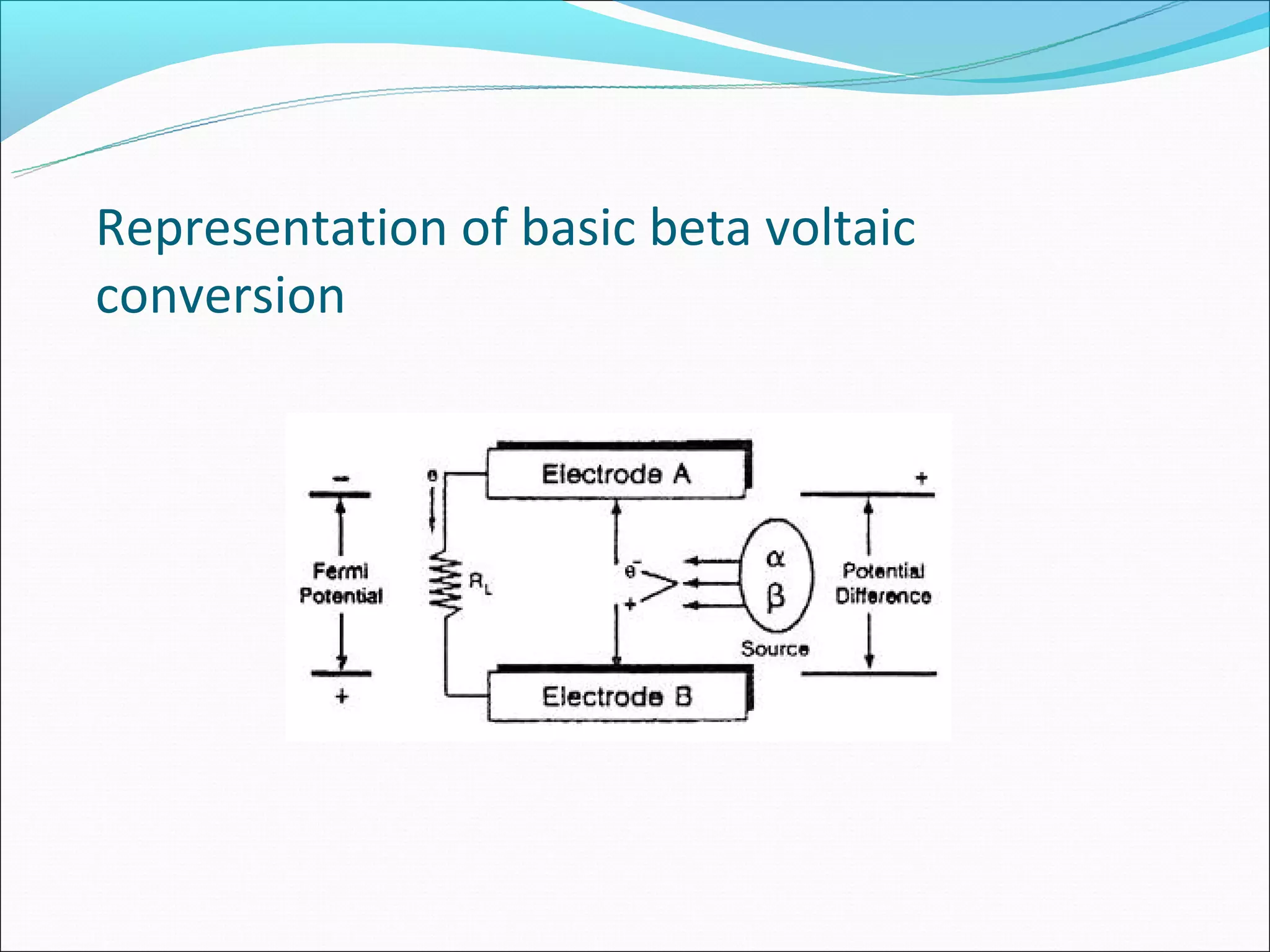
Representation of basic beta voltaic
conversion
The Energy Conversion Mechanism

Before the radioactive source is introduced , no
 current flows as the electrical forces are in
 equilibrium.
As a beta emitter is introduced , electrons are
 knocked out by its energy.
Generates electron-hole pairs in the junction.
When beta particle imparts more than ionization
 potential the electron rises to a higher level.
Fermi voltage established between the electrodes.
Potential difference drives electrons from electrode A
 through the load where they give up the energy.
Electron is then driven into electrode B to recombine
 with a junction ion.
Betavoltaics does not have solar-cell efficiency.
Electrons shoot out in all directions; hence lost.
Porous Si diodes with pits provide a 3-D surface
 thereby increasing the efficiency.
Direct charging generators:
 Primary generator consists of LC tank circuit.
 Energy from radioactive decay products sustain and
  amplify oscillations.
 Circuit impedance has coil wound on a core
  composed of radioactive elements.
 Decay by alpha emission; hence greater flux of
  radioactive decay.
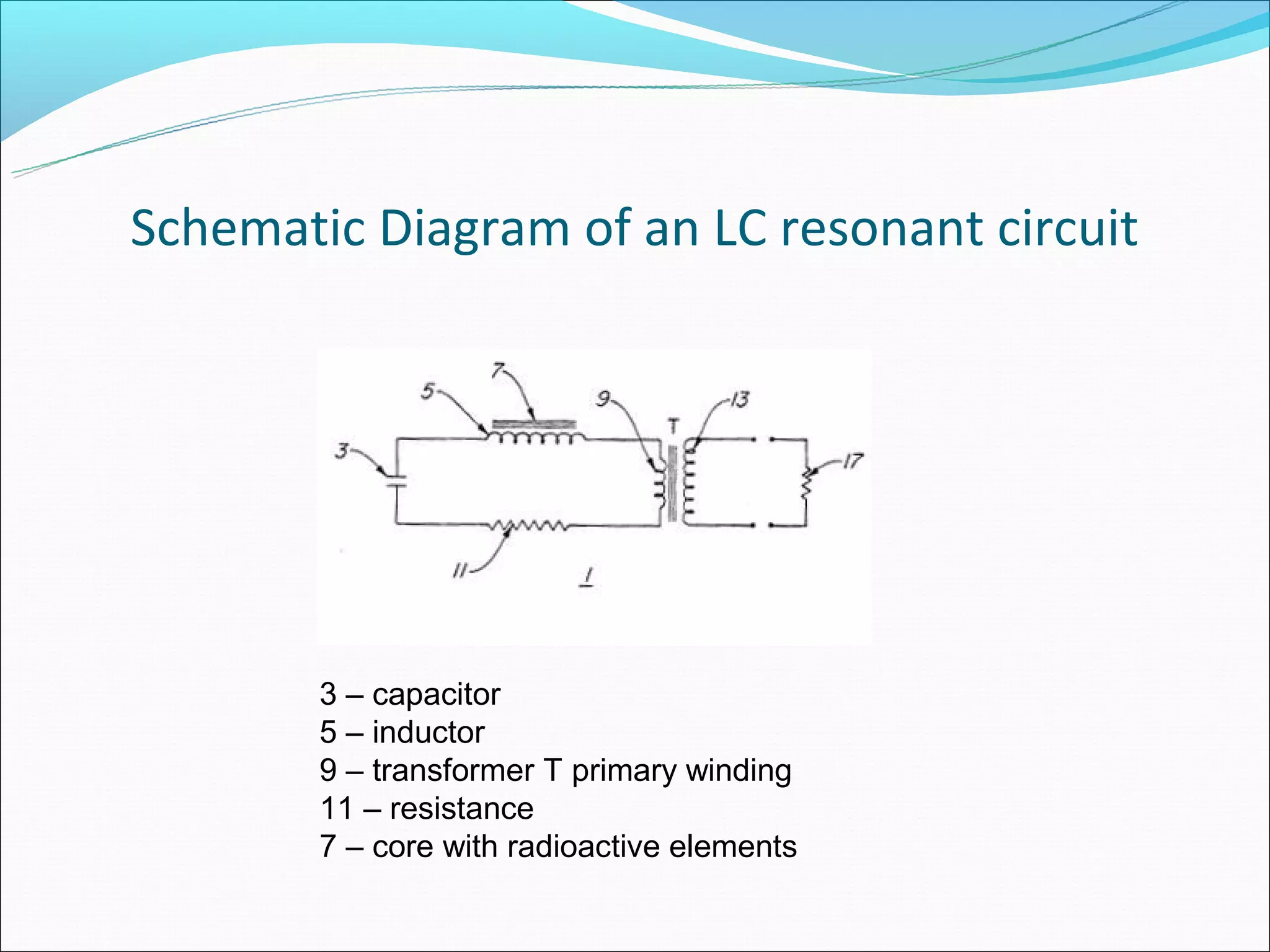
Schematic Diagram of an LC resonant circuit


        3 – capacitor
        5 – inductor
        9 – transformer T primary winding
        11 – resistance
        7 – core with radioactive elements
Working
Oscillations induced in LCR circuit damp out due to
 loss of energy.
Here energy is imparted to the alpha particles during
 the decay of elements in the core.
This energy is introduced to circuit when alpha
 particles are absorbed by the inductor.
Oscillations sustain until amount of energy
 absorbed=amount of energy dissipated in ohmic
 resistance.
 This excess energy is delivered to the load connected
 across transformer T secondary winding.
FUEL CONSIDERATIONS
Avoiding gamma rays in decay chain.
               Ra-226 produces Bi-214.
               Strong gamma radiation.
               Shielding makes it bulky.
Half life.
Particle range.
Cost.
ADVANTAGES
Life span- minimum of 10 years.
Reliable electricity.
Amount of energy highest.
Lighter with high energy density.
Efficient; less waste generation.
Reduces green house and associated effects.
Fuel used is the nuclear waste from nuclear fission.
APPLICATIONS
Space applications:
 Unaffected by long period of darkness and radiation
 belts like Van-Allen belt.
 Compact and lighter in weight.
 Can avoid heating equipments required for storage
 batteries.
 High power for long time independent of
 atmospheric conditions.
 NASA is trying to harness this technology in space
 applications.
Medical applications:
  In Cardiac pacemakers
  Batteries should have reliability and longevity to avoid
  frequent replacements.
• Mobile devices:
   Nuclear powered laptop battery Xcell-N has 7000-
  8000 times more life.
   No need for charging, battery replacing.
Automobiles:
  In initial stages.
  No running short of fuel.
  Possibility of replacing ionic fuels with its advantages.
• Under-water sea probes and sea sensors:
   In sensors working for long time.
   At inaccessible and extreme conditions.
   Use in coal mines and polar sensor applications too.
• For powering MEMS devices : in optical switches and
  smart dust sensors.
DRAWBACKS
High initial cost of production as its in the
 experimental stage
Energy conversion methodologies are not much
 advanced.
Regional and country-specific laws regarding use and
 disposal of radioactive fuels.
To gain social acceptance.
CONCLUSION
Small compact devices of future require small
 batteries.
Nuclear batteries increase functionality, reliability
 and longevity.
Until final disposal all Radiation Protection Standards
 must be met.
Batteries of the near future.
THANK YOU

Nuclear battery (1)

  • 1.
  • 2.
    INTRODUCTION Need for compactreliable light weight and self- contained power supplies. Chemical batteries require frequent replacements and are bulky. Nuclear reactors offer economical and technical problems. Fuel and Solar cells are expensive and requires sunlight respectively.
  • 3.
    Nuclear batteries havelifespan upto decades and nearly 200 times more efficient. Do not rely on nuclear reaction , so no radioactive wastes. Uses emissions from radioactive isotope to generate electricity. Can be used in inaccessible and extreme conditions.
  • 4.
    HISTORICAL DEVELOPMENTS Idea wasintroduced in 1950 and patented to Tracer Lab. Radioisotope electric power system developed by Paul Brown. He organized an approach to harness energy from the magnetic field of alpha and beta particles using Radium-226. Low efficiency due to loss of electrons.
  • 5.
    ENERGY PRODUCTION MECHANISMS Betavoltaics: Alternative energy technology. Provides extended battery life and power density. Uses energy from beta particles. Beta particles from radioactive gas captured in Si wafer coated with diode material. Absorbed radiation creates electron-hole pair. Results in the generation of electric current.
  • 6.
    Representation of basicbeta voltaic conversion
  • 7.
    The Energy ConversionMechanism Before the radioactive source is introduced , no current flows as the electrical forces are in equilibrium. As a beta emitter is introduced , electrons are knocked out by its energy. Generates electron-hole pairs in the junction. When beta particle imparts more than ionization potential the electron rises to a higher level.
  • 8.
    Fermi voltage establishedbetween the electrodes. Potential difference drives electrons from electrode A through the load where they give up the energy. Electron is then driven into electrode B to recombine with a junction ion. Betavoltaics does not have solar-cell efficiency. Electrons shoot out in all directions; hence lost. Porous Si diodes with pits provide a 3-D surface thereby increasing the efficiency.
  • 9.
    Direct charging generators: Primary generator consists of LC tank circuit. Energy from radioactive decay products sustain and amplify oscillations. Circuit impedance has coil wound on a core composed of radioactive elements. Decay by alpha emission; hence greater flux of radioactive decay.
  • 10.
    Schematic Diagram ofan LC resonant circuit 3 – capacitor 5 – inductor 9 – transformer T primary winding 11 – resistance 7 – core with radioactive elements
  • 11.
    Working Oscillations induced inLCR circuit damp out due to loss of energy. Here energy is imparted to the alpha particles during the decay of elements in the core. This energy is introduced to circuit when alpha particles are absorbed by the inductor. Oscillations sustain until amount of energy absorbed=amount of energy dissipated in ohmic resistance.  This excess energy is delivered to the load connected across transformer T secondary winding.
  • 12.
    FUEL CONSIDERATIONS Avoiding gammarays in decay chain.  Ra-226 produces Bi-214.  Strong gamma radiation.  Shielding makes it bulky. Half life. Particle range. Cost.
  • 13.
    ADVANTAGES Life span- minimumof 10 years. Reliable electricity. Amount of energy highest. Lighter with high energy density. Efficient; less waste generation. Reduces green house and associated effects. Fuel used is the nuclear waste from nuclear fission.
  • 14.
    APPLICATIONS Space applications: Unaffectedby long period of darkness and radiation belts like Van-Allen belt. Compact and lighter in weight. Can avoid heating equipments required for storage batteries. High power for long time independent of atmospheric conditions. NASA is trying to harness this technology in space applications.
  • 15.
    Medical applications: In Cardiac pacemakers Batteries should have reliability and longevity to avoid frequent replacements. • Mobile devices: Nuclear powered laptop battery Xcell-N has 7000- 8000 times more life. No need for charging, battery replacing.
  • 16.
    Automobiles: Ininitial stages. No running short of fuel. Possibility of replacing ionic fuels with its advantages. • Under-water sea probes and sea sensors: In sensors working for long time. At inaccessible and extreme conditions. Use in coal mines and polar sensor applications too. • For powering MEMS devices : in optical switches and smart dust sensors.
  • 17.
    DRAWBACKS High initial costof production as its in the experimental stage Energy conversion methodologies are not much advanced. Regional and country-specific laws regarding use and disposal of radioactive fuels. To gain social acceptance.
  • 18.
    CONCLUSION Small compact devicesof future require small batteries. Nuclear batteries increase functionality, reliability and longevity. Until final disposal all Radiation Protection Standards must be met. Batteries of the near future.
  • 19.