Studies in Transition Metal
Catalyzed C-N Bond Formation
Reactions
-D. R. Nagargoje
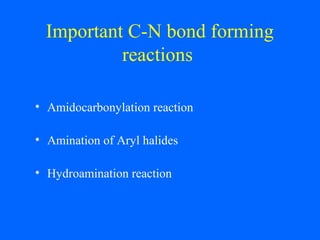
Important C-N bond forming
reactions
• Amidocarbonylation reaction
• Amination of Aryl halides
• Hydroamination reaction
Part –I)Amidocarbonylation Reaction
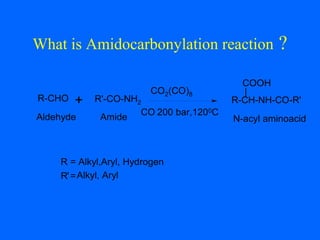
What is Amidocarbonylation reaction ?
'
CO
,
R-CHO + R'-CO-NH2 R-CH-NH-CO-R'
|
COOH
CO2(CO)8
200 bar,1200C
R = Alkyl,Aryl, Hydrogen
R =Alkyl, Aryl
Aldehyde Amide N-acyl aminoacid
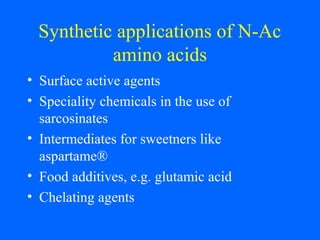
Synthetic applications of N-Ac
amino acids
• Surface active agents
• Speciality chemicals in the use of
sarcosinates
• Intermediates for sweetners like
aspartame®
• Food additives, e.g. glutamic acid
• Chelating agents
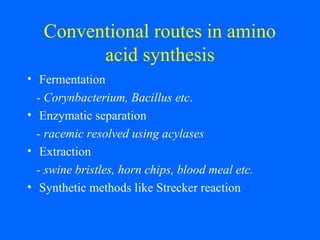
Conventional routes in amino
acid synthesis
• Fermentation
- Corynbacterium, Bacillus etc.
• Enzymatic separation
- racemic resolved using acylases
• Extraction
- swine bristles, horn chips, blood meal etc.
• Synthetic methods like Strecker reaction
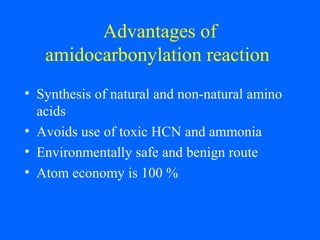
Advantages of
amidocarbonylation reaction
• Synthesis of natural and non-natural amino
acids
• Avoids use of toxic HCN and ammonia
• Environmentally safe and benign route
• Atom economy is 100 %
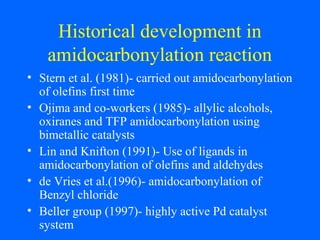
Historical development in
amidocarbonylation reaction
• Stern et al. (1981)- carried out amidocarbonylation
of olefins first time
• Ojima and co-workers (1985)- allylic alcohols,
oxiranes and TFP amidocarbonylation using
bimetallic catalysts
• Lin and Knifton (1991)- Use of ligands in
amidocarbonylation of olefins and aldehydes
• de Vries et al.(1996)- amidocarbonylation of
Benzyl chloride
• Beller group (1997)- highly active Pd catalyst
system
Substrate precursors in
amidocarbonylation
R
R
R
R
R
OR
OR
R
Cl
OH
O
OH
R' H
O
CO
[Co2(CO)8]
R"CONHR'"
R" N
R'"
O
O R'
OH
Aldehyde amidocarbonylation
reaction- An overview
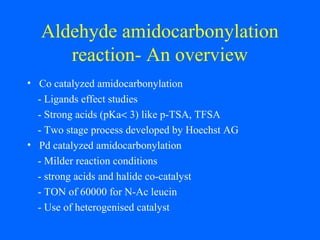
• Co catalyzed amidocarbonylation
- Ligands effect studies
- Strong acids (pKa< 3) like p-TSA, TFSA
- Two stage process developed by Hoechst AG
• Pd catalyzed amidocarbonylation
- Milder reaction conditions
- strong acids and halide co-catalyst
- TON of 60000 for N-Ac leucin
- Use of heterogenised catalyst
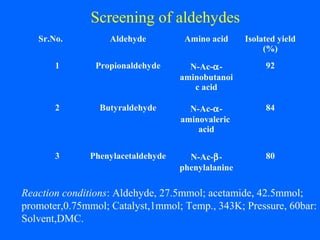
Screening of aldehydes
Sr.No. Aldehyde Amino acid Isolated yield
(%)
1 Propionaldehyde N-Ac-α-
aminobutanoi
c acid
92
2 Butyraldehyde N-Ac-α-
aminovaleric
acid
84
3 Phenylacetaldehyde N-Ac-β-
phenylalanine
80
Reaction conditions: Aldehyde, 27.5mmol; acetamide, 42.5mmol;
promoter,0.75mmol; Catalyst,1mmol; Temp., 343K; Pressure, 60bar:
Solvent,DMC.
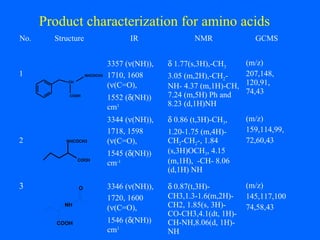
No. Structure IR NMR GCMS
1
3357 (ν(NH)),
1710, 1608
(ν(C=O),
1552 (δ(NH))
cm1
δ 1.77(s,3H),-CH3
3.05 (m,2H),-CH2-
NH- 4.37 (m,1H)-CH,
7.24 (m,5H) Ph and
8.23 (d,1H)NH
(m/z)
207,148,
120,91,
74,43
2
3344 (ν(NH)),
1718, 1598
(ν(C=O),
1545 (δ(NH))
cm-1
δ 0.86 (t,3H)-CH3,
1.20-1.75 (m,4H)-
CH2-CH2-, 1.84
(s,3H)OCH3, 4.15
(m,1H), -CH- 8.06
(d,1H) NH
(m/z)
159,114,99,
72,60,43
3 3346 (ν(NH)),
1720, 1600
(ν(C=O),
1546 (δ(NH))
cm1
δ 0.87(t,3H)-
CH3,1.3-1.6(m,2H)-
CH2, 1.85(s, 3H)-
CO-CH3,4.1(dt, 1H)-
CH-NH,8.06(d, 1H)-
NH
(m/z)
145,117,100
74,58,43
CH
COOH
NHCOCH3
COOH
NHCOCH3
Product characterization for amino acids
COOH
NH
O
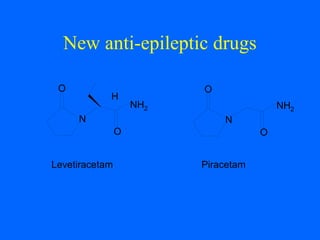
New anti-epileptic drugs
N
O
NH2
H
O
N
O
NH2
O
Levetiracetam Piracetam
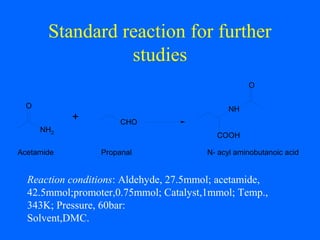
Standard reaction for further
studies
Reaction conditions: Aldehyde, 27.5mmol; acetamide,
42.5mmol;promoter,0.75mmol; Catalyst,1mmol; Temp.,
343K; Pressure, 60bar:
Solvent,DMC.
CHO
O
NH2
+
Acetamide Propanal N- acyl aminobutanoic acid
COOH
NH
O
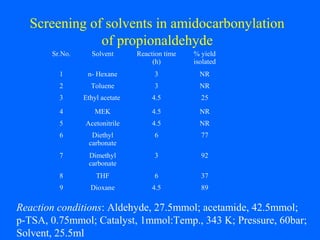
Screening of solvents in amidocarbonylation
of propionaldehyde
Sr.No. Solvent Reaction time
(h)
% yield
isolated
1 n- Hexane 3 NR
2 Toluene 3 NR
3 Ethyl acetate 4.5 25
4 MEK 4.5 NR
5 Acetonitrile 4.5 NR
6 Diethyl
carbonate
6 77
7 Dimethyl
carbonate
3 92
8 THF 6 37
9 Dioxane 4.5 89
Reaction conditions: Aldehyde, 27.5mmol; acetamide, 42.5mmol;
p-TSA, 0.75mmol; Catalyst, 1mmol:Temp., 343 K; Pressure, 60bar;
Solvent, 25.5ml
Part-II) Reductive amination of phenol
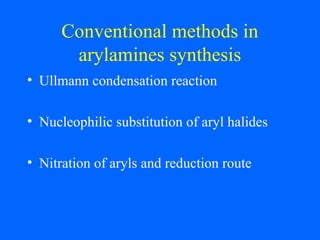
Conventional methods in
arylamines synthesis
• Ullmann condensation reaction
• Nucleophilic substitution of aryl halides
• Nitration of aryls and reduction route
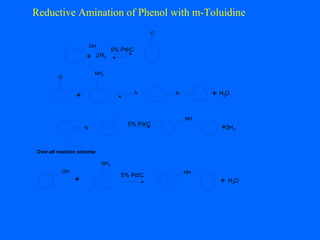
Reductive Amination of Phenol with m-Toluidine
O
Over-all reaction scheme:
NH2
OH
NH2
N +
N
NH
OH
+
NH
+ H2
+
5% Pd/C
5% Pd/C
5% Pd/C
+
+ H2
O
+ +
H2O
H2O
2
2
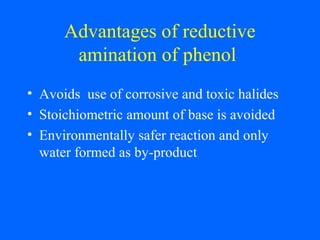
Advantages of reductive
amination of phenol
• Avoids use of corrosive and toxic halides
• Stoichiometric amount of base is avoided
• Environmentally safer reaction and only
water formed as by-product
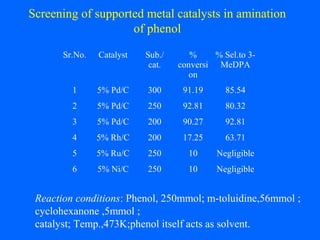
Screening of supported metal catalysts in amination
of phenol
Sr.No. Catalyst Sub./
cat.
%
conversi
on
% Sel.to 3-
MeDPA
1 5% Pd/C 300 91.19 85.54
2 5% Pd/C 250 92.81 80.32
3 5% Pd/C 200 90.27 92.81
4 5% Rh/C 200 17.25 63.71
5 5% Ru/C 250 10 Negligible
6 5% Ni/C 250 10 Negligible
Reaction conditions: Phenol, 250mmol; m-toluidine,56mmol ;
cyclohexanone ,5mmol ;
catalyst; Temp.,473K;phenol itself acts as solvent.
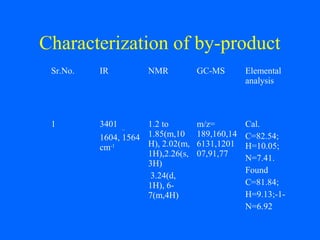
Characterization of by-product
Sr.No. IR NMR GC-MS Elemental
analysis
1 3401 _
1604, 1564
cm-1
1.2 to
1.85(m,10
H), 2.02(m,
1H),2.26(s,
3H)
3.24(d,
1H), 6-
7(m,4H)
m/z=
189,160,14
6131,1201
07,91,77
Cal.
C=82.54;
H=10.05;
N=7.41.
Found
C=81.84;
H=9.13;-1-
N=6.92
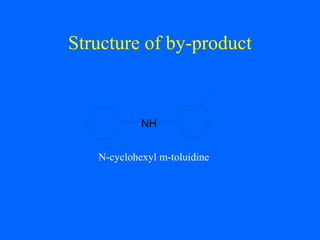
Structure of by-product
NH
N-cyclohexyl m-toluidine
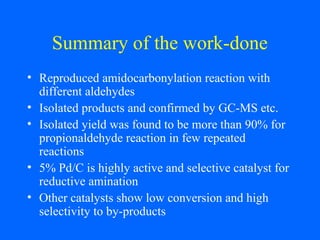
Summary of the work-done
• Reproduced amidocarbonylation reaction with
different aldehydes
• Isolated products and confirmed by GC-MS etc.
• Isolated yield was found to be more than 90% for
propionaldehyde reaction in few repeated
reactions
• 5% Pd/C is highly active and selective catalyst for
reductive amination
• Other catalysts show low conversion and high
selectivity to by-products
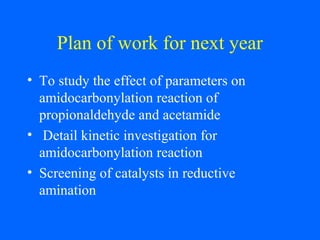
Plan of work for next year
• To study the effect of parameters on
amidocarbonylation reaction of
propionaldehyde and acetamide
• Detail kinetic investigation for
amidocarbonylation reaction
• Screening of catalysts in reductive
amination
References
1. Wakamatsu et al., Chem.Comm.,1971,
1540
2. I. Ojima et al., Tet.Lett., 1982, 23,249
3. Beller M. and Eckert M.,
Angew.Chem.Int.Ed.Engl., 2000, 39,1494
4. Lin J.J. and Knifton J.F., J.Orgmet.Chem.,
1991, 417, 99.
5. Nagata et al., US 5,618,980; 1997.
Thank you

Carbon- Nitrogen Bond formation reactions

  • 1.
    Studies in TransitionMetal Catalyzed C-N Bond Formation Reactions -D. R. Nagargoje
  • 2.
    Important C-N bondforming reactions • Amidocarbonylation reaction • Amination of Aryl halides • Hydroamination reaction
  • 3.
  • 4.
    What is Amidocarbonylationreaction ? ' CO , R-CHO + R'-CO-NH2 R-CH-NH-CO-R' | COOH CO2(CO)8 200 bar,1200C R = Alkyl,Aryl, Hydrogen R =Alkyl, Aryl Aldehyde Amide N-acyl aminoacid
  • 5.
    Synthetic applications ofN-Ac amino acids • Surface active agents • Speciality chemicals in the use of sarcosinates • Intermediates for sweetners like aspartame® • Food additives, e.g. glutamic acid • Chelating agents
  • 6.
    Conventional routes inamino acid synthesis • Fermentation - Corynbacterium, Bacillus etc. • Enzymatic separation - racemic resolved using acylases • Extraction - swine bristles, horn chips, blood meal etc. • Synthetic methods like Strecker reaction
  • 7.
    Advantages of amidocarbonylation reaction •Synthesis of natural and non-natural amino acids • Avoids use of toxic HCN and ammonia • Environmentally safe and benign route • Atom economy is 100 %
  • 8.
    Historical development in amidocarbonylationreaction • Stern et al. (1981)- carried out amidocarbonylation of olefins first time • Ojima and co-workers (1985)- allylic alcohols, oxiranes and TFP amidocarbonylation using bimetallic catalysts • Lin and Knifton (1991)- Use of ligands in amidocarbonylation of olefins and aldehydes • de Vries et al.(1996)- amidocarbonylation of Benzyl chloride • Beller group (1997)- highly active Pd catalyst system
  • 9.
  • 10.
    Aldehyde amidocarbonylation reaction- Anoverview • Co catalyzed amidocarbonylation - Ligands effect studies - Strong acids (pKa< 3) like p-TSA, TFSA - Two stage process developed by Hoechst AG • Pd catalyzed amidocarbonylation - Milder reaction conditions - strong acids and halide co-catalyst - TON of 60000 for N-Ac leucin - Use of heterogenised catalyst
  • 11.
    Screening of aldehydes Sr.No.Aldehyde Amino acid Isolated yield (%) 1 Propionaldehyde N-Ac-α- aminobutanoi c acid 92 2 Butyraldehyde N-Ac-α- aminovaleric acid 84 3 Phenylacetaldehyde N-Ac-β- phenylalanine 80 Reaction conditions: Aldehyde, 27.5mmol; acetamide, 42.5mmol; promoter,0.75mmol; Catalyst,1mmol; Temp., 343K; Pressure, 60bar: Solvent,DMC.
  • 12.
    No. Structure IRNMR GCMS 1 3357 (ν(NH)), 1710, 1608 (ν(C=O), 1552 (δ(NH)) cm1 δ 1.77(s,3H),-CH3 3.05 (m,2H),-CH2- NH- 4.37 (m,1H)-CH, 7.24 (m,5H) Ph and 8.23 (d,1H)NH (m/z) 207,148, 120,91, 74,43 2 3344 (ν(NH)), 1718, 1598 (ν(C=O), 1545 (δ(NH)) cm-1 δ 0.86 (t,3H)-CH3, 1.20-1.75 (m,4H)- CH2-CH2-, 1.84 (s,3H)OCH3, 4.15 (m,1H), -CH- 8.06 (d,1H) NH (m/z) 159,114,99, 72,60,43 3 3346 (ν(NH)), 1720, 1600 (ν(C=O), 1546 (δ(NH)) cm1 δ 0.87(t,3H)- CH3,1.3-1.6(m,2H)- CH2, 1.85(s, 3H)- CO-CH3,4.1(dt, 1H)- CH-NH,8.06(d, 1H)- NH (m/z) 145,117,100 74,58,43 CH COOH NHCOCH3 COOH NHCOCH3 Product characterization for amino acids COOH NH O
  • 13.
  • 14.
    Standard reaction forfurther studies Reaction conditions: Aldehyde, 27.5mmol; acetamide, 42.5mmol;promoter,0.75mmol; Catalyst,1mmol; Temp., 343K; Pressure, 60bar: Solvent,DMC. CHO O NH2 + Acetamide Propanal N- acyl aminobutanoic acid COOH NH O
  • 15.
    Screening of solventsin amidocarbonylation of propionaldehyde Sr.No. Solvent Reaction time (h) % yield isolated 1 n- Hexane 3 NR 2 Toluene 3 NR 3 Ethyl acetate 4.5 25 4 MEK 4.5 NR 5 Acetonitrile 4.5 NR 6 Diethyl carbonate 6 77 7 Dimethyl carbonate 3 92 8 THF 6 37 9 Dioxane 4.5 89 Reaction conditions: Aldehyde, 27.5mmol; acetamide, 42.5mmol; p-TSA, 0.75mmol; Catalyst, 1mmol:Temp., 343 K; Pressure, 60bar; Solvent, 25.5ml
  • 16.
  • 17.
    Conventional methods in arylaminessynthesis • Ullmann condensation reaction • Nucleophilic substitution of aryl halides • Nitration of aryls and reduction route
  • 18.
    Reductive Amination ofPhenol with m-Toluidine O Over-all reaction scheme: NH2 OH NH2 N + N NH OH + NH + H2 + 5% Pd/C 5% Pd/C 5% Pd/C + + H2 O + + H2O H2O 2 2
  • 19.
    Advantages of reductive aminationof phenol • Avoids use of corrosive and toxic halides • Stoichiometric amount of base is avoided • Environmentally safer reaction and only water formed as by-product
  • 20.
    Screening of supportedmetal catalysts in amination of phenol Sr.No. Catalyst Sub./ cat. % conversi on % Sel.to 3- MeDPA 1 5% Pd/C 300 91.19 85.54 2 5% Pd/C 250 92.81 80.32 3 5% Pd/C 200 90.27 92.81 4 5% Rh/C 200 17.25 63.71 5 5% Ru/C 250 10 Negligible 6 5% Ni/C 250 10 Negligible Reaction conditions: Phenol, 250mmol; m-toluidine,56mmol ; cyclohexanone ,5mmol ; catalyst; Temp.,473K;phenol itself acts as solvent.
  • 21.
    Characterization of by-product Sr.No.IR NMR GC-MS Elemental analysis 1 3401 _ 1604, 1564 cm-1 1.2 to 1.85(m,10 H), 2.02(m, 1H),2.26(s, 3H) 3.24(d, 1H), 6- 7(m,4H) m/z= 189,160,14 6131,1201 07,91,77 Cal. C=82.54; H=10.05; N=7.41. Found C=81.84; H=9.13;-1- N=6.92
  • 22.
  • 23.
    Summary of thework-done • Reproduced amidocarbonylation reaction with different aldehydes • Isolated products and confirmed by GC-MS etc. • Isolated yield was found to be more than 90% for propionaldehyde reaction in few repeated reactions • 5% Pd/C is highly active and selective catalyst for reductive amination • Other catalysts show low conversion and high selectivity to by-products
  • 24.
    Plan of workfor next year • To study the effect of parameters on amidocarbonylation reaction of propionaldehyde and acetamide • Detail kinetic investigation for amidocarbonylation reaction • Screening of catalysts in reductive amination
  • 25.
    References 1. Wakamatsu etal., Chem.Comm.,1971, 1540 2. I. Ojima et al., Tet.Lett., 1982, 23,249 3. Beller M. and Eckert M., Angew.Chem.Int.Ed.Engl., 2000, 39,1494 4. Lin J.J. and Knifton J.F., J.Orgmet.Chem., 1991, 417, 99. 5. Nagata et al., US 5,618,980; 1997.
  • 26.