Content
1-Aromatic Compaund
2-Criteria for aromaticity
3-Difference between aromatic,
antiaromatic,nonaromatic
4-Aromatic hetrocyclic compound
5-Annulene
Introduction about
aromatic compound
5
Four structural criteria must be satisfied for a compound to be aromatic.
The Criteria for Aromaticity
[1] A molecule must be cyclic.
To be aromatic, each p orbital must overlap with p orbitals on adjacent
atoms.
Aeromatic compound (landscape)
6
[3] A molecule must be completely conjugated.
Aromatic compounds must have a p orbital on every atom.
Aeromatic compound (landscape)
7
[2] A molecule must be planar.
All adjacent p orbitals must be aligned so that the  electron density can be
delocalized.
Aeromatic compound (landscape)
8
[4] A molecule must satisfy Hückel’s rule, and contain
a particular number of  electrons.
Benzene is aromatic and especially stable because it contains 6 
electrons. Cyclobutadiene is antiaromatic and especially unstable because
it contains 4  electrons.
Hückel's rule:
9
1. Aromatic—A cyclic, planar, completely conjugated compound with 4n +
2  electrons.
2. Antiaromatic—A cyclic, planar, completely conjugated compound with
4n  electrons.
3. Not aromatic (nonaromatic)—A compound that lacks one (or more) of
the following requirements for aromaticity: being cyclic, planar, and
completely conjugated.
Considering aromaticity, a compound can be classified in one
of three ways:
Aeromatic compound (landscape)
10
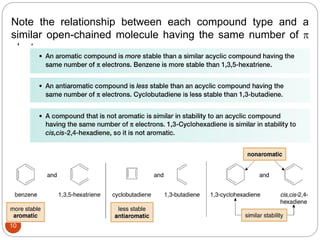
Note the relationship between each compound type and a
similar open-chained molecule having the same number of 
electrons.
11
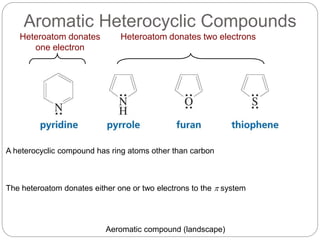
Aromatic Heterocyclic Compounds
A heterocyclic compound has ring atoms other than carbon
The heteroatom donates either one or two electrons to the  system
Heteroatom donates two electronsHeteroatom donates
one electron
Aeromatic compound (landscape)
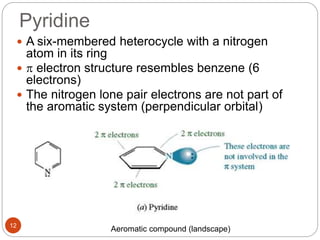
Pyridine
12
 A six-membered heterocycle with a nitrogen
atom in its ring
  electron structure resembles benzene (6
electrons)
 The nitrogen lone pair electrons are not part of
the aromatic system (perpendicular orbital)
Aeromatic compound (landscape)
Pyrrole
13
 A five-membered heterocycle with one nitrogen
  electron system similar to that of cyclopentadienyl anion
 Nitrogen atom is sp2-hybridized, and lone pair of electrons occupies a p
orbital (6  electrons)
Aeromatic compound (landscape)
Furan structure
Furan and Thiphene structure are similar
15
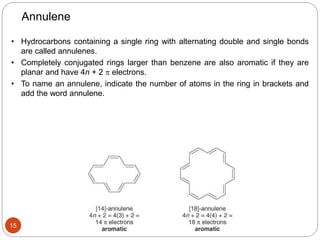
Annulene
• Hydrocarbons containing a single ring with alternating double and single bonds
are called annulenes.
• Completely conjugated rings larger than benzene are also aromatic if they are
planar and have 4n + 2  electrons.
• To name an annulene, indicate the number of atoms in the ring in brackets and
add the word annulene.
16
• [10]-Annulene has 10  electrons, which satisfies Hückel's rule, but a planar
molecule would place the two H atoms inside the ring too close to each other.
Thus, the ring puckers to relieve this strain.
• Since [10]-annulene is not planar, the 10  electrons can’t delocalize over the
entire ring and it is not aromatic.
Aromaticity Antiaromaticity Non aromaticity

Aromaticity Antiaromaticity Non aromaticity

  • 3.
    Content 1-Aromatic Compaund 2-Criteria foraromaticity 3-Difference between aromatic, antiaromatic,nonaromatic 4-Aromatic hetrocyclic compound 5-Annulene
  • 4.
  • 5.
    5 Four structural criteriamust be satisfied for a compound to be aromatic. The Criteria for Aromaticity [1] A molecule must be cyclic. To be aromatic, each p orbital must overlap with p orbitals on adjacent atoms. Aeromatic compound (landscape)
  • 6.
    6 [3] A moleculemust be completely conjugated. Aromatic compounds must have a p orbital on every atom. Aeromatic compound (landscape)
  • 7.
    7 [2] A moleculemust be planar. All adjacent p orbitals must be aligned so that the  electron density can be delocalized. Aeromatic compound (landscape)
  • 8.
    8 [4] A moleculemust satisfy Hückel’s rule, and contain a particular number of  electrons. Benzene is aromatic and especially stable because it contains 6  electrons. Cyclobutadiene is antiaromatic and especially unstable because it contains 4  electrons. Hückel's rule:
  • 9.
    9 1. Aromatic—A cyclic,planar, completely conjugated compound with 4n + 2  electrons. 2. Antiaromatic—A cyclic, planar, completely conjugated compound with 4n  electrons. 3. Not aromatic (nonaromatic)—A compound that lacks one (or more) of the following requirements for aromaticity: being cyclic, planar, and completely conjugated. Considering aromaticity, a compound can be classified in one of three ways: Aeromatic compound (landscape)
  • 10.
    10 Note the relationshipbetween each compound type and a similar open-chained molecule having the same number of  electrons.
  • 11.
    11 Aromatic Heterocyclic Compounds Aheterocyclic compound has ring atoms other than carbon The heteroatom donates either one or two electrons to the  system Heteroatom donates two electronsHeteroatom donates one electron Aeromatic compound (landscape)
  • 12.
    Pyridine 12  A six-memberedheterocycle with a nitrogen atom in its ring   electron structure resembles benzene (6 electrons)  The nitrogen lone pair electrons are not part of the aromatic system (perpendicular orbital) Aeromatic compound (landscape)
  • 13.
    Pyrrole 13  A five-memberedheterocycle with one nitrogen   electron system similar to that of cyclopentadienyl anion  Nitrogen atom is sp2-hybridized, and lone pair of electrons occupies a p orbital (6  electrons)
  • 14.
    Aeromatic compound (landscape) Furanstructure Furan and Thiphene structure are similar
  • 15.
    15 Annulene • Hydrocarbons containinga single ring with alternating double and single bonds are called annulenes. • Completely conjugated rings larger than benzene are also aromatic if they are planar and have 4n + 2  electrons. • To name an annulene, indicate the number of atoms in the ring in brackets and add the word annulene.
  • 16.
    16 • [10]-Annulene has10  electrons, which satisfies Hückel's rule, but a planar molecule would place the two H atoms inside the ring too close to each other. Thus, the ring puckers to relieve this strain. • Since [10]-annulene is not planar, the 10  electrons can’t delocalize over the entire ring and it is not aromatic.