TEBBE’S REAGENT
1
TEBBE’S REAGENT
The tebbe reagent is the organometallic compound .It is used in
the methylenation of carbonyl compounds ,that is it converts
organic compounds containing the R 2 C=O group into the related
R 2 C=CH 2 derivative.
Formula :C 13 H 18 Al Cl Ti
2
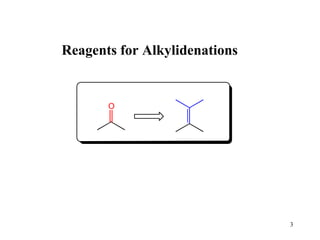
Reagents for Alkylidenations
O
3
Why useTitanium-based Reagents?
4
1. Non-basic, reactive reagent
2. More reactive to the sterically hindered carbonyl group
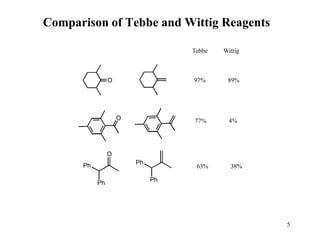
Comparison of Tebbe and Wittig Reagents
O
5
97% 89%
Tebbe Wittig
O 77% 4%
Ph
Ph
O
Ph
Ph
63% 38%
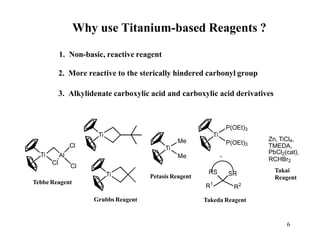
Why use Titanium-based Reagents ?
1. Non-basic, reactive reagent
2. More reactive to the sterically hindered carbonyl group
3. Alkylidenate carboxylic acid and carboxylic acid derivatives
Ti
Cl
Al
Cl
Cl
Tebbe Reagent
Ti
Ti
Grubbs Reagent
Ti
Me
Me
Petasis Reagent
Takeda Reagent
6
Ti
P(OEt)3
P(OEt)3
+
RS
R1
SR
R2
Zn, TiCl4,
TMEDA,
PbCl2(cat),
RCHBr2
Takai
Reagent
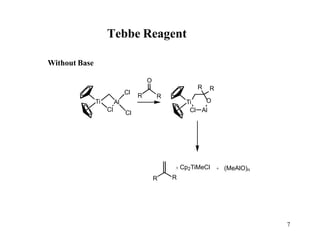
Tebbe Reagent
Ti
7
Cl
Al
Cl
Cl
Ti
Cl Al
R R
O
R
+ Cp2TiMeCl
R
+ (MeAlO)n
RR
O
Without Base
Tebbe Reagent
Ti
8
Cl
Al
Cl
Cl
Ti
R
+
R
R
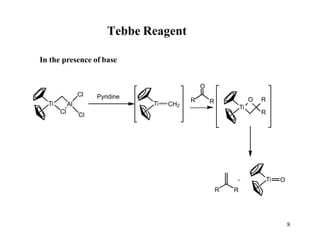
In the presence of base
O
Pyridine
Ti CH2
R O R
R
Ti O
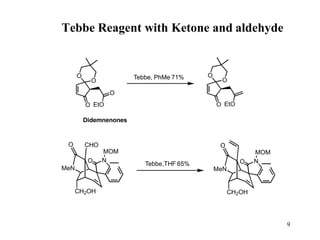
Tebbe Reagent with Ketone and aldehyde
Didemnenones
O
O
O
O EtO
O
O
O EtO
Tebbe, PhMe 71%
MeN
9
CHOO
CH2OH
O
MOM
N
Tebbe,THF 65%
MeN
O
CH2OH
O
MOM
N
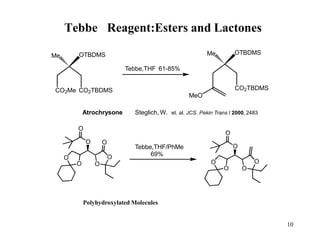
Tebbe Reagent:Esters and Lactones
Atrochrysone Steglich, W. et. al. JCS. Pekin Trans I 2000, 2483
Polyhydroxylated Molecules
CO2Me CO2TBDMS
OTBDMSMe
CO2TBDMS
OTBDMSMe
Tebbe,THF 61-85%
MeO
O
10
O O
O
OO
O
Tebbe,THF/PhMe
69%
O
O O
O
O
O
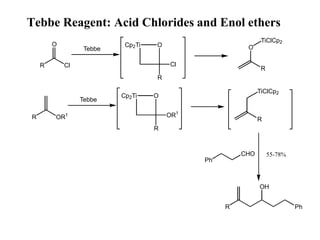
Tebbe Reagent: Acid Chlorides and Enol ethers
R Cl
O
Tebbe
Cp2Ti O
Cl
R
R
O
TiClCp2
R OR1
Tebbe
Cp2Ti O
OR1
R
R
TiClCp2
Ph
CHO
R Ph
OH
55-78%
Tebbe Reagent: Alkenes
Aplysins
O
12
O
Cp2TiCl2 (2.8 eq)
AlMe3 (7.8 eq)
Cp2TiCl2 (6 eq)
AlMe3 (12 eq)
O
O
O
TiCp2
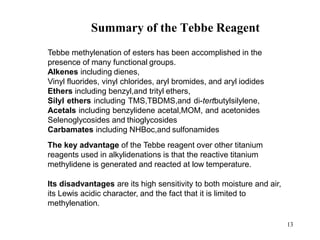
Summary of the Tebbe Reagent
13
Tebbe methylenation of esters has been accomplished in the
presence of many functional groups.
Alkenes including dienes,
Vinyl fluorides, vinyl chlorides, aryl bromides, and aryl iodides
Ethers including benzyl,and trityl ethers,
Silyl ethers including TMS,TBDMS,and di-tertbutylsilylene,
Acetals including benzylidene acetal,MOM, and acetonides
Selenoglycosides and thioglycosides
Carbamates including NHBoc,and sulfonamides
The key advantage of the Tebbe reagent over other titanium
reagents used in alkylidenations is that the reactive titanium
methylidene is generated and reacted at low temperature.
Its disadvantages are its high sensitivity to both moisture and air,
its Lewis acidic character, and the fact that it is limited to
methylenation.

Tebbes reagent

  • 1.
  • 2.
    TEBBE’S REAGENT The tebbereagent is the organometallic compound .It is used in the methylenation of carbonyl compounds ,that is it converts organic compounds containing the R 2 C=O group into the related R 2 C=CH 2 derivative. Formula :C 13 H 18 Al Cl Ti 2
  • 3.
  • 4.
    Why useTitanium-based Reagents? 4 1.Non-basic, reactive reagent 2. More reactive to the sterically hindered carbonyl group
  • 5.
    Comparison of Tebbeand Wittig Reagents O 5 97% 89% Tebbe Wittig O 77% 4% Ph Ph O Ph Ph 63% 38%
  • 6.
    Why use Titanium-basedReagents ? 1. Non-basic, reactive reagent 2. More reactive to the sterically hindered carbonyl group 3. Alkylidenate carboxylic acid and carboxylic acid derivatives Ti Cl Al Cl Cl Tebbe Reagent Ti Ti Grubbs Reagent Ti Me Me Petasis Reagent Takeda Reagent 6 Ti P(OEt)3 P(OEt)3 + RS R1 SR R2 Zn, TiCl4, TMEDA, PbCl2(cat), RCHBr2 Takai Reagent
  • 7.
    Tebbe Reagent Ti 7 Cl Al Cl Cl Ti Cl Al RR O R + Cp2TiMeCl R + (MeAlO)n RR O Without Base
  • 8.
    Tebbe Reagent Ti 8 Cl Al Cl Cl Ti R + R R In thepresence of base O Pyridine Ti CH2 R O R R Ti O
  • 9.
    Tebbe Reagent withKetone and aldehyde Didemnenones O O O O EtO O O O EtO Tebbe, PhMe 71% MeN 9 CHOO CH2OH O MOM N Tebbe,THF 65% MeN O CH2OH O MOM N
  • 10.
    Tebbe Reagent:Esters andLactones Atrochrysone Steglich, W. et. al. JCS. Pekin Trans I 2000, 2483 Polyhydroxylated Molecules CO2Me CO2TBDMS OTBDMSMe CO2TBDMS OTBDMSMe Tebbe,THF 61-85% MeO O 10 O O O OO O Tebbe,THF/PhMe 69% O O O O O O
  • 11.
    Tebbe Reagent: AcidChlorides and Enol ethers R Cl O Tebbe Cp2Ti O Cl R R O TiClCp2 R OR1 Tebbe Cp2Ti O OR1 R R TiClCp2 Ph CHO R Ph OH 55-78%
  • 12.
    Tebbe Reagent: Alkenes Aplysins O 12 O Cp2TiCl2(2.8 eq) AlMe3 (7.8 eq) Cp2TiCl2 (6 eq) AlMe3 (12 eq) O O O TiCp2
  • 13.
    Summary of theTebbe Reagent 13 Tebbe methylenation of esters has been accomplished in the presence of many functional groups. Alkenes including dienes, Vinyl fluorides, vinyl chlorides, aryl bromides, and aryl iodides Ethers including benzyl,and trityl ethers, Silyl ethers including TMS,TBDMS,and di-tertbutylsilylene, Acetals including benzylidene acetal,MOM, and acetonides Selenoglycosides and thioglycosides Carbamates including NHBoc,and sulfonamides The key advantage of the Tebbe reagent over other titanium reagents used in alkylidenations is that the reactive titanium methylidene is generated and reacted at low temperature. Its disadvantages are its high sensitivity to both moisture and air, its Lewis acidic character, and the fact that it is limited to methylenation.