
NUCLEAR
BATTERY
Visit www.seminarlinks.blogspot.in to Download
Introduction
 The term nuclear battery describes a device which uses energy
from the decay of a radioactive isotope to generate electricity.
 Like nuclear reactors they generate electricity from atomic
energy, but differ in that they do not use a chain reaction.
 Also known as Atomic Battery, Tritium Battery and
Radioisotope Generator
Evolution
 Nuclear battery technology began in 1913, when Henry Moseley first
demonstrated the beta cell.
 The field received considerable in-depth research attention for
applications requiring long-life power sources for space needs during
the 1950s and 1960s.
 In 1954 RCA (Radio Corporation of America) researched a small atomic
battery for small radio receivers and hearing aids.
Conversion Techniques
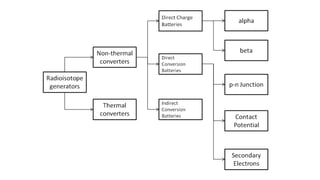
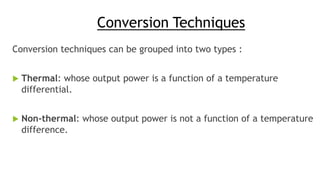
Conversion techniques can be grouped into two types :
 Thermal: whose output power is a function of a temperature
differential.
 Non-thermal: whose output power is not a function of a temperature
difference.
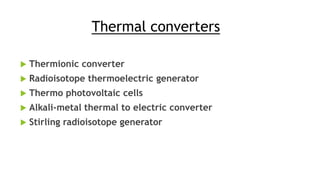
Thermal converters
 Thermionic converter
 Radioisotope thermoelectric generator
 Thermo photovoltaic cells
 Alkali-metal thermal to electric converter
 Stirling radioisotope generator
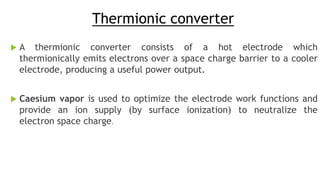
Thermionic converter
 A thermionic converter consists of a hot electrode which
thermionically emits electrons over a space charge barrier to a cooler
electrode, producing a useful power output.
 Caesium vapor is used to optimize the electrode work functions and
provide an ion supply (by surface ionization) to neutralize the
electron space charge.
Radioisotope Thermoelectric Generator
 A thermoelectric converter uses thermocouples.
 Each thermocouple is formed from two wires of different metals (or
other materials).
 A temperature gradient along the length of each wire produces a
voltage gradient from one end of the wire to the other.
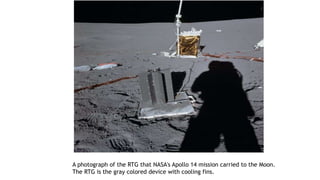
A photograph of the RTG that NASA's Apollo 14 mission carried to the Moon.
The RTG is the gray colored device with cooling fins.
Thermo Photovoltaic Cells
 Thermophotovoltaic cells work by the same principles as
a photovoltaic cell, except that they convert infrared light (rather
than visible light) emitted by a hot surface, into electricity.
 Thermophotovoltaic cells have an efficiency slightly higher than
thermoelectric couples and can be overlaid on thermoelectric
couples, potentially doubling efficiency.
Alkali-metal Thermal To Electric Converter
 The alkali-metal thermal to electric converter (AMTEC) is
an electrochemical system which is based on the electrolyte used
in the sodium-sulfur battery, sodium beta-alumina.
 Efficiency of AMTEC cells has reached 16% in the laboratory and is
predicted to approach 20%.
Stirling Radioisotope Generator
 A Stirling engine driven by the temperature difference produced by
a radioisotope.
 New developments have led to the creation of a more efficient
version, known as an Advanced Stirling Radioisotope Generator.
Non-thermal Converters
 Direct charging generators
 Betavoltaics
 Alphavoltaics
 Optoelectric
 Reciprocating Electromechanical Atomic Batteries
Direct Charging Generators
 The primary generator consists of a capacitor which is charged
by the current of charged particles from a radioactive layer
deposited on one of the electrodes.
 Spacing can be either vacuum or dielectric.
Betavoltaics
 Betavoltaics are generators of electrical current, in effect a form of
battery, which use energy from a radioactive source emitting beta
particles (electrons).
 A common source used is the hydrogen isotope, tritium.
 Betavoltaics use a non-thermal conversion process, using
a semiconductor p-n junction.
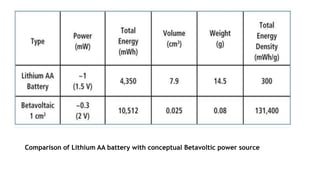
Comparison of Lithium AA battery with conceptual Betavoltic power source
Alphavoltaics
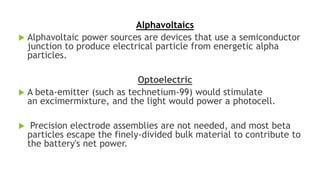
 Alphavoltaic power sources are devices that use a semiconductor
junction to produce electrical particle from energetic alpha
particles.
Optoelectric
 A beta-emitter (such as technetium-99) would stimulate
an excimermixture, and the light would power a photocell.
 Precision electrode assemblies are not needed, and most beta
particles escape the finely-divided bulk material to contribute to
the battery's net power.
Reciprocating Electromechanical Atomic Batteries
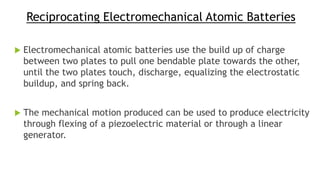
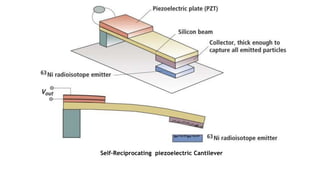
 Electromechanical atomic batteries use the build up of charge
between two plates to pull one bendable plate towards the other,
until the two plates touch, discharge, equalizing the electrostatic
buildup, and spring back.
 The mechanical motion produced can be used to produce electricity
through flexing of a piezoelectric material or through a linear
generator.
Self-Reciprocating piezoelectric Cantilever
Radioisotopes used
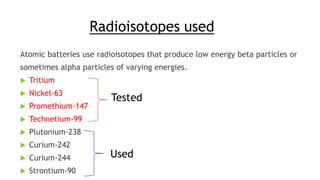
Atomic batteries use radioisotopes that produce low energy beta particles or
sometimes alpha particles of varying energies.
 Tritium
 Nickel-63
 Promethium-147
 Technetium-99
 Plutonium-238
 Curium-242
 Curium-244
 Strontium-90
Tested
Used
Applications
They have extremely long life and high energy density, and so they are mainly
used as power sources for equipment that must operate unattended for long
periods of time, such as
 Spacecraft
 Pacemakers
 underwater systems
 automated scientific stations in remote parts of the world.
Advantages
 Life span- minimum of decades.
 Reliable electricity.
 Amount of energy obtained is very high.
 Lighter with high energy density.
 Less waste generation.
 Reduces green house and associated effects.
 Fuel used is the nuclear waste from nuclear fission.
Disadvantages
 High initial cost of production as its in the experimental stage.
 Energy conversion methodologies are not much advanced.
 Regional and country-specific laws regarding use and disposal of radioactive
fuels.
 To gain social acceptance.
Conclusion
Clearly the current research of nuclear batteries shows promise in
future applications for sure. With implementation of this new
technology credibility and feasibility of the device will be heightened.
References
 http://en.wikipedia.org/wiki/Atomic_battery
 http://www.ethicalhavoc.net/Thread-NUCLEAR-BATTERIES
 http://www.raytheon.com/newsroom/technology_today/2011_i1/power.html
 http://large.stanford.edu/courses/2012/ph241/kumar1/
Nuclear Battery PPT

Nuclear Battery PPT

  • 1.
  • 2.
    Introduction  The termnuclear battery describes a device which uses energy from the decay of a radioactive isotope to generate electricity.  Like nuclear reactors they generate electricity from atomic energy, but differ in that they do not use a chain reaction.  Also known as Atomic Battery, Tritium Battery and Radioisotope Generator
  • 3.
    Evolution  Nuclear batterytechnology began in 1913, when Henry Moseley first demonstrated the beta cell.  The field received considerable in-depth research attention for applications requiring long-life power sources for space needs during the 1950s and 1960s.  In 1954 RCA (Radio Corporation of America) researched a small atomic battery for small radio receivers and hearing aids.
  • 6.
    Conversion Techniques Conversion techniquescan be grouped into two types :  Thermal: whose output power is a function of a temperature differential.  Non-thermal: whose output power is not a function of a temperature difference.
  • 7.
    Thermal converters  Thermionicconverter  Radioisotope thermoelectric generator  Thermo photovoltaic cells  Alkali-metal thermal to electric converter  Stirling radioisotope generator
  • 8.
    Thermionic converter  Athermionic converter consists of a hot electrode which thermionically emits electrons over a space charge barrier to a cooler electrode, producing a useful power output.  Caesium vapor is used to optimize the electrode work functions and provide an ion supply (by surface ionization) to neutralize the electron space charge.
  • 9.
    Radioisotope Thermoelectric Generator A thermoelectric converter uses thermocouples.  Each thermocouple is formed from two wires of different metals (or other materials).  A temperature gradient along the length of each wire produces a voltage gradient from one end of the wire to the other.
  • 10.
    A photograph ofthe RTG that NASA's Apollo 14 mission carried to the Moon. The RTG is the gray colored device with cooling fins.
  • 11.
    Thermo Photovoltaic Cells Thermophotovoltaic cells work by the same principles as a photovoltaic cell, except that they convert infrared light (rather than visible light) emitted by a hot surface, into electricity.  Thermophotovoltaic cells have an efficiency slightly higher than thermoelectric couples and can be overlaid on thermoelectric couples, potentially doubling efficiency.
  • 12.
    Alkali-metal Thermal ToElectric Converter  The alkali-metal thermal to electric converter (AMTEC) is an electrochemical system which is based on the electrolyte used in the sodium-sulfur battery, sodium beta-alumina.  Efficiency of AMTEC cells has reached 16% in the laboratory and is predicted to approach 20%.
  • 13.
    Stirling Radioisotope Generator A Stirling engine driven by the temperature difference produced by a radioisotope.  New developments have led to the creation of a more efficient version, known as an Advanced Stirling Radioisotope Generator.
  • 14.
    Non-thermal Converters  Directcharging generators  Betavoltaics  Alphavoltaics  Optoelectric  Reciprocating Electromechanical Atomic Batteries
  • 15.
    Direct Charging Generators The primary generator consists of a capacitor which is charged by the current of charged particles from a radioactive layer deposited on one of the electrodes.  Spacing can be either vacuum or dielectric.
  • 16.
    Betavoltaics  Betavoltaics aregenerators of electrical current, in effect a form of battery, which use energy from a radioactive source emitting beta particles (electrons).  A common source used is the hydrogen isotope, tritium.  Betavoltaics use a non-thermal conversion process, using a semiconductor p-n junction.
  • 17.
    Comparison of LithiumAA battery with conceptual Betavoltic power source
  • 18.
    Alphavoltaics  Alphavoltaic powersources are devices that use a semiconductor junction to produce electrical particle from energetic alpha particles. Optoelectric  A beta-emitter (such as technetium-99) would stimulate an excimermixture, and the light would power a photocell.  Precision electrode assemblies are not needed, and most beta particles escape the finely-divided bulk material to contribute to the battery's net power.
  • 19.
    Reciprocating Electromechanical AtomicBatteries  Electromechanical atomic batteries use the build up of charge between two plates to pull one bendable plate towards the other, until the two plates touch, discharge, equalizing the electrostatic buildup, and spring back.  The mechanical motion produced can be used to produce electricity through flexing of a piezoelectric material or through a linear generator.
  • 20.
  • 21.
    Radioisotopes used Atomic batteriesuse radioisotopes that produce low energy beta particles or sometimes alpha particles of varying energies.  Tritium  Nickel-63  Promethium-147  Technetium-99  Plutonium-238  Curium-242  Curium-244  Strontium-90 Tested Used
  • 22.
    Applications They have extremelylong life and high energy density, and so they are mainly used as power sources for equipment that must operate unattended for long periods of time, such as  Spacecraft  Pacemakers  underwater systems  automated scientific stations in remote parts of the world.
  • 23.
    Advantages  Life span-minimum of decades.  Reliable electricity.  Amount of energy obtained is very high.  Lighter with high energy density.  Less waste generation.  Reduces green house and associated effects.  Fuel used is the nuclear waste from nuclear fission.
  • 24.
    Disadvantages  High initialcost of production as its in the experimental stage.  Energy conversion methodologies are not much advanced.  Regional and country-specific laws regarding use and disposal of radioactive fuels.  To gain social acceptance.
  • 25.
    Conclusion Clearly the currentresearch of nuclear batteries shows promise in future applications for sure. With implementation of this new technology credibility and feasibility of the device will be heightened.
  • 26.
    References  http://en.wikipedia.org/wiki/Atomic_battery  http://www.ethicalhavoc.net/Thread-NUCLEAR-BATTERIES http://www.raytheon.com/newsroom/technology_today/2011_i1/power.html  http://large.stanford.edu/courses/2012/ph241/kumar1/