Asymmetric Morita Baylis Hillman  Reaction Lalit Kumar Medicinal & Process chemistry Division CDRI
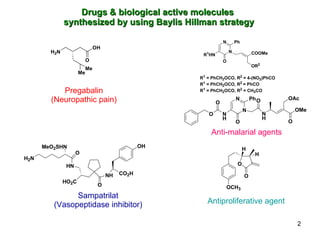
Pregabalin (Neuropathic pain) Sampatrilat (Vasopeptidase inhibitor) Anti-malarial agents Antiproliferative agent Drugs & biological active molecules synthesized by using Baylis Hillman strategy
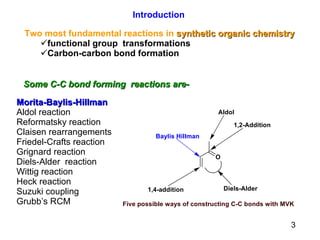
Introduction Two most fundamental reactions in  synthetic organic chemistry functional group  transformations   Carbon-carbon bond formation Morita-Baylis-Hillman Aldol reaction Reformatsky reaction Claisen rearrangements  Friedel-Crafts reaction  Grignard reaction  Diels-Alder  reaction  Wittig reaction  Heck reaction Suzuki coupling  Grubb’s RCM Some C-C bond forming  reactions are- 3
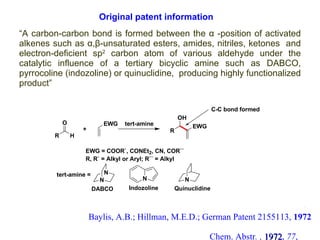
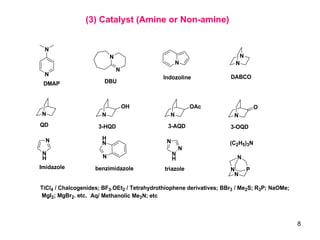
“ A carbon-carbon bond is formed between the  α  -position of activated alkenes such as  α,β-unsaturated esters, amides, nitriles, ketones   and electron-deficient sp 2  carbon atom of various aldehyde under the catalytic influence of a tertiary bicyclic amine such as DABCO, pyrrocoline (indozoline) or quinuclidine,  producing highly functionalized product” Baylis, A.B.; Hillman, M.E.D.; German Patent 2155113,  1972  Chem. Abstr . ,   1972 ,  77 , 34174q Original patent information 4
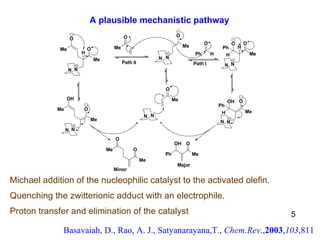
A plausible mechanistic pathway   Basavaiah, D., Rao, A. J., Satyanarayana,T.,  Chem.Rev ., 2003 , 103 ,811 Michael addition of the nucleophilic catalyst to the activated olefin. Quenching the zwitterionic adduct with an electrophile. Proton transfer and elimination of the catalyst 5
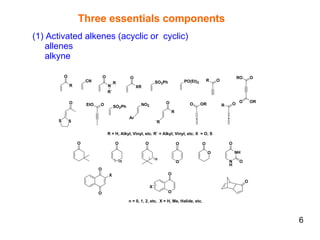
Three essentials components   (1) Activated alkenes (acyclic or  cyclic) allenes alkyne 6
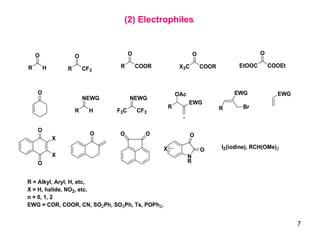
(2) Electrophiles
(3) Catalyst (Amine or Non-amine)
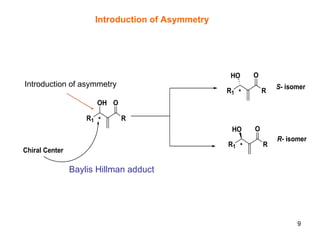
Baylis Hillman adduct Introduction of asymmetry Introduction of Asymmetry
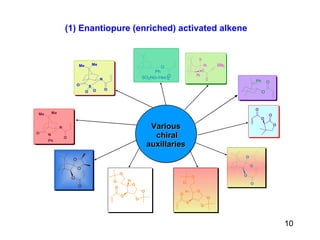
(1) Enantiopure (enriched) activated alkene   10 Various chiral auxillaries
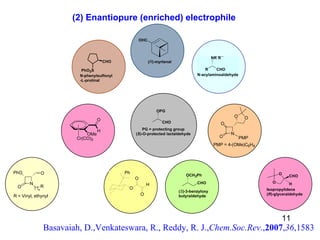
(2) Enantiopure (enriched) electrophile   Basavaiah, D.,Venkateswara, R., Reddy, R. J., Chem.Soc.Rev ., 2007 , 36 ,1583 11
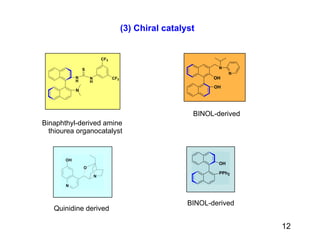
(3) Chiral catalyst BINOL-derived Quinidine derived Binaphthyl-derived amine thiourea organocatalyst BINOL-derived 12
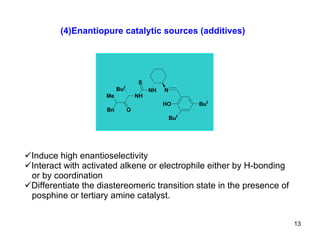
(4)Enantiopure catalytic sources (additives) Induce high enantioselectivity  Interact with activated alkene or electrophile either by H-bonding or by coordination  Differentiate the diastereomeric transition state in the presence of posphine or tertiary amine catalyst.
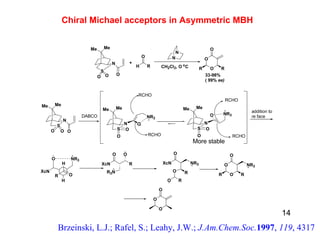
Brzeinski, L.J.; Rafel, S.; Leahy, J.W.;  J.Am.Chem.Soc. 1997 ,  119 , 4317 Chiral Michael acceptors in Asymmetric MBH More stable 14
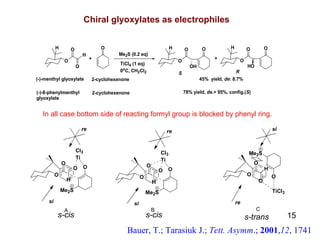
Chiral glyoxylates as electrophiles Bauer, T.; Tarasiuk J.;  Tett. Asymm .;  2001 , 12 , 1741 s-cis s-cis s-trans In all case bottom side of reacting formyl group is blocked by phenyl ring. 15
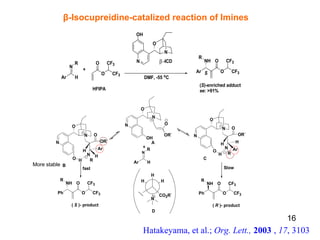
Hatakeyama, et al.;  Org. Lett.,   2003   ,  17 , 3103  β -Isocupreidine-catalized reaction of Imines   More stable   16
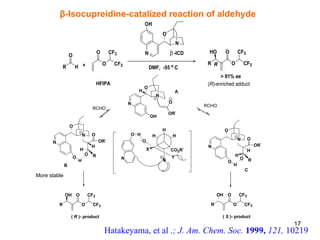
β -Isocupreidine-catalized reaction of aldehyde More stable Hatakeyama, et al  .; J. Am. Chem. Soc.  1999,  121,  10219
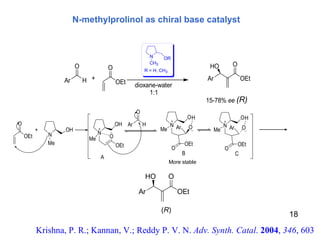
N-methylprolinol as chiral base catalyst Krishna, P. R.; Kannan, V.; Reddy P. V. N.  Adv. Synth. Catal .  2004 ,  346 , 603 More stable 18 (R)
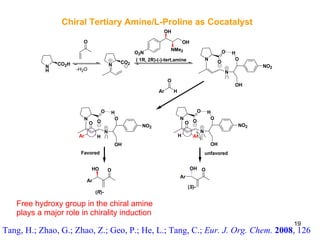
Free hydroxy group in the chiral amine plays a major role in chirality induction Tang, H.; Zhao, G.; Zhao, Z.; Geo, P.; He, L.; Tang, C.;  Eur. J. Org. Chem.  2008 , 126   Chiral Tertiary Amine/L-Proline as Cocatalyst
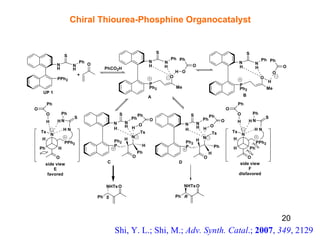
Shi, Y. L.; Shi, M.;  Adv. Synth. Catal .;  2007 ,  349 , 2129 Chiral Thiourea-Phosphine Organocatalyst 20
Conformational lock in a Brønsted acid–Lewis base organocatalyst The acid–base functionalities help in substrate activation and fixing of the organocatalyst conformation to promote the reaction with high enantioselectivity . Mataui, K., Tanaka, K., Horii, A., Takizawa, S., Sasai, H.;  Tett. Asym.,   2006 ,  17 , 578 1a : (S)-3-[4-(dimethylamino)pyridin-2-yl]BINOL 1b : (S )-3-[4-(dimethylamino)pyridin-3-yl]BINOL 1c : (S)-3-[3-(dimethylamino)pyridin-5-yl]BINOL 2a : (S)-3-(N-methyl-N-3-pyridinylaminomethyl)BINOL 2b : (S )-3-(N-methyl-N-2-pyridinylaminomethyl)BINOL 2c : (S)-3-(N-methyl-N-4-pyridinylaminomethyl)BINOL 21 β Proposed catalytic cycle for the bifunctional organocatalyst- mediated aza-MBH reaction Br Ø nsted acid unit Concept of chiral bifunctional organocatalyst 1a-b,  1c,  2a-c   Novel chiral organocatalyst
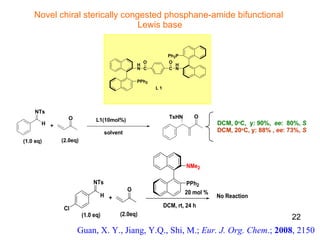
Novel chiral sterically congested phosphane-amide bifunctional Lewis base Guan, X. Y., Jiang, Y.Q., Shi, M.;  Eur. J. Org. Chem .;   2008 , 2150 DCM, 0 o C,  y: 90%,  ee :  80%,  S DCM, 20 o C, y: 88% ,  ee : 73%,  S 22
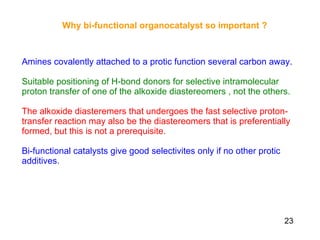
Why bi-functional organocatalyst so important ?   Amines covalently attached to a protic function several carbon away. Suitable positioning of H-bond donors for selective intramolecular proton transfer of one of the alkoxide diastereomers , not the others. The alkoxide diasteremers that undergoes the fast selective proton-transfer reaction may also be the diastereomers that is preferentially formed, but this is not a prerequisite.  Bi-functional catalysts give good selectivites only if no other protic additives.   23
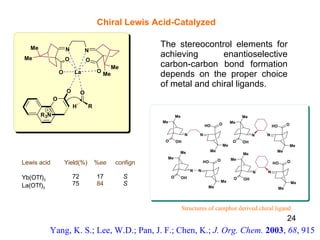
Yang, K. S.; Lee, W.D.; Pan, J. F.; Chen, K.;  J. Org. Chem.  2003 ,  68 , 915 Chiral Lewis Acid-Catalyzed The stereocontrol elements for achieving enantioselective carbon-carbon bond formation depends on the proper choice of metal and chiral ligands. Structures of camphor derived chiral ligand Lewis acid Yb(OTf) 3 La(OTf) 3 Yield(%) 72 75 % ee 17 84 confign S S 24
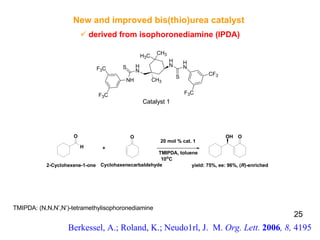
New and improved bis(thio)urea catalyst  derived from isophoronediamine (IPDA) Berkessel, A.; Roland, K.; Neudo1rl, J.  M.  Org. Lett.  2006 , 8,  4195 Catalyst 1 TMIPDA: (N,N,N’,N’)-tetramethylisophoronediamine 25
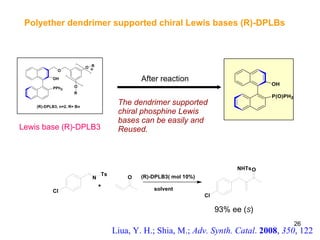
Polyether dendrimer supported chiral Lewis bases (R)-DPLBs After reaction Liua, Y. H.; Shia, M.;  Adv. Synth. Catal .  2008 ,  350 , 122   93% ee ( S )  The dendrimer supported chiral phosphine Lewis bases can be easily and  Reused. Lewis base (R)-DPLB3
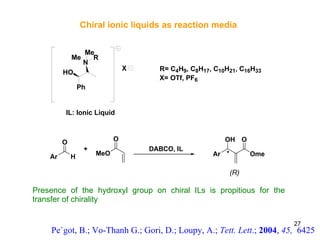
Chiral ionic liquids as reaction media Presence of the hydroxyl group on chiral ILs is propitious for the transfer of chirality Pe´got, B.; Vo-Thanh G.; Gori, D.; Loupy, A.;  Tett. Lett .;  2004 ,  45,  6425 (R)
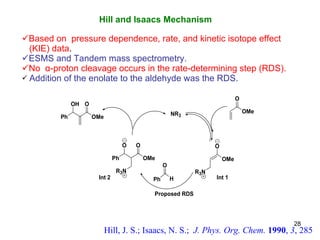
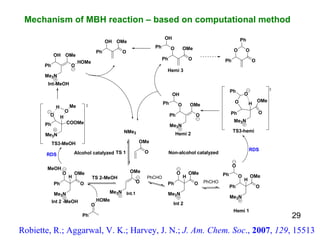
Hill and Isaacs Mechanism   Based on  pressure dependence, rate, and kinetic isotope effect  (KIE) data . ESMS and Tandem mass spectrometry. No  α -proton cleavage occurs in the rate-determining step (RDS). Addition of the enolate to the aldehyde was the RDS. Hill, J. S.; Isaacs, N. S.;  J. Phys. Org. Chem.  1990 ,  3 , 285
Robiette, R.; Aggarwal, V. K.; Harvey, J. N.;  J. Am. Chem. Soc .,  2007 ,  129 , 15513 Mechanism of MBH reaction – based on computational method 29 PhCHO PhCHO Int.1
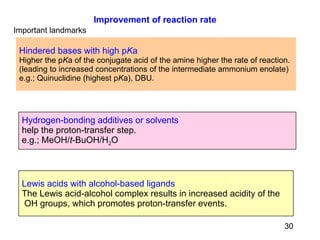
Hindered bases with high p K a   Higher the p K a of the conjugate acid of the amine higher the rate of reaction. (leading to increased concentrations of the intermediate ammonium enolate) e.g.; Quinuclidine (highest p K a), DBU.  Improvement of reaction rate Important landmarks Hydrogen-bonding additives or solvents help the proton-transfer step. e.g.; MeOH/ t -BuOH/H 2 O Lewis acids with alcohol-based ligands The Lewis acid-alcohol complex results in increased acidity of the OH groups, which promotes proton-transfer events. 30
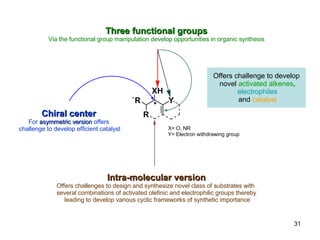
Three functional groups Via the functional group manipulation develop opportunities in organic synthesis Chiral center For  asymmetric version  offers challenge to develop efficient catalyst Intra-molecular version Offers challenges to design and synthesize novel class of substrates with  several combinations of activated olefinic and electrophilic groups thereby leading to develop various cyclic frameworks of synthetic importance X= O, NR Y= Electron withdrawing group Offers challenge to develop novel  activated alkenes , electrophiles and  catalyst
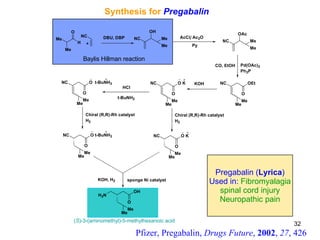
Synthesis for  Pregabalin / Pfizer, Pregabalin,  Drugs Future ,  2002 ,  27 , 426 Pregabalin ( Lyrica ) Used in:  Fibromyalagia spinal cord injury Neuropathic pain Baylis Hillman reaction ( S )-3-(aminomethyl)-5-methylhexanoic acid
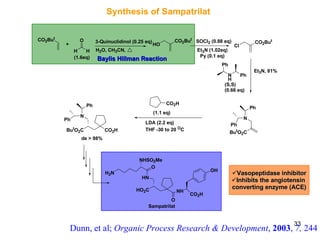
Synthesis of Sampatrilat Dunn, et al;  Organic Process Research & Development ,  2003 ,  7,  244 Baylis Hillman Reaction Vasopeptidase inhibitor Inhibits the angiotensin  converting enzyme (ACE)
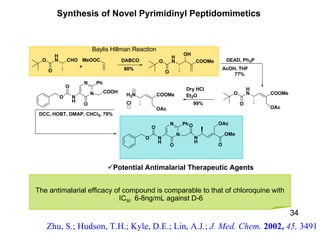
34 Potential Antimalarial Therapeutic Agents Baylis Hillman Reaction The antimalarial efficacy of compound   is comparable to that of chloroquine with IC 50   6-8ng/mL against D-6 Synthesis of Novel Pyrimidinyl Peptidomimetics  Zhu, S.; Hudson, T.H.; Kyle, D.E.; Lin, A.J.;  J. Med. Chem.  2002,  45,  3491
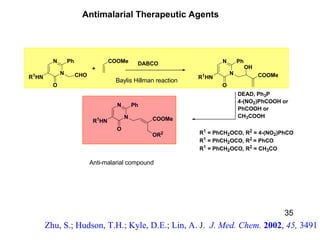
Anti-malarial compound Baylis Hillman reaction Zhu, S.; Hudson, T.H.; Kyle, D.E.; Lin, A. J.  J. Med. Chem.  2002 ,   45,  3491 Antimalarial Therapeutic Agents 35
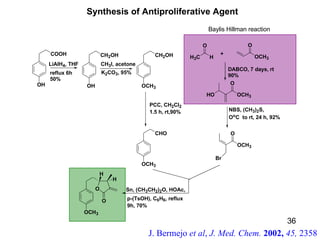
J. Bermejo  et al ,  J. Med. Chem.  2002,  45,  2358 Synthesis of Antiproliferative Agent 36 Baylis Hillman reaction
Simplicity of this reaction in the easy construction of the carbon-  carbon bond. Conclusions Morita Baylis Hillman adduct is an excellent source for various  stereochemical transformation methodologies. Several natural products and biologically active molecules have also  been synthesized using Morita Baylis Hillman strategy. 37
Acknowledgement Dr. V.L. Sharma & All my friends
T h a n k   y o u

Lalit Kumar

  • 1.
    Asymmetric Morita BaylisHillman Reaction Lalit Kumar Medicinal & Process chemistry Division CDRI
  • 2.
    Pregabalin (Neuropathic pain)Sampatrilat (Vasopeptidase inhibitor) Anti-malarial agents Antiproliferative agent Drugs & biological active molecules synthesized by using Baylis Hillman strategy
  • 3.
    Introduction Two mostfundamental reactions in synthetic organic chemistry functional group transformations Carbon-carbon bond formation Morita-Baylis-Hillman Aldol reaction Reformatsky reaction Claisen rearrangements Friedel-Crafts reaction Grignard reaction Diels-Alder reaction Wittig reaction Heck reaction Suzuki coupling Grubb’s RCM Some C-C bond forming reactions are- 3
  • 4.
    “ A carbon-carbonbond is formed between the α -position of activated alkenes such as α,β-unsaturated esters, amides, nitriles, ketones and electron-deficient sp 2 carbon atom of various aldehyde under the catalytic influence of a tertiary bicyclic amine such as DABCO, pyrrocoline (indozoline) or quinuclidine, producing highly functionalized product” Baylis, A.B.; Hillman, M.E.D.; German Patent 2155113, 1972 Chem. Abstr . , 1972 , 77 , 34174q Original patent information 4
  • 5.
    A plausible mechanisticpathway Basavaiah, D., Rao, A. J., Satyanarayana,T., Chem.Rev ., 2003 , 103 ,811 Michael addition of the nucleophilic catalyst to the activated olefin. Quenching the zwitterionic adduct with an electrophile. Proton transfer and elimination of the catalyst 5
  • 6.
    Three essentials components (1) Activated alkenes (acyclic or cyclic) allenes alkyne 6
  • 7.
  • 8.
    (3) Catalyst (Amineor Non-amine)
  • 9.
    Baylis Hillman adductIntroduction of asymmetry Introduction of Asymmetry
  • 10.
    (1) Enantiopure (enriched)activated alkene 10 Various chiral auxillaries
  • 11.
    (2) Enantiopure (enriched)electrophile Basavaiah, D.,Venkateswara, R., Reddy, R. J., Chem.Soc.Rev ., 2007 , 36 ,1583 11
  • 12.
    (3) Chiral catalystBINOL-derived Quinidine derived Binaphthyl-derived amine thiourea organocatalyst BINOL-derived 12
  • 13.
    (4)Enantiopure catalytic sources(additives) Induce high enantioselectivity Interact with activated alkene or electrophile either by H-bonding or by coordination Differentiate the diastereomeric transition state in the presence of posphine or tertiary amine catalyst.
  • 14.
    Brzeinski, L.J.; Rafel,S.; Leahy, J.W.; J.Am.Chem.Soc. 1997 , 119 , 4317 Chiral Michael acceptors in Asymmetric MBH More stable 14
  • 15.
    Chiral glyoxylates aselectrophiles Bauer, T.; Tarasiuk J.; Tett. Asymm .; 2001 , 12 , 1741 s-cis s-cis s-trans In all case bottom side of reacting formyl group is blocked by phenyl ring. 15
  • 16.
    Hatakeyama, et al.; Org. Lett., 2003 , 17 , 3103 β -Isocupreidine-catalized reaction of Imines More stable 16
  • 17.
    β -Isocupreidine-catalized reactionof aldehyde More stable Hatakeyama, et al .; J. Am. Chem. Soc. 1999, 121, 10219
  • 18.
    N-methylprolinol as chiralbase catalyst Krishna, P. R.; Kannan, V.; Reddy P. V. N. Adv. Synth. Catal . 2004 , 346 , 603 More stable 18 (R)
  • 19.
    Free hydroxy groupin the chiral amine plays a major role in chirality induction Tang, H.; Zhao, G.; Zhao, Z.; Geo, P.; He, L.; Tang, C.; Eur. J. Org. Chem. 2008 , 126 Chiral Tertiary Amine/L-Proline as Cocatalyst
  • 20.
    Shi, Y. L.;Shi, M.; Adv. Synth. Catal .; 2007 , 349 , 2129 Chiral Thiourea-Phosphine Organocatalyst 20
  • 21.
    Conformational lock ina Brønsted acid–Lewis base organocatalyst The acid–base functionalities help in substrate activation and fixing of the organocatalyst conformation to promote the reaction with high enantioselectivity . Mataui, K., Tanaka, K., Horii, A., Takizawa, S., Sasai, H.; Tett. Asym., 2006 , 17 , 578 1a : (S)-3-[4-(dimethylamino)pyridin-2-yl]BINOL 1b : (S )-3-[4-(dimethylamino)pyridin-3-yl]BINOL 1c : (S)-3-[3-(dimethylamino)pyridin-5-yl]BINOL 2a : (S)-3-(N-methyl-N-3-pyridinylaminomethyl)BINOL 2b : (S )-3-(N-methyl-N-2-pyridinylaminomethyl)BINOL 2c : (S)-3-(N-methyl-N-4-pyridinylaminomethyl)BINOL 21 β Proposed catalytic cycle for the bifunctional organocatalyst- mediated aza-MBH reaction Br Ø nsted acid unit Concept of chiral bifunctional organocatalyst 1a-b, 1c, 2a-c Novel chiral organocatalyst
  • 22.
    Novel chiral stericallycongested phosphane-amide bifunctional Lewis base Guan, X. Y., Jiang, Y.Q., Shi, M.; Eur. J. Org. Chem .; 2008 , 2150 DCM, 0 o C, y: 90%, ee : 80%, S DCM, 20 o C, y: 88% , ee : 73%, S 22
  • 23.
    Why bi-functional organocatalystso important ? Amines covalently attached to a protic function several carbon away. Suitable positioning of H-bond donors for selective intramolecular proton transfer of one of the alkoxide diastereomers , not the others. The alkoxide diasteremers that undergoes the fast selective proton-transfer reaction may also be the diastereomers that is preferentially formed, but this is not a prerequisite. Bi-functional catalysts give good selectivites only if no other protic additives. 23
  • 24.
    Yang, K. S.;Lee, W.D.; Pan, J. F.; Chen, K.; J. Org. Chem. 2003 , 68 , 915 Chiral Lewis Acid-Catalyzed The stereocontrol elements for achieving enantioselective carbon-carbon bond formation depends on the proper choice of metal and chiral ligands. Structures of camphor derived chiral ligand Lewis acid Yb(OTf) 3 La(OTf) 3 Yield(%) 72 75 % ee 17 84 confign S S 24
  • 25.
    New and improvedbis(thio)urea catalyst derived from isophoronediamine (IPDA) Berkessel, A.; Roland, K.; Neudo1rl, J. M. Org. Lett. 2006 , 8, 4195 Catalyst 1 TMIPDA: (N,N,N’,N’)-tetramethylisophoronediamine 25
  • 26.
    Polyether dendrimer supportedchiral Lewis bases (R)-DPLBs After reaction Liua, Y. H.; Shia, M.; Adv. Synth. Catal . 2008 , 350 , 122 93% ee ( S ) The dendrimer supported chiral phosphine Lewis bases can be easily and Reused. Lewis base (R)-DPLB3
  • 27.
    Chiral ionic liquidsas reaction media Presence of the hydroxyl group on chiral ILs is propitious for the transfer of chirality Pe´got, B.; Vo-Thanh G.; Gori, D.; Loupy, A.; Tett. Lett .; 2004 , 45, 6425 (R)
  • 28.
    Hill and IsaacsMechanism Based on pressure dependence, rate, and kinetic isotope effect (KIE) data . ESMS and Tandem mass spectrometry. No α -proton cleavage occurs in the rate-determining step (RDS). Addition of the enolate to the aldehyde was the RDS. Hill, J. S.; Isaacs, N. S.; J. Phys. Org. Chem. 1990 , 3 , 285
  • 29.
    Robiette, R.; Aggarwal,V. K.; Harvey, J. N.; J. Am. Chem. Soc ., 2007 , 129 , 15513 Mechanism of MBH reaction – based on computational method 29 PhCHO PhCHO Int.1
  • 30.
    Hindered bases withhigh p K a Higher the p K a of the conjugate acid of the amine higher the rate of reaction. (leading to increased concentrations of the intermediate ammonium enolate) e.g.; Quinuclidine (highest p K a), DBU. Improvement of reaction rate Important landmarks Hydrogen-bonding additives or solvents help the proton-transfer step. e.g.; MeOH/ t -BuOH/H 2 O Lewis acids with alcohol-based ligands The Lewis acid-alcohol complex results in increased acidity of the OH groups, which promotes proton-transfer events. 30
  • 31.
    Three functional groupsVia the functional group manipulation develop opportunities in organic synthesis Chiral center For asymmetric version offers challenge to develop efficient catalyst Intra-molecular version Offers challenges to design and synthesize novel class of substrates with several combinations of activated olefinic and electrophilic groups thereby leading to develop various cyclic frameworks of synthetic importance X= O, NR Y= Electron withdrawing group Offers challenge to develop novel activated alkenes , electrophiles and catalyst
  • 32.
    Synthesis for Pregabalin / Pfizer, Pregabalin, Drugs Future , 2002 , 27 , 426 Pregabalin ( Lyrica ) Used in: Fibromyalagia spinal cord injury Neuropathic pain Baylis Hillman reaction ( S )-3-(aminomethyl)-5-methylhexanoic acid
  • 33.
    Synthesis of SampatrilatDunn, et al; Organic Process Research & Development , 2003 , 7, 244 Baylis Hillman Reaction Vasopeptidase inhibitor Inhibits the angiotensin converting enzyme (ACE)
  • 34.
    34 Potential AntimalarialTherapeutic Agents Baylis Hillman Reaction The antimalarial efficacy of compound is comparable to that of chloroquine with IC 50 6-8ng/mL against D-6 Synthesis of Novel Pyrimidinyl Peptidomimetics Zhu, S.; Hudson, T.H.; Kyle, D.E.; Lin, A.J.; J. Med. Chem. 2002, 45, 3491
  • 35.
    Anti-malarial compound BaylisHillman reaction Zhu, S.; Hudson, T.H.; Kyle, D.E.; Lin, A. J. J. Med. Chem. 2002 , 45, 3491 Antimalarial Therapeutic Agents 35
  • 36.
    J. Bermejo et al , J. Med. Chem. 2002, 45, 2358 Synthesis of Antiproliferative Agent 36 Baylis Hillman reaction
  • 37.
    Simplicity of thisreaction in the easy construction of the carbon- carbon bond. Conclusions Morita Baylis Hillman adduct is an excellent source for various stereochemical transformation methodologies. Several natural products and biologically active molecules have also been synthesized using Morita Baylis Hillman strategy. 37
  • 38.
    Acknowledgement Dr. V.L.Sharma & All my friends
  • 39.
    T h an k y o u