 A transition metal as an element whose atom has a
partially filled d subshell, or which can give rise to
cations with an incomplete d sub-shell .
 The transition metal ions the outermost d orbitals are
incompletely filled with electrons so they can easily
give and take electrons. This makes transition metals
prime candidates for catalysis.
 Here transition metals are used as catalysts .
Zinc, cadmium, and mercury are generally excluded
from the transition metals as they have the electronic
configuration [ ]d 10s 2 , with no incomplete d shell.
 The formation of compounds in many oxidation states, due
to the relatively low energy gap between different
possible oxidation states eg, Fe(II), Fe(III) or switch
oxidizing state .
 Form complexes with reagents by adsorption at active site
.
 Colour in transition-series metal compounds is generally
due to electronic transitions of two principal
types.
 Charge transfer transitions
 d-d transitions
•Charge transfer transitions:
An electron may jump from a predominantly ligand orbital to a
predominantly metal orbital, giving rise to a ligand-to-metal
charge-transfer (LMCT) transition. These can most easily
occur when the metal is in a high oxidation state.
For example, The colour of chromate, dichromate and
permanganate ions is due to LMCT transitions.
Another example is that mercuric iodide, HgI2, is red because
of a LMCT transition .
•d-d transitions:
An electron jumps from one d-orbital to another d-orbital and
leads to d-d transitions .
The principal reasons why transition metals
contribute the essential ingredient in catalyst
systems can be summarized as the following
headings:
(a) Bonding ability
(b) Catholic choice of ligands
(c) Ligand effects
(d) Variability of oxidation state
(e) Variablility of co-ordination number
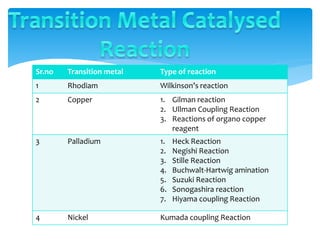
Sr.no Transition metal Type of reaction
1 Rhodiam Wilkinson’s reaction
2 Copper 1. Gilman reaction
2. Ullman Coupling Reaction
3. Reactions of organo copper
reagent
3 Palladium 1. Heck Reaction
2. Negishi Reaction
3. Stille Reaction
4. Buchwalt-Hartwig amination
5. Suzuki Reaction
6. Sonogashira reaction
7. Hiyama coupling Reaction
4 Nickel Kumada coupling Reaction
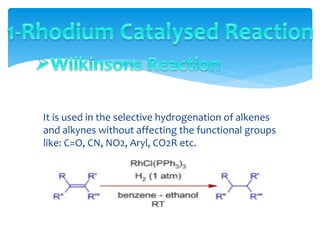
It is used in the selective hydrogenation of alkenes
and alkynes without affecting the functional groups
like: C=O, CN, NO2, Aryl, CO2R etc.
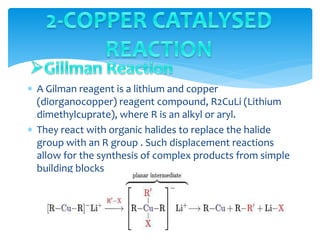
 A Gilman reagent is a lithium and copper
(diorganocopper) reagent compound, R2CuLi (Lithium
dimethylcuprate), where R is an alkyl or aryl.
 They react with organic halides to replace the halide
group with an R group . Such displacement reactions
allow for the synthesis of complex products from simple
building blocks
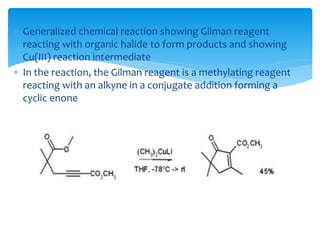
 Generalized chemical reaction showing Gilman reagent
reacting with organic halide to form products and showing
Cu(III) reaction intermediate
 In the reaction, the Gilman reagent is a methylating reagent
reacting with an alkyne in a conjugate addition forming a
cyclic enone
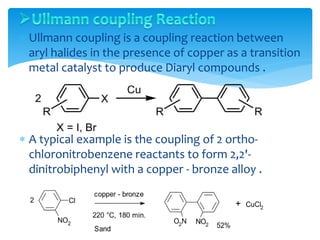
 Ullmann coupling is a coupling reaction between
aryl halides in the presence of copper as a transition
metal catalyst to produce Diaryl compounds .
 A typical example is the coupling of 2 ortho-
chloronitrobenzene reactants to form 2,2'-
dinitrobiphenyl with a copper - bronze alloy .
 Carbocupration is a nucleophilic addition of organocopper
reagents (R-Cu) to acetylene or terminal alkynes resulting in
an alkenylcopper compound (RC=C-Cu).It is a special case of
carbometalation and also called the Normant reaction.
A. Substitution Reactions
 oxidative addition of copper(I) into the carbon-leaving
group bond takes place, generating a copper(III)
intermediate which then undergoes reductive elimination
to generate the coupled product .
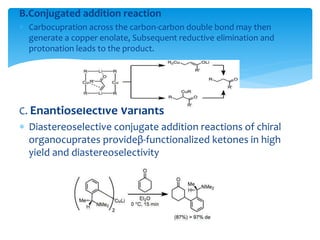
B.Conjugated addition reaction
 Carbocupration across the carbon-carbon double bond may then
generate a copper enolate, Subsequent reductive elimination and
protonation leads to the product.
C. Enantioselective Variants
 Diastereoselective conjugate addition reactions of chiral
organocuprates provideβ-functionalized ketones in high
yield and diastereoselectivity
 It is the chemical reaction of an alkyl halide with
an alkene in the presence of a base and a
palladium catalyst (or palladium nanomaterial-
based catalyst) to form a substituted alkene .
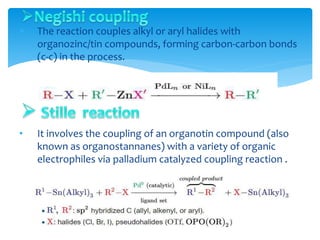
 The reaction couples alkyl or aryl halides with
organozinc/tin compounds, forming carbon-carbon bonds
(c-c) in the process.
• It involves the coupling of an organotin compound (also
known as organostannanes) with a variety of organic
electrophiles via palladium catalyzed coupling reaction .
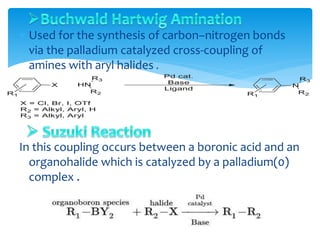
 Used for the synthesis of carbon–nitrogen bonds
via the palladium catalyzed cross-coupling of
amines with aryl halides .
In this coupling occurs between a boronic acid and an
organohalide which is catalyzed by a palladium(0)
complex .
The Sonogashira reaction is a cross-coupling reaction used in
organic synthesis to form carbon–carbon bonds. It employs
a palladium catalyst to form a carbon–carbon bond between
a terminal alkyne and an aryl or vinyl halide .
The Hiyama coupling is a palladium-catalyzed cross-coupling
reaction of organosilanes with organic halides used in organic
chemistry to form carbon–carbon bonds (C-C bonds) .
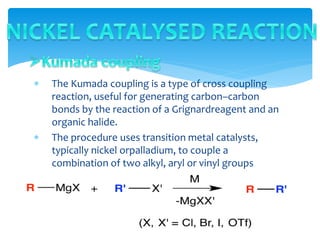
 The Kumada coupling is a type of cross coupling
reaction, useful for generating carbon–carbon
bonds by the reaction of a Grignardreagent and an
organic halide.
 The procedure uses transition metal catalysts,
typically nickel orpalladium, to couple a
combination of two alkyl, aryl or vinyl groups
 www.wikipeadia.com
 Textbook of organic chemistry by morrisons and boyd
seventh edition pg no 350
 Textbook of Organic chemistry by Arun bahl and B.S.
bahl Pg no 356

TRANSITION METAL CATALYSIS

  • 2.
     A transitionmetal as an element whose atom has a partially filled d subshell, or which can give rise to cations with an incomplete d sub-shell .  The transition metal ions the outermost d orbitals are incompletely filled with electrons so they can easily give and take electrons. This makes transition metals prime candidates for catalysis.  Here transition metals are used as catalysts .
  • 3.
    Zinc, cadmium, andmercury are generally excluded from the transition metals as they have the electronic configuration [ ]d 10s 2 , with no incomplete d shell.
  • 4.
     The formationof compounds in many oxidation states, due to the relatively low energy gap between different possible oxidation states eg, Fe(II), Fe(III) or switch oxidizing state .  Form complexes with reagents by adsorption at active site .  Colour in transition-series metal compounds is generally due to electronic transitions of two principal types.  Charge transfer transitions  d-d transitions
  • 5.
    •Charge transfer transitions: Anelectron may jump from a predominantly ligand orbital to a predominantly metal orbital, giving rise to a ligand-to-metal charge-transfer (LMCT) transition. These can most easily occur when the metal is in a high oxidation state. For example, The colour of chromate, dichromate and permanganate ions is due to LMCT transitions. Another example is that mercuric iodide, HgI2, is red because of a LMCT transition . •d-d transitions: An electron jumps from one d-orbital to another d-orbital and leads to d-d transitions .
  • 6.
    The principal reasonswhy transition metals contribute the essential ingredient in catalyst systems can be summarized as the following headings: (a) Bonding ability (b) Catholic choice of ligands (c) Ligand effects (d) Variability of oxidation state (e) Variablility of co-ordination number
  • 7.
    Sr.no Transition metalType of reaction 1 Rhodiam Wilkinson’s reaction 2 Copper 1. Gilman reaction 2. Ullman Coupling Reaction 3. Reactions of organo copper reagent 3 Palladium 1. Heck Reaction 2. Negishi Reaction 3. Stille Reaction 4. Buchwalt-Hartwig amination 5. Suzuki Reaction 6. Sonogashira reaction 7. Hiyama coupling Reaction 4 Nickel Kumada coupling Reaction
  • 8.
    It is usedin the selective hydrogenation of alkenes and alkynes without affecting the functional groups like: C=O, CN, NO2, Aryl, CO2R etc.
  • 9.
     A Gilmanreagent is a lithium and copper (diorganocopper) reagent compound, R2CuLi (Lithium dimethylcuprate), where R is an alkyl or aryl.  They react with organic halides to replace the halide group with an R group . Such displacement reactions allow for the synthesis of complex products from simple building blocks
  • 10.
     Generalized chemicalreaction showing Gilman reagent reacting with organic halide to form products and showing Cu(III) reaction intermediate  In the reaction, the Gilman reagent is a methylating reagent reacting with an alkyne in a conjugate addition forming a cyclic enone
  • 11.
     Ullmann couplingis a coupling reaction between aryl halides in the presence of copper as a transition metal catalyst to produce Diaryl compounds .  A typical example is the coupling of 2 ortho- chloronitrobenzene reactants to form 2,2'- dinitrobiphenyl with a copper - bronze alloy .
  • 12.
     Carbocupration isa nucleophilic addition of organocopper reagents (R-Cu) to acetylene or terminal alkynes resulting in an alkenylcopper compound (RC=C-Cu).It is a special case of carbometalation and also called the Normant reaction. A. Substitution Reactions  oxidative addition of copper(I) into the carbon-leaving group bond takes place, generating a copper(III) intermediate which then undergoes reductive elimination to generate the coupled product .
  • 13.
    B.Conjugated addition reaction Carbocupration across the carbon-carbon double bond may then generate a copper enolate, Subsequent reductive elimination and protonation leads to the product. C. Enantioselective Variants  Diastereoselective conjugate addition reactions of chiral organocuprates provideβ-functionalized ketones in high yield and diastereoselectivity
  • 14.
     It isthe chemical reaction of an alkyl halide with an alkene in the presence of a base and a palladium catalyst (or palladium nanomaterial- based catalyst) to form a substituted alkene .
  • 15.
     The reactioncouples alkyl or aryl halides with organozinc/tin compounds, forming carbon-carbon bonds (c-c) in the process. • It involves the coupling of an organotin compound (also known as organostannanes) with a variety of organic electrophiles via palladium catalyzed coupling reaction .
  • 16.
     Used forthe synthesis of carbon–nitrogen bonds via the palladium catalyzed cross-coupling of amines with aryl halides . In this coupling occurs between a boronic acid and an organohalide which is catalyzed by a palladium(0) complex .
  • 17.
    The Sonogashira reactionis a cross-coupling reaction used in organic synthesis to form carbon–carbon bonds. It employs a palladium catalyst to form a carbon–carbon bond between a terminal alkyne and an aryl or vinyl halide . The Hiyama coupling is a palladium-catalyzed cross-coupling reaction of organosilanes with organic halides used in organic chemistry to form carbon–carbon bonds (C-C bonds) .
  • 18.
     The Kumadacoupling is a type of cross coupling reaction, useful for generating carbon–carbon bonds by the reaction of a Grignardreagent and an organic halide.  The procedure uses transition metal catalysts, typically nickel orpalladium, to couple a combination of two alkyl, aryl or vinyl groups
  • 19.
     www.wikipeadia.com  Textbookof organic chemistry by morrisons and boyd seventh edition pg no 350  Textbook of Organic chemistry by Arun bahl and B.S. bahl Pg no 356