Efficient Synthesis of
3-Aminocyclobut-2-en-1-ones:
Squaramide Surrogates as Potent VLA-4
Antagonists
Stephen Brand,* Benjamin C. de Candole, and Julien A. Brown
Medicinal Chemistry, Celltech Group plc, 216 Bath Road, Slough SL1 4EN, UK
sbrand@celltech.co.uk
Received April 28, 2003
ABSTRACT
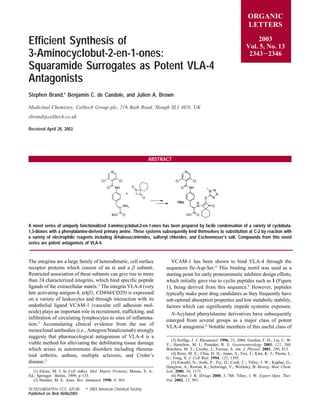
A novel series of uniquely functionalized 3-aminocyclobut-2-en-1-ones has been prepared by facile condensation of a variety of cyclobuta-
1,3-diones with a phenylalanine-derived primary amine. These systems subsequently lend themselves to substitution at C-2 by reaction with
a variety of electrophilic reagents including N-halosuccinimides, sulfenyl chlorides, and Eschenmoser’s salt. Compounds from this novel
series are potent antagonists of VLA-4.
The integrins are a large family of heterodimeric, cell surface
receptor proteins which consist of an R and a β subunit.
Restricted association of these subunits can give rise to more
than 24 characterized integrins, which bind specific peptide
ligands of the extracellular matrix.1 The integrin VLA-4 (very
late activating antigen-4, R4β1, CD49d/CD29) is expressed
on a variety of leukocytes and through interaction with its
endothelial ligand VCAM-1 (vascular cell adhesion mol-
ecule) plays an important role in recruitment, trafficking, and
infiltration of circulating lymphocytes to sites of inflamma-
tion.2
Accumulating clinical evidence from the use of
monoclonal antibodies (i.e., Antegren/Natalizumab) strongly
suggests that pharmacological antagonism of VLA-4 is a
viable method for alleviating the debilitating tissue damage
which arises in autoimmune disorders including rheuma-
toid arthritis, asthma, multiple sclerosis, and Crohn’s
disease.3
VCAM-1 has been shown to bind VLA-4 through the
sequences Ile-Asp-Ser.4
This binding motif was used as a
starting point for early proteomimetic inhibitor design efforts,
which initially gave rise to cyclic peptides such as 1 (Figure
1), being derived from this sequence.5
However, peptides
typically make poor drug candidates as they frequently have
sub-optimal absorption properties and low metabolic stability,
factors which can significantly impede systemic exposure.
N-Acylated phenylalanine derivatives have subsequently
emerged from several groups as a major class of potent
VLA-4 antagonist.6
Notable members of this useful class of
(1) Elices, M. J. In Cell Adhes. Mol. Matrix Proteins; Mouse, S. A.,
Ed.; Springer: Berlin, 1999; p 133.
(2) Hemler, M. E. Annu. ReV. Immunol. 1990, 8, 365.
(3) Seiffge, J. J. Rheumatol. 1996, 23, 2086. Gordon, F. H.; Lai, C. W.
Y.; Hamilton, M. I.; Pounder, R. E. Gastroenterology 2001, 121, 268.
Borchers, M. T.; Crosby, J.; Farmer, S. Am. J. Physiol. 2001, 280, 813.
(4) Renz, M. E.; Chiu, H. H.; Jones, S.; Fox, J.; Kim, K. J.; Presta, L.
G.; Fong, S. J. Cell Biol. 1994, 125, 1395.
(5) Fotouhi, N.; Joshi, P.; Fry, D.; Cook, C.; Tilley, J. W.; Kaplan, G.;
Hanglow, A.; Rowan, K.; Schwinge, V.; Wolitsky, B. Bioorg. Med. Chem.
Lett. 2000, 10, 1171.
(6) Porter, J. R. IDrugs 2000, 3, 788. Tilley, J. W. Expert Opin. Ther.
Pat. 2002, 12, 991.
ORGANIC
LETTERS
2003
Vol. 5, No. 13
2343-2346
10.1021/ol034701n CCC: $25.00 © 2003 American Chemical Society
Published on Web 06/06/2003
small molecule are 27 and 3,8 which are reportedly under-
going clinical evaluation for the treatment of asthma and are
currently in phase 1 and phase 2, respectively.
Of the numerous inhibitors reported in this class, it is clear
that a high degree of diversity in the N-acyl substituent is
tolerated, although these are generally hydrophobic, and that
the amino acid R-NH is important for activity. We have
recently described the discovery of squaric acid derivatives
including CT7015 (4) as VLA-4 antagonists9 that illustrate
these observations.
As part of a search for a unique class of VLA-4 antagonists
distinct from 4, we hypothesized that the combination of a
hydrophobic spirocyclic substituent, such as that in 1, in the
context of a rigid planar scaffold such as that provided by
the 3,4-diamino-3-cyclobuten-1,2-dione (squaramide) group
of 4, would provide potent compounds with an advantageous
pharmacokinetic profile. We believed that the 3-amino-2-
cyclobuten-1-one analogues typified by 5 would be the most
appropriate compounds to test this “hybridization” hypothesis
(Figure 2) and investigated the synthesis of these by
condensation of an R-amino ester with a cyclobuta-1,3-dione
or its enol ether.10
We felt that this intriguing structural element, thus far
unutilized in the pharmaceutical arena, warranted further
investigation and embarked upon development of a robust
method which would grant access to 5 and its analogues.
Accordingly, gem-disubstituted 3-ethoxy-2-cyclobutene-
1-ones were readily accessed by the cycloaddition of a
disubstituted ketene, generated in situ by dehydrohalogena-
tion of the corresponding acid chloride, and ethoxyacetylene,
according to a previously recognized phenomenon11 (Scheme
1). For example, the reaction of cyclohexanecarbonyl
chloride and NEt3 (1.5 equiv) in the presence of ethoxy-
acetylene12 (2.0 equiv) in Et2O afforded 3-ethoxyspiro[3.5]-
non-2-en-1-one (7e) in 81% yield.
The reaction time can be reduced from a reported 21 days
at 5 °C10a to less than 48 h by heating the reaction to reflux
temperature. Although feasible, no apparent dimerization of
the intermediate ketenes was observed at this elevated
temperature. The novel spirocyclic examples 7g-l were
prepared using an analogous transformation with comparable
yields being obtained. In all cases examined, the cycloadducts
were found to be stable and were conveniently purified by
column chromatography on silica gel.
Various attempts to convert enolether 7e directly to the
desired 3-amino derivative (i.e., 5) by substitution with
L-phenylalanine ethyl ester as a test substrate were frustrat-
(7) Sircar, I.; Gudmundsson, K. S.; Martin, R.; Liang, J.; Nomura, S.;
Jayakumar, H.; Teegarden, B. R.; Nowlin, D. M.; Cardarelli, P. M.; Mah,
J. R.; Connell, S.; Griffith, R. C.; Lazarides, E. Bioorg. Med. Chem. 2002,
10, 2051.
(8) Chen, L.; Tilley, J.; Trilles, R. V.; Yun, Weiya, Y.; Fry, D.; Cook,
C.; Rowan, K.; Schwinge, V.; Campbell, R. Bioorg. Med. Chem. Lett. 2002,
12, 137.
(9) Porter, J. R.; Archibald, S. C.; Childs, K.; Critchley, D.; Head, J. C.;
Linsley, J. M.; Parton, T. A. H.; Robinson, M. K.; Shock, A.; Taylor, R. J.;
Warrellow, G. J.; Alexander, R. P.; Langham, B. Bioorg. Med. Chem. Lett.
2002, 12, 1051.
(10) Wasserman, Martin, and Moore have each reported the synthesis
of a single example of the title compound using this approach, the latter
within the context of the preparation of an amino-substituted naphthol,
see: (a) Wasserman, H. H.; Piper, J. U.; Dehmlow, E. V. J. Org. Chem.
1973, 38, 1451. (b) Hasek, R. H.; Gott, P. G.; Martin, J. C. J. Org. Chem.
1964, 29, 2510. (c) Turnbull, P.; Moore, H. W. J. Org. Chem. 1995, 60,
644.
(11) Arens, J. F. AdVances in Organic Chemistry Methods and Results;
Raphael, R. A., Taylor, E. C., Ed.; Interscience Publishers: New York,
1960; Vol. 2, pp 117-212. Martin, J. C. U.S. Patent 3 288 854, 1966.
(12) Ethoxyacetylene was purchased from Lancaster Chemical Co. as
an approximately 50%w/w solution in hexanes. Yields 7a-l were calculated
based upon the amount of acid chloride used.
Figure 1. Potent small molecule VLA-4 antagonists.
Figure 2. Proposed route to 3-aminocyclobut-2-en-1-ones.
Scheme 1. Synthesis of Cyclobuta-1,3-diones
2344 Org. Lett., Vol. 5, No. 13, 2003
ingly unproductive. We were consequently forced to examine
formation of the desired vinylogous amides by combination
of an amine with a cyclobuta-1,3-dione. To this end,
cyclobutenones 7a-l could be hydrolyzed to cyclobutadiones
8a-l in good yield by treatment with 2 M HCl at 20 °C for
24 h. A notable aspect of these conversions is that hydrolysis
proceeds without detriment to the four-membered carbocycle,
in contrast to analogues lacking geminal substitution at C4
which undergo a facile ring-opening under these conditions
to give β-ethoxycrotonic acids.10a
In an effort to expand the scope of the ring-forming
process, we attempted substitution at the 2-position of the
cyclobutenone by employing a variety of substituted alkoxy-
acetylenes. Consequently, cycloaddition precursors 9a,b were
prepared directly by alkylation of the acetylide anion of
ethoxyacetylene (1.1 equiv of n
Buli, 2.2 equiv of HMPA)
with benzyl bromide and n-hexyl iodide, respectively,
according to literature procedure.13
Alkynes 9c-e were
prepared by reaction of chloroacetaldehyde dibutylacetal with
2.2 equiv LDA/HMPA followed by alkylation with the
appropriate alkyl bromide, RBr.14 Alkynes 9a-e were also
found to undergo cycloaddition with dimethylketene to give
enol ethers 10a-e (Scheme 2), and these were hydrolyzed
without incident under similar conditions to give diones
11a-e.
In all cases described, the expected regiochemistry of the
cycloaddition was complete and no regioisomeric material
was detected.
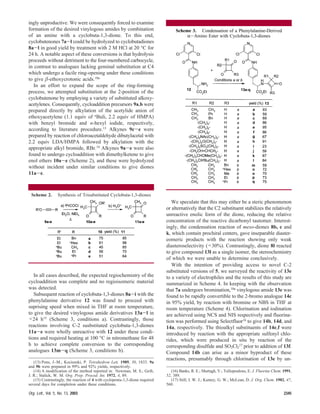
Subsequent reaction of cyclobuta-1,3-diones 8a-i with the
phenylalanine derivative 12 was found to proceed with
suprising speed when mixed in THF at room temperature,
to give the desired vinylogous amide derivatives 13a-l in
<24 h15 (Scheme 3, conditions a). Contrastingly, those
reactions involving C-2 susbstituted cyclobuta-1,3-diones
11a-e were wholly unreactive with 12 under these condi-
tions and required heating at 100 °C in nitromethane for 48
h to achieve complete conversion to the corresponding
analogues 13m-q (Scheme 3, conditions b).
We speculate that this may either be a steric phenomenon
or alternatively that the C2 substituent stabilizes the relatively
unreactive enolic form of the dione, reducing the relative
concentration of the reactive dicarbonyl tautomer. Interest-
ingly, the condensation reaction of meso-diones 8b, c and
k, which contain prochiral centers, gave inseparable diaster-
eomeric products with the reaction showing only weak
diasteroselectivity (<30%). Contrastingly, dione 8l reacted
to give compound 13l as a single isomer, the stereochemistry
of which we were unable to determine conclusively.
With the intention of providing access to novel C-2
substituted versions of 5, we surveyed the reactivity of 13e
to a variety of electrophiles and the results of this study are
summarized in Scheme 4. In keeping with the observation
that 7a undergoes bromination,10a vinylogous amide 13e was
found to be rapidly convertible to the 2-bromo analogue 14c
in 95% yield, by reaction with bromine or NBS in THF at
room temperature (Scheme 4). Chlorination and iodination
are achieved using NCS and NIS respectively and fluorina-
tion was performed using Selectfluor16 to give 14b, 14d, and
14a, respectively. The thioalkyl substituents of 14e,f were
introduced by reaction with the appropriate sulfenyl chlo-
rides, which were produced in situ by reaction of the
corresponding disulfide and SO2Cl2
17
prior to addition of 13f.
Compound 14b can arise as a minor byproduct of these
reactions, presumably through chlorination of 13e by un-
(13) Pons, J.-M.; Kocienski, P. Tetrahedron Lett. 1989, 30, 1833. 9a
and 9b were prepared in 99% and 92% yields, respectively.
(14) A modification of the method reported in: Newman, M. S.; Geib,
J. R.; Stalick, W. M. Org. Prep. Proced. Int. 1972, 4, 89.
(15) Contrastingly, the reaction of 4 with cyclopenta-1,3-dione required
several days for completion under these conditions.
(16) Banks, R. E.; Murtagh, V.; Tsiliopoulous, E. J. Fluorine Chem. 1991,
52, 389.
(17) Still, I. W. J.; Kutney, G. W.; McLean, D. J. Org. Chem. 1982, 47,
560.
Scheme 2. Synthesis of Trisubstituted Cyclobuta-1,3-diones
Scheme 3. Condensation of a Phenylalanine-Derived
R-Amino Ester with Cyclobuta-1,3-diones
Org. Lett., Vol. 5, No. 13, 2003 2345
reacted SO2Cl2, although this side-reaction could be avoided
by using an excess of disulfide during the sulfenyl chloride
preparation step.
Compounds 14g,h were prepared in an analogous fashion
by reaction with commercially available phenylsulfenyl and
-selenenyl chloride. A dimethylaminomethyl group can be
introduced onto 13e by reaction with Eschenmoser’s salt
[H2CdN(Me)2
+ I-]. Hydroxylation of the unsubstituted
vinylic carbon was achieved by oxidation with Pb(OAc)4 to
give compound 14j. π-Electrophiles are also found to react
with the nucleophilic amino-cyclobutenone system as evi-
denced by reaction of 13e with 1,3-dithienium tetrafluoro-
borate to give 14k. The heterocyclic sulfenyl chlorides used
in reactions l and m were prepared in-situ directly from the
corresponding heterocyclic mercaptans by reaction with NCS
in THF18
and these were found to react predictably with 13e
to give 14l,m.
The ability of vinyl iodide 14d to act as a participant in a
Stille-type reaction would allow more convenient parallel
synthesis of C2-substituted compounds, thereby circumvent-
ing the need to synthesize individual acetylenes. To this end,
14d undergoes a Pd(PPh3)4-catalyzed Stille coupling with
3-tributylstannylpyridine and tributylstannyl-1,4-pyridazine
in 41% and 53% yield, respectively, as representative
examples of this strategy.
As a prelude to biological testing, ethyl esters 14a-m were
required to be converted to their corresponding acids 15a-
m, and this could be achieved by reaction with 1M LiOH in
THF, in high yield (>85%). It is noteworthy that the
aminocyclobutenone core of all compounds were found to
be stable under these basic conditions (with the exception
of 14j), an indication of the “amidic” stabilization of the
enaminone moiety. The ability of carboxylic acids 15a-m
to disrupt binding of VLA4 to VCAM was evaluated in a
cell based assay using E6.1 Jurkat cells (human T-cell line)
and immobilized VCAM-1 in the presence of 1%BSA
(bovine serum albumin), and all demonstrated an IC50 < 1
µM. Notably compound 14m has an IC50 of 3 nM in this
assay. A fuller analysis of the biological properties of
compounds 15a-m and their congeners shall be reported in
due course.
In summary, we have developed the synthesis of a variety
of highly functionalized 3-amino-2-cyclobutenones by con-
densation of an amine with a cyclobuta-1,3-dione as the key
step. These uncommon functional groups have subsequently
shown potential application as squaramide isosteres in a
biological context.
Acknowledgment. We thank Dr. Richard Taylor and
Barbara Mason for providing spectral and analytical data and
Dr. Tony Shock and Paul Hale for cell assay data.
Supporting Information Available: Preparative methods
and spectral and analytical data for compounds 7e-l, 13a-
q, and 14a-m. This material is available free of charge via
the Internet at http://pubs.acs.org.
OL034701N
(18) 1-Methyltetrazole-5-sulfenyl chloride has been previously prepared
by chlorination of the mercaptan with chlorine. See: Postle, S. R. U.S.
Patent 4 387 158, 1983.
Scheme 4. Reaction of 13e with Electrophiles
2346 Org. Lett., Vol. 5, No. 13, 2003

SBrand_VLA4

  • 1.
    Efficient Synthesis of 3-Aminocyclobut-2-en-1-ones: SquaramideSurrogates as Potent VLA-4 Antagonists Stephen Brand,* Benjamin C. de Candole, and Julien A. Brown Medicinal Chemistry, Celltech Group plc, 216 Bath Road, Slough SL1 4EN, UK sbrand@celltech.co.uk Received April 28, 2003 ABSTRACT A novel series of uniquely functionalized 3-aminocyclobut-2-en-1-ones has been prepared by facile condensation of a variety of cyclobuta- 1,3-diones with a phenylalanine-derived primary amine. These systems subsequently lend themselves to substitution at C-2 by reaction with a variety of electrophilic reagents including N-halosuccinimides, sulfenyl chlorides, and Eschenmoser’s salt. Compounds from this novel series are potent antagonists of VLA-4. The integrins are a large family of heterodimeric, cell surface receptor proteins which consist of an R and a β subunit. Restricted association of these subunits can give rise to more than 24 characterized integrins, which bind specific peptide ligands of the extracellular matrix.1 The integrin VLA-4 (very late activating antigen-4, R4β1, CD49d/CD29) is expressed on a variety of leukocytes and through interaction with its endothelial ligand VCAM-1 (vascular cell adhesion mol- ecule) plays an important role in recruitment, trafficking, and infiltration of circulating lymphocytes to sites of inflamma- tion.2 Accumulating clinical evidence from the use of monoclonal antibodies (i.e., Antegren/Natalizumab) strongly suggests that pharmacological antagonism of VLA-4 is a viable method for alleviating the debilitating tissue damage which arises in autoimmune disorders including rheuma- toid arthritis, asthma, multiple sclerosis, and Crohn’s disease.3 VCAM-1 has been shown to bind VLA-4 through the sequences Ile-Asp-Ser.4 This binding motif was used as a starting point for early proteomimetic inhibitor design efforts, which initially gave rise to cyclic peptides such as 1 (Figure 1), being derived from this sequence.5 However, peptides typically make poor drug candidates as they frequently have sub-optimal absorption properties and low metabolic stability, factors which can significantly impede systemic exposure. N-Acylated phenylalanine derivatives have subsequently emerged from several groups as a major class of potent VLA-4 antagonist.6 Notable members of this useful class of (1) Elices, M. J. In Cell Adhes. Mol. Matrix Proteins; Mouse, S. A., Ed.; Springer: Berlin, 1999; p 133. (2) Hemler, M. E. Annu. ReV. Immunol. 1990, 8, 365. (3) Seiffge, J. J. Rheumatol. 1996, 23, 2086. Gordon, F. H.; Lai, C. W. Y.; Hamilton, M. I.; Pounder, R. E. Gastroenterology 2001, 121, 268. Borchers, M. T.; Crosby, J.; Farmer, S. Am. J. Physiol. 2001, 280, 813. (4) Renz, M. E.; Chiu, H. H.; Jones, S.; Fox, J.; Kim, K. J.; Presta, L. G.; Fong, S. J. Cell Biol. 1994, 125, 1395. (5) Fotouhi, N.; Joshi, P.; Fry, D.; Cook, C.; Tilley, J. W.; Kaplan, G.; Hanglow, A.; Rowan, K.; Schwinge, V.; Wolitsky, B. Bioorg. Med. Chem. Lett. 2000, 10, 1171. (6) Porter, J. R. IDrugs 2000, 3, 788. Tilley, J. W. Expert Opin. Ther. Pat. 2002, 12, 991. ORGANIC LETTERS 2003 Vol. 5, No. 13 2343-2346 10.1021/ol034701n CCC: $25.00 © 2003 American Chemical Society Published on Web 06/06/2003
  • 2.
    small molecule are27 and 3,8 which are reportedly under- going clinical evaluation for the treatment of asthma and are currently in phase 1 and phase 2, respectively. Of the numerous inhibitors reported in this class, it is clear that a high degree of diversity in the N-acyl substituent is tolerated, although these are generally hydrophobic, and that the amino acid R-NH is important for activity. We have recently described the discovery of squaric acid derivatives including CT7015 (4) as VLA-4 antagonists9 that illustrate these observations. As part of a search for a unique class of VLA-4 antagonists distinct from 4, we hypothesized that the combination of a hydrophobic spirocyclic substituent, such as that in 1, in the context of a rigid planar scaffold such as that provided by the 3,4-diamino-3-cyclobuten-1,2-dione (squaramide) group of 4, would provide potent compounds with an advantageous pharmacokinetic profile. We believed that the 3-amino-2- cyclobuten-1-one analogues typified by 5 would be the most appropriate compounds to test this “hybridization” hypothesis (Figure 2) and investigated the synthesis of these by condensation of an R-amino ester with a cyclobuta-1,3-dione or its enol ether.10 We felt that this intriguing structural element, thus far unutilized in the pharmaceutical arena, warranted further investigation and embarked upon development of a robust method which would grant access to 5 and its analogues. Accordingly, gem-disubstituted 3-ethoxy-2-cyclobutene- 1-ones were readily accessed by the cycloaddition of a disubstituted ketene, generated in situ by dehydrohalogena- tion of the corresponding acid chloride, and ethoxyacetylene, according to a previously recognized phenomenon11 (Scheme 1). For example, the reaction of cyclohexanecarbonyl chloride and NEt3 (1.5 equiv) in the presence of ethoxy- acetylene12 (2.0 equiv) in Et2O afforded 3-ethoxyspiro[3.5]- non-2-en-1-one (7e) in 81% yield. The reaction time can be reduced from a reported 21 days at 5 °C10a to less than 48 h by heating the reaction to reflux temperature. Although feasible, no apparent dimerization of the intermediate ketenes was observed at this elevated temperature. The novel spirocyclic examples 7g-l were prepared using an analogous transformation with comparable yields being obtained. In all cases examined, the cycloadducts were found to be stable and were conveniently purified by column chromatography on silica gel. Various attempts to convert enolether 7e directly to the desired 3-amino derivative (i.e., 5) by substitution with L-phenylalanine ethyl ester as a test substrate were frustrat- (7) Sircar, I.; Gudmundsson, K. S.; Martin, R.; Liang, J.; Nomura, S.; Jayakumar, H.; Teegarden, B. R.; Nowlin, D. M.; Cardarelli, P. M.; Mah, J. R.; Connell, S.; Griffith, R. C.; Lazarides, E. Bioorg. Med. Chem. 2002, 10, 2051. (8) Chen, L.; Tilley, J.; Trilles, R. V.; Yun, Weiya, Y.; Fry, D.; Cook, C.; Rowan, K.; Schwinge, V.; Campbell, R. Bioorg. Med. Chem. Lett. 2002, 12, 137. (9) Porter, J. R.; Archibald, S. C.; Childs, K.; Critchley, D.; Head, J. C.; Linsley, J. M.; Parton, T. A. H.; Robinson, M. K.; Shock, A.; Taylor, R. J.; Warrellow, G. J.; Alexander, R. P.; Langham, B. Bioorg. Med. Chem. Lett. 2002, 12, 1051. (10) Wasserman, Martin, and Moore have each reported the synthesis of a single example of the title compound using this approach, the latter within the context of the preparation of an amino-substituted naphthol, see: (a) Wasserman, H. H.; Piper, J. U.; Dehmlow, E. V. J. Org. Chem. 1973, 38, 1451. (b) Hasek, R. H.; Gott, P. G.; Martin, J. C. J. Org. Chem. 1964, 29, 2510. (c) Turnbull, P.; Moore, H. W. J. Org. Chem. 1995, 60, 644. (11) Arens, J. F. AdVances in Organic Chemistry Methods and Results; Raphael, R. A., Taylor, E. C., Ed.; Interscience Publishers: New York, 1960; Vol. 2, pp 117-212. Martin, J. C. U.S. Patent 3 288 854, 1966. (12) Ethoxyacetylene was purchased from Lancaster Chemical Co. as an approximately 50%w/w solution in hexanes. Yields 7a-l were calculated based upon the amount of acid chloride used. Figure 1. Potent small molecule VLA-4 antagonists. Figure 2. Proposed route to 3-aminocyclobut-2-en-1-ones. Scheme 1. Synthesis of Cyclobuta-1,3-diones 2344 Org. Lett., Vol. 5, No. 13, 2003
  • 3.
    ingly unproductive. Wewere consequently forced to examine formation of the desired vinylogous amides by combination of an amine with a cyclobuta-1,3-dione. To this end, cyclobutenones 7a-l could be hydrolyzed to cyclobutadiones 8a-l in good yield by treatment with 2 M HCl at 20 °C for 24 h. A notable aspect of these conversions is that hydrolysis proceeds without detriment to the four-membered carbocycle, in contrast to analogues lacking geminal substitution at C4 which undergo a facile ring-opening under these conditions to give β-ethoxycrotonic acids.10a In an effort to expand the scope of the ring-forming process, we attempted substitution at the 2-position of the cyclobutenone by employing a variety of substituted alkoxy- acetylenes. Consequently, cycloaddition precursors 9a,b were prepared directly by alkylation of the acetylide anion of ethoxyacetylene (1.1 equiv of n Buli, 2.2 equiv of HMPA) with benzyl bromide and n-hexyl iodide, respectively, according to literature procedure.13 Alkynes 9c-e were prepared by reaction of chloroacetaldehyde dibutylacetal with 2.2 equiv LDA/HMPA followed by alkylation with the appropriate alkyl bromide, RBr.14 Alkynes 9a-e were also found to undergo cycloaddition with dimethylketene to give enol ethers 10a-e (Scheme 2), and these were hydrolyzed without incident under similar conditions to give diones 11a-e. In all cases described, the expected regiochemistry of the cycloaddition was complete and no regioisomeric material was detected. Subsequent reaction of cyclobuta-1,3-diones 8a-i with the phenylalanine derivative 12 was found to proceed with suprising speed when mixed in THF at room temperature, to give the desired vinylogous amide derivatives 13a-l in <24 h15 (Scheme 3, conditions a). Contrastingly, those reactions involving C-2 susbstituted cyclobuta-1,3-diones 11a-e were wholly unreactive with 12 under these condi- tions and required heating at 100 °C in nitromethane for 48 h to achieve complete conversion to the corresponding analogues 13m-q (Scheme 3, conditions b). We speculate that this may either be a steric phenomenon or alternatively that the C2 substituent stabilizes the relatively unreactive enolic form of the dione, reducing the relative concentration of the reactive dicarbonyl tautomer. Interest- ingly, the condensation reaction of meso-diones 8b, c and k, which contain prochiral centers, gave inseparable diaster- eomeric products with the reaction showing only weak diasteroselectivity (<30%). Contrastingly, dione 8l reacted to give compound 13l as a single isomer, the stereochemistry of which we were unable to determine conclusively. With the intention of providing access to novel C-2 substituted versions of 5, we surveyed the reactivity of 13e to a variety of electrophiles and the results of this study are summarized in Scheme 4. In keeping with the observation that 7a undergoes bromination,10a vinylogous amide 13e was found to be rapidly convertible to the 2-bromo analogue 14c in 95% yield, by reaction with bromine or NBS in THF at room temperature (Scheme 4). Chlorination and iodination are achieved using NCS and NIS respectively and fluorina- tion was performed using Selectfluor16 to give 14b, 14d, and 14a, respectively. The thioalkyl substituents of 14e,f were introduced by reaction with the appropriate sulfenyl chlo- rides, which were produced in situ by reaction of the corresponding disulfide and SO2Cl2 17 prior to addition of 13f. Compound 14b can arise as a minor byproduct of these reactions, presumably through chlorination of 13e by un- (13) Pons, J.-M.; Kocienski, P. Tetrahedron Lett. 1989, 30, 1833. 9a and 9b were prepared in 99% and 92% yields, respectively. (14) A modification of the method reported in: Newman, M. S.; Geib, J. R.; Stalick, W. M. Org. Prep. Proced. Int. 1972, 4, 89. (15) Contrastingly, the reaction of 4 with cyclopenta-1,3-dione required several days for completion under these conditions. (16) Banks, R. E.; Murtagh, V.; Tsiliopoulous, E. J. Fluorine Chem. 1991, 52, 389. (17) Still, I. W. J.; Kutney, G. W.; McLean, D. J. Org. Chem. 1982, 47, 560. Scheme 2. Synthesis of Trisubstituted Cyclobuta-1,3-diones Scheme 3. Condensation of a Phenylalanine-Derived R-Amino Ester with Cyclobuta-1,3-diones Org. Lett., Vol. 5, No. 13, 2003 2345
  • 4.
    reacted SO2Cl2, althoughthis side-reaction could be avoided by using an excess of disulfide during the sulfenyl chloride preparation step. Compounds 14g,h were prepared in an analogous fashion by reaction with commercially available phenylsulfenyl and -selenenyl chloride. A dimethylaminomethyl group can be introduced onto 13e by reaction with Eschenmoser’s salt [H2CdN(Me)2 + I-]. Hydroxylation of the unsubstituted vinylic carbon was achieved by oxidation with Pb(OAc)4 to give compound 14j. π-Electrophiles are also found to react with the nucleophilic amino-cyclobutenone system as evi- denced by reaction of 13e with 1,3-dithienium tetrafluoro- borate to give 14k. The heterocyclic sulfenyl chlorides used in reactions l and m were prepared in-situ directly from the corresponding heterocyclic mercaptans by reaction with NCS in THF18 and these were found to react predictably with 13e to give 14l,m. The ability of vinyl iodide 14d to act as a participant in a Stille-type reaction would allow more convenient parallel synthesis of C2-substituted compounds, thereby circumvent- ing the need to synthesize individual acetylenes. To this end, 14d undergoes a Pd(PPh3)4-catalyzed Stille coupling with 3-tributylstannylpyridine and tributylstannyl-1,4-pyridazine in 41% and 53% yield, respectively, as representative examples of this strategy. As a prelude to biological testing, ethyl esters 14a-m were required to be converted to their corresponding acids 15a- m, and this could be achieved by reaction with 1M LiOH in THF, in high yield (>85%). It is noteworthy that the aminocyclobutenone core of all compounds were found to be stable under these basic conditions (with the exception of 14j), an indication of the “amidic” stabilization of the enaminone moiety. The ability of carboxylic acids 15a-m to disrupt binding of VLA4 to VCAM was evaluated in a cell based assay using E6.1 Jurkat cells (human T-cell line) and immobilized VCAM-1 in the presence of 1%BSA (bovine serum albumin), and all demonstrated an IC50 < 1 µM. Notably compound 14m has an IC50 of 3 nM in this assay. A fuller analysis of the biological properties of compounds 15a-m and their congeners shall be reported in due course. In summary, we have developed the synthesis of a variety of highly functionalized 3-amino-2-cyclobutenones by con- densation of an amine with a cyclobuta-1,3-dione as the key step. These uncommon functional groups have subsequently shown potential application as squaramide isosteres in a biological context. Acknowledgment. We thank Dr. Richard Taylor and Barbara Mason for providing spectral and analytical data and Dr. Tony Shock and Paul Hale for cell assay data. Supporting Information Available: Preparative methods and spectral and analytical data for compounds 7e-l, 13a- q, and 14a-m. This material is available free of charge via the Internet at http://pubs.acs.org. OL034701N (18) 1-Methyltetrazole-5-sulfenyl chloride has been previously prepared by chlorination of the mercaptan with chlorine. See: Postle, S. R. U.S. Patent 4 387 158, 1983. Scheme 4. Reaction of 13e with Electrophiles 2346 Org. Lett., Vol. 5, No. 13, 2003