Decision Making
Process
Prepared by:
Prince Cielo
What is Decision Making
Process?
I. Introduction
Decision Making Process
• According to Baker..
“efficient decision-making involves a series of steps
that require the input of information at different
stages of the process, as well as a process for
feedback”.
• In Psychology..
decision-making is regarded as the cognitive process
resulting in the selection of a belief or a course of
action among several alternative possibilities.
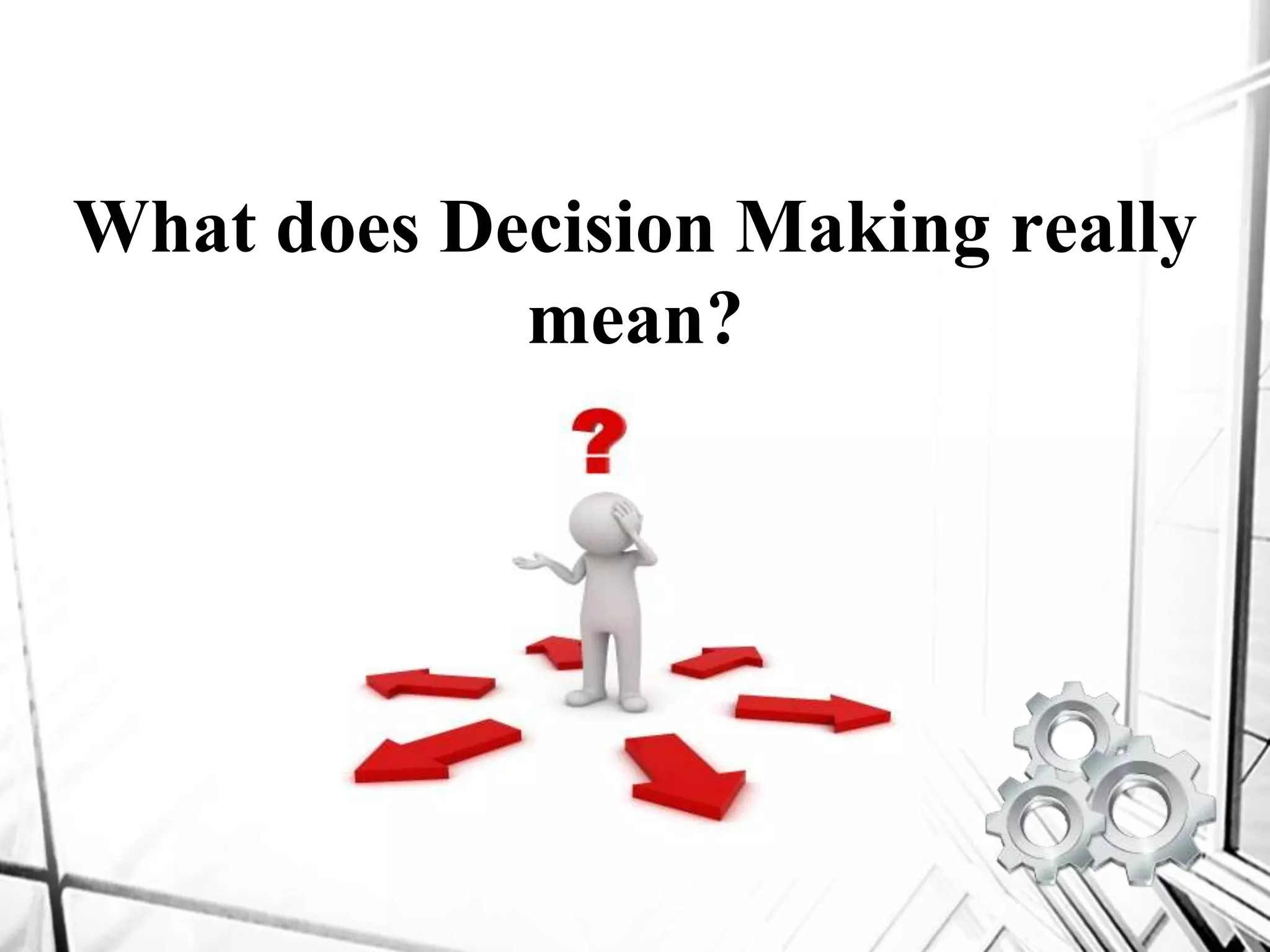
What does Decision Making really
mean?
Decision Making Process
• Defined simply as:
“ A process of making a
choice between a numbers
of options and committing
to a future course of
actions”.
Process
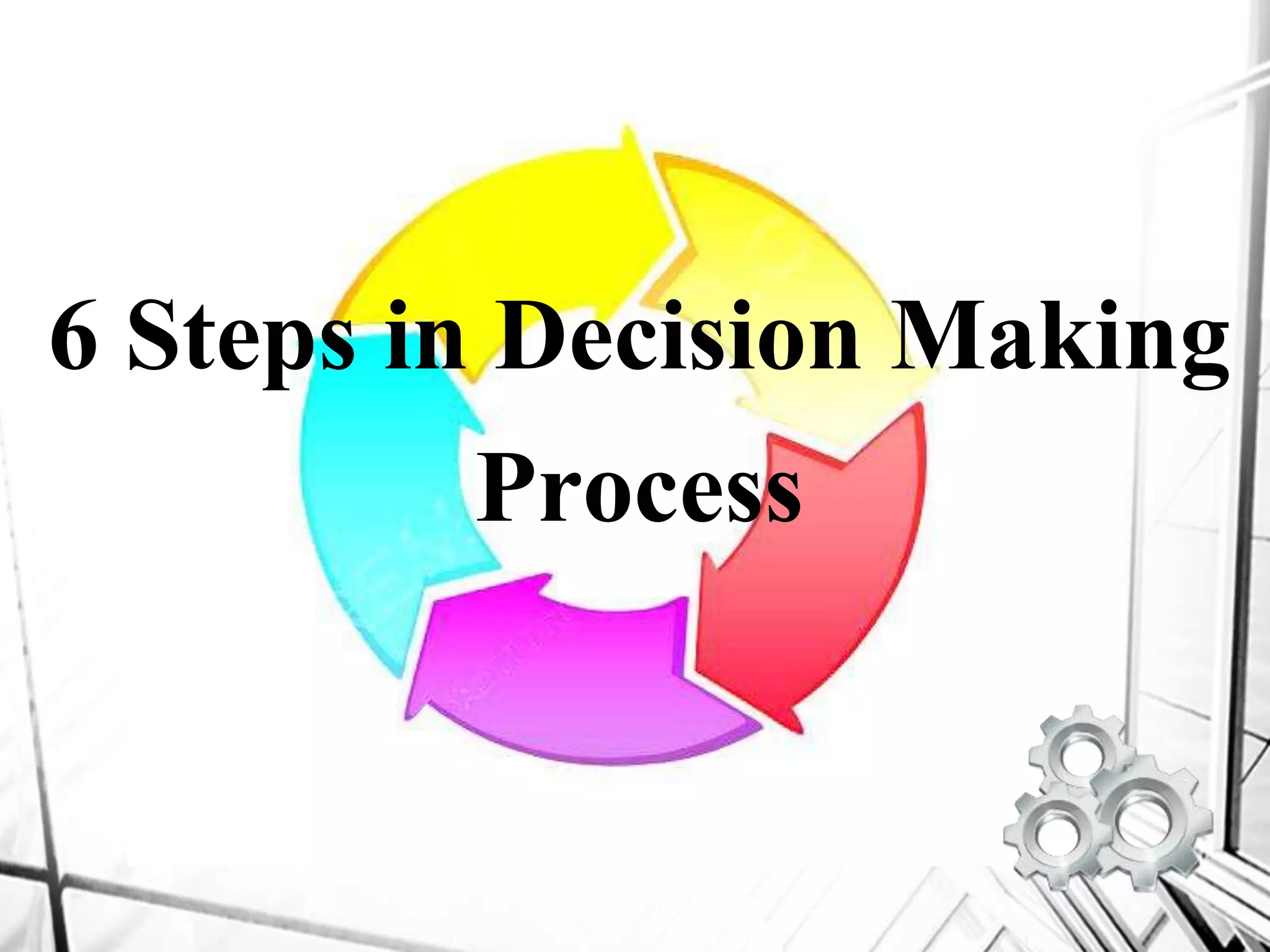
6 Steps in Decision Making
Process
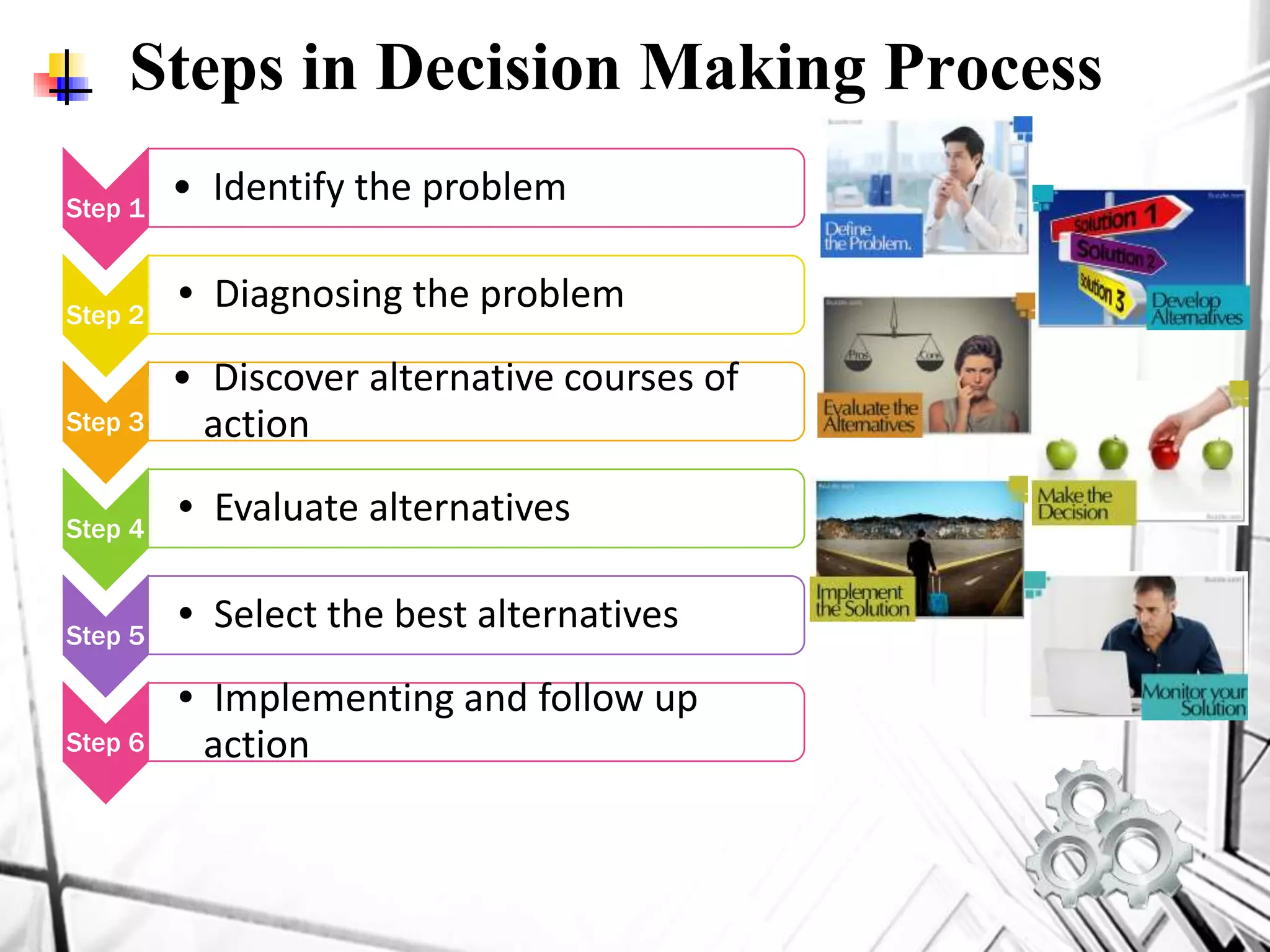
Steps in Decision Making Process
Step 1
• Identify the problem
Step 2
• Diagnosing the problem
Step 3
• Discover alternative courses of
action
Step 4
• Evaluate alternatives
Step 5
• Select the best alternatives
Step 6
• Implementing and follow up
action
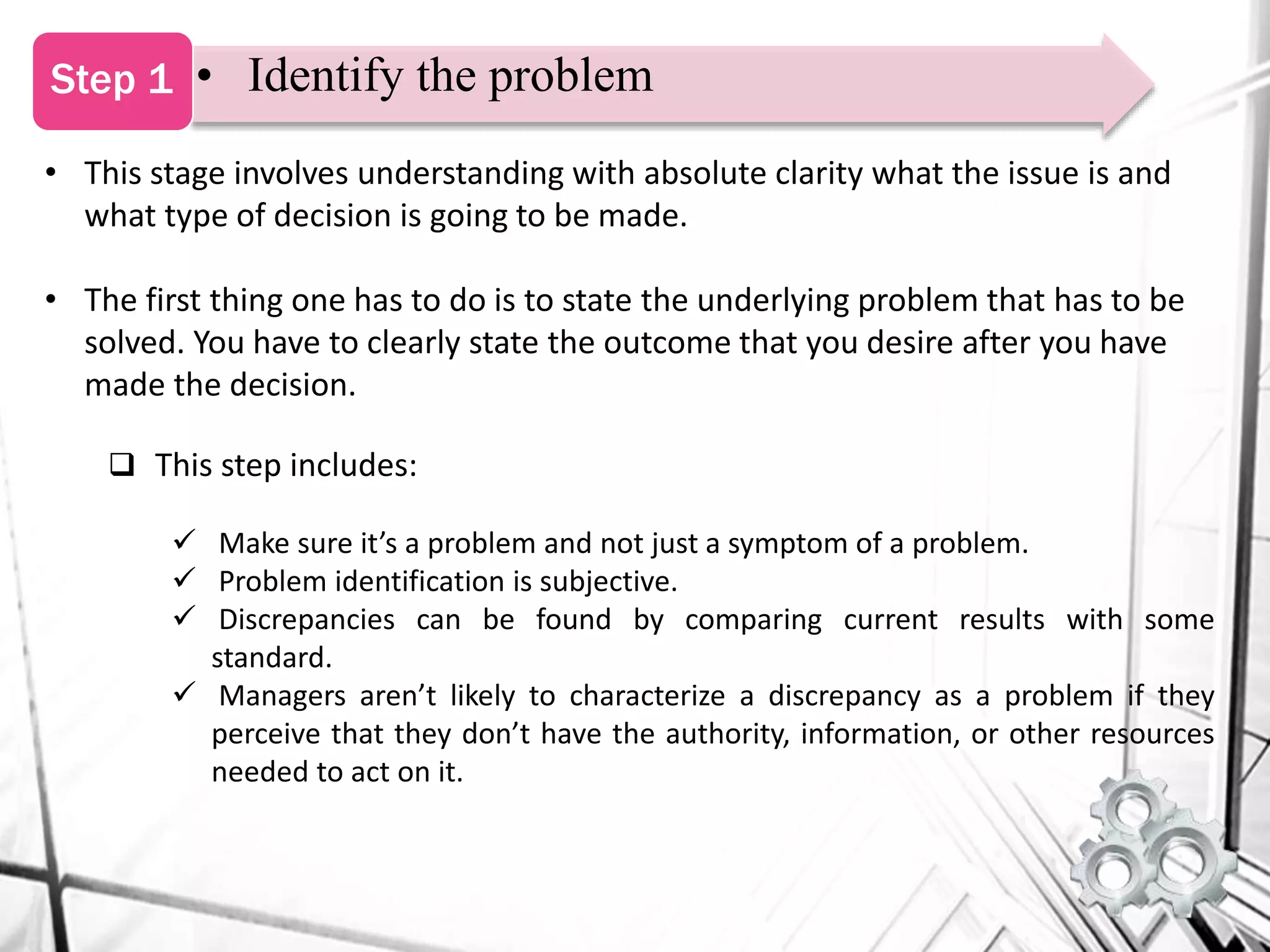
• This stage involves understanding with absolute clarity what the issue is and
what type of decision is going to be made.
• The first thing one has to do is to state the underlying problem that has to be
solved. You have to clearly state the outcome that you desire after you have
made the decision.
 This step includes:
 Make sure it’s a problem and not just a symptom of a problem.
 Problem identification is subjective.
 Discrepancies can be found by comparing current results with some
standard.
 Managers aren’t likely to characterize a discrepancy as a problem if they
perceive that they don’t have the authority, information, or other resources
needed to act on it.
• Identify the problemStep 1
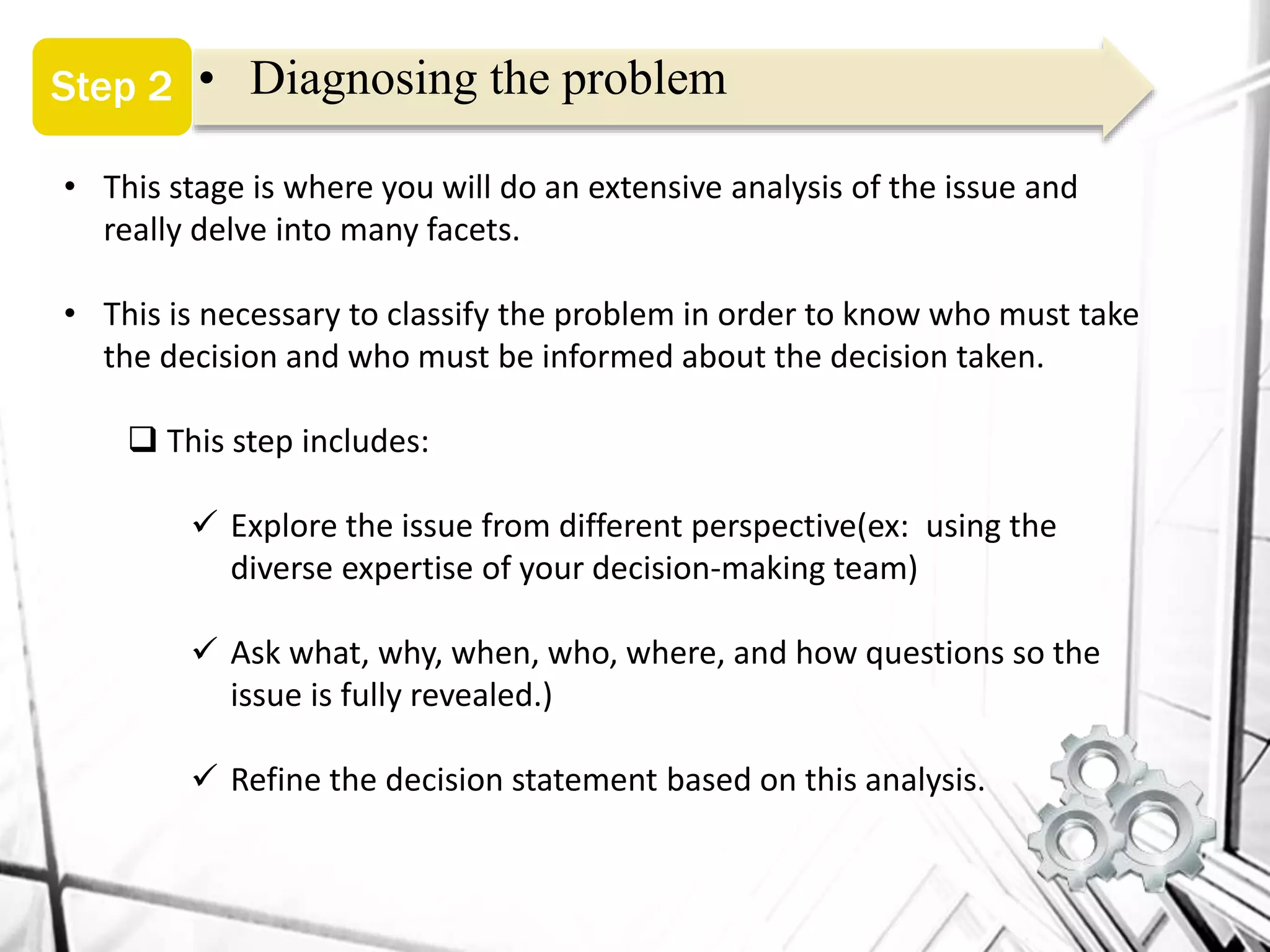
• Diagnosing the problemStep 2
• This stage is where you will do an extensive analysis of the issue and
really delve into many facets.
• This is necessary to classify the problem in order to know who must take
the decision and who must be informed about the decision taken.
 This step includes:
 Explore the issue from different perspective(ex: using the
diverse expertise of your decision-making team)
 Ask what, why, when, who, where, and how questions so the
issue is fully revealed.)
 Refine the decision statement based on this analysis.
• Discover alternative courses of actionStep 3
• In this step of the decision-making process, you will list all
possible and desirable alternatives.
• Here, you do not have to restrict yourself to think about the
very obvious options, rather you can use your creative skills
and come out with alternatives that may look a little
irrelevant.
• You would also have to do adequate research to come up
with the necessary facts that would aid in solving the
problem.
• Evaluate alternativesStep 4
• One of the most important stages of the decision-making procedure where
you have to analyze each alternative you have come up with.
 This step includes:
 Finding out the advantages and disadvantages of each option.
 Filter out the options that you think are impossible or do not serve
your purpose.
 Rating each option with a numerical digit would also help in the
filtration process.
• Select the best alternativesStep 5
• In this step is where the hard work you have put in
analyzing would lead to a proper decision.
• This includes selecting the alternative which seems
to be best suited to you.
• Choice of the best alternative is the most critical
point in decision making.
• Implementing and follow up actionStep 6
• In this step you experience the results of your decision and
evaluate whether or not it has “solved” the need you identified
in Step 1. If it has, you may stay with this decision for some
period of time.
• If the decision has not resolved the identified need, you may
repeat certain steps of the process in order to make a new
decision.
• Ex: example, gather more detailed or somewhat different
information or discover additional alternatives on which to
base your decision.
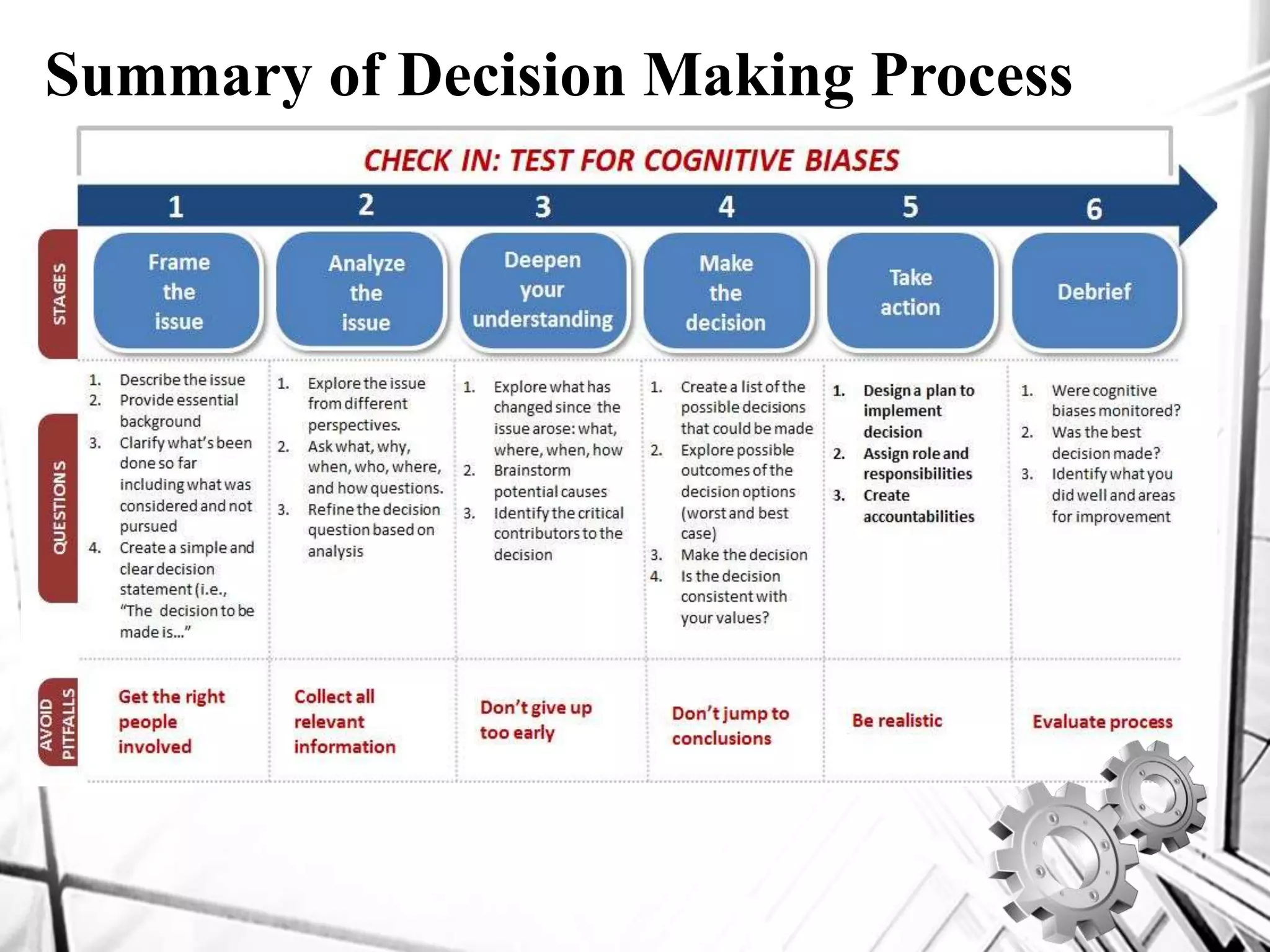
Summary of Decision Making Process
End of Slide

Decision Making Process

  • 1.
  • 2.
    What is DecisionMaking Process? I. Introduction
  • 3.
    Decision Making Process •According to Baker.. “efficient decision-making involves a series of steps that require the input of information at different stages of the process, as well as a process for feedback”. • In Psychology.. decision-making is regarded as the cognitive process resulting in the selection of a belief or a course of action among several alternative possibilities.
  • 4.
    What does DecisionMaking really mean?
  • 5.
    Decision Making Process •Defined simply as: “ A process of making a choice between a numbers of options and committing to a future course of actions”.
  • 6.
    Process 6 Steps inDecision Making Process
  • 7.
    Steps in DecisionMaking Process Step 1 • Identify the problem Step 2 • Diagnosing the problem Step 3 • Discover alternative courses of action Step 4 • Evaluate alternatives Step 5 • Select the best alternatives Step 6 • Implementing and follow up action
  • 8.
    • This stageinvolves understanding with absolute clarity what the issue is and what type of decision is going to be made. • The first thing one has to do is to state the underlying problem that has to be solved. You have to clearly state the outcome that you desire after you have made the decision.  This step includes:  Make sure it’s a problem and not just a symptom of a problem.  Problem identification is subjective.  Discrepancies can be found by comparing current results with some standard.  Managers aren’t likely to characterize a discrepancy as a problem if they perceive that they don’t have the authority, information, or other resources needed to act on it. • Identify the problemStep 1
  • 9.
    • Diagnosing theproblemStep 2 • This stage is where you will do an extensive analysis of the issue and really delve into many facets. • This is necessary to classify the problem in order to know who must take the decision and who must be informed about the decision taken.  This step includes:  Explore the issue from different perspective(ex: using the diverse expertise of your decision-making team)  Ask what, why, when, who, where, and how questions so the issue is fully revealed.)  Refine the decision statement based on this analysis.
  • 10.
    • Discover alternativecourses of actionStep 3 • In this step of the decision-making process, you will list all possible and desirable alternatives. • Here, you do not have to restrict yourself to think about the very obvious options, rather you can use your creative skills and come out with alternatives that may look a little irrelevant. • You would also have to do adequate research to come up with the necessary facts that would aid in solving the problem.
  • 11.
    • Evaluate alternativesStep4 • One of the most important stages of the decision-making procedure where you have to analyze each alternative you have come up with.  This step includes:  Finding out the advantages and disadvantages of each option.  Filter out the options that you think are impossible or do not serve your purpose.  Rating each option with a numerical digit would also help in the filtration process.
  • 12.
    • Select thebest alternativesStep 5 • In this step is where the hard work you have put in analyzing would lead to a proper decision. • This includes selecting the alternative which seems to be best suited to you. • Choice of the best alternative is the most critical point in decision making.
  • 13.
    • Implementing andfollow up actionStep 6 • In this step you experience the results of your decision and evaluate whether or not it has “solved” the need you identified in Step 1. If it has, you may stay with this decision for some period of time. • If the decision has not resolved the identified need, you may repeat certain steps of the process in order to make a new decision. • Ex: example, gather more detailed or somewhat different information or discover additional alternatives on which to base your decision.
  • 14.
    Summary of DecisionMaking Process
  • 15.