Management                                                                tenth edition


Stephen P. Robbins                                                       Mary Coulter


                Chapter                   Organizational
                    9                     Structure and
                                          Design
  Copyright © 2010 Pearson Education, Inc. Publishing as Prentice Hall
                                                                                          9–1
Designing Organizational Structure
• Organizational Design
   A process involving decisions about six key elements:
        Work specialization
        Departmentalization
        Chain of command
        Span of control
        Centralization and decentralization
        Formalization


    Copyright © 2010 Pearson Education, Inc. Publishing as Prentice Hall
                                                                           9–2
Exhibit 9–1 Purposes of Organizing

• Divides work to be done into specific jobs and
  departments.
• Assigns tasks and responsibilities associated with
  individual jobs.
• Coordinates diverse organizational tasks.
• Clusters jobs into units.
• Establishes relationships among individuals,
  groups, and departments.
• Establishes formal lines of authority.
• Allocates and deploys organizational resources.

   Copyright © 2010 Pearson Education, Inc. Publishing as Prentice Hall
                                                                          9–3
Organizational Structure
• Work Specialization
   The degree to which tasks in the organization are
    divided into separate jobs with each step completed
    by a different person.
   Overspecialization can result in human diseconomies
    from boredom, fatigue, stress, poor quality, increased
    absenteeism, and higher turnover.


   Copyright © 2010 Pearson Education, Inc. Publishing as Prentice Hall
                                                                          9–4
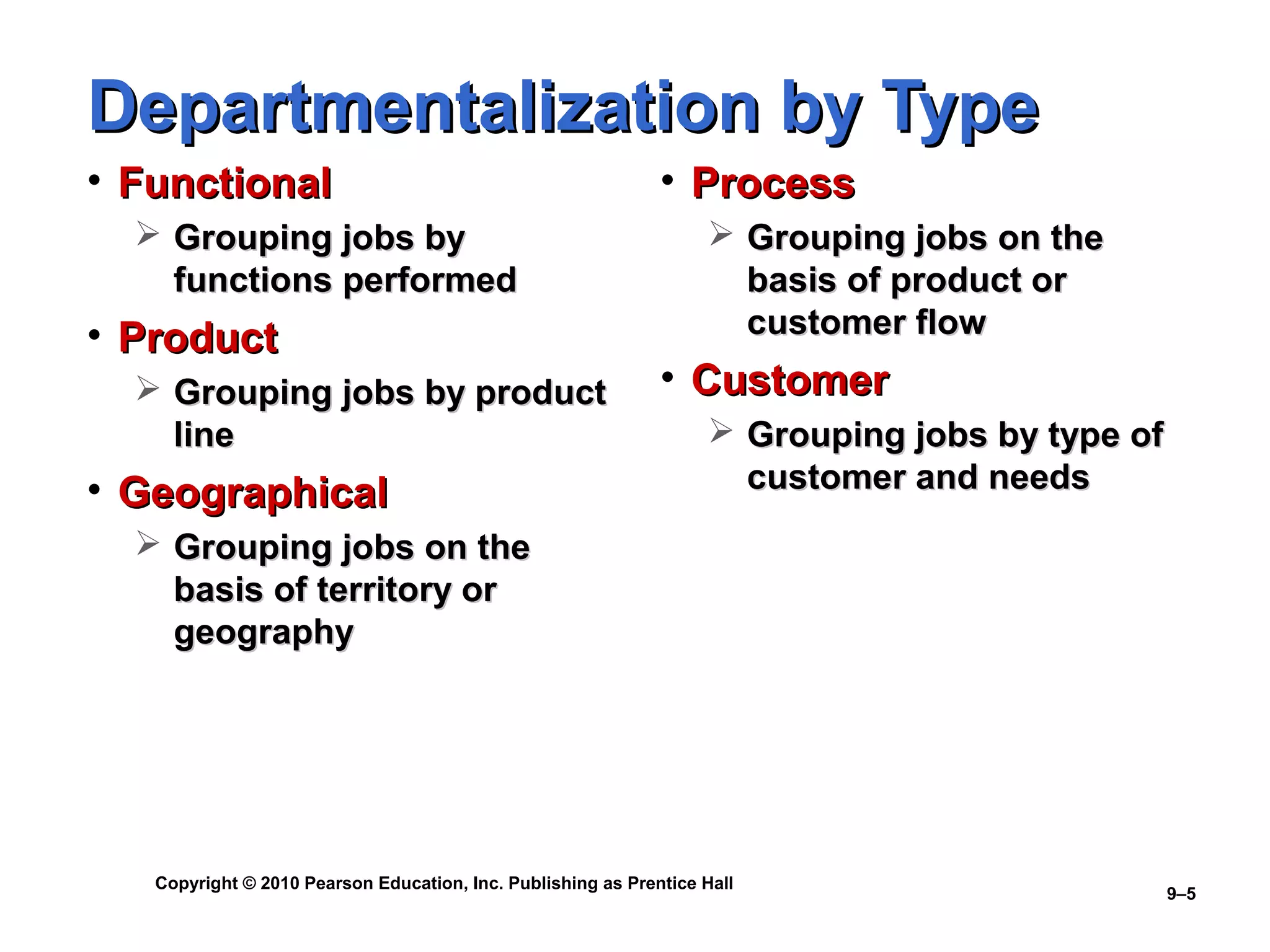
Departmentalization by Type
• Functional                                                  • Process
   Grouping jobs by                                                Grouping jobs on the
    functions performed                                              basis of product or
• Product                                                            customer flow
   Grouping jobs by product                                  • Customer
    line                                                            Grouping jobs by type of
• Geographical                                                       customer and needs
   Grouping jobs on the
    basis of territory or
    geography


   Copyright © 2010 Pearson Education, Inc. Publishing as Prentice Hall
                                                                                                9–5
Organizational Structure (cont’d)
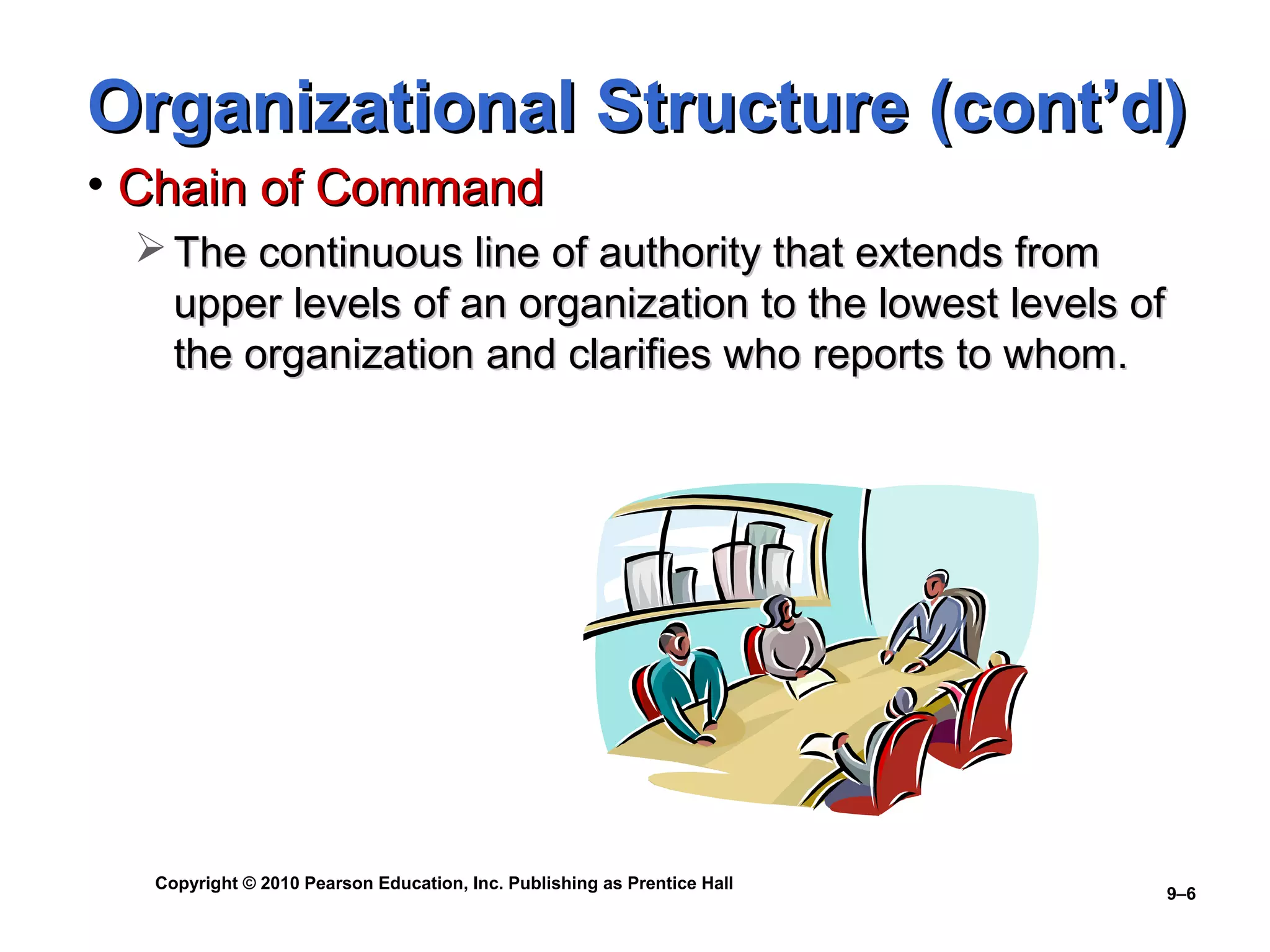
• Chain of Command
  The continuous line of authority that extends from
   upper levels of an organization to the lowest levels of
   the organization and clarifies who reports to whom.


  Copyright © 2010 Pearson Education, Inc. Publishing as Prentice Hall
                                                                         9–6
Organizational Structure (cont’d)
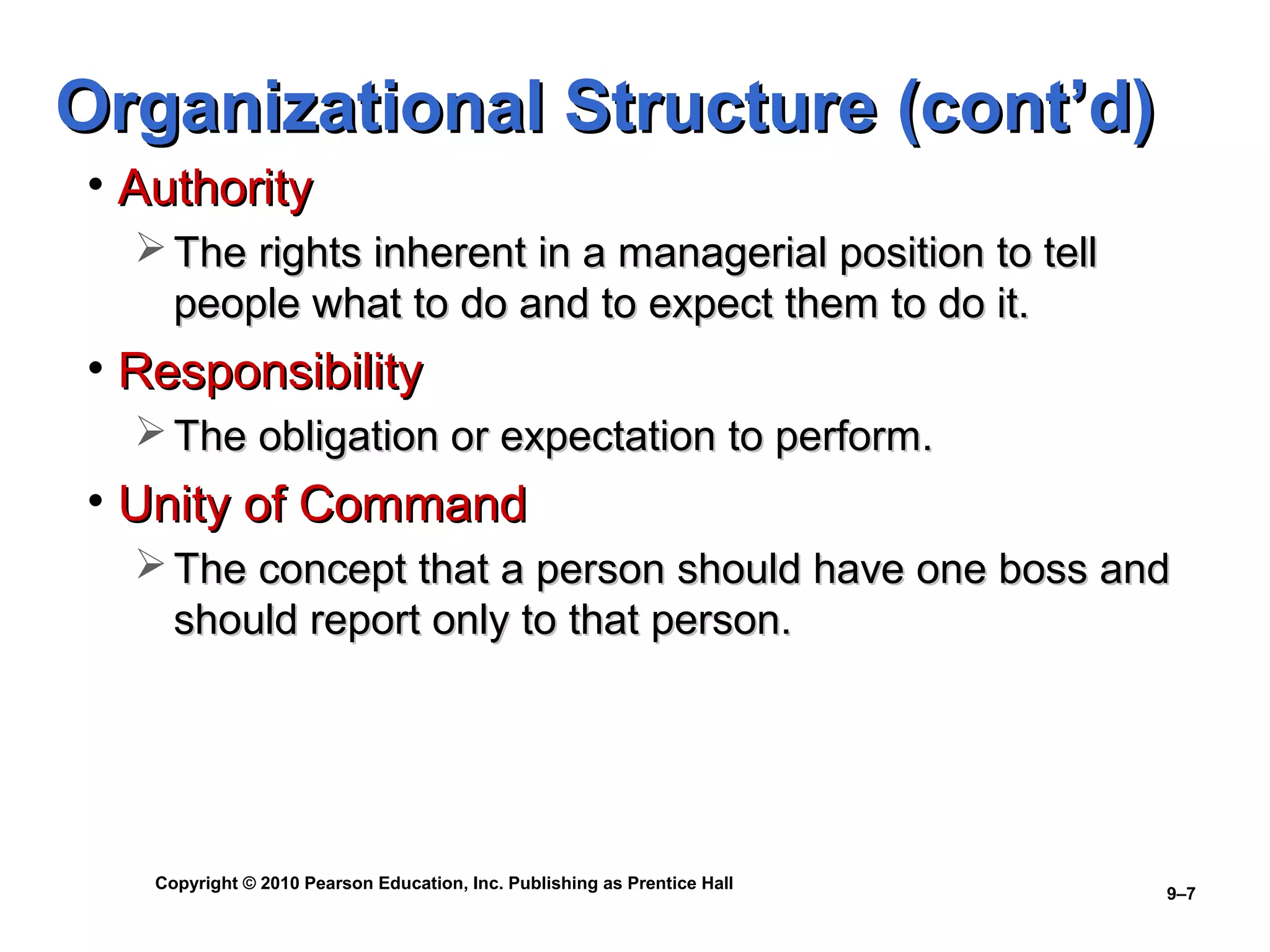
• Authority
   The rights inherent in a managerial position to tell
    people what to do and to expect them to do it.
• Responsibility
   The obligation or expectation to perform.
• Unity of Command
   The concept that a person should have one boss and
    should report only to that person.


   Copyright © 2010 Pearson Education, Inc. Publishing as Prentice Hall
                                                                          9–7
Organizational Structure (cont’d)
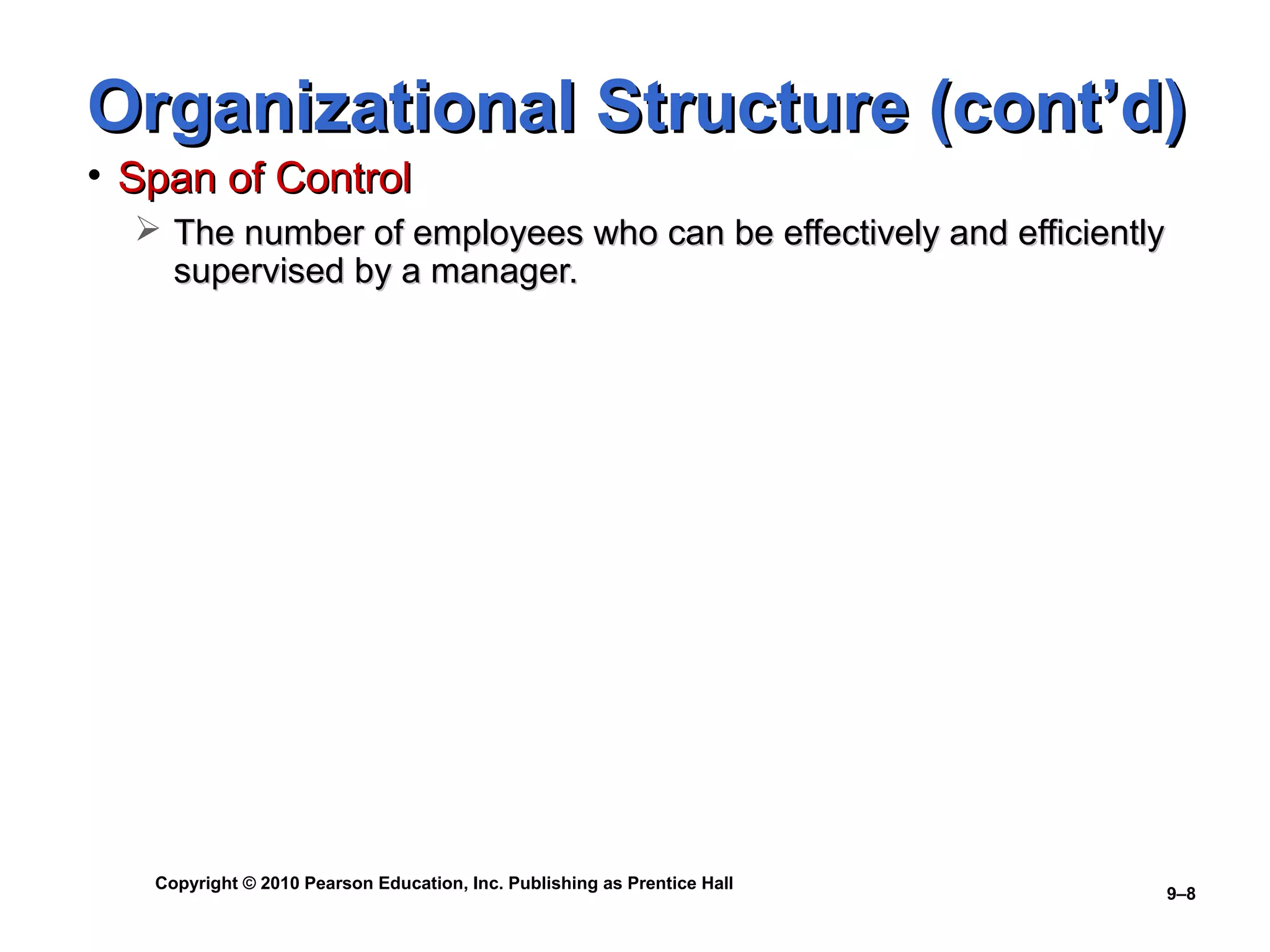
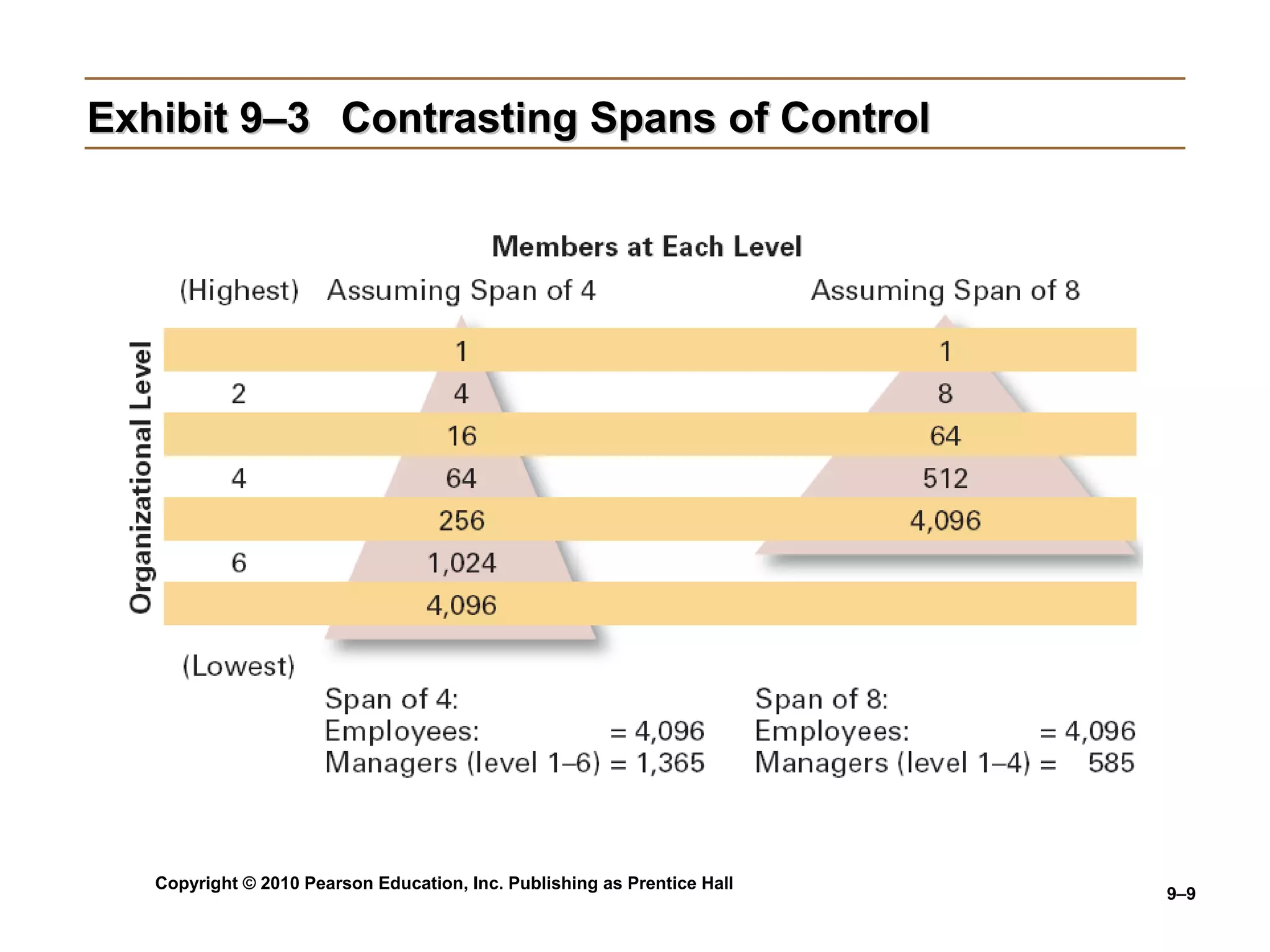
• Span of Control
   The number of employees who can be effectively and efficiently
    supervised by a manager.


   Copyright © 2010 Pearson Education, Inc. Publishing as Prentice Hall
                                                                          9–8
Exhibit 9–3 Contrasting Spans of Control


   Copyright © 2010 Pearson Education, Inc. Publishing as Prentice Hall
                                                                          9–9
Organizational Structure (cont’d)
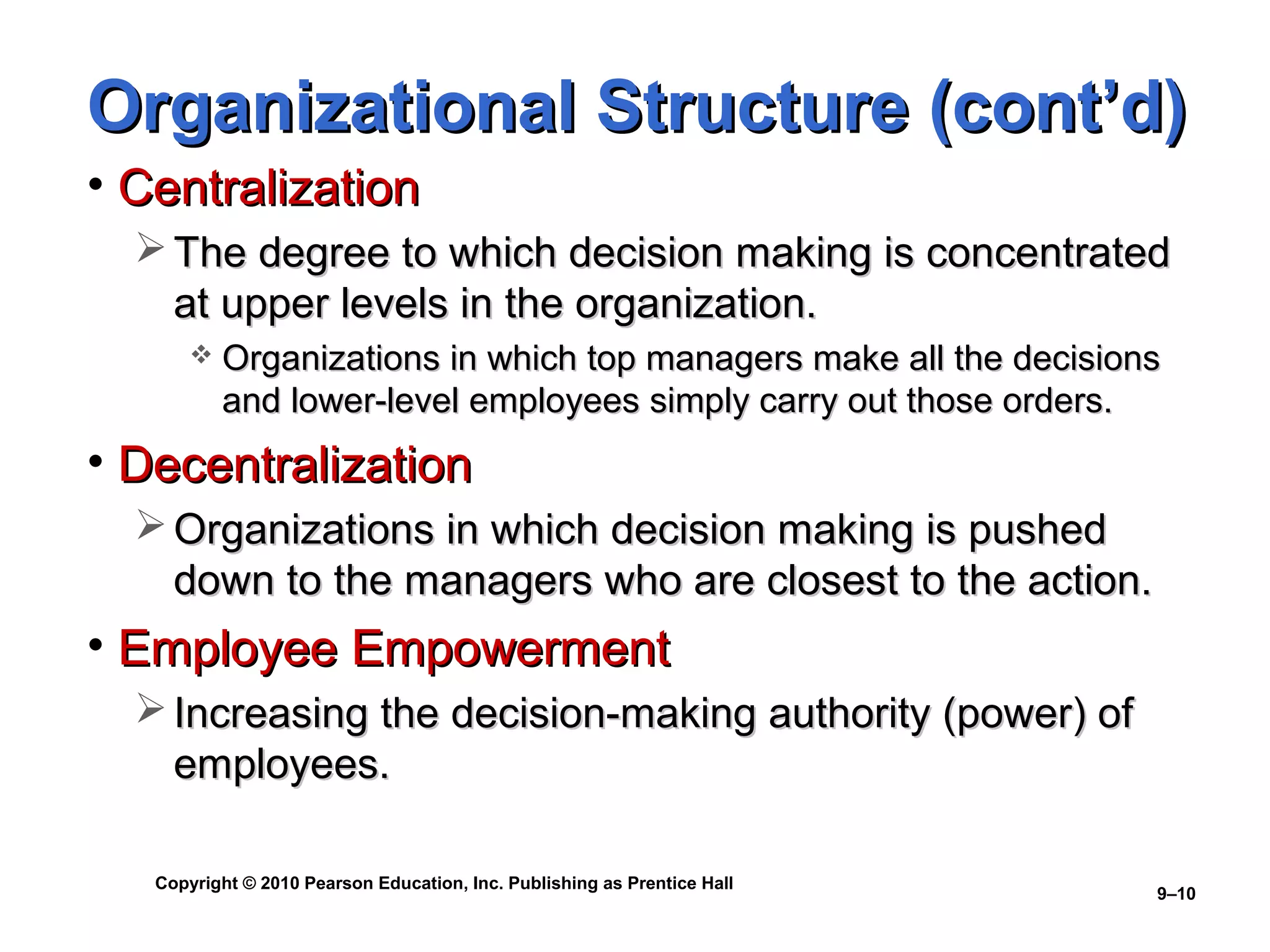
• Centralization
   The degree to which decision making is concentrated
    at upper levels in the organization.
          Organizations in which top managers make all the decisions
           and lower-level employees simply carry out those orders.
• Decentralization
   Organizations in which decision making is pushed
    down to the managers who are closest to the action.
• Employee Empowerment
   Increasing the decision-making authority (power) of
    employees.

   Copyright © 2010 Pearson Education, Inc. Publishing as Prentice Hall
                                                                          9–10
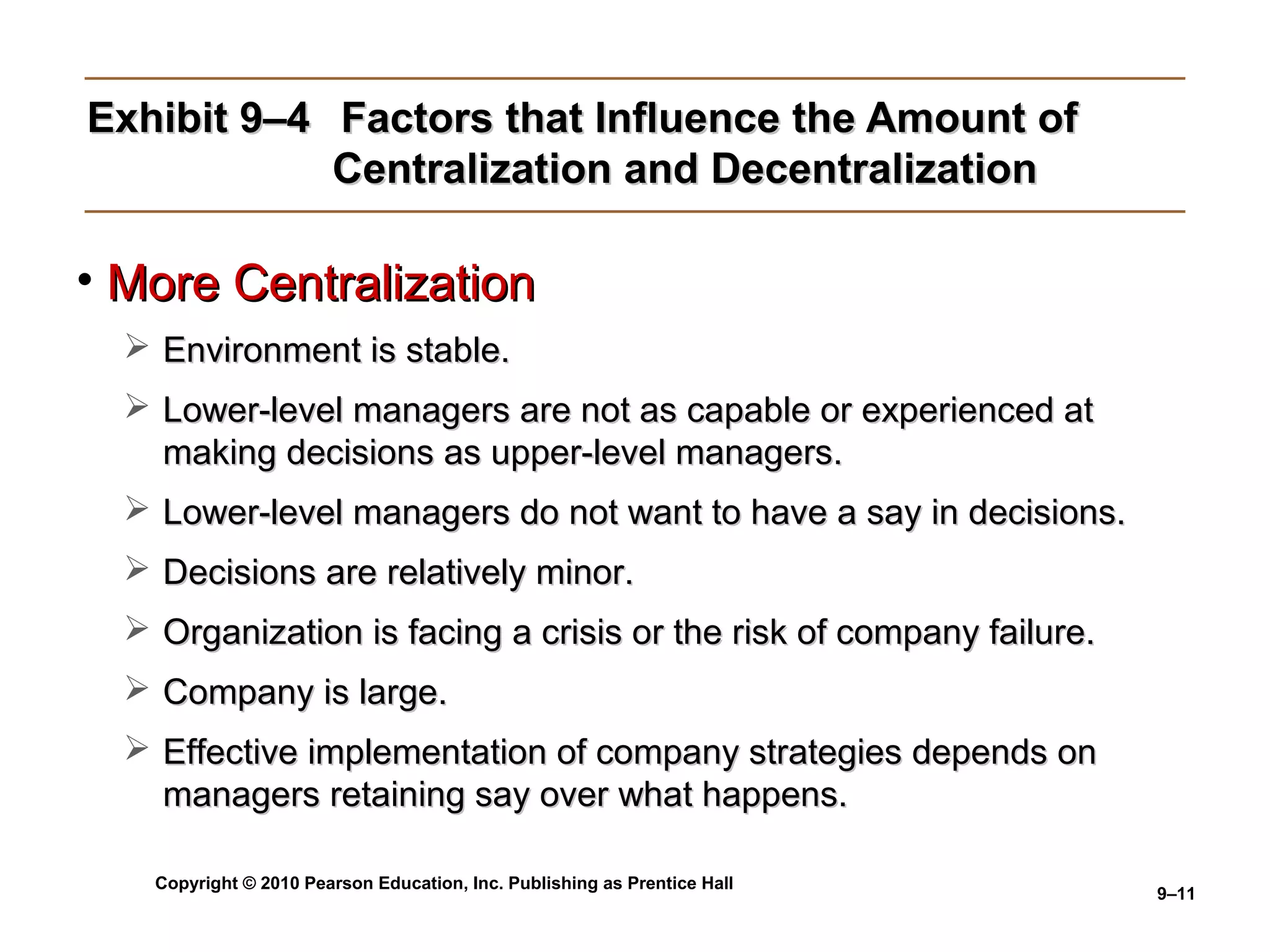
Exhibit 9–4 Factors that Influence the Amount of
            Centralization and Decentralization

• More Centralization
   Environment is stable.
   Lower-level managers are not as capable or experienced at
    making decisions as upper-level managers.
   Lower-level managers do not want to have a say in decisions.
   Decisions are relatively minor.
   Organization is facing a crisis or the risk of company failure.
   Company is large.
   Effective implementation of company strategies depends on
    managers retaining say over what happens.

    Copyright © 2010 Pearson Education, Inc. Publishing as Prentice Hall
                                                                           9–11
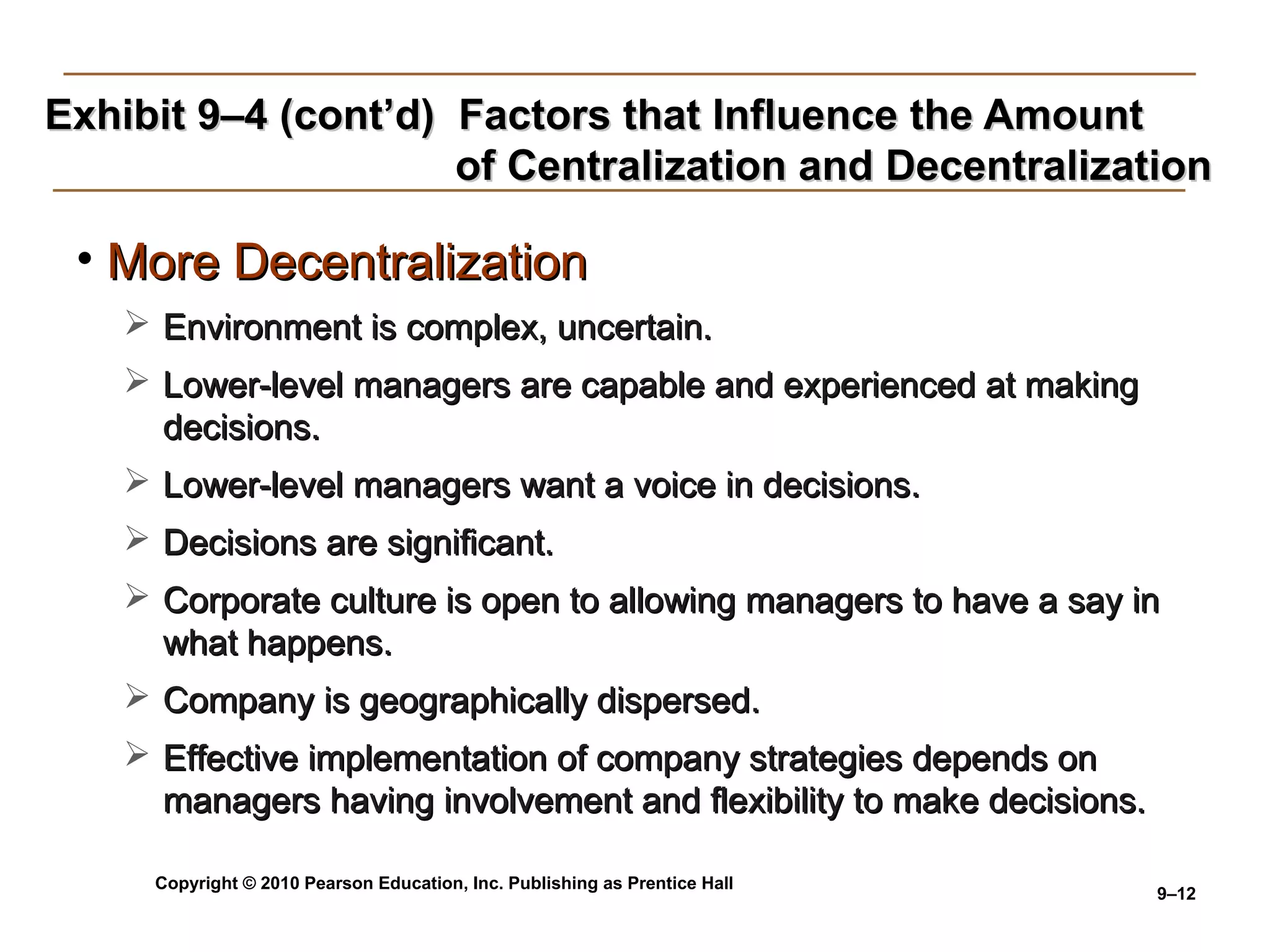
Exhibit 9–4 (cont’d) Factors that Influence the Amount
                     of Centralization and Decentralization

 • More Decentralization
    Environment is complex, uncertain.
    Lower-level managers are capable and experienced at making
     decisions.
    Lower-level managers want a voice in decisions.
    Decisions are significant.
    Corporate culture is open to allowing managers to have a say in
     what happens.
    Company is geographically dispersed.
    Effective implementation of company strategies depends on
     managers having involvement and flexibility to make decisions.

     Copyright © 2010 Pearson Education, Inc. Publishing as Prentice Hall
                                                                            9–12
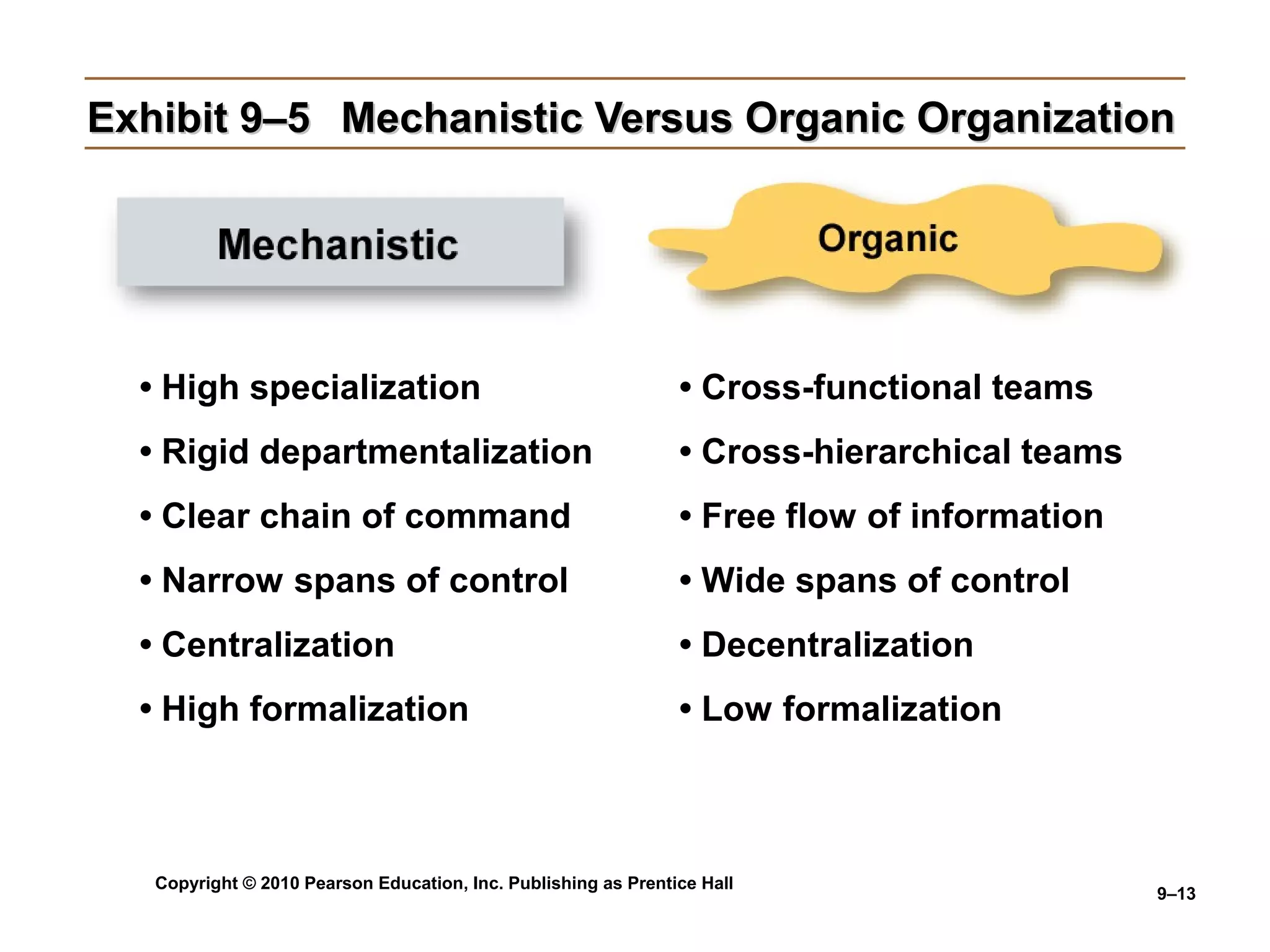
Exhibit 9–5 Mechanistic Versus Organic Organization


  • High specialization                                         • Cross-functional teams
  • Rigid departmentalization                                   • Cross-hierarchical teams
  • Clear chain of command                                      • Free flow of information
  • Narrow spans of control                                     • Wide spans of control
  • Centralization                                              • Decentralization
  • High formalization                                          • Low formalization


   Copyright © 2010 Pearson Education, Inc. Publishing as Prentice Hall
                                                                                             9–13
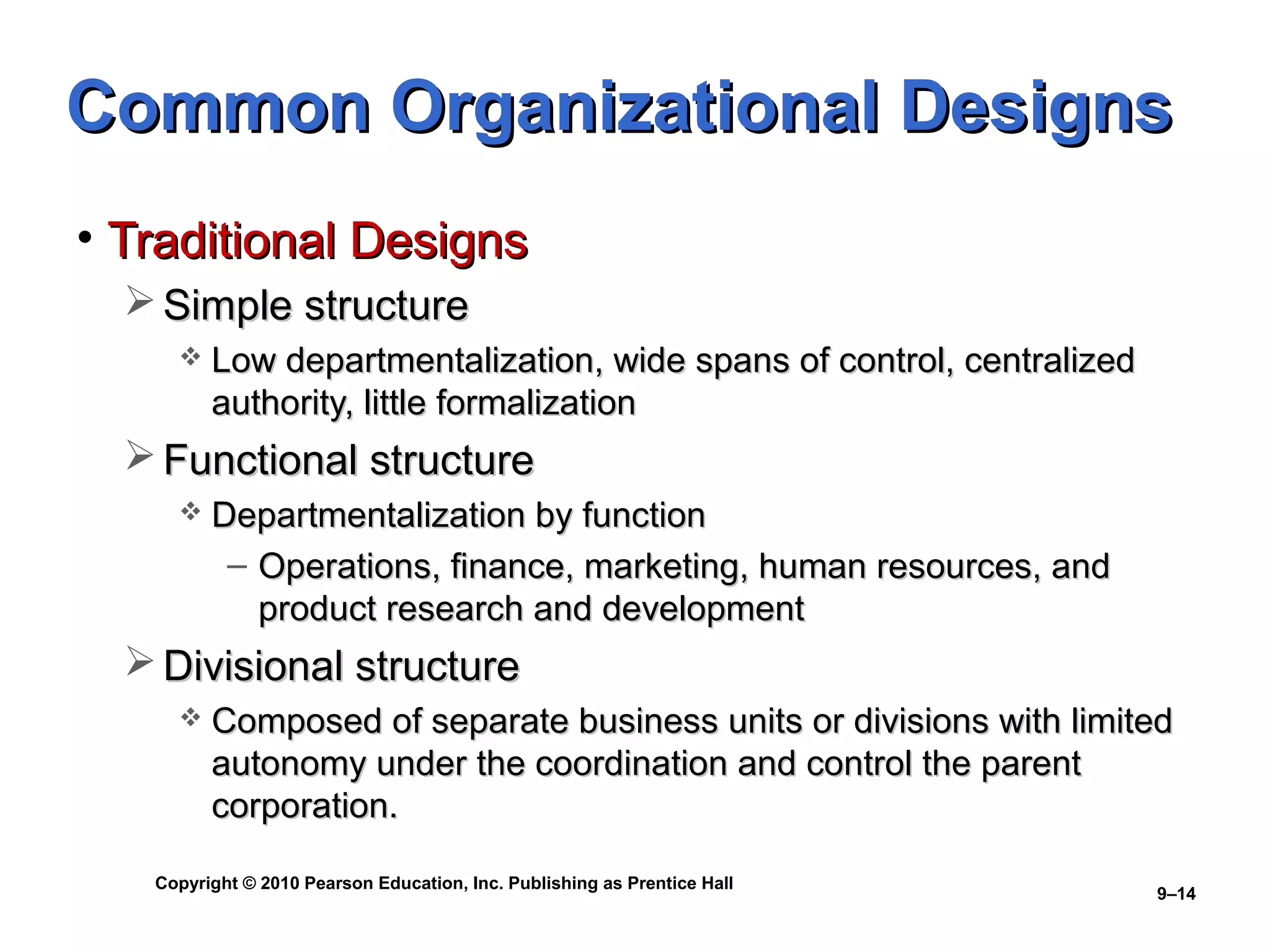
Common Organizational Designs
• Traditional Designs
   Simple structure
        Low departmentalization, wide spans of control, centralized
         authority, little formalization
   Functional structure
        Departmentalization by function
          – Operations, finance, marketing, human resources, and
            product research and development
   Divisional structure
        Composed of separate business units or divisions with limited
         autonomy under the coordination and control the parent
         corporation.

   Copyright © 2010 Pearson Education, Inc. Publishing as Prentice Hall
                                                                          9–14
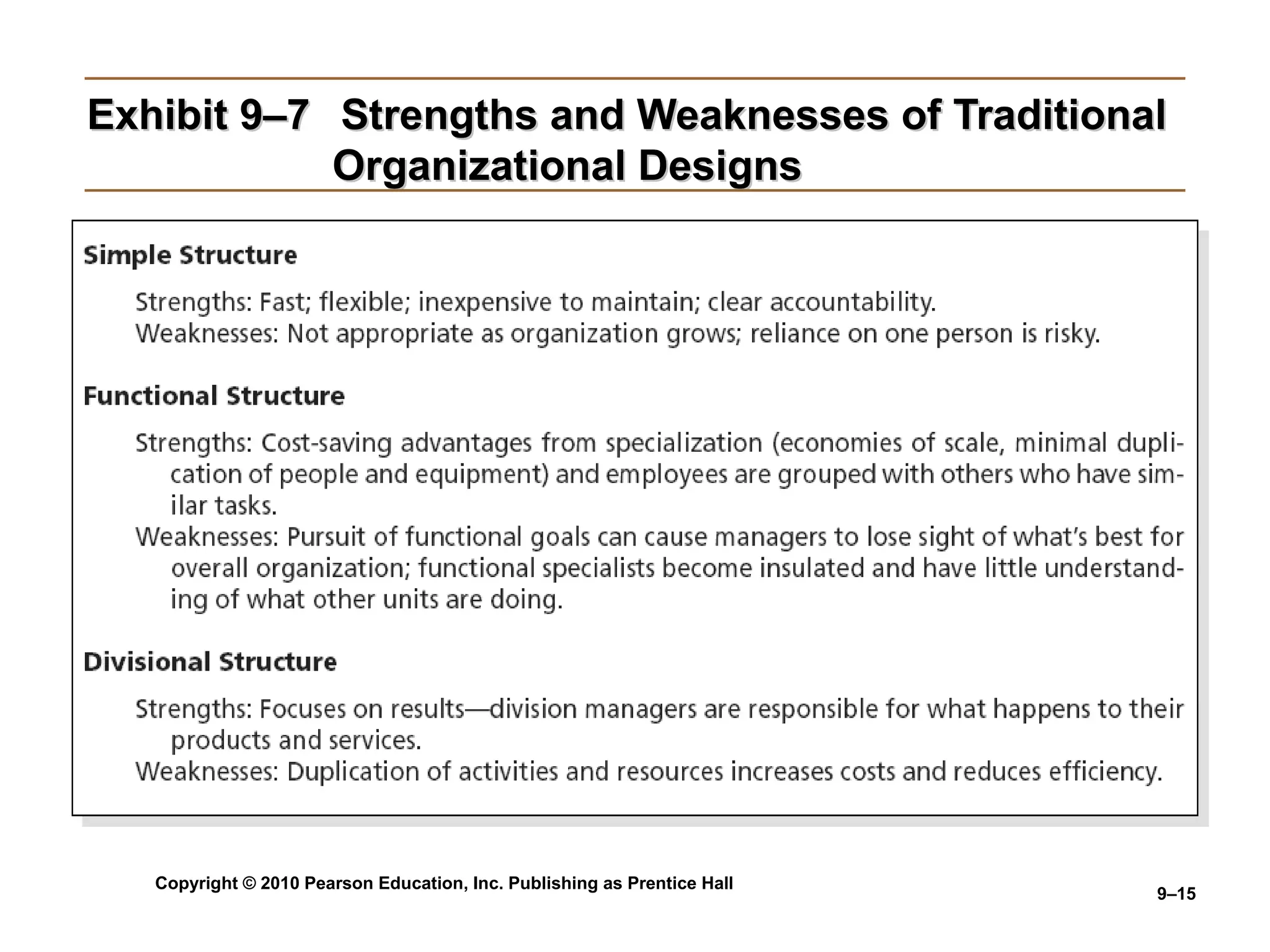
Exhibit 9–7 Strengths and Weaknesses of Traditional
            Organizational Designs


   Copyright © 2010 Pearson Education, Inc. Publishing as Prentice Hall
                                                                          9–15
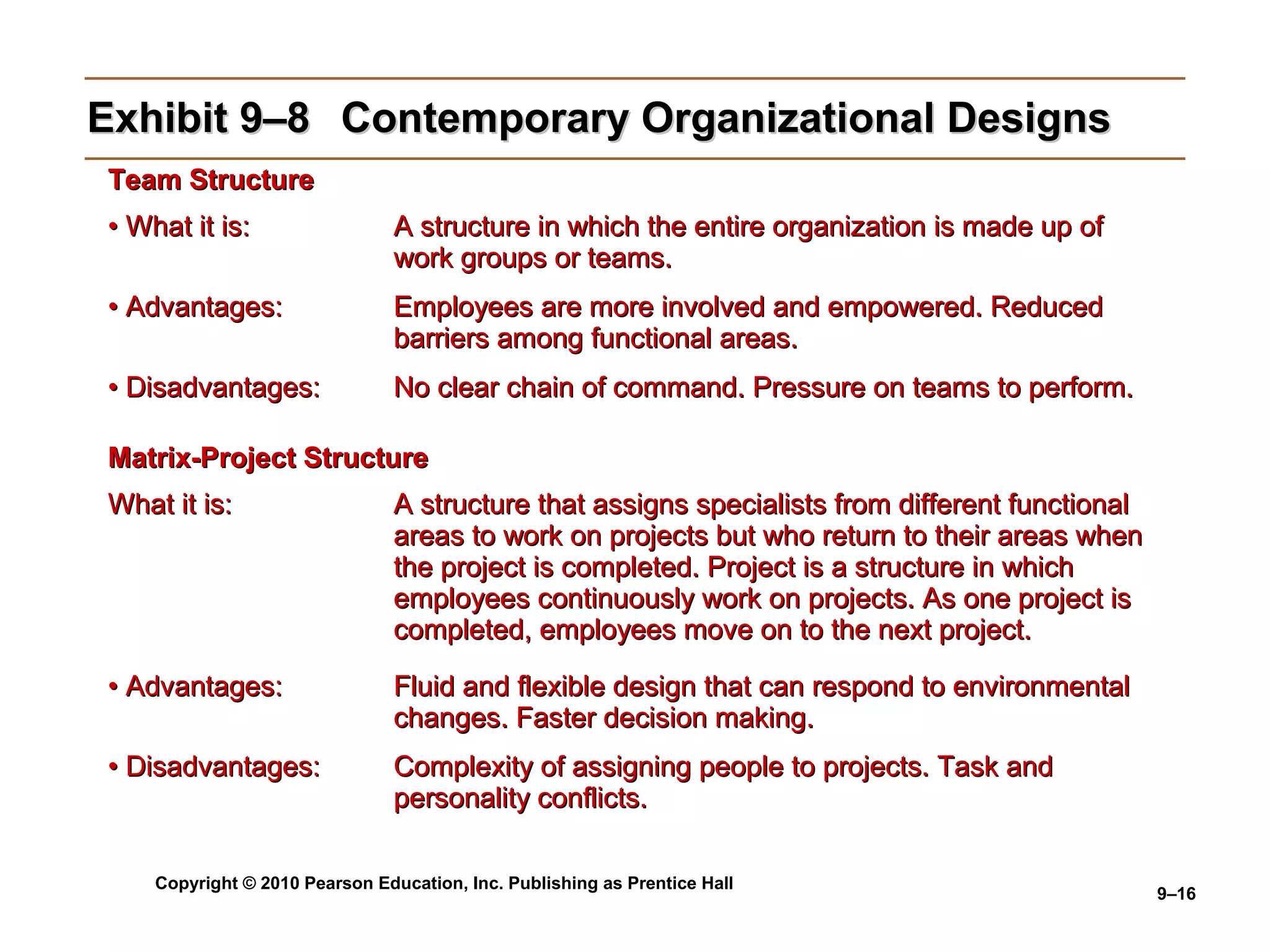
Exhibit 9–8 Contemporary Organizational Designs
Team Structure
• What it is:                   A structure in which the entire organization is made up of
                                work groups or teams.
• Advantages:                   Employees are more involved and empowered. Reduced
                                barriers among functional areas.
• Disadvantages:                No clear chain of command. Pressure on teams to perform.

Matrix-Project Structure
What it is:                     A structure that assigns specialists from different functional
                                areas to work on projects but who return to their areas when
                                the project is completed. Project is a structure in which
                                employees continuously work on projects. As one project is
                                completed, employees move on to the next project.

• Advantages:                   Fluid and flexible design that can respond to environmental
                                changes. Faster decision making.
• Disadvantages:                Complexity of assigning people to projects. Task and
                                personality conflicts.

    Copyright © 2010 Pearson Education, Inc. Publishing as Prentice Hall
                                                                                                 9–16
Exhibit 9–8 (cont’d ) Contemporary Organizational
                      Designs

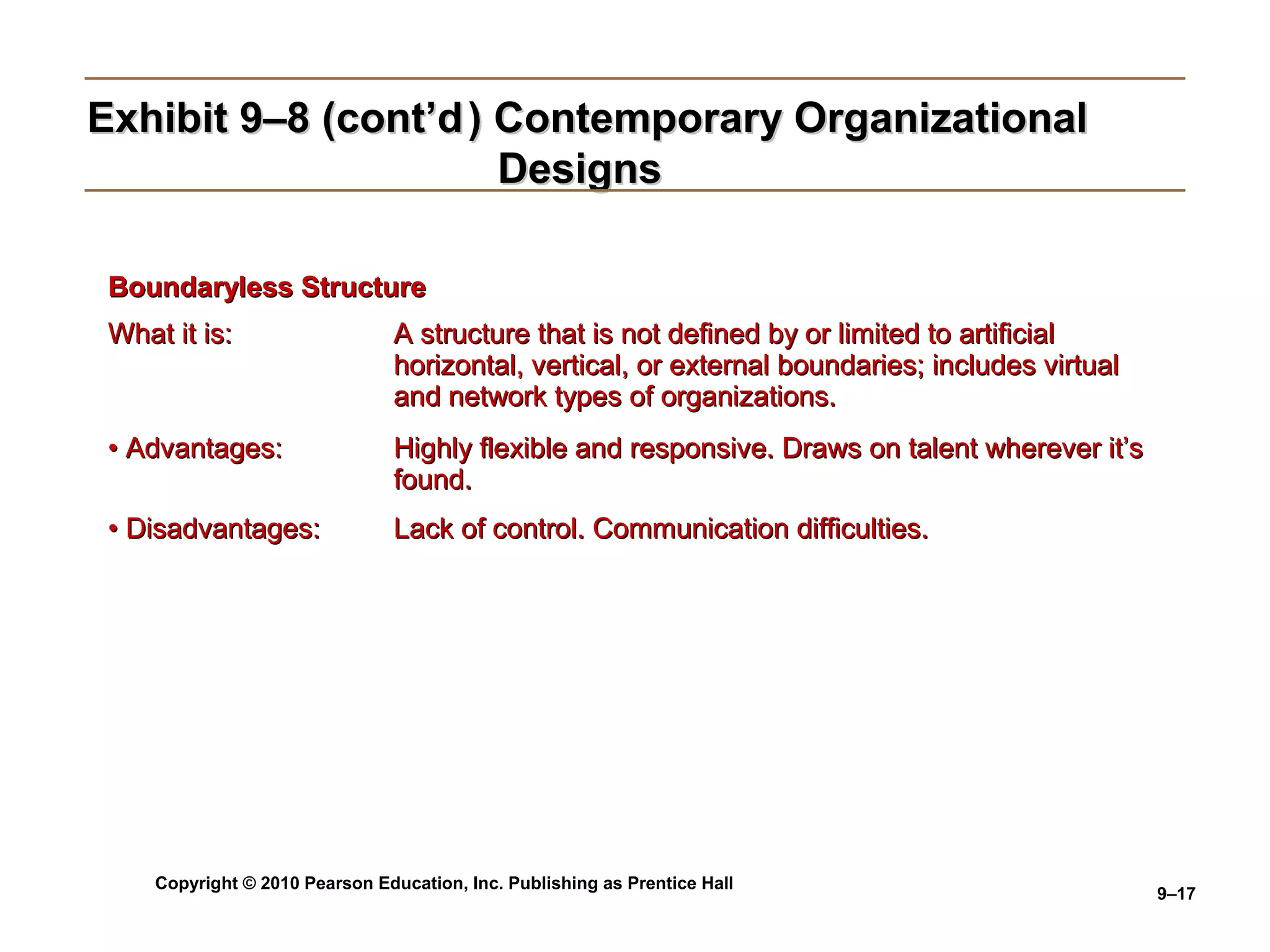
 Boundaryless Structure
 What it is:                     A structure that is not defined by or limited to artificial
                                 horizontal, vertical, or external boundaries; includes virtual
                                 and network types of organizations.
 • Advantages:                   Highly flexible and responsive. Draws on talent wherever it’s
                                 found.
 • Disadvantages:                Lack of control. Communication difficulties.


     Copyright © 2010 Pearson Education, Inc. Publishing as Prentice Hall
                                                                                                  9–17
Organizational Designs (cont’d)
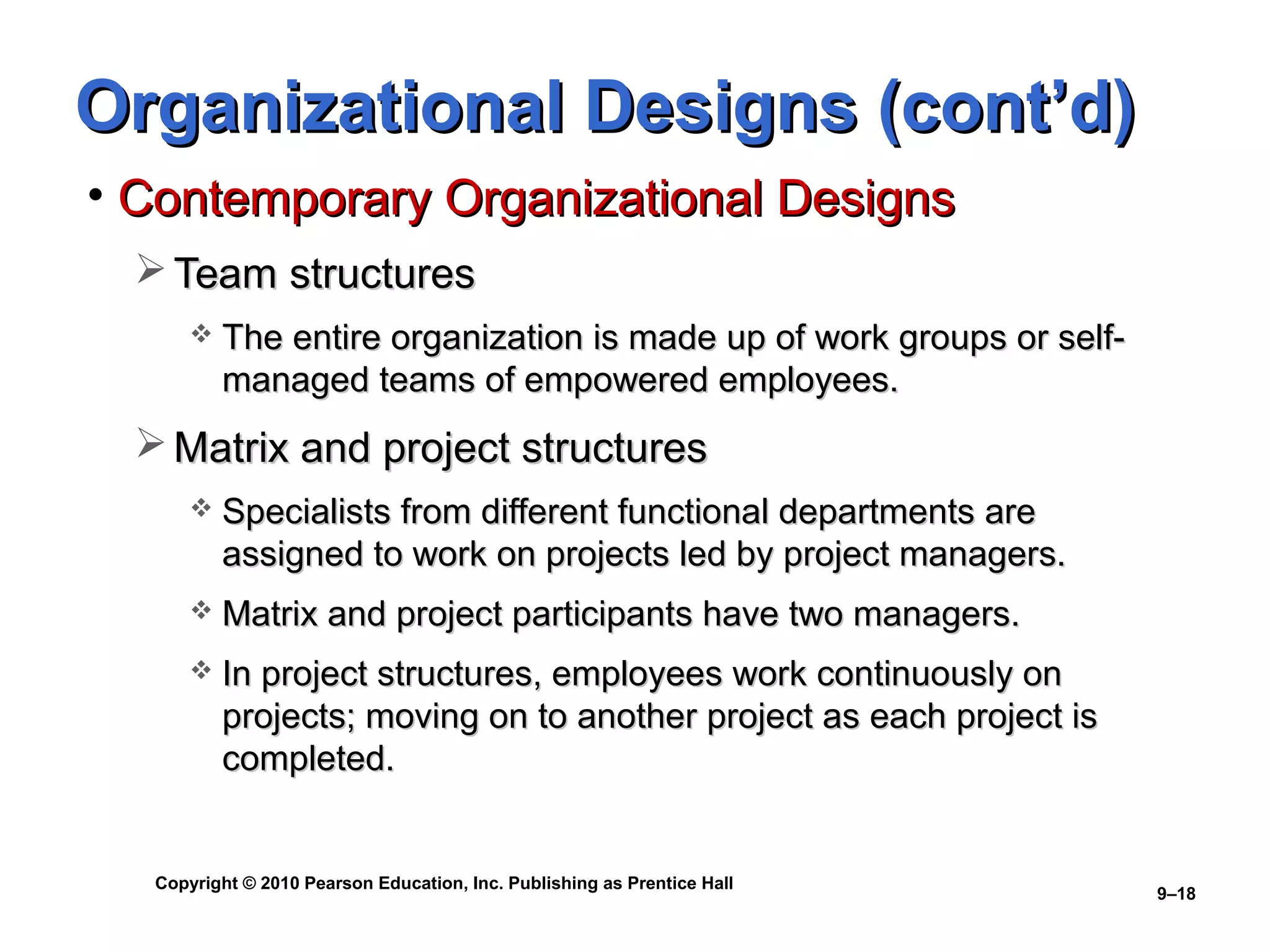
• Contemporary Organizational Designs
   Team structures
          The entire organization is made up of work groups or self-
           managed teams of empowered employees.
   Matrix and project structures
          Specialists from different functional departments are
           assigned to work on projects led by project managers.
          Matrix and project participants have two managers.
          In project structures, employees work continuously on
           projects; moving on to another project as each project is
           completed.


   Copyright © 2010 Pearson Education, Inc. Publishing as Prentice Hall
                                                                          9–18
Organizational Designs (cont’d)
• Contemporary Organizational Designs (cont’d)
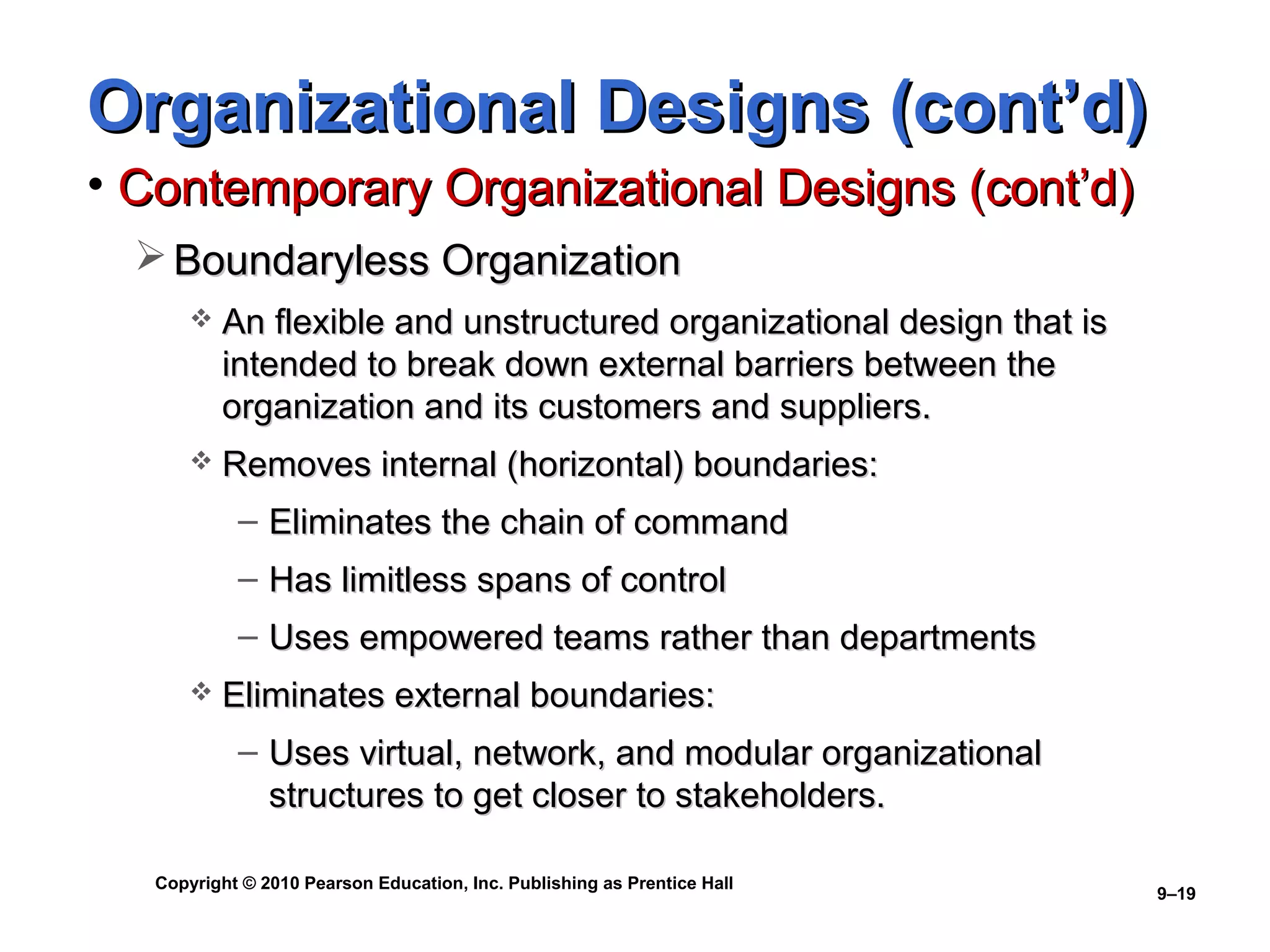
   Boundaryless Organization
          An flexible and unstructured organizational design that is
           intended to break down external barriers between the
           organization and its customers and suppliers.
          Removes internal (horizontal) boundaries:
            – Eliminates the chain of command
            – Has limitless spans of control
            – Uses empowered teams rather than departments
          Eliminates external boundaries:
            – Uses virtual, network, and modular organizational
              structures to get closer to stakeholders.

   Copyright © 2010 Pearson Education, Inc. Publishing as Prentice Hall
                                                                          9–19
Removing External Boundaries
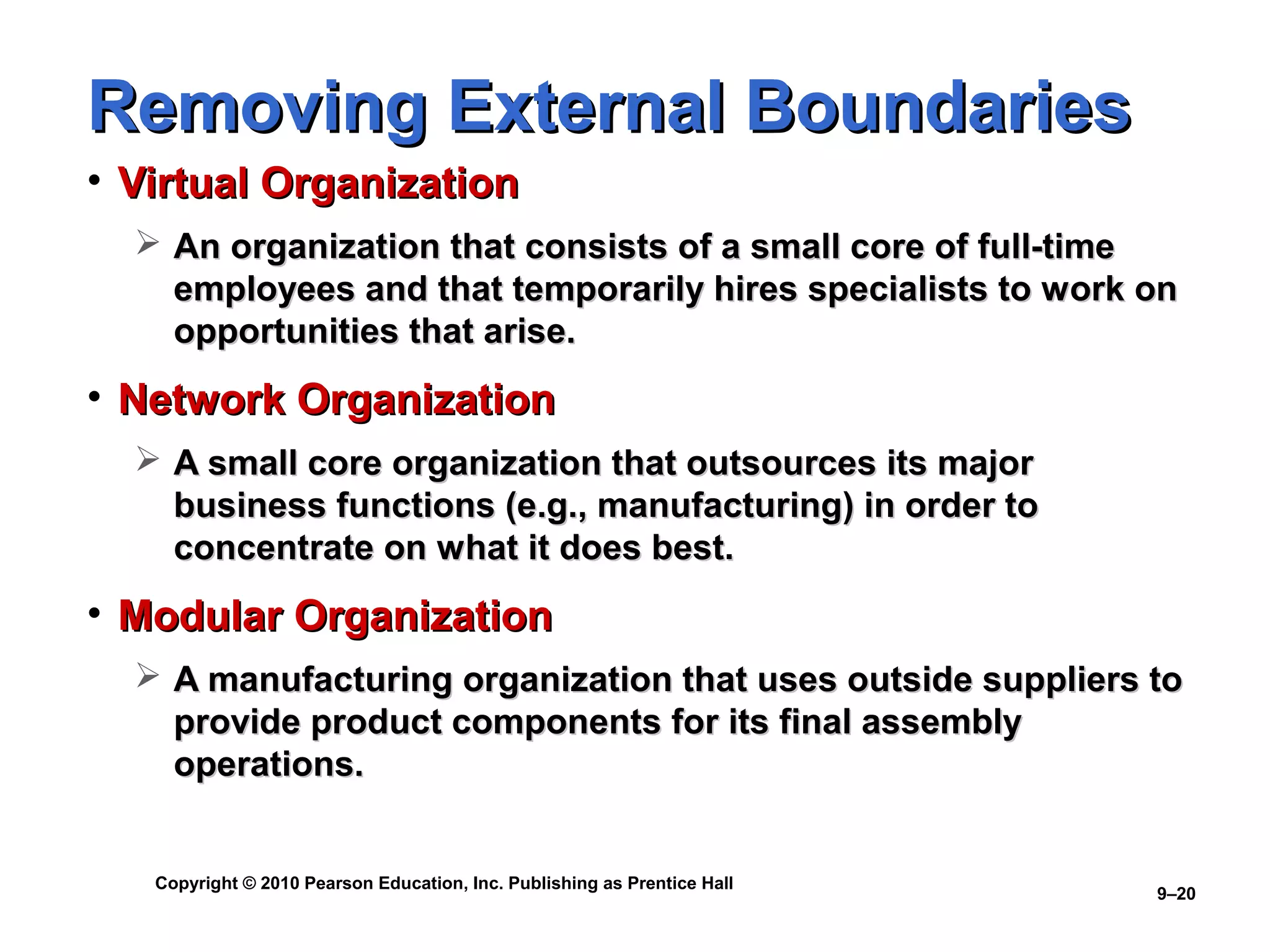
• Virtual Organization
   An organization that consists of a small core of full-time
    employees and that temporarily hires specialists to work on
    opportunities that arise.
• Network Organization
   A small core organization that outsources its major
    business functions (e.g., manufacturing) in order to
    concentrate on what it does best.
• Modular Organization
   A manufacturing organization that uses outside suppliers to
    provide product components for its final assembly
    operations.


   Copyright © 2010 Pearson Education, Inc. Publishing as Prentice Hall
                                                                          9–20
Today’s Organizational Design
Challenges
• Keeping Employees Connected
   Widely dispersed and mobile employees
• Building a Learning Organization
• Managing Global Structural Issues
   Cultural implications of design elements


   Copyright © 2010 Pearson Education, Inc. Publishing as Prentice Hall
                                                                          9–21
Organizational Designs (cont’d)
• The Learning Organization
   An organization that has developed the capacity to
    continuously learn, adapt, and change through the
    practice of knowledge management by employees.
   Characteristics of a learning organization:
          An open team-based organization design that empowers
           employees
          Extensive and open information sharing
          Leadership that provides a shared vision of the organization’s
           future.
          A strong culture of shared values, trust, openness, and a
           sense of community.

   Copyright © 2010 Pearson Education, Inc. Publishing as Prentice Hall
                                                                          9–22

Ch 9 organizational structure and design

  • 1.
    Management tenth edition Stephen P. Robbins Mary Coulter Chapter Organizational 9 Structure and Design Copyright © 2010 Pearson Education, Inc. Publishing as Prentice Hall 9–1
  • 2.
    Designing Organizational Structure •Organizational Design  A process involving decisions about six key elements:  Work specialization  Departmentalization  Chain of command  Span of control  Centralization and decentralization  Formalization Copyright © 2010 Pearson Education, Inc. Publishing as Prentice Hall 9–2
  • 3.
    Exhibit 9–1 Purposesof Organizing • Divides work to be done into specific jobs and departments. • Assigns tasks and responsibilities associated with individual jobs. • Coordinates diverse organizational tasks. • Clusters jobs into units. • Establishes relationships among individuals, groups, and departments. • Establishes formal lines of authority. • Allocates and deploys organizational resources. Copyright © 2010 Pearson Education, Inc. Publishing as Prentice Hall 9–3
  • 4.
    Organizational Structure • WorkSpecialization  The degree to which tasks in the organization are divided into separate jobs with each step completed by a different person.  Overspecialization can result in human diseconomies from boredom, fatigue, stress, poor quality, increased absenteeism, and higher turnover. Copyright © 2010 Pearson Education, Inc. Publishing as Prentice Hall 9–4
  • 5.
    Departmentalization by Type •Functional • Process  Grouping jobs by  Grouping jobs on the functions performed basis of product or • Product customer flow  Grouping jobs by product • Customer line  Grouping jobs by type of • Geographical customer and needs  Grouping jobs on the basis of territory or geography Copyright © 2010 Pearson Education, Inc. Publishing as Prentice Hall 9–5
  • 6.
    Organizational Structure (cont’d) •Chain of Command  The continuous line of authority that extends from upper levels of an organization to the lowest levels of the organization and clarifies who reports to whom. Copyright © 2010 Pearson Education, Inc. Publishing as Prentice Hall 9–6
  • 7.
    Organizational Structure (cont’d) •Authority  The rights inherent in a managerial position to tell people what to do and to expect them to do it. • Responsibility  The obligation or expectation to perform. • Unity of Command  The concept that a person should have one boss and should report only to that person. Copyright © 2010 Pearson Education, Inc. Publishing as Prentice Hall 9–7
  • 8.
    Organizational Structure (cont’d) •Span of Control  The number of employees who can be effectively and efficiently supervised by a manager. Copyright © 2010 Pearson Education, Inc. Publishing as Prentice Hall 9–8
  • 9.
    Exhibit 9–3 ContrastingSpans of Control Copyright © 2010 Pearson Education, Inc. Publishing as Prentice Hall 9–9
  • 10.
    Organizational Structure (cont’d) •Centralization  The degree to which decision making is concentrated at upper levels in the organization.  Organizations in which top managers make all the decisions and lower-level employees simply carry out those orders. • Decentralization  Organizations in which decision making is pushed down to the managers who are closest to the action. • Employee Empowerment  Increasing the decision-making authority (power) of employees. Copyright © 2010 Pearson Education, Inc. Publishing as Prentice Hall 9–10
  • 11.
    Exhibit 9–4 Factorsthat Influence the Amount of Centralization and Decentralization • More Centralization  Environment is stable.  Lower-level managers are not as capable or experienced at making decisions as upper-level managers.  Lower-level managers do not want to have a say in decisions.  Decisions are relatively minor.  Organization is facing a crisis or the risk of company failure.  Company is large.  Effective implementation of company strategies depends on managers retaining say over what happens. Copyright © 2010 Pearson Education, Inc. Publishing as Prentice Hall 9–11
  • 12.
    Exhibit 9–4 (cont’d)Factors that Influence the Amount of Centralization and Decentralization • More Decentralization  Environment is complex, uncertain.  Lower-level managers are capable and experienced at making decisions.  Lower-level managers want a voice in decisions.  Decisions are significant.  Corporate culture is open to allowing managers to have a say in what happens.  Company is geographically dispersed.  Effective implementation of company strategies depends on managers having involvement and flexibility to make decisions. Copyright © 2010 Pearson Education, Inc. Publishing as Prentice Hall 9–12
  • 13.
    Exhibit 9–5 MechanisticVersus Organic Organization • High specialization • Cross-functional teams • Rigid departmentalization • Cross-hierarchical teams • Clear chain of command • Free flow of information • Narrow spans of control • Wide spans of control • Centralization • Decentralization • High formalization • Low formalization Copyright © 2010 Pearson Education, Inc. Publishing as Prentice Hall 9–13
  • 14.
    Common Organizational Designs •Traditional Designs  Simple structure  Low departmentalization, wide spans of control, centralized authority, little formalization  Functional structure  Departmentalization by function – Operations, finance, marketing, human resources, and product research and development  Divisional structure  Composed of separate business units or divisions with limited autonomy under the coordination and control the parent corporation. Copyright © 2010 Pearson Education, Inc. Publishing as Prentice Hall 9–14
  • 15.
    Exhibit 9–7 Strengthsand Weaknesses of Traditional Organizational Designs Copyright © 2010 Pearson Education, Inc. Publishing as Prentice Hall 9–15
  • 16.
    Exhibit 9–8 ContemporaryOrganizational Designs Team Structure • What it is: A structure in which the entire organization is made up of work groups or teams. • Advantages: Employees are more involved and empowered. Reduced barriers among functional areas. • Disadvantages: No clear chain of command. Pressure on teams to perform. Matrix-Project Structure What it is: A structure that assigns specialists from different functional areas to work on projects but who return to their areas when the project is completed. Project is a structure in which employees continuously work on projects. As one project is completed, employees move on to the next project. • Advantages: Fluid and flexible design that can respond to environmental changes. Faster decision making. • Disadvantages: Complexity of assigning people to projects. Task and personality conflicts. Copyright © 2010 Pearson Education, Inc. Publishing as Prentice Hall 9–16
  • 17.
    Exhibit 9–8 (cont’d) Contemporary Organizational Designs Boundaryless Structure What it is: A structure that is not defined by or limited to artificial horizontal, vertical, or external boundaries; includes virtual and network types of organizations. • Advantages: Highly flexible and responsive. Draws on talent wherever it’s found. • Disadvantages: Lack of control. Communication difficulties. Copyright © 2010 Pearson Education, Inc. Publishing as Prentice Hall 9–17
  • 18.
    Organizational Designs (cont’d) •Contemporary Organizational Designs  Team structures  The entire organization is made up of work groups or self- managed teams of empowered employees.  Matrix and project structures  Specialists from different functional departments are assigned to work on projects led by project managers.  Matrix and project participants have two managers.  In project structures, employees work continuously on projects; moving on to another project as each project is completed. Copyright © 2010 Pearson Education, Inc. Publishing as Prentice Hall 9–18
  • 19.
    Organizational Designs (cont’d) •Contemporary Organizational Designs (cont’d)  Boundaryless Organization  An flexible and unstructured organizational design that is intended to break down external barriers between the organization and its customers and suppliers.  Removes internal (horizontal) boundaries: – Eliminates the chain of command – Has limitless spans of control – Uses empowered teams rather than departments  Eliminates external boundaries: – Uses virtual, network, and modular organizational structures to get closer to stakeholders. Copyright © 2010 Pearson Education, Inc. Publishing as Prentice Hall 9–19
  • 20.
    Removing External Boundaries •Virtual Organization  An organization that consists of a small core of full-time employees and that temporarily hires specialists to work on opportunities that arise. • Network Organization  A small core organization that outsources its major business functions (e.g., manufacturing) in order to concentrate on what it does best. • Modular Organization  A manufacturing organization that uses outside suppliers to provide product components for its final assembly operations. Copyright © 2010 Pearson Education, Inc. Publishing as Prentice Hall 9–20
  • 21.
    Today’s Organizational Design Challenges •Keeping Employees Connected  Widely dispersed and mobile employees • Building a Learning Organization • Managing Global Structural Issues  Cultural implications of design elements Copyright © 2010 Pearson Education, Inc. Publishing as Prentice Hall 9–21
  • 22.
    Organizational Designs (cont’d) •The Learning Organization  An organization that has developed the capacity to continuously learn, adapt, and change through the practice of knowledge management by employees.  Characteristics of a learning organization:  An open team-based organization design that empowers employees  Extensive and open information sharing  Leadership that provides a shared vision of the organization’s future.  A strong culture of shared values, trust, openness, and a sense of community. Copyright © 2010 Pearson Education, Inc. Publishing as Prentice Hall 9–22