Topics:
Performance Planning,
Role Analysis and
Evaluation of Performance
Management
Mr. Soumesh Ghosh,
PhD Scholar, CMS, NERIST
What is Performance Planning?
Meaning:
Performance planning is the process of communication between a
manager and an employee that results in mutual understanding of
what the employee should be doing during the next period of time.
Definition:
Performance Planning may be defined as a systematic outlining of the
activities that the manager is expected to undertake during a
specified period so that he is able to make his best contribution to
developmental and organizational outcomes. (Rao 2004)
Objectives of Performance Planning
At Organizational Level :-
1. To clearly define and communicate to employees the
organization's mission, objectives, strategies, and
performance goals.
2. To provide appropriate recourse's, support, and training to
employees in order to achieve goals and targets.
3. To ensure that employees receive feedback on a continuous
basis.
4. To align job description with organizational objectives and
strategy
5. To boost motivation and self-concept of the employees.
At Manager Level:-
• To provide opportunity to employees for joint goal setting for
greater ownership and accountability.
• To clearly articulate performance metrics used to measure
employee to perform success in meeting agreed goals and targets
• To provide training wherever required, to equip the employee to
perform as planned
• To provide an on-going ‘On-the-Job’ feedback.
At Employee level:-
• To determine performance goals and targets with the manager.
• To view manager as a counsellor or mentor rather than someone
who passes judgment.
• To become receptive to feedback.
• To develop self-efficacy for providing information on self-
performance
METHODOLOGIES OF PERFORMANCE
PLANNING
• Key Performance Areas
• Key Result Areas
• Task and Target Identification and
• Goal Setting Exercises
PROCESS OF PERFORMANCE
PLANNING
Business
Planning
Key Success
Factors
Departmental
objectives and
strategies
Individual’s
objectives and
action plan
Individual
performance
expectations
Role Analysis
 Role analysis is the process of defining a role in the context of its
work system, interims of expectation of important persons,
detailing specific tasks under each function, and elaborating the
process, standards and critical attributes namely knowledge,
attitude, skill, habits (KASH) required for effective role.
 Role is a position or an office a person occupies as defined by
expectations from significant persons in the organisation,
including the person himself. Position is the collection of tasks and
responsibilities performed by one person.
Role analysis is a newer concept of defining
what is required from an individual in an
organisation in achieving the objectives
 The focus is on establishing role of an
individual in the organization
Since role is a set of expectations, it implies
that one role cannot be defined by without
referring to another
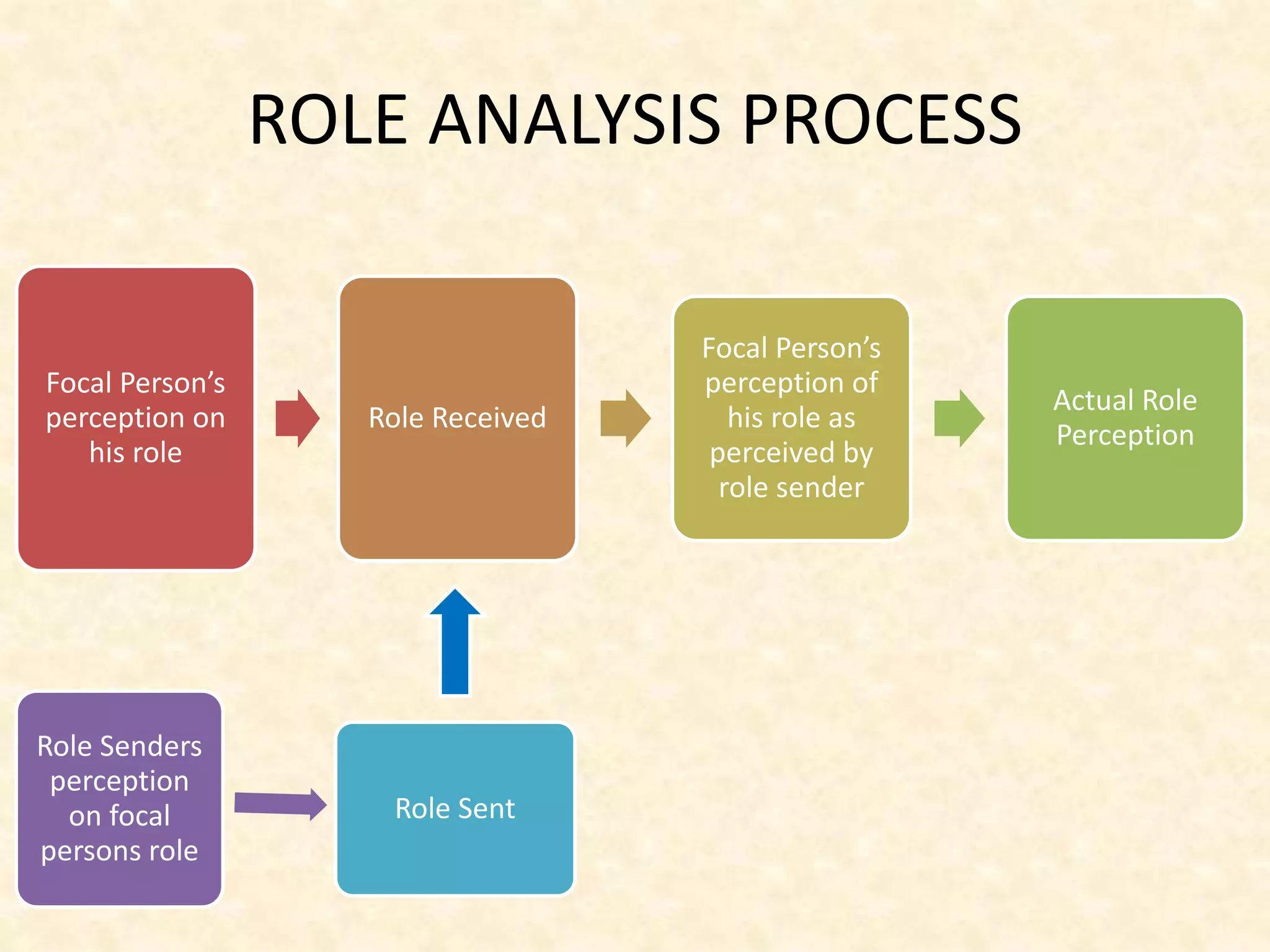
Thus, role analysis has to be undertaken as a
process consisting of different steps as focal
person’s perception of his role
ROLE ANALYSIS PROCESS
Focal Person’s
perception on
his role
Role Received
Focal Person’s
perception of
his role as
perceived by
role sender
Actual Role
Perception
Role Senders
perception
on focal
persons role
Role Sent
Performance Evaluation
What is Evaluation?
The making of a judgement about
• Amount
• Number
• Value of Something
Definition:
The systematic review and evaluation of job
performance as well as the provision of
performance feedback for the employee’s assign
duties and responsibilities”
For What?
The Annual Performance Evaluation Procedure
is designed to improve services by:
• Setting individual objectives and strategies.
• Assessing the progress of the objectives and
strategies.
• Conducting a comprehensive evaluation of
performance.
Performance evaluation by Who and When?
Immediate Supervisor
Higher Management
Self-Appraisals
Peers (Co-Workers)
Evaluation Teams
Customers
“360° Appraisals”
Evaluations will be completed on a calendar year basis
Note: Evaluations report must be submitted to Human Resources for salary/promotion
recommendation
Who?
 When?
Why performance evaluation?
Recognize excellence.
Provide rational for evaluation decisions.
Identify performance areas needing improvement.
Identify areas of general management
development training.
Providing appropriate learning and development
opportunities
Objectives of Performance Evaluation
Measuring the efficiency
Maintaining organizational control
Concrete and tangible particulars about their work
Assessment of performance
Mutual goals of the employees & the organization.
Growth & development
Increase harmony & effectiveness
Personal development
Work satisfaction
Involvement in the organization.
Performance Standards Approach
• Expected levels of performance Benchmarks,
goals, and targets
• S.M.A.R.T. approach for writing performance
standards
S=Specific
M=Measurable
A=Attainable
R=Relevant
T=Time bound
Good Evaluation System
• Validity
• Reliability
• Freedom from bias: errors
• Practicality According to Criteria
• According to Evaluation
Thank You

Performance planning

  • 1.
    Topics: Performance Planning, Role Analysisand Evaluation of Performance Management Mr. Soumesh Ghosh, PhD Scholar, CMS, NERIST
  • 2.
    What is PerformancePlanning? Meaning: Performance planning is the process of communication between a manager and an employee that results in mutual understanding of what the employee should be doing during the next period of time. Definition: Performance Planning may be defined as a systematic outlining of the activities that the manager is expected to undertake during a specified period so that he is able to make his best contribution to developmental and organizational outcomes. (Rao 2004)
  • 3.
    Objectives of PerformancePlanning At Organizational Level :- 1. To clearly define and communicate to employees the organization's mission, objectives, strategies, and performance goals. 2. To provide appropriate recourse's, support, and training to employees in order to achieve goals and targets. 3. To ensure that employees receive feedback on a continuous basis. 4. To align job description with organizational objectives and strategy 5. To boost motivation and self-concept of the employees.
  • 4.
    At Manager Level:- •To provide opportunity to employees for joint goal setting for greater ownership and accountability. • To clearly articulate performance metrics used to measure employee to perform success in meeting agreed goals and targets • To provide training wherever required, to equip the employee to perform as planned • To provide an on-going ‘On-the-Job’ feedback. At Employee level:- • To determine performance goals and targets with the manager. • To view manager as a counsellor or mentor rather than someone who passes judgment. • To become receptive to feedback. • To develop self-efficacy for providing information on self- performance
  • 5.
    METHODOLOGIES OF PERFORMANCE PLANNING •Key Performance Areas • Key Result Areas • Task and Target Identification and • Goal Setting Exercises
  • 6.
    PROCESS OF PERFORMANCE PLANNING Business Planning KeySuccess Factors Departmental objectives and strategies Individual’s objectives and action plan Individual performance expectations
  • 7.
    Role Analysis  Roleanalysis is the process of defining a role in the context of its work system, interims of expectation of important persons, detailing specific tasks under each function, and elaborating the process, standards and critical attributes namely knowledge, attitude, skill, habits (KASH) required for effective role.  Role is a position or an office a person occupies as defined by expectations from significant persons in the organisation, including the person himself. Position is the collection of tasks and responsibilities performed by one person.
  • 8.
    Role analysis isa newer concept of defining what is required from an individual in an organisation in achieving the objectives  The focus is on establishing role of an individual in the organization Since role is a set of expectations, it implies that one role cannot be defined by without referring to another Thus, role analysis has to be undertaken as a process consisting of different steps as focal person’s perception of his role
  • 9.
    ROLE ANALYSIS PROCESS FocalPerson’s perception on his role Role Received Focal Person’s perception of his role as perceived by role sender Actual Role Perception Role Senders perception on focal persons role Role Sent
  • 10.
    Performance Evaluation What isEvaluation? The making of a judgement about • Amount • Number • Value of Something Definition: The systematic review and evaluation of job performance as well as the provision of performance feedback for the employee’s assign duties and responsibilities”
  • 11.
    For What? The AnnualPerformance Evaluation Procedure is designed to improve services by: • Setting individual objectives and strategies. • Assessing the progress of the objectives and strategies. • Conducting a comprehensive evaluation of performance.
  • 12.
    Performance evaluation byWho and When? Immediate Supervisor Higher Management Self-Appraisals Peers (Co-Workers) Evaluation Teams Customers “360° Appraisals” Evaluations will be completed on a calendar year basis Note: Evaluations report must be submitted to Human Resources for salary/promotion recommendation Who?  When?
  • 13.
    Why performance evaluation? Recognizeexcellence. Provide rational for evaluation decisions. Identify performance areas needing improvement. Identify areas of general management development training. Providing appropriate learning and development opportunities
  • 14.
    Objectives of PerformanceEvaluation Measuring the efficiency Maintaining organizational control Concrete and tangible particulars about their work Assessment of performance Mutual goals of the employees & the organization. Growth & development Increase harmony & effectiveness Personal development Work satisfaction Involvement in the organization.
  • 15.
    Performance Standards Approach •Expected levels of performance Benchmarks, goals, and targets • S.M.A.R.T. approach for writing performance standards S=Specific M=Measurable A=Attainable R=Relevant T=Time bound
  • 16.
    Good Evaluation System •Validity • Reliability • Freedom from bias: errors • Practicality According to Criteria • According to Evaluation
  • 18.