Decision Making Process
ZUBAIR NAWAZ  09-125 Submitted by:
Managerial Decision Making Decision making:   the process by which managers respond to opportunities and threats by analyzing options, and making decisions about goals and courses of action. Characteristics of managerial decision making: Certainty Uncertainty Risk
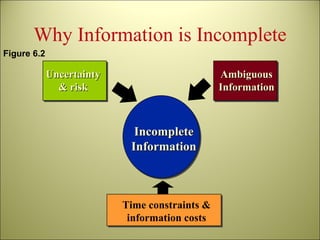
Incomplete Information Factors Incomplete information exists due to many issues: Risk:   managers know a given outcome can fail or succeed and probabilities can be assigned. Uncertainty:   probabilities cannot be given for outcomes and the future is unknown. Many decision outcomes are not known such as a new product introduction. Ambiguous information:   information whose meaning is not clear. Information can be interpreted in different ways.
Why Information is Incomplete Uncertainty & risk Ambiguous Information Time constraints & information costs Incomplete Information Figure 6.2
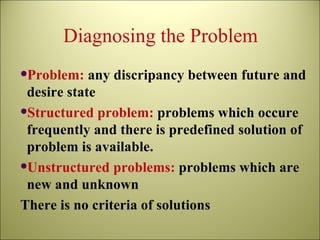
Diagnosing the Problem Problem:  any discripancy between future and desire state Structured problem:  problems which occure frequently and there is predefined solution of problem is available. Unstructured problems:  problems which are new and unknown  There is no criteria of solutions
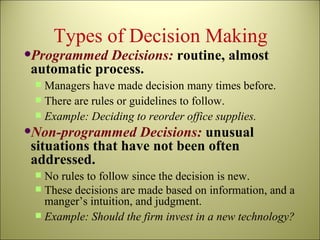
Types of Decision Making Programmed Decisions:   routine, almost automatic process. Managers have made decision many times before. There are rules or guidelines to follow. Example: Deciding to reorder office supplies. Non-programmed Decisions:   unusual situations that have not been often addressed. No rules to follow since the decision is new. These decisions are made based on information, and a manger’s intuition, and judgment.   Example: Should the firm invest in a new technology?
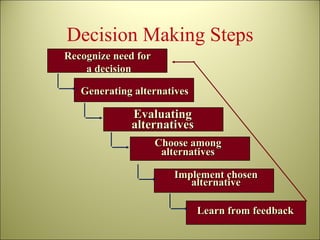
Decision Making Steps Recognize need for  a decision Generating alternatives Evaluating alternatives Choose among alternatives Implement chosen alternative Learn from feedback
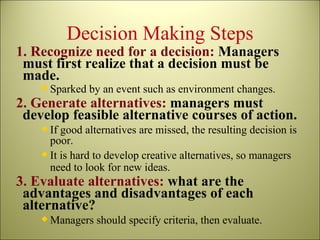
Decision Making Steps 1. Recognize need for a decision:  Managers must first realize that a decision must be made. Sparked by an event such as environment changes. 2. Generate alternatives:  managers must develop feasible alternative courses of action. If good alternatives are missed, the resulting decision is poor. It is hard to develop creative alternatives, so managers need to look for new ideas. 3. Evaluate alternatives:  what are the advantages and disadvantages of each alternative? Managers should specify criteria, then evaluate.
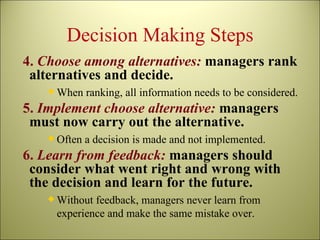
Decision Making Steps 4.  Choose among alternatives:   managers rank alternatives and decide. When ranking, all information needs to be considered. 5.  Implement choose alternative:   managers must now carry out the alternative. Often a decision is made and not implemented. 6.  Learn from feedback:   managers should consider what went right and wrong with the decision and learn for the future. Without feedback, managers never learn from experience and make the same mistake over.
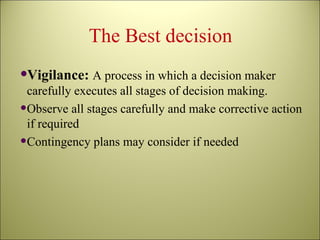
The Best decision Vigilance:  A process in which a decision maker carefully executes all stages of decision making. Observe all stages carefully and make corrective action if required Contingency plans may consider if needed
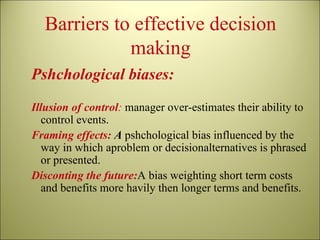
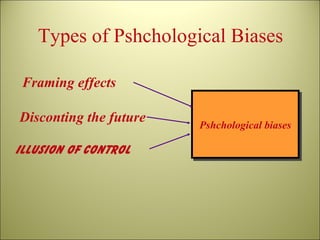
Barriers to effective decision making Pshchological biases: Illusion of control :  manager over-estimates their ability to control events. Framing effects:  A  pshchological bias influenced by the way in which aproblem or decisionalternatives is phrased or presented. Disconting the future: A bias weighting short term costs and benefits more havily then longer terms and benefits.
Types of Pshchological Biases Pshchological biases Framing effects Disconting the future Illusion of Control
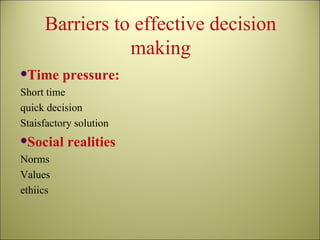
Barriers to effective decision making Time pressure: Short time quick decision Staisfactory solution Social realities Norms Values ethiics
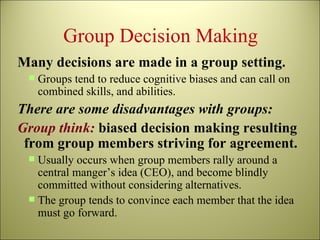
Group Decision Making Many decisions are made in a group setting. Groups tend to reduce cognitive biases and can call on combined skills, and abilities. There are some disadvantages with groups: Group think:   biased decision making resulting from group members striving for agreement. Usually occurs when group members rally around a central manger’s idea (CEO), and become blindly committed without considering alternatives. The group tends to convince each member that the idea must go forward.
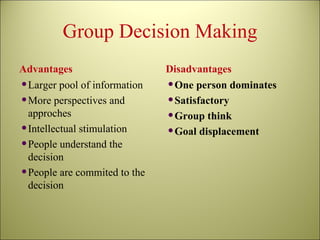
Group Decision Making Advantages Larger pool of information More perspectives and approches Intellectual stimulation People understand the decision People are commited to the decision Disadvantages One person dominates Satisfactory Group think Goal displacement
 
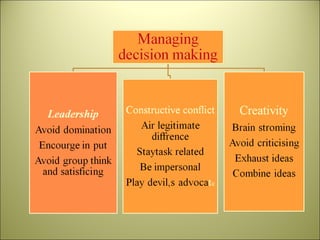
Leadership Avoid domination Encourge in put Avoid group think and satisficing
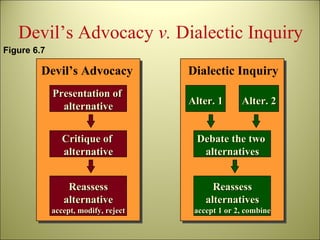
Constructive Conflicts  Devil’s Advocacy:  one member of the group acts as the devil’s advocate and critiques the way the group identified alternatives. Points out problems with the alternative selection. Dialectical inquiry:  two different groups are assigned to the problem and each group evaluates the other group’s alternatives.  Top managers then hear each group present their alternatives and each group can critique the other.
Devil’s Advocacy  v.  Dialectic Inquiry Devil’s Advocacy Presentation of  alternative Critique of  alternative Reassess alternative accept, modify, reject Dialectic Inquiry Alter. 1 Debate the two  alternatives Reassess alternatives accept 1 or 2, combine Alter. 2 Figure 6.7
Organizational Learning & Creativity Organizational Learning:  Managers seek to improve member’s ability to understand the organization and environment so as to raise effectiveness. The learning organization: managers try to improve the people’s ability to behave creatively to maximize organizational learning . Creativity:  is the ability of the decision maker to discover novel ideas leading to a feasible course of action. A creative management staff and employees are the key to the learning organization.
Individual Creativity Organizations can build an environment supportive of creativity. Many of these issues are the same as for the learning organization. Managers must provide employees with the ability to take risks. If people take risks, they will occasionally fail.  Thus, to build creativity, periodic failures must be rewarded. This idea is hard to accept for some managers.
Building Group Creativity Brainstorming:  managers meet face-to-face to generate and debate many alternatives.  Group members are not allowed to evaluate alternatives until all alternatives are listed. Be creative and radical in stating alternatives. When all are listed, then the pros and cons of each are discussed and a short list created. Production blocking  is a potential problem with brainstorming. Members cannot absorb all information being presented during the session and can forget their own alternatives.
Building Group Creativity Nominal Group Technique:  Provides a more structured way to generate alternatives in writing.  Avoids the production blocking problem. Similar to brainstorming except that each member is given time to first write down all alternatives he or she would suggest. Alternatives are then read aloud without discussion until all have been listed. Then discussion occurs and alternatives are ranked.
Building Group Creativity Delphi Technique:   provides for a written format without having all managers meet face-to-face. Problem is distributed in written form to managers who then generate written alternatives. Responses are received and summarized by top managers. These results are sent back to participants for feedback, and ranking. The process continues until consensus is reached. Delphi allows distant managers to participate.

Chpt06

  • 1.
  • 2.
    ZUBAIR NAWAZ 09-125 Submitted by:
  • 3.
    Managerial Decision MakingDecision making: the process by which managers respond to opportunities and threats by analyzing options, and making decisions about goals and courses of action. Characteristics of managerial decision making: Certainty Uncertainty Risk
  • 4.
    Incomplete Information FactorsIncomplete information exists due to many issues: Risk: managers know a given outcome can fail or succeed and probabilities can be assigned. Uncertainty: probabilities cannot be given for outcomes and the future is unknown. Many decision outcomes are not known such as a new product introduction. Ambiguous information: information whose meaning is not clear. Information can be interpreted in different ways.
  • 5.
    Why Information isIncomplete Uncertainty & risk Ambiguous Information Time constraints & information costs Incomplete Information Figure 6.2
  • 6.
    Diagnosing the ProblemProblem: any discripancy between future and desire state Structured problem: problems which occure frequently and there is predefined solution of problem is available. Unstructured problems: problems which are new and unknown There is no criteria of solutions
  • 7.
    Types of DecisionMaking Programmed Decisions: routine, almost automatic process. Managers have made decision many times before. There are rules or guidelines to follow. Example: Deciding to reorder office supplies. Non-programmed Decisions: unusual situations that have not been often addressed. No rules to follow since the decision is new. These decisions are made based on information, and a manger’s intuition, and judgment. Example: Should the firm invest in a new technology?
  • 8.
    Decision Making StepsRecognize need for a decision Generating alternatives Evaluating alternatives Choose among alternatives Implement chosen alternative Learn from feedback
  • 9.
    Decision Making Steps1. Recognize need for a decision: Managers must first realize that a decision must be made. Sparked by an event such as environment changes. 2. Generate alternatives: managers must develop feasible alternative courses of action. If good alternatives are missed, the resulting decision is poor. It is hard to develop creative alternatives, so managers need to look for new ideas. 3. Evaluate alternatives: what are the advantages and disadvantages of each alternative? Managers should specify criteria, then evaluate.
  • 10.
    Decision Making Steps4. Choose among alternatives: managers rank alternatives and decide. When ranking, all information needs to be considered. 5. Implement choose alternative: managers must now carry out the alternative. Often a decision is made and not implemented. 6. Learn from feedback: managers should consider what went right and wrong with the decision and learn for the future. Without feedback, managers never learn from experience and make the same mistake over.
  • 11.
    The Best decisionVigilance: A process in which a decision maker carefully executes all stages of decision making. Observe all stages carefully and make corrective action if required Contingency plans may consider if needed
  • 12.
    Barriers to effectivedecision making Pshchological biases: Illusion of control : manager over-estimates their ability to control events. Framing effects: A pshchological bias influenced by the way in which aproblem or decisionalternatives is phrased or presented. Disconting the future: A bias weighting short term costs and benefits more havily then longer terms and benefits.
  • 13.
    Types of PshchologicalBiases Pshchological biases Framing effects Disconting the future Illusion of Control
  • 14.
    Barriers to effectivedecision making Time pressure: Short time quick decision Staisfactory solution Social realities Norms Values ethiics
  • 15.
    Group Decision MakingMany decisions are made in a group setting. Groups tend to reduce cognitive biases and can call on combined skills, and abilities. There are some disadvantages with groups: Group think: biased decision making resulting from group members striving for agreement. Usually occurs when group members rally around a central manger’s idea (CEO), and become blindly committed without considering alternatives. The group tends to convince each member that the idea must go forward.
  • 16.
    Group Decision MakingAdvantages Larger pool of information More perspectives and approches Intellectual stimulation People understand the decision People are commited to the decision Disadvantages One person dominates Satisfactory Group think Goal displacement
  • 17.
  • 18.
    Leadership Avoid dominationEncourge in put Avoid group think and satisficing
  • 19.
    Constructive Conflicts Devil’s Advocacy: one member of the group acts as the devil’s advocate and critiques the way the group identified alternatives. Points out problems with the alternative selection. Dialectical inquiry: two different groups are assigned to the problem and each group evaluates the other group’s alternatives. Top managers then hear each group present their alternatives and each group can critique the other.
  • 20.
    Devil’s Advocacy v. Dialectic Inquiry Devil’s Advocacy Presentation of alternative Critique of alternative Reassess alternative accept, modify, reject Dialectic Inquiry Alter. 1 Debate the two alternatives Reassess alternatives accept 1 or 2, combine Alter. 2 Figure 6.7
  • 21.
    Organizational Learning &Creativity Organizational Learning: Managers seek to improve member’s ability to understand the organization and environment so as to raise effectiveness. The learning organization: managers try to improve the people’s ability to behave creatively to maximize organizational learning . Creativity: is the ability of the decision maker to discover novel ideas leading to a feasible course of action. A creative management staff and employees are the key to the learning organization.
  • 22.
    Individual Creativity Organizationscan build an environment supportive of creativity. Many of these issues are the same as for the learning organization. Managers must provide employees with the ability to take risks. If people take risks, they will occasionally fail. Thus, to build creativity, periodic failures must be rewarded. This idea is hard to accept for some managers.
  • 23.
    Building Group CreativityBrainstorming: managers meet face-to-face to generate and debate many alternatives. Group members are not allowed to evaluate alternatives until all alternatives are listed. Be creative and radical in stating alternatives. When all are listed, then the pros and cons of each are discussed and a short list created. Production blocking is a potential problem with brainstorming. Members cannot absorb all information being presented during the session and can forget their own alternatives.
  • 24.
    Building Group CreativityNominal Group Technique: Provides a more structured way to generate alternatives in writing. Avoids the production blocking problem. Similar to brainstorming except that each member is given time to first write down all alternatives he or she would suggest. Alternatives are then read aloud without discussion until all have been listed. Then discussion occurs and alternatives are ranked.
  • 25.
    Building Group CreativityDelphi Technique: provides for a written format without having all managers meet face-to-face. Problem is distributed in written form to managers who then generate written alternatives. Responses are received and summarized by top managers. These results are sent back to participants for feedback, and ranking. The process continues until consensus is reached. Delphi allows distant managers to participate.