© 2007 Prentice Hall Inc. All rights reserved.
Basic Approaches to
Leadership
ChapterTWELVE
© 2007 Prentice Hall Inc. All rights reserved.
What Is Leadership?What Is Leadership?
Leadership
The ability to influence a
group toward the
achievement of goals.
Management
Use of authority inherent
in designated formal rank
to obtain compliance from
organizational members.
© 2007 Prentice Hall Inc. All rights reserved.
Trait TheoriesTrait Theories
Leadership TraitsLeadership Traits::
• ExtraversionExtraversion
• ConscientiousnessConscientiousness
• OpennessOpenness
• EmotionalEmotional
IntelligenceIntelligence
(qualified)(qualified)
Leadership TraitsLeadership Traits::
• ExtraversionExtraversion
• ConscientiousnessConscientiousness
• OpennessOpenness
• EmotionalEmotional
IntelligenceIntelligence
(qualified)(qualified)
Traits Theories of
Leadership
Theories that consider
personality, social,
physical, or intellectual
traits to differentiate
leaders from nonleaders.
© 2007 Prentice Hall Inc. All rights reserved.
Trait TheoriesTrait Theories
LimitationsLimitations::
• No universal traits found that predictNo universal traits found that predict
leadership in all situations.leadership in all situations.
• Unclear evidence of the cause and effectUnclear evidence of the cause and effect
of relationship of leadership and traits.of relationship of leadership and traits.
• Better predictor of the appearance ofBetter predictor of the appearance of
leadership than distinguishing effectiveleadership than distinguishing effective
and ineffective leaders.and ineffective leaders.
LimitationsLimitations::
• No universal traits found that predictNo universal traits found that predict
leadership in all situations.leadership in all situations.
• Unclear evidence of the cause and effectUnclear evidence of the cause and effect
of relationship of leadership and traits.of relationship of leadership and traits.
• Better predictor of the appearance ofBetter predictor of the appearance of
leadership than distinguishing effectiveleadership than distinguishing effective
and ineffective leaders.and ineffective leaders.
Trait ApproachTrait Approach
 Traits (examples)
– Extraversion
– Conscientiousness
– Openness
 Assumption: Leaders are born
 Goal: Select leaders
 Problems
– Traits do not generalize across situations
– Better at predicting leader emergence than leader
effectiveness
© 2007 Prentice Hall Inc. All rights reserved.
Behavioral TheoriesBehavioral Theories
• Behavioral theory:Behavioral theory:
LLeadership behaviors can beeadership behaviors can be
taught.taught.
Vs.Vs.
Trait theory:Trait theory:
Leaders are born, not made.Leaders are born, not made.
• Behavioral theory:Behavioral theory:
LLeadership behaviors can beeadership behaviors can be
taught.taught.
Vs.Vs.
Trait theory:Trait theory:
Leaders are born, not made.Leaders are born, not made.
Behavioral Theories of Leadership
Theories proposing that specific behaviors
differentiate leaders from nonleaders.
Behavioral ApproachBehavioral Approach
 Ohio State Studies/U. of Michigan
– Initiating Structure/Production Orientation
– Consideration/Employee Orientation
 Assumption: Leaders can be trained
 Goal: Develop leaders
 Problem: Effective behaviors do not generalize across
situations
© 2007 Prentice Hall Inc. All rights reserved.
Ohio State StudiesOhio State Studies
Initiating Structure
The extent to which a leader is
likely to define and structure his
or her role and those of sub-
ordinates in the search for goal
attainment.
Consideration
The extent to which a leader is likely to have job
relationships characterized by mutual trust, respect
for subordinate’s ideas, and regard for their feelings.
© 2007 Prentice Hall Inc. All rights reserved.
University of Michigan StudiesUniversity of Michigan Studies
Employee-Oriented Leader
Emphasizing interpersonal relations; taking a
personal interest in the needs of employees and
accepting individual differences among members.
Production-Oriented Leader
One who emphasizes technical
or task aspects of the job.
© 2007 Prentice Hall Inc. All rights reserved.
The
Managerial
Grid
(Blake and Mouton)
The
Managerial
Grid
(Blake and Mouton)
E X H I B I T 12–1
E X H I B I T 12–1
© 2007 Prentice Hall Inc. All rights reserved.
CONTINGENCY THEORIESCONTINGENCY THEORIES
 All Consider the Situation
– Fiedler’s Contingency Model
– Cognitive Resource Theory
– Hersey and Blanchard’s Situational Leadership Model
– Path Goal Theory
Assumptions underlying the different models:
Fiedler: Leader’s style is fixed
Other’s: Leader’s style can and should be changed
Fiedler ModelFiedler Model
 Leader: Style is Fixed (Task oriented vs. Relationship
oriented)
 Considers Situational Favorableness for Leader
– Leader-member relations
– Task structure
– Position power
 Key Assumption
– Leader must fit situation; options to accomplish
this:
– Select leader to fit situation
– Change situation to fit leader
© 2007 Prentice Hall Inc. All rights reserved.
Fiedler’s Model: The LeaderFiedler’s Model: The Leader
Least Preferred Co-Worker (LPC)
Questionnaire
The way in which a leader will
evaluate a co-worker that is not
liked will indicate whether the leader
is task- or relationship-oriented.
Assumption: Leader’s Style is Fixed & Can
be Measured by the Least Preferred Co-
Worker (LPC) Questionnaire
© 2007 Prentice Hall Inc. All rights reserved.
Fiedler’s Model: Defining the SituationFiedler’s Model: Defining the Situation
Leader-Member Relations
The degree of confidence, trust, and respect
subordinates have in their leader.
Position Power
Influence derived from one’s formal structural
position in the organization; includes power to hire,
fire, discipline, promote, and give salary increases.
Task Structure
The degree to which the job assignments are
procedurized.
Findings of the Fiedler ModelFindings of the Fiedler Model
• Category
• Leader-Member
Relations
• Task Structure
• Position Power
I
Good
High
Strong
II
Good
High
Weak
III
Good
Low
Strong
IV
Good
Low
Weak
V
Poor
High
Strong
VI
Poor
High
Weak
VII
Poor
Low
Strong
VIII
Poor
Low
Weak
Good
Poor
Performance
Relationship
-Oriented
Task-Oriented
Favorable Moderate Unfavorable
© 2007 Prentice Hall Inc. All rights reserved.
Findings from Fiedler ModelFindings from Fiedler Model
E X H I B I T 12–2
E X H I B I T 12–2
© 2007 Prentice Hall Inc. All rights reserved.
Cognitive Resource TheoryCognitive Resource Theory
Research Support:
• Less intelligent individuals perform better in leadership
roles under high stress than do more intelligent
individuals.
• Less experienced people perform better in leadership
roles under low stress than do more experienced people.
Research Support:
• Less intelligent individuals perform better in leadership
roles under high stress than do more intelligent
individuals.
• Less experienced people perform better in leadership
roles under low stress than do more experienced people.
Cognitive Resource Theory
A theory of leadership that states that the level of
stress in a situation is what impacts whether a
leader’s intelligence or experience will be more
effective.
Contingency Approach: Hersey & Blanchard
Situational Model
Contingency Approach: Hersey & Blanchard
Situational Model
 Considers Leader Behaviors (Task & Relationship)
– Assumes Leaders CAN change their behaviors
 Considers Followers as the Situation
– Follower Task maturity (ability & experience)
– Follower Psychological maturity (willingness to take
responsibility)
Assumptions
–Leaders can and should change their style to fit their
followers’ degree of readiness (willingness and ability)
–Therefore, it is possible to TRAIN leaders to better fit their
style to their followers.
© 2007 Prentice Hall Inc. All rights reserved.
Hersey and Blanchard’s Situational Leadership
Theory
Hersey and Blanchard’s Situational Leadership
Theory
Situational Leadership Theory (SLT)
A contingency theory that focuses on followers’
readiness; the more “ready” the followers (the more
willing and able) the less the need for leader
support and supervision.
LOW Amount of Follower Readiness HIGH
Amount of Leader
Support &
Supervision RequiredHIGH LOW
© 2007 Prentice Hall Inc. All rights reserved.
Leadership Styles and Follower Readiness
(Hersey and Blanchard)
Leadership Styles and Follower Readiness
(Hersey and Blanchard)
WillingUnwilling
Able
Unable DirectiveDirective
High TaskHigh Task
andand
RelationshipRelationship
OrientationsOrientations
SupportiveSupportive
ParticipativeParticipative MonitoringMonitoring
Follower
Readiness
LeadershipLeadership
StylesStyles
© 2007 Prentice Hall Inc. All rights reserved.
Leader–Member Exchange TheoryLeader–Member Exchange Theory
Leader-Member Exchange (LMX) Theory
•Leaders select certain followers to be “in” (favorites)
Based on competence and/or compatibility &
similarity to leader
•“Exchanges” with these “In” followers will be higher
quality than with those who are “Out”
•RESULT: “In” subordinates will have higher
performance ratings, less turnover, and greater job
satisfaction
© 2007 Prentice Hall Inc. All rights reserved.
Leader-Member Exchange TheoryLeader-Member Exchange Theory
E X H I B I T 12–3
E X H I B I T 12–3
© 2007 Prentice Hall Inc. All rights reserved.
Path-Goal TheoryPath-Goal Theory
Premise
• Leader must help followers
attaining goals and reduce
roadblocks to success
•Leaders must change behaviors
to fit the situation (environmental
contingencies & subordinate
contingencies)
© 2007 Prentice Hall Inc. All rights reserved.
The Path-Goal TheoryThe Path-Goal Theory
E X H I B I T 12–4
E X H I B I T 12–4
© 2007 Prentice Hall Inc. All rights reserved.
Leader-Participation ModelLeader-Participation Model
Premise:
•Rule based decision tree to guide leaders about
when and when not to include subordinate
participation in decision making
•Considers 12 contingency variables to consider
whether or not to include subordinates in
decision making
© 2007 Prentice Hall Inc. All rights reserved.
Contingency Variables in the Revised
Leader-Participation Model
Contingency Variables in the Revised
Leader-Participation Model
E X H I B I T 12–5
E X H I B I T 12–5
1. Importance of the decision
2. Importance of obtaining follower commitment to the decision
3. Whether the leader has sufficient information to make a good decision
4. How well structured the problem is
5. Whether an autocratic decision would receive follower commitment
6. Whether followers “buy into” the organization’s goals
7. Whether there is likely to be conflict among followers over solution
alternatives
8. Whether followers have the necessary information to make a good decision
9. Time constraints on the leader that may limit follower involvement
10. Whether costs to bring geographically dispersed members together is
justified
11. Importance to the leader of minimizing the time it takes to make the decision
12. Importance of using participation as a tool for developing follower decision
skills
© 2007 Prentice Hall Inc. All rights reserved.
Which leadership theory (ies)
say(s) that a leader cannot be
trained?
Ohio State ModelOhio State Model
Fiedler’s Contingency TheoryFiedler’s Contingency Theory
U. Of Michigan StudiesU. Of Michigan Studies
Path Goal TheoryPath Goal Theory
All of the aboveAll of the above
Chapter Check-Up: Leadership
© 2007 Prentice Hall Inc. All rights reserved.
Which leadership theory (ies) say(s)
that a leader cannot be trained?
Chapter Check-Up: Leadership
Fielder’s Contingency Theory is the only one which says a
leader’s style is fixed and cannot be trained. But, what do all of
the theories above have in common?
Ohio State ModelOhio State Model
Fiedler’s Contingency TheoryFiedler’s Contingency Theory
U. Of Michigan StudiesU. Of Michigan Studies
Path Goal TheoryPath Goal Theory
All of the aboveAll of the above
© 2007 Prentice Hall Inc. All rights reserved.
Chapter Check-Up: Leadership
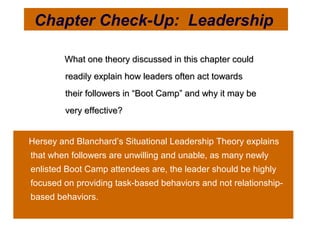
What one theory discussed in this chapter couldWhat one theory discussed in this chapter could
readily explain how leaders often act towardsreadily explain how leaders often act towards
their followers in “Boot Camp” and why it may betheir followers in “Boot Camp” and why it may be
very effective?very effective?
Hersey and Blanchard’s Situational Leadership Theory explains
that when followers are unwilling and unable, as many newly
enlisted Boot Camp attendees are, the leader should be highly
focused on providing task-based behaviors and not relationship-
based behaviors.

Leadership basic approaches

  • 1.
    © 2007 PrenticeHall Inc. All rights reserved. Basic Approaches to Leadership ChapterTWELVE
  • 2.
    © 2007 PrenticeHall Inc. All rights reserved. What Is Leadership?What Is Leadership? Leadership The ability to influence a group toward the achievement of goals. Management Use of authority inherent in designated formal rank to obtain compliance from organizational members.
  • 3.
    © 2007 PrenticeHall Inc. All rights reserved. Trait TheoriesTrait Theories Leadership TraitsLeadership Traits:: • ExtraversionExtraversion • ConscientiousnessConscientiousness • OpennessOpenness • EmotionalEmotional IntelligenceIntelligence (qualified)(qualified) Leadership TraitsLeadership Traits:: • ExtraversionExtraversion • ConscientiousnessConscientiousness • OpennessOpenness • EmotionalEmotional IntelligenceIntelligence (qualified)(qualified) Traits Theories of Leadership Theories that consider personality, social, physical, or intellectual traits to differentiate leaders from nonleaders.
  • 4.
    © 2007 PrenticeHall Inc. All rights reserved. Trait TheoriesTrait Theories LimitationsLimitations:: • No universal traits found that predictNo universal traits found that predict leadership in all situations.leadership in all situations. • Unclear evidence of the cause and effectUnclear evidence of the cause and effect of relationship of leadership and traits.of relationship of leadership and traits. • Better predictor of the appearance ofBetter predictor of the appearance of leadership than distinguishing effectiveleadership than distinguishing effective and ineffective leaders.and ineffective leaders. LimitationsLimitations:: • No universal traits found that predictNo universal traits found that predict leadership in all situations.leadership in all situations. • Unclear evidence of the cause and effectUnclear evidence of the cause and effect of relationship of leadership and traits.of relationship of leadership and traits. • Better predictor of the appearance ofBetter predictor of the appearance of leadership than distinguishing effectiveleadership than distinguishing effective and ineffective leaders.and ineffective leaders.
  • 5.
    Trait ApproachTrait Approach Traits (examples) – Extraversion – Conscientiousness – Openness  Assumption: Leaders are born  Goal: Select leaders  Problems – Traits do not generalize across situations – Better at predicting leader emergence than leader effectiveness
  • 6.
    © 2007 PrenticeHall Inc. All rights reserved. Behavioral TheoriesBehavioral Theories • Behavioral theory:Behavioral theory: LLeadership behaviors can beeadership behaviors can be taught.taught. Vs.Vs. Trait theory:Trait theory: Leaders are born, not made.Leaders are born, not made. • Behavioral theory:Behavioral theory: LLeadership behaviors can beeadership behaviors can be taught.taught. Vs.Vs. Trait theory:Trait theory: Leaders are born, not made.Leaders are born, not made. Behavioral Theories of Leadership Theories proposing that specific behaviors differentiate leaders from nonleaders.
  • 7.
    Behavioral ApproachBehavioral Approach Ohio State Studies/U. of Michigan – Initiating Structure/Production Orientation – Consideration/Employee Orientation  Assumption: Leaders can be trained  Goal: Develop leaders  Problem: Effective behaviors do not generalize across situations
  • 8.
    © 2007 PrenticeHall Inc. All rights reserved. Ohio State StudiesOhio State Studies Initiating Structure The extent to which a leader is likely to define and structure his or her role and those of sub- ordinates in the search for goal attainment. Consideration The extent to which a leader is likely to have job relationships characterized by mutual trust, respect for subordinate’s ideas, and regard for their feelings.
  • 9.
    © 2007 PrenticeHall Inc. All rights reserved. University of Michigan StudiesUniversity of Michigan Studies Employee-Oriented Leader Emphasizing interpersonal relations; taking a personal interest in the needs of employees and accepting individual differences among members. Production-Oriented Leader One who emphasizes technical or task aspects of the job.
  • 10.
    © 2007 PrenticeHall Inc. All rights reserved. The Managerial Grid (Blake and Mouton) The Managerial Grid (Blake and Mouton) E X H I B I T 12–1 E X H I B I T 12–1
  • 11.
    © 2007 PrenticeHall Inc. All rights reserved. CONTINGENCY THEORIESCONTINGENCY THEORIES  All Consider the Situation – Fiedler’s Contingency Model – Cognitive Resource Theory – Hersey and Blanchard’s Situational Leadership Model – Path Goal Theory Assumptions underlying the different models: Fiedler: Leader’s style is fixed Other’s: Leader’s style can and should be changed
  • 12.
    Fiedler ModelFiedler Model Leader: Style is Fixed (Task oriented vs. Relationship oriented)  Considers Situational Favorableness for Leader – Leader-member relations – Task structure – Position power  Key Assumption – Leader must fit situation; options to accomplish this: – Select leader to fit situation – Change situation to fit leader
  • 13.
    © 2007 PrenticeHall Inc. All rights reserved. Fiedler’s Model: The LeaderFiedler’s Model: The Leader Least Preferred Co-Worker (LPC) Questionnaire The way in which a leader will evaluate a co-worker that is not liked will indicate whether the leader is task- or relationship-oriented. Assumption: Leader’s Style is Fixed & Can be Measured by the Least Preferred Co- Worker (LPC) Questionnaire
  • 14.
    © 2007 PrenticeHall Inc. All rights reserved. Fiedler’s Model: Defining the SituationFiedler’s Model: Defining the Situation Leader-Member Relations The degree of confidence, trust, and respect subordinates have in their leader. Position Power Influence derived from one’s formal structural position in the organization; includes power to hire, fire, discipline, promote, and give salary increases. Task Structure The degree to which the job assignments are procedurized.
  • 15.
    Findings of theFiedler ModelFindings of the Fiedler Model • Category • Leader-Member Relations • Task Structure • Position Power I Good High Strong II Good High Weak III Good Low Strong IV Good Low Weak V Poor High Strong VI Poor High Weak VII Poor Low Strong VIII Poor Low Weak Good Poor Performance Relationship -Oriented Task-Oriented Favorable Moderate Unfavorable
  • 16.
    © 2007 PrenticeHall Inc. All rights reserved. Findings from Fiedler ModelFindings from Fiedler Model E X H I B I T 12–2 E X H I B I T 12–2
  • 17.
    © 2007 PrenticeHall Inc. All rights reserved. Cognitive Resource TheoryCognitive Resource Theory Research Support: • Less intelligent individuals perform better in leadership roles under high stress than do more intelligent individuals. • Less experienced people perform better in leadership roles under low stress than do more experienced people. Research Support: • Less intelligent individuals perform better in leadership roles under high stress than do more intelligent individuals. • Less experienced people perform better in leadership roles under low stress than do more experienced people. Cognitive Resource Theory A theory of leadership that states that the level of stress in a situation is what impacts whether a leader’s intelligence or experience will be more effective.
  • 18.
    Contingency Approach: Hersey& Blanchard Situational Model Contingency Approach: Hersey & Blanchard Situational Model  Considers Leader Behaviors (Task & Relationship) – Assumes Leaders CAN change their behaviors  Considers Followers as the Situation – Follower Task maturity (ability & experience) – Follower Psychological maturity (willingness to take responsibility) Assumptions –Leaders can and should change their style to fit their followers’ degree of readiness (willingness and ability) –Therefore, it is possible to TRAIN leaders to better fit their style to their followers.
  • 19.
    © 2007 PrenticeHall Inc. All rights reserved. Hersey and Blanchard’s Situational Leadership Theory Hersey and Blanchard’s Situational Leadership Theory Situational Leadership Theory (SLT) A contingency theory that focuses on followers’ readiness; the more “ready” the followers (the more willing and able) the less the need for leader support and supervision. LOW Amount of Follower Readiness HIGH Amount of Leader Support & Supervision RequiredHIGH LOW
  • 20.
    © 2007 PrenticeHall Inc. All rights reserved. Leadership Styles and Follower Readiness (Hersey and Blanchard) Leadership Styles and Follower Readiness (Hersey and Blanchard) WillingUnwilling Able Unable DirectiveDirective High TaskHigh Task andand RelationshipRelationship OrientationsOrientations SupportiveSupportive ParticipativeParticipative MonitoringMonitoring Follower Readiness LeadershipLeadership StylesStyles
  • 21.
    © 2007 PrenticeHall Inc. All rights reserved. Leader–Member Exchange TheoryLeader–Member Exchange Theory Leader-Member Exchange (LMX) Theory •Leaders select certain followers to be “in” (favorites) Based on competence and/or compatibility & similarity to leader •“Exchanges” with these “In” followers will be higher quality than with those who are “Out” •RESULT: “In” subordinates will have higher performance ratings, less turnover, and greater job satisfaction
  • 22.
    © 2007 PrenticeHall Inc. All rights reserved. Leader-Member Exchange TheoryLeader-Member Exchange Theory E X H I B I T 12–3 E X H I B I T 12–3
  • 23.
    © 2007 PrenticeHall Inc. All rights reserved. Path-Goal TheoryPath-Goal Theory Premise • Leader must help followers attaining goals and reduce roadblocks to success •Leaders must change behaviors to fit the situation (environmental contingencies & subordinate contingencies)
  • 24.
    © 2007 PrenticeHall Inc. All rights reserved. The Path-Goal TheoryThe Path-Goal Theory E X H I B I T 12–4 E X H I B I T 12–4
  • 25.
    © 2007 PrenticeHall Inc. All rights reserved. Leader-Participation ModelLeader-Participation Model Premise: •Rule based decision tree to guide leaders about when and when not to include subordinate participation in decision making •Considers 12 contingency variables to consider whether or not to include subordinates in decision making
  • 26.
    © 2007 PrenticeHall Inc. All rights reserved. Contingency Variables in the Revised Leader-Participation Model Contingency Variables in the Revised Leader-Participation Model E X H I B I T 12–5 E X H I B I T 12–5 1. Importance of the decision 2. Importance of obtaining follower commitment to the decision 3. Whether the leader has sufficient information to make a good decision 4. How well structured the problem is 5. Whether an autocratic decision would receive follower commitment 6. Whether followers “buy into” the organization’s goals 7. Whether there is likely to be conflict among followers over solution alternatives 8. Whether followers have the necessary information to make a good decision 9. Time constraints on the leader that may limit follower involvement 10. Whether costs to bring geographically dispersed members together is justified 11. Importance to the leader of minimizing the time it takes to make the decision 12. Importance of using participation as a tool for developing follower decision skills
  • 27.
    © 2007 PrenticeHall Inc. All rights reserved. Which leadership theory (ies) say(s) that a leader cannot be trained? Ohio State ModelOhio State Model Fiedler’s Contingency TheoryFiedler’s Contingency Theory U. Of Michigan StudiesU. Of Michigan Studies Path Goal TheoryPath Goal Theory All of the aboveAll of the above Chapter Check-Up: Leadership
  • 28.
    © 2007 PrenticeHall Inc. All rights reserved. Which leadership theory (ies) say(s) that a leader cannot be trained? Chapter Check-Up: Leadership Fielder’s Contingency Theory is the only one which says a leader’s style is fixed and cannot be trained. But, what do all of the theories above have in common? Ohio State ModelOhio State Model Fiedler’s Contingency TheoryFiedler’s Contingency Theory U. Of Michigan StudiesU. Of Michigan Studies Path Goal TheoryPath Goal Theory All of the aboveAll of the above
  • 29.
    © 2007 PrenticeHall Inc. All rights reserved. Chapter Check-Up: Leadership What one theory discussed in this chapter couldWhat one theory discussed in this chapter could readily explain how leaders often act towardsreadily explain how leaders often act towards their followers in “Boot Camp” and why it may betheir followers in “Boot Camp” and why it may be very effective?very effective? Hersey and Blanchard’s Situational Leadership Theory explains that when followers are unwilling and unable, as many newly enlisted Boot Camp attendees are, the leader should be highly focused on providing task-based behaviors and not relationship- based behaviors.

Editor's Notes

  • #16 Fiedler asserts that if the leader’s style matches the situation, he or she will be effective. His model predicts that low-LPC, task motivated leaders will be effective in high and low situational control. High-LPC, relationship motivated leaders will be effective in moderate situational control. The Fiedler model has several practical implications for managers: Leaders must understand their style and the situation. Leaders should focus on changing the situation to match their style. A good relationship with followers can compensate for a lack of power. Leaders can compensate for task ambiguity through training and experience.