GROUP BEHAVIOUR
Presented by….
Lokesh Irabatti
Roll No. – G17
Div - A
1
MAEER's MIT College Of Management,
Pune
• Two or more individuals
• Interacting and interdependent
• Who has come together to achieve organizational
goals
2
MAEER's MIT College Of Management,
Pune
group
Formal group
Informal
group
3
MAEER's MIT College Of Management,
Pune
Formal group
• Defined by organisation structure
• Designated with work assignments.
4
MAEER's MIT College Of Management,
Pune
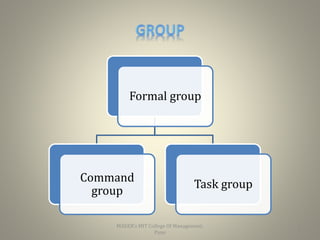
Formal group
Command
group
Task group
5
MAEER's MIT College Of Management,
Pune
Command group
• Relatively permanent
• Functional reporting relationship such as having
both a group manager and those who report to
the manager.
• Included in organization chart.
• Ex: A manager and his or her immediate
subordinate.
6
MAEER's MIT College Of Management,
Pune
Task group
• Relatively temporary
• Created to do a specific task
• Ex: Search committee for a new school
superintendent, Task force on new product quality
7
MAEER's MIT College Of Management,
Pune
• Created by mutual alliances
• Not formally structured
• Not organizationally determined
• Appear in response to the need for social
contact
8
MAEER's MIT College Of Management,
Pune
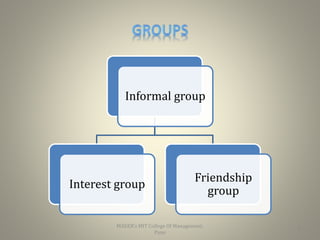
Informal group
Interest group
Friendship
group
9
MAEER's MIT College Of Management,
Pune
Interest group
• Those working together to attain a specific
objective with which each is concerned
• Relatively temporary
• Organised around a common activity or interest of
its members
10
MAEER's MIT College Of Management,
Pune
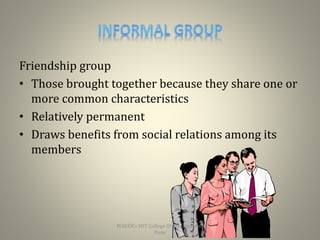
Friendship group
• Those brought together because they share one or
more common characteristics
• Relatively permanent
• Draws benefits from social relations among its
members
11
MAEER's MIT College Of Management,
Pune
1
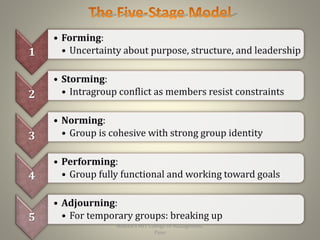
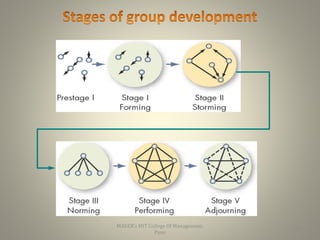
• Forming:
• Uncertainty about purpose, structure, and leadership
2
• Storming:
• Intragroup conflict as members resist constraints
3
• Norming:
• Group is cohesive with strong group identity
4
• Performing:
• Group fully functional and working toward goals
5
• Adjourning:
• For temporary groups: breaking up
12
MAEER's MIT College Of Management,
Pune
13
MAEER's MIT College Of Management,
Pune
• It shapes the behaviour of members in a
work group
• Predict individual behaviour within the
group
• Predict performance of the group
14
MAEER's MIT College Of Management,
Pune
• Roles
• Norms
• Status
• Size
• Cohesiveness
15
MAEER's MIT College Of Management,
Pune
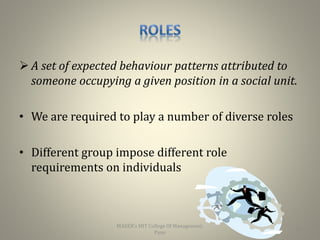
 A set of expected behaviour patterns attributed to
someone occupying a given position in a social unit.
• We are required to play a number of diverse roles
• Different group impose different role
requirements on individuals
16
MAEER's MIT College Of Management,
Pune
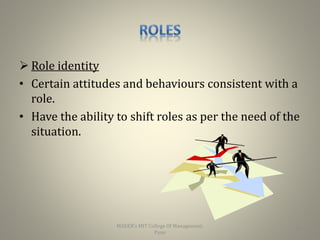
 Role identity
• Certain attitudes and behaviours consistent with a
role.
• Have the ability to shift roles as per the need of the
situation.
17
MAEER's MIT College Of Management,
Pune
 Role Perception
• An individual’s view of how he or she is supposed to
act in a given situation.
 Roles Expectation
• How others believe a person should act in a given
situation.
 Role conflict
• A situation in which an individual is confronted by
divergent role expectations.
18
MAEER's MIT College Of Management,
Pune
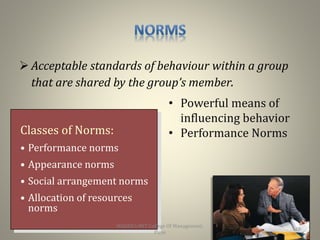
 Acceptable standards of behaviour within a group
that are shared by the group’s member.
Classes of Norms:
• Performance norms
• Appearance norms
• Social arrangement norms
• Allocation of resources
norms
• Powerful means of
influencing behavior
• Performance Norms
19
MAEER's MIT College Of Management,
Pune
• A socially defined position or rank given to groups
or group members by others.
What determines status?
• Status derived from one of three sources:
1.The power a person wields over others
2.A person’s ability to contribute to group’s goals
3.Individual’s personal characteristics
20
MAEER's MIT College Of Management,
Pune
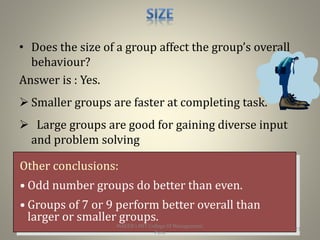
• Does the size of a group affect the group’s overall
behaviour?
Answer is : Yes.
 Smaller groups are faster at completing task.
 Large groups are good for gaining diverse input
and problem solving
Other conclusions:
• Odd number groups do better than even.
• Groups of 7 or 9 perform better overall than
larger or smaller groups.
21
MAEER's MIT College Of Management,
Pune
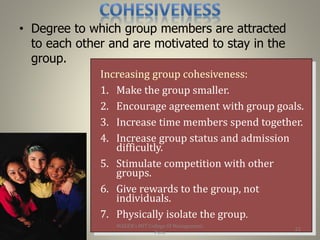
• Degree to which group members are attracted
to each other and are motivated to stay in the
group.
Increasing group cohesiveness:
1. Make the group smaller.
2. Encourage agreement with group goals.
3. Increase time members spend together.
4. Increase group status and admission
difficultly.
5. Stimulate competition with other
groups.
6. Give rewards to the group, not
individuals.
7. Physically isolate the group.
22
MAEER's MIT College Of Management,
Pune
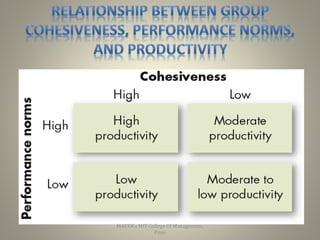
23
MAEER's MIT College Of Management,
Pune
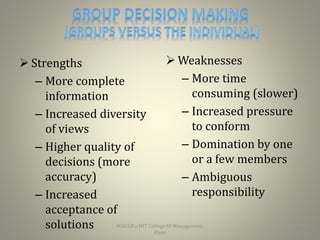
 Strengths
– More complete
information
– Increased diversity
of views
– Higher quality of
decisions (more
accuracy)
– Increased
acceptance of
solutions
 Weaknesses
– More time
consuming (slower)
– Increased pressure
to conform
– Domination by one
or a few members
– Ambiguous
responsibility
24
MAEER's MIT College Of Management,
Pune
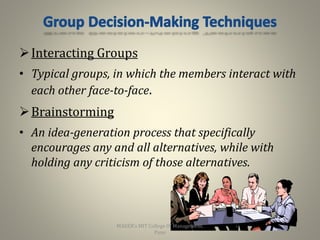
Interacting Groups
• Typical groups, in which the members interact with
each other face-to-face.
Brainstorming
• An idea-generation process that specifically
encourages any and all alternatives, while with
holding any criticism of those alternatives.
25
MAEER's MIT College Of Management,
Pune
 The process:
• The group leader states the problem clearly.
• Members then “free-wheel” as many alternatives
as they can in a given length of time.
• No criticism is allowed, and all the alternatives are
recorded for later discussion and analysis.
• One idea stimulates others, and group members
are encouraged to “think the unusual.”
26
MAEER's MIT College Of Management,
Pune
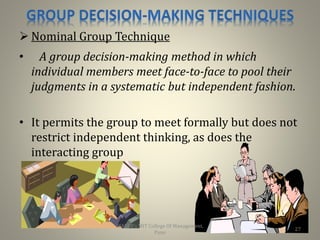
 Nominal Group Technique
• A group decision-making method in which
individual members meet face-to-face to pool their
judgments in a systematic but independent fashion.
• It permits the group to meet formally but does not
restrict independent thinking, as does the
interacting group
27
MAEER's MIT College Of Management,
Pune
 Electronic Meeting
• A meeting in which members interact on computers,
allowing for anonymity of comments and aggregation of
votes
• The major advantages of electronic meetings are
anonymity, honesty, and speed.
• Essentials of Organizational Behavior, 10/e
• Stephen P. Robbins & Timothy A. Judge
28
MAEER's MIT College Of Management,
Pune
29
MAEER's MIT College Of Management,
Pune

Group behaviour ppt

  • 1.
    GROUP BEHAVIOUR Presented by…. LokeshIrabatti Roll No. – G17 Div - A 1 MAEER's MIT College Of Management, Pune
  • 2.
    • Two ormore individuals • Interacting and interdependent • Who has come together to achieve organizational goals 2 MAEER's MIT College Of Management, Pune
  • 3.
  • 4.
    Formal group • Definedby organisation structure • Designated with work assignments. 4 MAEER's MIT College Of Management, Pune
  • 5.
    Formal group Command group Task group 5 MAEER'sMIT College Of Management, Pune
  • 6.
    Command group • Relativelypermanent • Functional reporting relationship such as having both a group manager and those who report to the manager. • Included in organization chart. • Ex: A manager and his or her immediate subordinate. 6 MAEER's MIT College Of Management, Pune
  • 7.
    Task group • Relativelytemporary • Created to do a specific task • Ex: Search committee for a new school superintendent, Task force on new product quality 7 MAEER's MIT College Of Management, Pune
  • 8.
    • Created bymutual alliances • Not formally structured • Not organizationally determined • Appear in response to the need for social contact 8 MAEER's MIT College Of Management, Pune
  • 9.
  • 10.
    Interest group • Thoseworking together to attain a specific objective with which each is concerned • Relatively temporary • Organised around a common activity or interest of its members 10 MAEER's MIT College Of Management, Pune
  • 11.
    Friendship group • Thosebrought together because they share one or more common characteristics • Relatively permanent • Draws benefits from social relations among its members 11 MAEER's MIT College Of Management, Pune
  • 12.
    1 • Forming: • Uncertaintyabout purpose, structure, and leadership 2 • Storming: • Intragroup conflict as members resist constraints 3 • Norming: • Group is cohesive with strong group identity 4 • Performing: • Group fully functional and working toward goals 5 • Adjourning: • For temporary groups: breaking up 12 MAEER's MIT College Of Management, Pune
  • 13.
    13 MAEER's MIT CollegeOf Management, Pune
  • 14.
    • It shapesthe behaviour of members in a work group • Predict individual behaviour within the group • Predict performance of the group 14 MAEER's MIT College Of Management, Pune
  • 15.
    • Roles • Norms •Status • Size • Cohesiveness 15 MAEER's MIT College Of Management, Pune
  • 16.
     A setof expected behaviour patterns attributed to someone occupying a given position in a social unit. • We are required to play a number of diverse roles • Different group impose different role requirements on individuals 16 MAEER's MIT College Of Management, Pune
  • 17.
     Role identity •Certain attitudes and behaviours consistent with a role. • Have the ability to shift roles as per the need of the situation. 17 MAEER's MIT College Of Management, Pune
  • 18.
     Role Perception •An individual’s view of how he or she is supposed to act in a given situation.  Roles Expectation • How others believe a person should act in a given situation.  Role conflict • A situation in which an individual is confronted by divergent role expectations. 18 MAEER's MIT College Of Management, Pune
  • 19.
     Acceptable standardsof behaviour within a group that are shared by the group’s member. Classes of Norms: • Performance norms • Appearance norms • Social arrangement norms • Allocation of resources norms • Powerful means of influencing behavior • Performance Norms 19 MAEER's MIT College Of Management, Pune
  • 20.
    • A sociallydefined position or rank given to groups or group members by others. What determines status? • Status derived from one of three sources: 1.The power a person wields over others 2.A person’s ability to contribute to group’s goals 3.Individual’s personal characteristics 20 MAEER's MIT College Of Management, Pune
  • 21.
    • Does thesize of a group affect the group’s overall behaviour? Answer is : Yes.  Smaller groups are faster at completing task.  Large groups are good for gaining diverse input and problem solving Other conclusions: • Odd number groups do better than even. • Groups of 7 or 9 perform better overall than larger or smaller groups. 21 MAEER's MIT College Of Management, Pune
  • 22.
    • Degree towhich group members are attracted to each other and are motivated to stay in the group. Increasing group cohesiveness: 1. Make the group smaller. 2. Encourage agreement with group goals. 3. Increase time members spend together. 4. Increase group status and admission difficultly. 5. Stimulate competition with other groups. 6. Give rewards to the group, not individuals. 7. Physically isolate the group. 22 MAEER's MIT College Of Management, Pune
  • 23.
    23 MAEER's MIT CollegeOf Management, Pune
  • 24.
     Strengths – Morecomplete information – Increased diversity of views – Higher quality of decisions (more accuracy) – Increased acceptance of solutions  Weaknesses – More time consuming (slower) – Increased pressure to conform – Domination by one or a few members – Ambiguous responsibility 24 MAEER's MIT College Of Management, Pune
  • 25.
    Interacting Groups • Typicalgroups, in which the members interact with each other face-to-face. Brainstorming • An idea-generation process that specifically encourages any and all alternatives, while with holding any criticism of those alternatives. 25 MAEER's MIT College Of Management, Pune
  • 26.
     The process: •The group leader states the problem clearly. • Members then “free-wheel” as many alternatives as they can in a given length of time. • No criticism is allowed, and all the alternatives are recorded for later discussion and analysis. • One idea stimulates others, and group members are encouraged to “think the unusual.” 26 MAEER's MIT College Of Management, Pune
  • 27.
     Nominal GroupTechnique • A group decision-making method in which individual members meet face-to-face to pool their judgments in a systematic but independent fashion. • It permits the group to meet formally but does not restrict independent thinking, as does the interacting group 27 MAEER's MIT College Of Management, Pune
  • 28.
     Electronic Meeting •A meeting in which members interact on computers, allowing for anonymity of comments and aggregation of votes • The major advantages of electronic meetings are anonymity, honesty, and speed. • Essentials of Organizational Behavior, 10/e • Stephen P. Robbins & Timothy A. Judge 28 MAEER's MIT College Of Management, Pune
  • 29.
    29 MAEER's MIT CollegeOf Management, Pune