


6–1
The Islamia UniversityThe Islamia University
BahawalpurBahawalpurORGANIZATIONAL BEHAVIORORGANIZATIONAL BEHAVIOR
Topic: individual and group decision makingTopic: individual and group decision making
Presented to : Miss Nida MehmoodPresented to : Miss Nida Mehmood
Presented by:Presented by:
Majid Aslam (704)Majid Aslam (704)
Iram Shakeel (702)Iram Shakeel (702)
Usman Bashir (712)Usman Bashir (712)
6–3
Decision MakingDecision Making
• DecisionDecision
 Making a choice from two or more alternatives.Making a choice from two or more alternatives.
 Decision making is a process of selecting the bestDecision making is a process of selecting the best
among the different alternatives. It is the act ofamong the different alternatives. It is the act of
making a choice. There are so many alternativesmaking a choice. There are so many alternatives
found in the organization and departments. Decisionfound in the organization and departments. Decision
making is defined as the selection of choice of onemaking is defined as the selection of choice of one
best alternativebest alternative
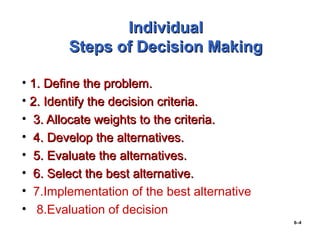
IndividualIndividual
Steps of Decision MakingSteps of Decision Making
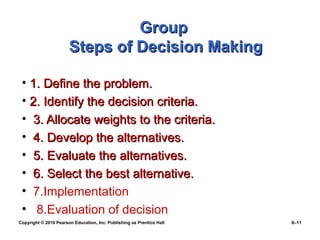
• 1. Define the problem.1. Define the problem.
• 2. Identify the decision criteria.2. Identify the decision criteria.
• 3. Allocate weights to the criteria.3. Allocate weights to the criteria.
• 4. Develop the alternatives.4. Develop the alternatives.
• 5. Evaluate the alternatives.5. Evaluate the alternatives.
• 6. Select the best alternative.6. Select the best alternative.
• 7.Implementation of the best alternative
• 8.Evaluation of decision
6–4
6–5
Step 1: Identifying the ProblemStep 1: Identifying the Problem
• ProblemProblem
 A discrepancy between an existing and desired stateA discrepancy between an existing and desired state
of affairs.of affairs.
• Characteristics of ProblemsCharacteristics of Problems
 A problem becomes a problem when a managerA problem becomes a problem when a manager
becomes aware of it.becomes aware of it.
 There is pressure to solve the problem.There is pressure to solve the problem.
 The manager must have the authority, information, orThe manager must have the authority, information, or
resources needed to solve the problem.resources needed to solve the problem.
6–6
Step 2: Identifying Decision CriteriaStep 2: Identifying Decision Criteria
• Once a decision maker has defined the problem,
he or she needs to identify the decision criteria
that will be important in solving the problem. In
this step, the decision maker is determining
what's relevant in making the decision. This step
brings the decision maker’s interests, values,
and personal preferences into the process.
Step 3: Allocating Weights to the CriteriaStep 3: Allocating Weights to the Criteria
The decision-maker weights the previously
identified criteria in order to give them correct
priority in the decision
6–7
Step 4: Developing AlternativesStep 4: Developing Alternatives
• Identifying viable alternativesIdentifying viable alternatives
 Alternatives are listed (without evaluation) that canAlternatives are listed (without evaluation) that can
resolve the problem.resolve the problem.
Step 5: Analyzing AlternativesStep 5: Analyzing Alternatives
• Appraising each alternative’s strengths andAppraising each alternative’s strengths and
weaknessesweaknesses
 An alternative’s appraisal is based on its ability toAn alternative’s appraisal is based on its ability to
resolve the issues identified in steps 2 and 3.resolve the issues identified in steps 2 and 3.
6–8
Step 6: Selecting an AlternativeStep 6: Selecting an Alternative
• Choosing the best alternativeChoosing the best alternative
• Decides which alternative is-Decides which alternative is-
the most feasible and effectivethe most feasible and effective
less cost to the organizationless cost to the organization
chances of successchances of success
Step 7: Implementing theStep 7: Implementing the
AlternativeAlternative
• Putting the chosen alternative into action.Putting the chosen alternative into action.
 Conveying the decision to and gaining commitmentConveying the decision to and gaining commitment
from those who will carry out the decision.from those who will carry out the decision.
6–9
Step 8: Evaluating the Decision’sStep 8: Evaluating the Decision’s
EffectivenessEffectiveness
• The soundness of the decision is judged by itsThe soundness of the decision is judged by its
outcomes.outcomes.
 How effectively was the problem resolved byHow effectively was the problem resolved by
outcomes resulting from the chosen alternatives?outcomes resulting from the chosen alternatives?
 If the problem was not resolved, what went wrong?If the problem was not resolved, what went wrong?
GROUP DECISION MAKINGGROUP DECISION MAKING
GroupGroup
Steps of Decision MakingSteps of Decision Making
• 1. Define the problem.1. Define the problem.
• 2. Identify the decision criteria.2. Identify the decision criteria.
• 3. Allocate weights to the criteria.3. Allocate weights to the criteria.
• 4. Develop the alternatives.4. Develop the alternatives.
• 5. Evaluate the alternatives.5. Evaluate the alternatives.
• 6. Select the best alternative.6. Select the best alternative.
• 7.Implementation
• 8.Evaluation of decision
Copyright © 2010 Pearson Education, Inc. Publishing as Prentice Hall 6–11
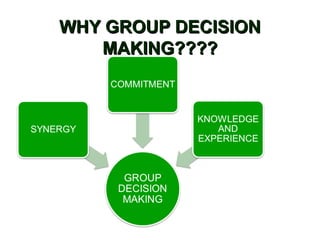
WHY GROUP DECISIONWHY GROUP DECISION
MAKING????MAKING????
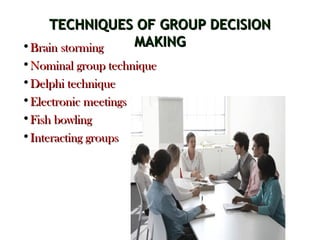
TECHNIQUES OF GROUP DECISIONTECHNIQUES OF GROUP DECISION
MAKINGMAKING•Brain stormingBrain storming
•Nominal group techniqueNominal group technique
•Delphi techniqueDelphi technique
•Electronic meetingsElectronic meetings
•Fish bowlingFish bowling
•Interacting groupsInteracting groups
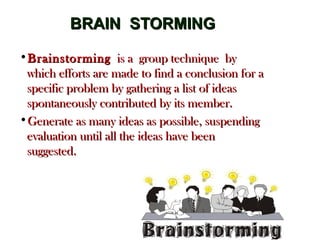
BRAIN STORMINGBRAIN STORMING
•BrainstormingBrainstorming is a group technique by is a group technique by
which efforts are made to find a conclusion for awhich efforts are made to find a conclusion for a
specific problem by gathering a list of ideasspecific problem by gathering a list of ideas
spontaneously contributed by its member.spontaneously contributed by its member.
•Generate as many ideas as possible, suspendingGenerate as many ideas as possible, suspending
evaluation until all the ideas have beenevaluation until all the ideas have been
suggested.suggested.
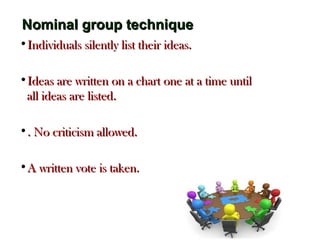
Nominal group techniqueNominal group technique
•Individuals silently list their ideas.Individuals silently list their ideas.
•Ideas are written on a chart one at a time untilIdeas are written on a chart one at a time until
all ideas are listed.all ideas are listed.
•. No criticism allowed.. No criticism allowed.
•A written vote is taken.A written vote is taken.
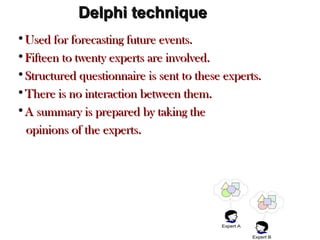
Delphi techniqueDelphi technique
•Used for forecasting future events.Used for forecasting future events.
•Fifteen to twenty experts are involved.Fifteen to twenty experts are involved.
•Structured questionnaire is sent to these experts.Structured questionnaire is sent to these experts.
•There is no interaction between them.There is no interaction between them.
•A summary is prepared by taking theA summary is prepared by taking the
opinions of the experts.opinions of the experts.
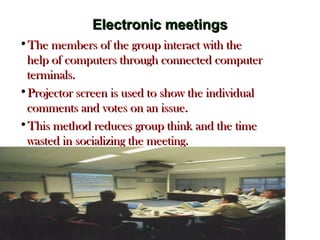
Electronic meetingsElectronic meetings
•The members of the group interact with theThe members of the group interact with the
help of computers through connected computerhelp of computers through connected computer
terminals.terminals.
•Projector screen is used to show the individualProjector screen is used to show the individual
comments and votes on an issue.comments and votes on an issue.
•This method reduces group think and the timeThis method reduces group think and the time
wasted in socializing the meeting.wasted in socializing the meeting.
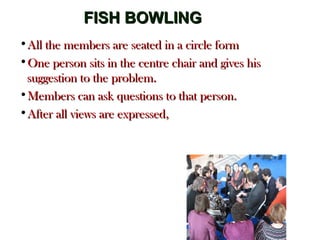
FISH BOWLINGFISH BOWLING
•All the members are seated in a circle formAll the members are seated in a circle form
•One person sits in the centre chair and gives hisOne person sits in the centre chair and gives his
suggestion to the problem.suggestion to the problem.
•Members can ask questions to that person.Members can ask questions to that person.
•After all views are expressed,After all views are expressed,
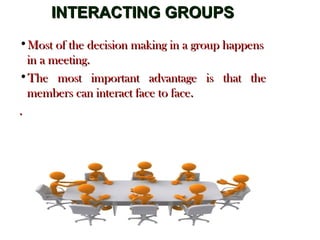
INTERACTING GROUPSINTERACTING GROUPS
•Most of the decision making in a group happensMost of the decision making in a group happens
in a meeting.in a meeting.
•The most important advantage is that theThe most important advantage is that the
members can interact face to face.members can interact face to face.
..
Individual and group decision making

Individual and group decision making

  • 1.
  • 2.
    The Islamia UniversityTheIslamia University BahawalpurBahawalpurORGANIZATIONAL BEHAVIORORGANIZATIONAL BEHAVIOR Topic: individual and group decision makingTopic: individual and group decision making Presented to : Miss Nida MehmoodPresented to : Miss Nida Mehmood Presented by:Presented by: Majid Aslam (704)Majid Aslam (704) Iram Shakeel (702)Iram Shakeel (702) Usman Bashir (712)Usman Bashir (712)
  • 3.
    6–3 Decision MakingDecision Making •DecisionDecision  Making a choice from two or more alternatives.Making a choice from two or more alternatives.  Decision making is a process of selecting the bestDecision making is a process of selecting the best among the different alternatives. It is the act ofamong the different alternatives. It is the act of making a choice. There are so many alternativesmaking a choice. There are so many alternatives found in the organization and departments. Decisionfound in the organization and departments. Decision making is defined as the selection of choice of onemaking is defined as the selection of choice of one best alternativebest alternative
  • 4.
    IndividualIndividual Steps of DecisionMakingSteps of Decision Making • 1. Define the problem.1. Define the problem. • 2. Identify the decision criteria.2. Identify the decision criteria. • 3. Allocate weights to the criteria.3. Allocate weights to the criteria. • 4. Develop the alternatives.4. Develop the alternatives. • 5. Evaluate the alternatives.5. Evaluate the alternatives. • 6. Select the best alternative.6. Select the best alternative. • 7.Implementation of the best alternative • 8.Evaluation of decision 6–4
  • 5.
    6–5 Step 1: Identifyingthe ProblemStep 1: Identifying the Problem • ProblemProblem  A discrepancy between an existing and desired stateA discrepancy between an existing and desired state of affairs.of affairs. • Characteristics of ProblemsCharacteristics of Problems  A problem becomes a problem when a managerA problem becomes a problem when a manager becomes aware of it.becomes aware of it.  There is pressure to solve the problem.There is pressure to solve the problem.  The manager must have the authority, information, orThe manager must have the authority, information, or resources needed to solve the problem.resources needed to solve the problem.
  • 6.
    6–6 Step 2: IdentifyingDecision CriteriaStep 2: Identifying Decision Criteria • Once a decision maker has defined the problem, he or she needs to identify the decision criteria that will be important in solving the problem. In this step, the decision maker is determining what's relevant in making the decision. This step brings the decision maker’s interests, values, and personal preferences into the process. Step 3: Allocating Weights to the CriteriaStep 3: Allocating Weights to the Criteria The decision-maker weights the previously identified criteria in order to give them correct priority in the decision
  • 7.
    6–7 Step 4: DevelopingAlternativesStep 4: Developing Alternatives • Identifying viable alternativesIdentifying viable alternatives  Alternatives are listed (without evaluation) that canAlternatives are listed (without evaluation) that can resolve the problem.resolve the problem. Step 5: Analyzing AlternativesStep 5: Analyzing Alternatives • Appraising each alternative’s strengths andAppraising each alternative’s strengths and weaknessesweaknesses  An alternative’s appraisal is based on its ability toAn alternative’s appraisal is based on its ability to resolve the issues identified in steps 2 and 3.resolve the issues identified in steps 2 and 3.
  • 8.
    6–8 Step 6: Selectingan AlternativeStep 6: Selecting an Alternative • Choosing the best alternativeChoosing the best alternative • Decides which alternative is-Decides which alternative is- the most feasible and effectivethe most feasible and effective less cost to the organizationless cost to the organization chances of successchances of success Step 7: Implementing theStep 7: Implementing the AlternativeAlternative • Putting the chosen alternative into action.Putting the chosen alternative into action.  Conveying the decision to and gaining commitmentConveying the decision to and gaining commitment from those who will carry out the decision.from those who will carry out the decision.
  • 9.
    6–9 Step 8: Evaluatingthe Decision’sStep 8: Evaluating the Decision’s EffectivenessEffectiveness • The soundness of the decision is judged by itsThe soundness of the decision is judged by its outcomes.outcomes.  How effectively was the problem resolved byHow effectively was the problem resolved by outcomes resulting from the chosen alternatives?outcomes resulting from the chosen alternatives?  If the problem was not resolved, what went wrong?If the problem was not resolved, what went wrong?
  • 10.
  • 11.
    GroupGroup Steps of DecisionMakingSteps of Decision Making • 1. Define the problem.1. Define the problem. • 2. Identify the decision criteria.2. Identify the decision criteria. • 3. Allocate weights to the criteria.3. Allocate weights to the criteria. • 4. Develop the alternatives.4. Develop the alternatives. • 5. Evaluate the alternatives.5. Evaluate the alternatives. • 6. Select the best alternative.6. Select the best alternative. • 7.Implementation • 8.Evaluation of decision Copyright © 2010 Pearson Education, Inc. Publishing as Prentice Hall 6–11
  • 12.
    WHY GROUP DECISIONWHYGROUP DECISION MAKING????MAKING????
  • 13.
    TECHNIQUES OF GROUPDECISIONTECHNIQUES OF GROUP DECISION MAKINGMAKING•Brain stormingBrain storming •Nominal group techniqueNominal group technique •Delphi techniqueDelphi technique •Electronic meetingsElectronic meetings •Fish bowlingFish bowling •Interacting groupsInteracting groups
  • 14.
    BRAIN STORMINGBRAIN STORMING •BrainstormingBrainstorming isa group technique by is a group technique by which efforts are made to find a conclusion for awhich efforts are made to find a conclusion for a specific problem by gathering a list of ideasspecific problem by gathering a list of ideas spontaneously contributed by its member.spontaneously contributed by its member. •Generate as many ideas as possible, suspendingGenerate as many ideas as possible, suspending evaluation until all the ideas have beenevaluation until all the ideas have been suggested.suggested.
  • 15.
    Nominal group techniqueNominalgroup technique •Individuals silently list their ideas.Individuals silently list their ideas. •Ideas are written on a chart one at a time untilIdeas are written on a chart one at a time until all ideas are listed.all ideas are listed. •. No criticism allowed.. No criticism allowed. •A written vote is taken.A written vote is taken.
  • 16.
    Delphi techniqueDelphi technique •Usedfor forecasting future events.Used for forecasting future events. •Fifteen to twenty experts are involved.Fifteen to twenty experts are involved. •Structured questionnaire is sent to these experts.Structured questionnaire is sent to these experts. •There is no interaction between them.There is no interaction between them. •A summary is prepared by taking theA summary is prepared by taking the opinions of the experts.opinions of the experts.
  • 17.
    Electronic meetingsElectronic meetings •Themembers of the group interact with theThe members of the group interact with the help of computers through connected computerhelp of computers through connected computer terminals.terminals. •Projector screen is used to show the individualProjector screen is used to show the individual comments and votes on an issue.comments and votes on an issue. •This method reduces group think and the timeThis method reduces group think and the time wasted in socializing the meeting.wasted in socializing the meeting.
  • 18.
    FISH BOWLINGFISH BOWLING •Allthe members are seated in a circle formAll the members are seated in a circle form •One person sits in the centre chair and gives hisOne person sits in the centre chair and gives his suggestion to the problem.suggestion to the problem. •Members can ask questions to that person.Members can ask questions to that person. •After all views are expressed,After all views are expressed,
  • 19.
    INTERACTING GROUPSINTERACTING GROUPS •Mostof the decision making in a group happensMost of the decision making in a group happens in a meeting.in a meeting. •The most important advantage is that theThe most important advantage is that the members can interact face to face.members can interact face to face. ..