DCE 5632 ORGANIZATIONAL  DIAGNOSIS  PUGANESHWARI D/O AKAMBARAM (GS 26998) HEMALATHA  d/o KRISHNAN (GS 27748) VIDHUBALA D/O BALASEGAR (GS 27947) Roohangiz Karimi (GS 28300)
INTRODUCTION Organizational diagnosis includes the compilation of information on the organization and its employees, the interrelations between the employees and the organization, and the manner in which the organization is perceived by management and employees. Organizational diagnosis reflects the organizational portrait at various dimensions (longitudinal and latitudinal) and it can be applied toward the definition of goals and objectives within the process of organizational change and development. The diagnostic process is the first stage toward realizing the goals of the organization managers in the implementation of change and introduction of innovation. The organizational diagnosis utilizes existing models and others, which were developed by the Company. The tool used in order to perform the diagnosis is adjusted to the needs specified by the organization. In any event of organizational diagnosis, the Company also addresses functional dimensions of the organization, such as: defining the organization's mission, structure, position holders, as well as symbolic dimensions, such as rituals and their significance, special terminology, etc.
DEFINITION   Organization Diagnosis(OD) determine ‘what is’ and ‘what could’ it seeks way to bridge the gap. It consists of planning to collect data,data collection ,analysis feedback to the organization, it for the basis for determine subsequent intervention (action planning and action taking). The diagnosis can focus on the organization overall or on specific aspect such as organization culture(Roger & Byham 1994) or aspect of diversity (Harrison & Shirom 1999).They also suggest that one ’’start with abroad scan of an organization challenges but close up examination (p 18)
Diagnosis Models . DESCRIPTIVE MODELS With descriptive models, the role of the OD practitioner is to illuminate “what is” for the client, and “what could be”.  The client determines the direction of change and the OD practitioner helps the client get there. Most diagnostic models fit under the “descriptive” category. Examples include: Bolman and Deal:  Four Frames Model Freedman:  Socio-technical Systems Model Galbraith:  Star Model Hornstein and Tichy:  Emergent Pragmatic Model McKinsey:  7-S Model Nadler and Tushman:  Congruence Mode
NORMATIVE MODELS With normative models, the practitioner recommends specific directions for change, prior to the diagnosis – the “one best way of managing.” Examples include: Blake and Mouton’s Grid [Concern for People/Concern for Productivity 9, 9]. Likert’s Profiles Organizational Theorists and consultants have developed a wide variety of models identifying important organizational elements and their interrelationships. Each is predicated on a particular theory/theories or perspective(s), and each intended to highlight and bring into focus a broad range of data and experience for purposes of diagnosis and intervention
Most of the models suggest interaction or interrelationships among all the selected variables. Many of the same variables are contained in all the models, although not necessarily in the same way or with the same emphasis
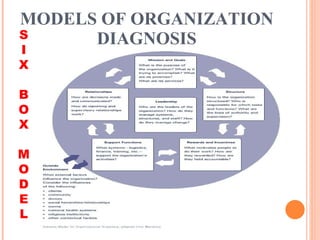
MODELS OF ORGANIZATION DIAGNOSIS S I X B O X M O D E L
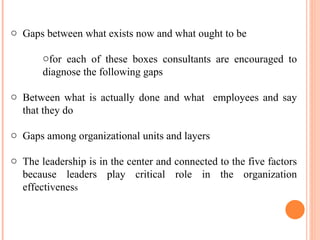
Gaps between what exists now and what ought to be for each of these boxes consultants are encouraged to diagnose the following gaps Between what is actually done and what  employees and say that they do Gaps among organizational units and layers The leadership is in the center and connected to the five factors because leaders play critical role in the organization effectivenes s
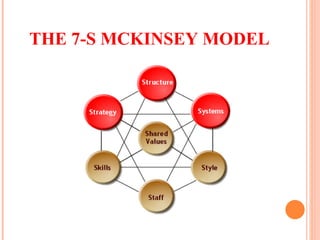
THE 7-S MCKINSEY MODEL
McKinsey Consulting developed a model for looking at organizations. The 7 S’s Model provides an especially useful framework for reviewing the impact of change:- Shared Values and Beliefs:  A role of the vision statement is to impart to the organization (and externally) what the organization stands for and what it believes in. Strategy:  States how an organization will attain its vision and respond to the threats and opportunities of the new mediums. Capabilities are needed in:marketing, distribution, product and service development, business requirements analysis; creation and management of alliances & partnerships. Systems, including Processes:  Capabilities are required in: IT & IS, sales and service, legal, actuarial. Staff:  HR management for developing the skills and aptitude for building lifetime customer relationships. Needed are policies, standards and processes re: recruitment, training & development, motivation & regards.
Style:  This refers to the management style best suited for the organization. The challenge for management is to use appropriate styles for the situation without confusing staff. Structure:  Organizations will find that changes to processes and style inevitably require changes to their structure. (e.g. centralized, decentralized, network, matrix, process structures.) Skills:  The degree to which necessary skills exist is the core of workforce planning and often a major aspect in organization diagnosis. If staff and managers are to acquire all the skills outlined above, then there needs to be an appropriate learning environment.
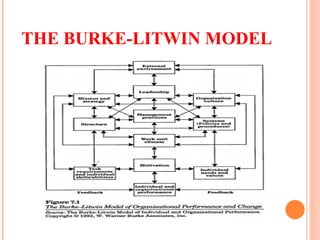
THE BURKE-LITWIN MODEL
This model shows the causal changes between 12 key areas  Can be used to  learn which organizational variables to change and why can be used to analyze , diagnose and even predict the effects of change throughout an organization Burke believes that organizational change stems from environmental impact than from any other factor. External environment, mission and strategy, leadership and organizational culture as the primary levers for change The remaining elements are used as levers for fine tuning and improving the existing behavior
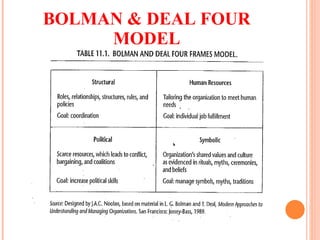
BOLMAN & DEAL FOUR MODEL
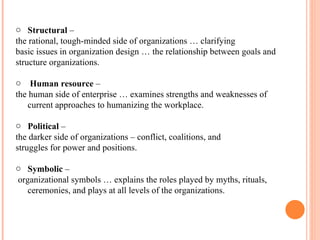
Structural  –  the rational, tough-minded side of organizations … clarifying basic issues in organization design … the relationship between goals and structure organizations. Human resource  –  the human side of enterprise … examines strengths and weaknesses of current approaches to humanizing the workplace. Political  –  the darker side of organizations – conflict, coalitions, and struggles for power and positions. Symbolic  – organizational symbols … explains the roles played by myths, rituals, ceremonies, and plays at all levels of the organizations.
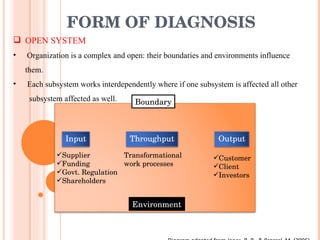
FORM OF DIAGNOSIS OPEN SYSTEM Organization is a complex and open: their boundaries and environments influence them. Each subsystem works interdependently where if one subsystem is affected all other    subsystem affected as well. Diagram adapted from Jones, B. B., & Brazzel, M. (2006) Boundary Environment Input Throughput Output Supplier Funding Govt. Regulation Shareholders Transformational work processes Customer Client Investors
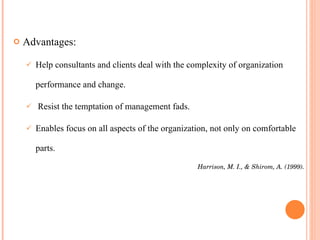
Advantages: Help consultants and clients deal with the complexity of organization  performance and change. Resist the temptation of management fads. Enables focus on all aspects of the organization, not only on comfortable parts. Harrison, M. I., & Shirom, A. (1999).
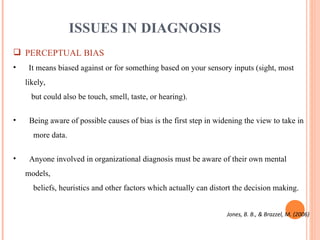
ISSUES IN DIAGNOSIS PERCEPTUAL BIAS It means  biased against or for something based on your sensory inputs (sight, most likely,    but could also be touch, smell, taste, or hearing). Being aware of possible causes of bias is the first step in widening the view to take in    more data. Anyone involved in organizational diagnosis must be aware of their own mental models,    beliefs, heuristics and other factors which actually can distort the decision making. Jones, B. B., & Brazzel, M. (2006)
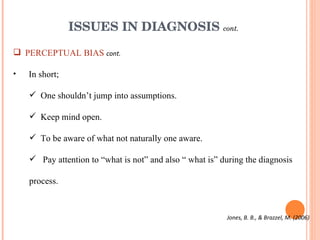
ISSUES IN DIAGNOSIS  cont. PERCEPTUAL BIAS  cont. In short; One shouldn’t jump into assumptions. Keep mind open. To be aware of what not naturally one aware. Pay attention to “what is not” and also “ what is” during the diagnosis process.  Jones, B. B., & Brazzel, M. (2006)
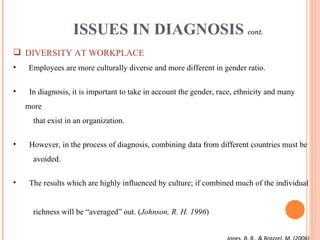
ISSUES IN DIAGNOSIS  cont. DIVERSITY AT WORKPLACE Employees are more culturally diverse and more different in gender ratio. In diagnosis, it is important to take in account the gender, race, ethnicity and many more    that exist in an organization. However, in the process of diagnosis, combining data from different countries must be    avoided. The results which are highly influenced by culture; if combined much of the individual    richness will be “averaged” out. ( Johnson, R. H. 1996 )  Jones, B. B., & Brazzel, M. (2006)
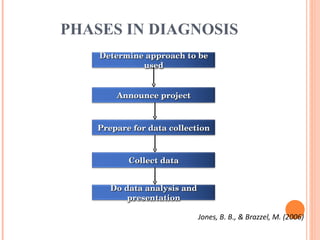
PHASES IN DIAGNOSIS Jones, B. B., & Brazzel, M. (2006) Determine approach to be used Announce project Prepare for data collection Collect data Do data analysis and presentation
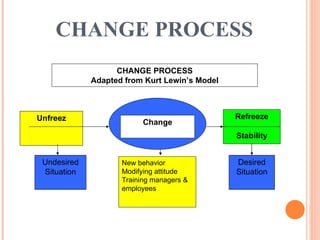
CHANGE PROCESS Unfreez Refreeze Stability Change CHANGE PROCESS Adapted from Kurt Lewin’s Model New behavior Modifying attitude Training managers & employees Desired Situation Undesired Situation
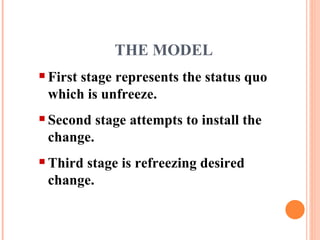
THE MODEL First stage represents the status quo which is unfreeze. Second stage attempts to install the change. Third stage is refreezing desired change.
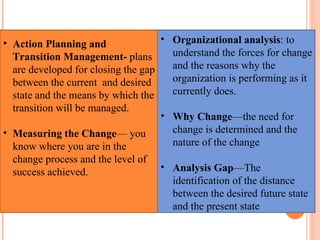
Action Planning and Transition Management-  plans are developed for closing the gap between the current  and desired state and the means by which the transition will be managed. Measuring the Change — you know where you are in the change process and the level of success achieved. Organizational analysis : to understand the forces for change and the reasons why the organization is performing as it currently does. Why Change —the need for change is determined and the nature of the change Analysis Gap —The identification of the distance between the desired future state and the present state
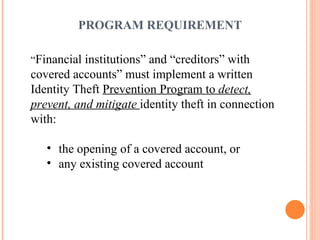
RED FLAG  A   red flag means a pattern, practice or specific activity that indicates the possible existence of identity theft Identify theft means fraud committed or attempted using the identifying information of another person without authority
PROGRAM REQUIREMENT “ Financial institutions” and “creditors” with covered accounts” must implement a written Identity Theft  Prevention Program to  detect, prevent, and mitigate  identity theft in connection with: the opening of a covered account, or any existing covered account
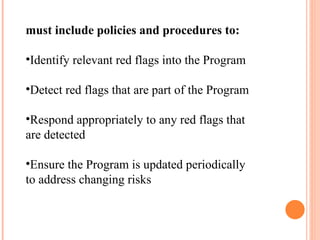
must include policies and procedures to: Identify relevant red flags into the Program Detect red flags that are part of the Program Respond appropriately to any red flags that are detected Ensure the Program is updated periodically to address changing risks
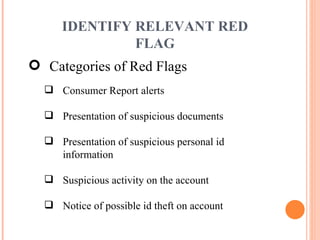
Categories of Red Flags Consumer Report alerts Presentation of suspicious documents Presentation of suspicious personal id information Suspicious activity on the account Notice of possible id theft on account IDENTIFY RELEVANT RED FLAG
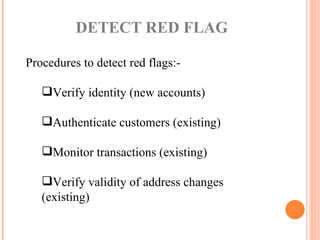
Procedures to detect red flags:- Verify identity (new accounts) Authenticate customers (existing) Monitor transactions (existing) Verify validity of address changes (existing) DETECT RED FLAG
Periodic updating of the Program Changes in methods of id theft; Changes in methods to detect, prevent and mitigate id theft Changes in types of accounts offered or maintained. Changes in business arrangements, services providers, etc. RED FLAG PROGRAM
Appropriate Responses to Red Flags Monitor accounts Contact customer Change passwords Close and reopen account Refuse to open account RESPONDING  TO  RED FLAG
RED FLAGS IN DIAGNOSIS Confidentiality of the data:- The over diagnosis many problems are identified that the diagnosis becomes a rule of continual analysis. The crisis diagnosis Attending only to the immediate, short term crisis. Important but less visible problems are misses .
The threatening or overwhelming diagnosis The client is confronted by problems to the extent that the relationship with the practitioner is damaged. It is difficult for the client to accept so much information and deal with it in any meaningful way. The practitioner’s favorite diagnosis The practitioner imposes a special diagnosis regardless of the problem. The diagnosis may be made to fit the practitioner’s own special skill areas. The diagnosis of symptom
CONCLUSION Organization diagnosis is critical to the organization development process. By gathering the organization information the practitioner is often able to help the client see the organization challenge. This phase and model of organization model creates an organization process system well
REFERENCES  Jones, B. B., & Brazzel, M. (2006).  The NTL handbook of organization development and change: Principles, practices, and perspectives . Pfeiffer & Co. Harrison, M. I., & Shirom, A. (1999).  Organizational diagnosis and assessment: Bridging theory and practice . Sage Publications, Inc. Johnson, R. H. (1996). Life in the consortium: The Mayflower group.  Organizational surveys: Tools for assessment and change , 285–309. Diagnosing Organizations With Impact Kaye Craft & Arty Trost March 29-April 1, 2004
THANK YOU

Organizational diagnosis

  • 1.
    DCE 5632 ORGANIZATIONAL DIAGNOSIS PUGANESHWARI D/O AKAMBARAM (GS 26998) HEMALATHA d/o KRISHNAN (GS 27748) VIDHUBALA D/O BALASEGAR (GS 27947) Roohangiz Karimi (GS 28300)
  • 2.
    INTRODUCTION Organizational diagnosisincludes the compilation of information on the organization and its employees, the interrelations between the employees and the organization, and the manner in which the organization is perceived by management and employees. Organizational diagnosis reflects the organizational portrait at various dimensions (longitudinal and latitudinal) and it can be applied toward the definition of goals and objectives within the process of organizational change and development. The diagnostic process is the first stage toward realizing the goals of the organization managers in the implementation of change and introduction of innovation. The organizational diagnosis utilizes existing models and others, which were developed by the Company. The tool used in order to perform the diagnosis is adjusted to the needs specified by the organization. In any event of organizational diagnosis, the Company also addresses functional dimensions of the organization, such as: defining the organization's mission, structure, position holders, as well as symbolic dimensions, such as rituals and their significance, special terminology, etc.
  • 3.
    DEFINITION Organization Diagnosis(OD) determine ‘what is’ and ‘what could’ it seeks way to bridge the gap. It consists of planning to collect data,data collection ,analysis feedback to the organization, it for the basis for determine subsequent intervention (action planning and action taking). The diagnosis can focus on the organization overall or on specific aspect such as organization culture(Roger & Byham 1994) or aspect of diversity (Harrison & Shirom 1999).They also suggest that one ’’start with abroad scan of an organization challenges but close up examination (p 18)
  • 4.
    Diagnosis Models .DESCRIPTIVE MODELS With descriptive models, the role of the OD practitioner is to illuminate “what is” for the client, and “what could be”. The client determines the direction of change and the OD practitioner helps the client get there. Most diagnostic models fit under the “descriptive” category. Examples include: Bolman and Deal: Four Frames Model Freedman: Socio-technical Systems Model Galbraith: Star Model Hornstein and Tichy: Emergent Pragmatic Model McKinsey: 7-S Model Nadler and Tushman: Congruence Mode
  • 5.
    NORMATIVE MODELS Withnormative models, the practitioner recommends specific directions for change, prior to the diagnosis – the “one best way of managing.” Examples include: Blake and Mouton’s Grid [Concern for People/Concern for Productivity 9, 9]. Likert’s Profiles Organizational Theorists and consultants have developed a wide variety of models identifying important organizational elements and their interrelationships. Each is predicated on a particular theory/theories or perspective(s), and each intended to highlight and bring into focus a broad range of data and experience for purposes of diagnosis and intervention
  • 6.
    Most of themodels suggest interaction or interrelationships among all the selected variables. Many of the same variables are contained in all the models, although not necessarily in the same way or with the same emphasis
  • 7.
    MODELS OF ORGANIZATIONDIAGNOSIS S I X B O X M O D E L
  • 8.
    Gaps between whatexists now and what ought to be for each of these boxes consultants are encouraged to diagnose the following gaps Between what is actually done and what employees and say that they do Gaps among organizational units and layers The leadership is in the center and connected to the five factors because leaders play critical role in the organization effectivenes s
  • 9.
  • 10.
    McKinsey Consulting developeda model for looking at organizations. The 7 S’s Model provides an especially useful framework for reviewing the impact of change:- Shared Values and Beliefs: A role of the vision statement is to impart to the organization (and externally) what the organization stands for and what it believes in. Strategy: States how an organization will attain its vision and respond to the threats and opportunities of the new mediums. Capabilities are needed in:marketing, distribution, product and service development, business requirements analysis; creation and management of alliances & partnerships. Systems, including Processes: Capabilities are required in: IT & IS, sales and service, legal, actuarial. Staff: HR management for developing the skills and aptitude for building lifetime customer relationships. Needed are policies, standards and processes re: recruitment, training & development, motivation & regards.
  • 11.
    Style: Thisrefers to the management style best suited for the organization. The challenge for management is to use appropriate styles for the situation without confusing staff. Structure: Organizations will find that changes to processes and style inevitably require changes to their structure. (e.g. centralized, decentralized, network, matrix, process structures.) Skills: The degree to which necessary skills exist is the core of workforce planning and often a major aspect in organization diagnosis. If staff and managers are to acquire all the skills outlined above, then there needs to be an appropriate learning environment.
  • 12.
  • 13.
    This model showsthe causal changes between 12 key areas Can be used to learn which organizational variables to change and why can be used to analyze , diagnose and even predict the effects of change throughout an organization Burke believes that organizational change stems from environmental impact than from any other factor. External environment, mission and strategy, leadership and organizational culture as the primary levers for change The remaining elements are used as levers for fine tuning and improving the existing behavior
  • 14.
    BOLMAN & DEALFOUR MODEL
  • 15.
    Structural – the rational, tough-minded side of organizations … clarifying basic issues in organization design … the relationship between goals and structure organizations. Human resource – the human side of enterprise … examines strengths and weaknesses of current approaches to humanizing the workplace. Political – the darker side of organizations – conflict, coalitions, and struggles for power and positions. Symbolic – organizational symbols … explains the roles played by myths, rituals, ceremonies, and plays at all levels of the organizations.
  • 16.
    FORM OF DIAGNOSISOPEN SYSTEM Organization is a complex and open: their boundaries and environments influence them. Each subsystem works interdependently where if one subsystem is affected all other subsystem affected as well. Diagram adapted from Jones, B. B., & Brazzel, M. (2006) Boundary Environment Input Throughput Output Supplier Funding Govt. Regulation Shareholders Transformational work processes Customer Client Investors
  • 17.
    Advantages: Help consultantsand clients deal with the complexity of organization performance and change. Resist the temptation of management fads. Enables focus on all aspects of the organization, not only on comfortable parts. Harrison, M. I., & Shirom, A. (1999).
  • 18.
    ISSUES IN DIAGNOSISPERCEPTUAL BIAS It means biased against or for something based on your sensory inputs (sight, most likely, but could also be touch, smell, taste, or hearing). Being aware of possible causes of bias is the first step in widening the view to take in more data. Anyone involved in organizational diagnosis must be aware of their own mental models, beliefs, heuristics and other factors which actually can distort the decision making. Jones, B. B., & Brazzel, M. (2006)
  • 19.
    ISSUES IN DIAGNOSIS cont. PERCEPTUAL BIAS cont. In short; One shouldn’t jump into assumptions. Keep mind open. To be aware of what not naturally one aware. Pay attention to “what is not” and also “ what is” during the diagnosis process. Jones, B. B., & Brazzel, M. (2006)
  • 20.
    ISSUES IN DIAGNOSIS cont. DIVERSITY AT WORKPLACE Employees are more culturally diverse and more different in gender ratio. In diagnosis, it is important to take in account the gender, race, ethnicity and many more that exist in an organization. However, in the process of diagnosis, combining data from different countries must be avoided. The results which are highly influenced by culture; if combined much of the individual richness will be “averaged” out. ( Johnson, R. H. 1996 ) Jones, B. B., & Brazzel, M. (2006)
  • 21.
    PHASES IN DIAGNOSISJones, B. B., & Brazzel, M. (2006) Determine approach to be used Announce project Prepare for data collection Collect data Do data analysis and presentation
  • 22.
    CHANGE PROCESS UnfreezRefreeze Stability Change CHANGE PROCESS Adapted from Kurt Lewin’s Model New behavior Modifying attitude Training managers & employees Desired Situation Undesired Situation
  • 23.
    THE MODEL Firststage represents the status quo which is unfreeze. Second stage attempts to install the change. Third stage is refreezing desired change.
  • 24.
    Action Planning andTransition Management- plans are developed for closing the gap between the current and desired state and the means by which the transition will be managed. Measuring the Change — you know where you are in the change process and the level of success achieved. Organizational analysis : to understand the forces for change and the reasons why the organization is performing as it currently does. Why Change —the need for change is determined and the nature of the change Analysis Gap —The identification of the distance between the desired future state and the present state
  • 25.
    RED FLAG A red flag means a pattern, practice or specific activity that indicates the possible existence of identity theft Identify theft means fraud committed or attempted using the identifying information of another person without authority
  • 26.
    PROGRAM REQUIREMENT “Financial institutions” and “creditors” with covered accounts” must implement a written Identity Theft Prevention Program to detect, prevent, and mitigate identity theft in connection with: the opening of a covered account, or any existing covered account
  • 27.
    must include policiesand procedures to: Identify relevant red flags into the Program Detect red flags that are part of the Program Respond appropriately to any red flags that are detected Ensure the Program is updated periodically to address changing risks
  • 28.
    Categories of RedFlags Consumer Report alerts Presentation of suspicious documents Presentation of suspicious personal id information Suspicious activity on the account Notice of possible id theft on account IDENTIFY RELEVANT RED FLAG
  • 29.
    Procedures to detectred flags:- Verify identity (new accounts) Authenticate customers (existing) Monitor transactions (existing) Verify validity of address changes (existing) DETECT RED FLAG
  • 30.
    Periodic updating ofthe Program Changes in methods of id theft; Changes in methods to detect, prevent and mitigate id theft Changes in types of accounts offered or maintained. Changes in business arrangements, services providers, etc. RED FLAG PROGRAM
  • 31.
    Appropriate Responses toRed Flags Monitor accounts Contact customer Change passwords Close and reopen account Refuse to open account RESPONDING TO RED FLAG
  • 32.
    RED FLAGS INDIAGNOSIS Confidentiality of the data:- The over diagnosis many problems are identified that the diagnosis becomes a rule of continual analysis. The crisis diagnosis Attending only to the immediate, short term crisis. Important but less visible problems are misses .
  • 33.
    The threatening oroverwhelming diagnosis The client is confronted by problems to the extent that the relationship with the practitioner is damaged. It is difficult for the client to accept so much information and deal with it in any meaningful way. The practitioner’s favorite diagnosis The practitioner imposes a special diagnosis regardless of the problem. The diagnosis may be made to fit the practitioner’s own special skill areas. The diagnosis of symptom
  • 34.
    CONCLUSION Organization diagnosisis critical to the organization development process. By gathering the organization information the practitioner is often able to help the client see the organization challenge. This phase and model of organization model creates an organization process system well
  • 35.
    REFERENCES Jones,B. B., & Brazzel, M. (2006). The NTL handbook of organization development and change: Principles, practices, and perspectives . Pfeiffer & Co. Harrison, M. I., & Shirom, A. (1999). Organizational diagnosis and assessment: Bridging theory and practice . Sage Publications, Inc. Johnson, R. H. (1996). Life in the consortium: The Mayflower group. Organizational surveys: Tools for assessment and change , 285–309. Diagnosing Organizations With Impact Kaye Craft & Arty Trost March 29-April 1, 2004
  • 36.