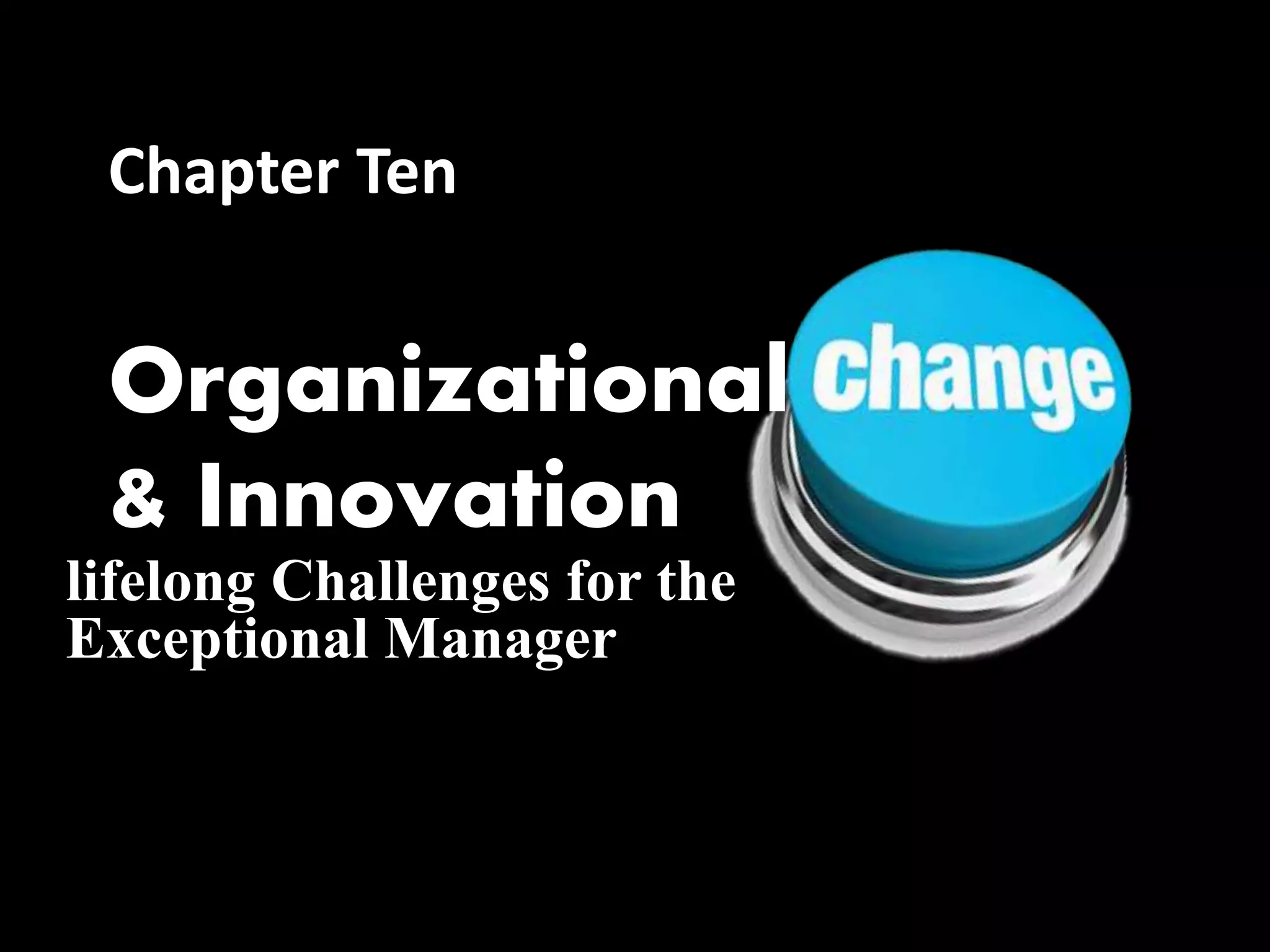
Chapter Ten
Organizational
& Innovation
lifelong Challenges for the
Exceptional Manager
Two(2) Types of Change
1. Reactive Change
-Making changes in response to
problems or opportunities as they arise
2. Proactive Change
-Involves making carefully thought-
out changes in anticipation of possible or
expected problems or opportunities.
-Also called Planned Change
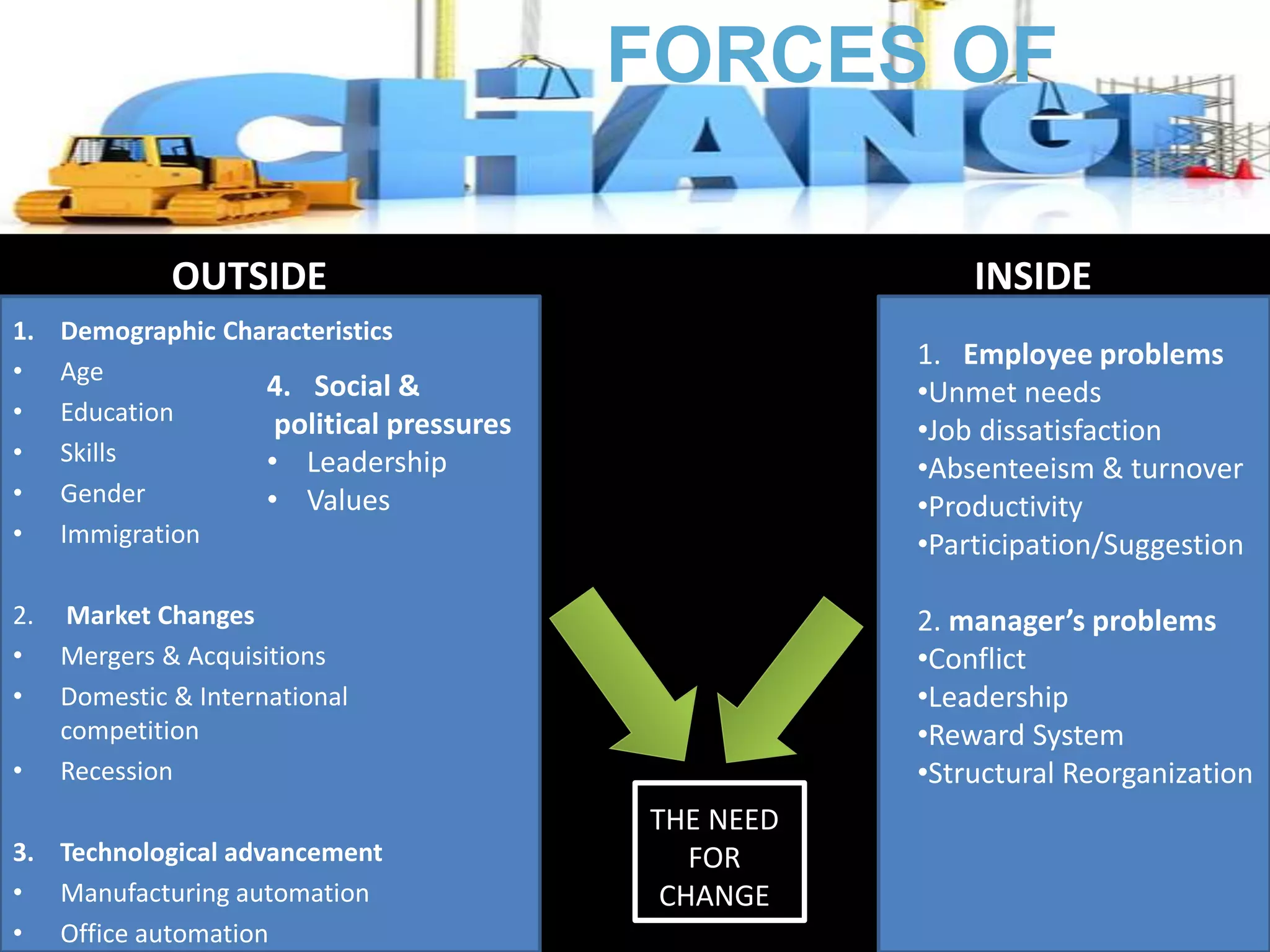
The Forces of Change: Outside the
Organization
1.Demographic Characteristics
2.Market Changes
3.Technical Advancement
4.Social & Political pressures
.
1. Demographic Characteristics
• Age
• Education
• Skills
• Gender
• Immigration
2. Market Changes
• Mergers & Acquisitions
• Domestic & International
competition
• Recession
3. Technological advancement
• Manufacturing automation
• Office automation
FORCES OF
4. Social &
political pressures
• Leadership
• Values
OUTSIDE
1. Employee problems
•Unmet needs
•Job dissatisfaction
•Absenteeism & turnover
•Productivity
•Participation/Suggestion
2. manager’s problems
•Conflict
•Leadership
•Reward System
•Structural Reorganization
INSIDE
THE NEED
FOR
CHANGE
Areas in Which Change is Often
Needed
1. Change people
-Perceptions, attitudes, performance,
skills.
2. Changing technology
3. Changing structure
4. Changing Strategy
Organizational Development
o Organizational Development (OD)
-set of techniques for implementing planned
change to make people and organizations
more effective
o Change Agent
- a consultant with a background in
behavioral sciences who can be a catalyst in
helping organizations deal with old problems
in new ways.
The OD Process
1. Diagnosis
-What is the
Problem?
2. Intervention
-What should
we do about it?
3. Evaluation
- How well has
the intervention
worked?
4. Feedback
-How can the
diagnosis be further
refined?
Types of Innovation
1. Product innovation
Change in the appearance or performance
of a product or the creation of a new one
2. Process innovation
Change in a way that a product is conceived,
manufactured or disseminated.
Types of Innovation
4. Incremental Innovation
-creation of products, services, or technologies
that modify existing ones
5. Radical change
-creation of products, services, or technologies
that replace existing ones
Four Characteristics of Innovation
1. Innovation is a uncertain business
2. People closest to innovation know the most
about it , at least initially
3. Innovations may be controversial
4. Innovation can be complex because it may
cause organizational boundaries
Three steps for fostering Innovation
1. Recognize
problems
and
opportunitie
s & devise
solution
2. Gain Allies
by
communicat
ing your
vision
3. Overcome
employee
resistance &
empower
& reward
them to
achieve
progress
Reasons Employees resist Change
• Peer pressure
• Disruption of cultural traditions or group
relationships
• Personality conflicts
• Lack of fact or poor timing
• Non-reinforcing reward system
Lewin’s Change Model
• Unfreezing
-Creating the motivation to Change
• Changing
-Learning new ways of doing things
• Refreezing
-Making the new ways normal
Steps
to leading
Organizational
Change
STEPS to leading Organizational Change
1. Establish a sense of
urgency
Unfreezing the organization by
creating a compelling reason for why
change is needed.
2. Create the guiding
coalition
Create a cross-functional,
cross-level group of people with
enough power to lead the
change.
Steps to leading Organizational Change
3. Develop a vision and
a strategy
Create a vision and a strategic
plan to guide the change process.
4. Communicate the
Change vision
Create and implement a
communication strategy that
consistently communicates the
new vision and strategic plan.
5. Empower board-based action
Eliminate barriers to Change, and
use target elements of change to
transform the organization.
Encourage risk taking and
creative problem solving.
6. Generate Short term
wins
Plan for and create short-
term “wins” or improvements,
Recognize and reward people
who contribute to the wins.
7. Consolidate gains and
produce more change
The guiding coalition uses
credibility from short-term wins to
create more change.
Additional people are brought
into the change process as change
cascades throughout the
organization.
Attempts are made to
reinvigorate the change process.
8. Anchor new approaches in
the culture
Reinforce the changes by
highlighting connections between
new behaviors and processes and
organizational success.
Developed methods to ensure
leadership development and
succession.
End
Thanks for listening 

Organizational Change and Innovation

  • 1.
    Chapter Ten Organizational & Innovation lifelongChallenges for the Exceptional Manager
  • 2.
    Two(2) Types ofChange 1. Reactive Change -Making changes in response to problems or opportunities as they arise 2. Proactive Change -Involves making carefully thought- out changes in anticipation of possible or expected problems or opportunities. -Also called Planned Change
  • 3.
    The Forces ofChange: Outside the Organization 1.Demographic Characteristics 2.Market Changes 3.Technical Advancement 4.Social & Political pressures
  • 4.
    . 1. Demographic Characteristics •Age • Education • Skills • Gender • Immigration 2. Market Changes • Mergers & Acquisitions • Domestic & International competition • Recession 3. Technological advancement • Manufacturing automation • Office automation FORCES OF 4. Social & political pressures • Leadership • Values OUTSIDE 1. Employee problems •Unmet needs •Job dissatisfaction •Absenteeism & turnover •Productivity •Participation/Suggestion 2. manager’s problems •Conflict •Leadership •Reward System •Structural Reorganization INSIDE THE NEED FOR CHANGE
  • 5.
    Areas in WhichChange is Often Needed 1. Change people -Perceptions, attitudes, performance, skills. 2. Changing technology 3. Changing structure 4. Changing Strategy
  • 6.
    Organizational Development o OrganizationalDevelopment (OD) -set of techniques for implementing planned change to make people and organizations more effective o Change Agent - a consultant with a background in behavioral sciences who can be a catalyst in helping organizations deal with old problems in new ways.
  • 7.
    The OD Process 1.Diagnosis -What is the Problem? 2. Intervention -What should we do about it? 3. Evaluation - How well has the intervention worked? 4. Feedback -How can the diagnosis be further refined?
  • 8.
    Types of Innovation 1.Product innovation Change in the appearance or performance of a product or the creation of a new one 2. Process innovation Change in a way that a product is conceived, manufactured or disseminated.
  • 9.
    Types of Innovation 4.Incremental Innovation -creation of products, services, or technologies that modify existing ones 5. Radical change -creation of products, services, or technologies that replace existing ones
  • 10.
    Four Characteristics ofInnovation 1. Innovation is a uncertain business 2. People closest to innovation know the most about it , at least initially 3. Innovations may be controversial 4. Innovation can be complex because it may cause organizational boundaries
  • 11.
    Three steps forfostering Innovation 1. Recognize problems and opportunitie s & devise solution 2. Gain Allies by communicat ing your vision 3. Overcome employee resistance & empower & reward them to achieve progress
  • 12.
    Reasons Employees resistChange • Peer pressure • Disruption of cultural traditions or group relationships • Personality conflicts • Lack of fact or poor timing • Non-reinforcing reward system
  • 13.
    Lewin’s Change Model •Unfreezing -Creating the motivation to Change • Changing -Learning new ways of doing things • Refreezing -Making the new ways normal
  • 14.
  • 15.
    STEPS to leadingOrganizational Change 1. Establish a sense of urgency Unfreezing the organization by creating a compelling reason for why change is needed. 2. Create the guiding coalition Create a cross-functional, cross-level group of people with enough power to lead the change.
  • 16.
    Steps to leadingOrganizational Change 3. Develop a vision and a strategy Create a vision and a strategic plan to guide the change process. 4. Communicate the Change vision Create and implement a communication strategy that consistently communicates the new vision and strategic plan.
  • 17.
    5. Empower board-basedaction Eliminate barriers to Change, and use target elements of change to transform the organization. Encourage risk taking and creative problem solving. 6. Generate Short term wins Plan for and create short- term “wins” or improvements, Recognize and reward people who contribute to the wins.
  • 18.
    7. Consolidate gainsand produce more change The guiding coalition uses credibility from short-term wins to create more change. Additional people are brought into the change process as change cascades throughout the organization. Attempts are made to reinvigorate the change process.
  • 19.
    8. Anchor newapproaches in the culture Reinforce the changes by highlighting connections between new behaviors and processes and organizational success. Developed methods to ensure leadership development and succession.
  • 20.