Prof. Shrinivas V K
1
Introduction
 The study of organizations and of the
collection of people within them together
comprises the field of organizational
behavior.
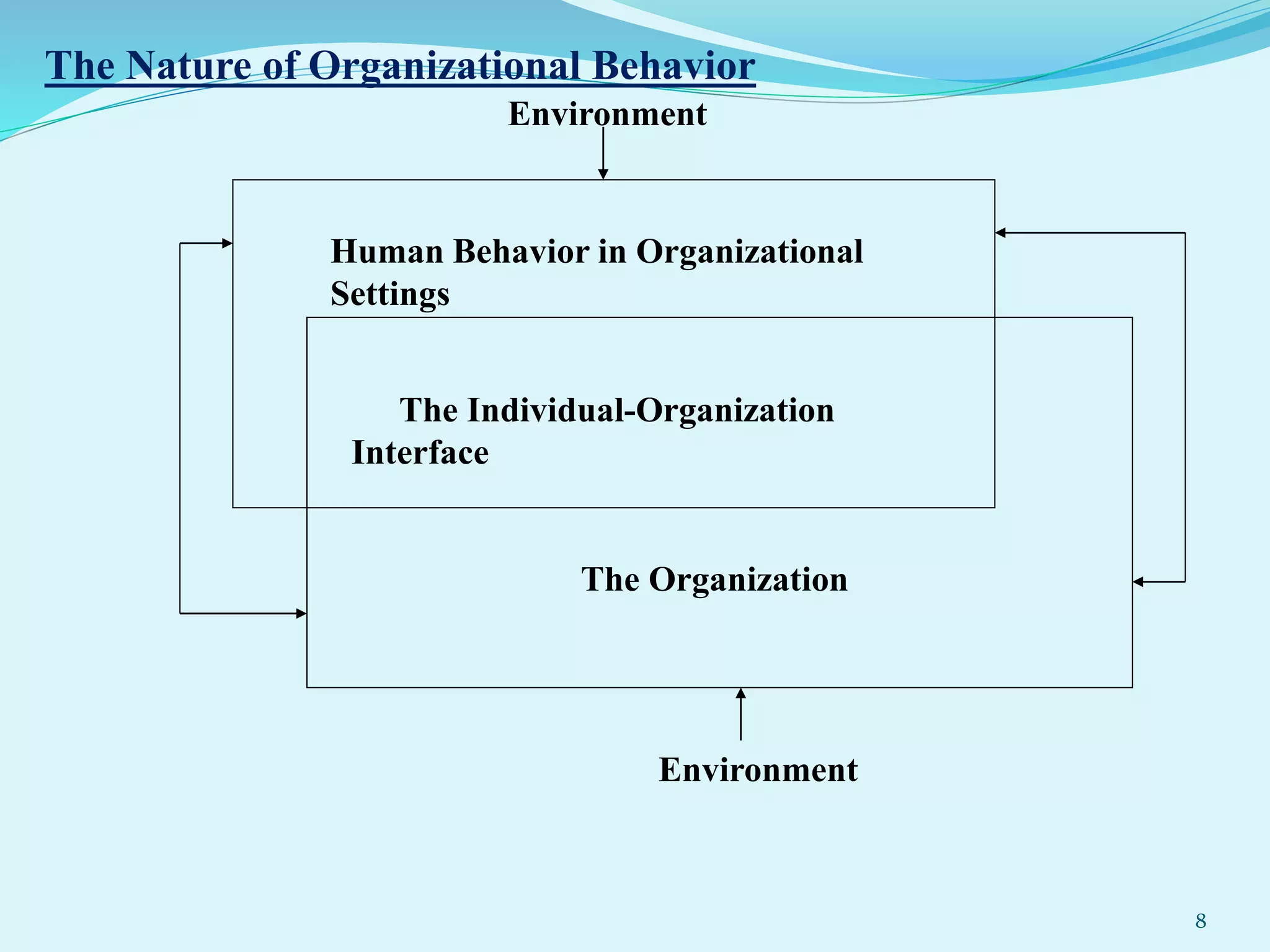
 Organizational behavior (OB) is the study of
human behavior in organizational settings,
the interface between human behavior and
the organization, and the organization itself.l
2
Organizational Behavior is a field of study that
investigates the impact that individuals, groups,
and structure have on behavior within
organizations for the purpose of applying such
knowledge towards improving an organization's
effectiveness.
3
What is Organizational Behavior?
 Organizations are social systems.
Organization is a combination of humanity
and technology.
 OB is the study and application of
knowledge about how people act within the
organization.
 It is a human tool for human benefit .
4
Contd..
A complex set of forces affects the
nature of organizations today.
 It can be classified into four areas:
1. People
2. Structure
3. Technology
4. Environment
5
Contd..
 When people join the organization to accomplish
the goals/ objectives, some kind of structure is
required. They use machinery, gadgets &
technology to achieve the organizational goals.
At the same time they are influenced by external
environment.
6
 Organizations are defined as social arrangements,
constructed by people, who can also change them.
----Buchanan and Huczynski (1997)
 Organizations are a system of cooperative activities -
and their coordination requires something intangible
and personal that is largely a matter of personal
relationships.
---- Barnard (1938)
 OB is concerned with “the study of the structure,
functioning and performance of organizations, and
the behavior of groups and individuals within them”.
---- Pugh (1971)
7
The Organization
Environment
Environment
The Individual-Organization
Interface
The Nature of Organizational Behavior
Human Behavior in Organizational
Settings
8
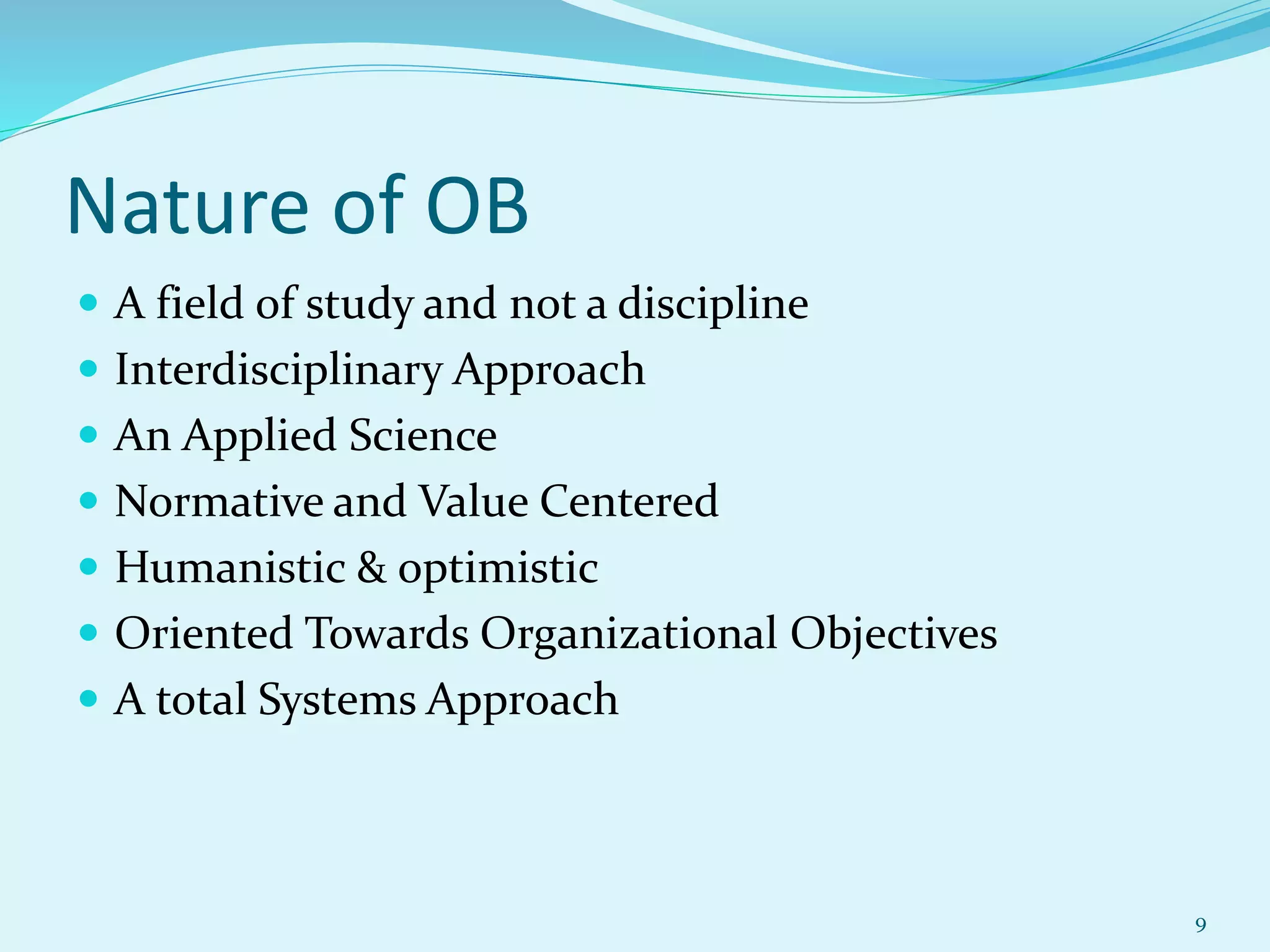
Nature of OB
 A field of study and not a discipline
 Interdisciplinary Approach
 An Applied Science
 Normative and Value Centered
 Humanistic & optimistic
 Oriented Towards Organizational Objectives
 A total Systems Approach
9
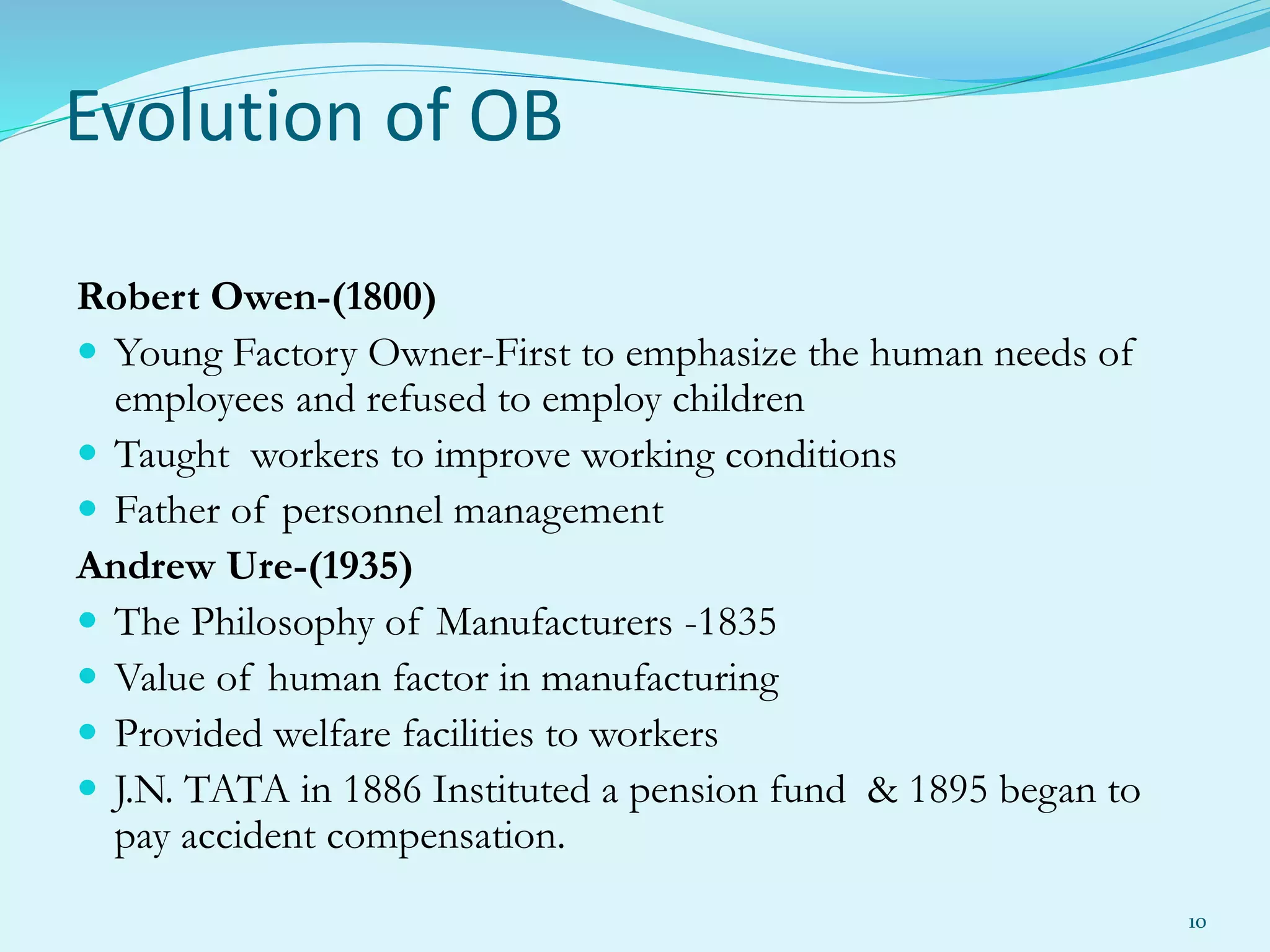
Evolution of OB
Robert Owen-(1800)
 Young Factory Owner-First to emphasize the human needs of
employees and refused to employ children
 Taught workers to improve working conditions
 Father of personnel management
Andrew Ure-(1935)
 The Philosophy of Manufacturers -1835
 Value of human factor in manufacturing
 Provided welfare facilities to workers
 J.N. TATA in 1886 Instituted a pension fund & 1895 began to
pay accident compensation.
10
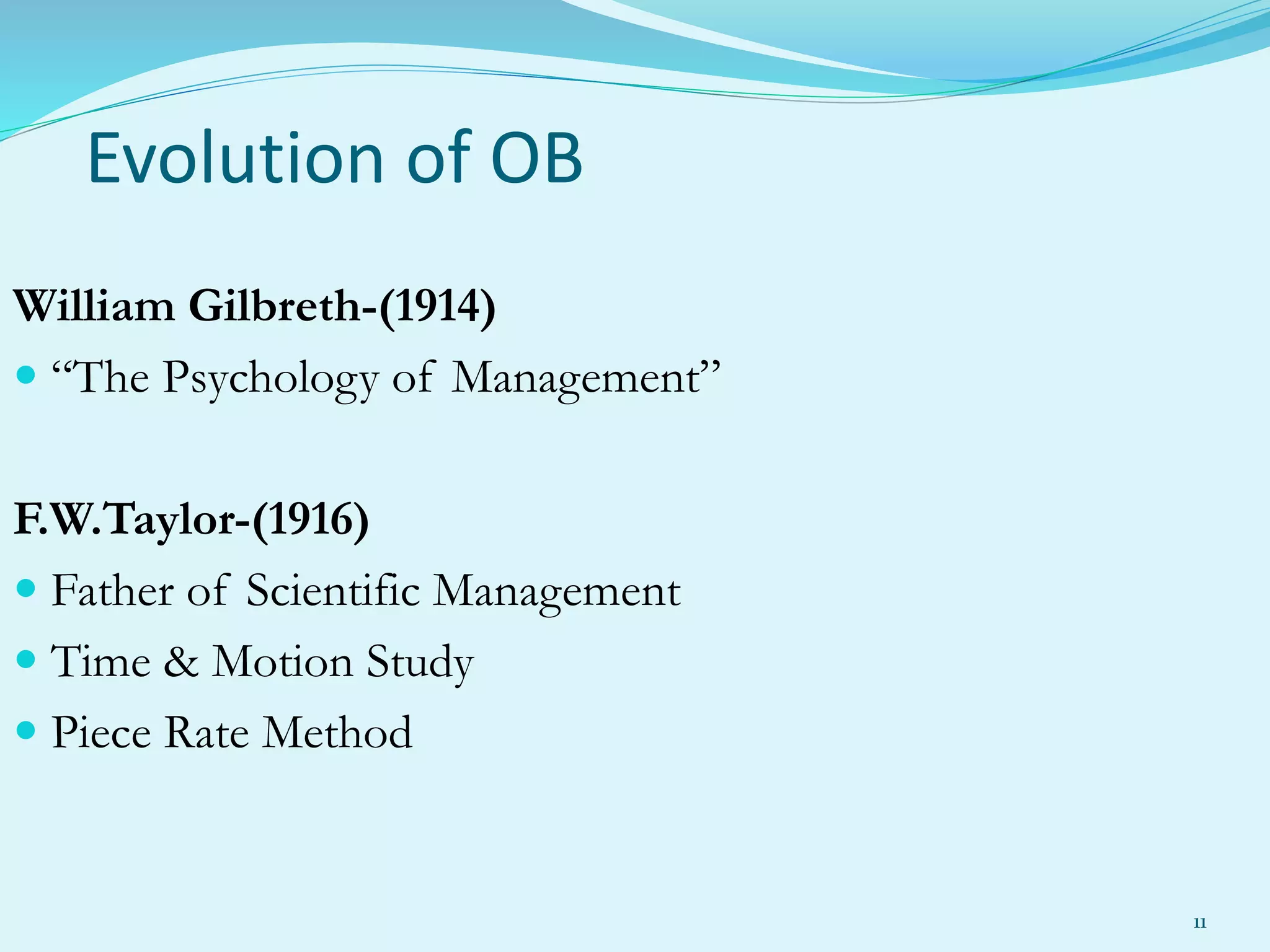
William Gilbreth-(1914)
 “The Psychology of Management”
F.W.Taylor-(1916)
 Father of Scientific Management
 Time & Motion Study
 Piece Rate Method
Evolution of OB
11
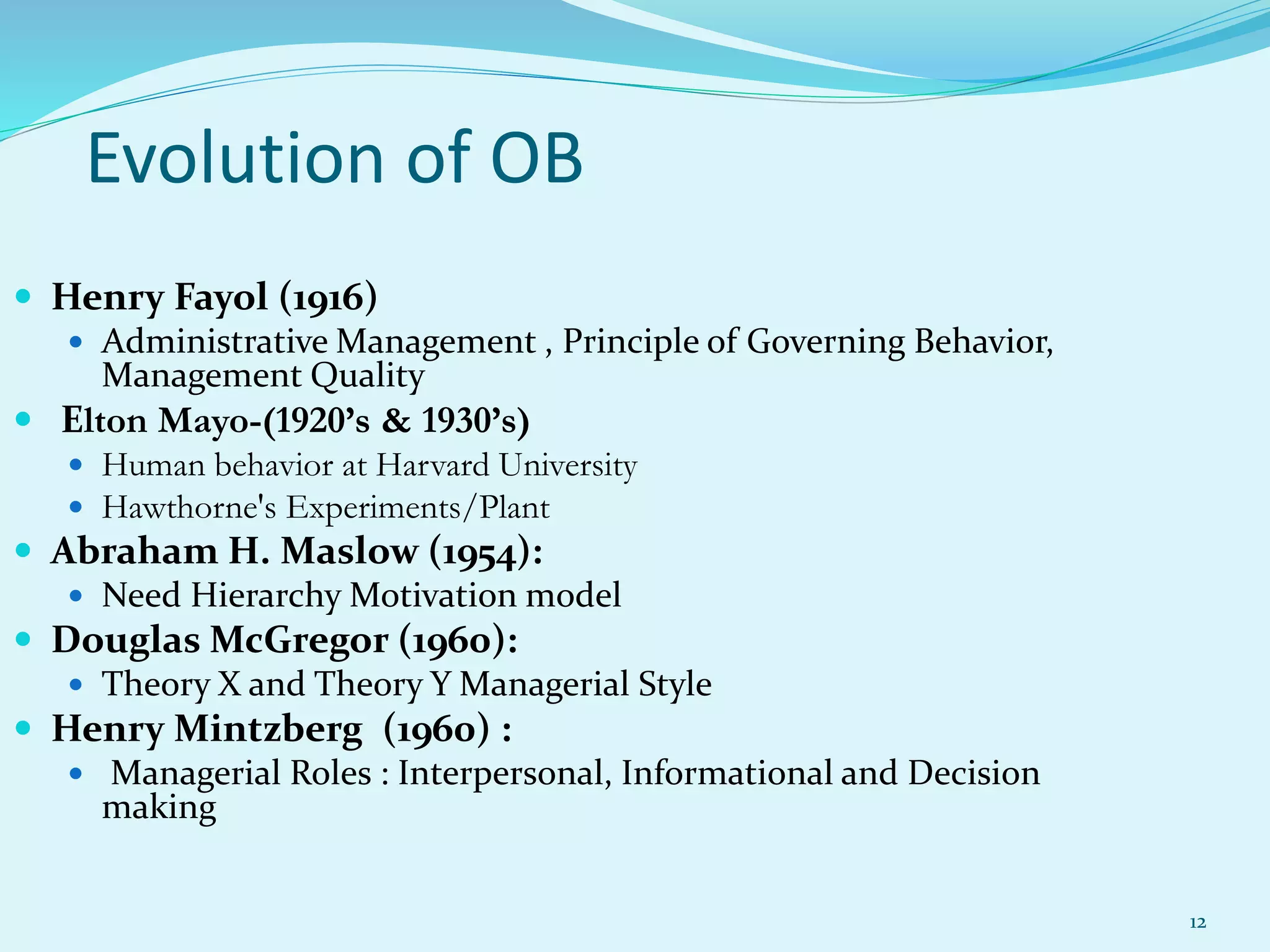
 Henry Fayol (1916)
 Administrative Management , Principle of Governing Behavior,
Management Quality
 Elton Mayo-(1920’s & 1930’s)
 Human behavior at Harvard University
 Hawthorne's Experiments/Plant
 Abraham H. Maslow (1954):
 Need Hierarchy Motivation model
 Douglas McGregor (1960):
 Theory X and Theory Y Managerial Style
 Henry Mintzberg (1960) :
 Managerial Roles : Interpersonal, Informational and Decision
making
Evolution of OB
12
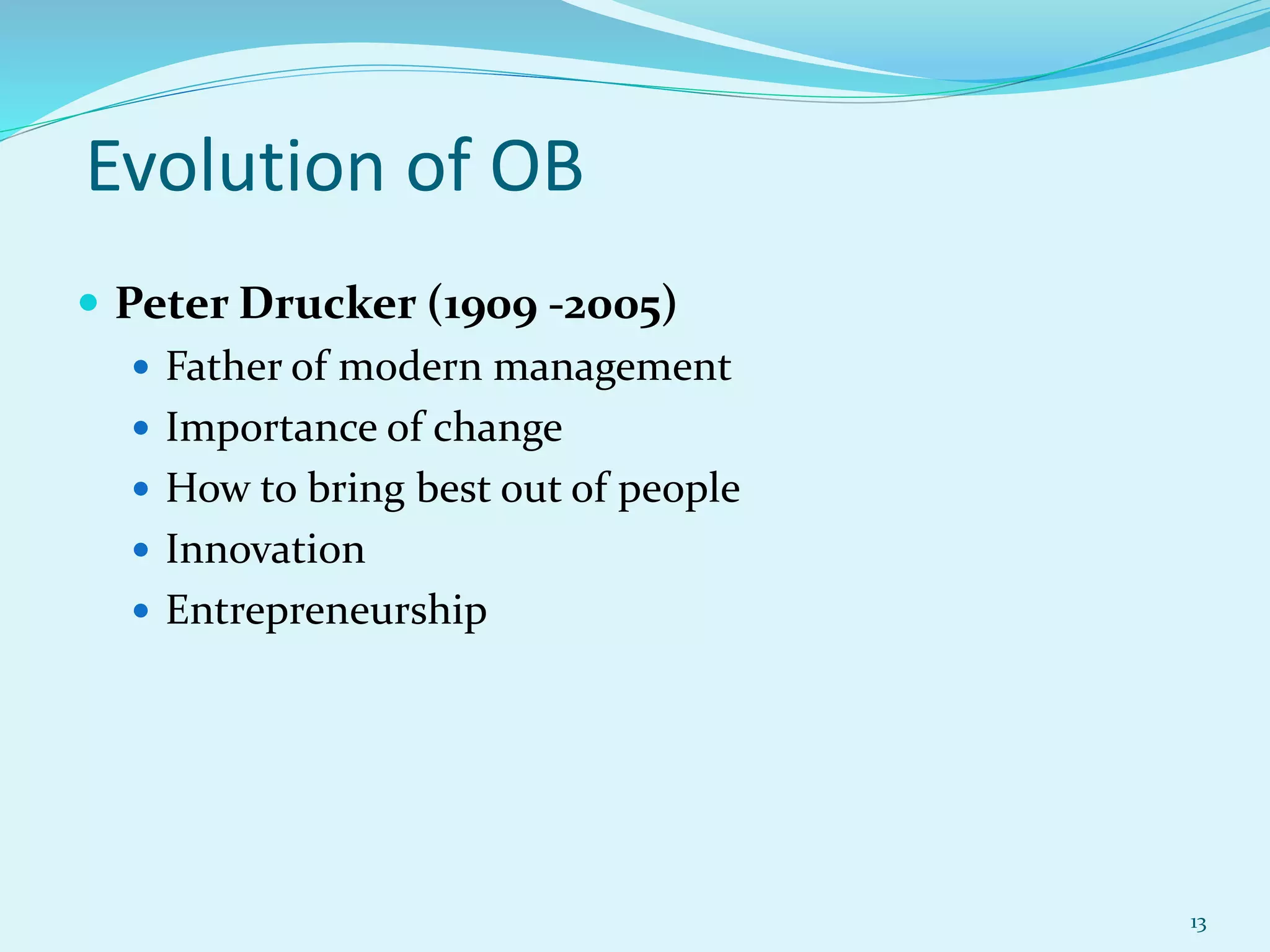
 Peter Drucker (1909 -2005)
 Father of modern management
 Importance of change
 How to bring best out of people
 Innovation
 Entrepreneurship
Evolution of OB
13
14
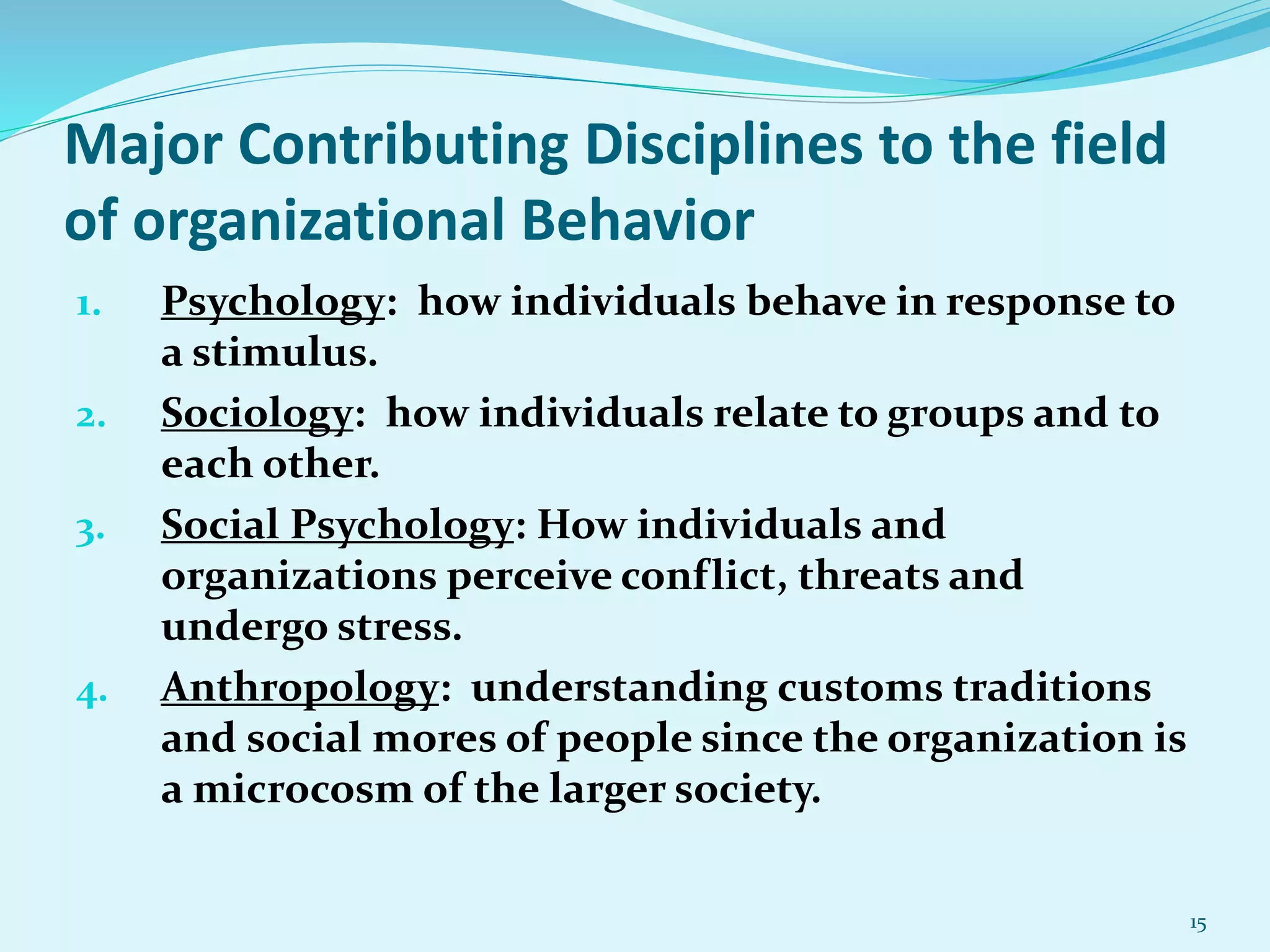
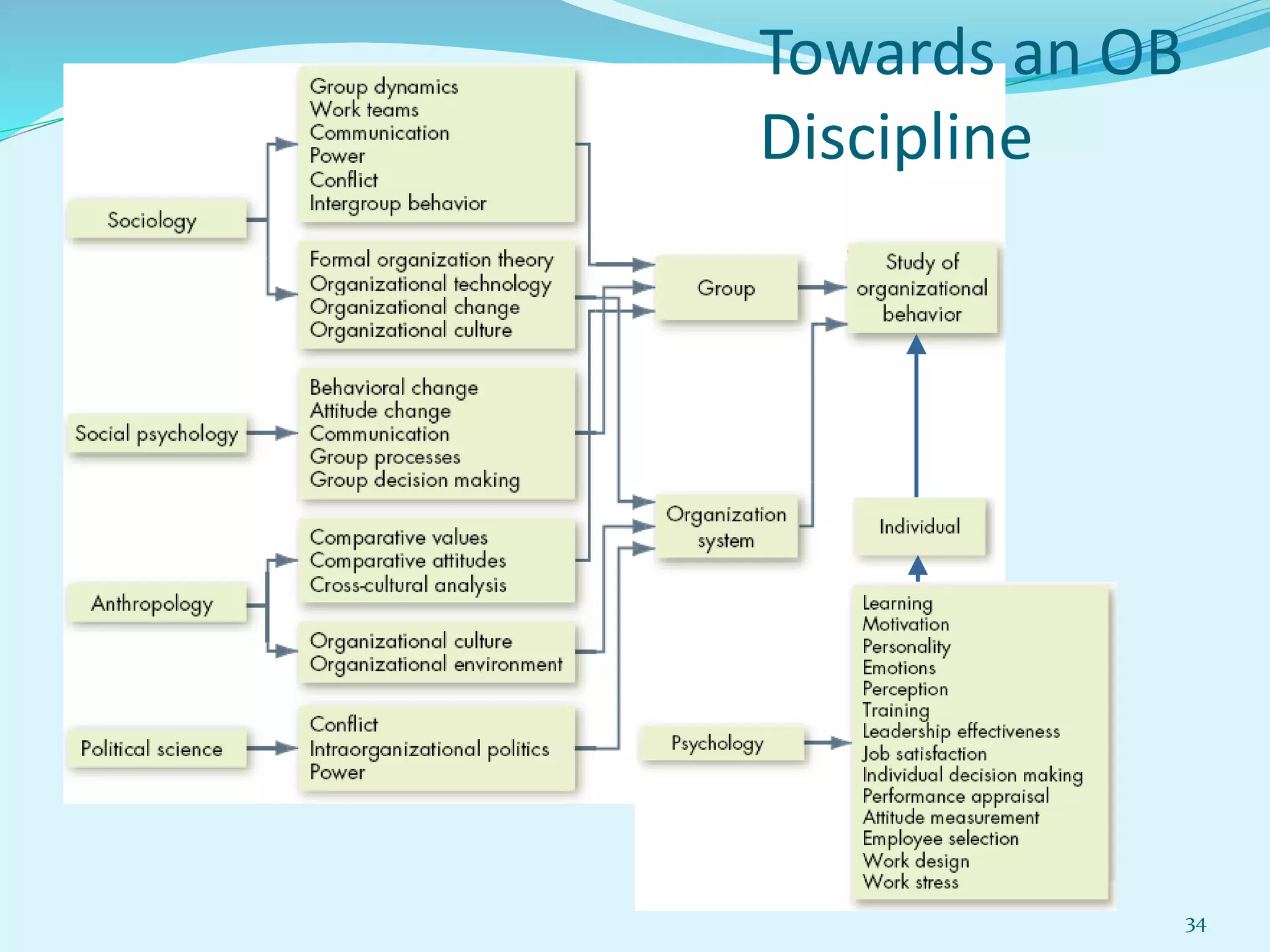
Major Contributing Disciplines to the field
of organizational Behavior
1. Psychology: how individuals behave in response to
a stimulus.
2. Sociology: how individuals relate to groups and to
each other.
3. Social Psychology: How individuals and
organizations perceive conflict, threats and
undergo stress.
4. Anthropology: understanding customs traditions
and social mores of people since the organization is
a microcosm of the larger society.
15
Contd..
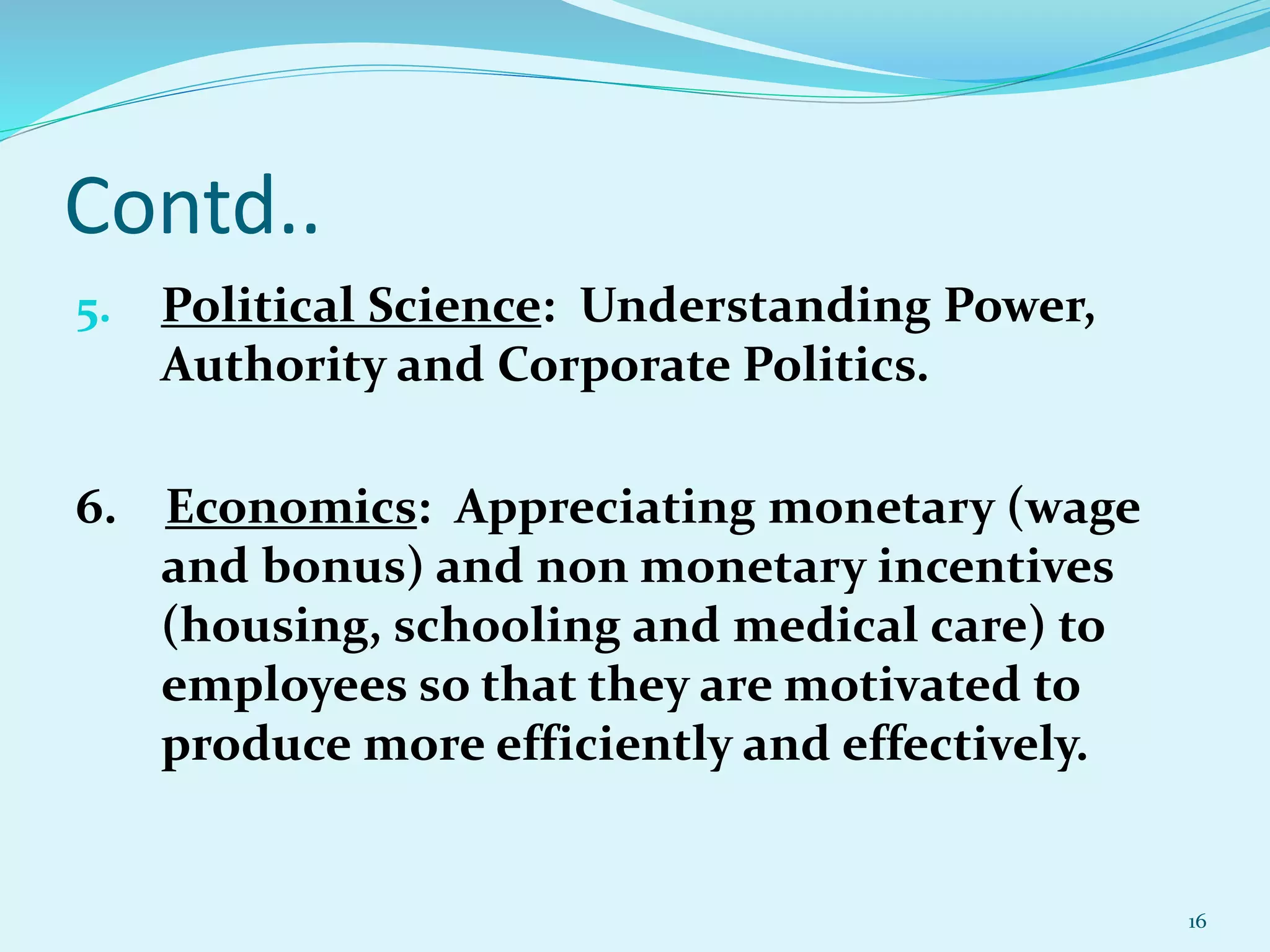
5. Political Science: Understanding Power,
Authority and Corporate Politics.
6. Economics: Appreciating monetary (wage
and bonus) and non monetary incentives
(housing, schooling and medical care) to
employees so that they are motivated to
produce more efficiently and effectively.
16
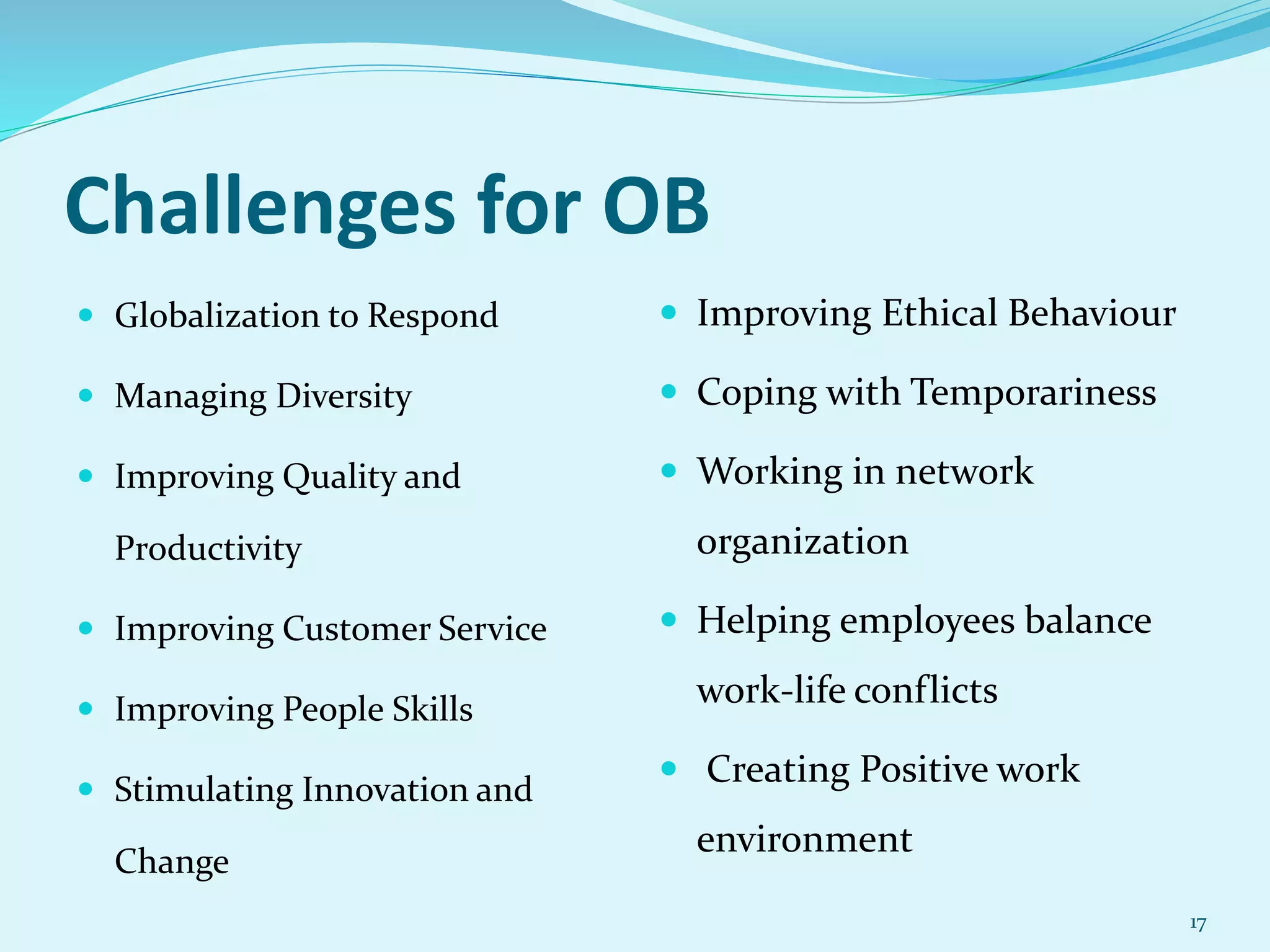
Challenges for OB
 Globalization to Respond
 Managing Diversity
 Improving Quality and
Productivity
 Improving Customer Service
 Improving People Skills
 Stimulating Innovation and
Change
 Improving Ethical Behaviour
 Coping with Temporariness
 Working in network
organization
 Helping employees balance
work-life conflicts
 Creating Positive work
environment
17
18
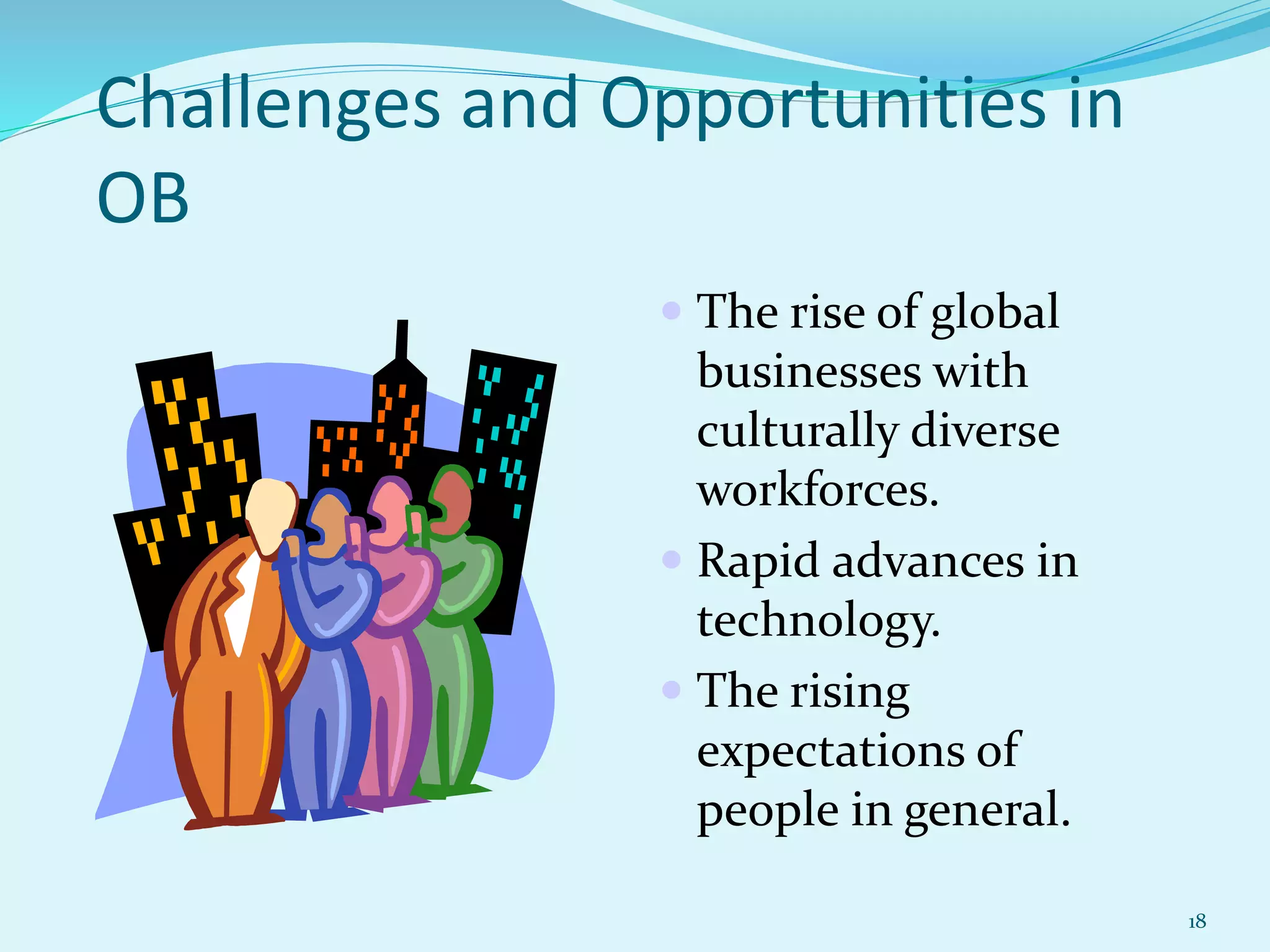
Challenges and Opportunities in
OB
 The rise of global
businesses with
culturally diverse
workforces.
 Rapid advances in
technology.
 The rising
expectations of
people in general.
19
Globalization
 The process of interconnecting the
world’s people with respect to the
cultural, economic, political,
technological, and environmental
aspects of their lives.
 Multinational Enterprises:
Organizations that have significant
operations spread throughout various
nations but are headquartered in a single
country.
20
Working Abroad
 Expatriates: People who are citizens of one country but
who are living and working in another country.
 Culture: The set of values, customs, and beliefs that
people have in common with other members of a social
unit (e.g., a nation).
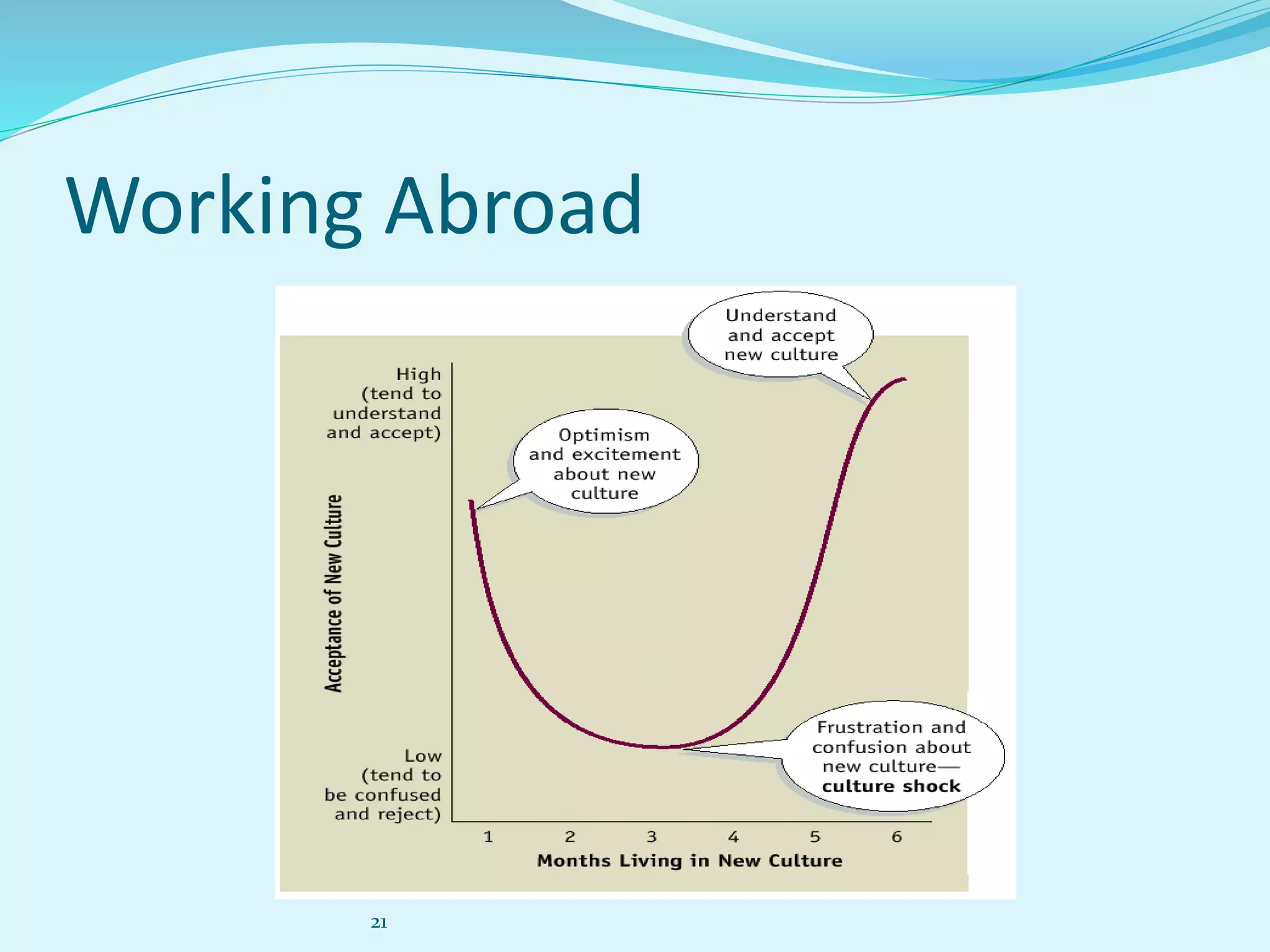
 Culture shock: The tendency for people to become
confused and disoriented as they attempt to adjust to a
new culture.
 Repatriation: The process of readjusting to one’s own
culture after spending time away from it.
21
Working Abroad
22
Management Perspectives
Convergence Hypothesis: A biased approach to
the study of management, which assumes that
principles of good management are universal,
and that ones that work well in the United
States will apply equally well in other nations.
Divergence Hypothesis: The approach to the
study of management that recognizes that
knowing how to manage most effectively
requires clear understanding of the culture in
which people work.
23
Shifting Demographics
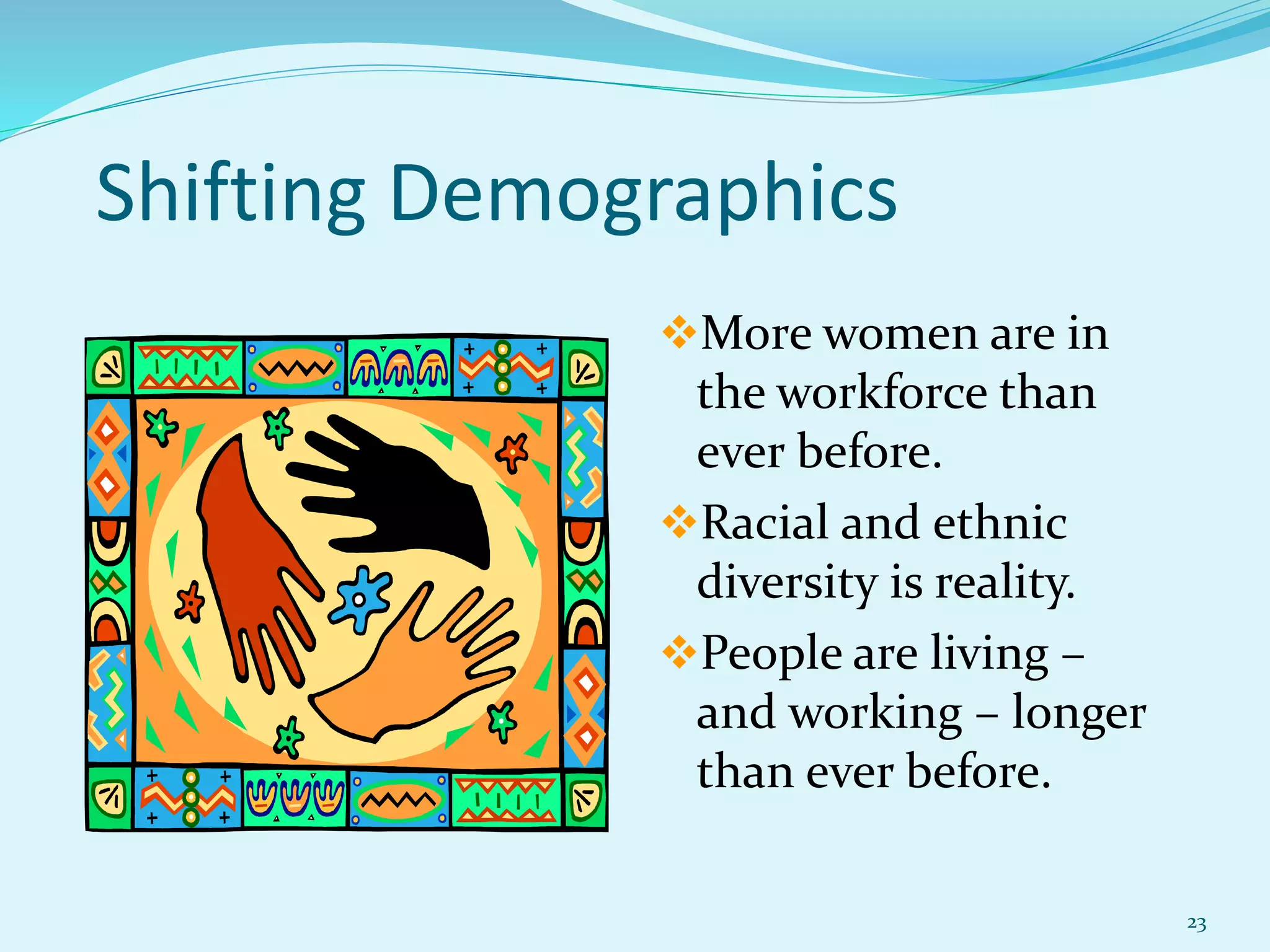
More women are in
the workforce than
ever before.
Racial and ethnic
diversity is reality.
People are living –
and working – longer
than ever before.
24
Responding to Changes in Technology
Creating Leaner Organizations
 Downsizing/Rightsizing: The process of adjusting the number of
employees needed to work in newly designed organizations.
 Outsourcing: The process of eliminating those parts of organizations
that focus on noncore sectors of the business and hiring outside firms
to perform these functions instead.
Creating Virtual Organizations
 Highly flexible, temporary organizations formed by a group of
companies that join forces to exploit a specific opportunity.
Increasing the Use of Telecommuting
 The practice of using communications technology so as to enable
work to be performed from remote locations.
25
Responding to Changes in Expectations
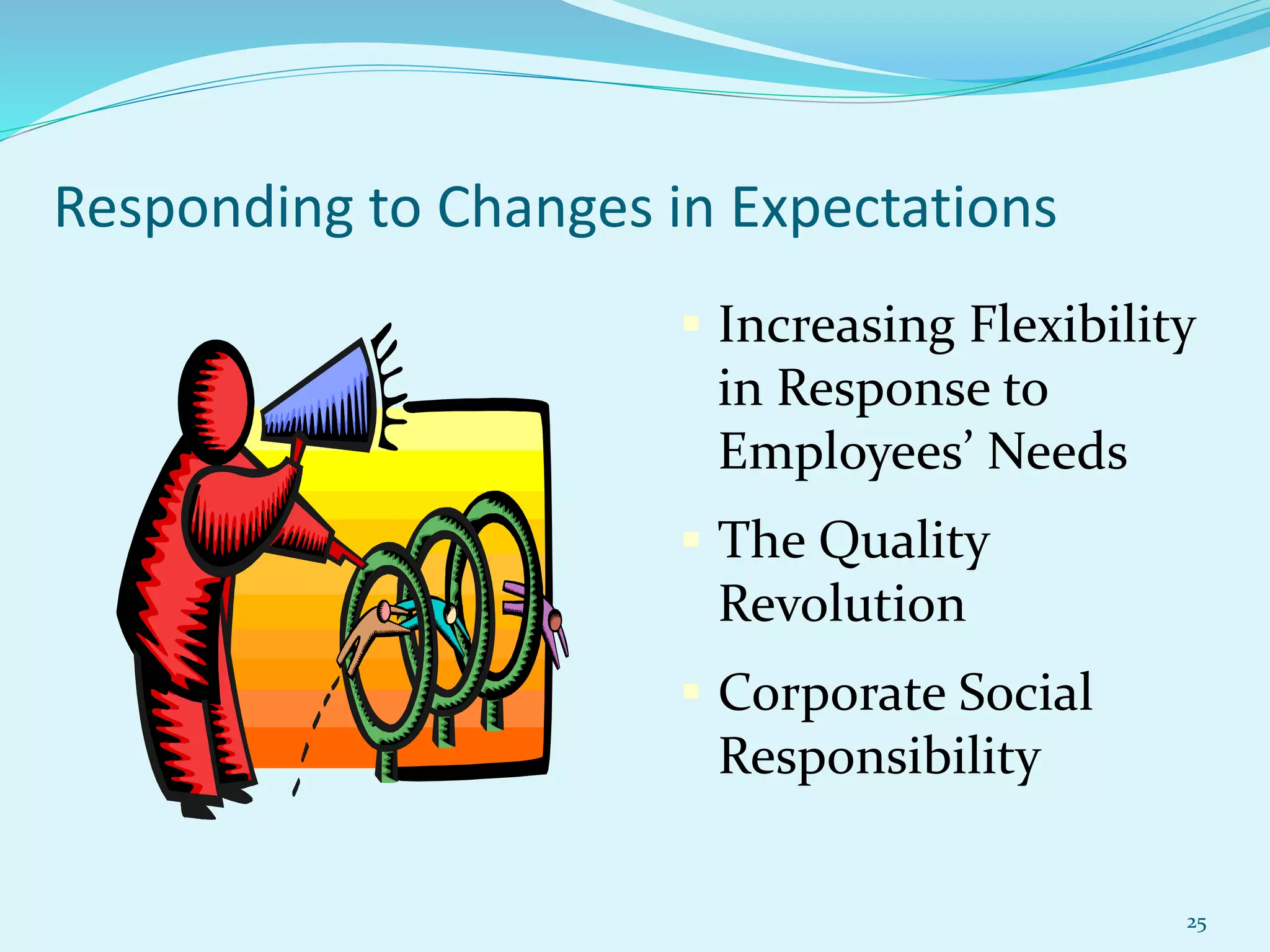
 Increasing Flexibility
in Response to
Employees’ Needs
 The Quality
Revolution
 Corporate Social
Responsibility
26
Increasing Flexibility
Flextime Programs: Policies that give employees some discretion
over when they can arrive and leave work, thereby making it easier
to adapt their work schedules to the demands of their personal
lives.
The Contingent Workforce: People hired by organizations
temporarily to work as needed for finite periods of time.
Compressed Workweeks: The practice of working fewer days each
week but longer hours each day.
Job Sharing: A form of regular part-time work in which pairs of
employees assume the duties of a single job, splitting its
responsibilities, salary, and benefits in proportion to the time
worked.
Voluntary Reduced Work Time Programs: Programs that allow
employees to reduce the amount of time they work by a certain
amount, with a proportional reduction in pay.
27
The Quality Revolution
 Total Quality Management: An organizational strategy
of commitment to improving customer satisfaction by
developing techniques to carefully manage output
quality.
 Benchmarking: The process of comparing one’s own
products or services with the best from others.
 Malcolm Baldridge Quality Award: An award given
annually to American companies that practice effective
quality management and make significant
improvements in the quality of their goods and services.
28
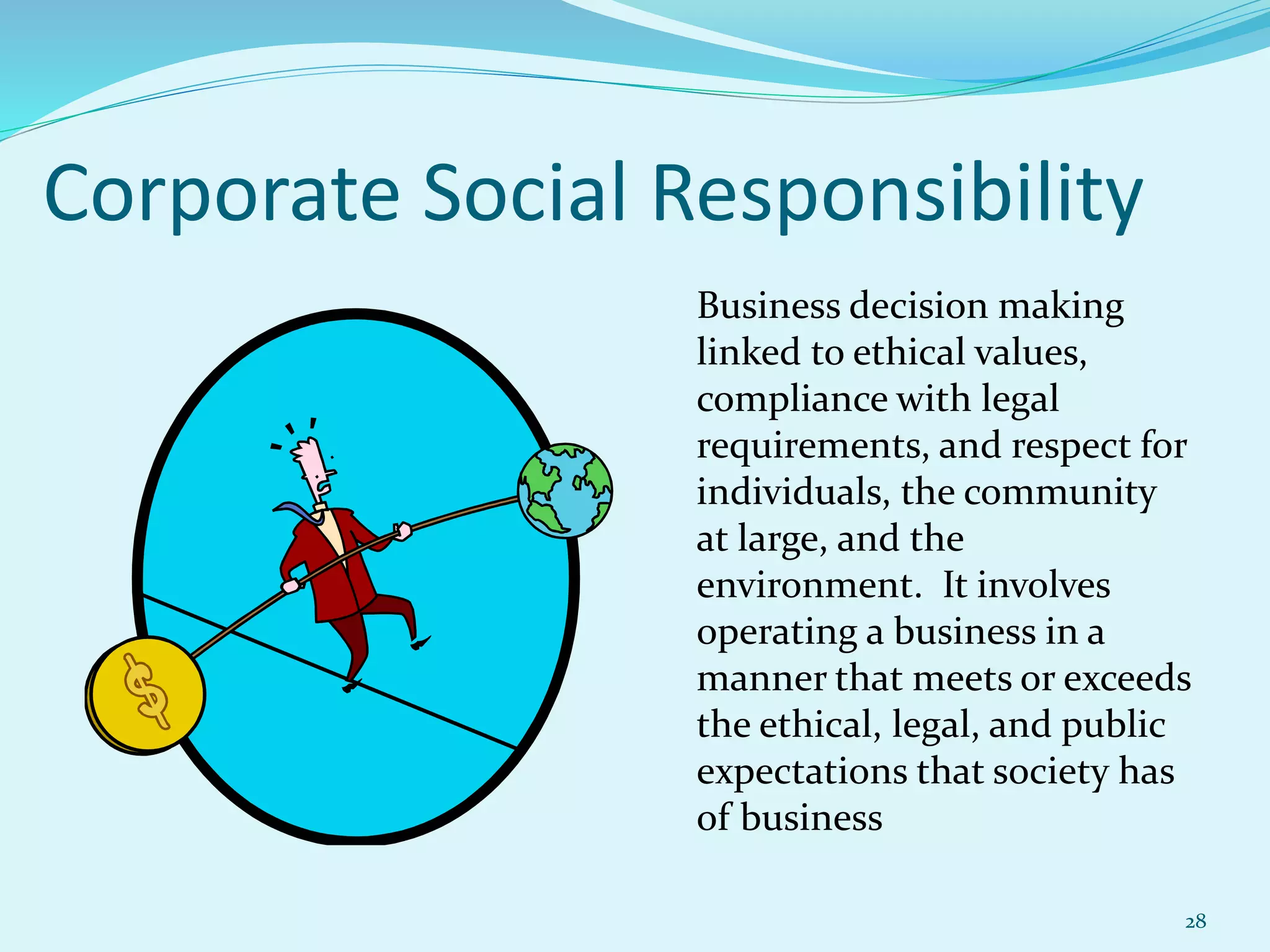
Corporate Social Responsibility
Business decision making
linked to ethical values,
compliance with legal
requirements, and respect for
individuals, the community
at large, and the
environment. It involves
operating a business in a
manner that meets or exceeds
the ethical, legal, and public
expectations that society has
of business
29
Ethics in Organizations
Good ethics is good business
 Improved financial performance
 Reduced operating costs
 Enhanced corporate reputation
 Increased ability to attract and retain employees
Code of Ethics: A document describing what an organization
stands for and the general rules of conduct it expects of its
employees.
Ethics Officers: Individuals (usually at the vice presidential level)
who oversee the ethics of a company’s operations.
Ethics Audit: The process of actively investigating and
documenting incidents of dubious ethical value within a
company.
30
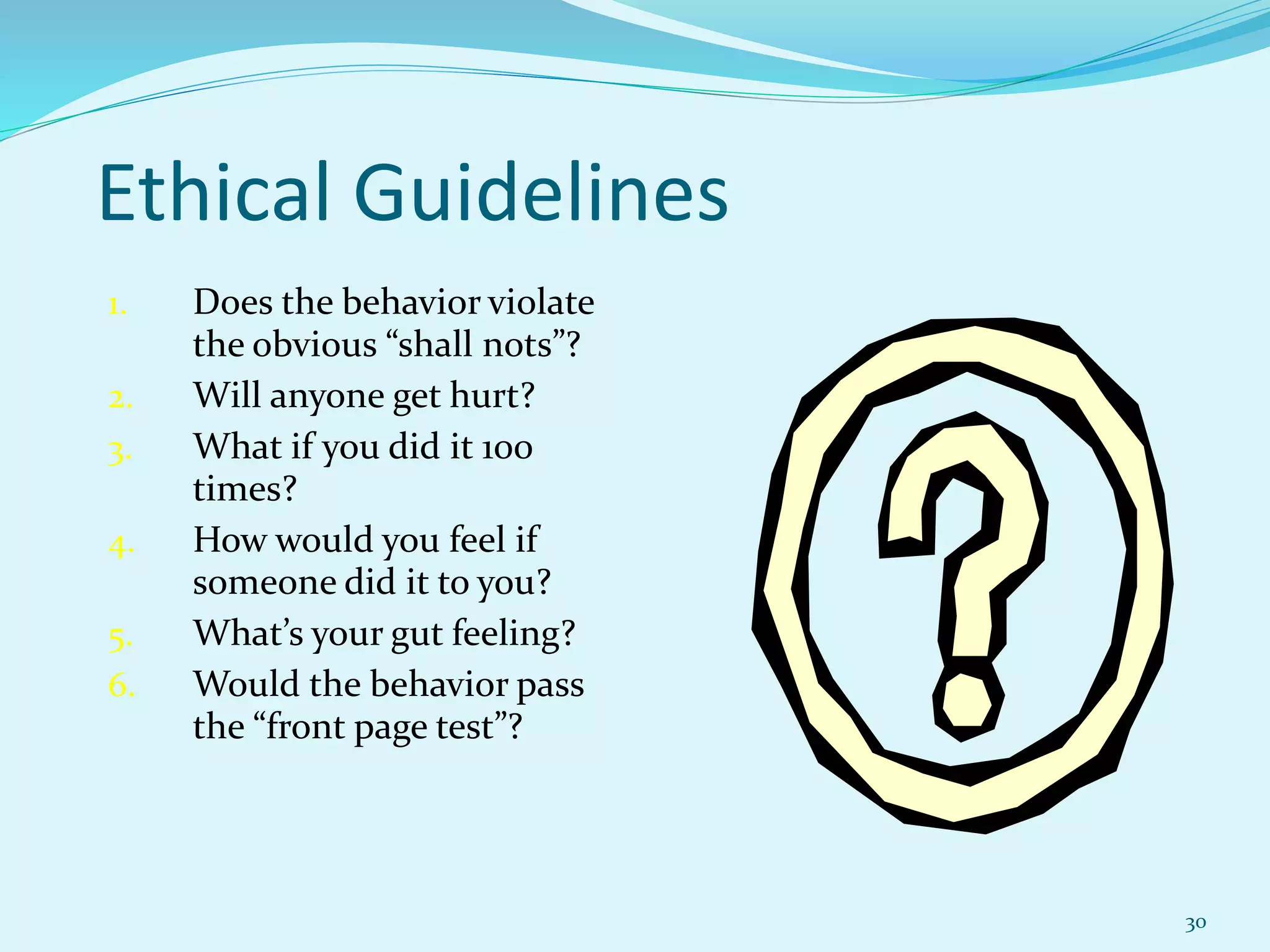
Ethical Guidelines
1. Does the behavior violate
the obvious “shall nots”?
2. Will anyone get hurt?
3. What if you did it 100
times?
4. How would you feel if
someone did it to you?
5. What’s your gut feeling?
6. Would the behavior pass
the “front page test”?
THE SCOPE OF THE ORGANIZATIONAL
BEHAVIOUR IS AS UNDER:
 Impact of personality on performance
(b) Employee motivation
 Leadership
 How to create effective teams and groups
 Study of different organizational structures
 Individual behaviour, attitude and learning
 Perception
 Design and development of effective organization
 Job design
31
Importance of OB
 OB provides a road map to our lives in organizations.
 OB uses scientific research to understand and make
organization life, as it helps to predict what people will do
under various conditions
 It helps to influence organizational events – to understand
and predict events
 It helps individual understand herself/ himself in better
fashion.
 It helps manager to manage human resources effectively.
Eg. Motivation
 It helps organizations for maintaining cordial industrial
relations.
 It is also useful in the field marketing.
32
33
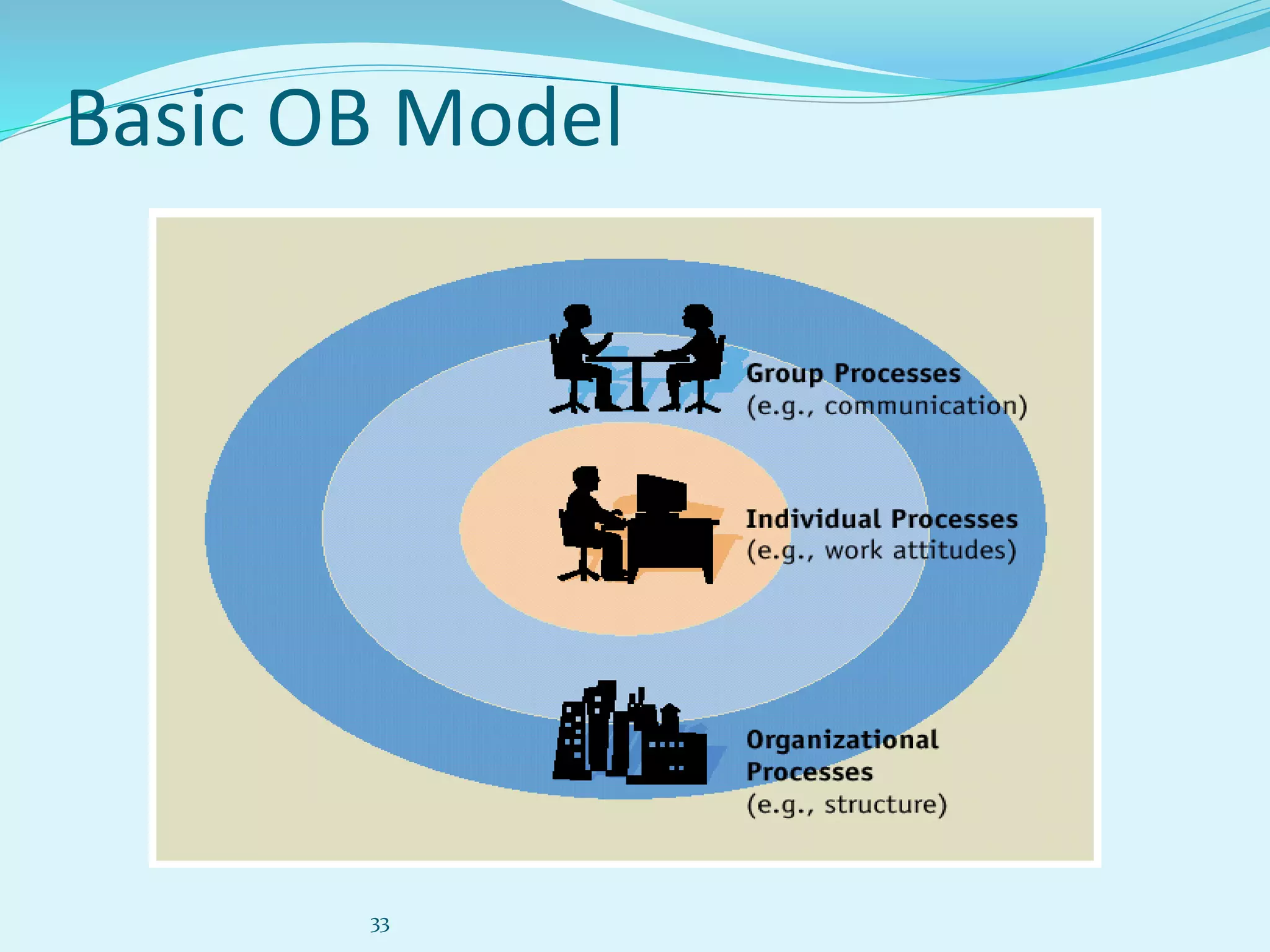
Basic OB Model
Towards an OB
Discipline
34
THANK YOU
35

Organisational Behavior Introduction

  • 1.
  • 2.
    Introduction  The studyof organizations and of the collection of people within them together comprises the field of organizational behavior.  Organizational behavior (OB) is the study of human behavior in organizational settings, the interface between human behavior and the organization, and the organization itself.l 2
  • 3.
    Organizational Behavior isa field of study that investigates the impact that individuals, groups, and structure have on behavior within organizations for the purpose of applying such knowledge towards improving an organization's effectiveness. 3
  • 4.
    What is OrganizationalBehavior?  Organizations are social systems. Organization is a combination of humanity and technology.  OB is the study and application of knowledge about how people act within the organization.  It is a human tool for human benefit . 4
  • 5.
    Contd.. A complex setof forces affects the nature of organizations today.  It can be classified into four areas: 1. People 2. Structure 3. Technology 4. Environment 5
  • 6.
    Contd..  When peoplejoin the organization to accomplish the goals/ objectives, some kind of structure is required. They use machinery, gadgets & technology to achieve the organizational goals. At the same time they are influenced by external environment. 6
  • 7.
     Organizations aredefined as social arrangements, constructed by people, who can also change them. ----Buchanan and Huczynski (1997)  Organizations are a system of cooperative activities - and their coordination requires something intangible and personal that is largely a matter of personal relationships. ---- Barnard (1938)  OB is concerned with “the study of the structure, functioning and performance of organizations, and the behavior of groups and individuals within them”. ---- Pugh (1971) 7
  • 8.
    The Organization Environment Environment The Individual-Organization Interface TheNature of Organizational Behavior Human Behavior in Organizational Settings 8
  • 9.
    Nature of OB A field of study and not a discipline  Interdisciplinary Approach  An Applied Science  Normative and Value Centered  Humanistic & optimistic  Oriented Towards Organizational Objectives  A total Systems Approach 9
  • 10.
    Evolution of OB RobertOwen-(1800)  Young Factory Owner-First to emphasize the human needs of employees and refused to employ children  Taught workers to improve working conditions  Father of personnel management Andrew Ure-(1935)  The Philosophy of Manufacturers -1835  Value of human factor in manufacturing  Provided welfare facilities to workers  J.N. TATA in 1886 Instituted a pension fund & 1895 began to pay accident compensation. 10
  • 11.
    William Gilbreth-(1914)  “ThePsychology of Management” F.W.Taylor-(1916)  Father of Scientific Management  Time & Motion Study  Piece Rate Method Evolution of OB 11
  • 12.
     Henry Fayol(1916)  Administrative Management , Principle of Governing Behavior, Management Quality  Elton Mayo-(1920’s & 1930’s)  Human behavior at Harvard University  Hawthorne's Experiments/Plant  Abraham H. Maslow (1954):  Need Hierarchy Motivation model  Douglas McGregor (1960):  Theory X and Theory Y Managerial Style  Henry Mintzberg (1960) :  Managerial Roles : Interpersonal, Informational and Decision making Evolution of OB 12
  • 13.
     Peter Drucker(1909 -2005)  Father of modern management  Importance of change  How to bring best out of people  Innovation  Entrepreneurship Evolution of OB 13
  • 14.
  • 15.
    Major Contributing Disciplinesto the field of organizational Behavior 1. Psychology: how individuals behave in response to a stimulus. 2. Sociology: how individuals relate to groups and to each other. 3. Social Psychology: How individuals and organizations perceive conflict, threats and undergo stress. 4. Anthropology: understanding customs traditions and social mores of people since the organization is a microcosm of the larger society. 15
  • 16.
    Contd.. 5. Political Science:Understanding Power, Authority and Corporate Politics. 6. Economics: Appreciating monetary (wage and bonus) and non monetary incentives (housing, schooling and medical care) to employees so that they are motivated to produce more efficiently and effectively. 16
  • 17.
    Challenges for OB Globalization to Respond  Managing Diversity  Improving Quality and Productivity  Improving Customer Service  Improving People Skills  Stimulating Innovation and Change  Improving Ethical Behaviour  Coping with Temporariness  Working in network organization  Helping employees balance work-life conflicts  Creating Positive work environment 17
  • 18.
    18 Challenges and Opportunitiesin OB  The rise of global businesses with culturally diverse workforces.  Rapid advances in technology.  The rising expectations of people in general.
  • 19.
    19 Globalization  The processof interconnecting the world’s people with respect to the cultural, economic, political, technological, and environmental aspects of their lives.  Multinational Enterprises: Organizations that have significant operations spread throughout various nations but are headquartered in a single country.
  • 20.
    20 Working Abroad  Expatriates:People who are citizens of one country but who are living and working in another country.  Culture: The set of values, customs, and beliefs that people have in common with other members of a social unit (e.g., a nation).  Culture shock: The tendency for people to become confused and disoriented as they attempt to adjust to a new culture.  Repatriation: The process of readjusting to one’s own culture after spending time away from it.
  • 21.
  • 22.
    22 Management Perspectives Convergence Hypothesis:A biased approach to the study of management, which assumes that principles of good management are universal, and that ones that work well in the United States will apply equally well in other nations. Divergence Hypothesis: The approach to the study of management that recognizes that knowing how to manage most effectively requires clear understanding of the culture in which people work.
  • 23.
    23 Shifting Demographics More womenare in the workforce than ever before. Racial and ethnic diversity is reality. People are living – and working – longer than ever before.
  • 24.
    24 Responding to Changesin Technology Creating Leaner Organizations  Downsizing/Rightsizing: The process of adjusting the number of employees needed to work in newly designed organizations.  Outsourcing: The process of eliminating those parts of organizations that focus on noncore sectors of the business and hiring outside firms to perform these functions instead. Creating Virtual Organizations  Highly flexible, temporary organizations formed by a group of companies that join forces to exploit a specific opportunity. Increasing the Use of Telecommuting  The practice of using communications technology so as to enable work to be performed from remote locations.
  • 25.
    25 Responding to Changesin Expectations  Increasing Flexibility in Response to Employees’ Needs  The Quality Revolution  Corporate Social Responsibility
  • 26.
    26 Increasing Flexibility Flextime Programs:Policies that give employees some discretion over when they can arrive and leave work, thereby making it easier to adapt their work schedules to the demands of their personal lives. The Contingent Workforce: People hired by organizations temporarily to work as needed for finite periods of time. Compressed Workweeks: The practice of working fewer days each week but longer hours each day. Job Sharing: A form of regular part-time work in which pairs of employees assume the duties of a single job, splitting its responsibilities, salary, and benefits in proportion to the time worked. Voluntary Reduced Work Time Programs: Programs that allow employees to reduce the amount of time they work by a certain amount, with a proportional reduction in pay.
  • 27.
    27 The Quality Revolution Total Quality Management: An organizational strategy of commitment to improving customer satisfaction by developing techniques to carefully manage output quality.  Benchmarking: The process of comparing one’s own products or services with the best from others.  Malcolm Baldridge Quality Award: An award given annually to American companies that practice effective quality management and make significant improvements in the quality of their goods and services.
  • 28.
    28 Corporate Social Responsibility Businessdecision making linked to ethical values, compliance with legal requirements, and respect for individuals, the community at large, and the environment. It involves operating a business in a manner that meets or exceeds the ethical, legal, and public expectations that society has of business
  • 29.
    29 Ethics in Organizations Goodethics is good business  Improved financial performance  Reduced operating costs  Enhanced corporate reputation  Increased ability to attract and retain employees Code of Ethics: A document describing what an organization stands for and the general rules of conduct it expects of its employees. Ethics Officers: Individuals (usually at the vice presidential level) who oversee the ethics of a company’s operations. Ethics Audit: The process of actively investigating and documenting incidents of dubious ethical value within a company.
  • 30.
    30 Ethical Guidelines 1. Doesthe behavior violate the obvious “shall nots”? 2. Will anyone get hurt? 3. What if you did it 100 times? 4. How would you feel if someone did it to you? 5. What’s your gut feeling? 6. Would the behavior pass the “front page test”?
  • 31.
    THE SCOPE OFTHE ORGANIZATIONAL BEHAVIOUR IS AS UNDER:  Impact of personality on performance (b) Employee motivation  Leadership  How to create effective teams and groups  Study of different organizational structures  Individual behaviour, attitude and learning  Perception  Design and development of effective organization  Job design 31
  • 32.
    Importance of OB OB provides a road map to our lives in organizations.  OB uses scientific research to understand and make organization life, as it helps to predict what people will do under various conditions  It helps to influence organizational events – to understand and predict events  It helps individual understand herself/ himself in better fashion.  It helps manager to manage human resources effectively. Eg. Motivation  It helps organizations for maintaining cordial industrial relations.  It is also useful in the field marketing. 32
  • 33.
  • 34.
  • 35.