Dr. Atul Kumar Anand
Senior Resident
AIIMS Patna
Infection of subcutaneous tissues of the
eyelids & periocular region anterior to orbital
septum.
Also K/A periorbital cellulitis
Orbital septum:- The orbit is separated from the
soft tissue of the eyelid by the orbital septum.
 Orbital septum inserts into the tarsal plate of the upper and
lower eyelids
 It proves to be an effective barrier that prevents the spread of
infection from the eyelids posteriorly to the orbit.
Causes eye lid to swell(strictly speking not
a disease of orbit)
May spread posteriorly to produce orbital
cellulitis
Causative organisms:- usually
staph. aureus or strepto pyogenes
Exogenous infection:- from skin lacerations or
insect bites
Endogenous infection:- by hematogenous
spread from middle ear infection or URTI
Extension from local infection:- from
hordeolum or acute dacryocystits.
Painful acute periorbital inflammatory
edema, erythema & hyperemia of the eye
lids(without involvement of orbit)
 May have fever & leukocytosis
Usually no extra ocular muscle movement
limitations and no visual impairment
 No proptosis
Oral & topical broad spectrum antibiotics
Anti inflammatory(NSAID) & analgesics
Regular follow up
Prognosis :- very good, {resolution quick &
complete}
Acute infection of the soft tissues of the orbit
posterior to the orbital septum.
May or may not progress to a subperiosteal
abscess or orbital abscess
 Extension from neighbouring structures : -
Parasnasal sinuses, Teeth, Face, Lids, Intracranial cavity,
Intraorbital structures.
This is the commonest mode of infection
 Exogenous Infection :- Penetrating injury, retaining
Foreign body, following operations like Evisceration,
Enucleation, Dacryocystectomy, Orbitotomy
 Endogenous infection :- Puerperal sepsis,
Septicemia, Thrombophlebitis of leg, rarely as metastasis
from Breast abscess
Predisposing factors like Diabetes mellitus
and Immunocompromised state also
increases risk of infection.
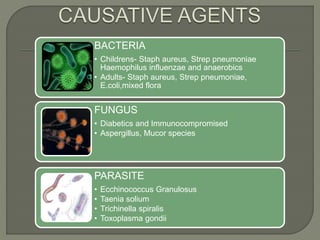
BACTERIA
• Childrens- Staph aureus, Strep pneumoniae
Haemophilus influenzae and anaerobics
• Adults- Staph aureus, Strep pneumoniae,
E.coli,mixed flora
FUNGUS
• Diabetics and Immunocompromised
• Aspergillus, Mucor species
PARASITE
• Ecchinococcus Granulosus
• Taenia solium
• Trichinella spiralis
• Toxoplasma gondii
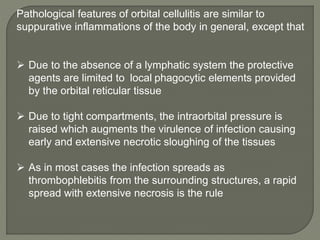
Pathological features of orbital cellulitis are similar to
suppurative inflammations of the body in general, except that
 Due to the absence of a lymphatic system the protective
agents are limited to local phagocytic elements provided
by the orbital reticular tissue
 Due to tight compartments, the intraorbital pressure is
raised which augments the virulence of infection causing
early and extensive necrotic sloughing of the tissues
 As in most cases the infection spreads as
thrombophlebitis from the surrounding structures, a rapid
spread with extensive necrosis is the rule
Factors
absent lymphatic
system
tight compartments
thrombophlebitis-
extensive necrosis
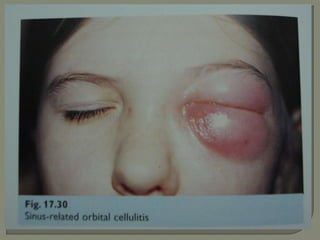
 Fever, generally 102 degree F or greater
 Painful swelling of upper and lower lids
 Eyelid appears shiny and is red or purple in color
 Infant or child is acutely ill or toxic
 Eye pain especially with movement
 Decreased vision
 Eye bulging
 Swelling of the eyelids
 General malaise
 Restricted or painful eye movements
SIGNS
Lid
Oedema
Chemosis
Proptosis
Restricted
Ocular
motility
Visual
impairment
Raised
IOP
 A marked swelling of the lids characterised
by woody hardness and redness
 A marked chemosis of conjunctiva, which
may protrude and become desiccated or
necrotic
 The eyeball is proptosed axially
 Frequently, there is mild to severe restriction
of the ocular movements
 Fundus examination may show congestion
of retinal veins and signs of papillitis or
papilloedem
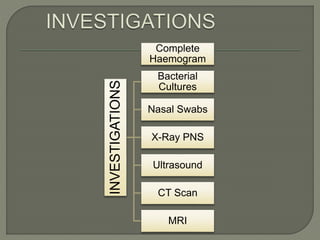
INVESTIGATIONS
Complete
Haemogram
Bacterial
Cultures
Nasal Swabs
X-Ray PNS
Ultrasound
CT Scan
MRI
ULTRASOUND
Rule out orbital
myositis
Determine foreign
bodies and abscess
Follow up of patients
of drained abscess
CT scan & MRI are useful:-
 In differentiating B/W preseptal & post septal
cellulitis
 In detecting subperiosteal & orbital abscess
 In detecting intracranial extensions
 In detecting extra or intraconal mass
 In deciding when & from where to drain an orbital
abscess
Cavernous sinus thrombosis
Grave’s orbitopathy
Orbital myositis
Orbital pseudotumor
Cavernous Sinus Thrombosis
 Presents almost same symptoms and signs as in
orbital cellulitis, but with systemic features fever,
headache and an altered sensorium
 Thrombosis of the cavernous sinus is accompanied by
rigors, vomiting and severe cerebral symptoms
 Transference of symptoms to the fellow eye, which
occurs in 50% of cases
 Bilateral orbital cellulitis is very rare
 First sign is often paralysis of the opposite lateral
rectus
Thyroid associated ophthmopathy(TAO) or
Grave’s orbitopathy
 Symptoms are gritty sensations, photophobia, lacrimation,
discomfort,dysfunctional eye motility or diminution of vision
 Lid retraction
 Lid lag of the upper eyelid on downward gaze
 Axial proptosis (most common cause)
 Exposure keratitis
 Compressive optic neuropathy
 Muscles affected results in ocular misalignment, diplopia
Orbital Myositis
 It’s an inflammatory process that primarily involves the
extraocular muscles.
 The classic appearance of EOM myositis includes a unilateral
thickening of one or two EOMs, often also involving the
surrounding fat, tendon, and myotendinous junction
 Presents as orbital and periorbital pain, ocular movement
impairment, diplopia, proptosis, swollen eyelids, and
conjunctival hyperemia
 Orbital cellulitis, which is commonly accompanied by fever,
leukocytosis
Pseudotumor/Idiopathic orbital inflammatory disease/
Non-specific orbital inflammatory disease
 Presents as proptosis,pain, diplopia, lid swelling and
redness
 Usually unilateral but occasionally bilateral.
 Ultrasonography of the orbit shows a diffuse infiltration of
heterogeneous Consistency
 CT scan shows diffuse thickening of the extraocular
muscles including their tendinous insertion, which is useful
in differentiating this from thyroid eye disease where the
muscle enlargement is confined to the
belly and spares the terminal tendinous portion
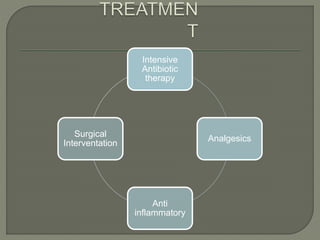
Intensive
Antibiotic
therapy
Analgesics
Anti
inflammatory
Surgical
Interventation
IV Antibiotics:- broad spectrum antibiotic (penicillin +
clavulanic acid) therapy should be continued until patient is
apyrexic for 4 days
Antifungals( if fungal infection suspected)
Nasal decongestants
Diuretics may be given to reduce the IOP
It is useful to do the swinging light test to check for a
Marcus Gunn pupil, which would indicate optic nerve
damage
Frequent ophthalmic assessment is mandatory in case of
intra cranial abscess formation, neurosurgical drainage
may be necessary
Unresponsiveness to antibiotcs
Decreasing vision with medical treatment
Presence of an orbital or subperiosteal
abscess
Free incision into abscess when pointing under skin or
conjunctiva
Subperiostial abscess drained by 2-3 cm curved incision
in upper medial aspect
Draining of orbits and paranasal sinuses
Brain abscess- Craniotomy
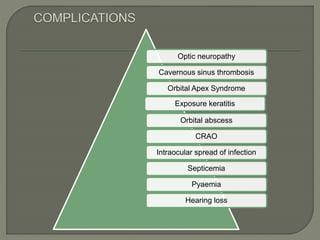
Optic neuropathy
Cavernous sinus thrombosis
Orbital Apex Syndrome
Exposure keratitis
Orbital abscess
CRAO
Intraocular spread of infection
Septicemia
Pyaemia
Hearing loss
Large venous space situated in the middle
cranial fossa, on either side of body of the
sphenoid bone.
Each sinus is about 2 cm long and 1 cm wide.
Interior is divided into a number of spaces or
caverns by trabeculae.
 Anterior - extends into
medial end of superior
orbital fissure.
 Posterior - upto apex of
petrous temporal bone.
 Medial – Pitutary above and
sphenoid below
 Lateral – temporal lobe and
uncus
 Superior – optic chiasma
 Inferior - endosteal dura
mater, greater wing of
sphenoid
 Superior to inferior (within the
lateral wall of the sinus)
• oculomotor nerve (CN III)
• trochlear nerve (CN IV)
• ophthalmic nerve, the
V1 branch of the trigeminal
nerve (CN V)
• maxillary nerve, the V2 branch
of CN V
abducens nerve (CN VI) runs through
the middle of the sinus alongside
the internal carotid artery (with
sympathetic plexus)
These nerves, except the CN V2, pass
through the cavernous sinus to
enter the orbital apex through
the superior orbital fissure.
flow of blood in all tributaries & communication
are reversible as they possess no valve
Spread of infection can lead to thrombosis of
cavernous sinus
The cavernous communicate with dangerous
area of face through 2 routes
 Superior opthalmic vein
 Deep facial veins , pterygoid plexus of vein ,
emissary vein.
1. Infection of the upper lip, vestibule of the nose and
eyelids  spread by way of the angular,
supraorbital and supratrochlear veins to the
ophthalmic veins. Commonest route of infection.
2. Intranasal operations on the septum, turbinates or
ethmoid / sphenoid sinus infection  through the
ethmoidal veins.
3. Operations on the tonsil, peritonsillar abscess, surgery or
osteomyelitis of the maxilla, dental extraction and deep
cervical abscess  spread by pterygoid plexus or by direct
extension to the internal jugular vein.
4. Involvement of the middle ear and mastoid with lateral sinus
phlebitis or thrombosis  retrograde spread through the
petrosal sinuses to the cavernous sinus.
 Most commonly results from contiguous spread of infection from
the nose (50%), sphenoidal or ethmoidal sinuses (30%) and dental
infections (10%).
 Staphylococcus aureus is the most common - found in 70% of the
cases.
 Streptococcus is the second leading cause.
 Gram-negative rods and anaerobes may also lead to cavernous
sinus thrombosis.
 Rarely Aspergillus fumigatus and mucormycosis.
 Starts initially as unilateral, soon becomes B/L in
more than 50% cases due to intercavernous
communication.
 General feature of infection – high grade fever, rigors,
malaise, vomiting, severe frontal & periorbital headache.
Ocular features:- severe pain in eye
 Edema Ptosis of eyelid
 Conjunctiva- chemosed & congested
 Proptosis develops rapidly
 3rd,4th, & 6th, CN palsy( so in later stage eye immobile,
pupil dilated & cornea anaesthetic)
Edema in mastoid region:- a pathognomonic
sign. It is due to back pressure in mastoid
emissary vein.
 1st sign is often paralysis of opposite lateral
rectus
 Fundus- normal with normal vision in early
stage, in advanced case congestion of retinal
vein & papilloedema may occur.
SIGN INVOLVED STRUCTURES
Ptosis Edema of upper eye lid
Sympathetic plexus
III cranial nerve
Chemosis Thrombosis of superior and inferior
ophthalamic vein
Proptosis Venous engorgement
Sensory loss/ Periorbital pain V cranial nerve
Corneal ulcers Corneal exposure due to proptosis
Lateral rectus palsy VI cranial nerve
Complete ophthalmoplegia CN III, IV, VI
Decreased visual acuity or blindness Central retinal artery/ vein occlusion
secondary to ICA arteritis, septic emboli,
ischemic optic neuropathy
 Intracranial extension of infection may result in
meningitis, encephalitis, brain abscess, pituitary
infection, and epidural and subdural empyema.
 Cortical vein thrombosis can result in
hemorrhagic infarction.
 Extension of the thrombus to other sinuses can
occur.
Septic cavernous sinus thrombosis –
 The mainstay of therapy is early and aggressive antibiotic
administration.
 Although S aureus is the usual cause, broad-spectrum coverage
for gram-positive, gram-negative, and anaerobic organisms should
be instituted pending the outcome of cultures.
 Empiric antibiotic therapy should include a penicillinase-resistant
penicillin plus a third generation cephalosporin.
 Vancomycin may be added for MRSA.
 IV antibiotics are recommended for a minimum of 3-4 weeks.
 The indication of anticoagulation is still debated because of
possible bleeding complications and an eventual suppressive role
of the thrombus on the extension of the infectious
thrombophlebitis.
 Anticoagulation carries a significant risk of hemorrhage
 Anticoagulant is contraindicated in the presence of intracerebral
hemorrhage or other bleeding diathesis.
 100% mortality prior to effective antimicrobials
 Typically, death is due to sepsis or central nervous system (CNS)
infection.
 With aggressive management, the mortality rate is now less than
30%.
 Morbidity, however, remains high, and complete recovery is rare.
 Roughly one sixth of patients are left with some degree of visual
impairment, and one half (50 %) have cranial nerve deficits.
 Conditions of orbit which clinically presented as
tumour but histopathologically proven to be chronic
inflammations.
 Uncertain aetiology.
 So presntly K/A Idiopathic Obital Inflammatory
Disease (IOID)
 Can occur throughout orbit from region of lacrimal
gland to orbital apex, so produce varied clinical
presentations
 Spontaneous remission & recurrences are common
 Commenest B/W 40-60 yrs, but can occur at any
age.
 Slightly commoner in male.
 Causes swelling of eyelids, proptosis, orbital pain,
restricted ocular movement, diplopia, chemosis &
redness.
 Clinically mimics thyroid ophthalmopathy.
 Mostly U/L but occasionally B/L.
 It is a diagnosis of exclusion.
 USG & CT Scan show a diffuse infltrative lesion
with irregular ill defined margins & variable density.
 FNAC:- may give histological clue.
 Incision biopsy:- confirm diagnosis.
 A short course of systemic steroid(60-80mg/day
prednisolone for 2 weeks, then gradually tapered)
show good response.
 50% may develop recurrence on withdrawal of
steroid therapy. Radiotherapy effective in
eliminating disease permanently in such cases.
 Unresponsive cases require cyclophosphamide in
addition to steroid & radiation
Orbital Inflammations.pptx

Orbital Inflammations.pptx

  • 1.
    Dr. Atul KumarAnand Senior Resident AIIMS Patna
  • 2.
    Infection of subcutaneoustissues of the eyelids & periocular region anterior to orbital septum. Also K/A periorbital cellulitis Orbital septum:- The orbit is separated from the soft tissue of the eyelid by the orbital septum.  Orbital septum inserts into the tarsal plate of the upper and lower eyelids  It proves to be an effective barrier that prevents the spread of infection from the eyelids posteriorly to the orbit.
  • 3.
    Causes eye lidto swell(strictly speking not a disease of orbit) May spread posteriorly to produce orbital cellulitis Causative organisms:- usually staph. aureus or strepto pyogenes
  • 4.
    Exogenous infection:- fromskin lacerations or insect bites Endogenous infection:- by hematogenous spread from middle ear infection or URTI Extension from local infection:- from hordeolum or acute dacryocystits.
  • 6.
    Painful acute periorbitalinflammatory edema, erythema & hyperemia of the eye lids(without involvement of orbit)  May have fever & leukocytosis Usually no extra ocular muscle movement limitations and no visual impairment  No proptosis
  • 7.
    Oral & topicalbroad spectrum antibiotics Anti inflammatory(NSAID) & analgesics Regular follow up Prognosis :- very good, {resolution quick & complete}
  • 8.
    Acute infection ofthe soft tissues of the orbit posterior to the orbital septum. May or may not progress to a subperiosteal abscess or orbital abscess
  • 9.
     Extension fromneighbouring structures : - Parasnasal sinuses, Teeth, Face, Lids, Intracranial cavity, Intraorbital structures. This is the commonest mode of infection  Exogenous Infection :- Penetrating injury, retaining Foreign body, following operations like Evisceration, Enucleation, Dacryocystectomy, Orbitotomy  Endogenous infection :- Puerperal sepsis, Septicemia, Thrombophlebitis of leg, rarely as metastasis from Breast abscess
  • 10.
    Predisposing factors likeDiabetes mellitus and Immunocompromised state also increases risk of infection.
  • 13.
    BACTERIA • Childrens- Staphaureus, Strep pneumoniae Haemophilus influenzae and anaerobics • Adults- Staph aureus, Strep pneumoniae, E.coli,mixed flora FUNGUS • Diabetics and Immunocompromised • Aspergillus, Mucor species PARASITE • Ecchinococcus Granulosus • Taenia solium • Trichinella spiralis • Toxoplasma gondii
  • 14.
    Pathological features oforbital cellulitis are similar to suppurative inflammations of the body in general, except that  Due to the absence of a lymphatic system the protective agents are limited to local phagocytic elements provided by the orbital reticular tissue  Due to tight compartments, the intraorbital pressure is raised which augments the virulence of infection causing early and extensive necrotic sloughing of the tissues  As in most cases the infection spreads as thrombophlebitis from the surrounding structures, a rapid spread with extensive necrosis is the rule
  • 15.
  • 17.
     Fever, generally102 degree F or greater  Painful swelling of upper and lower lids  Eyelid appears shiny and is red or purple in color  Infant or child is acutely ill or toxic  Eye pain especially with movement  Decreased vision  Eye bulging  Swelling of the eyelids  General malaise  Restricted or painful eye movements
  • 18.
  • 19.
     A markedswelling of the lids characterised by woody hardness and redness  A marked chemosis of conjunctiva, which may protrude and become desiccated or necrotic  The eyeball is proptosed axially  Frequently, there is mild to severe restriction of the ocular movements  Fundus examination may show congestion of retinal veins and signs of papillitis or papilloedem
  • 20.
  • 21.
    ULTRASOUND Rule out orbital myositis Determineforeign bodies and abscess Follow up of patients of drained abscess
  • 22.
    CT scan &MRI are useful:-  In differentiating B/W preseptal & post septal cellulitis  In detecting subperiosteal & orbital abscess  In detecting intracranial extensions  In detecting extra or intraconal mass  In deciding when & from where to drain an orbital abscess
  • 23.
    Cavernous sinus thrombosis Grave’sorbitopathy Orbital myositis Orbital pseudotumor
  • 24.
    Cavernous Sinus Thrombosis Presents almost same symptoms and signs as in orbital cellulitis, but with systemic features fever, headache and an altered sensorium  Thrombosis of the cavernous sinus is accompanied by rigors, vomiting and severe cerebral symptoms  Transference of symptoms to the fellow eye, which occurs in 50% of cases  Bilateral orbital cellulitis is very rare  First sign is often paralysis of the opposite lateral rectus
  • 25.
    Thyroid associated ophthmopathy(TAO)or Grave’s orbitopathy  Symptoms are gritty sensations, photophobia, lacrimation, discomfort,dysfunctional eye motility or diminution of vision  Lid retraction  Lid lag of the upper eyelid on downward gaze  Axial proptosis (most common cause)  Exposure keratitis  Compressive optic neuropathy  Muscles affected results in ocular misalignment, diplopia
  • 26.
    Orbital Myositis  It’san inflammatory process that primarily involves the extraocular muscles.  The classic appearance of EOM myositis includes a unilateral thickening of one or two EOMs, often also involving the surrounding fat, tendon, and myotendinous junction  Presents as orbital and periorbital pain, ocular movement impairment, diplopia, proptosis, swollen eyelids, and conjunctival hyperemia  Orbital cellulitis, which is commonly accompanied by fever, leukocytosis
  • 27.
    Pseudotumor/Idiopathic orbital inflammatorydisease/ Non-specific orbital inflammatory disease  Presents as proptosis,pain, diplopia, lid swelling and redness  Usually unilateral but occasionally bilateral.  Ultrasonography of the orbit shows a diffuse infiltration of heterogeneous Consistency  CT scan shows diffuse thickening of the extraocular muscles including their tendinous insertion, which is useful in differentiating this from thyroid eye disease where the muscle enlargement is confined to the belly and spares the terminal tendinous portion
  • 28.
  • 29.
    IV Antibiotics:- broadspectrum antibiotic (penicillin + clavulanic acid) therapy should be continued until patient is apyrexic for 4 days Antifungals( if fungal infection suspected) Nasal decongestants Diuretics may be given to reduce the IOP It is useful to do the swinging light test to check for a Marcus Gunn pupil, which would indicate optic nerve damage Frequent ophthalmic assessment is mandatory in case of intra cranial abscess formation, neurosurgical drainage may be necessary
  • 30.
    Unresponsiveness to antibiotcs Decreasingvision with medical treatment Presence of an orbital or subperiosteal abscess
  • 31.
    Free incision intoabscess when pointing under skin or conjunctiva Subperiostial abscess drained by 2-3 cm curved incision in upper medial aspect Draining of orbits and paranasal sinuses Brain abscess- Craniotomy
  • 32.
    Optic neuropathy Cavernous sinusthrombosis Orbital Apex Syndrome Exposure keratitis Orbital abscess CRAO Intraocular spread of infection Septicemia Pyaemia Hearing loss
  • 34.
    Large venous spacesituated in the middle cranial fossa, on either side of body of the sphenoid bone. Each sinus is about 2 cm long and 1 cm wide. Interior is divided into a number of spaces or caverns by trabeculae.
  • 35.
     Anterior -extends into medial end of superior orbital fissure.  Posterior - upto apex of petrous temporal bone.  Medial – Pitutary above and sphenoid below  Lateral – temporal lobe and uncus  Superior – optic chiasma  Inferior - endosteal dura mater, greater wing of sphenoid
  • 36.
     Superior toinferior (within the lateral wall of the sinus) • oculomotor nerve (CN III) • trochlear nerve (CN IV) • ophthalmic nerve, the V1 branch of the trigeminal nerve (CN V) • maxillary nerve, the V2 branch of CN V
  • 37.
    abducens nerve (CNVI) runs through the middle of the sinus alongside the internal carotid artery (with sympathetic plexus) These nerves, except the CN V2, pass through the cavernous sinus to enter the orbital apex through the superior orbital fissure.
  • 39.
    flow of bloodin all tributaries & communication are reversible as they possess no valve Spread of infection can lead to thrombosis of cavernous sinus The cavernous communicate with dangerous area of face through 2 routes  Superior opthalmic vein  Deep facial veins , pterygoid plexus of vein , emissary vein.
  • 40.
    1. Infection ofthe upper lip, vestibule of the nose and eyelids  spread by way of the angular, supraorbital and supratrochlear veins to the ophthalmic veins. Commonest route of infection. 2. Intranasal operations on the septum, turbinates or ethmoid / sphenoid sinus infection  through the ethmoidal veins.
  • 41.
    3. Operations onthe tonsil, peritonsillar abscess, surgery or osteomyelitis of the maxilla, dental extraction and deep cervical abscess  spread by pterygoid plexus or by direct extension to the internal jugular vein. 4. Involvement of the middle ear and mastoid with lateral sinus phlebitis or thrombosis  retrograde spread through the petrosal sinuses to the cavernous sinus.
  • 42.
     Most commonlyresults from contiguous spread of infection from the nose (50%), sphenoidal or ethmoidal sinuses (30%) and dental infections (10%).  Staphylococcus aureus is the most common - found in 70% of the cases.  Streptococcus is the second leading cause.  Gram-negative rods and anaerobes may also lead to cavernous sinus thrombosis.  Rarely Aspergillus fumigatus and mucormycosis.
  • 43.
     Starts initiallyas unilateral, soon becomes B/L in more than 50% cases due to intercavernous communication.  General feature of infection – high grade fever, rigors, malaise, vomiting, severe frontal & periorbital headache. Ocular features:- severe pain in eye  Edema Ptosis of eyelid  Conjunctiva- chemosed & congested  Proptosis develops rapidly  3rd,4th, & 6th, CN palsy( so in later stage eye immobile, pupil dilated & cornea anaesthetic)
  • 44.
    Edema in mastoidregion:- a pathognomonic sign. It is due to back pressure in mastoid emissary vein.  1st sign is often paralysis of opposite lateral rectus  Fundus- normal with normal vision in early stage, in advanced case congestion of retinal vein & papilloedema may occur.
  • 45.
    SIGN INVOLVED STRUCTURES PtosisEdema of upper eye lid Sympathetic plexus III cranial nerve Chemosis Thrombosis of superior and inferior ophthalamic vein Proptosis Venous engorgement Sensory loss/ Periorbital pain V cranial nerve Corneal ulcers Corneal exposure due to proptosis Lateral rectus palsy VI cranial nerve Complete ophthalmoplegia CN III, IV, VI Decreased visual acuity or blindness Central retinal artery/ vein occlusion secondary to ICA arteritis, septic emboli, ischemic optic neuropathy
  • 46.
     Intracranial extensionof infection may result in meningitis, encephalitis, brain abscess, pituitary infection, and epidural and subdural empyema.  Cortical vein thrombosis can result in hemorrhagic infarction.  Extension of the thrombus to other sinuses can occur.
  • 48.
    Septic cavernous sinusthrombosis –  The mainstay of therapy is early and aggressive antibiotic administration.  Although S aureus is the usual cause, broad-spectrum coverage for gram-positive, gram-negative, and anaerobic organisms should be instituted pending the outcome of cultures.  Empiric antibiotic therapy should include a penicillinase-resistant penicillin plus a third generation cephalosporin.  Vancomycin may be added for MRSA.  IV antibiotics are recommended for a minimum of 3-4 weeks.
  • 49.
     The indicationof anticoagulation is still debated because of possible bleeding complications and an eventual suppressive role of the thrombus on the extension of the infectious thrombophlebitis.  Anticoagulation carries a significant risk of hemorrhage  Anticoagulant is contraindicated in the presence of intracerebral hemorrhage or other bleeding diathesis.
  • 50.
     100% mortalityprior to effective antimicrobials  Typically, death is due to sepsis or central nervous system (CNS) infection.  With aggressive management, the mortality rate is now less than 30%.  Morbidity, however, remains high, and complete recovery is rare.  Roughly one sixth of patients are left with some degree of visual impairment, and one half (50 %) have cranial nerve deficits.
  • 51.
     Conditions oforbit which clinically presented as tumour but histopathologically proven to be chronic inflammations.  Uncertain aetiology.  So presntly K/A Idiopathic Obital Inflammatory Disease (IOID)  Can occur throughout orbit from region of lacrimal gland to orbital apex, so produce varied clinical presentations  Spontaneous remission & recurrences are common
  • 52.
     Commenest B/W40-60 yrs, but can occur at any age.  Slightly commoner in male.  Causes swelling of eyelids, proptosis, orbital pain, restricted ocular movement, diplopia, chemosis & redness.  Clinically mimics thyroid ophthalmopathy.  Mostly U/L but occasionally B/L.
  • 54.
     It isa diagnosis of exclusion.  USG & CT Scan show a diffuse infltrative lesion with irregular ill defined margins & variable density.  FNAC:- may give histological clue.  Incision biopsy:- confirm diagnosis.
  • 55.
     A shortcourse of systemic steroid(60-80mg/day prednisolone for 2 weeks, then gradually tapered) show good response.  50% may develop recurrence on withdrawal of steroid therapy. Radiotherapy effective in eliminating disease permanently in such cases.  Unresponsive cases require cyclophosphamide in addition to steroid & radiation