KERATOCONUS
Manoj Aryal
IOM. MMC
PRESENTATION LAYOUT
• Introduction
• Aetiology
• Onset
• Clinical signs and symptoms
• Histopathology
• Classification
• Management
INTRODUCTION
• Greek word
• Kerato : cornea Konos : cone
• First described by British ophthalmologist John
Nottingham in 1854
• Most common corneal ectasia
• Incidence 1 in 2000
INTRODUCTION
• Non-inflammatory, progressive thinning of the
cornea that results in apical protrusion (ectasia)
resulting in a high degree of irregular myopic
astigmatism with observable structural changes
appearing in later stages.
AETIOLOGY
• Collagen abnormality
• Familial tendency
• Eye rubbing due to allergy
Aggravating factors
• UV exposure
• Poorly fitting contact lenses.
• Inflammation.
ASSOCIATED CONDITIONS:
OCULAR
• Retinitis pigmetosa
• Retinopathy of
prematurity
• Ankyloblepharon
• Floppy eyelid syndrome
• Gyrate atrophy
• Leber’s congenital
amaurosis
• Vernal conjunctivitis
• Atopic dermatitis
• Micro cornea
• Blue Sclera
• Aniridia
• Congenital cataract
• Persistent pupillary
membrane
• Posterior lenticonus
ASSOCIATED CONDITIONS:
MULTI-SYSTEM
• Down’s Syndrome
• Marfan Syndrome
• Cruzan's Syndrome
• Ehlers-Danlos Syndrome
• Xeroderma pigmentosa
• Neurofibromatosis
• Osteogenesis
imperfect
• Turner’s Syndrome
ONSET
• Mean age of onset is age 16 years
• Shows no gender predilection and is
bilateral in over 90% of cases.
• Develops asymmetrically
 Frequently changing
spectacle Rx and
axis of astigmatism
 Ghosting/ monocular
diplopia
 Glare at night
 Haloes around lights
Blurred/ distorted
vision
 Scissors reflex
(swirling
retinoscopy reflex)
 Distorted/ irregular
Keratometer mires
with steep readings
 Prominent corneal
nerves
Signs Symptoms
Corneal nerves
• more prominent than in normal eye
Vogt’s striae
Fine vertical lines in the stroma and Descemet’s
membrane,
Form along the meridian of greatest curvature.
• Disappear temporarily on digital pressure.
Fleischer’s ring
Iron pigment ring forms the base of the
cone. May be partial or complete.
• Corneal thinning
•Visible in the central-inferior region in
moderate and advanced Keratoconus.
•Represents an actual reduction in the
number of stromal lamellae
• Munson’s sign
•Ectasic protrusion of the cornea on down
gaze produces a V-shaped conformation of
the lower lid.
• Rizzuit sign
•Lateral illumination of the cornea produces
a steeply focused beam of light near the
limbus. Moderate: beam central to limbus.
Advanced: beam displaced peripherally
•Corneal scarring
• Sub-epithelial corneal scarring,
not generally seen early, may
occur as keratoconus progresses
because of ruptures in Bowman's
membrane which is then filled
with connective tissue
•Corneal hydrops
• Occurs, generally in
advanced cases, when
Descemet's membrane
ruptures, aqueous flows into
the cornea and reseals
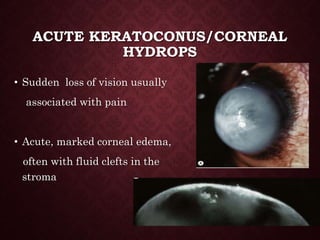
ACUTE KERATOCONUS/CORNEAL
HYDROPS
• Sudden loss of vision usually
associated with pain
• Acute, marked corneal edema,
often with fluid clefts in the
stroma
ACUTE KERATOCONUS/CORNEAL
HYDROPS
Resolves over a period of weeks to
months
Results in corneal scarring and
flattening, with or without corneal
neovascularization.
Rarely, complicated by corneal
perforation.
ACUTE KERATOCONUS/CORNEAL
HYDROPS
• Managed with
• Patching or bandage contact lens
• Cycloplegia
• Hypertonic sodium chloride ointment and
/or drops
HISTOPATHOLOGY:
• Fragmentation of Bowman layer
• Thinning of the stroma and overlying epithelium
• Folds or breaks in Descemet's membrane
• Fleischer ring: Ferritin particles accumulate within
and between the epithelial cells, particularly in the
basal epithelium
CLASSIFICATION
Based on severity of curvature
 Mild <45 D in both meridians
 Moderate 45-52 D in both meridians
 Advanced >52 D in both meridians
 Severe >62 D in both meridians
CLASSIFICATION
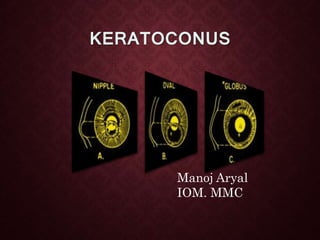
Based on type of cones
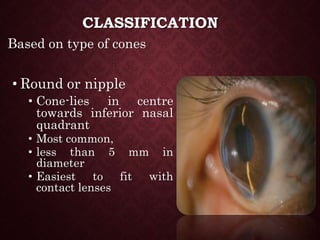
• Round or nipple
• Cone-lies in centre
towards inferior nasal
quadrant
• Most common,
• less than 5 mm in
diameter
• Easiest to fit with
contact lenses
• Oval cone
• diameter(>5 mm.);
often displaced
inferiorly
• more difficult to fit
with lenses
• Globus cone
• overall steepening
• diameter more than 6
mm diameter.
• 75% of cornea affected;
most difficult to fit
with lenses
Keratometer (Ophthalmometer )
Keratoscope :
• Placido disc
• Photokeratoscopy
• Video Keratoscopy (Computer assisted
topographic analysis.)
METHODS OF
MEASUREMENT(DIAGNOSIS)
 Principle
 Use of the first
Purkinje image.
• Consists of equally
spaced alternating
black & white lines.
PLACIDO DISC
• A luminous object
(target of rings) is
placed in front of
patient’s cornea.
• Image size produced in
the corneal reflection
is measured
 Circular Rings -Spherical cornea
 Oval Rings –Regular astigmatism .
 WTR astigmatism
 ATR astigmatism
CLINICAL INTERPRETATION
With long vertical axis –
Against the Rule Astigmatism.
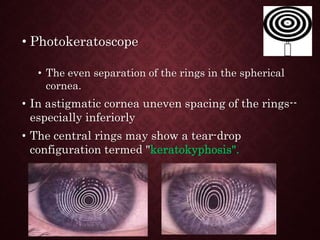
• Photokeratoscope
• The even separation of the rings in the spherical
cornea.
• In astigmatic cornea uneven spacing of the rings--
especially inferiorly
• The central rings may show a tear-drop
configuration termed "keratokyphosis".
Cool colors (black, blue, azure)
Flatter surfaces
Warm colors (orange, red, white)
Steeper surfaces
Normal (green, yellow)
Normal surfaces
CORNEAL TOPOGRAPHY
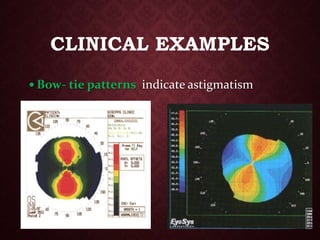
 Bow- tie patterns indicate astigmatism
CLINICAL EXAMPLES
Small, near central ectasia, less
than 5.0 mm in cord diameter
NIPPLE-SHAPED TOPOGRAPHY
May manifest as moderate to
high with-the-rule corneal
astigmatism
In advanced keratoconus.
Corneal apex is displaced
well below the midline
resulting in varying degrees
of inferior mid-peripheral
steepening.
Kissing pigeon pattern
(diagnostic of PMD)
OVAL SHAPED TOPOGRAPHY
GLOBUS-SHAPED TOPOGRAPHY
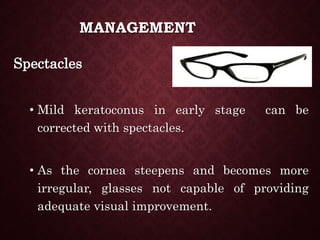
Spectacles
• Mild keratoconus in early stage can be
corrected with spectacles.
• As the cornea steepens and becomes more
irregular, glasses not capable of providing
adequate visual improvement.
MANAGEMENT
FITTING PHILOSOPHIES
FOR KERATOCONUS
WITH CONTACT LENS
1. FLAT FITTING
• The flat fitting method places almost
the entire weight of the lens on the
cone
• Good visual acuity is obtained as a
result of apical touch.
• Alignment can be obtained in early
keratoconus; however, flat fitting
lenses can lead to progression/
acceleration of apical changes and
corneal abrasions
2. APICAL CLEARANCE
• The lens vaults the cone and clears
the central cornea, resting on the
paracentral cornea
• Apical clearance would minimize
trauma to the central cornea
• The potential advantages of reducing
central corneal scarring are
outweighed by the disadvantages of
poor tear film, corneal edema, and
poor visual acuity as a result of
bubbles becoming trapped under the
lens
3. THREE-POINT TOUCH
• The aim is to distribute the
weight of the contact lens as
evenly as possible between the
cone and the peripheral cornea.
• lens lightly touches the peak of
the cone then a very low vault
over the edges of the cone, and
lastly a thin band of touching
near the edge of the lens
Contact lenses
• Soft contact lenses
• Rigid gas permeable lenses
• Combined lens system
• Piggy back system
• Hybrid lens system
• Fully keratonic designed lenses
• Rose k family of lens
• Scleral and mini scleral lens
SOFT CONTACT LENSES
• It is not better than spectacle lens but it works in piggy
back system
• At very early stage, this way work as equal to spectacle
does.
• But patient may not be satisfied with the level of vision he
has even though it is 6/6
• Shadow effect of texts
• Ghosting of image
• Poor night vision
• Eye fatigue on prolong reading
RIGID GAS PERMEABLE LENSES
• Cost effective, easily available,
suitable for mild to moderate
keratoconus
• Fitting: three point conventional
fitting philosophy
COMBINED LENS SYSTEM
Piggy back system
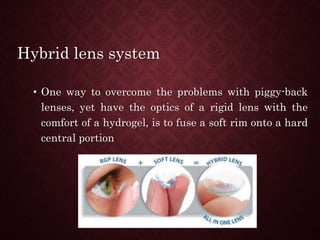
 Hybrid lens system
Piggy back system
• Rigid lens fitted over a hydrogel lens increases
comfort resulting in adequate wearing time
with good vision
Hybrid lens system
• One way to overcome the problems with piggy-back
lenses, yet have the optics of a rigid lens with the
comfort of a hydrogel, is to fuse a soft rim onto a hard
central portion
FULLY KERATONIC DESIGNED LENS
Rose k family of lens
SCLERAL AND MINI-SCLERAL LENS
Design to fit all irregular corneas which don’t
tolerate any other RGP or hybrid/Soft lens
COLLAGEN CROSS-LINKING (CXL
OR C3-R)
• It may slow or halt the progression of
keratoconus by using a photo-oxidative
treatment to increase the rigidity of the
corneal stroma.
KERATOPLASTY
• For patients Intolerant to contact lens and
cases with scarring
• Penetrating keratoplasty and Deep anterior
lamellar keratoplasty can be done
• Patient may have to continue contact lens ,but
will have better tolerance
Keratoconus

Keratoconus

  • 1.
  • 2.
    PRESENTATION LAYOUT • Introduction •Aetiology • Onset • Clinical signs and symptoms • Histopathology • Classification • Management
  • 3.
    INTRODUCTION • Greek word •Kerato : cornea Konos : cone • First described by British ophthalmologist John Nottingham in 1854 • Most common corneal ectasia • Incidence 1 in 2000
  • 4.
    INTRODUCTION • Non-inflammatory, progressivethinning of the cornea that results in apical protrusion (ectasia) resulting in a high degree of irregular myopic astigmatism with observable structural changes appearing in later stages.
  • 5.
    AETIOLOGY • Collagen abnormality •Familial tendency • Eye rubbing due to allergy Aggravating factors • UV exposure • Poorly fitting contact lenses. • Inflammation.
  • 6.
    ASSOCIATED CONDITIONS: OCULAR • Retinitispigmetosa • Retinopathy of prematurity • Ankyloblepharon • Floppy eyelid syndrome • Gyrate atrophy • Leber’s congenital amaurosis • Vernal conjunctivitis • Atopic dermatitis • Micro cornea • Blue Sclera • Aniridia • Congenital cataract • Persistent pupillary membrane • Posterior lenticonus
  • 7.
    ASSOCIATED CONDITIONS: MULTI-SYSTEM • Down’sSyndrome • Marfan Syndrome • Cruzan's Syndrome • Ehlers-Danlos Syndrome • Xeroderma pigmentosa • Neurofibromatosis • Osteogenesis imperfect • Turner’s Syndrome
  • 8.
    ONSET • Mean ageof onset is age 16 years • Shows no gender predilection and is bilateral in over 90% of cases. • Develops asymmetrically
  • 9.
     Frequently changing spectacleRx and axis of astigmatism  Ghosting/ monocular diplopia  Glare at night  Haloes around lights Blurred/ distorted vision  Scissors reflex (swirling retinoscopy reflex)  Distorted/ irregular Keratometer mires with steep readings  Prominent corneal nerves Signs Symptoms
  • 10.
    Corneal nerves • moreprominent than in normal eye Vogt’s striae Fine vertical lines in the stroma and Descemet’s membrane, Form along the meridian of greatest curvature. • Disappear temporarily on digital pressure. Fleischer’s ring Iron pigment ring forms the base of the cone. May be partial or complete.
  • 11.
    • Corneal thinning •Visiblein the central-inferior region in moderate and advanced Keratoconus. •Represents an actual reduction in the number of stromal lamellae • Munson’s sign •Ectasic protrusion of the cornea on down gaze produces a V-shaped conformation of the lower lid. • Rizzuit sign •Lateral illumination of the cornea produces a steeply focused beam of light near the limbus. Moderate: beam central to limbus. Advanced: beam displaced peripherally
  • 12.
    •Corneal scarring • Sub-epithelialcorneal scarring, not generally seen early, may occur as keratoconus progresses because of ruptures in Bowman's membrane which is then filled with connective tissue •Corneal hydrops • Occurs, generally in advanced cases, when Descemet's membrane ruptures, aqueous flows into the cornea and reseals
  • 13.
    ACUTE KERATOCONUS/CORNEAL HYDROPS • Suddenloss of vision usually associated with pain • Acute, marked corneal edema, often with fluid clefts in the stroma
  • 14.
    ACUTE KERATOCONUS/CORNEAL HYDROPS Resolves overa period of weeks to months Results in corneal scarring and flattening, with or without corneal neovascularization. Rarely, complicated by corneal perforation.
  • 15.
    ACUTE KERATOCONUS/CORNEAL HYDROPS • Managedwith • Patching or bandage contact lens • Cycloplegia • Hypertonic sodium chloride ointment and /or drops
  • 16.
    HISTOPATHOLOGY: • Fragmentation ofBowman layer • Thinning of the stroma and overlying epithelium • Folds or breaks in Descemet's membrane • Fleischer ring: Ferritin particles accumulate within and between the epithelial cells, particularly in the basal epithelium
  • 17.
    CLASSIFICATION Based on severityof curvature  Mild <45 D in both meridians  Moderate 45-52 D in both meridians  Advanced >52 D in both meridians  Severe >62 D in both meridians
  • 18.
    CLASSIFICATION Based on typeof cones • Round or nipple • Cone-lies in centre towards inferior nasal quadrant • Most common, • less than 5 mm in diameter • Easiest to fit with contact lenses
  • 19.
    • Oval cone •diameter(>5 mm.); often displaced inferiorly • more difficult to fit with lenses
  • 20.
    • Globus cone •overall steepening • diameter more than 6 mm diameter. • 75% of cornea affected; most difficult to fit with lenses
  • 21.
    Keratometer (Ophthalmometer ) Keratoscope: • Placido disc • Photokeratoscopy • Video Keratoscopy (Computer assisted topographic analysis.) METHODS OF MEASUREMENT(DIAGNOSIS)
  • 22.
     Principle  Useof the first Purkinje image. • Consists of equally spaced alternating black & white lines. PLACIDO DISC
  • 23.
    • A luminousobject (target of rings) is placed in front of patient’s cornea. • Image size produced in the corneal reflection is measured
  • 24.
     Circular Rings-Spherical cornea  Oval Rings –Regular astigmatism .  WTR astigmatism  ATR astigmatism CLINICAL INTERPRETATION With long vertical axis – Against the Rule Astigmatism.
  • 25.
    • Photokeratoscope • Theeven separation of the rings in the spherical cornea. • In astigmatic cornea uneven spacing of the rings-- especially inferiorly • The central rings may show a tear-drop configuration termed "keratokyphosis".
  • 26.
    Cool colors (black,blue, azure) Flatter surfaces Warm colors (orange, red, white) Steeper surfaces Normal (green, yellow) Normal surfaces CORNEAL TOPOGRAPHY
  • 27.
     Bow- tiepatterns indicate astigmatism CLINICAL EXAMPLES
  • 28.
    Small, near centralectasia, less than 5.0 mm in cord diameter NIPPLE-SHAPED TOPOGRAPHY May manifest as moderate to high with-the-rule corneal astigmatism
  • 29.
    In advanced keratoconus. Cornealapex is displaced well below the midline resulting in varying degrees of inferior mid-peripheral steepening. Kissing pigeon pattern (diagnostic of PMD) OVAL SHAPED TOPOGRAPHY
  • 30.
  • 31.
    Spectacles • Mild keratoconusin early stage can be corrected with spectacles. • As the cornea steepens and becomes more irregular, glasses not capable of providing adequate visual improvement. MANAGEMENT
  • 32.
  • 33.
    1. FLAT FITTING •The flat fitting method places almost the entire weight of the lens on the cone • Good visual acuity is obtained as a result of apical touch. • Alignment can be obtained in early keratoconus; however, flat fitting lenses can lead to progression/ acceleration of apical changes and corneal abrasions
  • 34.
    2. APICAL CLEARANCE •The lens vaults the cone and clears the central cornea, resting on the paracentral cornea • Apical clearance would minimize trauma to the central cornea • The potential advantages of reducing central corneal scarring are outweighed by the disadvantages of poor tear film, corneal edema, and poor visual acuity as a result of bubbles becoming trapped under the lens
  • 35.
    3. THREE-POINT TOUCH •The aim is to distribute the weight of the contact lens as evenly as possible between the cone and the peripheral cornea. • lens lightly touches the peak of the cone then a very low vault over the edges of the cone, and lastly a thin band of touching near the edge of the lens
  • 36.
    Contact lenses • Softcontact lenses • Rigid gas permeable lenses • Combined lens system • Piggy back system • Hybrid lens system • Fully keratonic designed lenses • Rose k family of lens • Scleral and mini scleral lens
  • 37.
    SOFT CONTACT LENSES •It is not better than spectacle lens but it works in piggy back system • At very early stage, this way work as equal to spectacle does. • But patient may not be satisfied with the level of vision he has even though it is 6/6 • Shadow effect of texts • Ghosting of image • Poor night vision • Eye fatigue on prolong reading
  • 38.
    RIGID GAS PERMEABLELENSES • Cost effective, easily available, suitable for mild to moderate keratoconus • Fitting: three point conventional fitting philosophy
  • 39.
    COMBINED LENS SYSTEM Piggyback system  Hybrid lens system
  • 40.
    Piggy back system •Rigid lens fitted over a hydrogel lens increases comfort resulting in adequate wearing time with good vision
  • 41.
    Hybrid lens system •One way to overcome the problems with piggy-back lenses, yet have the optics of a rigid lens with the comfort of a hydrogel, is to fuse a soft rim onto a hard central portion
  • 42.
    FULLY KERATONIC DESIGNEDLENS Rose k family of lens
  • 43.
    SCLERAL AND MINI-SCLERALLENS Design to fit all irregular corneas which don’t tolerate any other RGP or hybrid/Soft lens
  • 44.
    COLLAGEN CROSS-LINKING (CXL ORC3-R) • It may slow or halt the progression of keratoconus by using a photo-oxidative treatment to increase the rigidity of the corneal stroma.
  • 45.
    KERATOPLASTY • For patientsIntolerant to contact lens and cases with scarring • Penetrating keratoplasty and Deep anterior lamellar keratoplasty can be done • Patient may have to continue contact lens ,but will have better tolerance

Editor's Notes

  • #6 The role of heredity : not been clearly established. . In some cases, however, a sex-linked autosomal dominant mode of inheritance
  • #26 Corneal topography :a test used to map the topographical surface area of the cornea