Dr. Atul Kumar Anand
Senior Resident
AIIMS Patna
Definition: It is an operation in which the
patient's diseased cornea is replaced by
the donor's healthy clear cornea.
Types:
1. Penetrating keratoplasty (full-thickness
grafting)
2. Lamellar keratoplasty (partial-thickness
grafting) -anterior or posterior lamellar
Indications
 Optical ,i.e., to improve vision - corneal
opacity, bullous keratopathy, corneal
dystrophies, advanced keratoconus.
 Therapeutic, i.e., to replace inflamed cornea
not responding to conventional therapy
 Tectonic graft, i.e., to restore integrity of
eyeball in eyes with severe structural changes
such as severe thinning with descemetocele.
 Cosmetic, i.e., to improve the appearance of
the eye.
 removed as early as possible (12–24 hours of
death).
 Corneas from infants (3 years and under) are
rarely used -surgical, refractive and rejection
problems.
 It should be stored under sterile conditions.
 Evaluation –medical history review and donor
blood screening to exclude contraindications,
and microscopic examination of the cornea
including endothelial cell count determination
Short-term storage (up to 2 days) -The
whole globe is preserved at 40C in a moist
chamber.
Intermediate storage (up to 2 weeks) -
McCarey-Kaufman (MK) medium and
various chondroitin sulfate enriched media
such as optisol medium used.
Long-term storage (up to 35 days) -It is
done by organ culture method.
 Death of unknown cause.
 Certain systemic infections such as HIV, viral
hepatitis, syphilis, congenital rubella,
tuberculosis, septicemia and active malaria.
 Prior high-risk behavior for HIV and hepatitis.
 infectious diseases of the CNS.
 Receipt of a transplanted organ.
 Most hematological malignancies.
 Ocular disease such as inflammation and
malignancies (e.g. retinoblastoma) and
corneal refractive surgery.
 Severe stromal vascularization, extreme
thinning at the proposed host-graft junction
and active corneal inflammation.
 Abnormalities of the eyelids (blepharitis,
ectropion, entropion and trichiasis).
 Recurrent or progressive forms of
conjunctival inflammation.
 Tear film dysfunction.
 Anterior synechiae.
 Uncontrolled glaucoma.
 Uveitis.
most commonly performed corneal
transplantation procedure.
INDICATIONS INCLUDE:
Disease involving all layers of the cornea.
Specific common indications: keratoconus,
pseudophakic bullous keratopathy, Fuchs
endothelial and other dystrophies.
 Determination of graft size:
- by trial placement of trephines with different
diameters or by measurement with a caliper.
- An ideal size is 7.5 mm.
- grafts smaller than this may give rise to high
astigmatism.
- Grafts of diameter 8.5 mm or more are prone
to postoperative anterior synechiae formation,
vascularization and increased intraocular
pressure.
Excision of donor corneal button -The
donor corneal button should be trephined
0.25 mm larger than the recipient, taking
care not to damage the endothelium.
Excision of recipient corneal button -
care should be taken, not to damage the
iris and lens.
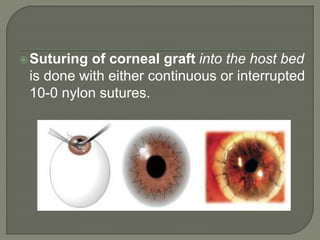
Suturing of corneal graft into the host bed
is done with either continuous or interrupted
10-0 nylon sutures.
 Topical steroids are used to decrease the risk of
immunological graft rejection.
 Other immunosuppressant –azathioprine,
cyclosporin may be rarely used in high-risk for
prevention of rejection.
 Mydriatics - if uveitis persists.
 Monitoring of IOP is performed during the early
postoperative period.
 Removal of sutures when the graft-host junction
has healed. This is usually after 12–18 months.
 Rigid contact lenses -to optimize visual acuity in
eyes with astigmatism.
 Early complications: persistent epithelial
defects, irritation by protruding sutures,
wound leak, flat anterior chamber, iris
prolapse, uveitis, elevation of intraocular
pressure, microbial keratitis and
endophthalmitis .
 Late: astigmatism, recurrence of initial
disease process, late wound separation,
retro-corneal membrane formation, glaucoma
and cystoid macular oedema.
This involves partial thickness excision of
the corneal epithelium and stroma.
endothelium and part of the deep stroma
are left behind.
Indications:
 Opacification of the superficial one-third of the corneal
stroma.
 Marginal corneal thinning or infiltration as in recurrent
pterygium, marginal degeneration.
 Localized thinning or descemetocele formation.
 Opaque corneal tissue is removed almost to the level
of Descemet membrane.
 decreased risk of rejection because the endothelium, a
major target for rejection, is not transplanted.
Indications:
 Disease involving the anterior 95% of corneal
thickness with a normal endothelium and absence of
breaks or scars in Descemet membrane .
 Chronic inflammatory disease such as atopic
keratoconjunctivitis which carries an increased risk of
graft rejection.
 It involves removal only of diseased
endothelium along with Descemet membrane,
through a corneoscleral or corneal incision.
 Folded donor tissue is introduced through the
same small (about 5 mm) incision.
Indications:
 include endothelial disease such as
pseudophakic bullous keratopathy.
keratoplasty.pptx

keratoplasty.pptx

  • 1.
    Dr. Atul KumarAnand Senior Resident AIIMS Patna
  • 2.
    Definition: It isan operation in which the patient's diseased cornea is replaced by the donor's healthy clear cornea. Types: 1. Penetrating keratoplasty (full-thickness grafting) 2. Lamellar keratoplasty (partial-thickness grafting) -anterior or posterior lamellar
  • 3.
    Indications  Optical ,i.e.,to improve vision - corneal opacity, bullous keratopathy, corneal dystrophies, advanced keratoconus.  Therapeutic, i.e., to replace inflamed cornea not responding to conventional therapy  Tectonic graft, i.e., to restore integrity of eyeball in eyes with severe structural changes such as severe thinning with descemetocele.  Cosmetic, i.e., to improve the appearance of the eye.
  • 4.
     removed asearly as possible (12–24 hours of death).  Corneas from infants (3 years and under) are rarely used -surgical, refractive and rejection problems.  It should be stored under sterile conditions.  Evaluation –medical history review and donor blood screening to exclude contraindications, and microscopic examination of the cornea including endothelial cell count determination
  • 5.
    Short-term storage (upto 2 days) -The whole globe is preserved at 40C in a moist chamber. Intermediate storage (up to 2 weeks) - McCarey-Kaufman (MK) medium and various chondroitin sulfate enriched media such as optisol medium used. Long-term storage (up to 35 days) -It is done by organ culture method.
  • 6.
     Death ofunknown cause.  Certain systemic infections such as HIV, viral hepatitis, syphilis, congenital rubella, tuberculosis, septicemia and active malaria.  Prior high-risk behavior for HIV and hepatitis.  infectious diseases of the CNS.  Receipt of a transplanted organ.  Most hematological malignancies.  Ocular disease such as inflammation and malignancies (e.g. retinoblastoma) and corneal refractive surgery.
  • 7.
     Severe stromalvascularization, extreme thinning at the proposed host-graft junction and active corneal inflammation.  Abnormalities of the eyelids (blepharitis, ectropion, entropion and trichiasis).  Recurrent or progressive forms of conjunctival inflammation.  Tear film dysfunction.  Anterior synechiae.  Uncontrolled glaucoma.  Uveitis.
  • 8.
    most commonly performedcorneal transplantation procedure. INDICATIONS INCLUDE: Disease involving all layers of the cornea. Specific common indications: keratoconus, pseudophakic bullous keratopathy, Fuchs endothelial and other dystrophies.
  • 9.
     Determination ofgraft size: - by trial placement of trephines with different diameters or by measurement with a caliper. - An ideal size is 7.5 mm. - grafts smaller than this may give rise to high astigmatism. - Grafts of diameter 8.5 mm or more are prone to postoperative anterior synechiae formation, vascularization and increased intraocular pressure.
  • 10.
    Excision of donorcorneal button -The donor corneal button should be trephined 0.25 mm larger than the recipient, taking care not to damage the endothelium.
  • 11.
    Excision of recipientcorneal button - care should be taken, not to damage the iris and lens.
  • 12.
    Suturing of cornealgraft into the host bed is done with either continuous or interrupted 10-0 nylon sutures.
  • 13.
     Topical steroidsare used to decrease the risk of immunological graft rejection.  Other immunosuppressant –azathioprine, cyclosporin may be rarely used in high-risk for prevention of rejection.  Mydriatics - if uveitis persists.  Monitoring of IOP is performed during the early postoperative period.  Removal of sutures when the graft-host junction has healed. This is usually after 12–18 months.  Rigid contact lenses -to optimize visual acuity in eyes with astigmatism.
  • 14.
     Early complications:persistent epithelial defects, irritation by protruding sutures, wound leak, flat anterior chamber, iris prolapse, uveitis, elevation of intraocular pressure, microbial keratitis and endophthalmitis .  Late: astigmatism, recurrence of initial disease process, late wound separation, retro-corneal membrane formation, glaucoma and cystoid macular oedema.
  • 15.
    This involves partialthickness excision of the corneal epithelium and stroma. endothelium and part of the deep stroma are left behind. Indications:  Opacification of the superficial one-third of the corneal stroma.  Marginal corneal thinning or infiltration as in recurrent pterygium, marginal degeneration.  Localized thinning or descemetocele formation.
  • 16.
     Opaque cornealtissue is removed almost to the level of Descemet membrane.  decreased risk of rejection because the endothelium, a major target for rejection, is not transplanted. Indications:  Disease involving the anterior 95% of corneal thickness with a normal endothelium and absence of breaks or scars in Descemet membrane .  Chronic inflammatory disease such as atopic keratoconjunctivitis which carries an increased risk of graft rejection.
  • 17.
     It involvesremoval only of diseased endothelium along with Descemet membrane, through a corneoscleral or corneal incision.  Folded donor tissue is introduced through the same small (about 5 mm) incision. Indications:  include endothelial disease such as pseudophakic bullous keratopathy.