COMPLICATIONS OF
SINUSITIS
ATIN BINDAL
11M2321
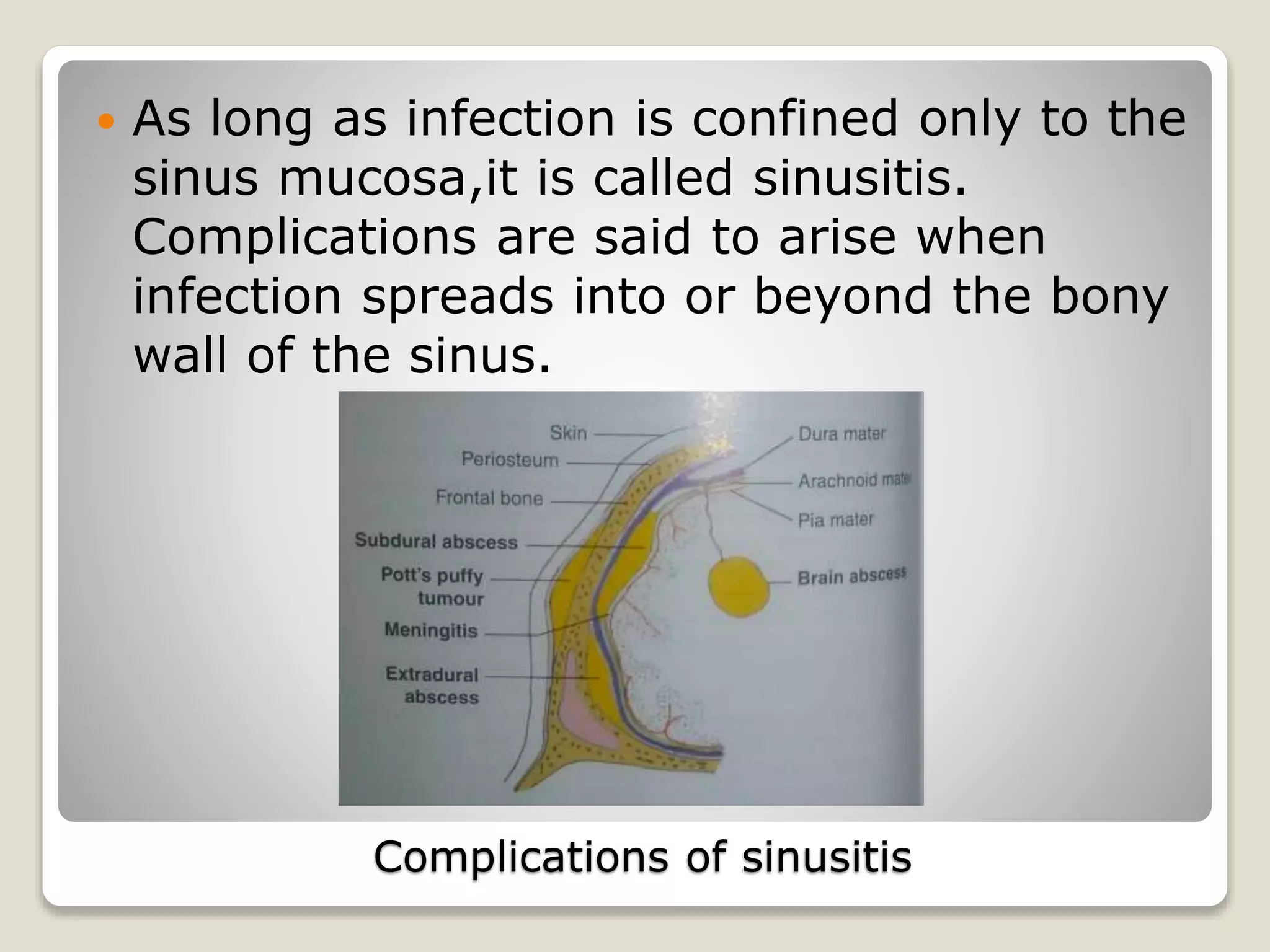
Complications of sinusitis
 As long as infection is confined only to the
sinus mucosa,it is called sinusitis.
Complications are said to arise when
infection spreads into or beyond the bony
wall of the sinus.
A- Local Mucocele/Pyocele
Mucous retention cyst
Osteomyelitis- frontal bone and maxila
B- Orbital Preseptal inflammatory oedema of lids
Subperiosteal abscess
Orbital cellulitis
Orbital abscess
Superior orbital fissure syndrome
Orbital apex syndrome
C- Intacranial Meningitis
Extradural abscess
Subdural abscess
Brain abscess
Cavernous sinus thrombosis
D- Descending
infections
E- Focal infections
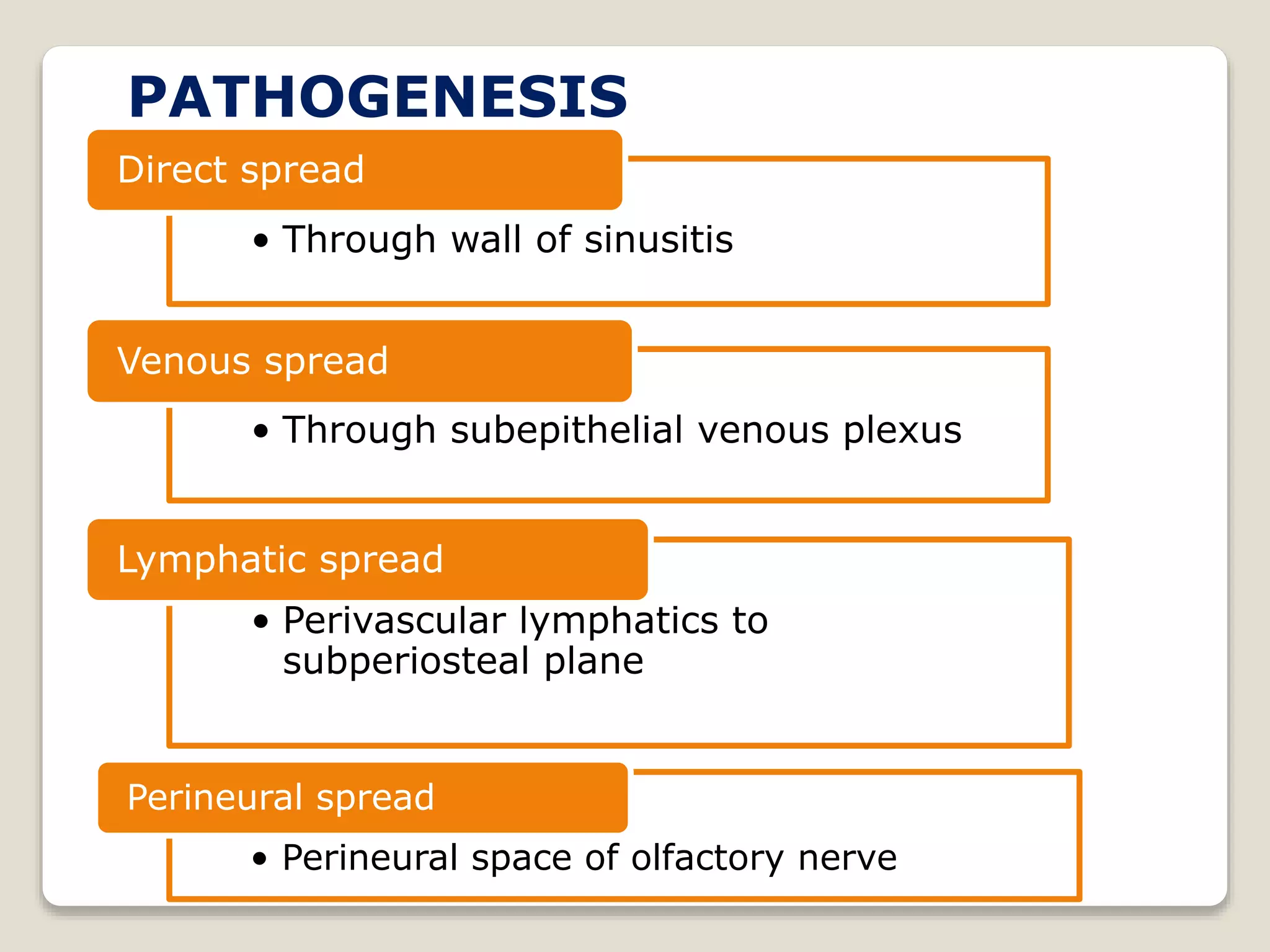
TYPES :
• Perineural space of olfactory nerve
Perineural spread
PATHOGENESIS
• Through wall of sinusitis
Direct spread
• Through subepithelial venous plexus
Venous spread
• Perivascular lymphatics to
subperiosteal plane
Lymphatic spread
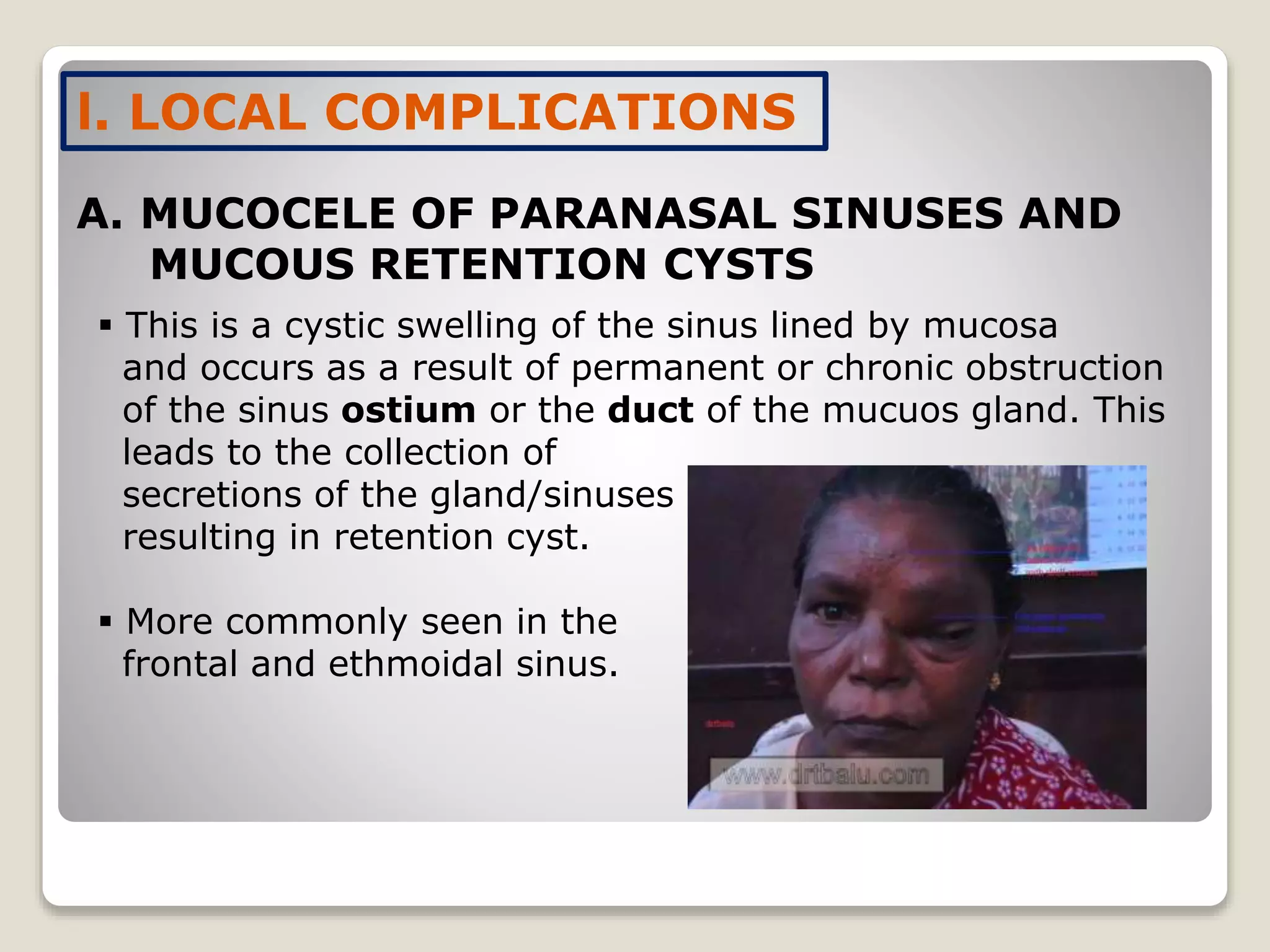
l. LOCAL COMPLICATIONS
A. MUCOCELE OF PARANASAL SINUSES AND
MUCOUS RETENTION CYSTS
 This is a cystic swelling of the sinus lined by mucosa
and occurs as a result of permanent or chronic obstruction
of the sinus ostium or the duct of the mucuos gland. This
leads to the collection of
secretions of the gland/sinuses
resulting in retention cyst.
 More commonly seen in the
frontal and ethmoidal sinus.
 Frontal sinus mucocele:
Usually presents in the superomedial quadrant of the orbit
Commonly occurs as a result of obstruction to the frontal
ostium due to chronic disease of the frontal recess or due
to postsurgical/traumatic fibrosis causing blockage.
Clinical Features:
Symptoms:
•Supraorbital swelling usually above and lateral to medial canthus.
•Diplopia may be present due to proptosis.
•Headache is usually confined to the frontal region, mild type.
Signs :
•Proptosis
•Swelling is usually cystic and non-tender and egg shell cracking
may be elicited.
Investigations:
•X-ray PNS- show cloudiness of the affected frontal
sinus with loss of scalloping.
•CT scan of the osteomeatal complex and PNS.
•Diagnostic nasal endoscopy.
Treatment:
•Endoscopic sinus surgery with frontal recess
clearance and uncapping of the mucocele is the
treatment of choice.
•Alternatively external frontoethmo-diectomy(Lynch-
Howarth operation) or osteoplastic flap operation by
bicoronal incision may be done.
•In case of pyocele a course of antibiotics should be
given prior to surgery.
B. OSTEOMYELITIS
• Osteomyelitis is infection of bone marrow and should be
differentiated from osteitis which is infection of compact
bone. It involves either maxilla or frontal bone.
1. Osteomyelitis of maxilla
• More often seen in infants and children because of presence of
spongy bone in the anterior wall of the maxilla.
• Clinical features: Erythema, swelling of cheek, lower lid oedema,
purulent nasal discharge and fever.
• Subperiosteal abscess followed by fistulae may form in infraorbital
region,alveolus, or in zygoma.
• Sequestration of bone may occur.
• Treatment: Large doses of antibiotics, drainage of any abscess and
sequestra removal.
2. Osteomyelitis of frontal bone
• More often seen in adults as frontal sinus is not developed
in infants and children.
• It may result from acute infection of frontal sinus either
directly or through the venous spread.
• Pus may form externally under the periosteum as soft
doughy swelling (Pott’s puffy tumour), or internally as an
extradural abscess.
• Treatment: Large doses of antibiotics, drainage of abscess
and trephining of frontal sinus through its floor.
Sometimes, it requires removal of sequestra and necrotic
bone by raising a scalp flap through a coronal incision.
ll. ORBITAL COMPLICATIONS
•Most of the orbital complications follow infection of
ethmoids as they are separated from the orbit only by
a thin lamina of bone- lamina papyracea.
•Infection travels from these sinuses either by osteitis
or as thrombophlebitic process of ethmoidal veins.
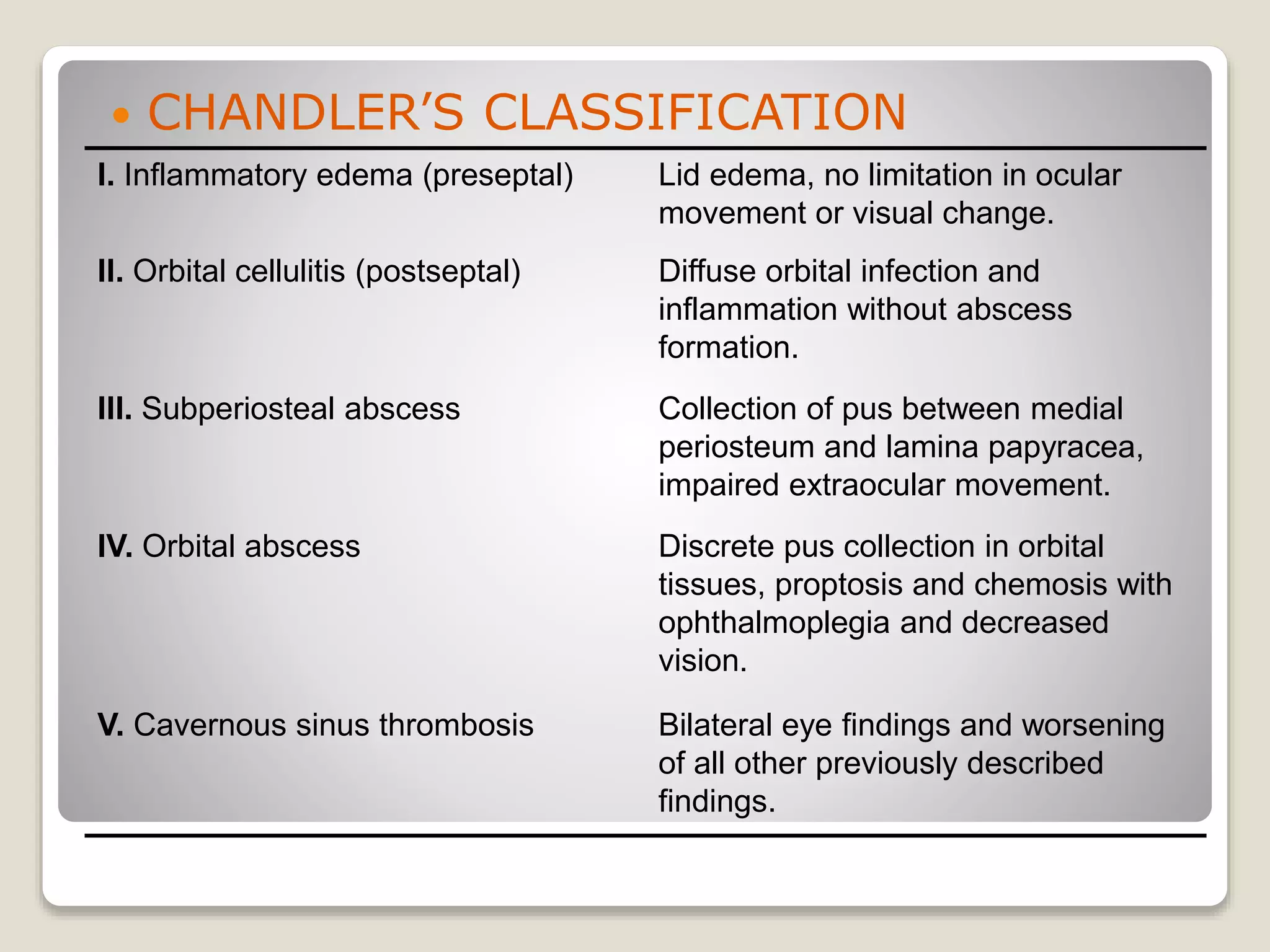
Pre-septal
cellulitis
Orbital cellulitis Subperiosteal
abscess
Orbital abscess
I. Inflammatory edema (preseptal) Lid edema, no limitation in ocular
movement or visual change.
II. Orbital cellulitis (postseptal) Diffuse orbital infection and
inflammation without abscess
formation.
III. Subperiosteal abscess Collection of pus between medial
periosteum and lamina papyracea,
impaired extraocular movement.
IV. Orbital abscess Discrete pus collection in orbital
tissues, proptosis and chemosis with
ophthalmoplegia and decreased
vision.
V. Cavernous sinus thrombosis Bilateral eye findings and worsening
of all other previously described
findings.
 CHANDLER’S CLASSIFICATION
1. Preseptal inflammatory oedema of lids
• This is only reactionary. No erythema or tenderness.
• Eyeball movements and vision are normal.
• Generally, upper lid is swollen in frontal, lower lid in maxillary and
both the lids in ethmoidal sinusitis.
 Pus collects outside the bone under the periosteum.
 A subperiosteal abscess from ethmoids forms on the medial wall of
the orbit and displaces the eyeball forward, downward and laterally.
 From frontal sinuses, abscess is situated just
above and behind the medial canthus and
displaces the eye ball downwards and laterally.
 From the maxillary sinus, abscess forms in
the floor of the orbit and displaces the
eyeball upwards and forwards.
2. Subperiosteal abscess
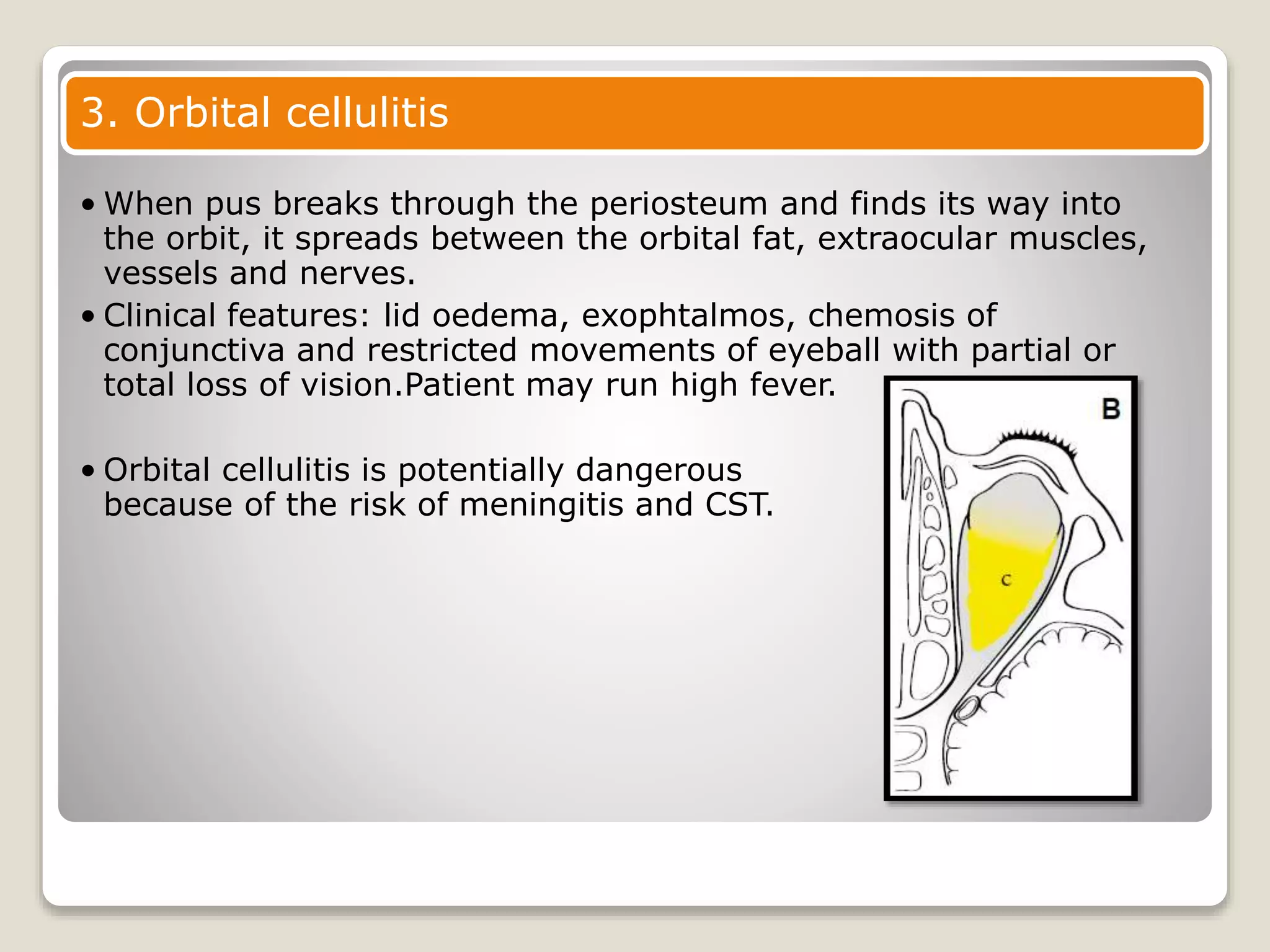
3. Orbital cellulitis
• When pus breaks through the periosteum and finds its way into
the orbit, it spreads between the orbital fat, extraocular muscles,
vessels and nerves.
• Clinical features: lid oedema, exophtalmos, chemosis of
conjunctiva and restricted movements of eyeball with partial or
total loss of vision.Patient may run high fever.
• Orbital cellulitis is potentially dangerous
because of the risk of meningitis and CST.
 Intraorbital abscess usually forms along lamina papyracea or the
floor of the frontal sinus.
 Clinical features: same as above.
 Diagnosis: CT scan or ultrasound of the orbit.
 Treatment: i.v. antibiotics and drainage of the
abscess and that of the sinus (ethmoidectomy
or trephination of frontal sinus).
4. Orbital abscess
5. Superior orbital fissure syndrome
• Infection of sphenoid sinus can rarely affect structures of
superior orbital fissure.
• Symptoms: Deep orbital pain, frontal headache and
progressive paralysis of CN VI, III and IV, in that order.
6. Orbital apex syndrome
• It is superior orbital fissure syndrome with additional
involvement of the optic nerve and maxillary division of the
tigeminal (V ).2
lll. INTRACRANIAL COMPICATIONS
Frontal, ethmoid and sphenoid sinuses are closely related to
anterior cranial fossa and infection from these can cause following
complications:
1) Meningitis and encephalitis
2) Extradural abscess
3) Subdural abscess
4) Brai abscess
5) Cavernous sinus thrombosis
 Cavernous sinus thrombosis :
Aetiology: Infection of paranasal sinuses and orbital
complications from these sinus infections can
cause thrombophlebitis of the cavernous sinus.
Clinical features:
 Abrupt onset with chills and rigors.
 Swollen eyelids with chemosis and proptosis of eyeball.
 CN III, IV and VI get involved individually and sequentially
causing total ophthalmoplegia.
 Pupil becomes dilated and fixed.
 Congestion of optic disc with diminution of vision.
 Sensation in the distribution of V is diminished.
Treatment: i.v. antibiotics and attention to the focus of infection,
drainage of infected ethmoid or sphenoid sinus.
1
ORBITAL CELLULITIS CAVERNOU SINUS
THROMBOSIS
SOURCE Commonly ethmoid
sinuses
Nose, sinuses, orbit, ear
or pharynx
ONSET Slow; starts with
oedema of eyelids the
inner canthus
chemosis proptosis
•Abrupt with high fever
and chills with near
signs of toxaemia
•Oedema of eyelids,
chemosis and proptosis
CRANIAL NERVE
INVOLVEMENT
Involved concurrently
with complete
ophthalmoplegia
Involved individually
and sequentially
LATERALITY Often involves one eye Involves both eyes
DIFFERENCES BETWEEN ORBITAL CELLULITIS
AND CAVERNOUS SINUS THROMBOSIS
lV. DESCENDING INFECTIONS
In suppurative sinusitis, discharge constantly flows into the
pharynx and can cause or aggravate:
1) Otitis media
2) Pharyngitis and tonsillitis: hypertrophy of lateral lymphoid
bands behind the posterior pillars (lateral pharyngitis) is
indicative of chronic sinusitis.
3) Persistent laryngitis and tracheobronchitis
V. FOCAL INFECTIONS
Sinusitis may act as focus of infection is conditions like:
Polyarthritis, tenosynovitis, fibrositis and certain skin diseases.
THANKYOU

Complications of sinusitis

  • 1.
  • 2.
    Complications of sinusitis As long as infection is confined only to the sinus mucosa,it is called sinusitis. Complications are said to arise when infection spreads into or beyond the bony wall of the sinus.
  • 3.
    A- Local Mucocele/Pyocele Mucousretention cyst Osteomyelitis- frontal bone and maxila B- Orbital Preseptal inflammatory oedema of lids Subperiosteal abscess Orbital cellulitis Orbital abscess Superior orbital fissure syndrome Orbital apex syndrome C- Intacranial Meningitis Extradural abscess Subdural abscess Brain abscess Cavernous sinus thrombosis D- Descending infections E- Focal infections TYPES :
  • 4.
    • Perineural spaceof olfactory nerve Perineural spread PATHOGENESIS • Through wall of sinusitis Direct spread • Through subepithelial venous plexus Venous spread • Perivascular lymphatics to subperiosteal plane Lymphatic spread
  • 5.
    l. LOCAL COMPLICATIONS A.MUCOCELE OF PARANASAL SINUSES AND MUCOUS RETENTION CYSTS  This is a cystic swelling of the sinus lined by mucosa and occurs as a result of permanent or chronic obstruction of the sinus ostium or the duct of the mucuos gland. This leads to the collection of secretions of the gland/sinuses resulting in retention cyst.  More commonly seen in the frontal and ethmoidal sinus.
  • 6.
     Frontal sinusmucocele: Usually presents in the superomedial quadrant of the orbit Commonly occurs as a result of obstruction to the frontal ostium due to chronic disease of the frontal recess or due to postsurgical/traumatic fibrosis causing blockage. Clinical Features: Symptoms: •Supraorbital swelling usually above and lateral to medial canthus. •Diplopia may be present due to proptosis. •Headache is usually confined to the frontal region, mild type. Signs : •Proptosis •Swelling is usually cystic and non-tender and egg shell cracking may be elicited.
  • 7.
    Investigations: •X-ray PNS- showcloudiness of the affected frontal sinus with loss of scalloping. •CT scan of the osteomeatal complex and PNS. •Diagnostic nasal endoscopy. Treatment: •Endoscopic sinus surgery with frontal recess clearance and uncapping of the mucocele is the treatment of choice. •Alternatively external frontoethmo-diectomy(Lynch- Howarth operation) or osteoplastic flap operation by bicoronal incision may be done. •In case of pyocele a course of antibiotics should be given prior to surgery.
  • 8.
    B. OSTEOMYELITIS • Osteomyelitisis infection of bone marrow and should be differentiated from osteitis which is infection of compact bone. It involves either maxilla or frontal bone. 1. Osteomyelitis of maxilla • More often seen in infants and children because of presence of spongy bone in the anterior wall of the maxilla. • Clinical features: Erythema, swelling of cheek, lower lid oedema, purulent nasal discharge and fever. • Subperiosteal abscess followed by fistulae may form in infraorbital region,alveolus, or in zygoma. • Sequestration of bone may occur. • Treatment: Large doses of antibiotics, drainage of any abscess and sequestra removal.
  • 9.
    2. Osteomyelitis offrontal bone • More often seen in adults as frontal sinus is not developed in infants and children. • It may result from acute infection of frontal sinus either directly or through the venous spread. • Pus may form externally under the periosteum as soft doughy swelling (Pott’s puffy tumour), or internally as an extradural abscess. • Treatment: Large doses of antibiotics, drainage of abscess and trephining of frontal sinus through its floor. Sometimes, it requires removal of sequestra and necrotic bone by raising a scalp flap through a coronal incision.
  • 10.
    ll. ORBITAL COMPLICATIONS •Mostof the orbital complications follow infection of ethmoids as they are separated from the orbit only by a thin lamina of bone- lamina papyracea. •Infection travels from these sinuses either by osteitis or as thrombophlebitic process of ethmoidal veins. Pre-septal cellulitis Orbital cellulitis Subperiosteal abscess Orbital abscess
  • 11.
    I. Inflammatory edema(preseptal) Lid edema, no limitation in ocular movement or visual change. II. Orbital cellulitis (postseptal) Diffuse orbital infection and inflammation without abscess formation. III. Subperiosteal abscess Collection of pus between medial periosteum and lamina papyracea, impaired extraocular movement. IV. Orbital abscess Discrete pus collection in orbital tissues, proptosis and chemosis with ophthalmoplegia and decreased vision. V. Cavernous sinus thrombosis Bilateral eye findings and worsening of all other previously described findings.  CHANDLER’S CLASSIFICATION
  • 12.
    1. Preseptal inflammatoryoedema of lids • This is only reactionary. No erythema or tenderness. • Eyeball movements and vision are normal. • Generally, upper lid is swollen in frontal, lower lid in maxillary and both the lids in ethmoidal sinusitis.
  • 13.
     Pus collectsoutside the bone under the periosteum.  A subperiosteal abscess from ethmoids forms on the medial wall of the orbit and displaces the eyeball forward, downward and laterally.  From frontal sinuses, abscess is situated just above and behind the medial canthus and displaces the eye ball downwards and laterally.  From the maxillary sinus, abscess forms in the floor of the orbit and displaces the eyeball upwards and forwards. 2. Subperiosteal abscess
  • 14.
    3. Orbital cellulitis •When pus breaks through the periosteum and finds its way into the orbit, it spreads between the orbital fat, extraocular muscles, vessels and nerves. • Clinical features: lid oedema, exophtalmos, chemosis of conjunctiva and restricted movements of eyeball with partial or total loss of vision.Patient may run high fever. • Orbital cellulitis is potentially dangerous because of the risk of meningitis and CST.
  • 15.
     Intraorbital abscessusually forms along lamina papyracea or the floor of the frontal sinus.  Clinical features: same as above.  Diagnosis: CT scan or ultrasound of the orbit.  Treatment: i.v. antibiotics and drainage of the abscess and that of the sinus (ethmoidectomy or trephination of frontal sinus). 4. Orbital abscess
  • 16.
    5. Superior orbitalfissure syndrome • Infection of sphenoid sinus can rarely affect structures of superior orbital fissure. • Symptoms: Deep orbital pain, frontal headache and progressive paralysis of CN VI, III and IV, in that order. 6. Orbital apex syndrome • It is superior orbital fissure syndrome with additional involvement of the optic nerve and maxillary division of the tigeminal (V ).2
  • 17.
    lll. INTRACRANIAL COMPICATIONS Frontal,ethmoid and sphenoid sinuses are closely related to anterior cranial fossa and infection from these can cause following complications: 1) Meningitis and encephalitis 2) Extradural abscess 3) Subdural abscess 4) Brai abscess 5) Cavernous sinus thrombosis
  • 18.
     Cavernous sinusthrombosis : Aetiology: Infection of paranasal sinuses and orbital complications from these sinus infections can cause thrombophlebitis of the cavernous sinus. Clinical features:  Abrupt onset with chills and rigors.  Swollen eyelids with chemosis and proptosis of eyeball.  CN III, IV and VI get involved individually and sequentially causing total ophthalmoplegia.  Pupil becomes dilated and fixed.  Congestion of optic disc with diminution of vision.  Sensation in the distribution of V is diminished. Treatment: i.v. antibiotics and attention to the focus of infection, drainage of infected ethmoid or sphenoid sinus. 1
  • 19.
    ORBITAL CELLULITIS CAVERNOUSINUS THROMBOSIS SOURCE Commonly ethmoid sinuses Nose, sinuses, orbit, ear or pharynx ONSET Slow; starts with oedema of eyelids the inner canthus chemosis proptosis •Abrupt with high fever and chills with near signs of toxaemia •Oedema of eyelids, chemosis and proptosis CRANIAL NERVE INVOLVEMENT Involved concurrently with complete ophthalmoplegia Involved individually and sequentially LATERALITY Often involves one eye Involves both eyes DIFFERENCES BETWEEN ORBITAL CELLULITIS AND CAVERNOUS SINUS THROMBOSIS
  • 20.
    lV. DESCENDING INFECTIONS Insuppurative sinusitis, discharge constantly flows into the pharynx and can cause or aggravate: 1) Otitis media 2) Pharyngitis and tonsillitis: hypertrophy of lateral lymphoid bands behind the posterior pillars (lateral pharyngitis) is indicative of chronic sinusitis. 3) Persistent laryngitis and tracheobronchitis V. FOCAL INFECTIONS Sinusitis may act as focus of infection is conditions like: Polyarthritis, tenosynovitis, fibrositis and certain skin diseases.
  • 21.