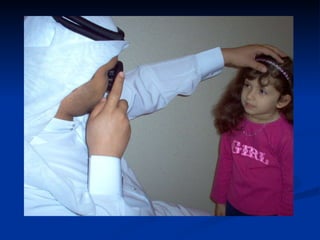
Strabismus Nizar Al-Hibshi MD Consultant Pediatric Ophthalmolgy
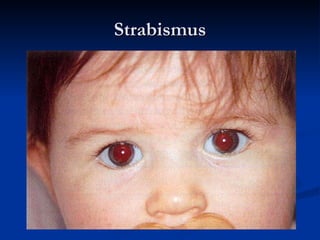
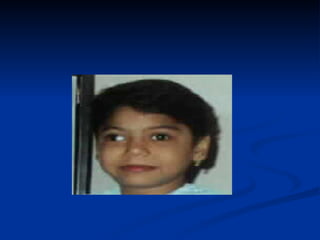
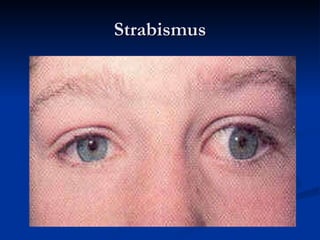
Strabismus *Squint *Crossed Eyes
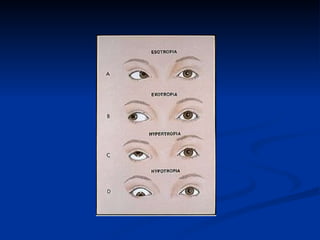
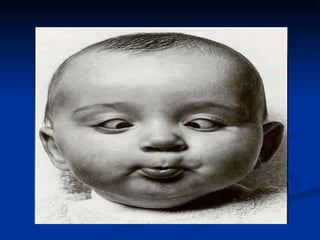
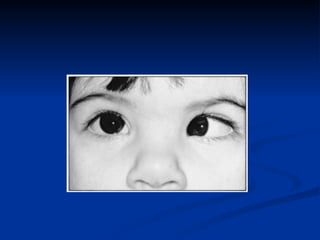
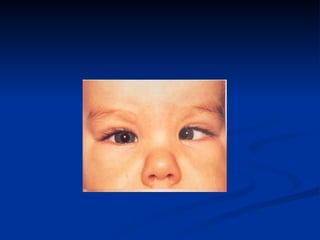
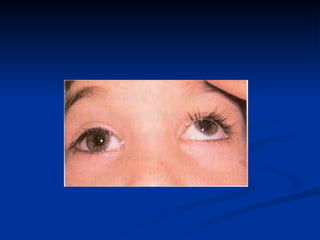
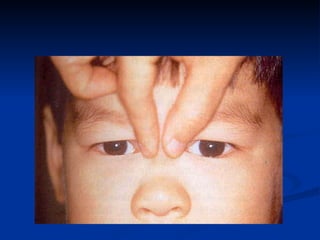
Strabismus Definition: Misalignment of the eyes
 
Points that will be discussed in the lecture Anatomy Why we treat Examination ET XT Syndromes
Points that will be discussed in the lecture Anatomy Why we treat Examination Esotropia Exotropia Syndromes
Anatomy Of The EOM’s How many?
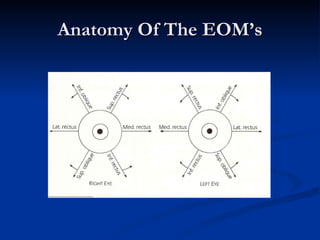
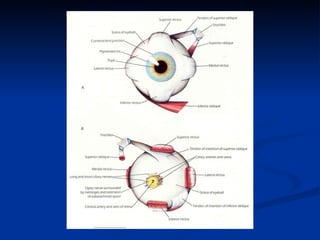
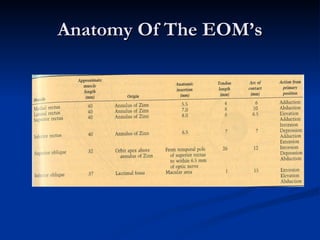
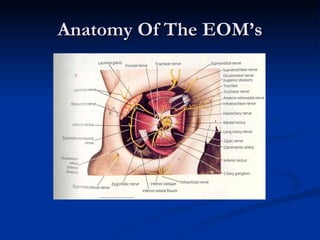
Anatomy Of The EOM’s Six Extraocular muscles surround each eye: Medial Rectus Lateral Rectus Superior Rectus Inferior Rectus Superior Oblique Inferior Oblique
Anatomy Of The EOM’s What are their actions??
Anatomy Of The EOM’s Medial Rectus Action??
Anatomy Of The EOM’s Medial Rectus Action?? Adduction
Anatomy Of The EOM’s Lateral Rectus Action??
Anatomy Of The EOM’s Lateral Rectus Action?? Abduction
Anatomy Of The EOM’s Superior Rectus Action??
Anatomy Of The EOM’s Superior Rectus Action?? Elevation
Anatomy Of The EOM’s Superior Rectus Action?? Elevation Adduction
Anatomy Of The EOM’s Superior Rectus Action?? Elevation Adduction Intorsion
Anatomy Of The EOM’s Inferior Rectus Action??
Anatomy Of The EOM’s Inferior Rectus Action?? Depression
Anatomy Of The EOM’s Inferior Rectus Action?? Depression Adduction
Anatomy Of The EOM’s Inferior Rectus Action?? Depression Adduction Extorsion
Anatomy Of The EOM’s Superior Oblique Action??
Anatomy Of The EOM’s Superior Oblique Action?? Intorsion
Anatomy Of The EOM’s Superior Oblique Action?? Intorsion Depression
Anatomy Of The EOM’s Superior Oblique Action?? Intorsion Depression Abduction
Anatomy Of The EOM’s Inferior Oblique Action??
Anatomy Of The EOM’s Inferior Oblique Action?? Extorsion
Anatomy Of The EOM’s Inferior Oblique Action?? Extorsion Elevation
Anatomy Of The EOM’s Inferior Oblique Action?? Extorsion Elevation Abduction
Anatomy Of The EOM’s The two  Obliques  are  Abductors
Anatomy Of The EOM’s The two  Obliques  are  Abductors The two  Recti  are  Adductors
Anatomy Of The EOM’s The two  Obliques  are  Abductors The two  Recti  are  Adductors The two  Superiors  are  Intorters
Anatomy Of The EOM’s The two  Obliques  are  Abductors The two  Recti  are  Adductors The two  Superiors  are  Intorters The two  Inferiors  are  Extorters
Anatomy Of The EOM’s
Anatomy Of The EOM’s Origin A common tendinous ring (annulus of Zinn)
Anatomy Of The EOM’s
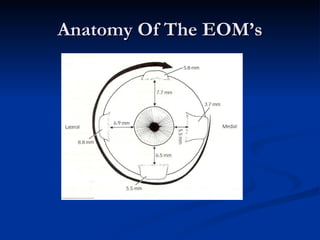
Anatomy Of The EOM’s Insertion
Anatomy Of The EOM’s
 
Anatomy Of The EOM’s Blood supply Each muscle is supplied by two Anterior Ciliary  Arteries except the Lateral Rectus which is only  supplied by one.
Anatomy Of The EOM’s Nerve supply
Anatomy Of The EOM’s Nerve supply Third Fourth Sixth
Anatomy Of The EOM’s Nerve supply Third: MR, IR, SR, IO Fourth Sixth
Anatomy Of The EOM’s Nerve supply Third: MR, IR, SR, IO Fourth: Superior Oblique Sixth
Anatomy Of The EOM’s Nerve supply Third: MR, IR, SR, IO Fourth: Superior Oblique Sixth: Lateral Rectus
Anatomy Of The EOM’s
Anatomy Why we treat Examination Esotropia Exotropia Syndromes
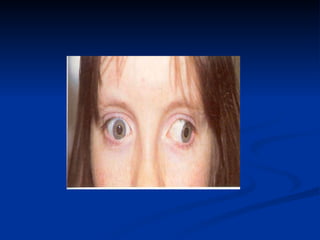
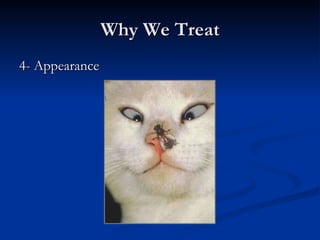
Why We Treat 1- Restore Stereopsis 2- Prevent Amblyopia 3- Prevent Confusion and Diplopia 4- Appearance
Why We Treat 1- Restore Stereopsis Three dimensional vision..
Why We Treat 2- Amblyopia Amblyopia is the unilateral or bilateral decrease of  Vision caused by form vision deprivation and/or  abnormal binocular interaction for which there is  no obvious cause found by physical examination  of the eye.
Why We Treat The main types of Amblyopia are: 1. Strabismic amblyopia results from abnormal  binocular interaction where there is continued  monocular suppression of the deviating eye. It is  Characterized by an impairment of vision which is  present even when the eye is forced to fixate.
Why We Treat 2. Anisometropic amblyopia is caused by a  difference in refractive error. It results from  abnormal binocular interaction from the  superimposition of a focused and unfocused image  or from the superimposition of large and small  images from aniseikonia. 3. Deprivation Amblyopia is caused from form  vision deprivation of one eye.
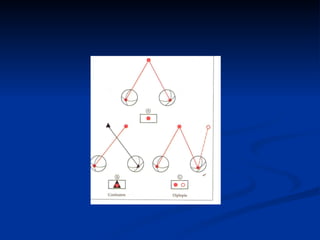
Why We Treat 3- Confusion and Diplopia DEFINITIONS 1. Visual axis is a line that passes through the point of fixation and the fovea. The normal visual axes intersect at the point of fixation. 2. Strabismus is a malalignment of the visual axes which, initially, results in confusion and diplopia. 3. Confusion is the simultaneous appreciation of two superimposed but dissimilar images caused by stimulation of corresponding points (usually foveae) by images of different objects. 4. Diplopia is the simultaneous appreciation of two images of one object. Jt results from a failure to maintain binocular vision.
 
Why We Treat 4- Appearance
Anatomy Why we treat Examination Esotropia Exotropia Syndromes


Strabismus


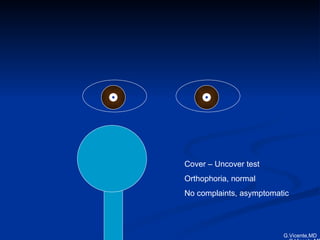
Cover – Uncover test Orthophoria, normal No complaints, asymptomatic G.Vicente,MD G.Vicente,MD
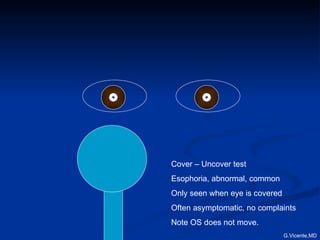
Cover – Uncover test Esophoria, abnormal, common Only seen when eye is covered Often asymptomatic, no complaints Note OS does not move. G.Vicente,MD
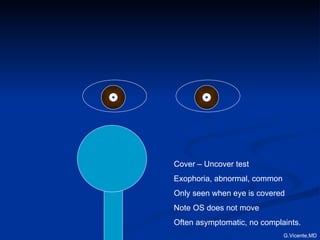
Cover – Uncover test Exophoria, abnormal, common Only seen when eye is covered Note OS does not move Often asymptomatic, no complaints. G.Vicente,MD
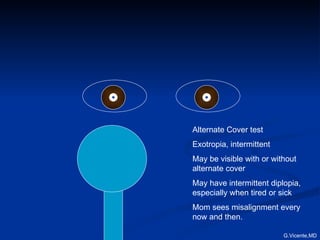
Alternate Cover test Exotropia, intermittent May be visible with or without alternate cover May have intermittent diplopia, especially when tired or sick Mom sees misalignment every now and then. G.Vicente,MD
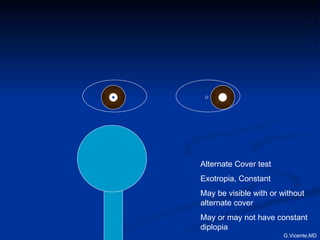
Alternate Cover test Exotropia, Constant May be visible with or without alternate cover May or may not have constant diplopia G.Vicente,MD
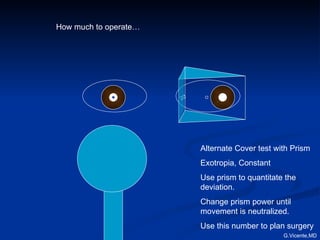
Alternate Cover test with Prism Exotropia, Constant Use prism to quantitate the deviation. Change prism power until movement is neutralized.  Use this number to plan surgery How much to operate… G.Vicente,MD 20
Anatomy Why we treat Examination Esotropia Exotropia Syndromes
 
 
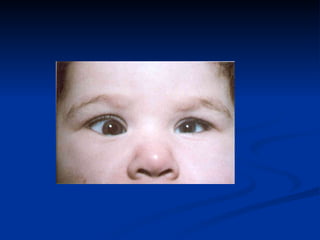
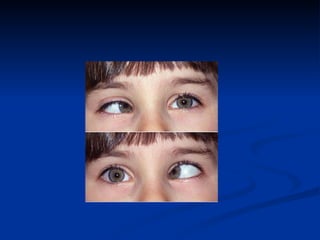
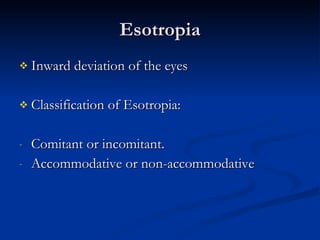
Esotropia Inward deviation of the eyes Classification of Esotropia: Comitant or incomitant. Accommodative or non-accommodative
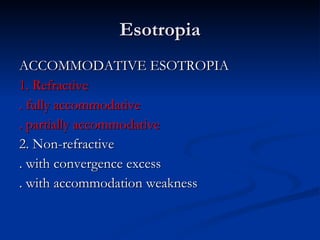
Esotropia ACCOMMODATIVE ESOTROPIA 1. Refractive . fully accommodative . partially accommodative 2. Non-refractive . with convergence excess . with accommodation weakness
Esotropia NON-ACCOMMODATIVE ESOTROPIA .  Infantile . microtropia . basic . convergence excess . convergence spasm . divergence insufficiency . divergence paralysis . sensory . consecutive . acute-onset . cyclic
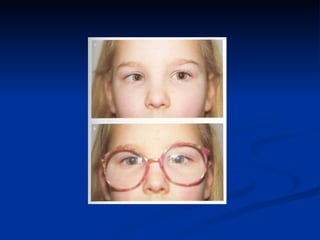
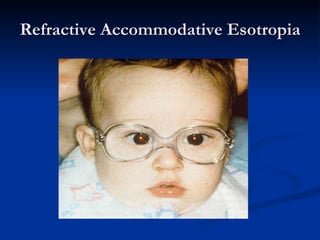
Refractive Accommodative Esotropia Refractive accommodative esotropia, with a normal  AC/A ratio, is a physiological response to excessive  hypermetropia and is beyond the patient's fusional  divergence amplitude.  The deviation presents at about the age of 2.5 years, with  a range of 6 months to 7 years. The two types are: 1. Fully accommodative, which is completely eliminated by correction of the hypermetropic refractive error 2. Partially accommodative, which is only partially eliminated by correction of hypermetropia
Refractive Accommodative Esotropia MANAGEMENT 1.Refraction is performed and any significant error corrected. In  children under the age of 6 years, the full cycloplegic refraction  should be prescribed. In the fully accommodative refractive  esotrope this will control the deviation for both near and distance. 2. Bifocals may be prescribed if there is accommodative esotropia  for near. The purpose of bifocals is to allow the child to maintain  fusion at near. The ultimate prognosis for complete withdrawal of  spectacles is related to the degree of hypermetropia, the amount of  associated astigmatism and also the AC/A ratio. In some cases the  spectacles need to be worn only for close work.
 
Refractive Accommodative Esotropia 3. Surgery should be considered if spectacles do not fully correct the deviation and after every attempt has been made to treat amblyopia. The two main surgical options are: (a) Recession-resection on the amblyopic eye in patients with residual amblyopia. (b) Bilateral medial rectus recessions in patients with equal vision in both eyes.
Refractive Accommodative Esotropia
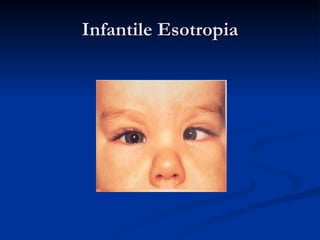
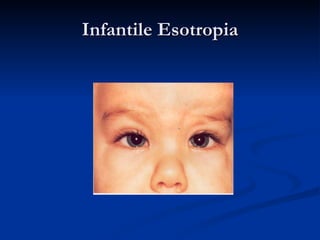
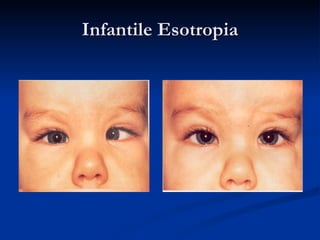
Infantile Esotropia Infantile (Congenital) Esotropia CLINICAL FEATURES Infantile Esotropia is defined as Esotropia  developing within the first 6 months of birth in an  otherwise normal infant.
Infantile Esotropia 1. Signs (a) The angle is usually fairly large (>30) and stable. (b) Fixation in most infants is alternating in the primary  position and crossfixating in side gaze, so that the child  uses the right eye in left gaze and the left eye in right gaze.  This pattern of crossed fixation will give the false  impression of abduction deficit with a bilateral sixth nerve  palsy. However, abduction can usually be demonstrated  by either using the doll's head manoeuvre or rotating the  child.
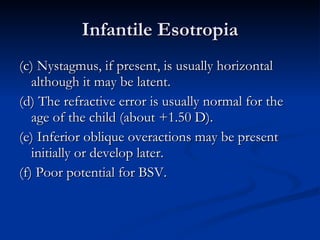
Infantile Esotropia (c) Nystagmus, if present, is usually horizontal although it may be latent. (d) The refractive error is usually normal for the age of the child (about +1.50 D). (e) Inferior oblique overactions may be present initially or develop later. (f) Poor potential for BSV.
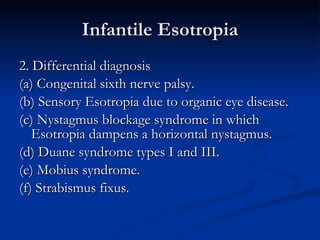
Infantile Esotropia 2. Differential diagnosis (a) Congenital sixth nerve palsy. (b) Sensory Esotropia due to organic eye disease. (c) Nystagmus blockage syndrome in which Esotropia dampens a horizontal nystagmus. (d) Duane syndrome types I and III. (e) Mobius syndrome. (f) Strabismus fixus.
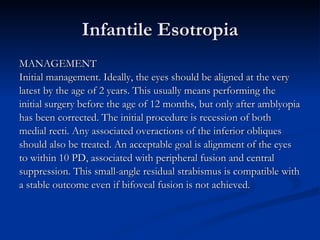
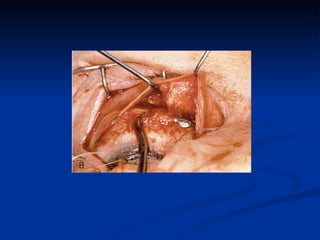
Infantile Esotropia MANAGEMENT Initial management. Ideally, the eyes should be aligned at the very  latest by the age of 2 years. This usually means performing the  initial surgery before the age of 12 months, but only after amblyopia  has been corrected. The initial procedure is recession of both  medial recti. Any associated overactions of the inferior obliques  should also be treated. An acceptable goal is alignment of the eyes  to within 10 PD, associated with peripheral fusion and central  suppression. This small-angle residual strabismus is compatible with  a stable outcome even if bifoveal fusion is not achieved.
Infantile Esotropia
 
Infantile Esotropia
Infantile Esotropia
Anatomy Why we treat Examination Esotropia Exotropia Syndromes
Strabismus
 
Exotropia Classification 1. Constant . Congenital . Sensory . Consecutive 2. Intermittent . divergence excess (worse for distance) . convergence weakness (worse for near) . basic exotropia (same for distance and near)
Constant Exotropia CONGENITAL EXOTROPIA 1. Presentation is at birth, in contrast to infantile esotropia. 2. Signs (a) Normal refraction. (b) Large and constant angle. (c) DVD may be present. 3. Treatment is mainly surgical.
Constant Exotropia OTHER TYPES 1. Sensory Exotropia, which is the result of disruption of binocular reflexes by acquired lesions, such as cataract or other opacities of the media, in children over the age of 5 years or in adults. If possible, treatment consists of correction of amblyopia followed by surgery. 2. Consecutve exotropia: which most frequently follows previous correction or overcorrection of an esodeviation
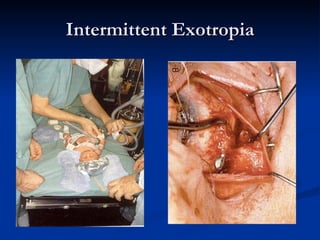
Intermittent Exotropia Presentation is most frequent at around 2 years.  The Exotropia may be precipitated by bright light  (resulting in reflex closure of the affected eye),  day-dreaming, fatigue, ill health or visual  distraction. Occasionally, the deviation remains  constant and very rarely it may decrease.
Intermittent Exotropia MANAGEMENT 1. Spectacle correction in myopic patients may, in some  cases, control the deviation. 2. Orthoptic treatment consisting of occlusion therapy,  diplopia awareness, and improvement of fusional  convergence, may also be useful in selected cases. 3. Surgery is necessary in most patients by about the age  of 5 years.
Intermittent Exotropia
Anatomy Why we treat Examination Esotropia Exotropia Syndromes
Syndromes Duane Syndrome Brown Syndrome
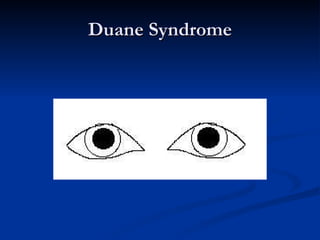
Duane Syndrome The hallmark of Duane syndrome is retraction of  the globe on attempted adduction caused by co- contraction of the medial and lateral recti. Both  eyes are affected in about 20% of cases. Some  children with Duane syndrome have associated  congenital defects; the most common is perceptive  deafness with associated speech disorder.
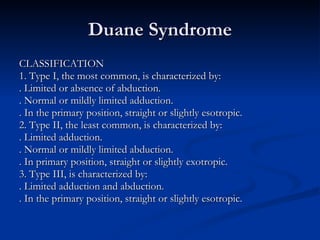
Duane Syndrome CLASSIFICATION 1. Type I, the most common, is characterized by: . Limited or absence of abduction. . Normal or mildly limited adduction. . In the primary position, straight or slightly esotropic. 2. Type II, the least common, is characterized by: . Limited adduction. . Normal or mildly limited abduction. . In primary position, straight or slightly exotropic. 3. Type III, is characterized by: . Limited adduction and abduction. . In the primary position, straight or slightly esotropic.
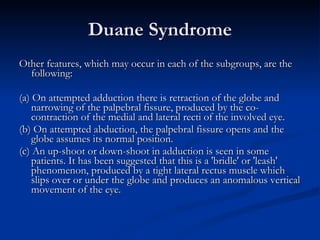
Duane Syndrome Other features, which may occur in each of the subgroups, are the following: (a) On attempted adduction there is retraction of the globe and narrowing of the palpebral fissure, produced by the co-contraction of the medial and lateral recti of the involved eye. (b) On attempted abduction, the palpebral fissure opens and the globe assumes its normal position. (c) An up-shoot or down-shoot in adduction is seen in some patients. It has been suggested that this is a 'bridle' or 'leash' phenomenon, produced by a tight lateral rectus muscle which slips over or under the globe and produces an anomalous vertical movement of the eye.
Duane Syndrome
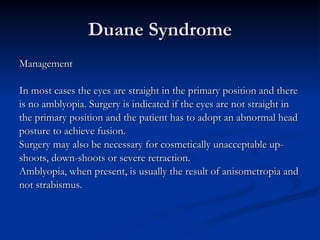
Duane Syndrome Management In most cases the eyes are straight in the primary position and there  is no amblyopia. Surgery is indicated if the eyes are not straight in  the primary position and the patient has to adopt an abnormal head  posture to achieve fusion. Surgery may also be necessary for cosmetically unacceptable up- shoots, down-shoots or severe retraction. Amblyopia, when present, is usually the result of anisometropia and  not strabismus.
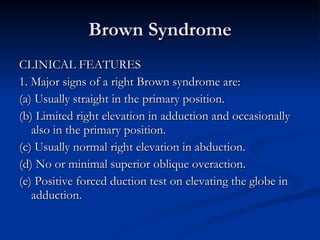
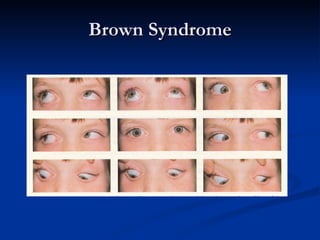
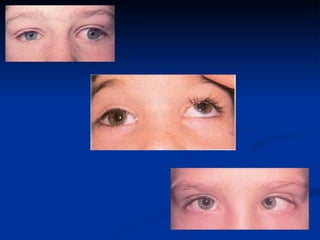
Brown Syndrome CLINICAL FEATURES 1. Major signs of a right Brown syndrome are: (a) Usually straight in the primary position. (b) Limited right elevation in adduction and occasionally also in the primary position. (c) Usually normal right elevation in abduction. (d) No or minimal superior oblique overaction. (e) Positive forced duction test on elevating the globe in adduction.
Brown Syndrome
Brown Syndrome 2. Variable signs (a) Downshoot in adduction. (b) Hypotropia in primary position. (c) Anomalous head position with ipsilateral head tilt and chin up.
Brown Syndrome CAUSES Brown syndrome is usually congenital but occasionally may be acquired: 1. Congenital (a) Idiopathic. (b) Congenital click syndrome where there is impaired movement of the tendon through the trochlea. 2. Acquired (a) Iatrogenic damage of the trochlea or superios oblique tendon. (b) Inflammation of the tendon which may be caused by rheumatoid arthritis, pansinusitis and scleritis.
Brown Syndrome Management 1. Congenital cases do not usually require treatment. Indications for surgery include the presence of a primary position hypotropia and/or an anomalous head posture. 2. Acquired cases may benefit from steroids.
 
Strabismus *Refer to an Ophthalmologist. *Talk to the parents. *AMBLYOPIA *Normal Visual function (Streopsis)
Strabismus Treatment: Should be started as early as possible Glasses Surgery (Botox Injections)
 

Strabismus

  • 1.
    Strabismus Nizar Al-HibshiMD Consultant Pediatric Ophthalmolgy
  • 2.
  • 3.
  • 4.
  • 5.
    Points that willbe discussed in the lecture Anatomy Why we treat Examination ET XT Syndromes
  • 6.
    Points that willbe discussed in the lecture Anatomy Why we treat Examination Esotropia Exotropia Syndromes
  • 7.
    Anatomy Of TheEOM’s How many?
  • 8.
    Anatomy Of TheEOM’s Six Extraocular muscles surround each eye: Medial Rectus Lateral Rectus Superior Rectus Inferior Rectus Superior Oblique Inferior Oblique
  • 9.
    Anatomy Of TheEOM’s What are their actions??
  • 10.
    Anatomy Of TheEOM’s Medial Rectus Action??
  • 11.
    Anatomy Of TheEOM’s Medial Rectus Action?? Adduction
  • 12.
    Anatomy Of TheEOM’s Lateral Rectus Action??
  • 13.
    Anatomy Of TheEOM’s Lateral Rectus Action?? Abduction
  • 14.
    Anatomy Of TheEOM’s Superior Rectus Action??
  • 15.
    Anatomy Of TheEOM’s Superior Rectus Action?? Elevation
  • 16.
    Anatomy Of TheEOM’s Superior Rectus Action?? Elevation Adduction
  • 17.
    Anatomy Of TheEOM’s Superior Rectus Action?? Elevation Adduction Intorsion
  • 18.
    Anatomy Of TheEOM’s Inferior Rectus Action??
  • 19.
    Anatomy Of TheEOM’s Inferior Rectus Action?? Depression
  • 20.
    Anatomy Of TheEOM’s Inferior Rectus Action?? Depression Adduction
  • 21.
    Anatomy Of TheEOM’s Inferior Rectus Action?? Depression Adduction Extorsion
  • 22.
    Anatomy Of TheEOM’s Superior Oblique Action??
  • 23.
    Anatomy Of TheEOM’s Superior Oblique Action?? Intorsion
  • 24.
    Anatomy Of TheEOM’s Superior Oblique Action?? Intorsion Depression
  • 25.
    Anatomy Of TheEOM’s Superior Oblique Action?? Intorsion Depression Abduction
  • 26.
    Anatomy Of TheEOM’s Inferior Oblique Action??
  • 27.
    Anatomy Of TheEOM’s Inferior Oblique Action?? Extorsion
  • 28.
    Anatomy Of TheEOM’s Inferior Oblique Action?? Extorsion Elevation
  • 29.
    Anatomy Of TheEOM’s Inferior Oblique Action?? Extorsion Elevation Abduction
  • 30.
    Anatomy Of TheEOM’s The two Obliques are Abductors
  • 31.
    Anatomy Of TheEOM’s The two Obliques are Abductors The two Recti are Adductors
  • 32.
    Anatomy Of TheEOM’s The two Obliques are Abductors The two Recti are Adductors The two Superiors are Intorters
  • 33.
    Anatomy Of TheEOM’s The two Obliques are Abductors The two Recti are Adductors The two Superiors are Intorters The two Inferiors are Extorters
  • 34.
  • 35.
    Anatomy Of TheEOM’s Origin A common tendinous ring (annulus of Zinn)
  • 36.
  • 37.
    Anatomy Of TheEOM’s Insertion
  • 38.
  • 39.
  • 40.
    Anatomy Of TheEOM’s Blood supply Each muscle is supplied by two Anterior Ciliary Arteries except the Lateral Rectus which is only supplied by one.
  • 41.
    Anatomy Of TheEOM’s Nerve supply
  • 42.
    Anatomy Of TheEOM’s Nerve supply Third Fourth Sixth
  • 43.
    Anatomy Of TheEOM’s Nerve supply Third: MR, IR, SR, IO Fourth Sixth
  • 44.
    Anatomy Of TheEOM’s Nerve supply Third: MR, IR, SR, IO Fourth: Superior Oblique Sixth
  • 45.
    Anatomy Of TheEOM’s Nerve supply Third: MR, IR, SR, IO Fourth: Superior Oblique Sixth: Lateral Rectus
  • 46.
  • 47.
    Anatomy Why wetreat Examination Esotropia Exotropia Syndromes
  • 48.
    Why We Treat1- Restore Stereopsis 2- Prevent Amblyopia 3- Prevent Confusion and Diplopia 4- Appearance
  • 49.
    Why We Treat1- Restore Stereopsis Three dimensional vision..
  • 50.
    Why We Treat2- Amblyopia Amblyopia is the unilateral or bilateral decrease of Vision caused by form vision deprivation and/or abnormal binocular interaction for which there is no obvious cause found by physical examination of the eye.
  • 51.
    Why We TreatThe main types of Amblyopia are: 1. Strabismic amblyopia results from abnormal binocular interaction where there is continued monocular suppression of the deviating eye. It is Characterized by an impairment of vision which is present even when the eye is forced to fixate.
  • 52.
    Why We Treat2. Anisometropic amblyopia is caused by a difference in refractive error. It results from abnormal binocular interaction from the superimposition of a focused and unfocused image or from the superimposition of large and small images from aniseikonia. 3. Deprivation Amblyopia is caused from form vision deprivation of one eye.
  • 53.
    Why We Treat3- Confusion and Diplopia DEFINITIONS 1. Visual axis is a line that passes through the point of fixation and the fovea. The normal visual axes intersect at the point of fixation. 2. Strabismus is a malalignment of the visual axes which, initially, results in confusion and diplopia. 3. Confusion is the simultaneous appreciation of two superimposed but dissimilar images caused by stimulation of corresponding points (usually foveae) by images of different objects. 4. Diplopia is the simultaneous appreciation of two images of one object. Jt results from a failure to maintain binocular vision.
  • 54.
  • 55.
    Why We Treat4- Appearance
  • 56.
    Anatomy Why wetreat Examination Esotropia Exotropia Syndromes
  • 57.
  • 58.
  • 59.
  • 60.
  • 61.
  • 62.
  • 63.
  • 64.
  • 65.
  • 66.
  • 67.
  • 68.
    Cover – Uncovertest Orthophoria, normal No complaints, asymptomatic G.Vicente,MD G.Vicente,MD
  • 69.
    Cover – Uncovertest Esophoria, abnormal, common Only seen when eye is covered Often asymptomatic, no complaints Note OS does not move. G.Vicente,MD
  • 70.
    Cover – Uncovertest Exophoria, abnormal, common Only seen when eye is covered Note OS does not move Often asymptomatic, no complaints. G.Vicente,MD
  • 71.
    Alternate Cover testExotropia, intermittent May be visible with or without alternate cover May have intermittent diplopia, especially when tired or sick Mom sees misalignment every now and then. G.Vicente,MD
  • 72.
    Alternate Cover testExotropia, Constant May be visible with or without alternate cover May or may not have constant diplopia G.Vicente,MD
  • 73.
    Alternate Cover testwith Prism Exotropia, Constant Use prism to quantitate the deviation. Change prism power until movement is neutralized. Use this number to plan surgery How much to operate… G.Vicente,MD 20
  • 74.
    Anatomy Why wetreat Examination Esotropia Exotropia Syndromes
  • 75.
  • 76.
  • 77.
    Esotropia Inward deviationof the eyes Classification of Esotropia: Comitant or incomitant. Accommodative or non-accommodative
  • 78.
    Esotropia ACCOMMODATIVE ESOTROPIA1. Refractive . fully accommodative . partially accommodative 2. Non-refractive . with convergence excess . with accommodation weakness
  • 79.
    Esotropia NON-ACCOMMODATIVE ESOTROPIA. Infantile . microtropia . basic . convergence excess . convergence spasm . divergence insufficiency . divergence paralysis . sensory . consecutive . acute-onset . cyclic
  • 80.
    Refractive Accommodative EsotropiaRefractive accommodative esotropia, with a normal AC/A ratio, is a physiological response to excessive hypermetropia and is beyond the patient's fusional divergence amplitude. The deviation presents at about the age of 2.5 years, with a range of 6 months to 7 years. The two types are: 1. Fully accommodative, which is completely eliminated by correction of the hypermetropic refractive error 2. Partially accommodative, which is only partially eliminated by correction of hypermetropia
  • 81.
    Refractive Accommodative EsotropiaMANAGEMENT 1.Refraction is performed and any significant error corrected. In children under the age of 6 years, the full cycloplegic refraction should be prescribed. In the fully accommodative refractive esotrope this will control the deviation for both near and distance. 2. Bifocals may be prescribed if there is accommodative esotropia for near. The purpose of bifocals is to allow the child to maintain fusion at near. The ultimate prognosis for complete withdrawal of spectacles is related to the degree of hypermetropia, the amount of associated astigmatism and also the AC/A ratio. In some cases the spectacles need to be worn only for close work.
  • 82.
  • 83.
    Refractive Accommodative Esotropia3. Surgery should be considered if spectacles do not fully correct the deviation and after every attempt has been made to treat amblyopia. The two main surgical options are: (a) Recession-resection on the amblyopic eye in patients with residual amblyopia. (b) Bilateral medial rectus recessions in patients with equal vision in both eyes.
  • 84.
  • 85.
    Infantile Esotropia Infantile(Congenital) Esotropia CLINICAL FEATURES Infantile Esotropia is defined as Esotropia developing within the first 6 months of birth in an otherwise normal infant.
  • 86.
    Infantile Esotropia 1.Signs (a) The angle is usually fairly large (>30) and stable. (b) Fixation in most infants is alternating in the primary position and crossfixating in side gaze, so that the child uses the right eye in left gaze and the left eye in right gaze. This pattern of crossed fixation will give the false impression of abduction deficit with a bilateral sixth nerve palsy. However, abduction can usually be demonstrated by either using the doll's head manoeuvre or rotating the child.
  • 87.
    Infantile Esotropia (c)Nystagmus, if present, is usually horizontal although it may be latent. (d) The refractive error is usually normal for the age of the child (about +1.50 D). (e) Inferior oblique overactions may be present initially or develop later. (f) Poor potential for BSV.
  • 88.
    Infantile Esotropia 2.Differential diagnosis (a) Congenital sixth nerve palsy. (b) Sensory Esotropia due to organic eye disease. (c) Nystagmus blockage syndrome in which Esotropia dampens a horizontal nystagmus. (d) Duane syndrome types I and III. (e) Mobius syndrome. (f) Strabismus fixus.
  • 89.
    Infantile Esotropia MANAGEMENTInitial management. Ideally, the eyes should be aligned at the very latest by the age of 2 years. This usually means performing the initial surgery before the age of 12 months, but only after amblyopia has been corrected. The initial procedure is recession of both medial recti. Any associated overactions of the inferior obliques should also be treated. An acceptable goal is alignment of the eyes to within 10 PD, associated with peripheral fusion and central suppression. This small-angle residual strabismus is compatible with a stable outcome even if bifoveal fusion is not achieved.
  • 90.
  • 91.
  • 92.
  • 93.
  • 94.
    Anatomy Why wetreat Examination Esotropia Exotropia Syndromes
  • 95.
  • 96.
  • 97.
    Exotropia Classification 1.Constant . Congenital . Sensory . Consecutive 2. Intermittent . divergence excess (worse for distance) . convergence weakness (worse for near) . basic exotropia (same for distance and near)
  • 98.
    Constant Exotropia CONGENITALEXOTROPIA 1. Presentation is at birth, in contrast to infantile esotropia. 2. Signs (a) Normal refraction. (b) Large and constant angle. (c) DVD may be present. 3. Treatment is mainly surgical.
  • 99.
    Constant Exotropia OTHERTYPES 1. Sensory Exotropia, which is the result of disruption of binocular reflexes by acquired lesions, such as cataract or other opacities of the media, in children over the age of 5 years or in adults. If possible, treatment consists of correction of amblyopia followed by surgery. 2. Consecutve exotropia: which most frequently follows previous correction or overcorrection of an esodeviation
  • 100.
    Intermittent Exotropia Presentationis most frequent at around 2 years. The Exotropia may be precipitated by bright light (resulting in reflex closure of the affected eye), day-dreaming, fatigue, ill health or visual distraction. Occasionally, the deviation remains constant and very rarely it may decrease.
  • 101.
    Intermittent Exotropia MANAGEMENT1. Spectacle correction in myopic patients may, in some cases, control the deviation. 2. Orthoptic treatment consisting of occlusion therapy, diplopia awareness, and improvement of fusional convergence, may also be useful in selected cases. 3. Surgery is necessary in most patients by about the age of 5 years.
  • 102.
  • 103.
    Anatomy Why wetreat Examination Esotropia Exotropia Syndromes
  • 104.
  • 105.
    Duane Syndrome Thehallmark of Duane syndrome is retraction of the globe on attempted adduction caused by co- contraction of the medial and lateral recti. Both eyes are affected in about 20% of cases. Some children with Duane syndrome have associated congenital defects; the most common is perceptive deafness with associated speech disorder.
  • 106.
    Duane Syndrome CLASSIFICATION1. Type I, the most common, is characterized by: . Limited or absence of abduction. . Normal or mildly limited adduction. . In the primary position, straight or slightly esotropic. 2. Type II, the least common, is characterized by: . Limited adduction. . Normal or mildly limited abduction. . In primary position, straight or slightly exotropic. 3. Type III, is characterized by: . Limited adduction and abduction. . In the primary position, straight or slightly esotropic.
  • 107.
    Duane Syndrome Otherfeatures, which may occur in each of the subgroups, are the following: (a) On attempted adduction there is retraction of the globe and narrowing of the palpebral fissure, produced by the co-contraction of the medial and lateral recti of the involved eye. (b) On attempted abduction, the palpebral fissure opens and the globe assumes its normal position. (c) An up-shoot or down-shoot in adduction is seen in some patients. It has been suggested that this is a 'bridle' or 'leash' phenomenon, produced by a tight lateral rectus muscle which slips over or under the globe and produces an anomalous vertical movement of the eye.
  • 108.
  • 109.
    Duane Syndrome ManagementIn most cases the eyes are straight in the primary position and there is no amblyopia. Surgery is indicated if the eyes are not straight in the primary position and the patient has to adopt an abnormal head posture to achieve fusion. Surgery may also be necessary for cosmetically unacceptable up- shoots, down-shoots or severe retraction. Amblyopia, when present, is usually the result of anisometropia and not strabismus.
  • 110.
    Brown Syndrome CLINICALFEATURES 1. Major signs of a right Brown syndrome are: (a) Usually straight in the primary position. (b) Limited right elevation in adduction and occasionally also in the primary position. (c) Usually normal right elevation in abduction. (d) No or minimal superior oblique overaction. (e) Positive forced duction test on elevating the globe in adduction.
  • 111.
  • 112.
    Brown Syndrome 2.Variable signs (a) Downshoot in adduction. (b) Hypotropia in primary position. (c) Anomalous head position with ipsilateral head tilt and chin up.
  • 113.
    Brown Syndrome CAUSESBrown syndrome is usually congenital but occasionally may be acquired: 1. Congenital (a) Idiopathic. (b) Congenital click syndrome where there is impaired movement of the tendon through the trochlea. 2. Acquired (a) Iatrogenic damage of the trochlea or superios oblique tendon. (b) Inflammation of the tendon which may be caused by rheumatoid arthritis, pansinusitis and scleritis.
  • 114.
    Brown Syndrome Management1. Congenital cases do not usually require treatment. Indications for surgery include the presence of a primary position hypotropia and/or an anomalous head posture. 2. Acquired cases may benefit from steroids.
  • 115.
  • 116.
    Strabismus *Refer toan Ophthalmologist. *Talk to the parents. *AMBLYOPIA *Normal Visual function (Streopsis)
  • 117.
    Strabismus Treatment: Shouldbe started as early as possible Glasses Surgery (Botox Injections)
  • 118.