Dr. Atul Kumar Anand
Senior Resident
AIIMS Patna
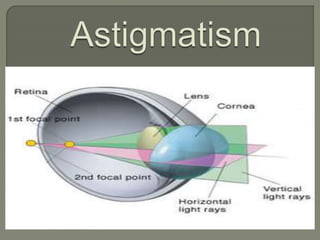
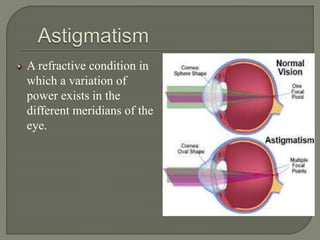
A refractive condition in
which a variation of
power exists in the
different meridians of the
eye.
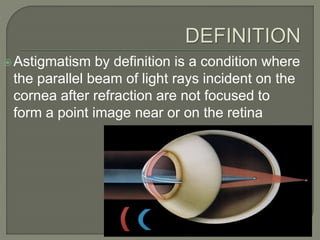
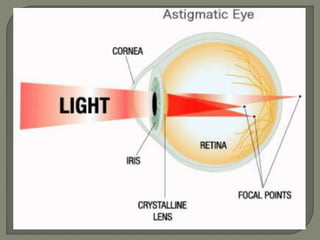
Astigmatism by definition is a condition where
the parallel beam of light rays incident on the
cornea after refraction are not focused to
form a point image near or on the retina
Irregular curvature or RI in the anterior
surface of cornea
Irregular curvature or RI and also the
position of lens/IOL
The refracting power is not uniform in all
meridians of both lens or cornea
Based on axis of the principal
meridians
Regular astigmatism – principal meridians
are perpendicular
• With-the-rule astigmatism
• Against-the-rule astigmatism
• Oblique astigmatism
Irregular astigmatism - principal meridians
are not perpendicular
 Correctable by cylindrical lenses
Etiology :
1. Corneal - abnormalities of curvature [common]
2. Lenticular is rare. It may be:
i. Curvatural - abnormalities of curvature of
lens as seen in lenticonus.
ii. Positional - tilting or oblique placement of
lens , subluxation.
3. Retinal - oblique placement of macula [rare]
Based on focus of the principal
meridians
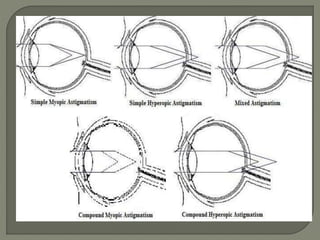
Simple astigmatism
• Simple hyperopic astigmatism
• Simple myopic astigmatism
Compound astigmatism
• Compound hyperopic astigmatism
• Compound myopic astigmatism
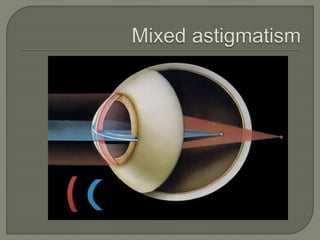
Mixed astigmatism
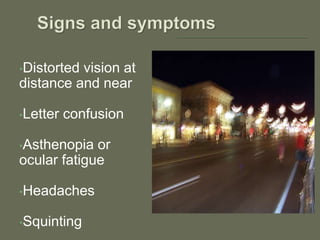
•Distorted vision at
distance and near
•Letter confusion
•Asthenopia or
ocular fatigue
•Headaches
•Squinting
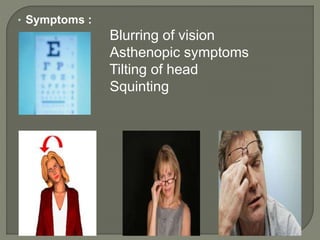
• Symptoms :
Blurring of vision
Asthenopic symptoms
Tilting of head
Squinting
Visual acuity tests – distance and near
Autorefraction
Keratometry
Retinoscopy
Monocular subjective refraction
 Spectacles
Cylindrical lenses and spherocylindrical lenses in
spectacles
 Contact lens
Toric soft contact lenses
 rigid gas permeable contact lenses
 Refractive surgery
Photorefractive keratectomy (PRK)
Laser in-situ keratomileusis (LASIK)
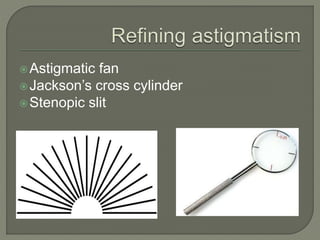
Astigmatic fan
Jackson’s cross cylinder
Stenopic slit
• Etiology :
Corneal -[ Scars , Keratoconus
flap complications,
marginal degenration ]
Lenticular -[Cataract maturation]
Retinal-[scarring of macula,
tumours of retina,choroid]
Symptoms :
Defective vision
Distorsion of objects
Polyopia
Investigations:
- Placido's disc test reveals distorted
circles
- Computerized corneal topography
 Optical treatment :
- RGP contact lenses
-Hybrid contact lenses
-Scleral lenses
 Surgical treatment:
- penetrating keratoplasty
 The amount of astigmatism that still
remains after correction of a refractive
error.
Difference in refractive power between 2
eyes
refractive correction often leads to different
image sizes on the 2 retinas( aniseikonia)
aniseikonia depend on degree of refractive
anomaly and type of correction
Glasses : magnified or minified 2% per 1 D
Contact lens : change less than glasses
Tolerate aniseikonia ~ 5-8%
Treatment
• anisometropia > 4 D-->contact lens
• unilateral aphakia-->contact lens or
intraocular lens
Astigmatism.pptx
Astigmatism.pptx

Astigmatism.pptx

  • 1.
    Dr. Atul KumarAnand Senior Resident AIIMS Patna
  • 3.
    A refractive conditionin which a variation of power exists in the different meridians of the eye.
  • 4.
    Astigmatism by definitionis a condition where the parallel beam of light rays incident on the cornea after refraction are not focused to form a point image near or on the retina
  • 5.
    Irregular curvature orRI in the anterior surface of cornea Irregular curvature or RI and also the position of lens/IOL The refracting power is not uniform in all meridians of both lens or cornea
  • 6.
    Based on axisof the principal meridians Regular astigmatism – principal meridians are perpendicular • With-the-rule astigmatism • Against-the-rule astigmatism • Oblique astigmatism Irregular astigmatism - principal meridians are not perpendicular
  • 7.
     Correctable bycylindrical lenses Etiology : 1. Corneal - abnormalities of curvature [common] 2. Lenticular is rare. It may be: i. Curvatural - abnormalities of curvature of lens as seen in lenticonus. ii. Positional - tilting or oblique placement of lens , subluxation. 3. Retinal - oblique placement of macula [rare]
  • 8.
    Based on focusof the principal meridians Simple astigmatism • Simple hyperopic astigmatism • Simple myopic astigmatism Compound astigmatism • Compound hyperopic astigmatism • Compound myopic astigmatism Mixed astigmatism
  • 11.
    •Distorted vision at distanceand near •Letter confusion •Asthenopia or ocular fatigue •Headaches •Squinting
  • 12.
    • Symptoms : Blurringof vision Asthenopic symptoms Tilting of head Squinting
  • 13.
    Visual acuity tests– distance and near Autorefraction Keratometry Retinoscopy Monocular subjective refraction
  • 14.
     Spectacles Cylindrical lensesand spherocylindrical lenses in spectacles  Contact lens Toric soft contact lenses  rigid gas permeable contact lenses  Refractive surgery Photorefractive keratectomy (PRK) Laser in-situ keratomileusis (LASIK)
  • 15.
    Astigmatic fan Jackson’s crosscylinder Stenopic slit
  • 16.
    • Etiology : Corneal-[ Scars , Keratoconus flap complications, marginal degenration ] Lenticular -[Cataract maturation] Retinal-[scarring of macula, tumours of retina,choroid]
  • 17.
    Symptoms : Defective vision Distorsionof objects Polyopia Investigations: - Placido's disc test reveals distorted circles - Computerized corneal topography
  • 19.
     Optical treatment: - RGP contact lenses -Hybrid contact lenses -Scleral lenses  Surgical treatment: - penetrating keratoplasty
  • 20.
     The amountof astigmatism that still remains after correction of a refractive error.
  • 21.
    Difference in refractivepower between 2 eyes refractive correction often leads to different image sizes on the 2 retinas( aniseikonia) aniseikonia depend on degree of refractive anomaly and type of correction
  • 22.
    Glasses : magnifiedor minified 2% per 1 D Contact lens : change less than glasses Tolerate aniseikonia ~ 5-8% Treatment • anisometropia > 4 D-->contact lens • unilateral aphakia-->contact lens or intraocular lens