1
Tokyo Institute of Technology
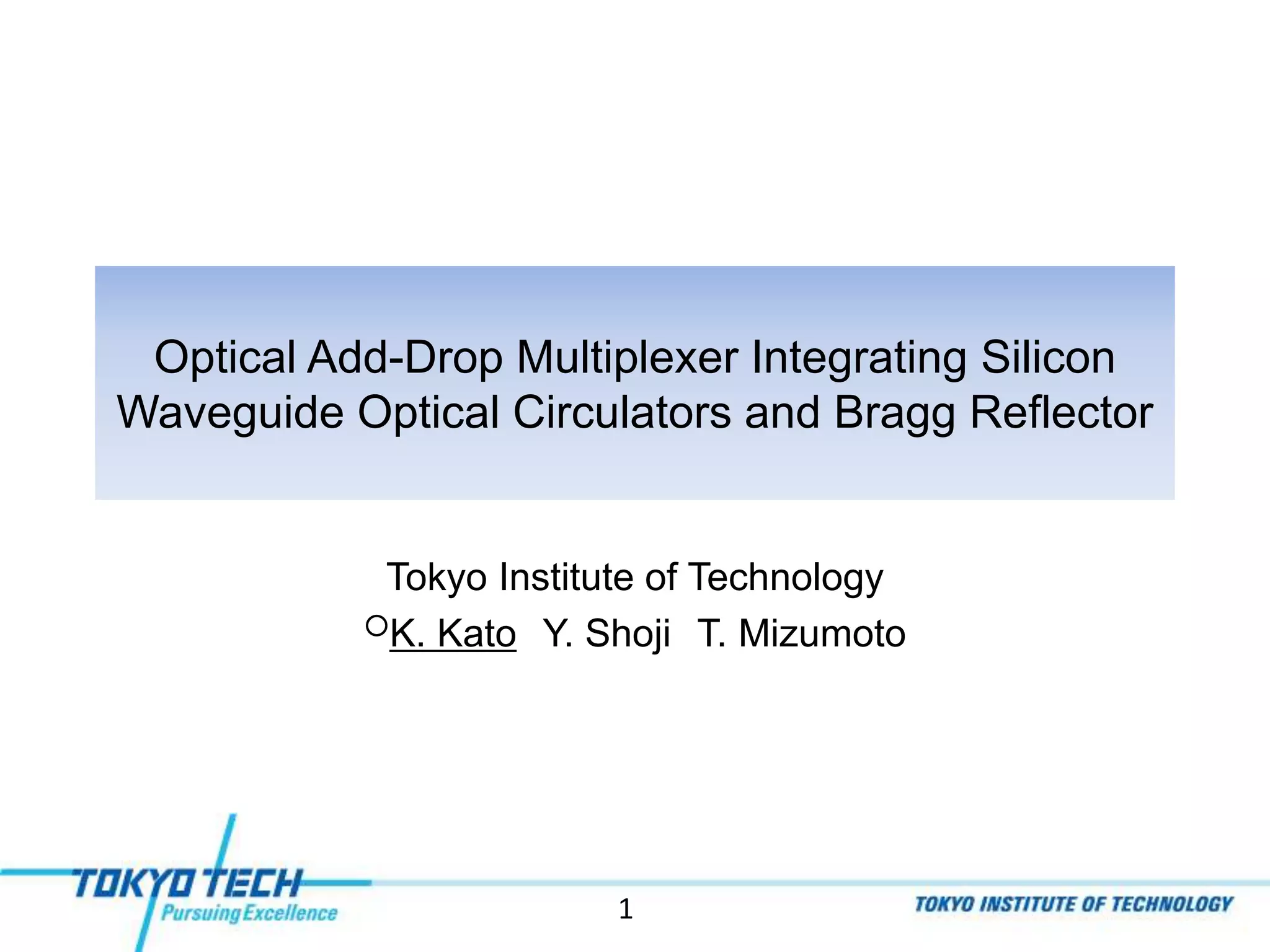
○K. Kato Y. Shoji T. Mizumoto
Optical Add-Drop Multiplexer Integrating Silicon
Waveguide Optical Circulators and Bragg Reflector
2
Background
Short distance optical
signal transmission
・・・
Optical interconnection
• Silica glass
• III-V semiconductor
• Silicon photonics
Small footprint & high functionality
Requirement
• High-speed and high-capacity
• Low power consumption
Optical waveguide device
5 μm
Rack to rack
Tokyo Inst. Tech.
On chip
IBM
Chip to chip
Intel
Board to board
Keio Univ.
3
Silicon Waveguide Optical Circulator
Port2
Port1 Port4
Port3
Nonreciprocal optical path circulation
• Integratable with other components
• Maximum isolation of 33 dB
• TM mode operation
・・・
• Optical add-drop multiplexer
• Dispersion compensator
• Bidirectional transmission system
Optical circulator
Silicon waveguide optical circulator
T. Mizumoto, et al., Proc. SPIE, 8988, 89880C (2014).
1530 1540 1550 1560 1570
-80
-60
-40
-20
Wavelength [nm]
Transmittance[dB]
Port 1 → Port 2
Port 2 → Port 1
33 dB
Port1
Port4
Port2
Port3 Si
SiO2
Ce:YIG
3 dB directional coupler
Non-reciprocal
Reciprocal phase shifter (RPS)
Magnetic field
phase shifter (NPS)
4
Operation Principle of Optical Circulator
Port 1→Port 2
Port 2→Port 3
NPSRPS
-π/2+π/2
Magnetic
field
0 (Cross)
Port1
Port2
NPSRPS
Magnetic
field
+π/2+π/2
+π (Bar)
Port3 Port2
5
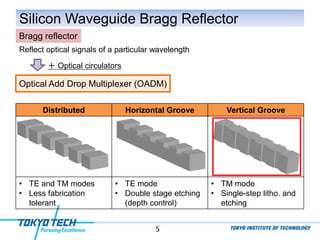
Silicon Waveguide Bragg Reflector
Optical Add Drop Multiplexer (OADM)
+ Optical circulators
Distributed Horizontal Groove Vertical Groove
• TE and TM modes
• Less fabrication
tolerant
• TE mode
• Double stage etching
(depth control)
• TM mode
• Single-step litho. and
etching
Reflect optical signals of a particular wavelength
Bragg reflector
6
Characterization ~Bragg Reflector~
30 dB Bragg reflection
(TM mode)
1540 1560 1580 1600 1620
-70
-60
-50
-40
-30
-20
Wavelength [nm]
Transmittance[dB]
Ref w/o Ce:YIG
Bragg reflector
Ref w/ Ce:YIG
Waveguide width
Waveguide height
Grating period
Groove depth
Groove length
184 nm
368 nm
70 nm
220 nm
550 nm
Grooves were repeated 500 times
220 nm
550 nm
Si
SiO2
Ce:YIG
7
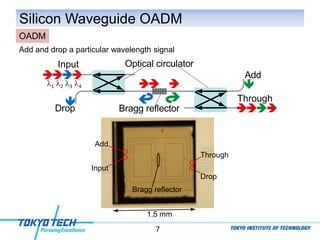
Silicon Waveguide OADM
Add and drop a particular wavelength signal
OADM
l1 l2 l3 l4
Drop
Optical circulator
Bragg reflector
Through
Input
Add
1.5 mm
Bragg reflector
Through
Drop
Input
Add
8
Input→Through
Add→Through
Input→Drop
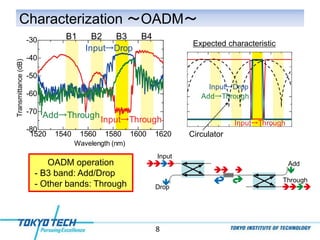
Characterization ~OADM~
1520 1540 1560 1580 1600 1620
-80
-70
-60
-50
-40
-30
Wavelength (nm)
Transmittance(dB)
Input→Through
Input→Drop
Add→Through
B1 B2 B3 B4
OADM operation
- B3 band: Add/Drop
- Other bands: Through
Expected characteristic
Drop
Through
Input
Add
Circulator
9
Summary
 Successful fabrication of a silicon waveguide Bragg
reflector cladded with Ce:YIG
 30 dB reflection for the TM mode
 Demonstration of a silicon waveguide OADM by
integrating two optical circulators and a Bragg reflector

Optical Add-Drop Multiplexer Integrating Silicon Waveguide Optical Circulators and Bragg Reflector

  • 1.
    1 Tokyo Institute ofTechnology ○K. Kato Y. Shoji T. Mizumoto Optical Add-Drop Multiplexer Integrating Silicon Waveguide Optical Circulators and Bragg Reflector
  • 2.
    2 Background Short distance optical signaltransmission ・・・ Optical interconnection • Silica glass • III-V semiconductor • Silicon photonics Small footprint & high functionality Requirement • High-speed and high-capacity • Low power consumption Optical waveguide device 5 μm Rack to rack Tokyo Inst. Tech. On chip IBM Chip to chip Intel Board to board Keio Univ.
  • 3.
    3 Silicon Waveguide OpticalCirculator Port2 Port1 Port4 Port3 Nonreciprocal optical path circulation • Integratable with other components • Maximum isolation of 33 dB • TM mode operation ・・・ • Optical add-drop multiplexer • Dispersion compensator • Bidirectional transmission system Optical circulator Silicon waveguide optical circulator T. Mizumoto, et al., Proc. SPIE, 8988, 89880C (2014). 1530 1540 1550 1560 1570 -80 -60 -40 -20 Wavelength [nm] Transmittance[dB] Port 1 → Port 2 Port 2 → Port 1 33 dB Port1 Port4 Port2 Port3 Si SiO2 Ce:YIG 3 dB directional coupler Non-reciprocal Reciprocal phase shifter (RPS) Magnetic field phase shifter (NPS)
  • 4.
    4 Operation Principle ofOptical Circulator Port 1→Port 2 Port 2→Port 3 NPSRPS -π/2+π/2 Magnetic field 0 (Cross) Port1 Port2 NPSRPS Magnetic field +π/2+π/2 +π (Bar) Port3 Port2
  • 5.
    5 Silicon Waveguide BraggReflector Optical Add Drop Multiplexer (OADM) + Optical circulators Distributed Horizontal Groove Vertical Groove • TE and TM modes • Less fabrication tolerant • TE mode • Double stage etching (depth control) • TM mode • Single-step litho. and etching Reflect optical signals of a particular wavelength Bragg reflector
  • 6.
    6 Characterization ~Bragg Reflector~ 30dB Bragg reflection (TM mode) 1540 1560 1580 1600 1620 -70 -60 -50 -40 -30 -20 Wavelength [nm] Transmittance[dB] Ref w/o Ce:YIG Bragg reflector Ref w/ Ce:YIG Waveguide width Waveguide height Grating period Groove depth Groove length 184 nm 368 nm 70 nm 220 nm 550 nm Grooves were repeated 500 times 220 nm 550 nm Si SiO2 Ce:YIG
  • 7.
    7 Silicon Waveguide OADM Addand drop a particular wavelength signal OADM l1 l2 l3 l4 Drop Optical circulator Bragg reflector Through Input Add 1.5 mm Bragg reflector Through Drop Input Add
  • 8.
    8 Input→Through Add→Through Input→Drop Characterization ~OADM~ 1520 15401560 1580 1600 1620 -80 -70 -60 -50 -40 -30 Wavelength (nm) Transmittance(dB) Input→Through Input→Drop Add→Through B1 B2 B3 B4 OADM operation - B3 band: Add/Drop - Other bands: Through Expected characteristic Drop Through Input Add Circulator
  • 9.
    9 Summary  Successful fabricationof a silicon waveguide Bragg reflector cladded with Ce:YIG  30 dB reflection for the TM mode  Demonstration of a silicon waveguide OADM by integrating two optical circulators and a Bragg reflector

Editor's Notes

  • #2 Thank you Mr. chair person. I am Keita Kato at Tokyo Tech. The title of my talk is “optical add-drop multiplexer integrating silicon waveguide optical circulators and bragg reflector.”
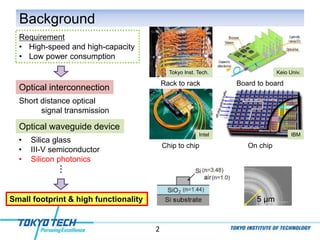
  • #3 The growth of smart phones and high-capacity contents on the internet increases the data center traffic dramatically. This brings about the increasing demand for high-speed and high-capacity data transmission systems with low power consumption. A photonic network system is used for not only long distance communications but also short distance optical signal transmission such as optical interconnections. For example, the technology is used in rack-to-rack and board-to-board interconnections. Recently, it is investigated to apply the technology to chip-to-chip and even on-chip interconnections. In these applications, silicon photonics plays an essential role to provide high functionality in a small-footprint.
  • #4 An optical circulator provides a nonreciprocal optical path circulation among 3 or 4 ports. The transmission of a lightwave from an input port to an output port is defined in a circulating manner. The lightwave is transmitted from port 1 to port 2, from port 2 to port 3, and so forth. Such a function is important to realize highly functional photonic circuits. For example, an optical add drop multiplexer, a dispersion compensator, a bidirectional transmission system, and so on. For realizing highly functional photonic circuits, it is desired to develop a waveguide optical circulator that can be integrated with other optical components. We have already demonstrated a 4-port silicon waveguide optical circulator as shown in this slide. Basically, it consists of a Mach-Zehnder interferometer. That is to say, it is composed of two 3 dB directional couplers, non-reciprocal phase shifter, and reciprocal phase shifter. The nonreciprocal phase shifter is constructed in a silicon waveguide with a Ce:YIG cladding layer directly bonded onto a silicon waveguide core. The under cladding layer is a buried oxide. By applying a static external magnetic field in an anti-parallel direction transverse to the lightwave propagation direction in the film plane of Ce:YIG, the propagation constant of TM mode is changed depending on the propagation direction. In this configuration, by the effect called nonreciprocal phase shift, a silicon waveguide optical circulator operates for the TM mode. The right-lower figure shows the transmission spectra measured between port 1 and port 2. An isolation ratio is defined by the difference in transmittance between forward and backward directions. An isolation ratio of 33 dB is successfully demonstrated at a wavelength of 1543 nm.
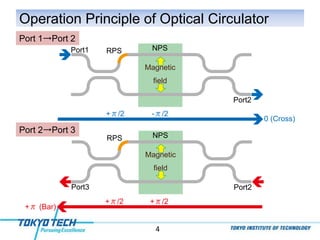
  • #5 This slide shows the operation principle of waveguide optical circulator. In the rightward direction, the light input at port 1 is divided into two by a 3 dB directional coupler. While propagating in the nonreciprocal phase shifter, they experience magneto-optical phase shift with opposite sign in two arms. This results in a phase difference of – pi over 2 in the upper arm with respect to the lower arm. The phase difference is canceled by a reciprocal phase difference of pi over 2 installed in the upper arm. After combining in an output coupler, they are output at port 2, which is the cross port of port 1. On the other hand, in the leftward direction, the magneto-optical phase difference changes its sign because of the nonreciprocal nature of the magneto-optical phase shift. Thus, the total phase difference amounts to pi between two interferometer arms. So the lightwave is not combined into port 1, but is output at port 3, which is the bar port of port 2. Accordingly, the light propagates from port 1 to port 2, from port 2 to port 3, from port 3 to port 4 and from port 4 to port 1, which leads to a circular operation.
  • #6 A Bragg reflector is the optical component that reflects optical signals of a particular wavelength. An optical add drop multiplexer is realized by integrating it with optical circulators. Three types of waveguide silicon Bragg reflectors are compared, distributed type, horizontal groove type and vertical groove type. The Bragg reflector needs to provide a high reflection for the TM mode in order to work together with the waveguide optical circulator. In this study, we used the Bragg reflector with a vertical groove grating so as to obtain high reflectivity for the TM mode. Also, it has the advantage that it can be fabricated in a single etching process.
  • #7 This figure shows the transmittance spectra measured in a fabricated Bragg reflector. A reflectivity of 30 dB was obtained at a wavelength band of 1579 to 1593 nm for the TM mode. A 550-nm wide and 220-nm high silicon waveguide with a Ce:YIG cladding layer was used for the Bragg reflector as well as the optical circulator. The waveguide width was periodically narrowed by making vertical grooves whose length were half of the grating period. The grating period was 368 nm, the groove depth was 70 nm and grooves were repeated 500 times to form a periodic grating.
  • #8 An OADM is configured so as to add and drop a particular wavelength signal through optical circulators. In the drop operation, an input light launched into the input port propagates to the Bragg reflector. The lightwave with the drop wavelength is reflected by the Bragg reflector and output at the drop port through the left circulator. The lightwave passing through the Bragg reflector is transmitted to the cross port of the right circulator, which is the through port. In the add operation, an input light launched into the add port propagates to the Bragg reflector. The lightwave is reflected by the Bragg reflector and output at the through port. The lower figure shows the silicon waveguide OADM fabricated by the direct bonding technique. The whole circuit was covered with a 1.5 by 1.5 millimeter square garnet die.
  • #9 This figure shows the transmittance spectra measured in a fabricated OADM. The red, blue, and green lines represent the transmittance spectra of the input-to-through ports, the input-to-drop ports, and the add-to-through ports, respectively. When the wavelength bands are set as the yellow ranges B1, B2, B3 and B4, the optical signal of B3 was extracted to the drop port as shown in the blue line and other signals of B1, B2, B4 were transmitted to the through port as shown in the red line. Also, the add signal of B3 was combined to the through port as shown in the green line. Therefore, an OADM operation was obtained. Ideally, the transmittance for the through signal should be flat against wavelength. However, it was not achieved because of the wavelength dependence of the optical circulator. Also, the transmission spectra of the optical circulator was different from the reflection spectra of the Bragg reflector in B3 band. Because the wavelength dependences of the two circulators were not identical, a complex wavelength response was observed. It can be improved by designing the MZI circulator so as to have a wide operation bandwidth.
  • #10 Finally, I will summarize my talk. We fabricated a silicon waveguide Bragg reflector cladded with Ce:YIG. A reflectivity of 30 dB was obtained for the TM mode. Moreover, we demonstrated a silicon waveguide OADM by integrating two optical circulators and a Bragg reflector. The optical add and drop operations were achieved for a particular wavelength range. Thank you for your kind attention.
  • #12 This slide shows a fabrication process. We use an SOI wafer having 220-nm-thick Si guiding layer. An SiO2 layer is deposited as an etching mask. The waveguide pattern is drawn using the EB lithography. Next, the pattern is transferred into SiO2 by CF4 RIE. In the second RIE process with SF6, the pattern is transferred into the silicon layer. Finally, Ce:YIG is bonded onto the silicon waveguide using the surface activated direct bonding technique. In the direct bonding, the surfaces of wafers are activated by N2 plasma exposure. Two wafers are brought into contact, and pressure is applied at 200 degree centigrade in a vacuum chamber. This technique makes it possible to contact two wafers strongly.