Optical Multiplexers
Presented by: Aizaz Ahmed Sahito
Multiplexing
 Multiplexing is an essential part in a communication system where
multiple users transmit data simultaneously through a single link,
whether the link is a coaxial cable, a fiber, radio or satellite.
 Multiplexing is widely employed in communication systems due to
its capability to increase the channel utilization or the transmission
capacity and decrease system costs.
Multiplexing in Fiber Optics
 The bandwidth properties of optical fiber are well known and make
it the media of choice for high-speed data and video applications.
However, various forms of multiplexing are required to take
advantage of this bandwidth.
 Optical multiplexer and de-multiplexer are basically passive optical filter
systems, which are arranged to process specific wavelengths in and out of
the transport system (usually optical fiber).
 Process of filtering the wavelengths can be performed using:
 Prisms
 Thin film filter
 Dichroic filters or interference filters
 There are different techniques in multiplexing light signals onto a single
optical fiber link.
 Optical Multiplexing Techniques
 Optical Time Division Multiplexing (OTDM)
Separating wavelengths in time
 Wavelength division multiplexing (WDM)
Each channel is assigned a unique carrier frequency
Channel spacing of about 50GHz
I. Coarse Wavelength Division Multiplexing (CWDM)
II. Dense Wavelength Division Multiplexing
Uses a much narrower channel spacing, therefore, many more wavelengths are
supported.
Optical Time Division Multiplexing
 Optical time division multiplexing (OTDM) has a similar concept to
electrical TDM, only that it is implemented in optical domain.
 OTDM (Optical Time-Division Multiplexing) is a very powerful optical
multiplexing technique that deliveries very high capacity of data
over optical fiber.
 The basic principle of this technology is to multiplex a number of
low bit rate optical channels in time domain.
Optical Time Division Multiplexing
 The overall OTDM system can be viewed as three big blocks
1. transmitter block
2. line system,
3. receiver block.
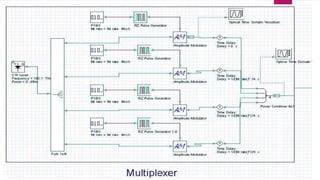
 The transmitter block is consist of Laser sources, modulators, channel
alignment systems, and multiplexer.
 The line system contains optical amplifiers and transmission fibers.
 The receiver block is made of synchronization/timing extraction circuit and
channel De-multiplexer.
Wavelength division Multiplexing
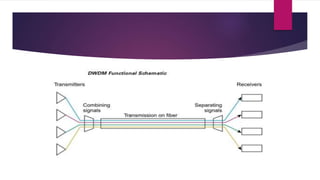
 Wavelength division multiplexing (WDM) is used to transmit more than one
high-speed digital data stream on a single optical fiber.
 Different wavelengths of light, (different colors) propagate in a single fiber
without interfering. The devices that do the optical combining and
separation are referred to as WDMs.
 These are passive optical devices that typically employ optical filters
 In wavelength-division multiplexing (WDM) systems, different independent
users transmit data over a single fiber using different wavelengths
 At the transmitter side, n independent user’s data are modulated onto n
high frequency carriers, each with a unique wavelength (λ).
 A wavelength multiplexer combines these optical signals and couples
them into a single fiber.
 At the receiving end, a De-multiplexer is required to separate the optical
signals into appropriate channels.
 This is done with n optical filters,
 Coarse wavelength division multiplexing
uses a relatively small number of channels, e.g. four or eight, and a large
channel spacing of 20 nm
The resulting total data rates are useful e.g. within metropolitan areas, as
long as broadband technologies are not widespread in households
 Dense wavelength division multiplexing
It extended method for very large data capacities, as required e.g. in the
Internet backbone. It uses a large number of channels (e.g. 40, 80, or
160), and a correspondingly small channel spacing
 Code Division Multiplexing
 Also used in microwave transmission.
 Spectrum of each wavelength is assigned a unique spreading
code.
 Channels overlap both in time and frequency domains but the
code guide each wavelength.
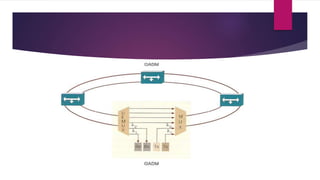
optical add-drop multiplexer (OADM)
 It is a device used in wavelength division multiplexing systems for
multiplexing and routing different channels of light into or out of a single
mode fiber (SMF).
 "Add" and "drop" here refer to the capability of the device to add one or
more new wavelength channels to an existing multi-wavelength WDM
signal. and/or to drop (remove) one or more channels, passing those
signals to another network path.
 An OADM may be considered to be a specific type of optical cross-
connect.
Applications
 The major scarce resource in telecommunication is bandwidth – users
want transmit at more high rate and service providers want to offer more
services, hence, the need for a faster and more reliable high speed
system.
 Reducing cost of hardware, one multiplexing system can be used to
combine and transmit multiple signals from Location A to Location B.
 Each wavelength, λ, can carry multiple signals.
 Mux/De-Mux serve optical switching of signals in telecommunication and
other field of signal processing and transmission.
 Future next generation internet.
Optical multiplexers

Optical multiplexers

  • 1.
  • 2.
    Multiplexing  Multiplexing isan essential part in a communication system where multiple users transmit data simultaneously through a single link, whether the link is a coaxial cable, a fiber, radio or satellite.  Multiplexing is widely employed in communication systems due to its capability to increase the channel utilization or the transmission capacity and decrease system costs.
  • 3.
    Multiplexing in FiberOptics  The bandwidth properties of optical fiber are well known and make it the media of choice for high-speed data and video applications. However, various forms of multiplexing are required to take advantage of this bandwidth.  Optical multiplexer and de-multiplexer are basically passive optical filter systems, which are arranged to process specific wavelengths in and out of the transport system (usually optical fiber).  Process of filtering the wavelengths can be performed using:  Prisms  Thin film filter  Dichroic filters or interference filters
  • 4.
     There aredifferent techniques in multiplexing light signals onto a single optical fiber link.  Optical Multiplexing Techniques  Optical Time Division Multiplexing (OTDM) Separating wavelengths in time  Wavelength division multiplexing (WDM) Each channel is assigned a unique carrier frequency Channel spacing of about 50GHz I. Coarse Wavelength Division Multiplexing (CWDM) II. Dense Wavelength Division Multiplexing Uses a much narrower channel spacing, therefore, many more wavelengths are supported.
  • 5.
    Optical Time DivisionMultiplexing  Optical time division multiplexing (OTDM) has a similar concept to electrical TDM, only that it is implemented in optical domain.  OTDM (Optical Time-Division Multiplexing) is a very powerful optical multiplexing technique that deliveries very high capacity of data over optical fiber.  The basic principle of this technology is to multiplex a number of low bit rate optical channels in time domain.
  • 6.
    Optical Time DivisionMultiplexing  The overall OTDM system can be viewed as three big blocks 1. transmitter block 2. line system, 3. receiver block.  The transmitter block is consist of Laser sources, modulators, channel alignment systems, and multiplexer.  The line system contains optical amplifiers and transmission fibers.  The receiver block is made of synchronization/timing extraction circuit and channel De-multiplexer.
  • 8.
    Wavelength division Multiplexing Wavelength division multiplexing (WDM) is used to transmit more than one high-speed digital data stream on a single optical fiber.  Different wavelengths of light, (different colors) propagate in a single fiber without interfering. The devices that do the optical combining and separation are referred to as WDMs.  These are passive optical devices that typically employ optical filters  In wavelength-division multiplexing (WDM) systems, different independent users transmit data over a single fiber using different wavelengths
  • 9.
     At thetransmitter side, n independent user’s data are modulated onto n high frequency carriers, each with a unique wavelength (λ).  A wavelength multiplexer combines these optical signals and couples them into a single fiber.  At the receiving end, a De-multiplexer is required to separate the optical signals into appropriate channels.  This is done with n optical filters,
  • 11.
     Coarse wavelengthdivision multiplexing uses a relatively small number of channels, e.g. four or eight, and a large channel spacing of 20 nm The resulting total data rates are useful e.g. within metropolitan areas, as long as broadband technologies are not widespread in households  Dense wavelength division multiplexing It extended method for very large data capacities, as required e.g. in the Internet backbone. It uses a large number of channels (e.g. 40, 80, or 160), and a correspondingly small channel spacing
  • 12.
     Code DivisionMultiplexing  Also used in microwave transmission.  Spectrum of each wavelength is assigned a unique spreading code.  Channels overlap both in time and frequency domains but the code guide each wavelength.
  • 13.
    optical add-drop multiplexer(OADM)  It is a device used in wavelength division multiplexing systems for multiplexing and routing different channels of light into or out of a single mode fiber (SMF).  "Add" and "drop" here refer to the capability of the device to add one or more new wavelength channels to an existing multi-wavelength WDM signal. and/or to drop (remove) one or more channels, passing those signals to another network path.  An OADM may be considered to be a specific type of optical cross- connect.
  • 15.
    Applications  The majorscarce resource in telecommunication is bandwidth – users want transmit at more high rate and service providers want to offer more services, hence, the need for a faster and more reliable high speed system.  Reducing cost of hardware, one multiplexing system can be used to combine and transmit multiple signals from Location A to Location B.  Each wavelength, λ, can carry multiple signals.  Mux/De-Mux serve optical switching of signals in telecommunication and other field of signal processing and transmission.  Future next generation internet.