Aakash   Presents
 
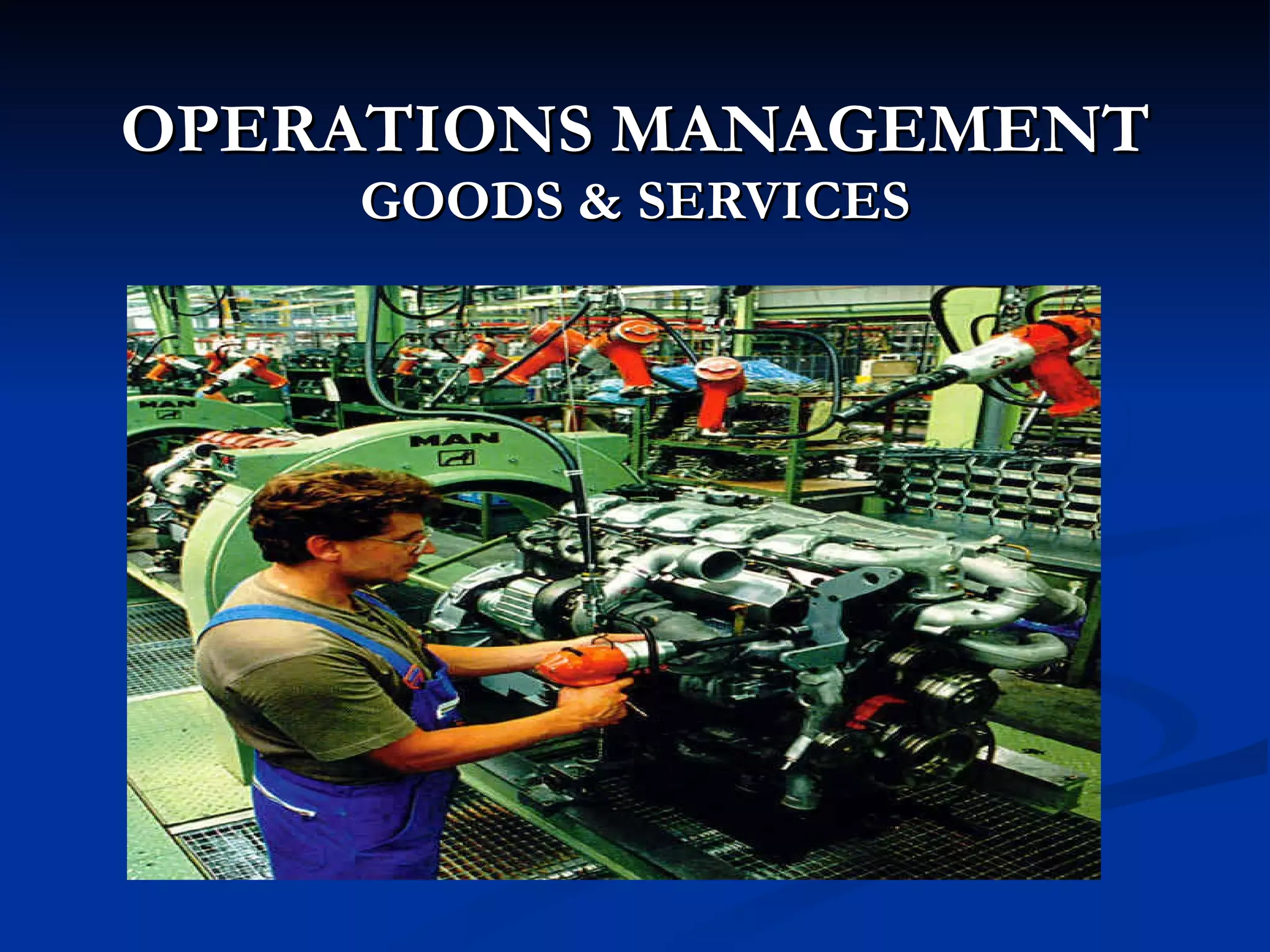
OPERATIONS MANAGEMENT GOODS & SERVICES
OPERATIONS MANAGEMENT  Managing various operations involved in production of goods and services For the production of goods and services there are various operations that are associated with them Goods- IMC, Manufacturing management, PPC, QC/QA, Dispatching, Distribution etc Services- Marketing, DBMS, IS, HRM etc
OM Vs Productions management  Production management is the part of OM Managing the operations associated with the actual manufacturing or only production process is called productions management  While overall management of operations taking place in a manufacturing or service industry is called OM
Need of OM Main focus of all industries is to achieve maximum possible efficiency and effectiveness in the processes taking place in the organization Through OM, we try to conduct all organizational operations in most efficient and effective way OM assures efficient and effective utilization of resources and it assures the proper distribution of goods & services to the customers.
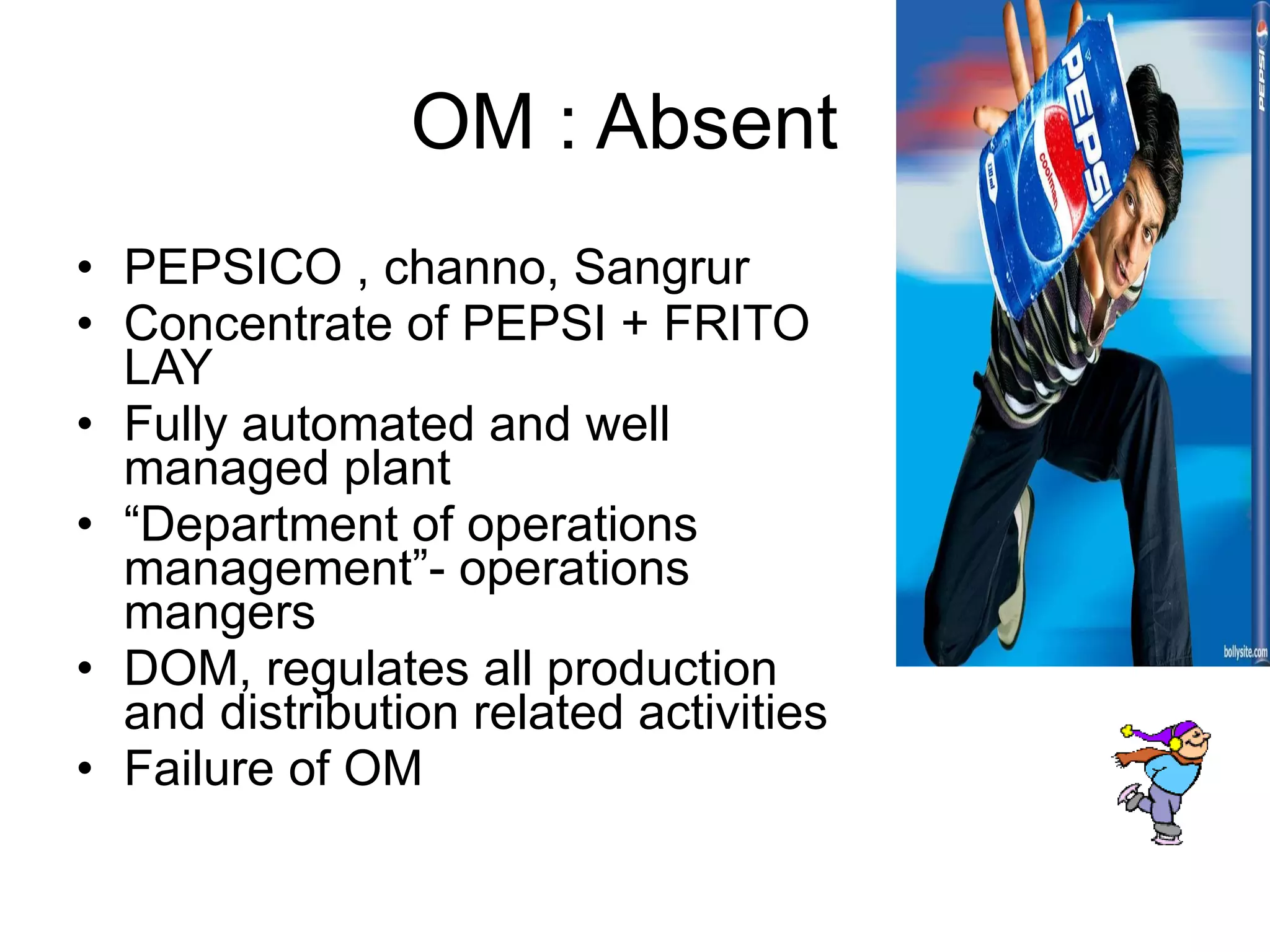
OM : Absent  PEPSICO , channo, Sangrur Concentrate of PEPSI + FRITO LAY Fully automated and well managed plant “ Department of operations management”- operations mangers DOM, regulates all production and distribution related activities Failure of OM
Major functions/areas of OM Purchase management Management control and coordinating function Productions management- goods & services Quality management Inventory management Logistics & transport management Facilities management Configuration management-keeping the systems of organization up-to-date Dispatch & distribution All operations functions work in coordinated way for establishing an efficient OM in the organization.
Birth of OM 18 th  century- introduction of factory system to the world, mass production concept came into existence 19 th  century-Management thinkers- scientific mode of management, moving assembly lines, sophisticated the operations in organizations HRM, Marketing concepts introduced To resolve sophisticated operations, operations managers started using mathematical models and scientific tools to manage operations.  Forecasting, Gantt charts, CPM (to connect different operations), linear programming Finally with the incorporation of IT I organizations, Modern OM came into existence.
Buffering of operations  Do business in Turbulent market conditions Ex- food processing unit, cant predict the inflow of raw food material.  To minimize these market uncertainties- operations managers do buffering of operations. Two type of buffering methods- physical buffering & organizational buffering
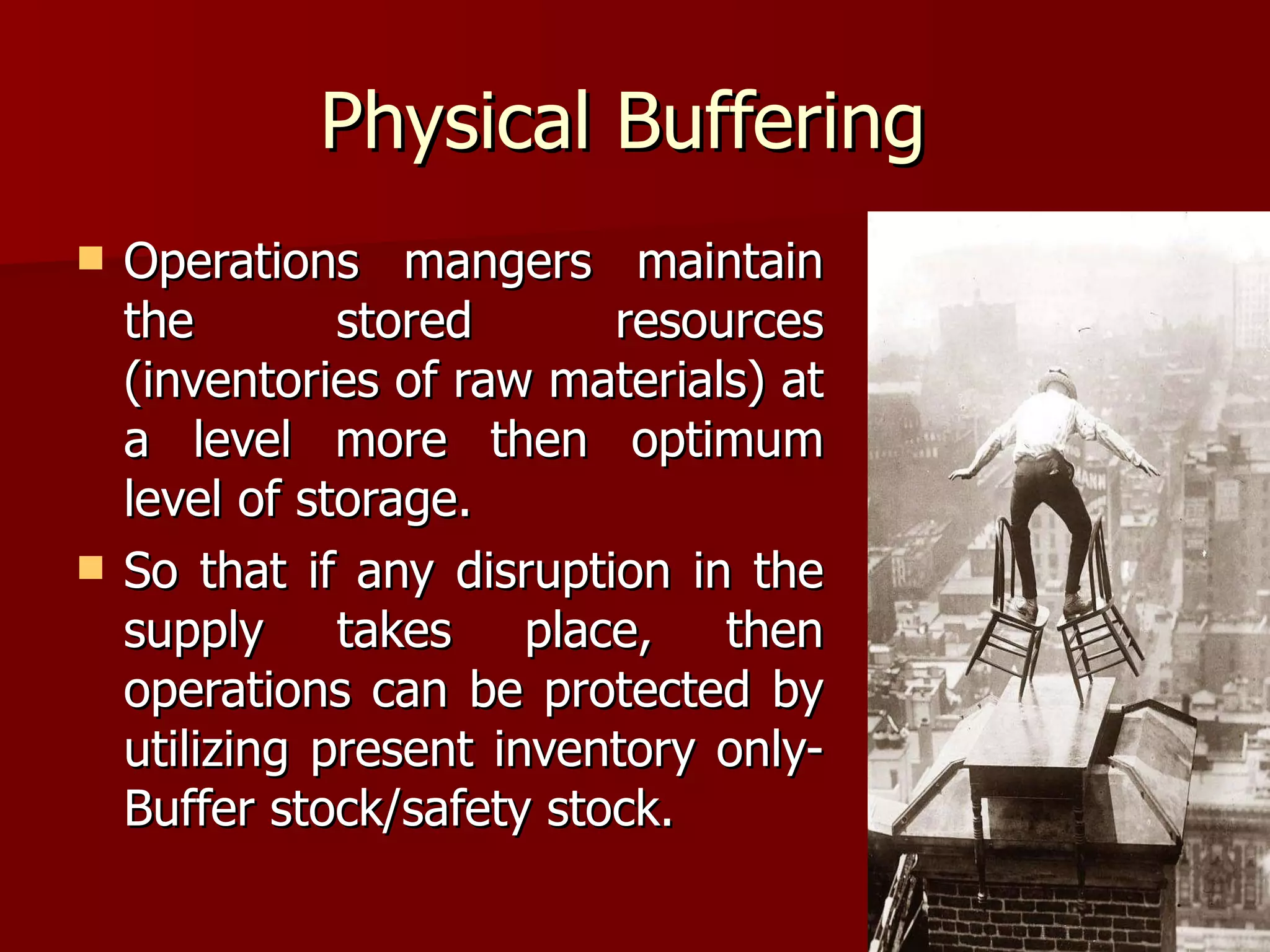
Physical Buffering  Operations mangers maintain the stored resources (inventories of raw materials) at a level more then optimum level of storage.  So that if any disruption in the supply takes place, then operations can be protected by utilizing present inventory only- Buffer stock/safety stock.
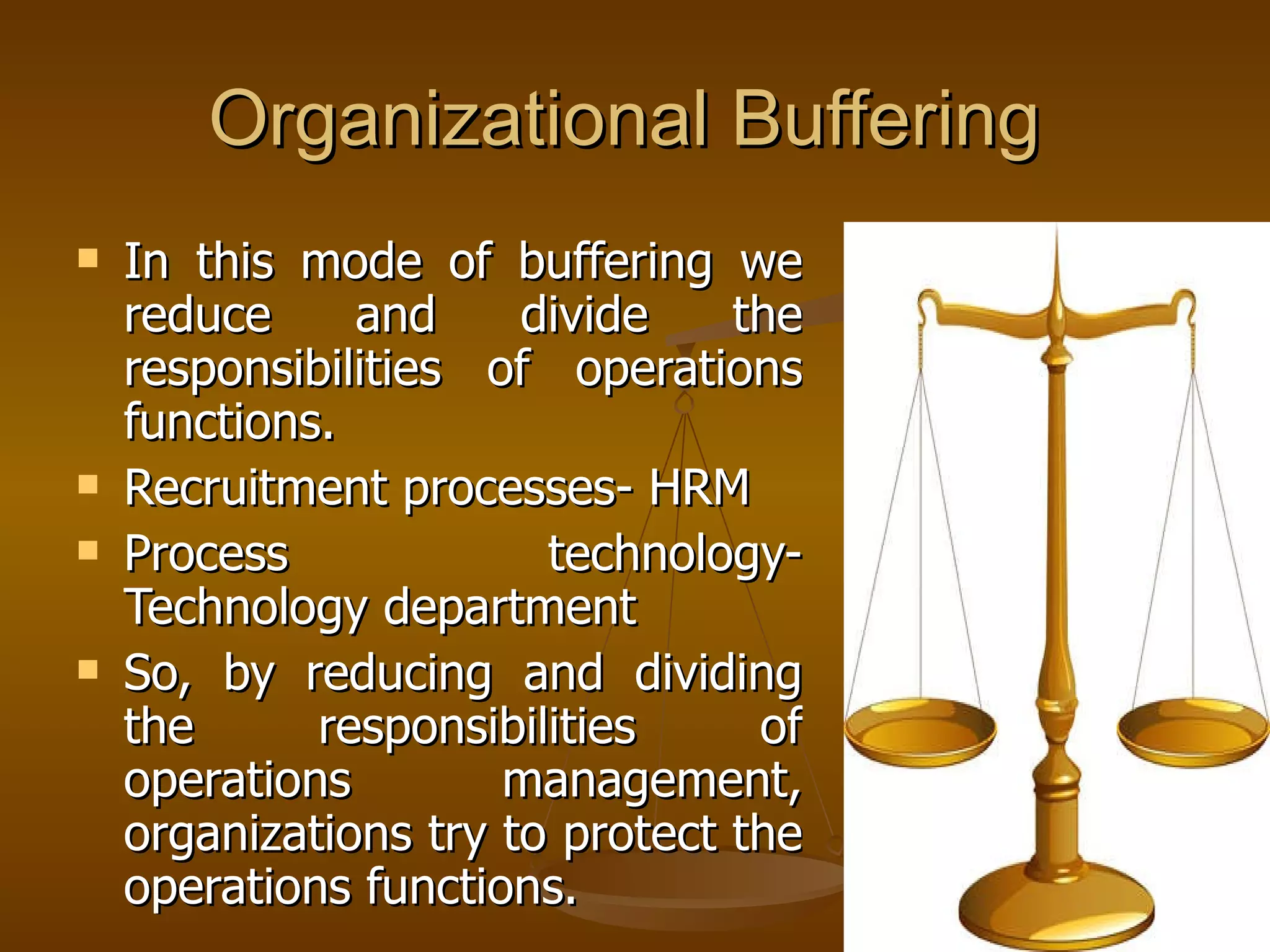
Organizational Buffering  In this mode of buffering we reduce and divide the responsibilities of operations functions.  Recruitment processes- HRM Process technology- Technology department So, by reducing and dividing the responsibilities of operations management, organizations try to protect the operations functions.
Companies  Manufacturing companies- Goods  Ex- Agriculture, mining, fishing etc. Service companies- Services  Ex- transportation, consultancy, finance etc Mixed companies- Goods as well as services
Goods Any tangible, physical, touchable entity Consumer goods- those goods that satisfy needs or wants of customers, manufactured by manufacturing companies Durable goods- long span of life, goods that doesn't get disposed quickly. Ex- LCD. Perishable goods- less span of life, goods that get consumed very rapidly. Ex- an ice-cream
Producer goods- that are physically required to produce consumer goods i.e. raw materials-used by manufacturing companies as inputs Capital goods- those goods which are required for converting producer’s goods into consumer’s goods ex- machinery
Services Intangible, non-physical in nature When you pay somebody to do something for you, you are buying a service Service businesses- service companies that produce services by directly interacting with the customers, ex- airlines, hospitals etc. – Facility based services and field based services Customer support services- provided by both manufacturing as well as service companies  Internal services- provided to internal customers of organization (IS)
Similarities  Both of them provide value to customers  Both get produced by processes involving people & technology.  OM is required in both Both can be Standardized
Dissimilarities Goods are tangible while services are intangible The demand for services is more difficult to predict than the demand for goods. Services cannot be stored as physical inventory Patents do not protect services
Toyota  MNC, headquartered in Japan  Founded by Kiichiro Toyoda in 1937 As a manufacturing company, understands the need of efficient operations management in the company. Dedicates its major portion of finance and Human power to well manage the operations in the organization
Just in Time Through JIT strategy, Toyota tries to minimize the efforts required in IMC function of OM Operations managers at Toyota use various forecasting methods, mathematical models and analytical tools to get exact predictions about market demand. On the basis of these analysis reports they plan the traffic of inventory in production plant
Each day material coming in plant gets consumed for production  And finished goods get distributed to outlets on same day So there is no accumulation of inventory at all This is called JIT strategy, that reduces inventory costs to a great extent
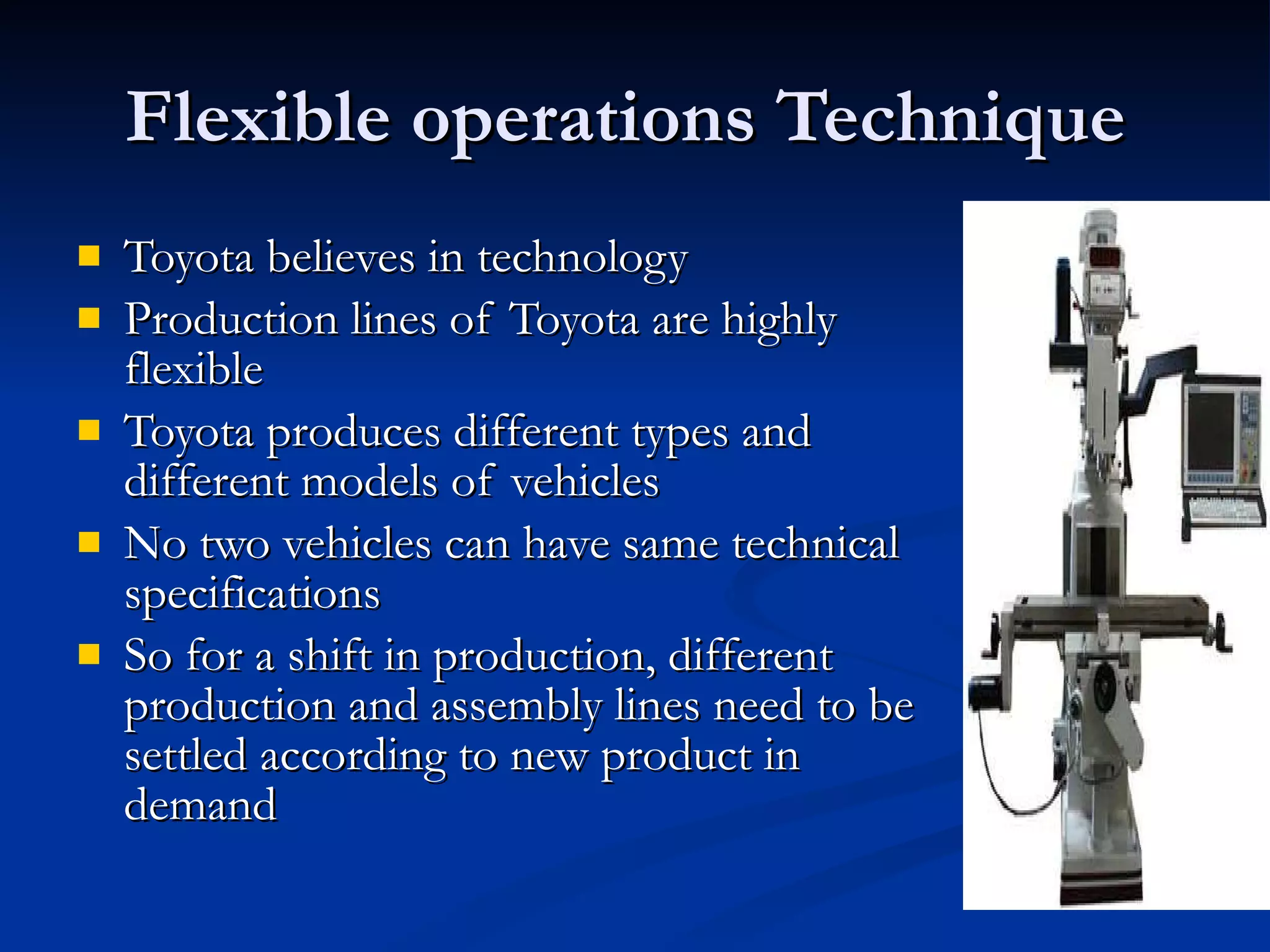
Flexible operations Technique  Toyota believes in technology  Production lines of Toyota are highly flexible  Toyota produces different types and different models of vehicles  No two vehicles can have same technical specifications So for a shift in production, different production and assembly lines need to be settled according to new product in demand
But in Toyota their production and assembly lines are extremely flexible.  So whenevr, there is a need of shift in production, production and assembly lines require only a few changes in linear programming to restart the production For example- CNC lathe instead of gear cutting machines  To avoid market turbulence Toyota follows organizational buffering strategy.
Above given were only a few examples of operations management in Toyota. By efficient operations magnet, Toyota became the world leader in automobile industry So, operations management is quite necessary tool of effective management in organizations
THANK   YOU

Operations Management

  • 1.
    Aakash Presents
  • 2.
  • 3.
  • 4.
    OPERATIONS MANAGEMENT Managing various operations involved in production of goods and services For the production of goods and services there are various operations that are associated with them Goods- IMC, Manufacturing management, PPC, QC/QA, Dispatching, Distribution etc Services- Marketing, DBMS, IS, HRM etc
  • 5.
    OM Vs Productionsmanagement Production management is the part of OM Managing the operations associated with the actual manufacturing or only production process is called productions management While overall management of operations taking place in a manufacturing or service industry is called OM
  • 6.
    Need of OMMain focus of all industries is to achieve maximum possible efficiency and effectiveness in the processes taking place in the organization Through OM, we try to conduct all organizational operations in most efficient and effective way OM assures efficient and effective utilization of resources and it assures the proper distribution of goods & services to the customers.
  • 7.
    OM : Absent PEPSICO , channo, Sangrur Concentrate of PEPSI + FRITO LAY Fully automated and well managed plant “ Department of operations management”- operations mangers DOM, regulates all production and distribution related activities Failure of OM
  • 8.
    Major functions/areas ofOM Purchase management Management control and coordinating function Productions management- goods & services Quality management Inventory management Logistics & transport management Facilities management Configuration management-keeping the systems of organization up-to-date Dispatch & distribution All operations functions work in coordinated way for establishing an efficient OM in the organization.
  • 9.
    Birth of OM18 th century- introduction of factory system to the world, mass production concept came into existence 19 th century-Management thinkers- scientific mode of management, moving assembly lines, sophisticated the operations in organizations HRM, Marketing concepts introduced To resolve sophisticated operations, operations managers started using mathematical models and scientific tools to manage operations. Forecasting, Gantt charts, CPM (to connect different operations), linear programming Finally with the incorporation of IT I organizations, Modern OM came into existence.
  • 10.
    Buffering of operations Do business in Turbulent market conditions Ex- food processing unit, cant predict the inflow of raw food material. To minimize these market uncertainties- operations managers do buffering of operations. Two type of buffering methods- physical buffering & organizational buffering
  • 11.
    Physical Buffering Operations mangers maintain the stored resources (inventories of raw materials) at a level more then optimum level of storage. So that if any disruption in the supply takes place, then operations can be protected by utilizing present inventory only- Buffer stock/safety stock.
  • 12.
    Organizational Buffering In this mode of buffering we reduce and divide the responsibilities of operations functions. Recruitment processes- HRM Process technology- Technology department So, by reducing and dividing the responsibilities of operations management, organizations try to protect the operations functions.
  • 13.
    Companies Manufacturingcompanies- Goods Ex- Agriculture, mining, fishing etc. Service companies- Services Ex- transportation, consultancy, finance etc Mixed companies- Goods as well as services
  • 14.
    Goods Any tangible,physical, touchable entity Consumer goods- those goods that satisfy needs or wants of customers, manufactured by manufacturing companies Durable goods- long span of life, goods that doesn't get disposed quickly. Ex- LCD. Perishable goods- less span of life, goods that get consumed very rapidly. Ex- an ice-cream
  • 15.
    Producer goods- thatare physically required to produce consumer goods i.e. raw materials-used by manufacturing companies as inputs Capital goods- those goods which are required for converting producer’s goods into consumer’s goods ex- machinery
  • 16.
    Services Intangible, non-physicalin nature When you pay somebody to do something for you, you are buying a service Service businesses- service companies that produce services by directly interacting with the customers, ex- airlines, hospitals etc. – Facility based services and field based services Customer support services- provided by both manufacturing as well as service companies Internal services- provided to internal customers of organization (IS)
  • 17.
    Similarities Bothof them provide value to customers Both get produced by processes involving people & technology. OM is required in both Both can be Standardized
  • 18.
    Dissimilarities Goods aretangible while services are intangible The demand for services is more difficult to predict than the demand for goods. Services cannot be stored as physical inventory Patents do not protect services
  • 19.
    Toyota MNC,headquartered in Japan Founded by Kiichiro Toyoda in 1937 As a manufacturing company, understands the need of efficient operations management in the company. Dedicates its major portion of finance and Human power to well manage the operations in the organization
  • 20.
    Just in TimeThrough JIT strategy, Toyota tries to minimize the efforts required in IMC function of OM Operations managers at Toyota use various forecasting methods, mathematical models and analytical tools to get exact predictions about market demand. On the basis of these analysis reports they plan the traffic of inventory in production plant
  • 21.
    Each day materialcoming in plant gets consumed for production And finished goods get distributed to outlets on same day So there is no accumulation of inventory at all This is called JIT strategy, that reduces inventory costs to a great extent
  • 22.
    Flexible operations Technique Toyota believes in technology Production lines of Toyota are highly flexible Toyota produces different types and different models of vehicles No two vehicles can have same technical specifications So for a shift in production, different production and assembly lines need to be settled according to new product in demand
  • 23.
    But in Toyotatheir production and assembly lines are extremely flexible. So whenevr, there is a need of shift in production, production and assembly lines require only a few changes in linear programming to restart the production For example- CNC lathe instead of gear cutting machines To avoid market turbulence Toyota follows organizational buffering strategy.
  • 24.
    Above given wereonly a few examples of operations management in Toyota. By efficient operations magnet, Toyota became the world leader in automobile industry So, operations management is quite necessary tool of effective management in organizations
  • 25.
    THANK YOU