














 !! 25.07.2015!! 
Have an idea?
How good is it?
You could make a business plan.
Do the market research
Create the product
What if nobody wants it?
Because that’s what usually happens…90% of the time.
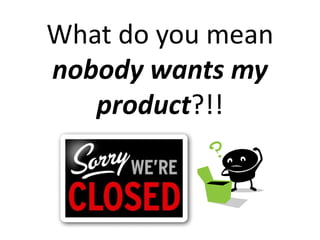
What do you mean
nobody wants my
product?!!
I made a 60 page
business plan
I did the market research to find
out what people wanted.
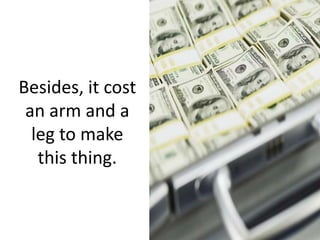
Besides, it cost
an arm and a
leg to make
this thing.
Business
plans are just
guesses
They become
outdated at first
contact with a real
customer.
And market research?
…a vague idea based
on surveys.
If Henry Ford had done market
research his customers would
have said they wanted a faster
horse.
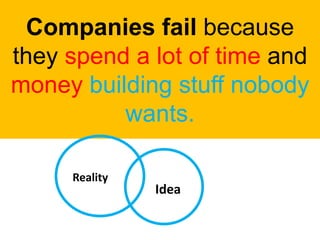
Companies fail because
they spend a lot of time and
money building stuff nobody
wants.
Reality
Idea
They build stuff based on guesses.
STOP it.
Stop wasting money
Stop wastingtime.
Stop wasting your
dreams.
There’s another way to
do this.
A better way
It’s called LEAN
Lean Management
The Next Advantage…….
Akash Deep Sharma
Lean means only doing what
matters and getting rid of the
rest.
• Origination of Concept Lean?
• What is Lean Management?
• Why we need LM? Why I
NEED LM?
• What is our current state on
LM?
• What are the changes we
need?
• How to Implement Lean?
• When to Implement Lean?
• Who will Ring the bell?
• State of art manufacturing facility
• Extremely Skilled workforce
• Always working – 100 % time in utilization
• Workloads are smartly assigned
• Orders are increasing and sales potential is huge in market
• Inventories for 7 days is maintained
• Merely 50 % of Installed capacity is utilized
Doing ONLY that thing,
which ADD Value to the
process or the product
or the service or the
customer – Lean
Management
Improving Processes,
Reducing Wastes,
Maximizing Profits
Way of Life that makes
you more available to
yourself
The History……….
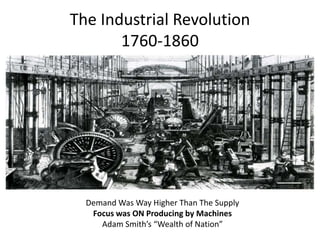
The Industrial Revolution
1760-1860
Demand Was Way Higher Than The Supply
Focus was ON Producing by Machines
Adam Smith’s “Wealth of Nation”
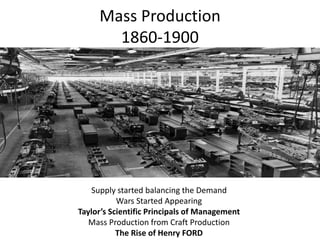
Mass Production
1860-1900
Supply started balancing the Demand
Wars Started Appearing
Taylor’s Scientific Principals of Management
Mass Production from Craft Production
The Rise of Henry FORD
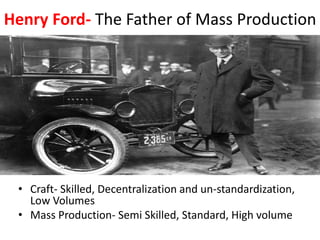
Henry Ford- The Father of Mass Production
• Craft- Skilled, Decentralization and un-standardization,
Low Volumes
• Mass Production- Semi Skilled, Standard, High volume
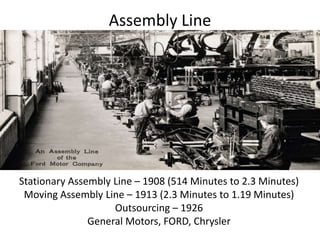
Assembly Line
Stationary Assembly Line – 1908 (514 Minutes to 2.3 Minutes)
Moving Assembly Line – 1913 (2.3 Minutes to 1.19 Minutes)
Outsourcing – 1926
General Motors, FORD, Chrysler
The fall and flaws of Mass Production
• Too much standardized
• Available to All – No competitive advantage
• Very Heavy Costs – EXTRA
• Foyel’ Human Behavior
• THE WAR (Demand was less for the first time)
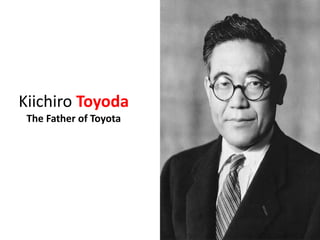
Kiichiro Toyoda
The Father of Toyota
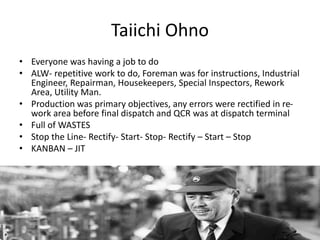
Taiichi Ohno
• Everyone was having a job to do
• ALW- repetitive work to do, Foreman was for instructions, Industrial
Engineer, Repairman, Housekeepers, Special Inspectors, Rework
Area, Utility Man.
• Production was primary objectives, any errors were rectified in re-
work area before final dispatch and QCR was at dispatch terminal
• Full of WASTES
• Stop the Line- Rectify- Start- Stop- Rectify – Start – Stop
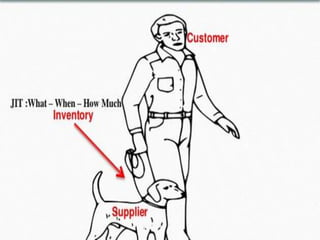
• KANBAN – JIT
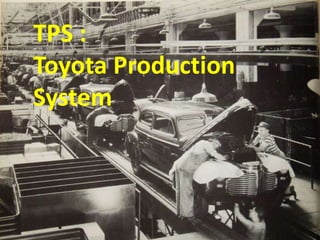
TPS :
Toyota Production
System
Relevant to Me ???
My Way of Life- Lean Management
 Value is Customer’s Perspective- Everyone is a
Customer
 Eliminate the Waste
 Continuous Improvement in yourself and your
processes
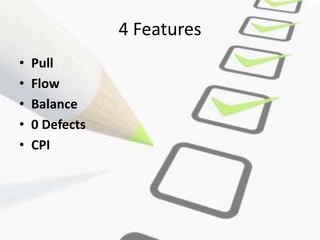
4 Features
• Pull
• Flow
• Balance
• 0 Defects
• CPI
Video
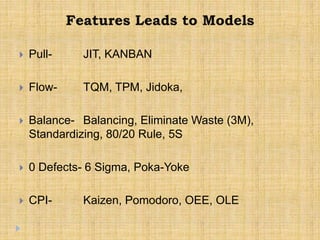
Features Leads to Models
 Pull- JIT, KANBAN
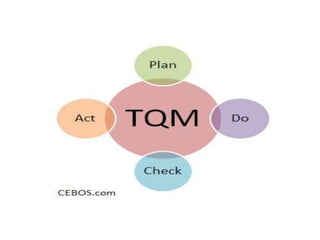
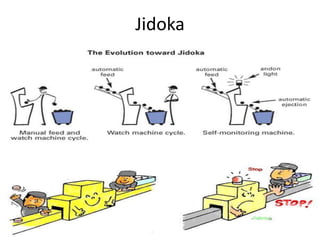
 Flow- TQM, TPM, Jidoka,
 Balance- Balancing, Eliminate Waste (3M),
Standardizing, 80/20 Rule, 5S
 0 Defects- 6 Sigma, Poka-Yoke
 CPI- Kaizen, Pomodoro, OEE, OLE
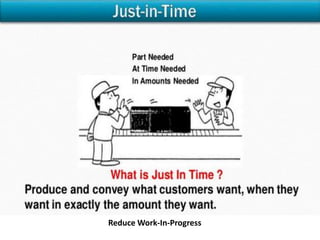
Reduce Work-In-Progress
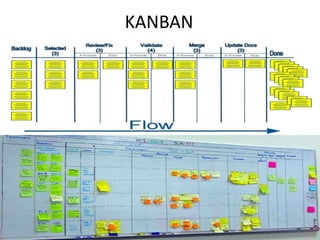
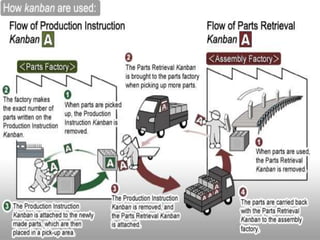
KANBAN
Jidoka
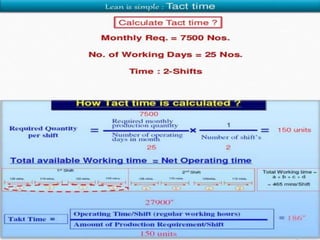
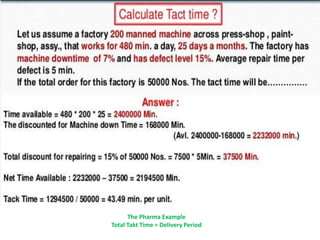
The Pharma Example
Total Takt Time = Delivery Period
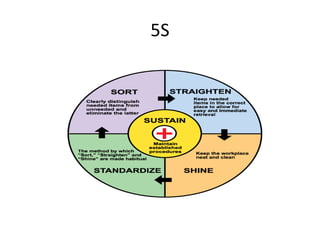
5S
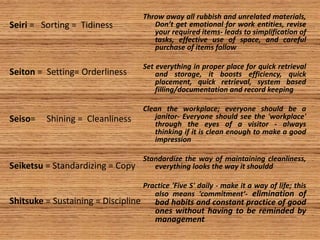
Seiri = Sorting = Tidiness
Seiton = Setting= Orderliness
Seiso= Shining = Cleanliness
Seiketsu = Standardizing = Copy
Shitsuke = Sustaining = Discipline
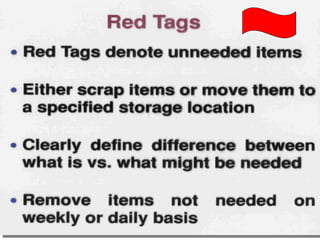
Throw away all rubbish and unrelated materials,
Don’t get emotional for work entities, revise
your required items- leads to simplification of
tasks, effective use of space, and careful
purchase of items follow
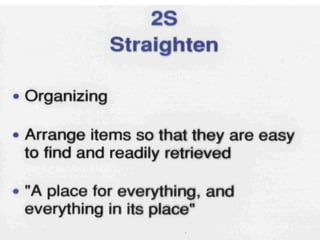
Set everything in proper place for quick retrieval
and storage, it boosts efficiency, quick
placement, quick retrieval, system based
filling/documentation and record keeping
Clean the workplace; everyone should be a
janitor- Everyone should see the 'workplace'
through the eyes of a visitor - always
thinking if it is clean enough to make a good
impression
Standardize the way of maintaining cleanliness,
everything looks the way it shouldd
Practice 'Five S' daily - make it a way of life; this
also means 'commitment‘- elimination of
bad habits and constant practice of good
ones without having to be reminded by
management
5S- Office Module
“Everything has a place and everything
at its place”
• Process to achieve total Organization,
Cleanliness and standardization at
work place (be it a factory or office or
hotel or hospital or service station or
even your home)
• A 5s based workplace is found to be
More efficient and More productive-
Majority of waste full activities are
eliminated and people do only what
is required to be done.
• Hiroyuki Hirano- Invented in Japan,
stands for 5 Japanese words starting
from “S”(5 Pillars of workplace)
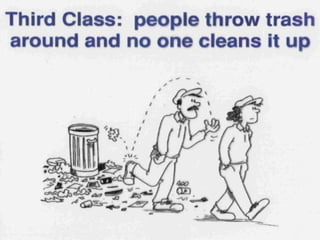
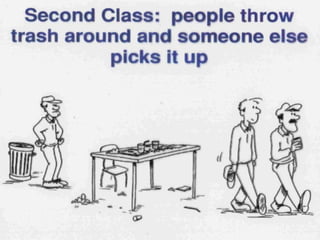
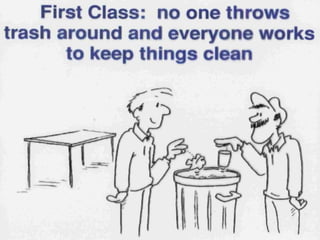
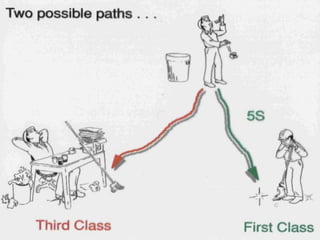
There are basically three
different types of workplaces...
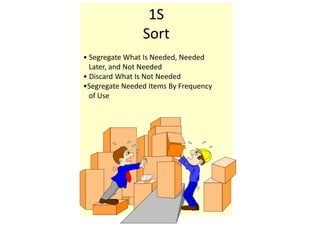
1S
Sort
• Segregate What Is Needed, Needed
Later, and Not Needed
• Discard What Is Not Needed
•Segregate Needed Items By Frequency
of Use
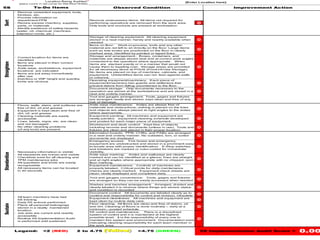
5S Observed Condition Improvement Action
0
Storage of cleaning equipment: All cleaning equipment
stored in a neat manner; handy and readily available when
needed
0
Items on floor: Work-in-process, tools and any other
material are not left to sit directly on the floor. Large items
such as tote boxes are positioned on the floor in clearly
marked area, identified by painted or taped lines.
0
Storage and arrangement:: Boxes, containers, and
materials are always stored neat and at correct work angles
convenient to the operators where appropriate. When
items are stacked evenly or in a manner that would not
cause them to toppling over. Storage areas are provided
for all necessary items at POUS (Point-Of-Use Storage).
No items are placed on top of machines, cabinets, and
equipment. Unidentified items can not lean against walls
or columns.
0
Operating equipment/machinery: Each piece of
equipment/machinery has guards and deflectors that
prevent debris from falling uncontained to the floor.
0
Document storage: Only documents necessary to the
operation are stored at the workstations and are stored in a
neat and orderly manner.
0
Tool and gauges arrangement: Tools, gages and fixtures
are arranged neatly and stored, kept clean and free of any
risk of damage.
0
Workbench and desk control: Kept free of objects
including records and documents (unless in use). Tools and
fixtures are clean and placed in their proper location.
0
Information boards: PPB, COBs, and PABs are arranged
in a neat and orderly manner. No outdated, torn, or soiled
documents are displayed
0
Emergency access: Fire hoses and emergency
equipment are unobstructed and stored in a prominent easy-
to-locate area with proper identification. E-Stop switches
and breakers are marked or color-coded for immediate
visibility.
0
Aisle ways marking: Aisles and walkways are clearly
marked and can be identified at a glance; lines are straight
and at right angles where appropriate with no chipped, worn
floor marking.
0
Equipment maintenance: Controls of machines are
properly labeled. Critical points for daily maintenance
checks are clearly marked. Equipment check sheets are
clean, neatly displayed and completed daily.
0
Tool and gauges convenience: Tools, gages and fixtures
are arranged so they can be easily accessed when needed. 0
Shelves and benches arrangement: Arranged, divided and
clearly labeled it is obvious where things are stored; status
and condition is recorded
0
Equipment cleanliness: All machines and equipment are
kept clean by routine daily care. 0
Floor cleaning: All floors are clean and free of debris, oil
and dirt. Cleaning of floors is done routinely -- daily at a
minimum—posted schedule.
0
5S control and maintenance: There is a disciplined
system of control and it is maintained at the highest
possible level. It is the responsibility of every one to
maintain this system and environment. Documentation exist
indicating cleaning responsibility for each team member in
the work area.
0
Sort
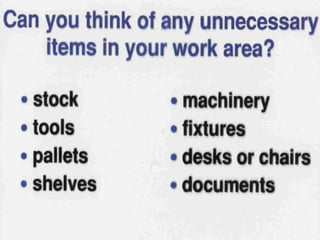
· Remove unneeded equipment, tools,
furniture, etc.
· Provide information on
department PPB
· Review excess inventory, supplies,
parts, or materials
· Identify existence of safety hazards
(water, oil, chemical, machines,
extension cords, etc.)
{Enter Location here}Location Being Audited:
(place cursor in red corner for INSTRUCTIONS)
To-Do Items
Remove unnecessary items. All items not required for
performing operations are removed from the work area.
Only tools and products are present at workstation
· All team members have had
5S training
· Daily 5S actions performed
· Place all personal belongings
stored in a neatly maintained
location
· Job aids are current and readily
accessible
· Routine 5S Implementation Audit
is performed until sustained
Aisle ways maintenance: Aisles are always free of
materials and obstructions; nothing is placed on the lines
and objects are always placed at right angles to the aisles
where appropriate.
0.00Legend: <2 (RED) 2 to 4.75 >4.75 (GREEN)
Equipment painting: All machines and equipment are
neatly painted; equipment cleaning schedule developed
and posted for each major piece of equipment.
ShineStandardizeSustain
Document control: All documents are labeled clearly as to
content and responsibility for control and revision. Obsolete
Straighten
· Floors, walls, stairs, and surfaces are
free of dirt, oil and grease
· Equipment is kept clean and free of
dirt, oil, and grease
· Cleaning materials are easily
accessible
· Lines, labels, signs, etc. are clean
and not damaged
· No other cleaning problems
(of any kind) are present
0
0
0
· Correct location for items are
identified
· Items are placed in their correct
locations
· Aisle ways, workstations, equipment
locations are indicated
· Items are put away immediately
after use
· Inventory or WIP height and quantity
limits are obvious
· Necessary information is visible
· All standards are known and visible
· Checklists exist for all cleaning and
TPM maintenance jobs
· All quantities and limits are easily
recognizable
· All necessary items can be located
in 30 seconds
5S Implementation Audit Score =
Benefits
• Freeing of work space for productive work
• Reduction in search time of documents and other items (A 5S office is
expected to retrieve any document in less than one minute !)
• As a result of the above, much faster response times to Customer
Requests
• Visible and distinctive improvement in House keeping
• Reduction in number and duration of work breakdowns
• Generation of a much "safer" and more "hygienic" working environment
• Significant reduction in loss due to damage and misplacement in storage
• Reduction in consumption of consumables
• We work for a 5s Organization !!  - Aditya Birla, TVS , TATA Motors, TCS,
Mumbai High Courts, RBI, Wipro, ONGC.
5S is the first step taken, in varying degrees, in all Workplace Improvement
initiatives like TQM, TPM, Kaizen, JIT & Six Sigma, a company that cannot
successfully implement the 5S's cannot expect to effectively integrate JIT,
re-engineering, or any other large-scale change.
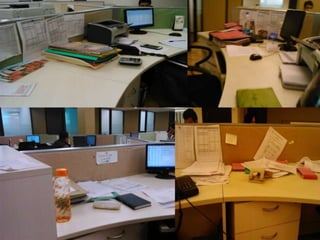
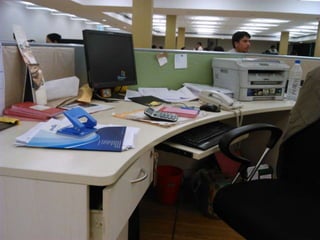
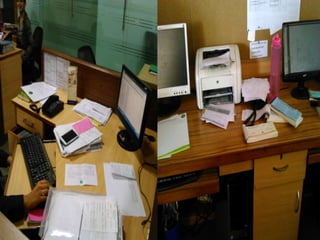
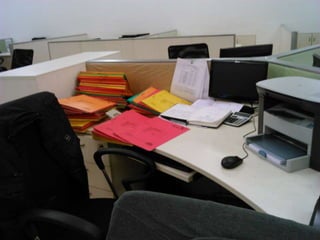
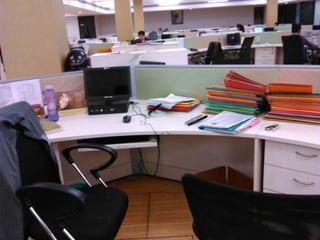
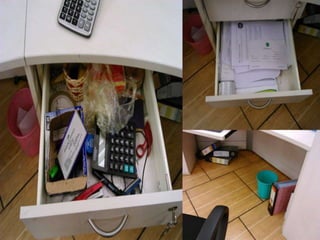
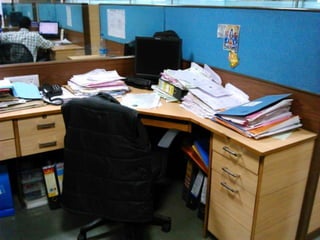
Photos
Let’s Play a Game
How to do it?
• A simple and easy to replicate 5s module has
been developed and implemented -Office
Management System “OMS”
• Demonstration
• Three Parts-
Workstations, Documents/Items, Computers
Project 5S.docx
OMS_Directory.xlsx
OMS_Format.xlsx
DOCUMENTS/ITEMS
 Sort- Take it out, Evaluate, Throw
 Set – Code the Locations,
Documents, Files, Records, Add in
the directory, Place at locations in
set order in set hierarchy
 Shine- Clean the space, change
the files
 Standardize- Copy to all in
department
 Sustain- Maintain it with discipline,
review it every week on Saturday,
Weekly Audits shall be conducted
Workstations
1. Top Drawer- For W.IP (work in
progress files)
2. Second Drawer- Stationary
3. Third Drawer- Miscellaneous
files and documents
• No loose paper on the table or
in drawers
• Clean your desk before going to
Lunch and before leaving the
office
• All papers of current work
should be in 1 or 2 folders
named as “Working Paper” –
Less Paper do not mean Less
Work and Vice Versa
Items Permitted
• Telephone directory
• Address directory of
units
• Name of the person
with designation and
phone number
• 1 Calendar Near PC
• Nicely tied phone
wire is considered to
be understood by
default
• No lose chargers/PC
wires are expected
on any workstation
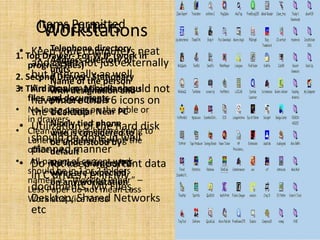
Computers
• Keep your computers neat
and clean not just externally
but internally as well
• An ideal machine should not
have more than 6 icons on
the desktop
• Utilization of the hard disk
should be done in well
planned manner
• Do not keep important data
in C drives i.e. in My
documents, My Files,
Desktop, Shared Networks
etc
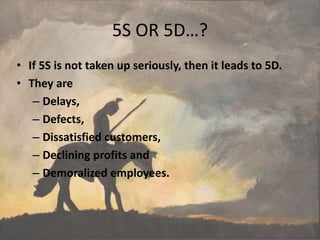
5S OR 5D…?
• If 5S is not taken up seriously, then it leads to 5D.
• They are
– Delays,
– Defects,
– Dissatisfied customers,
– Declining profits and
– Demoralized employees.
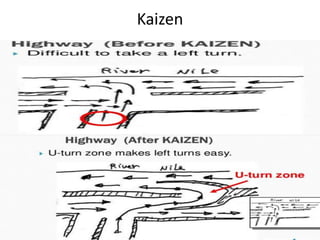
Kaizen
Poka- Yoke
6 Sigma, OEE, OLE
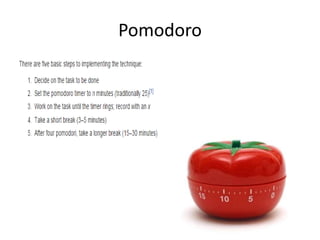
Pomodoro
Task of Change Agents
• Share what you have learned with everyone in the
department
• Develop a 5s Directory of your specific department,
cover all documents and files
• Mark each and every document with appropriate
codes, mark locations of your department with
codes
• Coordinate SORTING in your department
• After SORTING of documents, Trash the un required
ones and submit the old ones to the record room
• After proper alignment of department, submit the
copy of directory to HR and paste one copy of the
directory in department ( to be updated whenever
there is a change)
• HR shall conduct the 5s Audit after you submit the
directory to office and on the day of Audit your
department will get a (pass/fail) status.
• If failed, re-audit shall be planned in 2-3 days time
• If Passed, Maintenance of 5S shall be departments
shared responsibility
• Timelines shall be communicated soon
• All the Best !!
• Working for yourself is good for health.
– BE THE CHANGE AGENTS !!
Thank You for Your Patience
Akash Deep Sharma
Any Queries are Invited

Lean Management

  • 1.
  • 2.
  • 3.
  • 4.
    You could makea business plan.
  • 5.
    Do the marketresearch
  • 6.
  • 7.
    What if nobodywants it?
  • 8.
    Because that’s whatusually happens…90% of the time.
  • 9.
    What do youmean nobody wants my product?!!
  • 10.
    I made a60 page business plan
  • 11.
    I did themarket research to find out what people wanted.
  • 12.
    Besides, it cost anarm and a leg to make this thing.
  • 13.
    Business plans are just guesses Theybecome outdated at first contact with a real customer.
  • 14.
    And market research? …avague idea based on surveys.
  • 15.
    If Henry Fordhad done market research his customers would have said they wanted a faster horse.
  • 16.
    Companies fail because theyspend a lot of time and money building stuff nobody wants. Reality Idea
  • 17.
    They build stuffbased on guesses.
  • 18.
  • 19.
  • 20.
  • 21.
  • 22.
  • 23.
  • 24.
  • 25.
    Lean Management The NextAdvantage……. Akash Deep Sharma
  • 26.
    Lean means onlydoing what matters and getting rid of the rest.
  • 27.
    • Origination ofConcept Lean? • What is Lean Management? • Why we need LM? Why I NEED LM? • What is our current state on LM? • What are the changes we need? • How to Implement Lean? • When to Implement Lean? • Who will Ring the bell?
  • 29.
    • State ofart manufacturing facility • Extremely Skilled workforce • Always working – 100 % time in utilization • Workloads are smartly assigned • Orders are increasing and sales potential is huge in market • Inventories for 7 days is maintained • Merely 50 % of Installed capacity is utilized
  • 32.
    Doing ONLY thatthing, which ADD Value to the process or the product or the service or the customer – Lean Management Improving Processes, Reducing Wastes, Maximizing Profits Way of Life that makes you more available to yourself
  • 33.
  • 34.
    The Industrial Revolution 1760-1860 DemandWas Way Higher Than The Supply Focus was ON Producing by Machines Adam Smith’s “Wealth of Nation”
  • 35.
    Mass Production 1860-1900 Supply startedbalancing the Demand Wars Started Appearing Taylor’s Scientific Principals of Management Mass Production from Craft Production The Rise of Henry FORD
  • 36.
    Henry Ford- TheFather of Mass Production • Craft- Skilled, Decentralization and un-standardization, Low Volumes • Mass Production- Semi Skilled, Standard, High volume
  • 37.
    Assembly Line Stationary AssemblyLine – 1908 (514 Minutes to 2.3 Minutes) Moving Assembly Line – 1913 (2.3 Minutes to 1.19 Minutes) Outsourcing – 1926 General Motors, FORD, Chrysler
  • 38.
    The fall andflaws of Mass Production • Too much standardized • Available to All – No competitive advantage • Very Heavy Costs – EXTRA • Foyel’ Human Behavior • THE WAR (Demand was less for the first time)
  • 39.
  • 40.
    Taiichi Ohno • Everyonewas having a job to do • ALW- repetitive work to do, Foreman was for instructions, Industrial Engineer, Repairman, Housekeepers, Special Inspectors, Rework Area, Utility Man. • Production was primary objectives, any errors were rectified in re- work area before final dispatch and QCR was at dispatch terminal • Full of WASTES • Stop the Line- Rectify- Start- Stop- Rectify – Start – Stop • KANBAN – JIT
  • 41.
  • 42.
  • 43.
    My Way ofLife- Lean Management  Value is Customer’s Perspective- Everyone is a Customer  Eliminate the Waste  Continuous Improvement in yourself and your processes
  • 44.
    4 Features • Pull •Flow • Balance • 0 Defects • CPI
  • 45.
  • 46.
    Features Leads toModels  Pull- JIT, KANBAN  Flow- TQM, TPM, Jidoka,  Balance- Balancing, Eliminate Waste (3M), Standardizing, 80/20 Rule, 5S  0 Defects- 6 Sigma, Poka-Yoke  CPI- Kaizen, Pomodoro, OEE, OLE
  • 47.
  • 50.
  • 53.
  • 55.
    The Pharma Example TotalTakt Time = Delivery Period
  • 75.
  • 77.
    Seiri = Sorting= Tidiness Seiton = Setting= Orderliness Seiso= Shining = Cleanliness Seiketsu = Standardizing = Copy Shitsuke = Sustaining = Discipline Throw away all rubbish and unrelated materials, Don’t get emotional for work entities, revise your required items- leads to simplification of tasks, effective use of space, and careful purchase of items follow Set everything in proper place for quick retrieval and storage, it boosts efficiency, quick placement, quick retrieval, system based filling/documentation and record keeping Clean the workplace; everyone should be a janitor- Everyone should see the 'workplace' through the eyes of a visitor - always thinking if it is clean enough to make a good impression Standardize the way of maintaining cleanliness, everything looks the way it shouldd Practice 'Five S' daily - make it a way of life; this also means 'commitment‘- elimination of bad habits and constant practice of good ones without having to be reminded by management
  • 83.
    5S- Office Module “Everythinghas a place and everything at its place” • Process to achieve total Organization, Cleanliness and standardization at work place (be it a factory or office or hotel or hospital or service station or even your home) • A 5s based workplace is found to be More efficient and More productive- Majority of waste full activities are eliminated and people do only what is required to be done. • Hiroyuki Hirano- Invented in Japan, stands for 5 Japanese words starting from “S”(5 Pillars of workplace)
  • 84.
    There are basicallythree different types of workplaces...
  • 88.
    1S Sort • Segregate WhatIs Needed, Needed Later, and Not Needed • Discard What Is Not Needed •Segregate Needed Items By Frequency of Use
  • 96.
    5S Observed ConditionImprovement Action 0 Storage of cleaning equipment: All cleaning equipment stored in a neat manner; handy and readily available when needed 0 Items on floor: Work-in-process, tools and any other material are not left to sit directly on the floor. Large items such as tote boxes are positioned on the floor in clearly marked area, identified by painted or taped lines. 0 Storage and arrangement:: Boxes, containers, and materials are always stored neat and at correct work angles convenient to the operators where appropriate. When items are stacked evenly or in a manner that would not cause them to toppling over. Storage areas are provided for all necessary items at POUS (Point-Of-Use Storage). No items are placed on top of machines, cabinets, and equipment. Unidentified items can not lean against walls or columns. 0 Operating equipment/machinery: Each piece of equipment/machinery has guards and deflectors that prevent debris from falling uncontained to the floor. 0 Document storage: Only documents necessary to the operation are stored at the workstations and are stored in a neat and orderly manner. 0 Tool and gauges arrangement: Tools, gages and fixtures are arranged neatly and stored, kept clean and free of any risk of damage. 0 Workbench and desk control: Kept free of objects including records and documents (unless in use). Tools and fixtures are clean and placed in their proper location. 0 Information boards: PPB, COBs, and PABs are arranged in a neat and orderly manner. No outdated, torn, or soiled documents are displayed 0 Emergency access: Fire hoses and emergency equipment are unobstructed and stored in a prominent easy- to-locate area with proper identification. E-Stop switches and breakers are marked or color-coded for immediate visibility. 0 Aisle ways marking: Aisles and walkways are clearly marked and can be identified at a glance; lines are straight and at right angles where appropriate with no chipped, worn floor marking. 0 Equipment maintenance: Controls of machines are properly labeled. Critical points for daily maintenance checks are clearly marked. Equipment check sheets are clean, neatly displayed and completed daily. 0 Tool and gauges convenience: Tools, gages and fixtures are arranged so they can be easily accessed when needed. 0 Shelves and benches arrangement: Arranged, divided and clearly labeled it is obvious where things are stored; status and condition is recorded 0 Equipment cleanliness: All machines and equipment are kept clean by routine daily care. 0 Floor cleaning: All floors are clean and free of debris, oil and dirt. Cleaning of floors is done routinely -- daily at a minimum—posted schedule. 0 5S control and maintenance: There is a disciplined system of control and it is maintained at the highest possible level. It is the responsibility of every one to maintain this system and environment. Documentation exist indicating cleaning responsibility for each team member in the work area. 0 Sort · Remove unneeded equipment, tools, furniture, etc. · Provide information on department PPB · Review excess inventory, supplies, parts, or materials · Identify existence of safety hazards (water, oil, chemical, machines, extension cords, etc.) {Enter Location here}Location Being Audited: (place cursor in red corner for INSTRUCTIONS) To-Do Items Remove unnecessary items. All items not required for performing operations are removed from the work area. Only tools and products are present at workstation · All team members have had 5S training · Daily 5S actions performed · Place all personal belongings stored in a neatly maintained location · Job aids are current and readily accessible · Routine 5S Implementation Audit is performed until sustained Aisle ways maintenance: Aisles are always free of materials and obstructions; nothing is placed on the lines and objects are always placed at right angles to the aisles where appropriate. 0.00Legend: <2 (RED) 2 to 4.75 >4.75 (GREEN) Equipment painting: All machines and equipment are neatly painted; equipment cleaning schedule developed and posted for each major piece of equipment. ShineStandardizeSustain Document control: All documents are labeled clearly as to content and responsibility for control and revision. Obsolete Straighten · Floors, walls, stairs, and surfaces are free of dirt, oil and grease · Equipment is kept clean and free of dirt, oil, and grease · Cleaning materials are easily accessible · Lines, labels, signs, etc. are clean and not damaged · No other cleaning problems (of any kind) are present 0 0 0 · Correct location for items are identified · Items are placed in their correct locations · Aisle ways, workstations, equipment locations are indicated · Items are put away immediately after use · Inventory or WIP height and quantity limits are obvious · Necessary information is visible · All standards are known and visible · Checklists exist for all cleaning and TPM maintenance jobs · All quantities and limits are easily recognizable · All necessary items can be located in 30 seconds 5S Implementation Audit Score =
  • 97.
    Benefits • Freeing ofwork space for productive work • Reduction in search time of documents and other items (A 5S office is expected to retrieve any document in less than one minute !) • As a result of the above, much faster response times to Customer Requests • Visible and distinctive improvement in House keeping • Reduction in number and duration of work breakdowns • Generation of a much "safer" and more "hygienic" working environment • Significant reduction in loss due to damage and misplacement in storage • Reduction in consumption of consumables • We work for a 5s Organization !!  - Aditya Birla, TVS , TATA Motors, TCS, Mumbai High Courts, RBI, Wipro, ONGC. 5S is the first step taken, in varying degrees, in all Workplace Improvement initiatives like TQM, TPM, Kaizen, JIT & Six Sigma, a company that cannot successfully implement the 5S's cannot expect to effectively integrate JIT, re-engineering, or any other large-scale change.
  • 100.
  • 107.
  • 108.
    How to doit? • A simple and easy to replicate 5s module has been developed and implemented -Office Management System “OMS” • Demonstration • Three Parts- Workstations, Documents/Items, Computers Project 5S.docx OMS_Directory.xlsx OMS_Format.xlsx
  • 109.
    DOCUMENTS/ITEMS  Sort- Takeit out, Evaluate, Throw  Set – Code the Locations, Documents, Files, Records, Add in the directory, Place at locations in set order in set hierarchy  Shine- Clean the space, change the files  Standardize- Copy to all in department  Sustain- Maintain it with discipline, review it every week on Saturday, Weekly Audits shall be conducted
  • 110.
    Workstations 1. Top Drawer-For W.IP (work in progress files) 2. Second Drawer- Stationary 3. Third Drawer- Miscellaneous files and documents • No loose paper on the table or in drawers • Clean your desk before going to Lunch and before leaving the office • All papers of current work should be in 1 or 2 folders named as “Working Paper” – Less Paper do not mean Less Work and Vice Versa Items Permitted • Telephone directory • Address directory of units • Name of the person with designation and phone number • 1 Calendar Near PC • Nicely tied phone wire is considered to be understood by default • No lose chargers/PC wires are expected on any workstation Computers • Keep your computers neat and clean not just externally but internally as well • An ideal machine should not have more than 6 icons on the desktop • Utilization of the hard disk should be done in well planned manner • Do not keep important data in C drives i.e. in My documents, My Files, Desktop, Shared Networks etc
  • 111.
    5S OR 5D…? •If 5S is not taken up seriously, then it leads to 5D. • They are – Delays, – Defects, – Dissatisfied customers, – Declining profits and – Demoralized employees.
  • 112.
  • 113.
  • 114.
  • 115.
    Task of ChangeAgents • Share what you have learned with everyone in the department • Develop a 5s Directory of your specific department, cover all documents and files • Mark each and every document with appropriate codes, mark locations of your department with codes • Coordinate SORTING in your department • After SORTING of documents, Trash the un required ones and submit the old ones to the record room • After proper alignment of department, submit the copy of directory to HR and paste one copy of the directory in department ( to be updated whenever there is a change) • HR shall conduct the 5s Audit after you submit the directory to office and on the day of Audit your department will get a (pass/fail) status. • If failed, re-audit shall be planned in 2-3 days time • If Passed, Maintenance of 5S shall be departments shared responsibility • Timelines shall be communicated soon • All the Best !!
  • 116.
    • Working foryourself is good for health. – BE THE CHANGE AGENTS !! Thank You for Your Patience Akash Deep Sharma Any Queries are Invited