FORECASTING

                               PRESENTED BY
                              MANISHA VAGHELA


vaghela_manisha13@yahoo.com BY:MANISHA VAGHELA   1
Flow of presentation
    Introduction
    Meaning
    Definition
    Features of forecasting
    Process of forecasting
    Importance of forecasting
    Advantages of forecasting
    Limitations of forecasting
    Methods of forecasting
    Conclusion
    Bibliography

vaghela_manisha13@yahoo.com BY:MANISHA VAGHELA   2
INTRODUCTION
                  In simple terms forecasting means,
    “estimation or prediction of future”. The prediction of
    outcomes, trends, or expected future behavior of a
    business, industry sector, or the economy through the
    use of statistics. Forecasting is an operational
    research technique used as a basis for management
    planning and decision making.


vaghela_manisha13@yahoo.com BY:MANISHA VAGHELA                3
Meaning
  Forecasting is a systematic guessing of the
   future course of events.
  Forecasting provides a basis for a planning.
  According to fayol, forecasting includes both
   assessing the future and making provision
   for it.


vaghela_manisha13@yahoo.com BY:MANISHA VAGHELA     4
DEFINITION:
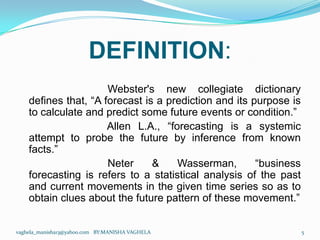
                      Webster's new collegiate dictionary
    defines that, “A forecast is a prediction and its purpose is
    to calculate and predict some future events or condition.”
                      Allen L.A., “forecasting is a systemic
    attempt to probe the future by inference from known
    facts.”
                      Neter     &    Wasserman,        “business
    forecasting is refers to a statistical analysis of the past
    and current movements in the given time series so as to
    obtain clues about the future pattern of these movement.”


vaghela_manisha13@yahoo.com BY:MANISHA VAGHELA                     5
Features of forecasting
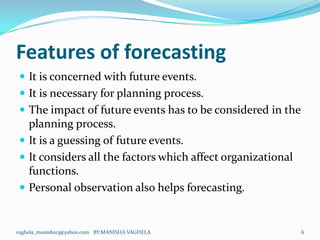
  It is concerned with future events.
  It is necessary for planning process.
  The impact of future events has to be considered in the
   planning process.
  It is a guessing of future events.
  It considers all the factors which affect organizational
   functions.
  Personal observation also helps forecasting.


vaghela_manisha13@yahoo.com BY:MANISHA VAGHELA                6
Process of forecasting
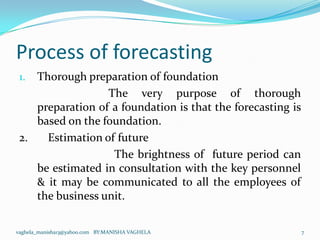
 1. Thorough preparation of foundation
                  The very purpose of thorough
    preparation of a foundation is that the forecasting is
    based on the foundation.
 2.   Estimation of future
                   The brightness of future period can
    be estimated in consultation with the key personnel
    & it may be communicated to all the employees of
    the business unit.

vaghela_manisha13@yahoo.com BY:MANISHA VAGHELA               7
Cont….
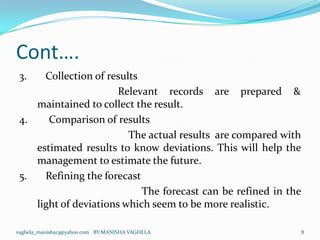
 3.   Collection of results
                       Relevant records are prepared &
    maintained to collect the result.
 4.    Comparison of results
                         The actual results are compared with
    estimated results to know deviations. This will help the
    management to estimate the future.
 5.   Refining the forecast
                            The forecast can be refined in the
    light of deviations which seem to be more realistic.

vaghela_manisha13@yahoo.com BY:MANISHA VAGHELA                   8
Importance of forecasting
1. Pivotal role in an organization:-
                Many organizations have failed because of
   lack of forecasting or faulty forecasting. The reason is
   that planning is based on accurate forecasting.
2. Development of a business:-
                The performance of specified objectives
   depends upon the proper forecasting. So the
   development of a business or an organization is fully
   based on the forecasting.


 vaghela_manisha13@yahoo.com BY:MANISHA VAGHELA               9
Cont…
  3. Co-ordination:-
                             Forecasting helps to collect the information
         about internal and external factors. Thus collected
         information provides a basis for co-ordination.
  4. effective control:-
                             Management executive can ascertain the
         strength and weaknesses of sub-ordinates or
         employees through forecasting.
  5. Key to success:-
                            All business organizations are facing risks.
         Forecasting provides clues and reduce risk and
         uncertainties. The management executives can save
         the business and get success by taking appropriate
         action.
vaghela_manisha13@yahoo.com BY:MANISHA VAGHELA                            10
Cont…
 6.   Implementation of project:-
                   Many entrepreneurs implement a project on
       the basis of their experience .Forecasting helps an
       entrepreneur to gain experience and ensures him
       success.

 7.    Primacy to planning:-
             The information required for planning is supplied
       by forecasting. So, forecasting is the primacy to the
       planning.

vaghela_manisha13@yahoo.com BY:MANISHA VAGHELA                   11
Advantages
  Effective handling of uncertainty
  Better labor relations
  Balanced work-load
  Minimization in the fluctuations of production
  Better use of production facilities
  Better material management
  Better customer service
  Better utilization of capital and resources
  Better design of facilities and production system.
vaghela_manisha13@yahoo.com BY:MANISHA VAGHELA          12
Limitation
  Forecasting is to be made on the basis of certain
     assumptions and human judgments which yield wrong
     result.
    It can not be considered as a scientific method for guessing
     future events.
    It does not specify any concrete relationship between past
     and future events.
    It requires high degree of skill.
    It needs adequate reliable information so difficult
      to collect reliable information.
    Heavy cost and time consuming.
    It can not be applied to a long period.

vaghela_manisha13@yahoo.com BY:MANISHA VAGHELA                      13
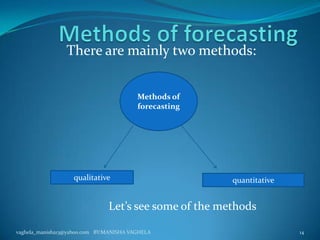
There are mainly two methods:


                                         Methods of
                                         forecasting


                   qualitative                         quantitative


                               Let’s see some of the methods

vaghela_manisha13@yahoo.com BY:MANISHA VAGHELA                        14
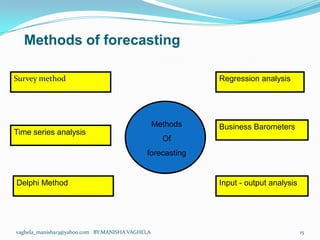
Methods of forecasting

Survey method                                              Regression analysis


                                                 Methods   Business Barometers
Time series analysis
                                                   Of
                                            forecasting


Delphi Method                                              Input - output analysis


vaghela_manisha13@yahoo.com BY:MANISHA VAGHELA                                       15
METHODS
 1.    Regression Analysis:-
                Regression analysis is used to find out the effect
       of changes of the relative movements of two or more
       inter-related variables. In the modern business
       conditions and situations ,number of factor are
       responsible for the changes made in the variables.
                For example , if we take two inter related
       variables viz. cost of production and profit ,there will be a
       direct relationship prevailing between this two variables.
       It is possible to have an estimate of profit on the basis of
       cost of production ,provided other things remain the
       same.

vaghela_manisha13@yahoo.com BY:MANISHA VAGHELA                     16
2.    Business barometer:-
                 Index numbers are used to measure the state of
       condition of business condition between two or more
       periods. Business trend, seasonal fluctuations      of a
       business and cyclical movements are studied with the
       help of index numbers.
 3.    Input and output analysis:-
                 Under this method, a forecast can be made if
       the relationship between input and output is known . At
       the same time , the input requirements can be forecast of
       the basis of output. In other words, input can be
       determined on the basis of need of output.


vaghela_manisha13@yahoo.com BY:MANISHA VAGHELA                 17
4. Survey method:-
       Field survey can be conducted to collect
   information regarding the attitude of people.
5. Time series analysis:-
        This method is quite accurate where future
   is expected to be similar to the past. Time series
   analysis can be applied. Only when the data are
   available for a long period of time.


vaghela_manisha13@yahoo.com BY:MANISHA VAGHELA          18
6. Delphi method:-
         Rand corporation has developed the Delphi
      method initially in 1969 to forecast the military events.
      Then, it has been applied in other areas also.

                Delphi method is useful when past data are
      not available and where the past data don’t give
      an indication for the future events.


vaghela_manisha13@yahoo.com BY:MANISHA VAGHELA                    19
conclusion
  Thus, forecasting involves detailed analysis of the past
   and present events with a view to draw conclusions
   about future events.
  And to get a clear cut idea about probable events in the
   future.


vaghela_manisha13@yahoo.com BY:MANISHA VAGHELA            20
BIBLIOGRAPHY
  Principles of management by B.S.Shah.
  Principles of management by T. Ramasamy.
  Principle of management by P.N.Reedy.


vaghela_manisha13@yahoo.com BY:MANISHA VAGHELA   21
vaghela_manisha13@yahoo.com BY:MANISHA VAGHELA   22

Forecasting

  • 1.
    FORECASTING PRESENTED BY MANISHA VAGHELA vaghela_manisha13@yahoo.com BY:MANISHA VAGHELA 1
  • 2.
    Flow of presentation  Introduction  Meaning  Definition  Features of forecasting  Process of forecasting  Importance of forecasting  Advantages of forecasting  Limitations of forecasting  Methods of forecasting  Conclusion  Bibliography vaghela_manisha13@yahoo.com BY:MANISHA VAGHELA 2
  • 3.
    INTRODUCTION In simple terms forecasting means, “estimation or prediction of future”. The prediction of outcomes, trends, or expected future behavior of a business, industry sector, or the economy through the use of statistics. Forecasting is an operational research technique used as a basis for management planning and decision making. vaghela_manisha13@yahoo.com BY:MANISHA VAGHELA 3
  • 4.
    Meaning  Forecastingis a systematic guessing of the future course of events.  Forecasting provides a basis for a planning.  According to fayol, forecasting includes both assessing the future and making provision for it. vaghela_manisha13@yahoo.com BY:MANISHA VAGHELA 4
  • 5.
    DEFINITION: Webster's new collegiate dictionary defines that, “A forecast is a prediction and its purpose is to calculate and predict some future events or condition.” Allen L.A., “forecasting is a systemic attempt to probe the future by inference from known facts.” Neter & Wasserman, “business forecasting is refers to a statistical analysis of the past and current movements in the given time series so as to obtain clues about the future pattern of these movement.” vaghela_manisha13@yahoo.com BY:MANISHA VAGHELA 5
  • 6.
    Features of forecasting  It is concerned with future events.  It is necessary for planning process.  The impact of future events has to be considered in the planning process.  It is a guessing of future events.  It considers all the factors which affect organizational functions.  Personal observation also helps forecasting. vaghela_manisha13@yahoo.com BY:MANISHA VAGHELA 6
  • 7.
    Process of forecasting 1. Thorough preparation of foundation The very purpose of thorough preparation of a foundation is that the forecasting is based on the foundation. 2. Estimation of future The brightness of future period can be estimated in consultation with the key personnel & it may be communicated to all the employees of the business unit. vaghela_manisha13@yahoo.com BY:MANISHA VAGHELA 7
  • 8.
    Cont…. 3. Collection of results Relevant records are prepared & maintained to collect the result. 4. Comparison of results The actual results are compared with estimated results to know deviations. This will help the management to estimate the future. 5. Refining the forecast The forecast can be refined in the light of deviations which seem to be more realistic. vaghela_manisha13@yahoo.com BY:MANISHA VAGHELA 8
  • 9.
    Importance of forecasting 1.Pivotal role in an organization:- Many organizations have failed because of lack of forecasting or faulty forecasting. The reason is that planning is based on accurate forecasting. 2. Development of a business:- The performance of specified objectives depends upon the proper forecasting. So the development of a business or an organization is fully based on the forecasting. vaghela_manisha13@yahoo.com BY:MANISHA VAGHELA 9
  • 10.
    Cont… 3.Co-ordination:- Forecasting helps to collect the information about internal and external factors. Thus collected information provides a basis for co-ordination. 4. effective control:- Management executive can ascertain the strength and weaknesses of sub-ordinates or employees through forecasting. 5. Key to success:- All business organizations are facing risks. Forecasting provides clues and reduce risk and uncertainties. The management executives can save the business and get success by taking appropriate action. vaghela_manisha13@yahoo.com BY:MANISHA VAGHELA 10
  • 11.
    Cont… 6. Implementation of project:- Many entrepreneurs implement a project on the basis of their experience .Forecasting helps an entrepreneur to gain experience and ensures him success. 7. Primacy to planning:- The information required for planning is supplied by forecasting. So, forecasting is the primacy to the planning. vaghela_manisha13@yahoo.com BY:MANISHA VAGHELA 11
  • 12.
    Advantages  Effectivehandling of uncertainty  Better labor relations  Balanced work-load  Minimization in the fluctuations of production  Better use of production facilities  Better material management  Better customer service  Better utilization of capital and resources  Better design of facilities and production system. vaghela_manisha13@yahoo.com BY:MANISHA VAGHELA 12
  • 13.
    Limitation  Forecastingis to be made on the basis of certain assumptions and human judgments which yield wrong result.  It can not be considered as a scientific method for guessing future events.  It does not specify any concrete relationship between past and future events.  It requires high degree of skill.  It needs adequate reliable information so difficult to collect reliable information.  Heavy cost and time consuming.  It can not be applied to a long period. vaghela_manisha13@yahoo.com BY:MANISHA VAGHELA 13
  • 14.
    There are mainlytwo methods: Methods of forecasting qualitative quantitative Let’s see some of the methods vaghela_manisha13@yahoo.com BY:MANISHA VAGHELA 14
  • 15.
    Methods of forecasting Surveymethod Regression analysis Methods Business Barometers Time series analysis Of forecasting Delphi Method Input - output analysis vaghela_manisha13@yahoo.com BY:MANISHA VAGHELA 15
  • 16.
    METHODS 1. Regression Analysis:- Regression analysis is used to find out the effect of changes of the relative movements of two or more inter-related variables. In the modern business conditions and situations ,number of factor are responsible for the changes made in the variables. For example , if we take two inter related variables viz. cost of production and profit ,there will be a direct relationship prevailing between this two variables. It is possible to have an estimate of profit on the basis of cost of production ,provided other things remain the same. vaghela_manisha13@yahoo.com BY:MANISHA VAGHELA 16
  • 17.
    2. Business barometer:- Index numbers are used to measure the state of condition of business condition between two or more periods. Business trend, seasonal fluctuations of a business and cyclical movements are studied with the help of index numbers. 3. Input and output analysis:- Under this method, a forecast can be made if the relationship between input and output is known . At the same time , the input requirements can be forecast of the basis of output. In other words, input can be determined on the basis of need of output. vaghela_manisha13@yahoo.com BY:MANISHA VAGHELA 17
  • 18.
    4. Survey method:- Field survey can be conducted to collect information regarding the attitude of people. 5. Time series analysis:- This method is quite accurate where future is expected to be similar to the past. Time series analysis can be applied. Only when the data are available for a long period of time. vaghela_manisha13@yahoo.com BY:MANISHA VAGHELA 18
  • 19.
    6. Delphi method:- Rand corporation has developed the Delphi method initially in 1969 to forecast the military events. Then, it has been applied in other areas also. Delphi method is useful when past data are not available and where the past data don’t give an indication for the future events. vaghela_manisha13@yahoo.com BY:MANISHA VAGHELA 19
  • 20.
    conclusion  Thus,forecasting involves detailed analysis of the past and present events with a view to draw conclusions about future events.  And to get a clear cut idea about probable events in the future. vaghela_manisha13@yahoo.com BY:MANISHA VAGHELA 20
  • 21.
    BIBLIOGRAPHY  Principlesof management by B.S.Shah.  Principles of management by T. Ramasamy.  Principle of management by P.N.Reedy. vaghela_manisha13@yahoo.com BY:MANISHA VAGHELA 21
  • 22.