Welcome
23.05.2015
Akash Deep Sharma
Goal Achievement
ĀĠ
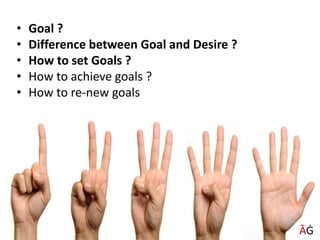
• Goal ?
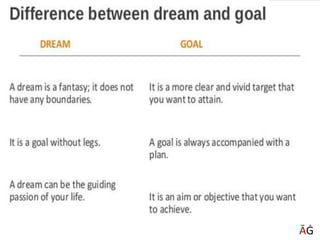
• Difference between Goal and Desire ?
• How to set Goals ?
• How to achieve goals ?
• How to re-new goals ?
ĀĠ
ĀĠ
ĀĠ
Goal is something or anything….
• That keeps you awake at Nights
• That keeps you restless
• That keeps you waiting
• That keeps you desiring
• That keeps you thinking
ĀĠ
ĀĠ
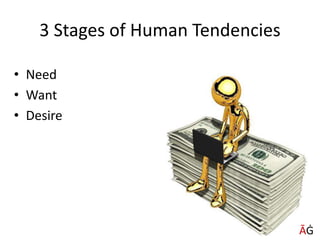
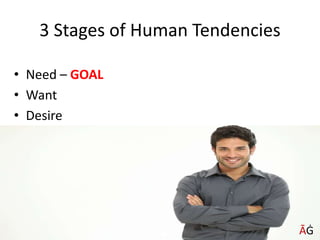
3 Stages of Human Tendencies
• Need
• Want
• Desire
ĀĠ
3 Stages of Human Tendencies
• Need
• Want
• Desire
ĀĠ
ĀĠ
3 Stages of Human Tendencies
• Need – Necessity that lead to mental and
physical pain if remain unsatisfied
• Want
• Desire
ĀĠ
3 Stages of Human Tendencies
• Need
• Want
• Desire
ĀĠ
ĀĠ
3 Stages of Human Tendencies
• Need
• Want- personal and leads to only mental pain
• Desire
ĀĠ
3 Stages of Human Tendencies
• Need
• Want
• Desire
ĀĠ
ĀĠ
3 Stages of Human Tendencies
• Need
• Want
• Desire – does not lead to any mental or
physical pain
ĀĠ
3 Stages of Human Tendencies
• Need
• Want
• Desire - GOAL
ĀĠ
3 Stages of Human Tendencies
• Need
• Want - GOAL
• Desire
ĀĠ
3 Stages of Human Tendencies
• Need – GOAL
• Want
• Desire
ĀĠ
Interest Vs Commitment
ĀĠ
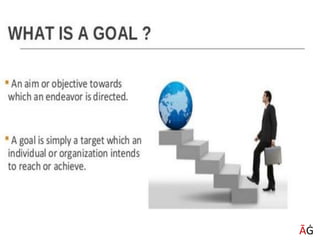
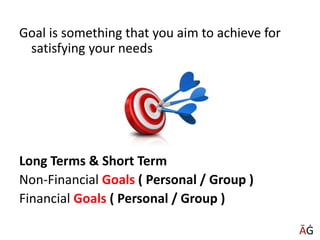
Goal is something that you aim to achieve for
satisfying your needs
Long Terms & Short Term
Non-Financial Goals ( Personal / Group )
Financial Goals ( Personal / Group )
ĀĠ
Seven goal areas
Family/home
Social
Educational
Religious
Achievement/recognition
Career
Physical/health
ĀĠ
• Goal ?
• Difference between Goal and Desire ?
• How to set Goals ?
• How to achieve goals ?
• How to re-new goals ?
ĀĠ
• Goal ?
• Difference between Goal and Desire ?
• How to set Goals ?
• How to achieve goals ?
• How to re-new goals
ĀĠ
Setting the Goals
ĀĠ
• Achieving a goal start with setting a goal
• If you set a wrong goal, you will defiantly achieve
something you never wanted
• Now write down your Goal
ĀĠ
ĀĠ
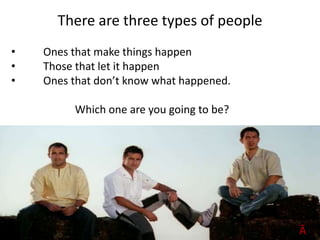
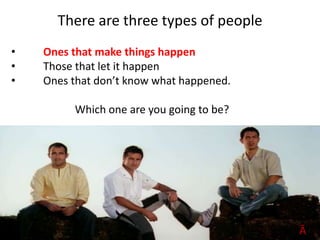
There are three types of people
• Ones that make things happen
• Those that let it happen
• Ones that don’t know what happened.
Which one are you going to be?
ĀĠ
There are three types of people
• Ones that make things happen
• Those that let it happen
• Ones that don’t know what happened.
Which one are you going to be?
ĀĠ
Meaningless Goals
• A farmer had a dog who used to sit by the
roadside waiting for vehicles to come around.
As soon as one came he would run down the
road, barking and trying to overtake it.
One day a neighbor asked the farmer "Do you
think your dog is ever going to catch a car?"
The farmer replied, "That is not what bothers
me. What bothers me is what he would do if
he ever caught one."
•
:: Moral of the Story ::
Many people in life behave like that dog who is
pursuing meaningless goals.
First set Meaningful and Realistic goal and
then work to achieve GOAL.
ĀĠ
Why These People Fail
• The goal was not written down.
• Rewards for achieving the goals were not given.
• The goal was unrealistic or not specific enough.
• The goal is not really believable or little commitment exists.
• Keep changing or switching goals with the weather
• The person who set the goal has not told anyone else for added
accountability, help and support.
• The goal was not incorporated into a realistic plan that includes
measurements, timelines and resources.
ĀĠ
There are three types of people
• Ones that make things happen
• Those that let it happen
• Ones that don’t know what happened.
Which one are you going to be?
ĀĠ
Why don’t these people set goals?
• A pessimistic attitude – Always seeing the pitfalls
rather than the possibilities
• Fear of failure – What if I don’t make it? People feel
subconsciously that if they don’t set goals and if
they don’t make it, then they haven’t failed. But
they are failures to begin with.
• A lack of ambition – This is a result of our value
system and lack of desire to live a fulfilled life. Our
limited thinking prevents us from progress. There
was a fisherman who, every time he caught a big
fish, would throw it back into the river, keeping only
the smaller ones. A man watching this unusual
behavior asked the fisherman why he was doing
this. The fisherman replied, “Because I have a small
frying pan.” Most people never make it in life
because they are carrying a small frying pan. That is
limited thinking.
ĀĠ
• A fear of rejection – If I don’t make it, what will other
people says?
• Procrastination – “Someday, I will set my goals.” This
tie in with a lack of ambition.
• Low self-esteem – Because a person is not internally
driven and has no inspiration.
• Ignorance of the important of goals – Nobody taught
them and they never learned the importance of goal-
setting.
• A lack of knowledge about goal-setting – People don’t
know the mechanics of setting goals. They need a step-
by-step guide so that they can follow a system.
Why don’t more people set goals?
ĀĠ
There are three types of people
• Ones that make things happen
• Those that let it happen
• Ones that don’t know what happened.
Which one are you going to be?
ĀĠ
These People
1. You take control of your life
2. You focus on the important things
3. You will make good decisions
4. You can finish the task efficiently
5. You will be self-confident and
enthusiastic
6. You will make progress
7. You are closer to success
ĀĠ
Example
• “I knew I was a winner back in the late sixties.
I knew I was destined for great things. People
will say that kind of thinking is totally
immodest. I agree. Modesty is not a word that
applies to me in any way – I hope it never
will.”
ĀĠ
Story
• He wanted to be the greatest bodybuilder in the world
which meant winning the title of Mr Olympia – he
became the youngest ever Mr Olympia at the age of 23
(he’s won the title seven times).
• He wanted financial success. He was a millionaire by
the age of 30 thanks to successful business investments
and ventures (this was before Hollywood!).
• He wanted to become a successful Hollywood actor
(44+ movies).
• He wanted success in politics – he’s the current
governor of California and the husband of 26 years to
Maria Shriver (related to the Kennedy family).
ĀĠ
ĀĠ
“Create a vision of who you want to
be”
Take out a clean sheet of paper, write down a
description of yourself 10 years in the future. Who
are you? What does your life look like? What are
you doing? Where? Who is around you? Allow
yourself to imagine a future in which failure is
impossible, and there are no limits.
ĀĠ
“Live into that picture”
• Let’s say that you’ve articulated a 5 or 10-year vision. Given
this scenario, work backwards.
• What will have had to have happened for this to be true in
10 years?
• What will you have had to learn?
• What skills will you have had to develop?
• What auditions will you have had to take?
• Who will you have had to meet and develop relationships
with?
• Are any of these stepping stones any more improbable than
what Schwarzenegger has achieved?
ĀĠ
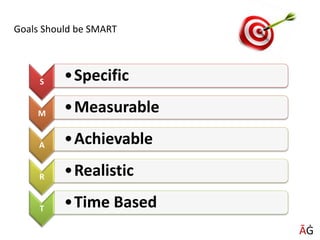
Goals Should be SMART
S •Specific
M •Measurable
A •Achievable
R •Realistic
T •Time Based
ĀĠ
SMART Goals
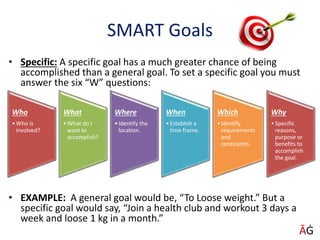
• Specific: A specific goal has a much greater chance of being
accomplished than a general goal. To set a specific goal you must
answer the six “W” questions:
• EXAMPLE: A general goal would be, “To Loose weight.” But a
specific goal would say, “Join a health club and workout 3 days a
week and loose 1 kg in a month.”
Who
•Who is
involved?
What
•What do I
want to
accomplish?
Where
•Identify the
location.
When
•Establish a
time frame.
Which
•Identify
requirements
and
constraints.
Why
•Specific
reasons,
purpose or
benefits to
accomplish
the goal.
ĀĠ
SMART Goals
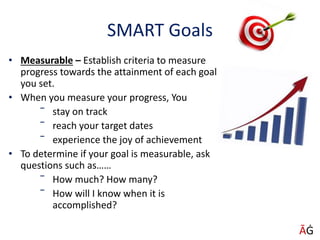
• Measurable – Establish criteria to measure
progress towards the attainment of each goal
you set.
• When you measure your progress, You
‾ stay on track
‾ reach your target dates
‾ experience the joy of achievement
• To determine if your goal is measurable, ask
questions such as……
‾ How much? How many?
‾ How will I know when it is
accomplished?
ĀĠ
SMART Goals
• Achievable – When you identify goals, you begin to
figure out ways you can make them come true. You
develop the attitudes, abilities, skills, and financial
capacity to reach them.
• How to Achieve your goals:
‾ Plan your steps wisely
‾ Establish a time frame to carry out those steps.
• Goals that may have seemed far away and out of
reach eventually move closer and become
attainable, not because your goals shrink, but
because you grow and expand to match them.
ĀĠ
SMART Goals
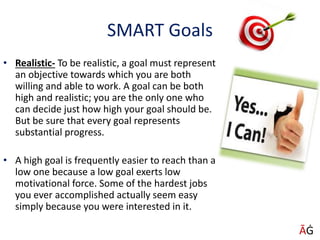
• Realistic- To be realistic, a goal must represent
an objective towards which you are both
willing and able to work. A goal can be both
high and realistic; you are the only one who
can decide just how high your goal should be.
But be sure that every goal represents
substantial progress.
• A high goal is frequently easier to reach than a
low one because a low goal exerts low
motivational force. Some of the hardest jobs
you ever accomplished actually seem easy
simply because you were interested in it.
ĀĠ
SMART Goals
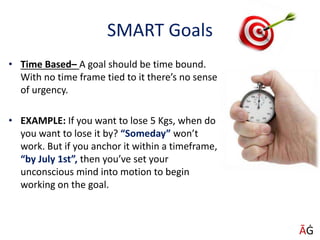
• Time Based– A goal should be time bound.
With no time frame tied to it there’s no sense
of urgency.
• EXAMPLE: If you want to lose 5 Kgs, when do
you want to lose it by? “Someday” won’t
work. But if you anchor it within a timeframe,
“by July 1st”, then you’ve set your
unconscious mind into motion to begin
working on the goal.
ĀĠ
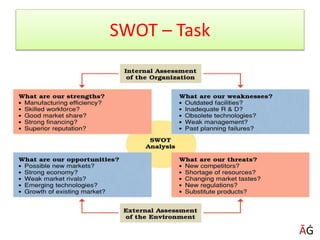
SWOT – Task
ĀĠ
ĀĠ
• Goal ?
• Difference between Goal and Desire ?
• How to set Goals ?
• How to achieve goals ?
• How to re-new goals
ĀĠ
Achieving the Goals
ĀĠ
Techniques
• PERT
• CPM
• GAANT
• BSC
• DPS
• TM
ĀĠ
PERT & CPM
• A method to analyze the tasks involved in completing a given
project.
• Focus is paid to the time needed to complete each task, and
identifying the minimum time needed to complete the total
project.
Project Evaluation and
Review Technique
Critical Path Method
ĀĠ
PERT & CPM
• Helps to plan the timing of projects involving sequential
activities.
• Identifies the time required to complete the activities in a
project and the order of the steps.
Project Evaluation and
Review Technique
Critical Path Method
ĀĠ
PERT & CPM
Each event has two important times associated with it:
• Earliest Time (Te): Which is a calendar time when an event
can occur when all the predecessor/ events completed at the
earliest possible time.
• Latest Time (Tl): Which is the latest time the event can occur
without delaying the subsequent events and completion of
project.
Tl- Te= Slack Time
Amt. of time an event can be delayed without delaying the
project completion
ĀĠ
PERT & CPM
• Critical Path is the sequence of activities and events where
there is no “Slack” i.e. Zero Slack.
• Outcomes of PERT/ CPM:
 Longest path through a network.
 Minimum project completion time.
Project Evaluation and
Review Technique
Critical Path Method
ĀĠ
PERT & CPM
• Questions answered by PERT/ CPM:
‾ Completion date?
‾ On Schedule?
‾ Within budget?
‾ Critical activities?
‾ How can the project be finished early at the least cost?
Project Evaluation and
Review Technique
Critical Path Method
ĀĠ
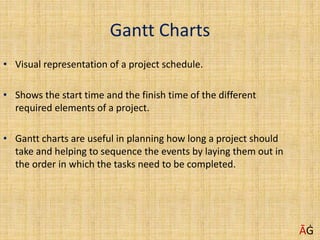
Gantt Charts
• Visual representation of a project schedule.
• Shows the start time and the finish time of the different
required elements of a project.
• Gantt charts are useful in planning how long a project should
take and helping to sequence the events by laying them out in
the order in which the tasks need to be completed.
ĀĠ
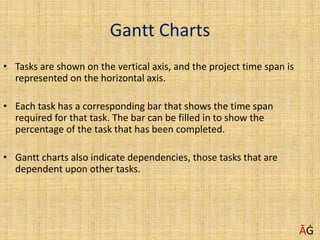
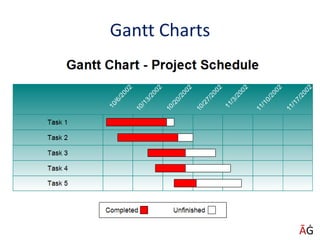
Gantt Charts
• Tasks are shown on the vertical axis, and the project time span is
represented on the horizontal axis.
• Each task has a corresponding bar that shows the time span
required for that task. The bar can be filled in to show the
percentage of the task that has been completed.
• Gantt charts also indicate dependencies, those tasks that are
dependent upon other tasks.
ĀĠ
Gantt Charts
ĀĠ
Balanced Score Cards
ĀĠ
Dashboards
Mapping
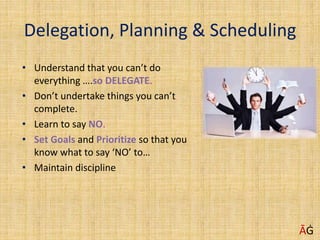
Delegation, Planning & Scheduling
• Understand that you can’t do
everything ….so DELEGATE.
• Don’t undertake things you can’t
complete.
• Learn to say NO.
• Set Goals and Prioritize so that you
know what to say ‘NO’ to…
• Maintain discipline
ĀĠ
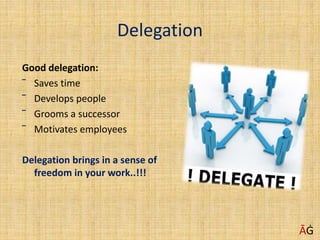
Delegation
Good delegation:
‾ Saves time
‾ Develops people
‾ Grooms a successor
‾ Motivates employees
Delegation brings in a sense of
freedom in your work..!!!
ĀĠ
Delegation
Steps for Successful Delegation:
• Define the task
• Select the individual or team
• Assess ability and training needs
• Explain the reasons
• State required results
• Consider resources required
• Agree deadlines
• Support and communicate
• Feedback on results
ĀĠ
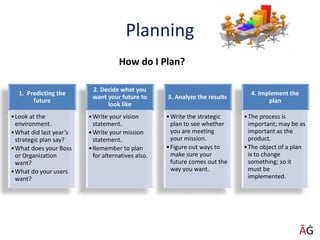
Planning
1. Predicting the
future
•Look at the
environment.
•What did last year’s
strategic plan say?
•What does your Boss
or Organization
want?
•What do your users
want?
2. Decide what you
want your future to
look like
•Write your vision
statement.
•Write your mission
statement.
•Remember to plan
for alternatives also.
3. Analyze the results
•Write the strategic
plan to see whether
you are meeting
your mission.
•Figure out ways to
make sure your
future comes out the
way you want.
4. Implement the
plan
•The process is
important; may be as
important as the
product.
•The object of a plan
is to change
something; so it
must be
implemented.
How do I Plan?
ĀĠ
Scheduling
• Scheduling is the process by which you look at the time
available to you, and plan how you will use it to achieve the
goals you have identified.
• By using a schedule properly, you can:
‾ Understand what you can realistically achieve with your
time.
‾ Plan to make the best use of the time available.
‾ Leave enough time for things you absolutely must do.
‾ Preserve contingency time to handle 'the unexpected'.
‾ Minimize stress by avoiding over-commitment to yourself
and others.
ĀĠ
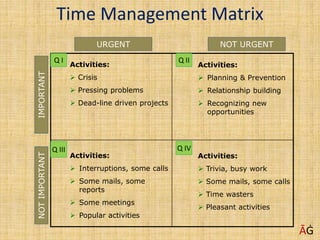
Time Management Matrix
URGENT NOT URGENTIMPORTANTNOTIMPORTANT
Q I Q II
Q IVQ III
Activities:
 Crisis
 Pressing problems
 Dead-line driven projects
Activities:
 Planning & Prevention
 Relationship building
 Recognizing new
opportunities
Activities:
 Interruptions, some calls
 Some mails, some
reports
 Some meetings
 Popular activities
Activities:
 Trivia, busy work
 Some mails, some calls
 Time wasters
 Pleasant activities
ĀĠ
Time Management Matrix- Decoding
• Urgent
‾ Requiring immediate attention
‾ Its NOW - Ringing phone
‾ You react to urgent matters
• Important
‾ Activities that have to do with results
‾ Contributing to your mission, vision and goal
‾ Requires initiative, proactivity
• 90% of our time goes in Quadrant I i.e. QI and 10% of it goes
in Quadrant IV or QIV.
• QI = Breakdown and QII = Preventive Maintenance
ĀĠ
Time Management Matrix- Decoding
• Focus on Q II as it is the heart of effective personal management.
• Q II activities are these activities
‾ Activities you should do …
‾ But you haven’t got around doing them
• By focusing on QII, you would be reducing QI
• The only place to look for time for the activities of QII is from QIII and
QIV
• The first thing to focus on is the “Ability to say NO”
ĀĠ
ĀĠ
ĀĠ
• Goal ?
• Difference between Goal and Desire ?
• How to set Goals ?
• How to achieve goals ?
• How to re-new goals
ĀĠ
ĀĠ
Thank You ĀĠ

Goal achievement

  • 1.
  • 2.
  • 3.
    • Goal ? •Difference between Goal and Desire ? • How to set Goals ? • How to achieve goals ? • How to re-new goals ? ĀĠ
  • 4.
  • 5.
  • 6.
    Goal is somethingor anything…. • That keeps you awake at Nights • That keeps you restless • That keeps you waiting • That keeps you desiring • That keeps you thinking ĀĠ
  • 7.
  • 8.
    3 Stages ofHuman Tendencies • Need • Want • Desire ĀĠ
  • 9.
    3 Stages ofHuman Tendencies • Need • Want • Desire ĀĠ
  • 10.
  • 11.
    3 Stages ofHuman Tendencies • Need – Necessity that lead to mental and physical pain if remain unsatisfied • Want • Desire ĀĠ
  • 12.
    3 Stages ofHuman Tendencies • Need • Want • Desire ĀĠ
  • 13.
  • 14.
    3 Stages ofHuman Tendencies • Need • Want- personal and leads to only mental pain • Desire ĀĠ
  • 15.
    3 Stages ofHuman Tendencies • Need • Want • Desire ĀĠ
  • 16.
  • 17.
    3 Stages ofHuman Tendencies • Need • Want • Desire – does not lead to any mental or physical pain ĀĠ
  • 18.
    3 Stages ofHuman Tendencies • Need • Want • Desire - GOAL ĀĠ
  • 19.
    3 Stages ofHuman Tendencies • Need • Want - GOAL • Desire ĀĠ
  • 20.
    3 Stages ofHuman Tendencies • Need – GOAL • Want • Desire ĀĠ
  • 21.
  • 22.
    Goal is somethingthat you aim to achieve for satisfying your needs Long Terms & Short Term Non-Financial Goals ( Personal / Group ) Financial Goals ( Personal / Group ) ĀĠ
  • 23.
  • 24.
    • Goal ? •Difference between Goal and Desire ? • How to set Goals ? • How to achieve goals ? • How to re-new goals ? ĀĠ
  • 25.
    • Goal ? •Difference between Goal and Desire ? • How to set Goals ? • How to achieve goals ? • How to re-new goals ĀĠ
  • 26.
  • 27.
    • Achieving agoal start with setting a goal • If you set a wrong goal, you will defiantly achieve something you never wanted • Now write down your Goal ĀĠ ĀĠ
  • 28.
    There are threetypes of people • Ones that make things happen • Those that let it happen • Ones that don’t know what happened. Which one are you going to be? ĀĠ
  • 29.
    There are threetypes of people • Ones that make things happen • Those that let it happen • Ones that don’t know what happened. Which one are you going to be? ĀĠ
  • 30.
    Meaningless Goals • Afarmer had a dog who used to sit by the roadside waiting for vehicles to come around. As soon as one came he would run down the road, barking and trying to overtake it. One day a neighbor asked the farmer "Do you think your dog is ever going to catch a car?" The farmer replied, "That is not what bothers me. What bothers me is what he would do if he ever caught one." • :: Moral of the Story :: Many people in life behave like that dog who is pursuing meaningless goals. First set Meaningful and Realistic goal and then work to achieve GOAL. ĀĠ
  • 31.
    Why These PeopleFail • The goal was not written down. • Rewards for achieving the goals were not given. • The goal was unrealistic or not specific enough. • The goal is not really believable or little commitment exists. • Keep changing or switching goals with the weather • The person who set the goal has not told anyone else for added accountability, help and support. • The goal was not incorporated into a realistic plan that includes measurements, timelines and resources. ĀĠ
  • 32.
    There are threetypes of people • Ones that make things happen • Those that let it happen • Ones that don’t know what happened. Which one are you going to be? ĀĠ
  • 33.
    Why don’t thesepeople set goals? • A pessimistic attitude – Always seeing the pitfalls rather than the possibilities • Fear of failure – What if I don’t make it? People feel subconsciously that if they don’t set goals and if they don’t make it, then they haven’t failed. But they are failures to begin with. • A lack of ambition – This is a result of our value system and lack of desire to live a fulfilled life. Our limited thinking prevents us from progress. There was a fisherman who, every time he caught a big fish, would throw it back into the river, keeping only the smaller ones. A man watching this unusual behavior asked the fisherman why he was doing this. The fisherman replied, “Because I have a small frying pan.” Most people never make it in life because they are carrying a small frying pan. That is limited thinking. ĀĠ
  • 34.
    • A fearof rejection – If I don’t make it, what will other people says? • Procrastination – “Someday, I will set my goals.” This tie in with a lack of ambition. • Low self-esteem – Because a person is not internally driven and has no inspiration. • Ignorance of the important of goals – Nobody taught them and they never learned the importance of goal- setting. • A lack of knowledge about goal-setting – People don’t know the mechanics of setting goals. They need a step- by-step guide so that they can follow a system. Why don’t more people set goals? ĀĠ
  • 35.
    There are threetypes of people • Ones that make things happen • Those that let it happen • Ones that don’t know what happened. Which one are you going to be? ĀĠ
  • 36.
    These People 1. Youtake control of your life 2. You focus on the important things 3. You will make good decisions 4. You can finish the task efficiently 5. You will be self-confident and enthusiastic 6. You will make progress 7. You are closer to success ĀĠ
  • 37.
    Example • “I knewI was a winner back in the late sixties. I knew I was destined for great things. People will say that kind of thinking is totally immodest. I agree. Modesty is not a word that applies to me in any way – I hope it never will.” ĀĠ
  • 38.
    Story • He wantedto be the greatest bodybuilder in the world which meant winning the title of Mr Olympia – he became the youngest ever Mr Olympia at the age of 23 (he’s won the title seven times). • He wanted financial success. He was a millionaire by the age of 30 thanks to successful business investments and ventures (this was before Hollywood!). • He wanted to become a successful Hollywood actor (44+ movies). • He wanted success in politics – he’s the current governor of California and the husband of 26 years to Maria Shriver (related to the Kennedy family). ĀĠ
  • 39.
  • 40.
    “Create a visionof who you want to be” Take out a clean sheet of paper, write down a description of yourself 10 years in the future. Who are you? What does your life look like? What are you doing? Where? Who is around you? Allow yourself to imagine a future in which failure is impossible, and there are no limits. ĀĠ
  • 41.
    “Live into thatpicture” • Let’s say that you’ve articulated a 5 or 10-year vision. Given this scenario, work backwards. • What will have had to have happened for this to be true in 10 years? • What will you have had to learn? • What skills will you have had to develop? • What auditions will you have had to take? • Who will you have had to meet and develop relationships with? • Are any of these stepping stones any more improbable than what Schwarzenegger has achieved? ĀĠ
  • 42.
    Goals Should beSMART S •Specific M •Measurable A •Achievable R •Realistic T •Time Based ĀĠ
  • 43.
    SMART Goals • Specific:A specific goal has a much greater chance of being accomplished than a general goal. To set a specific goal you must answer the six “W” questions: • EXAMPLE: A general goal would be, “To Loose weight.” But a specific goal would say, “Join a health club and workout 3 days a week and loose 1 kg in a month.” Who •Who is involved? What •What do I want to accomplish? Where •Identify the location. When •Establish a time frame. Which •Identify requirements and constraints. Why •Specific reasons, purpose or benefits to accomplish the goal. ĀĠ
  • 44.
    SMART Goals • Measurable– Establish criteria to measure progress towards the attainment of each goal you set. • When you measure your progress, You ‾ stay on track ‾ reach your target dates ‾ experience the joy of achievement • To determine if your goal is measurable, ask questions such as…… ‾ How much? How many? ‾ How will I know when it is accomplished? ĀĠ
  • 45.
    SMART Goals • Achievable– When you identify goals, you begin to figure out ways you can make them come true. You develop the attitudes, abilities, skills, and financial capacity to reach them. • How to Achieve your goals: ‾ Plan your steps wisely ‾ Establish a time frame to carry out those steps. • Goals that may have seemed far away and out of reach eventually move closer and become attainable, not because your goals shrink, but because you grow and expand to match them. ĀĠ
  • 46.
    SMART Goals • Realistic-To be realistic, a goal must represent an objective towards which you are both willing and able to work. A goal can be both high and realistic; you are the only one who can decide just how high your goal should be. But be sure that every goal represents substantial progress. • A high goal is frequently easier to reach than a low one because a low goal exerts low motivational force. Some of the hardest jobs you ever accomplished actually seem easy simply because you were interested in it. ĀĠ
  • 47.
    SMART Goals • TimeBased– A goal should be time bound. With no time frame tied to it there’s no sense of urgency. • EXAMPLE: If you want to lose 5 Kgs, when do you want to lose it by? “Someday” won’t work. But if you anchor it within a timeframe, “by July 1st”, then you’ve set your unconscious mind into motion to begin working on the goal. ĀĠ
  • 48.
  • 49.
  • 50.
    • Goal ? •Difference between Goal and Desire ? • How to set Goals ? • How to achieve goals ? • How to re-new goals ĀĠ
  • 51.
  • 52.
    Techniques • PERT • CPM •GAANT • BSC • DPS • TM ĀĠ
  • 53.
    PERT & CPM •A method to analyze the tasks involved in completing a given project. • Focus is paid to the time needed to complete each task, and identifying the minimum time needed to complete the total project. Project Evaluation and Review Technique Critical Path Method ĀĠ
  • 54.
    PERT & CPM •Helps to plan the timing of projects involving sequential activities. • Identifies the time required to complete the activities in a project and the order of the steps. Project Evaluation and Review Technique Critical Path Method ĀĠ
  • 55.
    PERT & CPM Eachevent has two important times associated with it: • Earliest Time (Te): Which is a calendar time when an event can occur when all the predecessor/ events completed at the earliest possible time. • Latest Time (Tl): Which is the latest time the event can occur without delaying the subsequent events and completion of project. Tl- Te= Slack Time Amt. of time an event can be delayed without delaying the project completion ĀĠ
  • 56.
    PERT & CPM •Critical Path is the sequence of activities and events where there is no “Slack” i.e. Zero Slack. • Outcomes of PERT/ CPM:  Longest path through a network.  Minimum project completion time. Project Evaluation and Review Technique Critical Path Method ĀĠ
  • 57.
    PERT & CPM •Questions answered by PERT/ CPM: ‾ Completion date? ‾ On Schedule? ‾ Within budget? ‾ Critical activities? ‾ How can the project be finished early at the least cost? Project Evaluation and Review Technique Critical Path Method ĀĠ
  • 58.
    Gantt Charts • Visualrepresentation of a project schedule. • Shows the start time and the finish time of the different required elements of a project. • Gantt charts are useful in planning how long a project should take and helping to sequence the events by laying them out in the order in which the tasks need to be completed. ĀĠ
  • 59.
    Gantt Charts • Tasksare shown on the vertical axis, and the project time span is represented on the horizontal axis. • Each task has a corresponding bar that shows the time span required for that task. The bar can be filled in to show the percentage of the task that has been completed. • Gantt charts also indicate dependencies, those tasks that are dependent upon other tasks. ĀĠ
  • 60.
  • 61.
  • 62.
    Delegation, Planning &Scheduling • Understand that you can’t do everything ….so DELEGATE. • Don’t undertake things you can’t complete. • Learn to say NO. • Set Goals and Prioritize so that you know what to say ‘NO’ to… • Maintain discipline ĀĠ
  • 63.
    Delegation Good delegation: ‾ Savestime ‾ Develops people ‾ Grooms a successor ‾ Motivates employees Delegation brings in a sense of freedom in your work..!!! ĀĠ

  • 64.
    Delegation Steps for SuccessfulDelegation: • Define the task • Select the individual or team • Assess ability and training needs • Explain the reasons • State required results • Consider resources required • Agree deadlines • Support and communicate • Feedback on results ĀĠ
  • 65.
    Planning 1. Predicting the future •Lookat the environment. •What did last year’s strategic plan say? •What does your Boss or Organization want? •What do your users want? 2. Decide what you want your future to look like •Write your vision statement. •Write your mission statement. •Remember to plan for alternatives also. 3. Analyze the results •Write the strategic plan to see whether you are meeting your mission. •Figure out ways to make sure your future comes out the way you want. 4. Implement the plan •The process is important; may be as important as the product. •The object of a plan is to change something; so it must be implemented. How do I Plan? ĀĠ
  • 66.
    Scheduling • Scheduling isthe process by which you look at the time available to you, and plan how you will use it to achieve the goals you have identified. • By using a schedule properly, you can: ‾ Understand what you can realistically achieve with your time. ‾ Plan to make the best use of the time available. ‾ Leave enough time for things you absolutely must do. ‾ Preserve contingency time to handle 'the unexpected'. ‾ Minimize stress by avoiding over-commitment to yourself and others. ĀĠ
  • 67.
    Time Management Matrix URGENTNOT URGENTIMPORTANTNOTIMPORTANT Q I Q II Q IVQ III Activities:  Crisis  Pressing problems  Dead-line driven projects Activities:  Planning & Prevention  Relationship building  Recognizing new opportunities Activities:  Interruptions, some calls  Some mails, some reports  Some meetings  Popular activities Activities:  Trivia, busy work  Some mails, some calls  Time wasters  Pleasant activities ĀĠ
  • 68.
    Time Management Matrix-Decoding • Urgent ‾ Requiring immediate attention ‾ Its NOW - Ringing phone ‾ You react to urgent matters • Important ‾ Activities that have to do with results ‾ Contributing to your mission, vision and goal ‾ Requires initiative, proactivity • 90% of our time goes in Quadrant I i.e. QI and 10% of it goes in Quadrant IV or QIV. • QI = Breakdown and QII = Preventive Maintenance ĀĠ
  • 69.
    Time Management Matrix-Decoding • Focus on Q II as it is the heart of effective personal management. • Q II activities are these activities ‾ Activities you should do … ‾ But you haven’t got around doing them • By focusing on QII, you would be reducing QI • The only place to look for time for the activities of QII is from QIII and QIV • The first thing to focus on is the “Ability to say NO” ĀĠ
  • 70.
  • 71.
  • 72.
    • Goal ? •Difference between Goal and Desire ? • How to set Goals ? • How to achieve goals ? • How to re-new goals ĀĠ
  • 73.
  • 74.