Operations
Management
Basic Concepts: Introduction, Operations Management Basics
Product and Process Design: The Product Development Process, Analyzing a Process,
Process Decision
Facility Location Planning & Facility Layout: Facility Planning, Location Decisions,
Facility Layout
Capacity Design and Planning: Introduction - Capacity Planning, Managing Supply and
Demand
Production Planning: Introduction, Scheduling
Productivity and Work Study: The Organization and Productivity, Job Design
Materials, Purchasing & Stores Management: Materials Management, The Supply
Chain,Supply Chain Performance
Inventory Management: Introduction - Inventory Management, Elementary Inventory
Models,Inventory Control
Managing for Quality: Introduction, Statistical Control
Maintenance Management: Introduction-The Maintenance Function, Maintenance
Strategies, Maintenance Performance
Course Outline
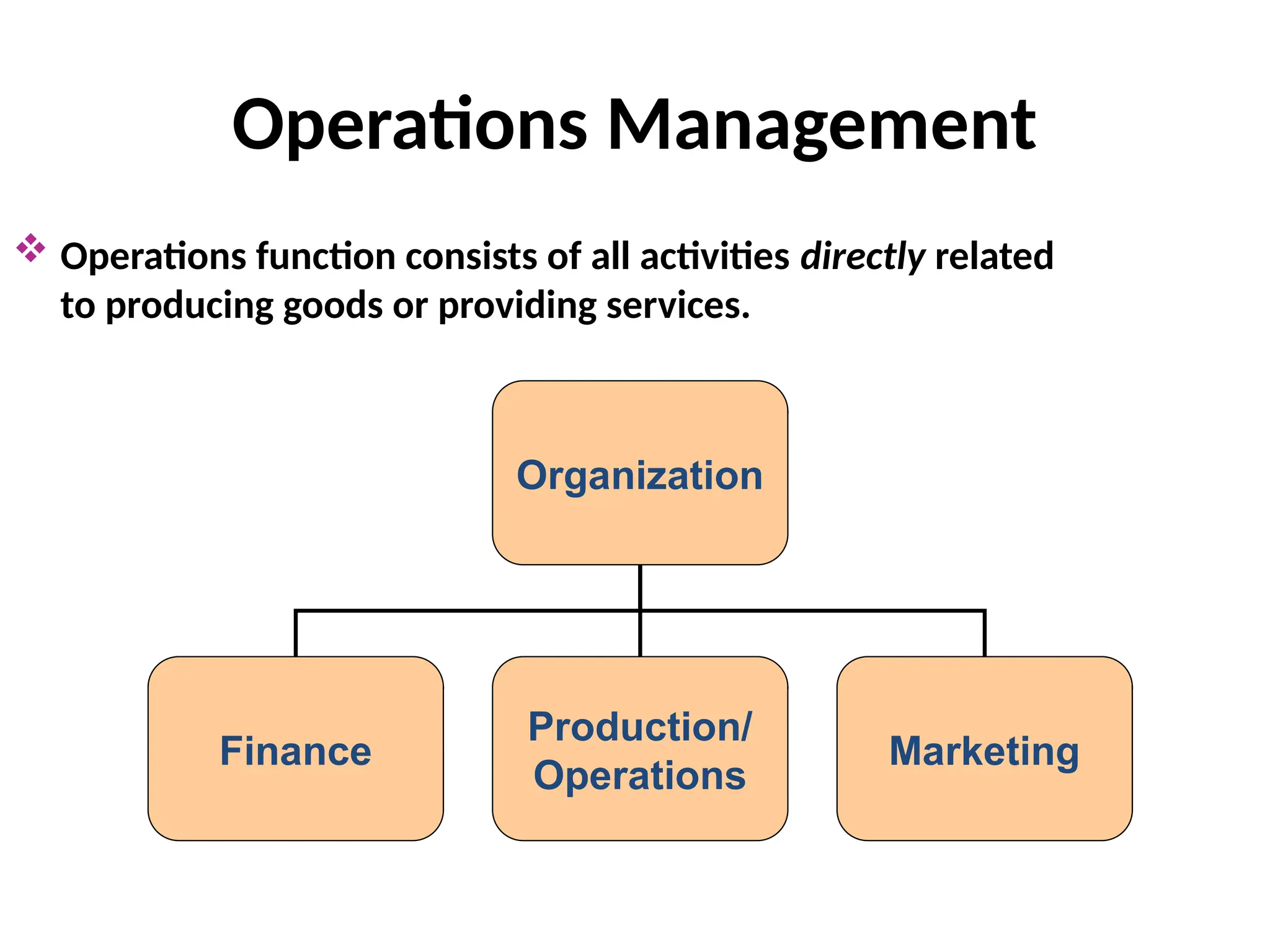
Operations Management
Organization
Finance
Production/
Operations
Marketing
 Operations function consists of all activities directly related
to producing goods or providing services.
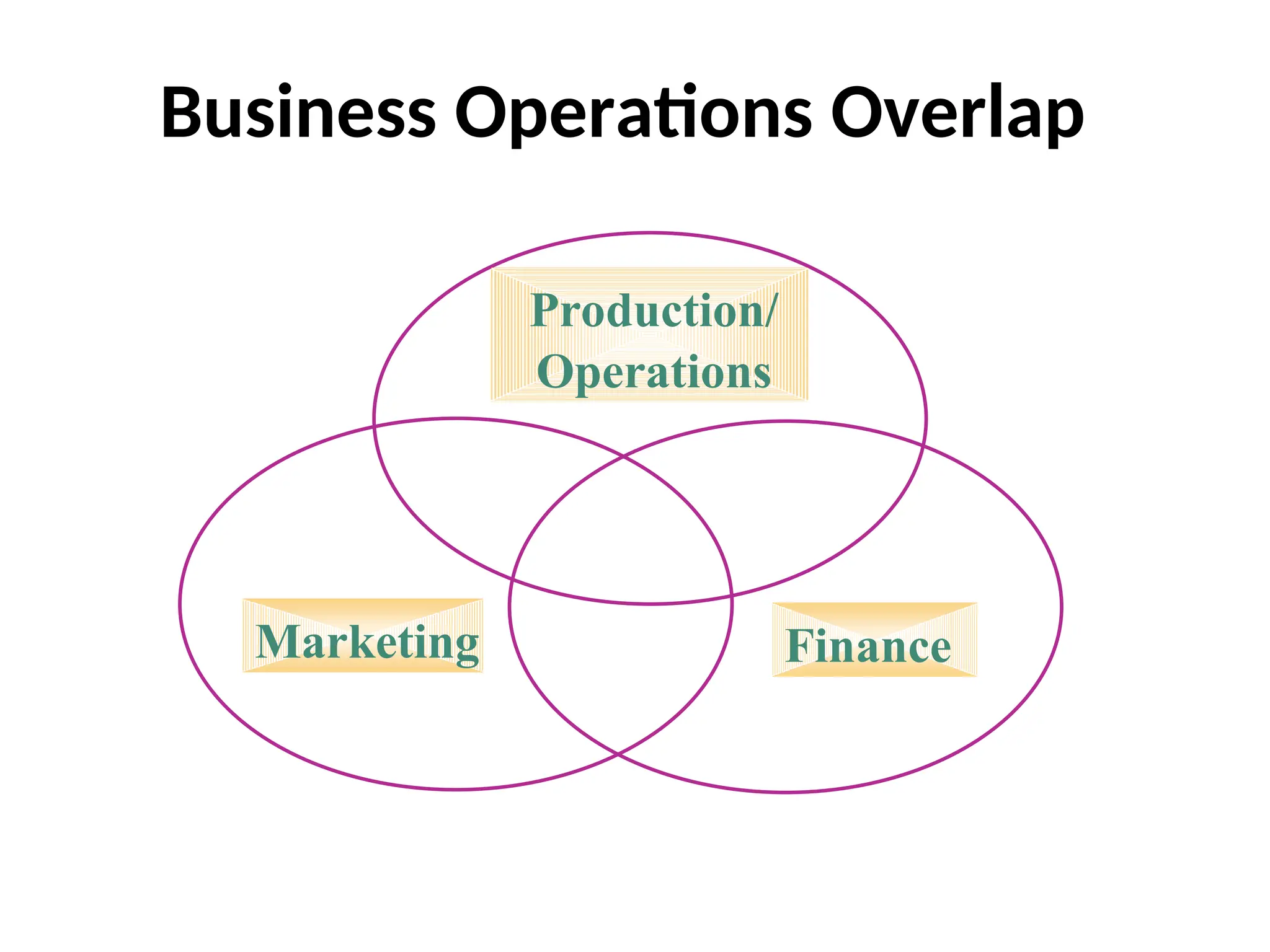
Business Operations Overlap
Marketing
Production/
Operations
Finance
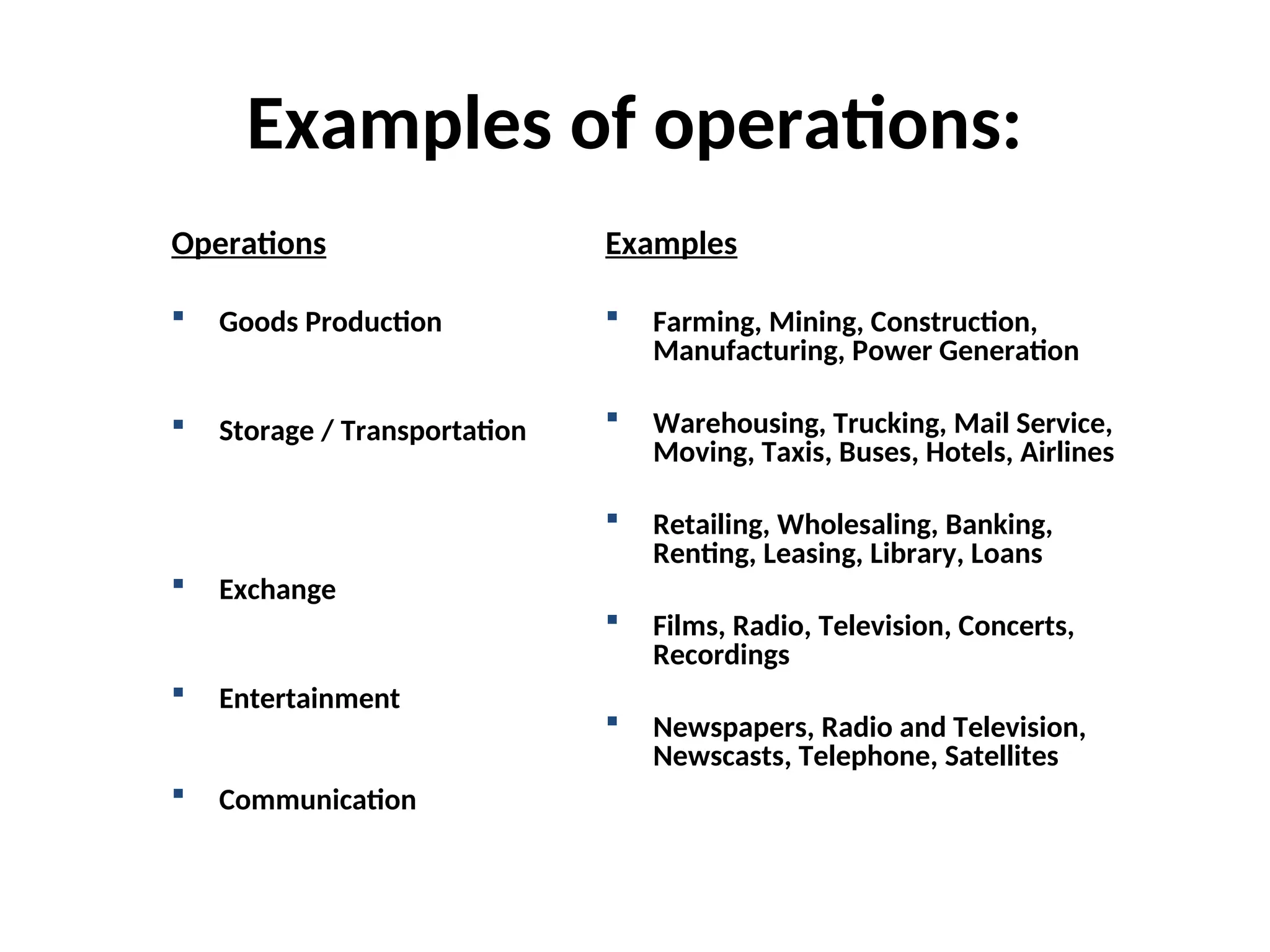
Examples of operations:
Operations
 Goods Production
 Storage / Transportation
 Exchange
 Entertainment
 Communication
Examples
 Farming, Mining, Construction,
Manufacturing, Power Generation
 Warehousing, Trucking, Mail Service,
Moving, Taxis, Buses, Hotels, Airlines
 Retailing, Wholesaling, Banking,
Renting, Leasing, Library, Loans
 Films, Radio, Television, Concerts,
Recordings
 Newspapers, Radio and Television,
Newscasts, Telephone, Satellites
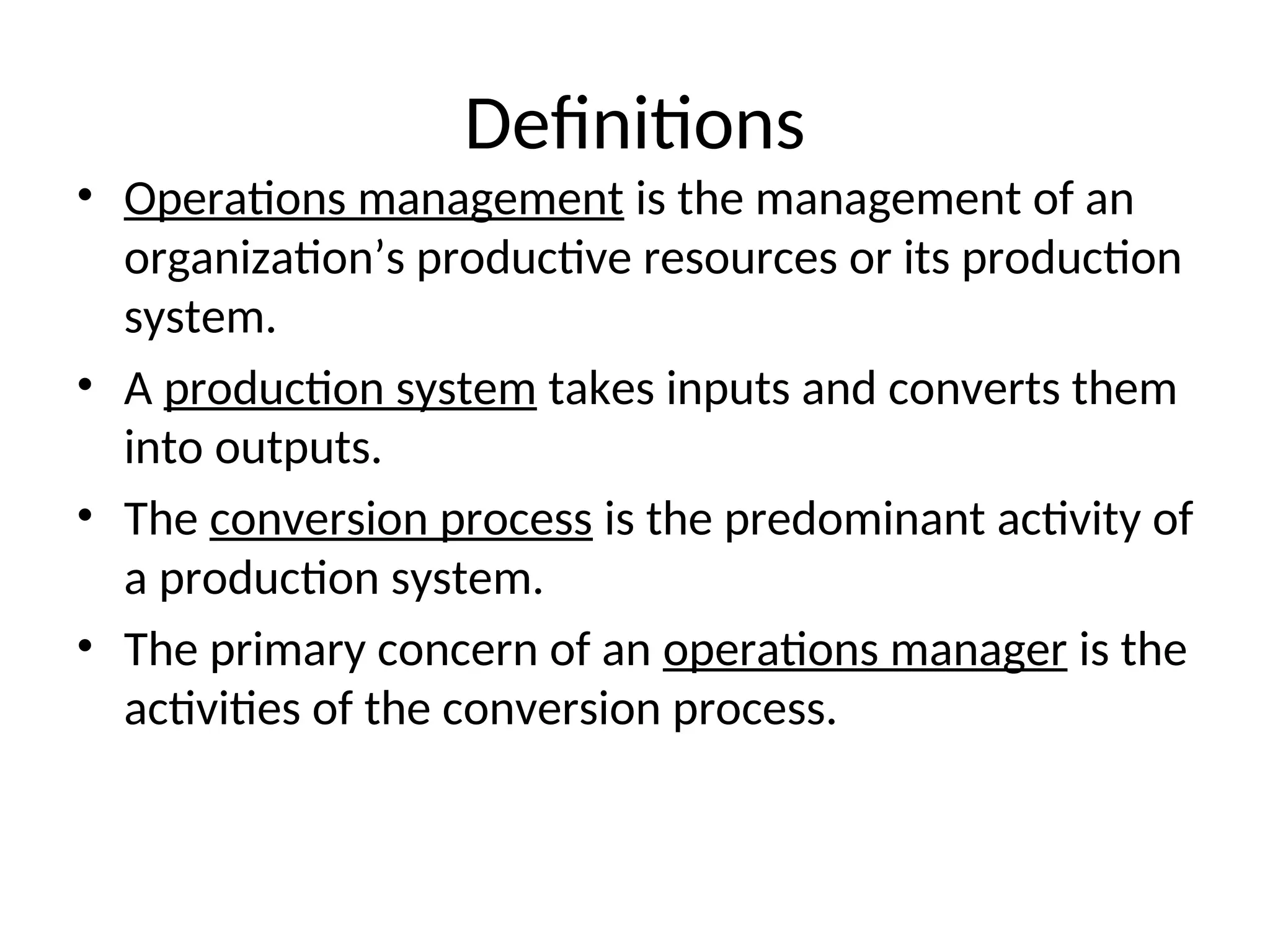
Definitions
• Operations management is the management of an
organization’s productive resources or its production
system.
• A production system takes inputs and converts them
into outputs.
• The conversion process is the predominant activity of
a production system.
• The primary concern of an operations manager is the
activities of the conversion process.
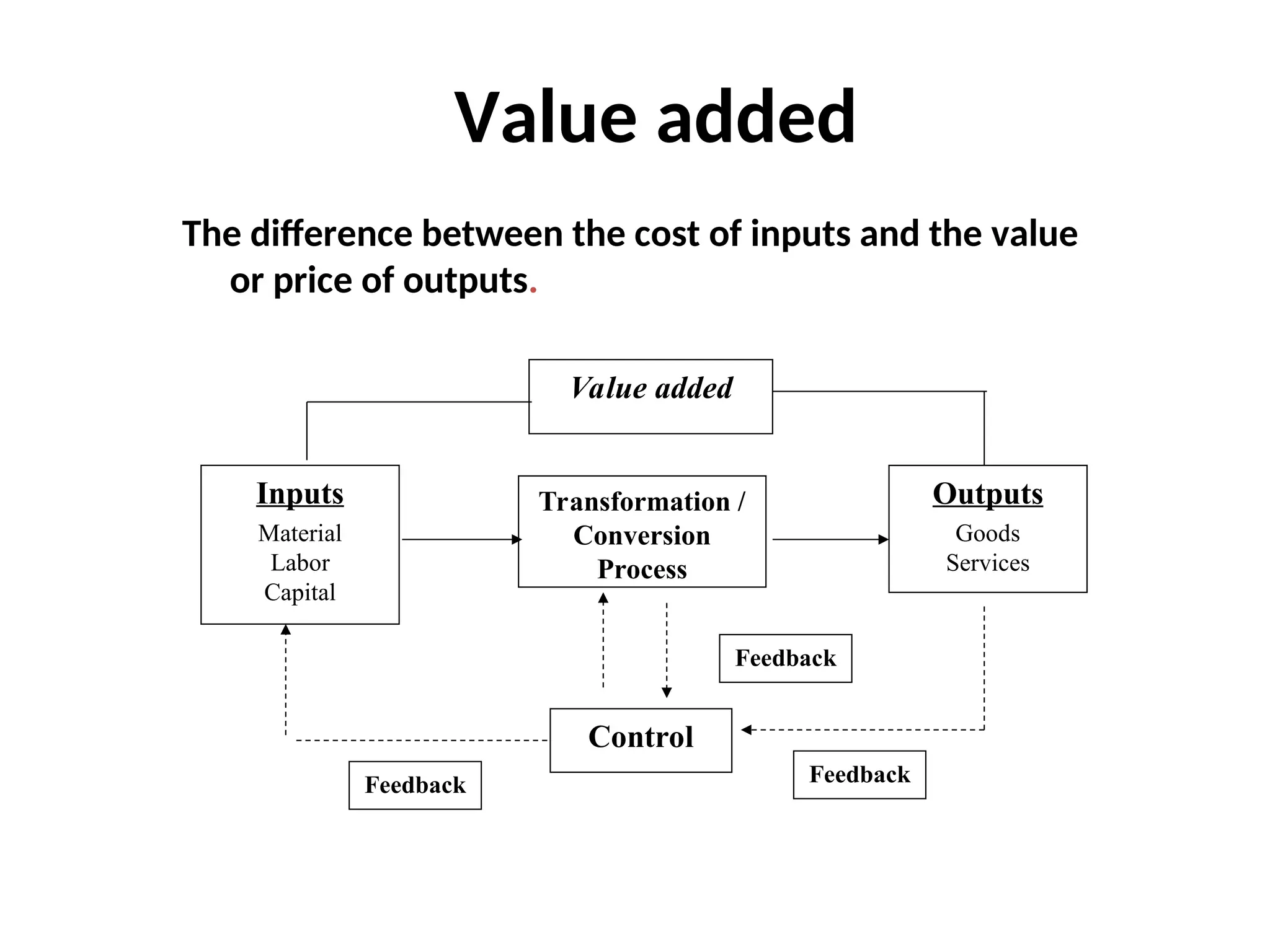
Value added
The difference between the cost of inputs and the value
or price of outputs.
Value added
Inputs
Material
Labor
Capital
Outputs
Goods
Services
Transformation /
Conversion
Process
Control
Feedback
Feedback
Feedback
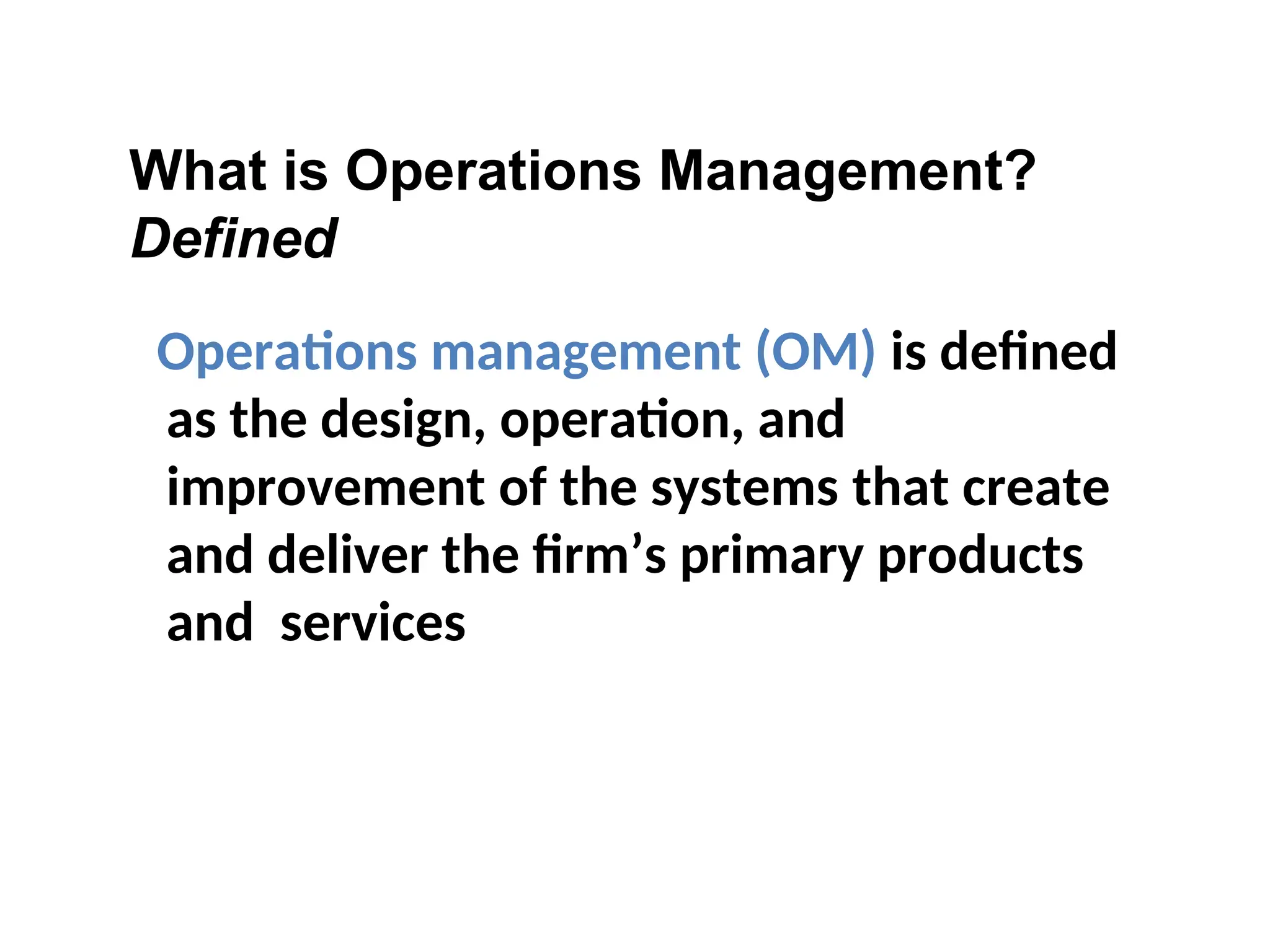
What is Operations Management?
Defined
Operations management (OM) is defined
as the design, operation, and
improvement of the systems that create
and deliver the firm’s primary products
and services
The Importance of Operations Management
• Synergies must exist with other functional
areas of the organization
• Operations account for 60-80% of the
direct expenses that burden a firm’s profit.
The historical development of
operations management
• Operations in some form has been
around as long as human endeavor itself
but, in manufacturing at least, it has
changed dramatically over time
Three Major Phases
Craft manufacturing
• Craft manufacturing describes the process by
which skilled craftspeople produce goods in
low volume, with a high degree of variety, to
meet the requirements of their individual
customers.
Mass production
• In many industries, craft manufacturing began
to be replaced by mass production in the 19th
century. Mass production involves producing
goods in high volume with low variety – the
opposite of craft manufacturing.
Mass Production(Innovations 1)
• Standardization:
• An important innovation in operations that
made mass production possible was the
system of standardised and interchangeable
parts known as the ‘American system of
manufacture’, which developed in the United
States and spread to the United Kingdom and
other countries.
Mass production(Innovations 2)
Scientific Management:
• A second innovation was the development by
Frederick Taylor (1911) of the system of
'scientific management’, which sought to
redesign jobs using similar principles to those
used in designing machines.
Mass Production(Innovations 3)
Moving Assembly Line:
• A third innovation was the development of
the moving assembly line by Henry Ford.
Instead of workers bringing all the parts and
tools to a fixed location where one car was
put together at a time, the assembly line
brought the cars to the workers.
Mass Production (in nut shell)
• A system through which large
volumes of standardized products
could be assembled by unskilled
workers at constantly decreasing
costs .
Modern Period
• During the 1970s, markets became highly
fragmented, product life cycles reduced dramatically
and consumers had far greater choice than ever
before.
• TQM
• JIT
• SCM
Modern Period(Different Approaches)
• Flexible specialization
• Lean production
• Mass customization
• Agile manufacturing
Modern Period(in a nutshell)
• These approaches all seek to
combine the high volume and
low cost associated with mass
production with the craft
production.
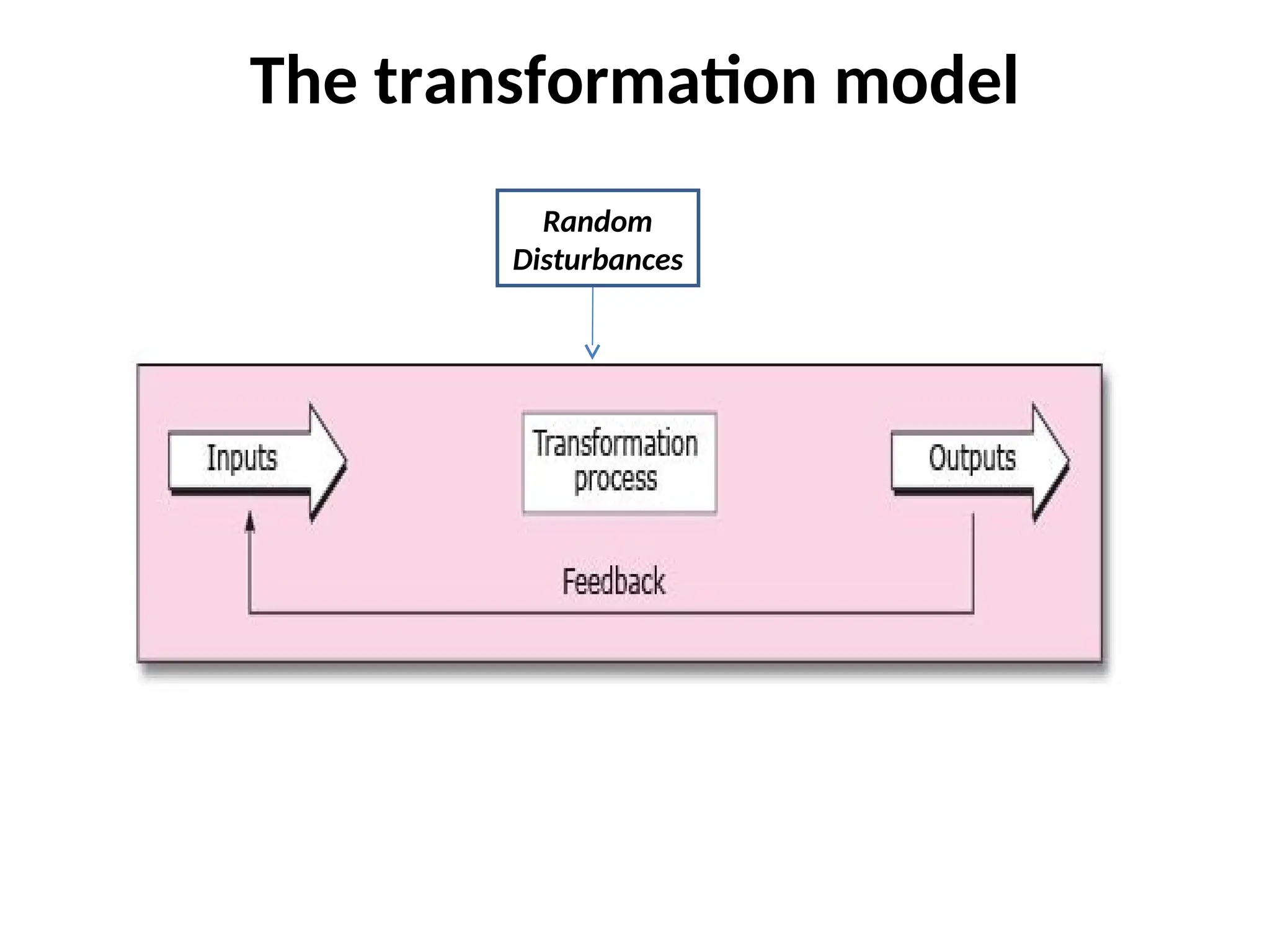
Transformation Process
The transformation model
Random
Disturbances
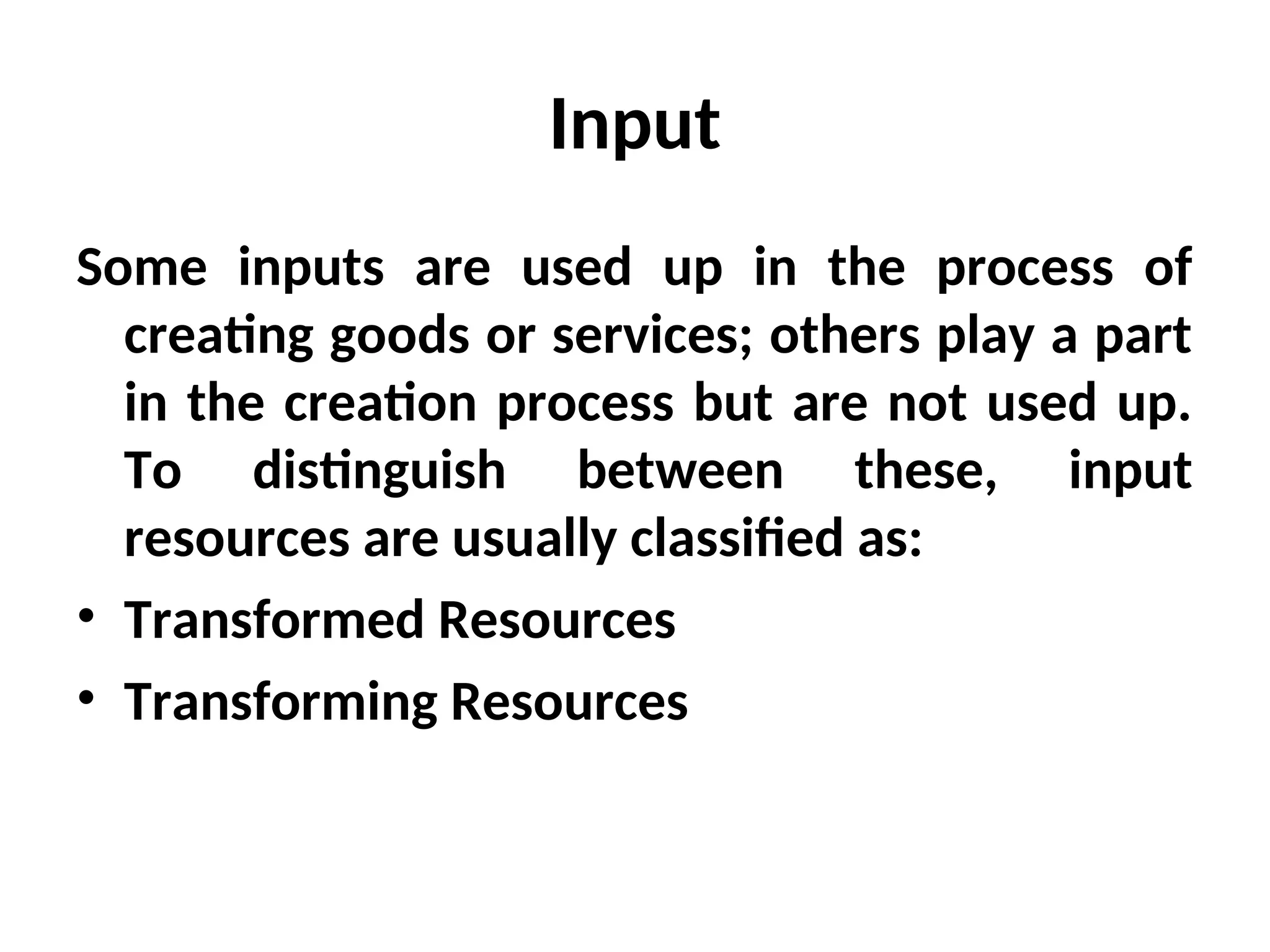
Input
Some inputs are used up in the process of
creating goods or services; others play a part
in the creation process but are not used up.
To distinguish between these, input
resources are usually classified as:
• Transformed Resources
• Transforming Resources
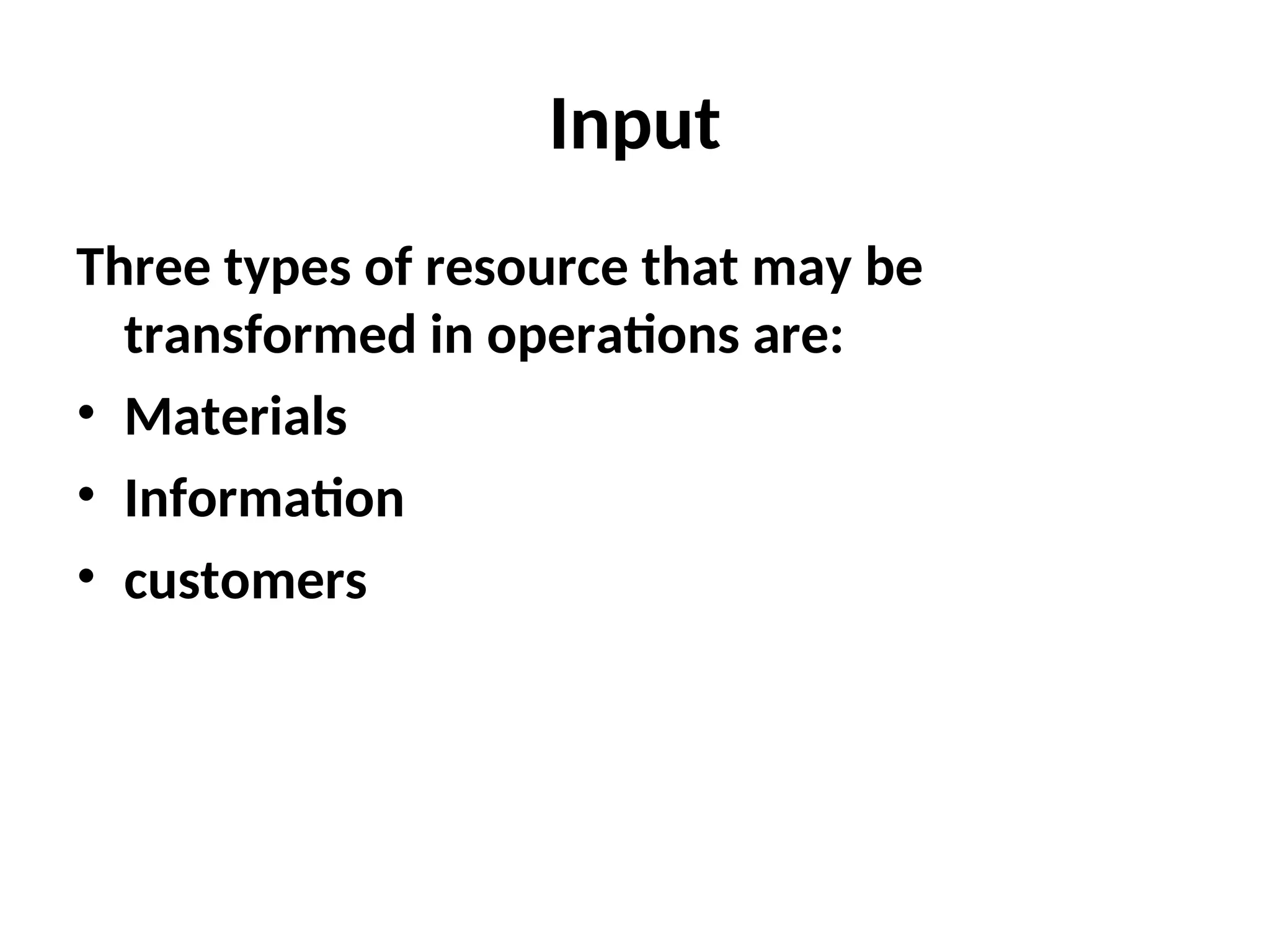
Input
Three types of resource that may be
transformed in operations are:
• Materials
• Information
• customers
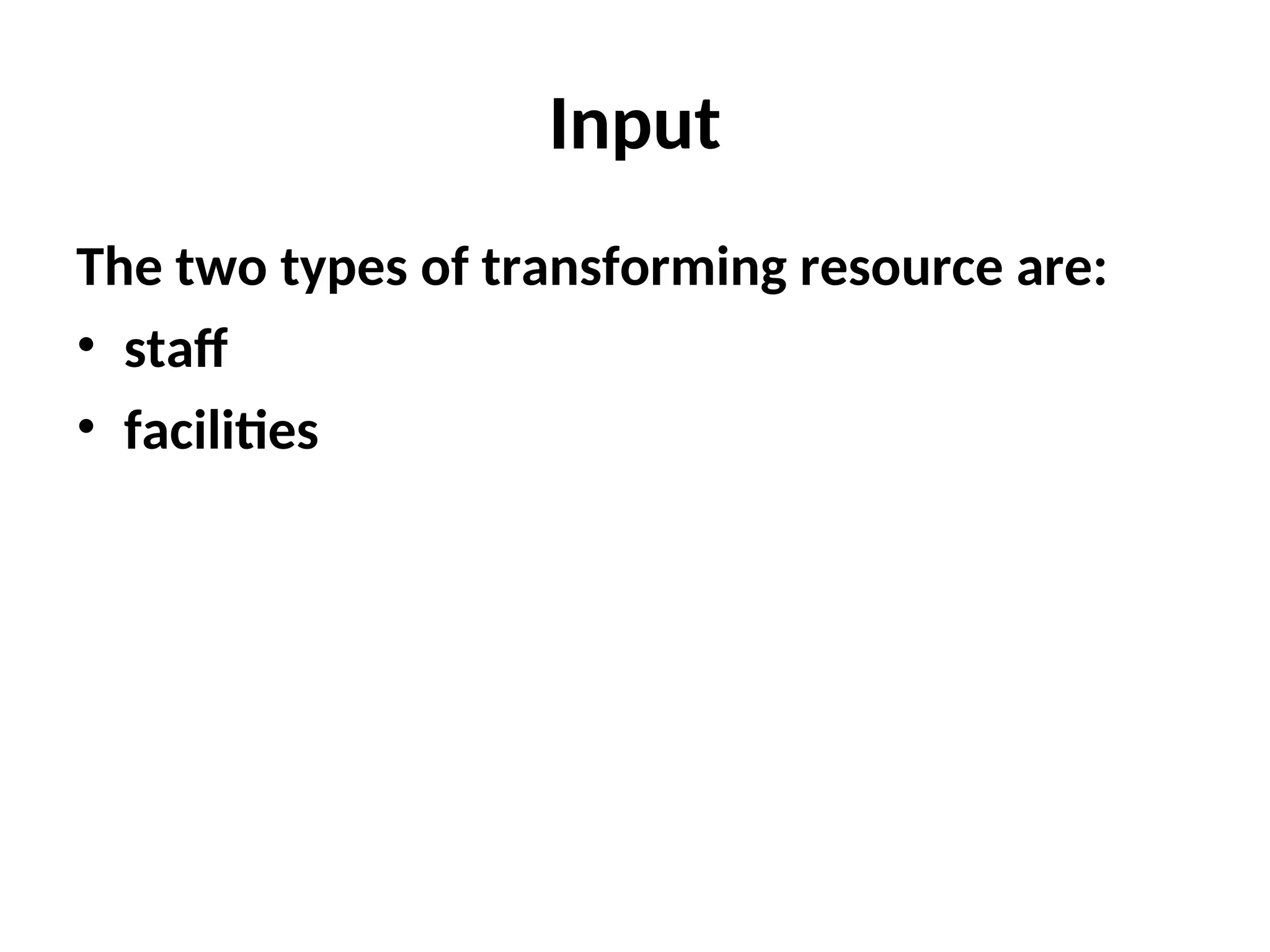
Input
The two types of transforming resource are:
• staff
• facilities
Output
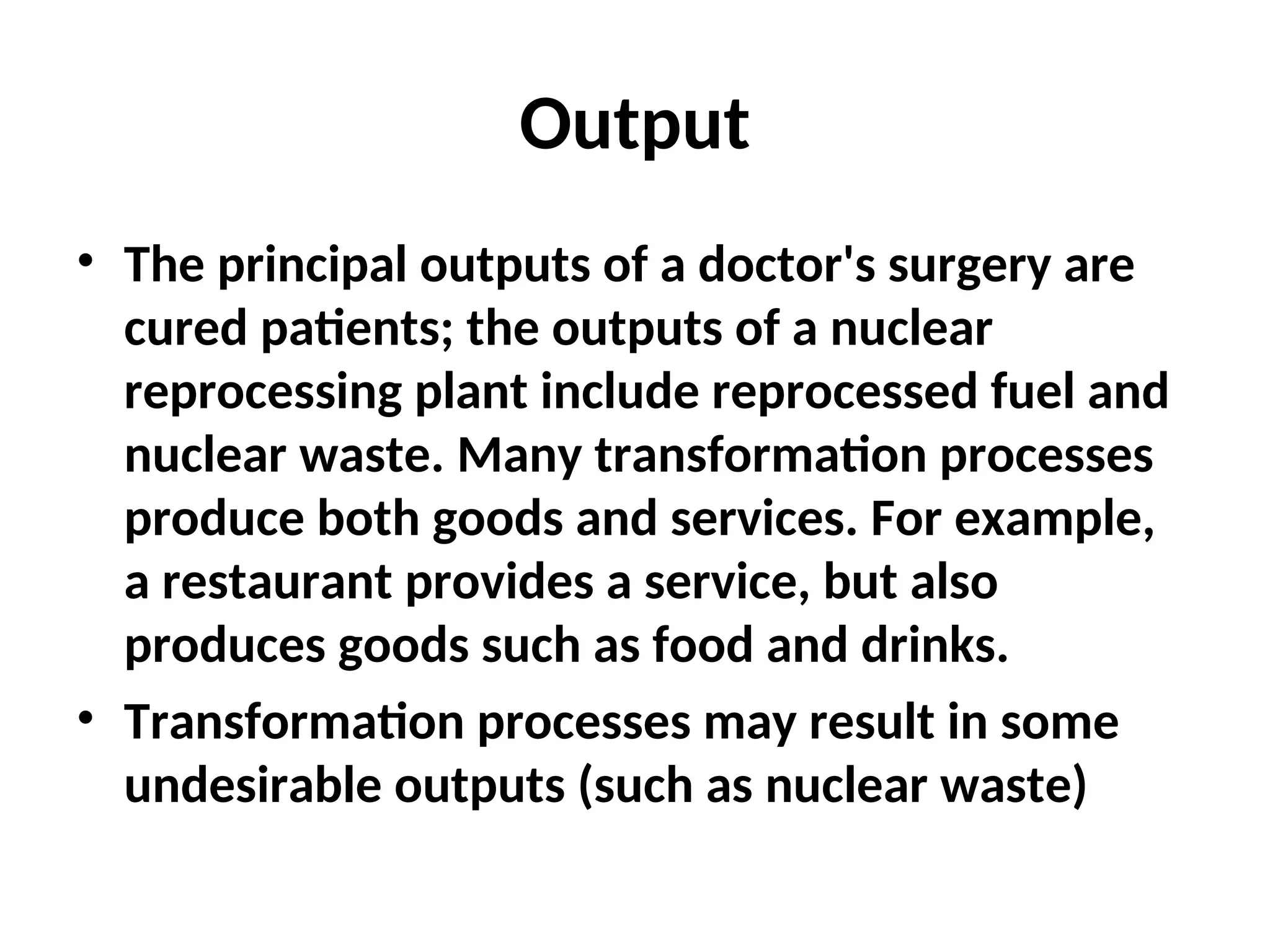
• The principal outputs of a doctor's surgery are
cured patients; the outputs of a nuclear
reprocessing plant include reprocessed fuel and
nuclear waste. Many transformation processes
produce both goods and services. For example,
a restaurant provides a service, but also
produces goods such as food and drinks.
• Transformation processes may result in some
undesirable outputs (such as nuclear waste)
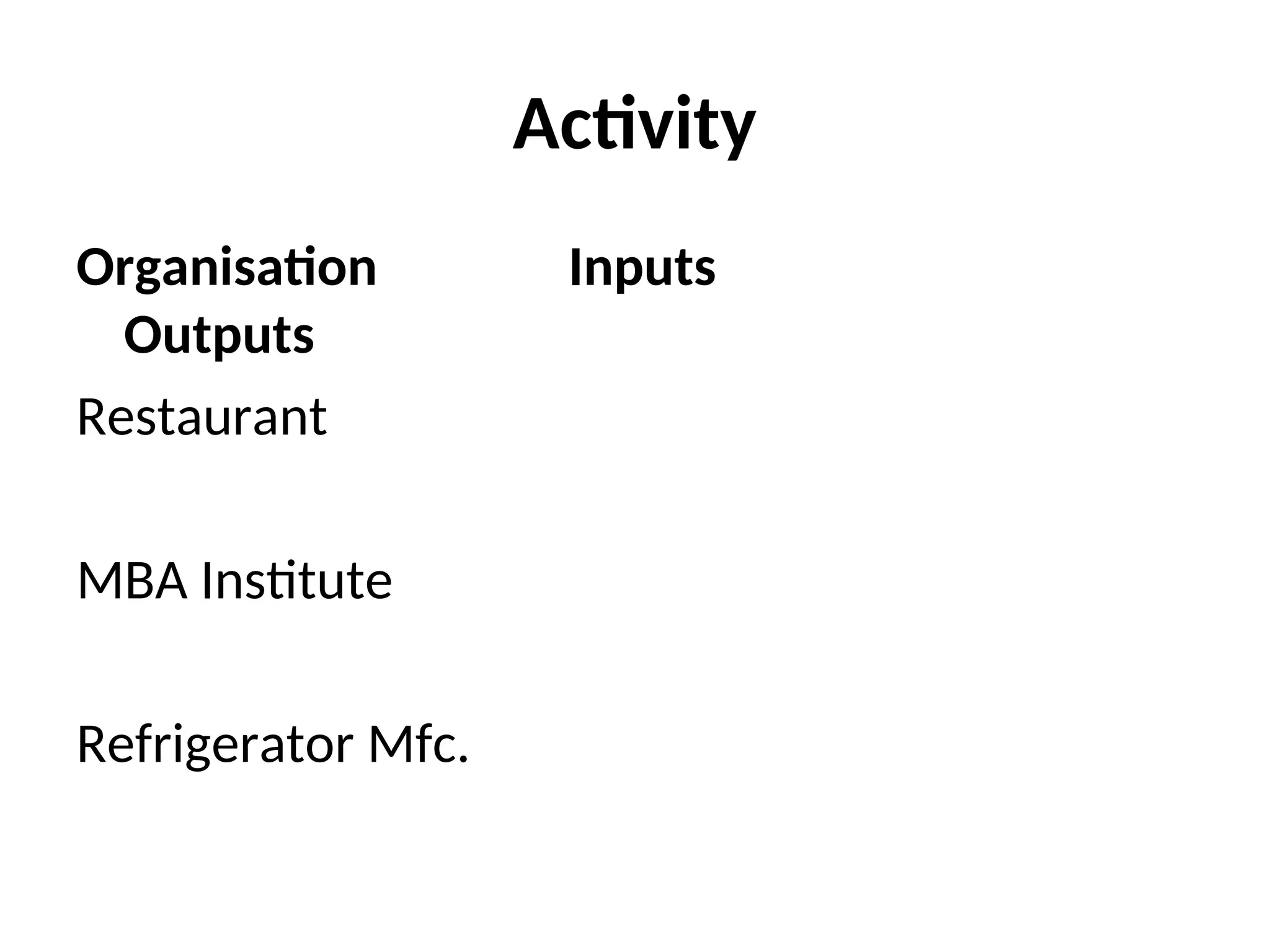
Activity
Organisation Inputs
Outputs
Restaurant
MBA Institute
Refrigerator Mfc.
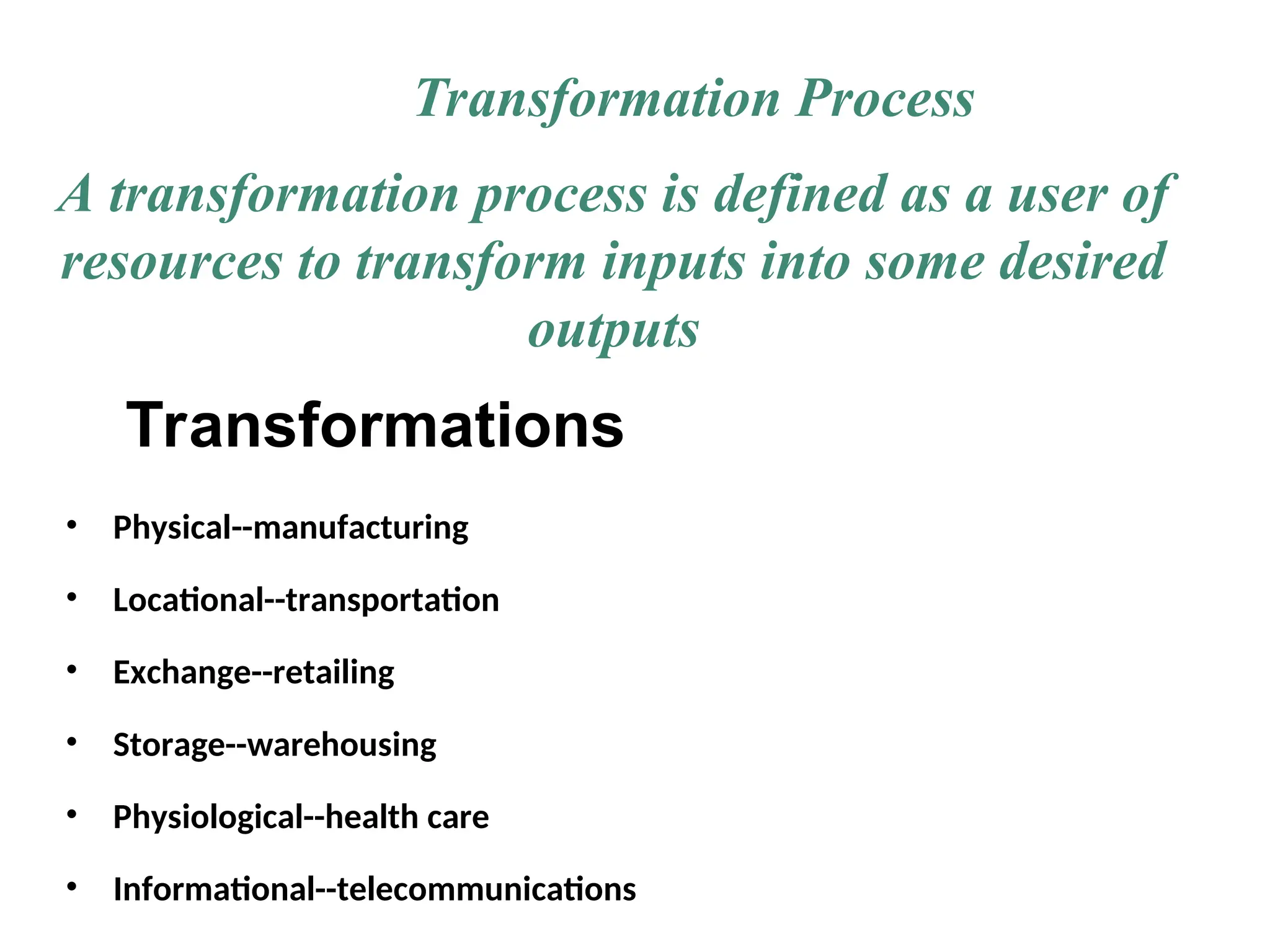
Transformations
• Physical--manufacturing
• Locational--transportation
• Exchange--retailing
• Storage--warehousing
• Physiological--health care
• Informational--telecommunications
Transformation Process
A transformation process is defined as a user of
resources to transform inputs into some desired
outputs
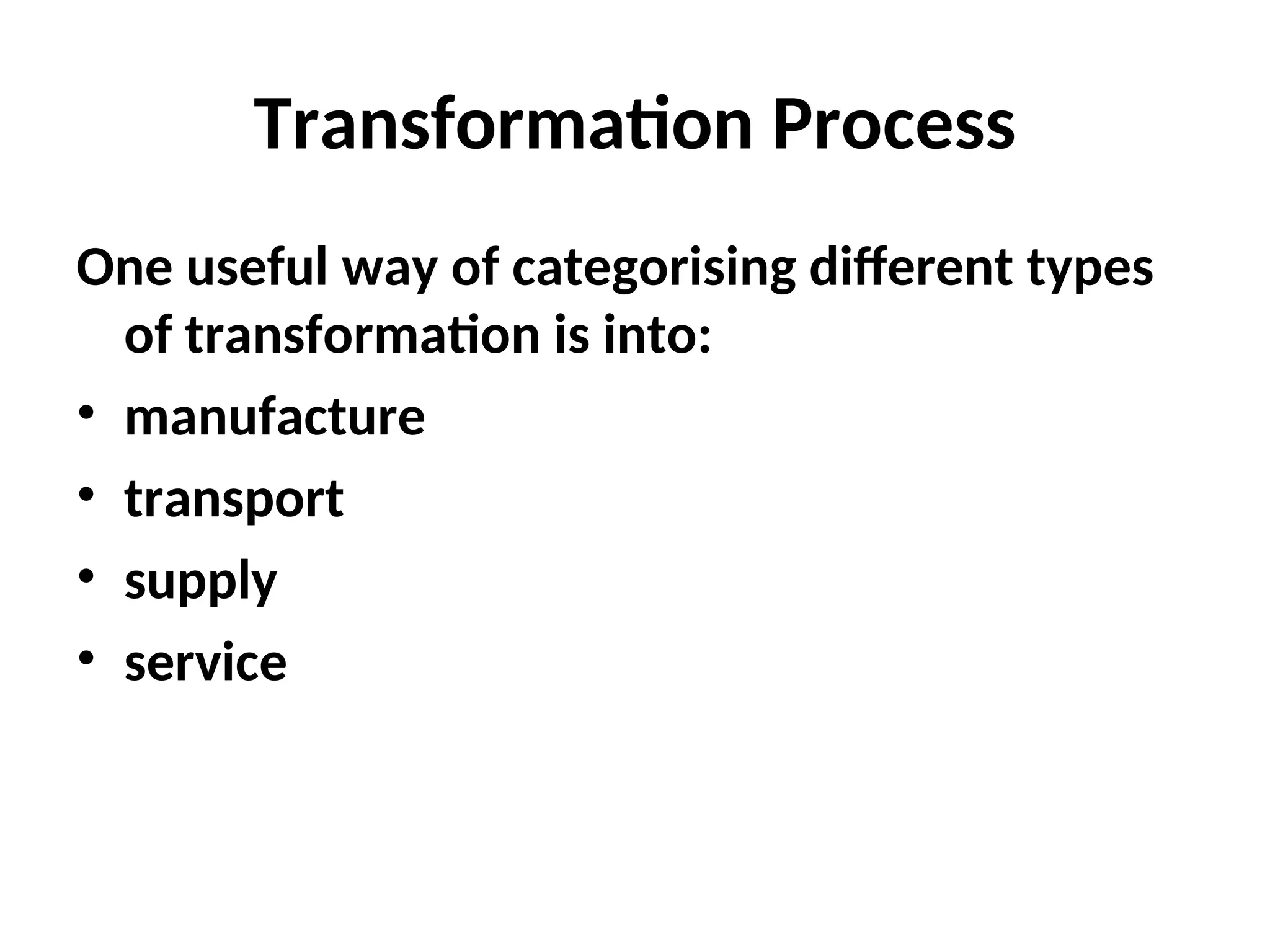
Transformation Process
One useful way of categorising different types
of transformation is into:
• manufacture
• transport
• supply
• service
Feedback
Feedback information is used to control the
operations system, by adjusting the inputs
and transformation processes that are used
to achieve desired outputs.
Random Disturbances
• It is unplanned or uncontrollable
environmental influences.
• It causes planned and actual output to differ.
Examples:-
Weather
Inflation
Equipment breakdown
Government controls
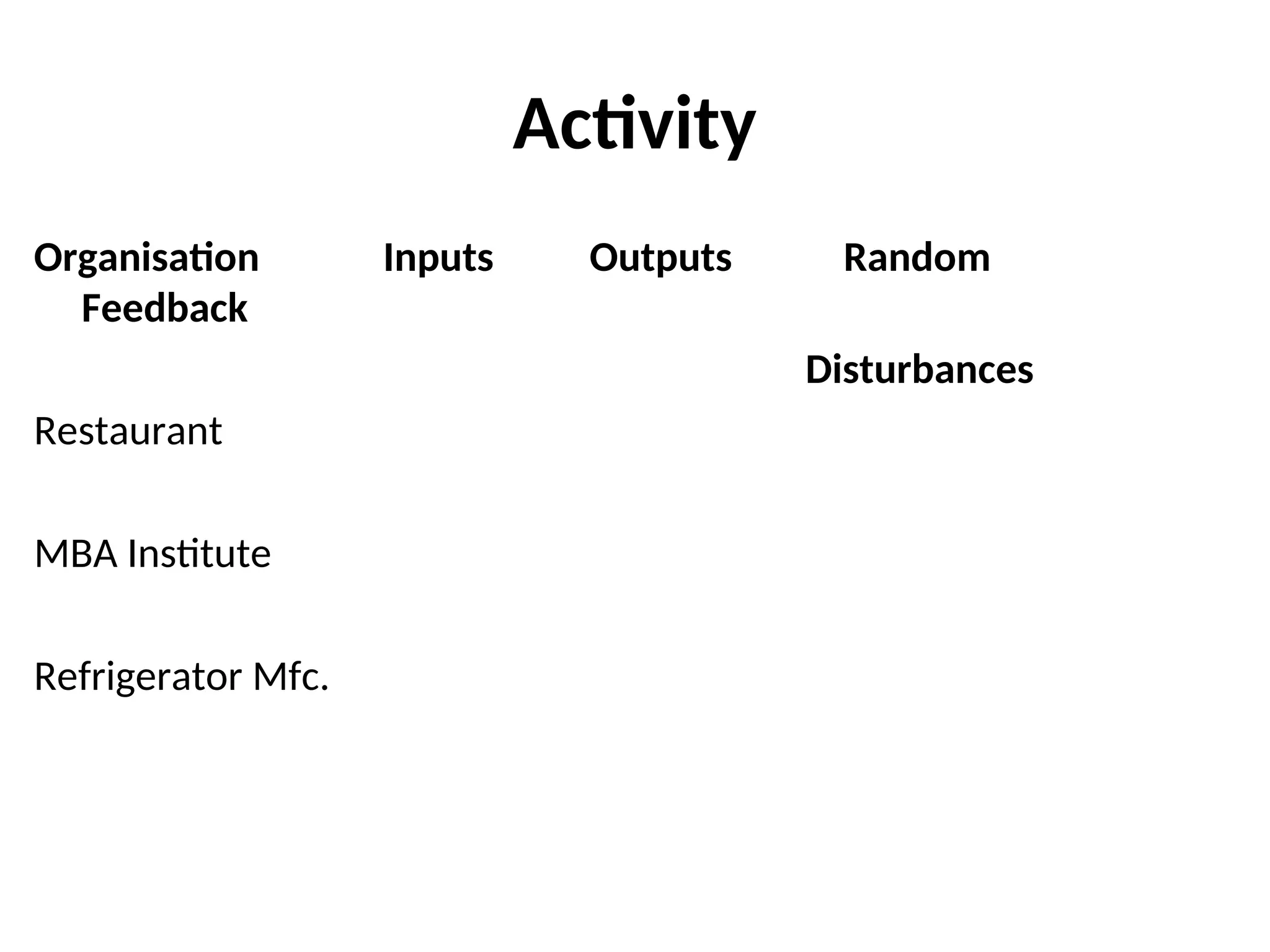
Activity
Organisation Inputs Outputs Random
Feedback
Disturbances
Restaurant
MBA Institute
Refrigerator Mfc.
Boundary Of Operations
• suppliers
• customers
• the environment.
Product & Services
Product
• People buy ,want satisfaction, not objects.
• Example: Consumers buy televisions because they want
entertainment, not because they want a box with a screen.
• Product Bundle of physical, service, and symbolic
attributes designed to satisfy a customer’s wants and needs
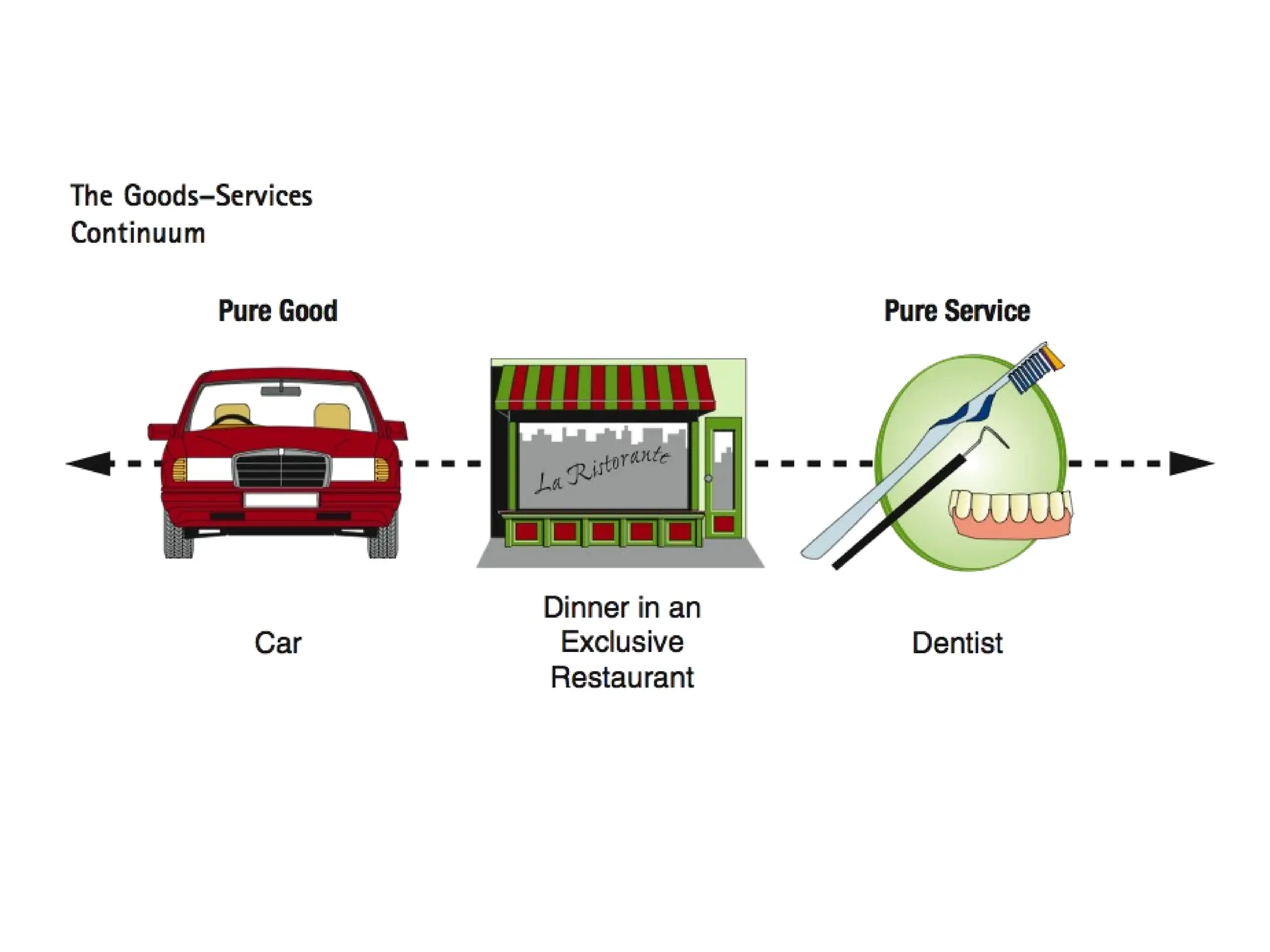
Goods & Services
• Services Intangible tasks that satisfy the
needs of consumer and business users.
• Goods Tangible products that customers
can see, hear, smell, taste, or touch.
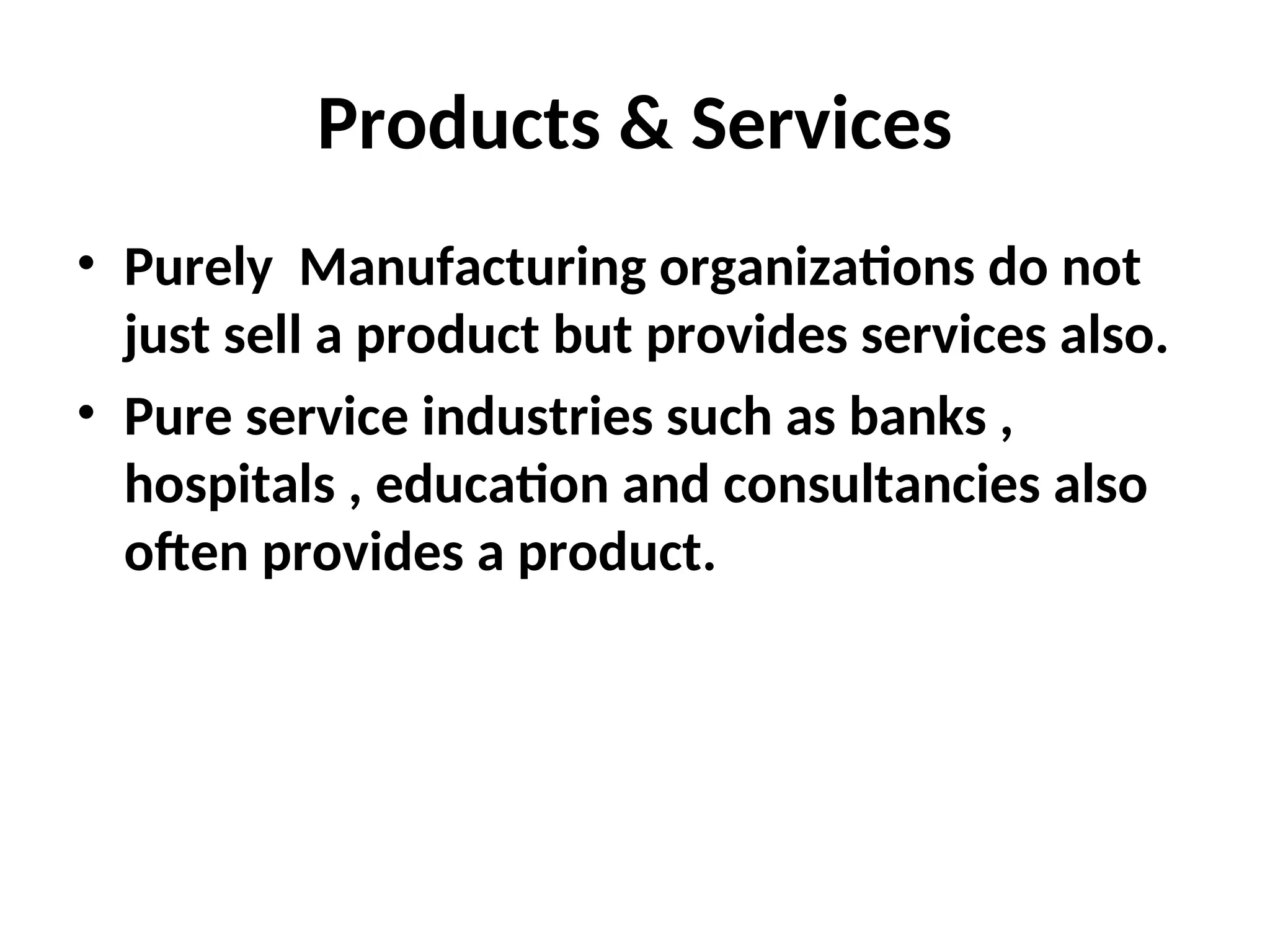
Products & Services
• Purely Manufacturing organizations do not
just sell a product but provides services also.
• Pure service industries such as banks ,
hospitals , education and consultancies also
often provides a product.
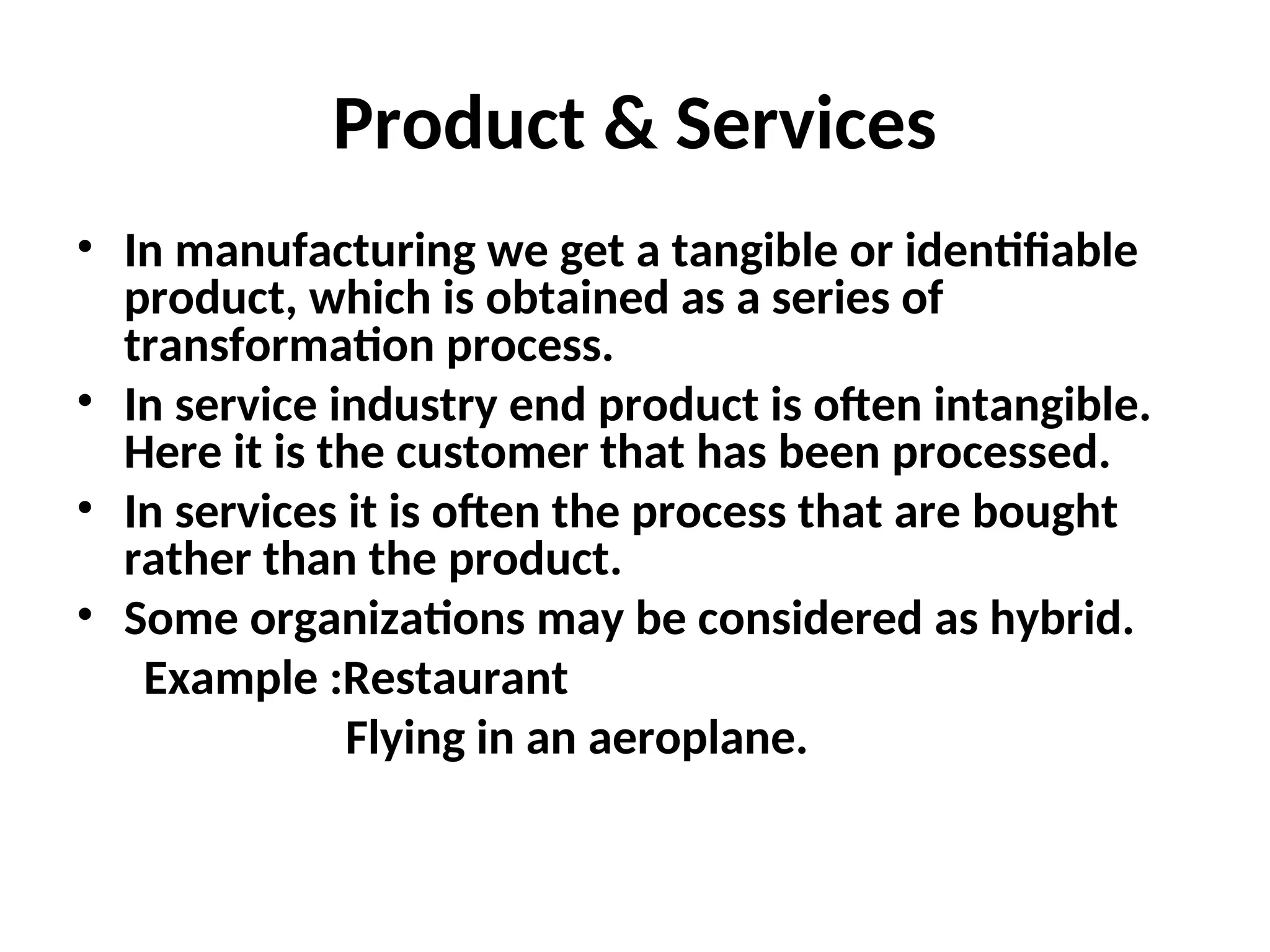
Product & Services
• In manufacturing we get a tangible or identifiable
product, which is obtained as a series of
transformation process.
• In service industry end product is often intangible.
Here it is the customer that has been processed.
• In services it is often the process that are bought
rather than the product.
• Some organizations may be considered as hybrid.
Example :Restaurant
Flying in an aeroplane.
Role of a operations manager
Human resource management
The people employed by an organization
either work directly to create a good or
service or provide support to those who do.
People and the way they are managed are a
key resource of all organizations.
Asset management
• An organization's buildings, facilities,
equipment and stock are directly involved in
or support the operations function
Break Even Analysis
Break Even Analysis is the concept that links
capacity to cost.It explains the significance of
having greater productive capacity to lower
cost and maximize profit or contribution.
Breakeven point is that at which the
contribution margin is able to cover total
fixed cost.
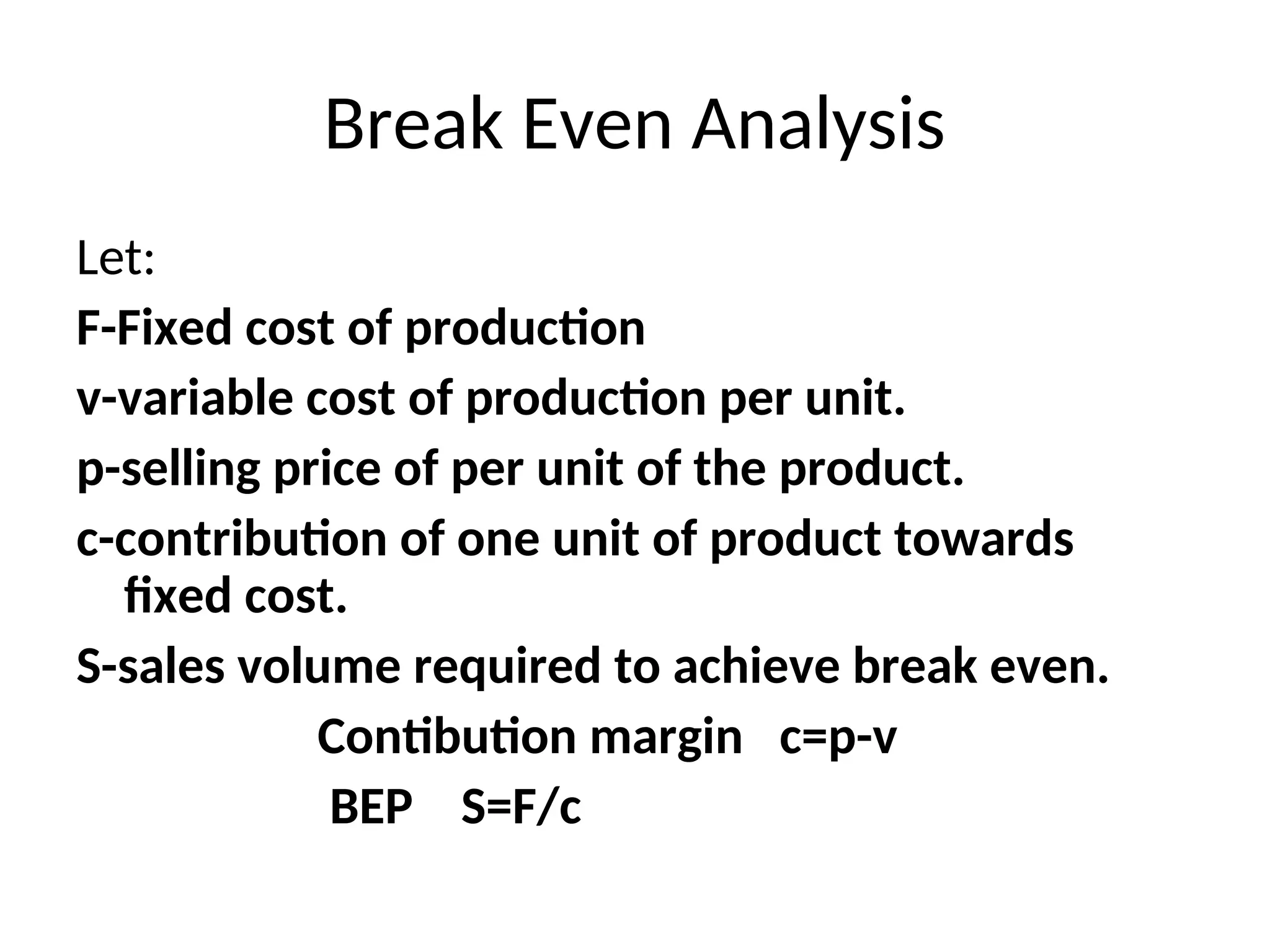
Break Even Analysis
Let:
F-Fixed cost of production
v-variable cost of production per unit.
p-selling price of per unit of the product.
c-contribution of one unit of product towards
fixed cost.
S-sales volume required to achieve break even.
Contibution margin c=p-v
BEP S=F/c
Cost management
Most of the costs of producing goods or
services are directly related to the costs of
acquiring resources, transforming them or
delivering them to customers
Decision making
Decisions need to be made in:
• designing the operations system
• managing the operations system
• improving the operations system.
Decision making
The five main kinds of decision in each of these
relate to:
• the processes by which goods and services are
produced
• the quality of goods or services
• the quantity of goods or services (the capacity
of operations)
• the stock of materials (inventory) needed to
produce goods or services
• the management of human resources.
Designing of Product & Process
PURPOSE OF DESIGN
• Produce a technological solution to a need!
– Create a physically recognizable object.
– Create an object with economic worth and
financial feasibility.
– Choose an optimum alternative solution.
– Develop a new way to do something.
– Reduce cost, inconvenience, improve safety.
– Produce convenience, service, value.
Product Design
– Product design must support product
manufacturability (the ease with which a product
can be made)
– Product design defines a product’s characteristics
of;
• appearance,
• materials,
• dimensions,
• tolerances, and
• performance standards
Design of Services versus Goods
• Service design is unique in that the service and
entire service concept are being designed
– must define both the service and concept
- Physical elements, aesthetic & psychological
benefits
e.g. promptness, friendliness, ambiance
The four “C’s of Design
• Creativity
– Requires creation of something that has not existed or
not existed in the proposed state.
• Complexity
– Requires decisions on many variables & parameters
• Choice
– Requires making choices between many possible
solutions at all levels, from basic concept to small details.
• Compromise
– Requires balancing multiple and sometimes conflicting
requirements.
Manufacturing and Process Selection
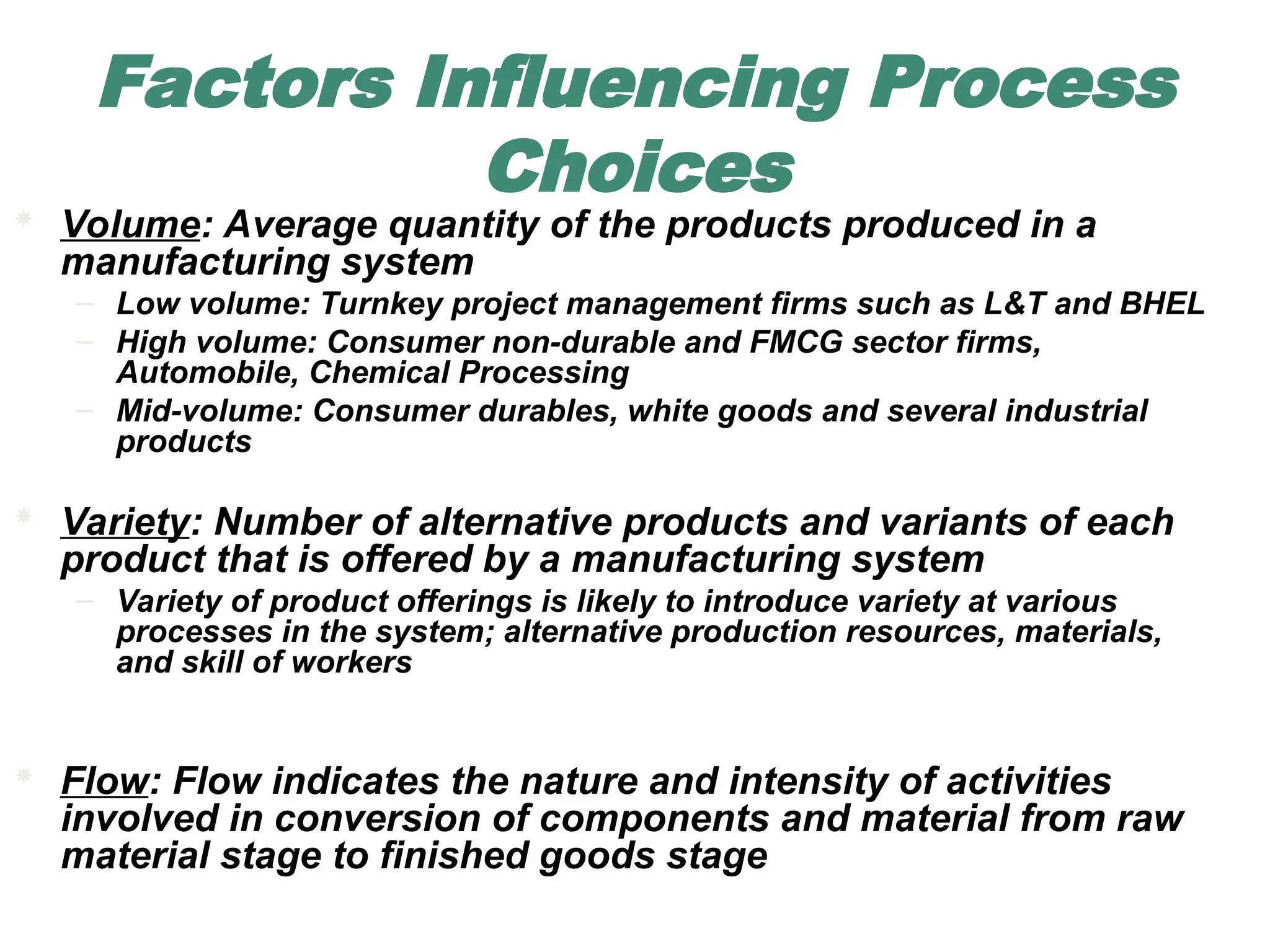
Factors Influencing Process
Choices
 Volume: Average quantity of the products produced in a
manufacturing system
– Low volume: Turnkey project management firms such as L&T and BHEL
– High volume: Consumer non-durable and FMCG sector firms,
Automobile, Chemical Processing
– Mid-volume: Consumer durables, white goods and several industrial
products
 Variety: Number of alternative products and variants of each
product that is offered by a manufacturing system
– Variety of product offerings is likely to introduce variety at various
processes in the system; alternative production resources, materials,
and skill of workers
 Flow: Flow indicates the nature and intensity of activities
involved in conversion of components and material from raw
material stage to finished goods stage
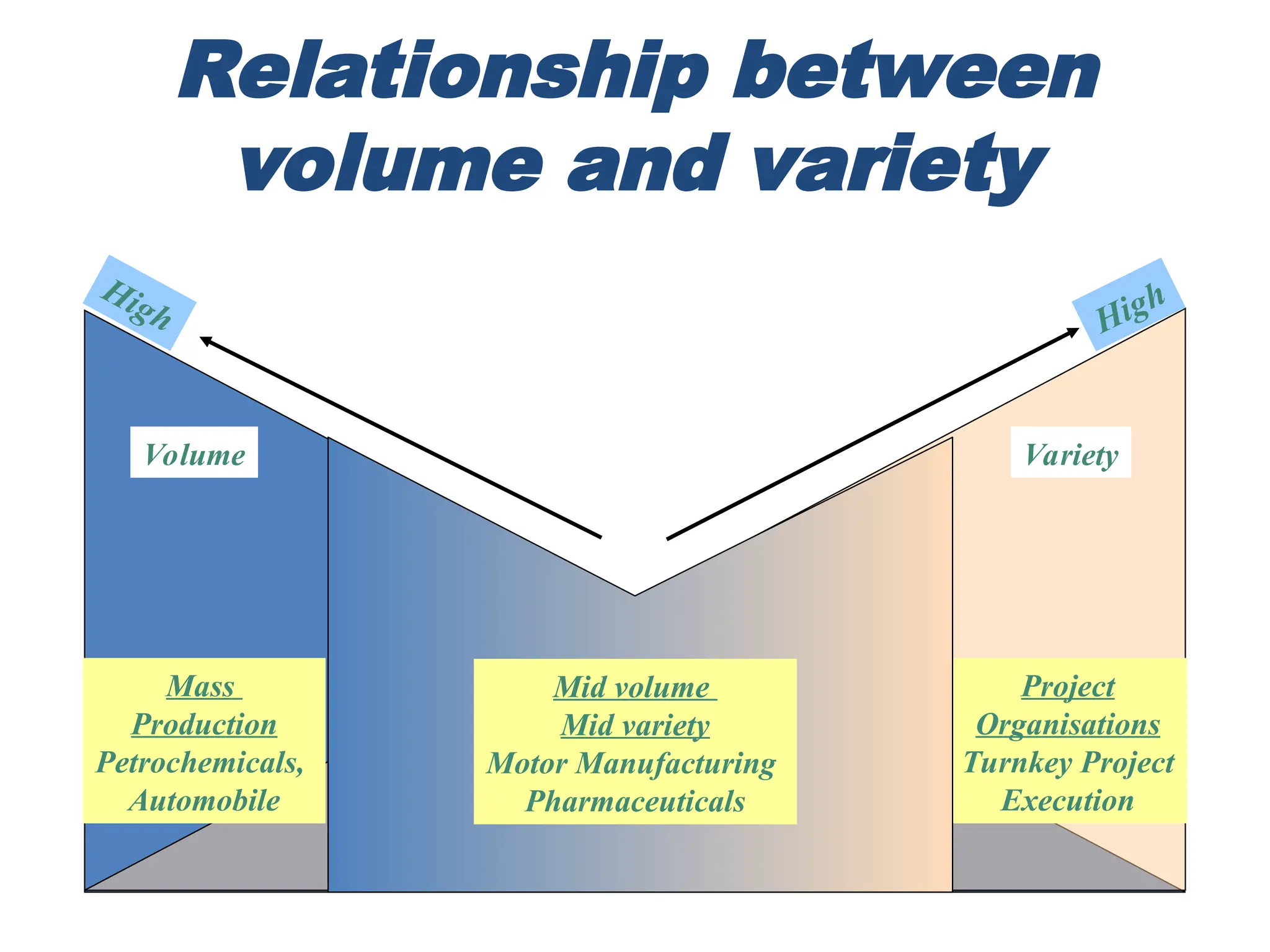
Relationship between
volume and variety
Volume Variety
Mass
Production
Petrochemicals,
Automobile
Project
Organisations
Turnkey Project
Execution
Mid volume
Mid variety
Motor Manufacturing
Pharmaceuticals
High High
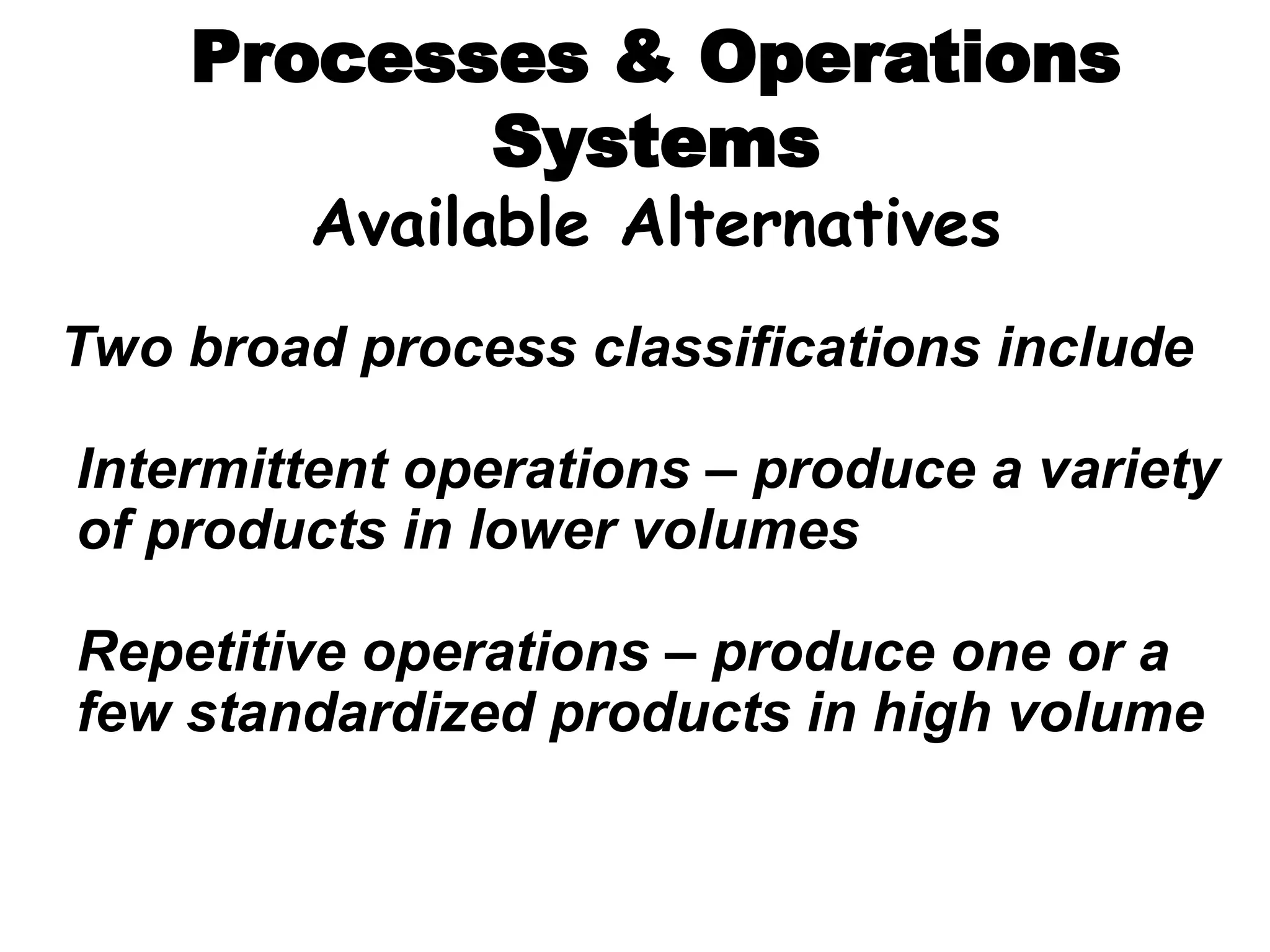
Processes & Operations
Systems
Available Alternatives
Two broad process classifications include
Intermittent operations – produce a variety
of products in lower volumes
Repetitive operations – produce one or a
few standardized products in high volume
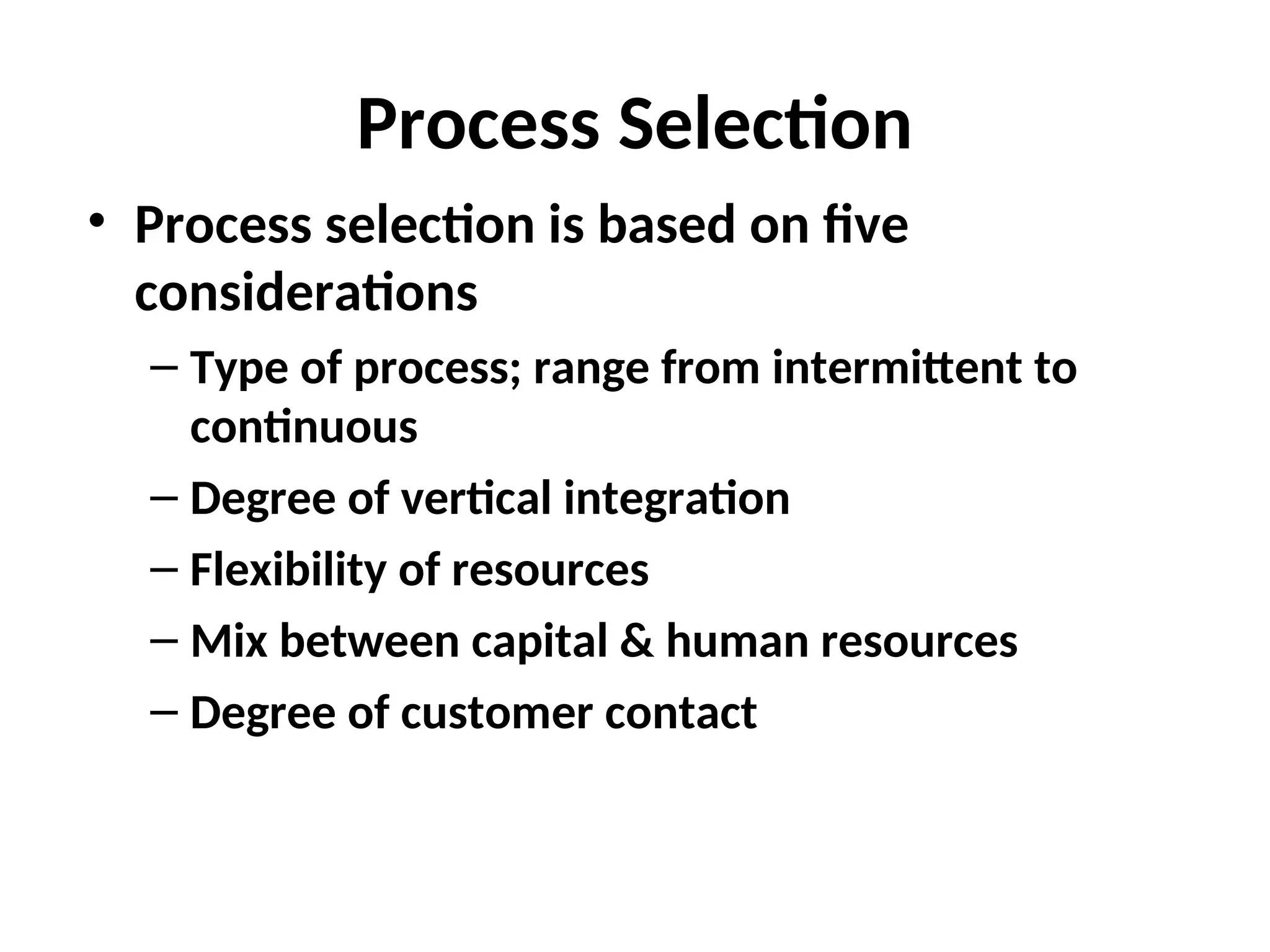
Process Selection
• Process selection is based on five
considerations
– Type of process; range from intermittent to
continuous
– Degree of vertical integration
– Flexibility of resources
– Mix between capital & human resources
– Degree of customer contact
Process Selection
• Process types can be:
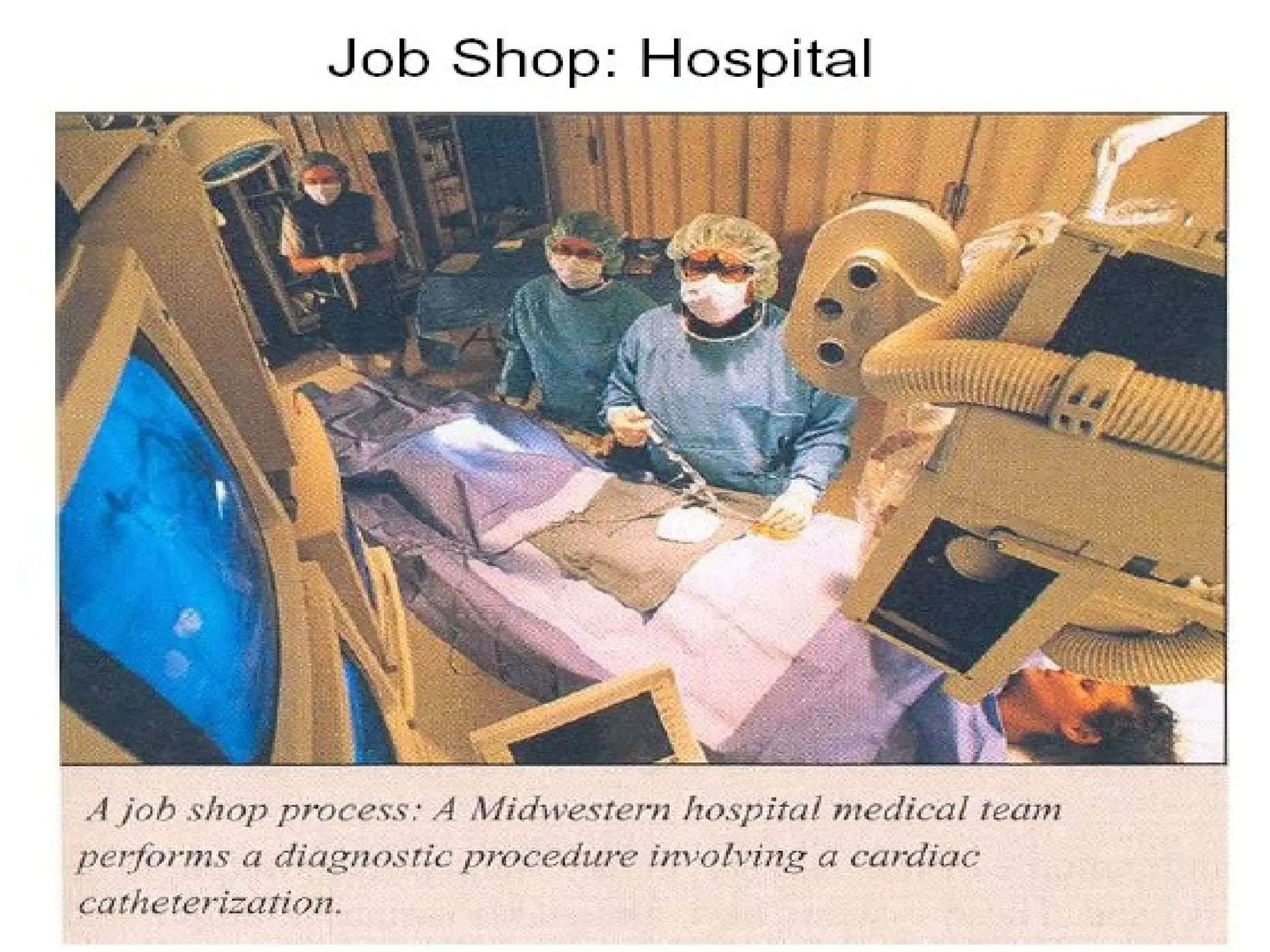
– Project process /Job Shop– make a one-at-a-time
product exactly to customer specifications
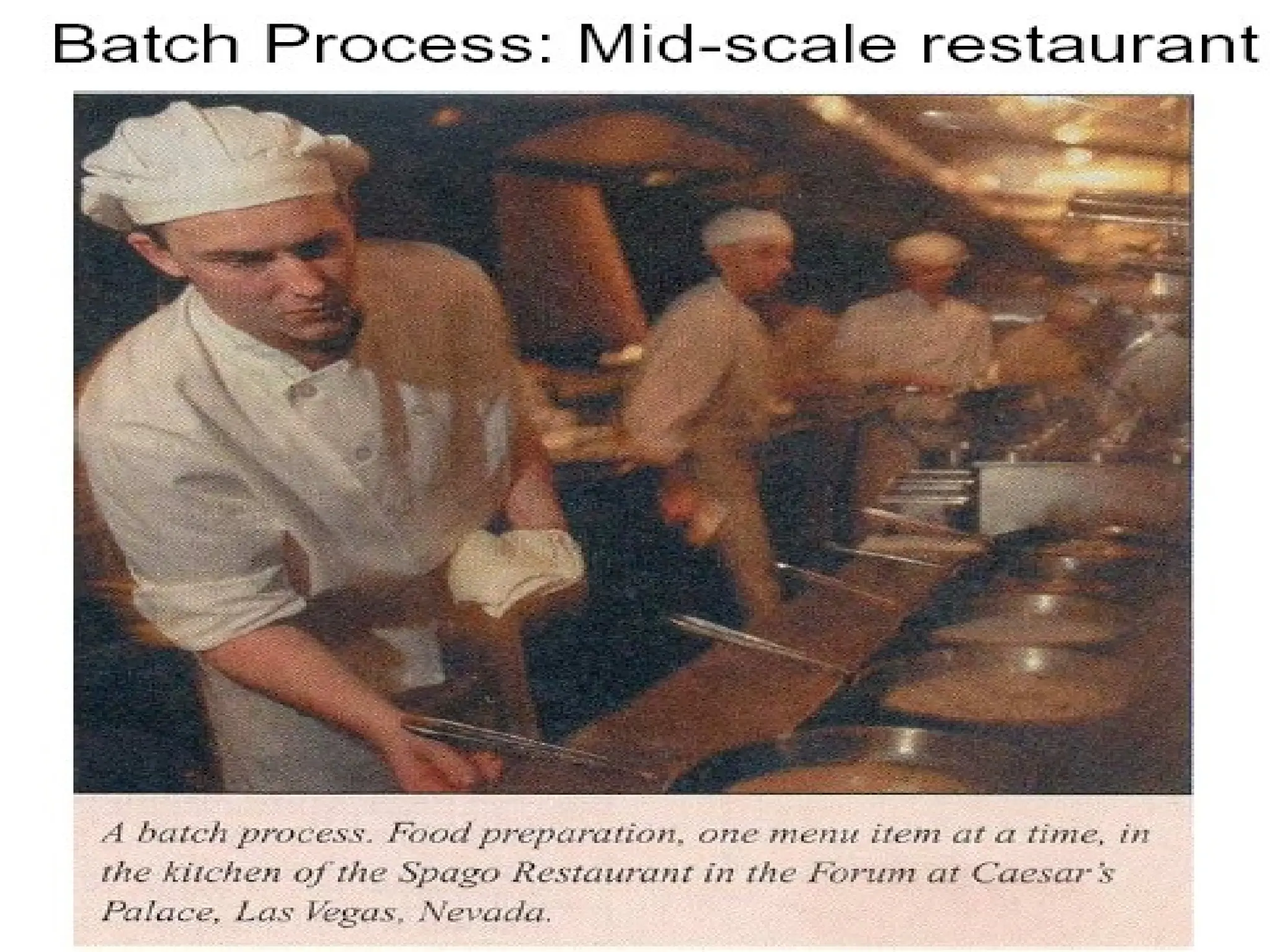
– Batch process – small quantities of product in
groups or batches based on customer orders or
specifications
Process Selection
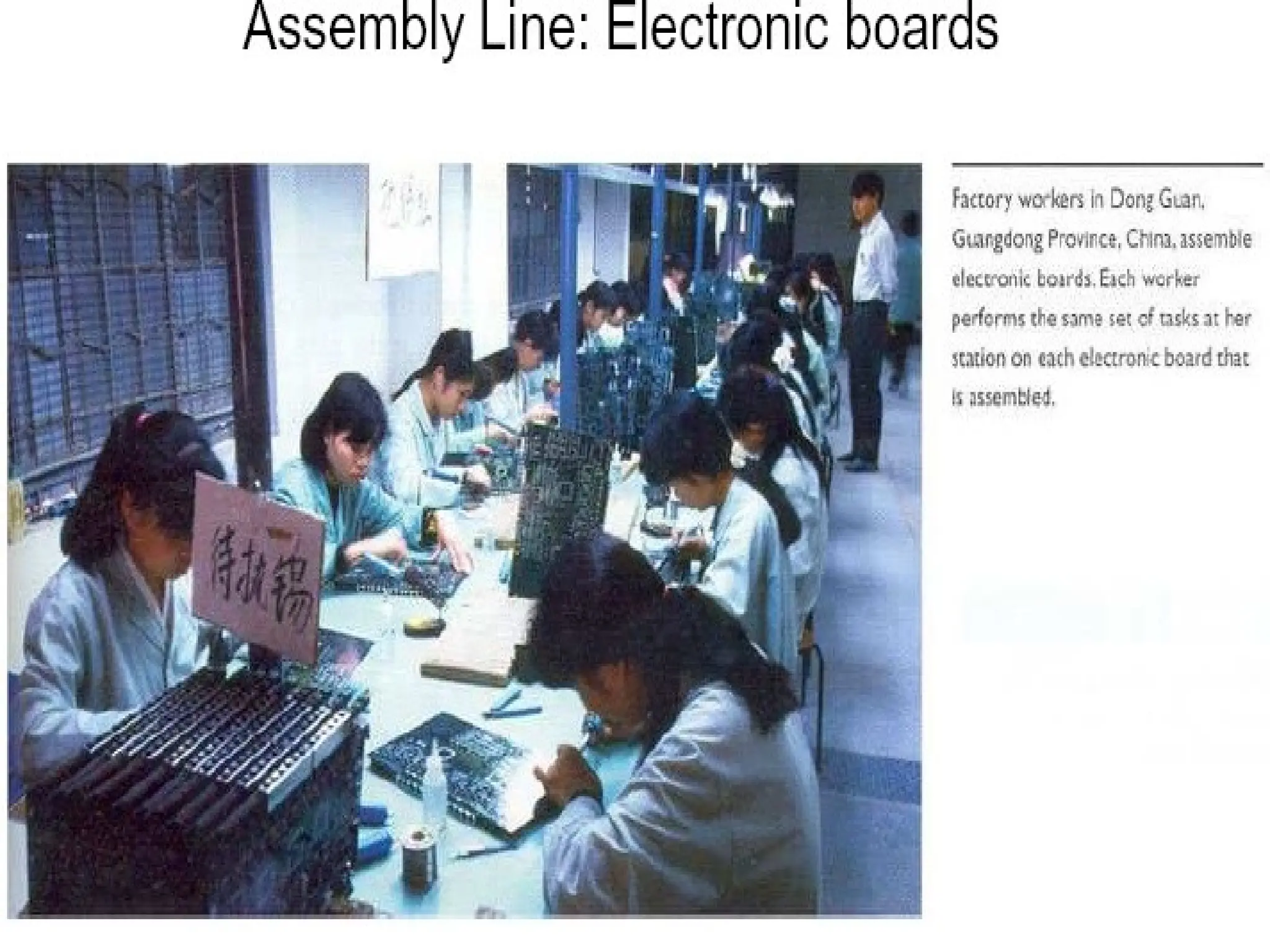
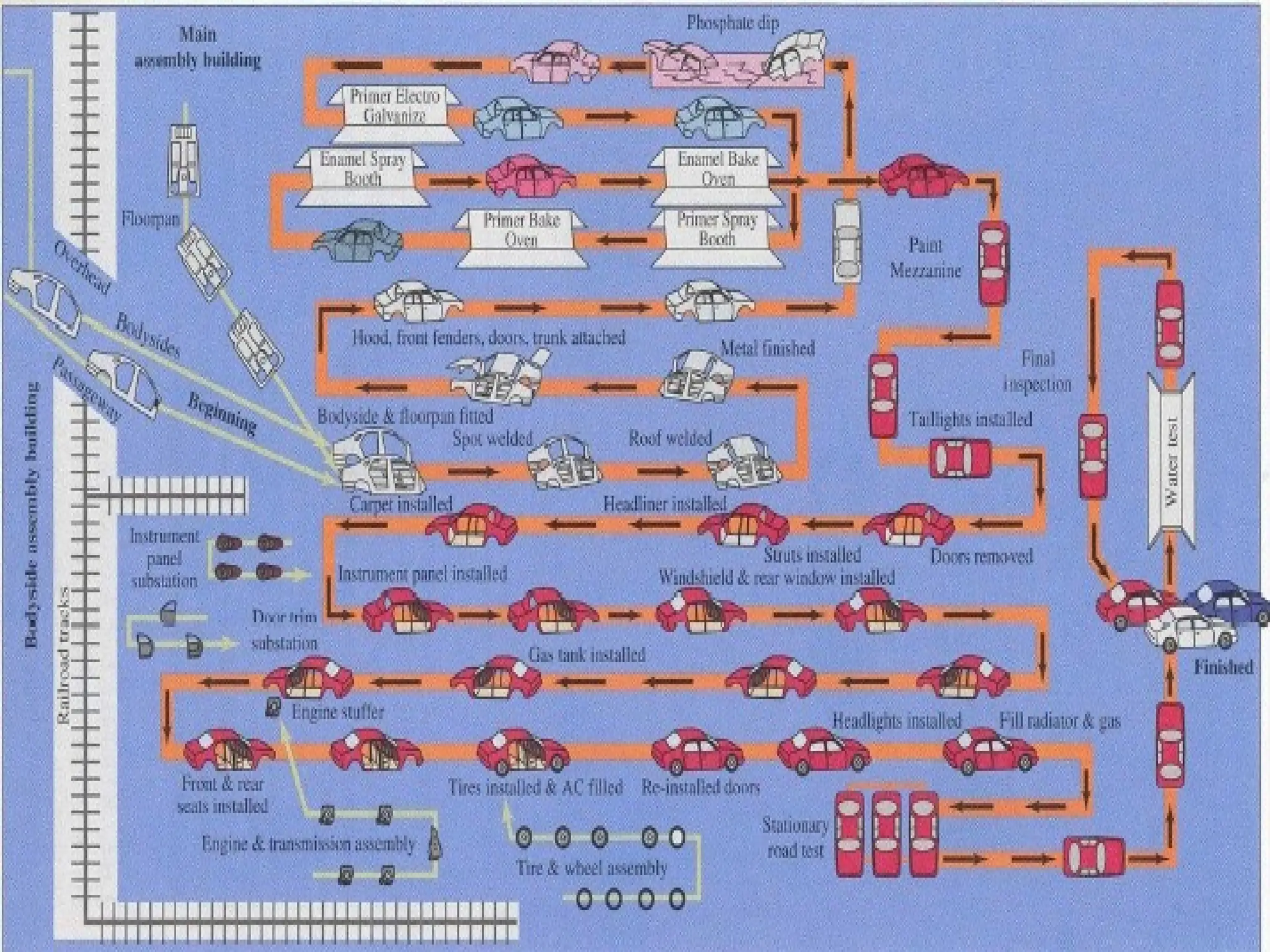
– Line process – large quantities of a standard
product
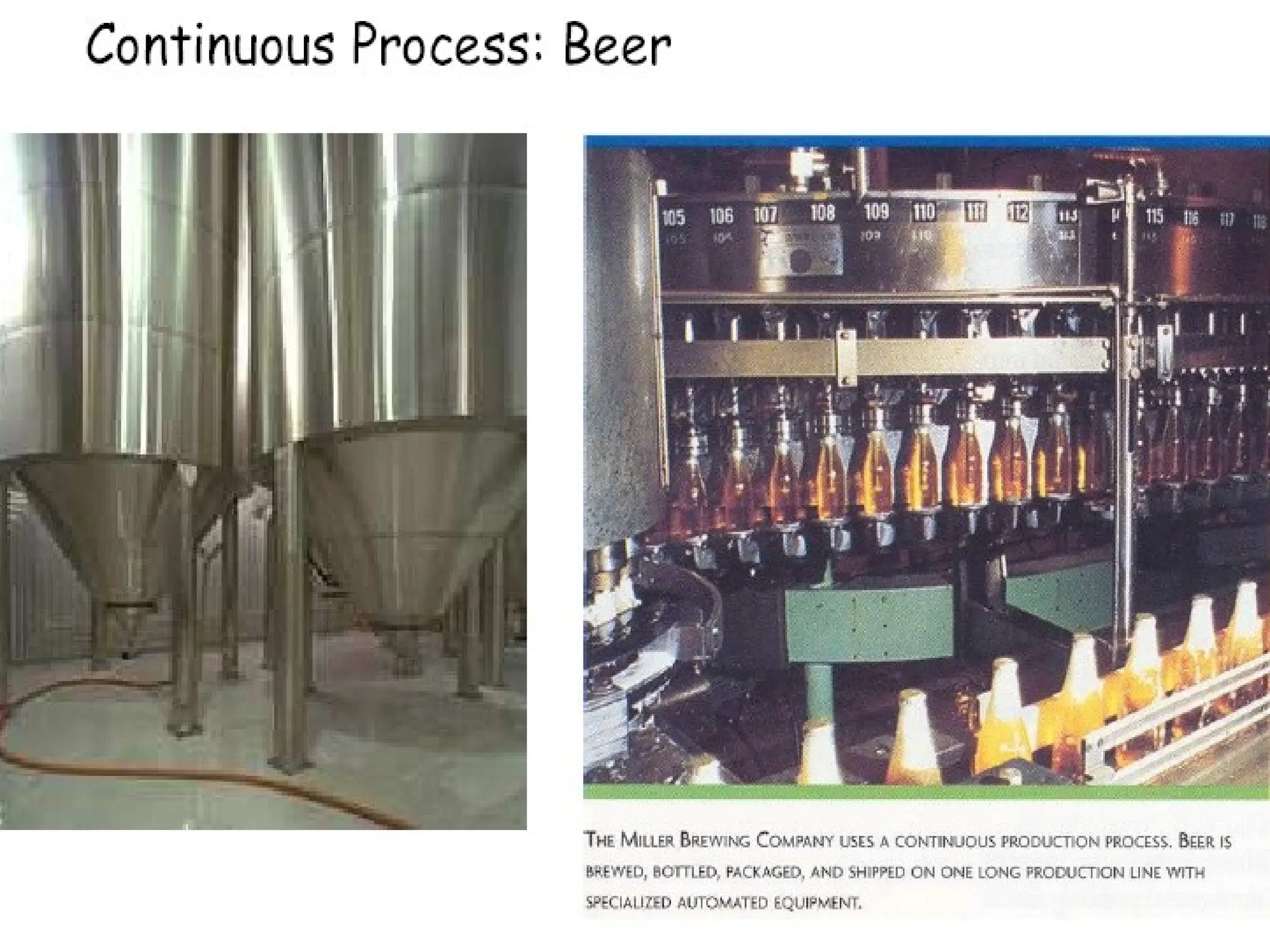
– Continuous process – very high volumes of a fully
standard product
© 2007 Wiley
© 2007 Wiley
© 2007 Wiley
© 2007 Wiley
© 2007 Wiley
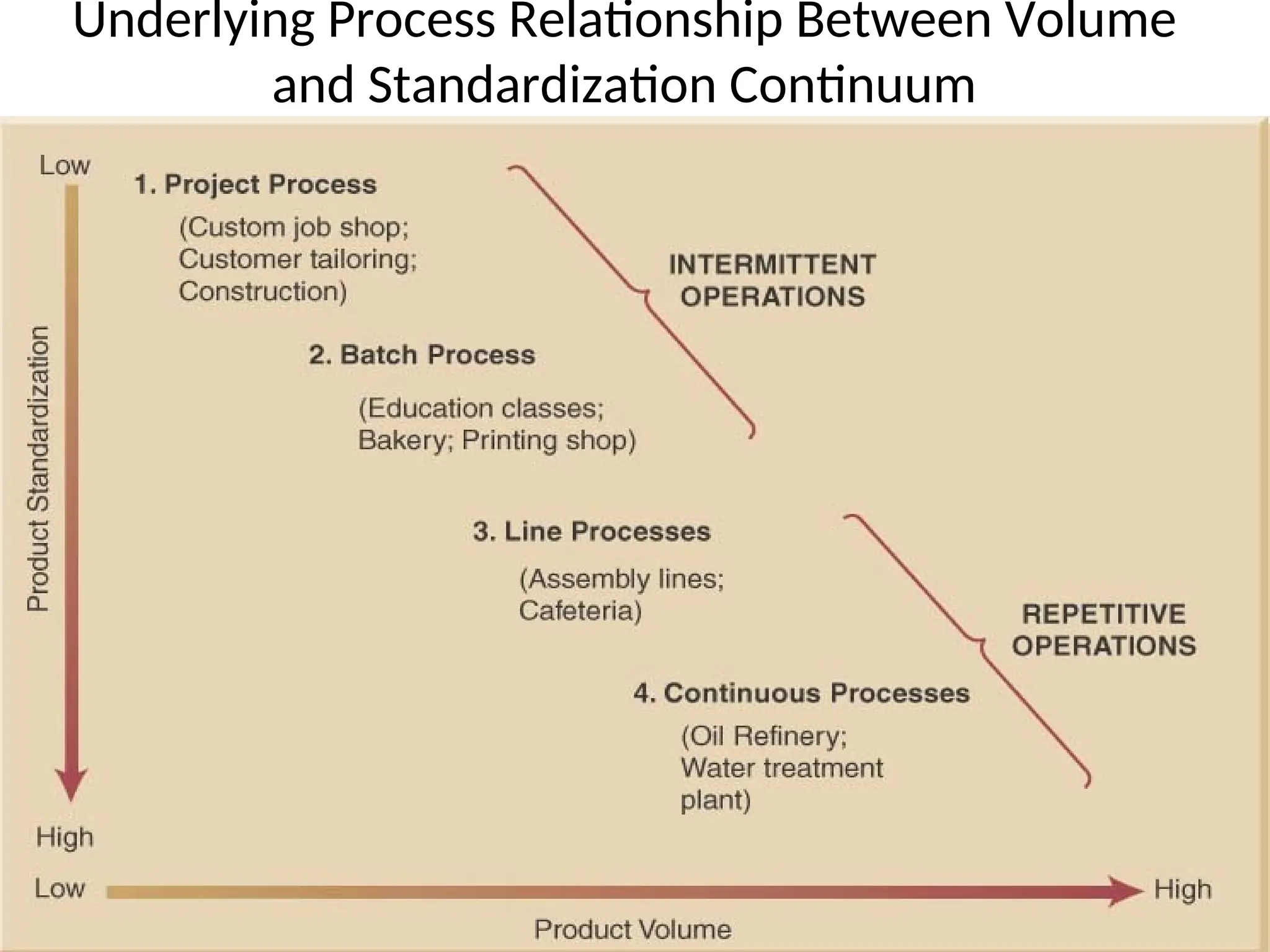
Underlying Process Relationship Between Volume
and Standardization Continuum
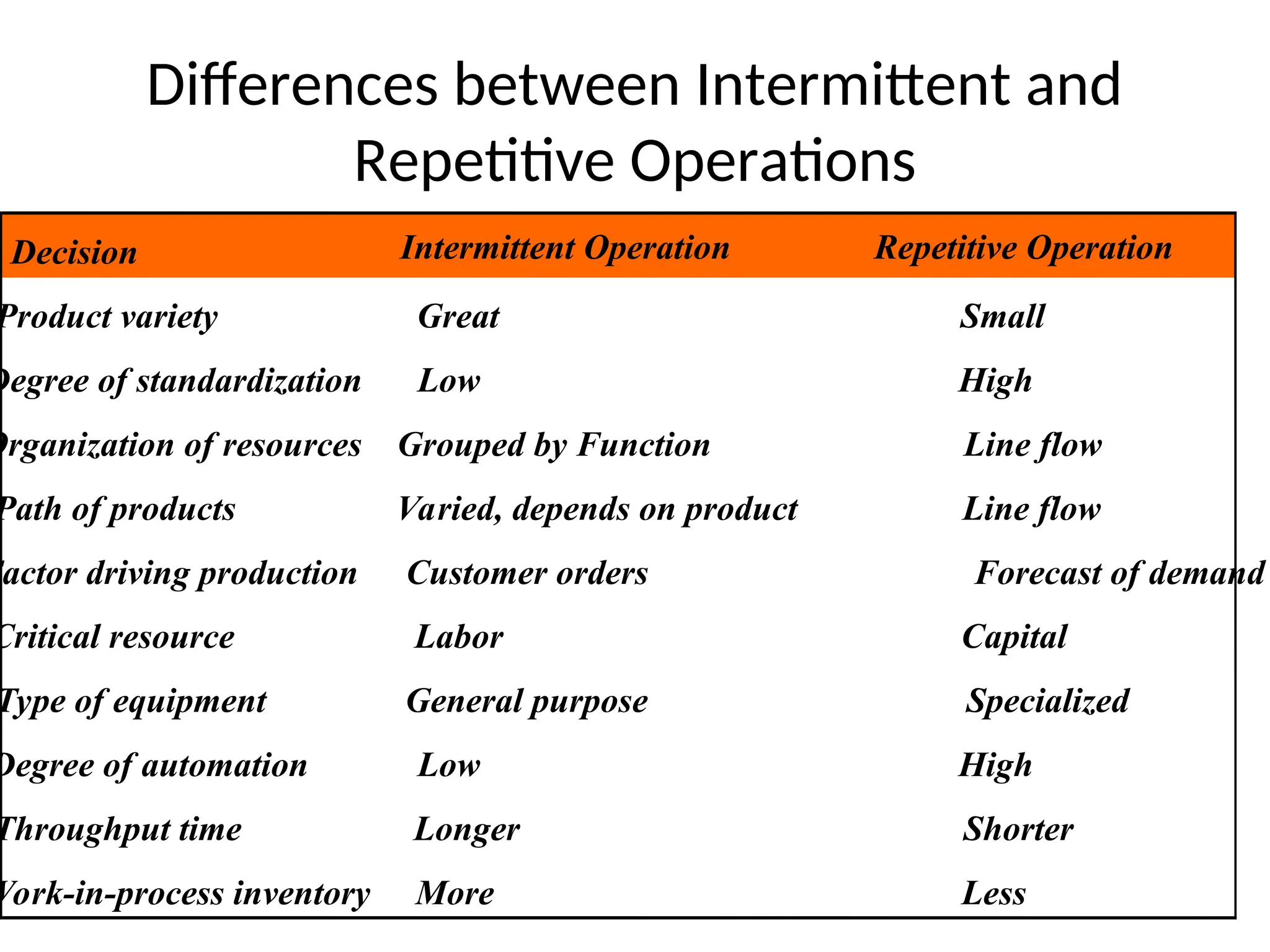
Differences between Intermittent and
Repetitive Operations
Decision Intermittent Operation Repetitive Operation
Product variety Great Small
Degree of standardization Low High
Organization of resources Grouped by Function Line flow
Path of products Varied, depends on product Line flow
Factor driving production Customer orders Forecast of demand
Critical resource Labor Capital
Type of equipment General purpose Specialized
Degree of automation Low High
Throughput time Longer Shorter
Work-in-process inventory More Less
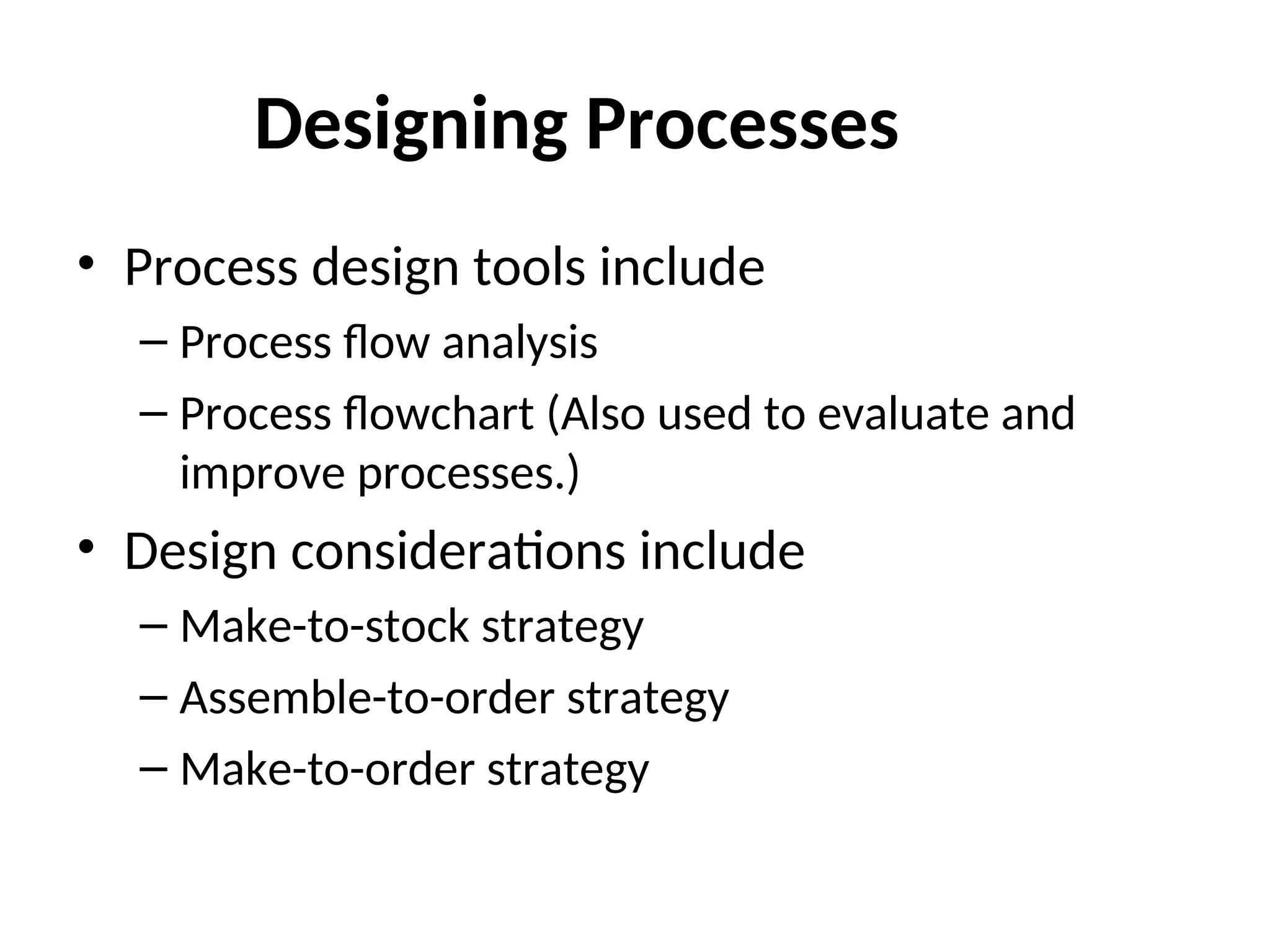
Designing Processes
• Process design tools include
– Process flow analysis
– Process flowchart (Also used to evaluate and
improve processes.)
• Design considerations include
– Make-to-stock strategy
– Assemble-to-order strategy
– Make-to-order strategy
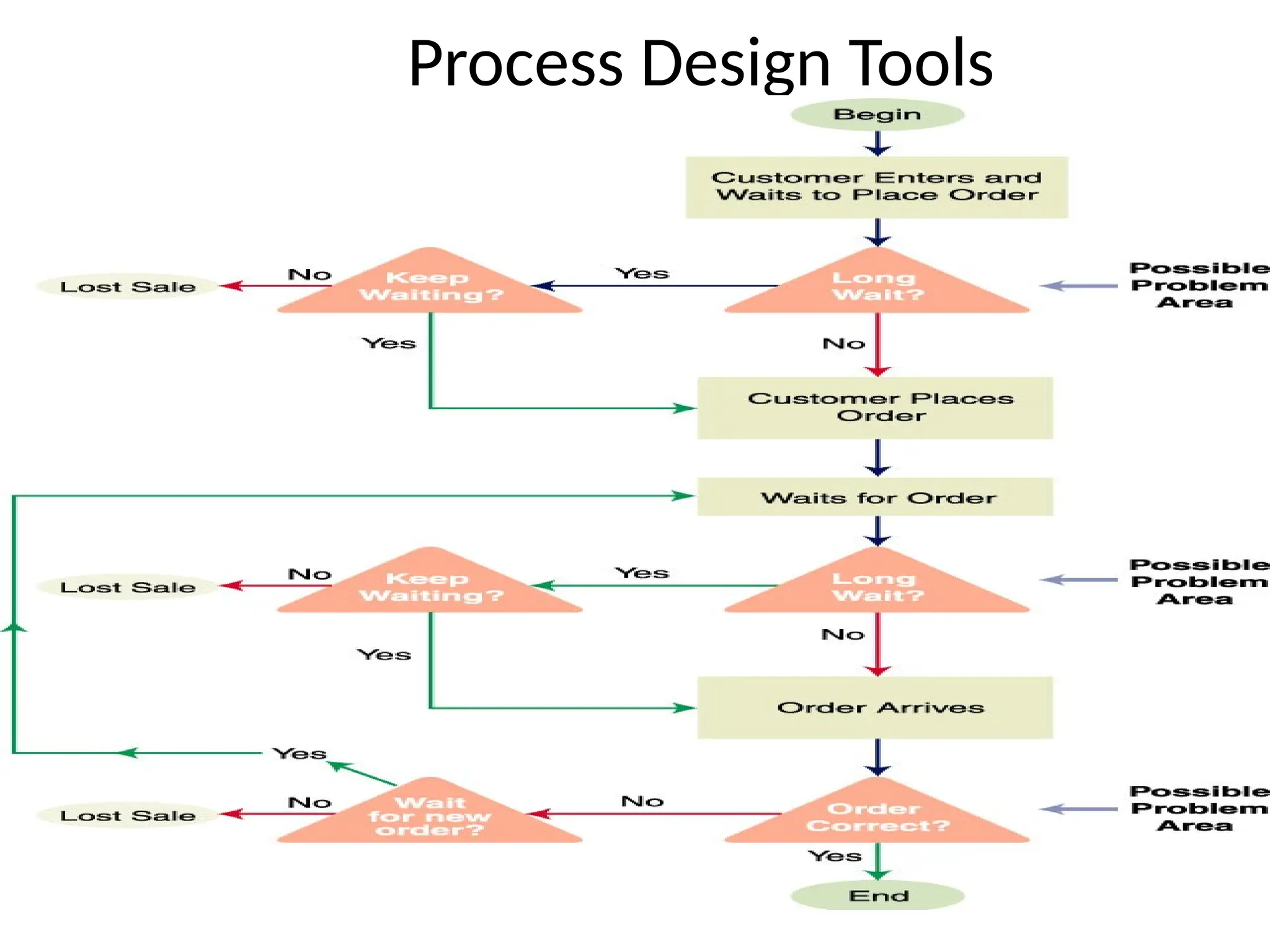
Process Design Tools
• Process flow analysis is a tool used to analyze and
document the sequence of steps within a total
process. Usually first step in Process Reengineering.
• Process Re-engineering is a structured
approach used when major business changes
are required as a result of:
– Major new products
– Quality improvement needed
– Better competitors
– Inadequate performance
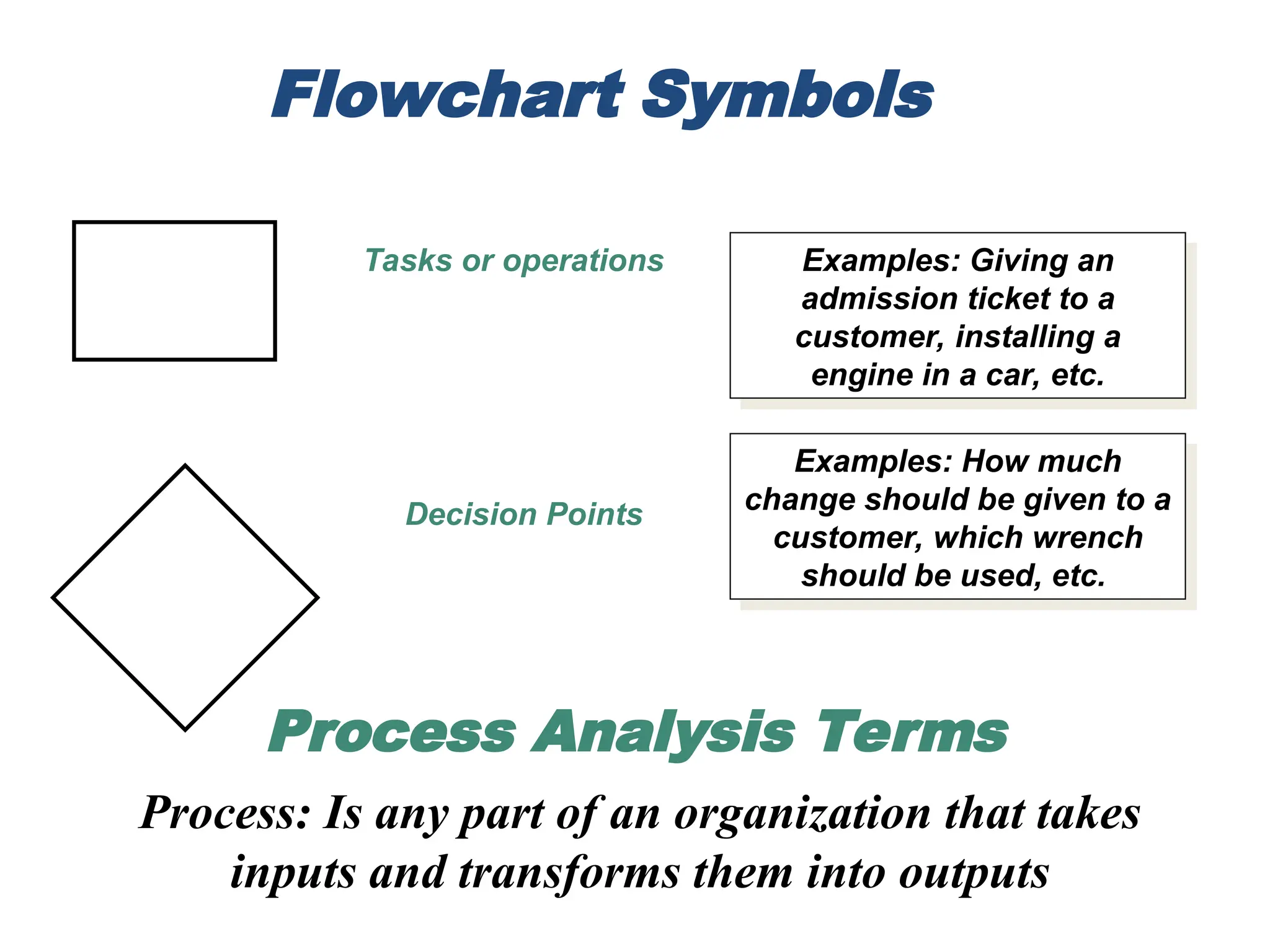
Flowchart Symbols
Tasks or operations Examples: Giving an
admission ticket to a
customer, installing a
engine in a car, etc.
Decision Points
Examples: How much
change should be given to a
customer, which wrench
should be used, etc.
Process Analysis Terms
Process: Is any part of an organization that takes
inputs and transforms them into outputs
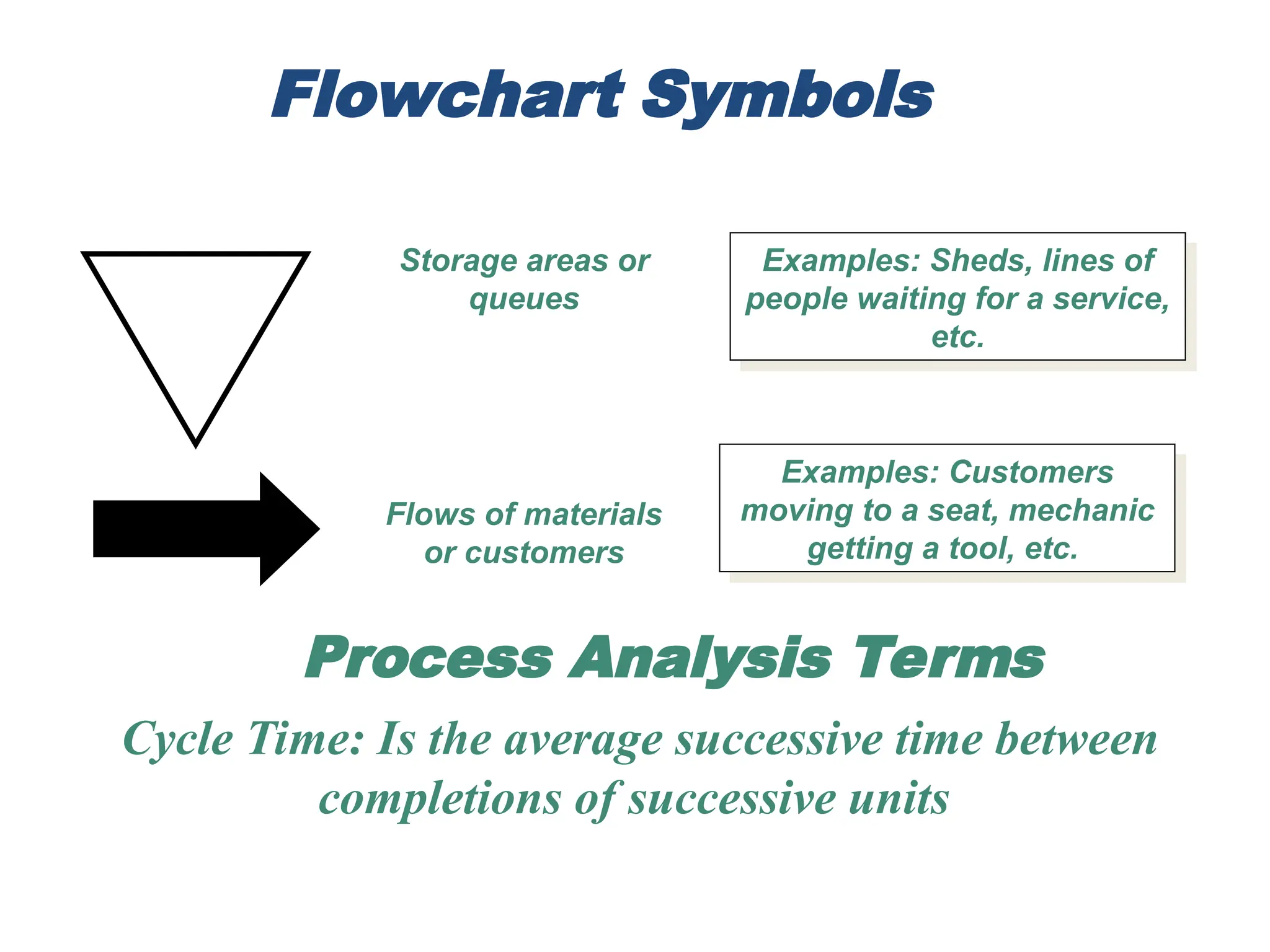
Examples: Sheds, lines of
people waiting for a service,
etc.
Examples: Customers
moving to a seat, mechanic
getting a tool, etc.
Storage areas or
queues
Flows of materials
or customers
Flowchart Symbols
Process Analysis Terms
Cycle Time: Is the average successive time between
completions of successive units
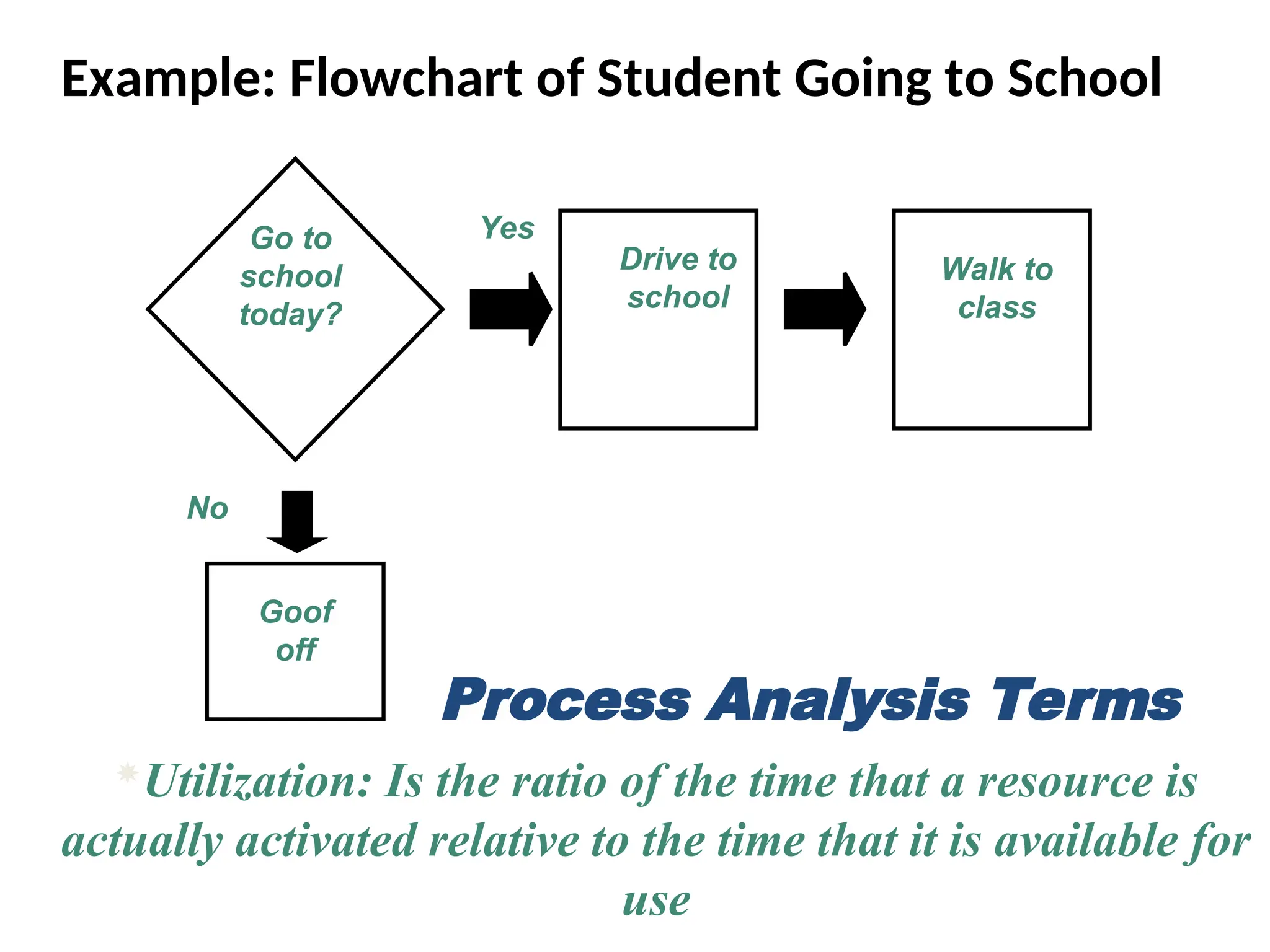
Example: Flowchart of Student Going to School
Yes
No
Goof
off
Go to
school
today?
Walk to
class
Drive to
school
Process Analysis Terms
Utilization: Is the ratio of the time that a resource is
actually activated relative to the time that it is available for
use
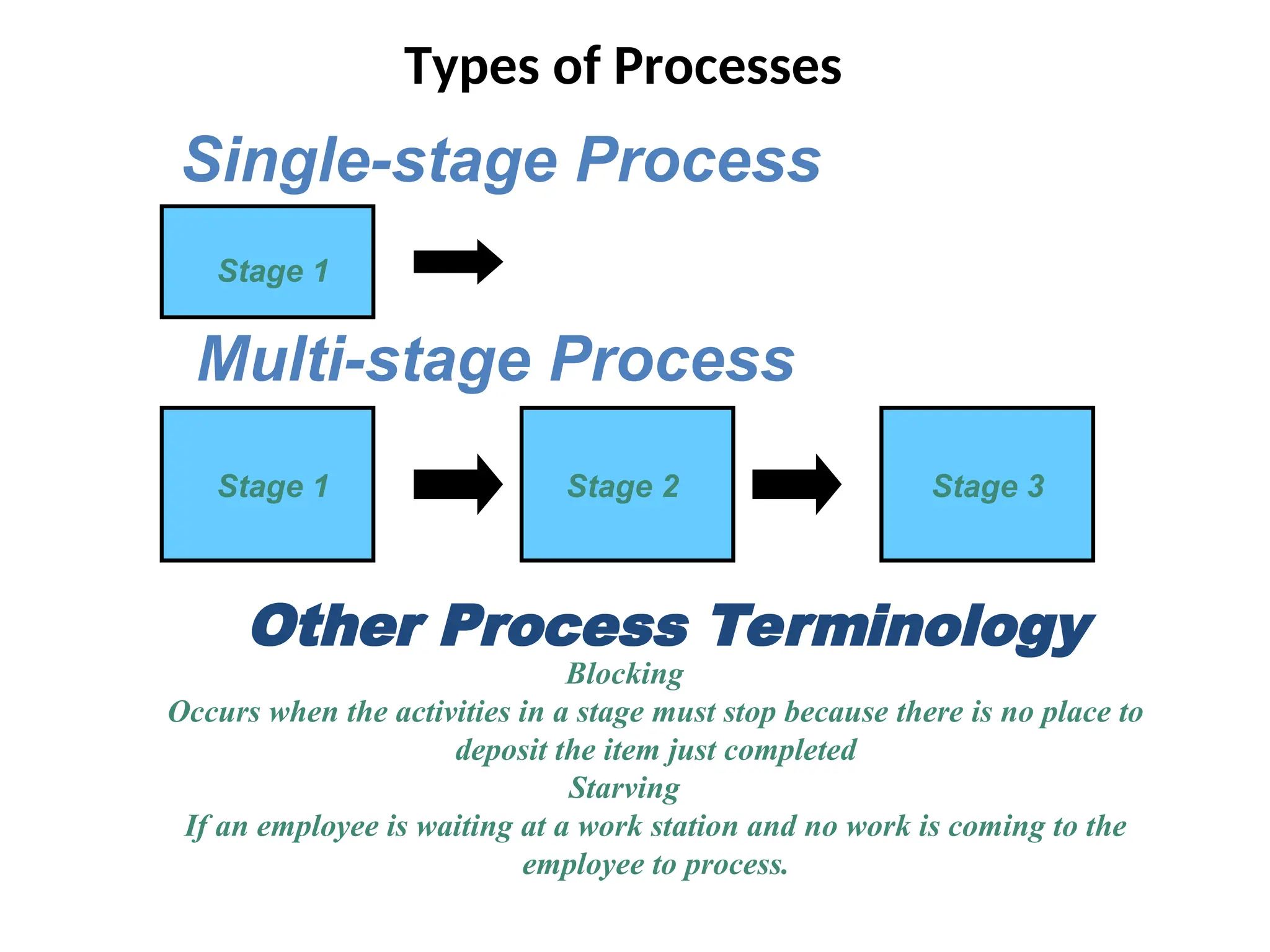
Types of Processes
Single-stage Process
Stage 1
Stage 1 Stage 2 Stage 3
Multi-stage Process
Other Process Terminology
Blocking
Occurs when the activities in a stage must stop because there is no place to
deposit the item just completed
Starving
If an employee is waiting at a work station and no work is coming to the
employee to process.
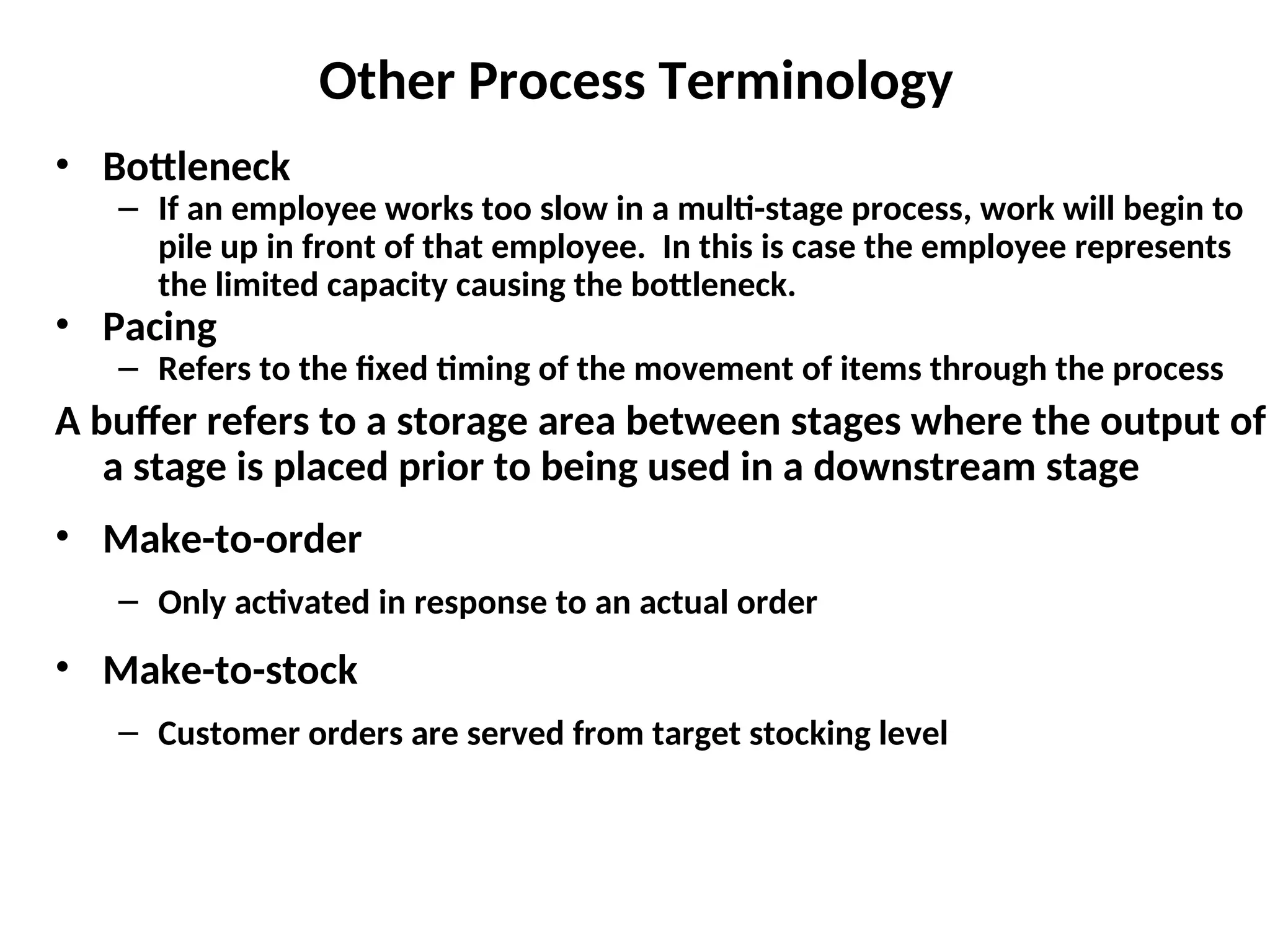
Other Process Terminology
• Bottleneck
– If an employee works too slow in a multi-stage process, work will begin to
pile up in front of that employee. In this is case the employee represents
the limited capacity causing the bottleneck.
• Pacing
– Refers to the fixed timing of the movement of items through the process
A buffer refers to a storage area between stages where the output of
a stage is placed prior to being used in a downstream stage
• Make-to-order
– Only activated in response to an actual order
• Make-to-stock
– Customer orders are served from target stocking level
Process Design Tools
© 2007 Wiley
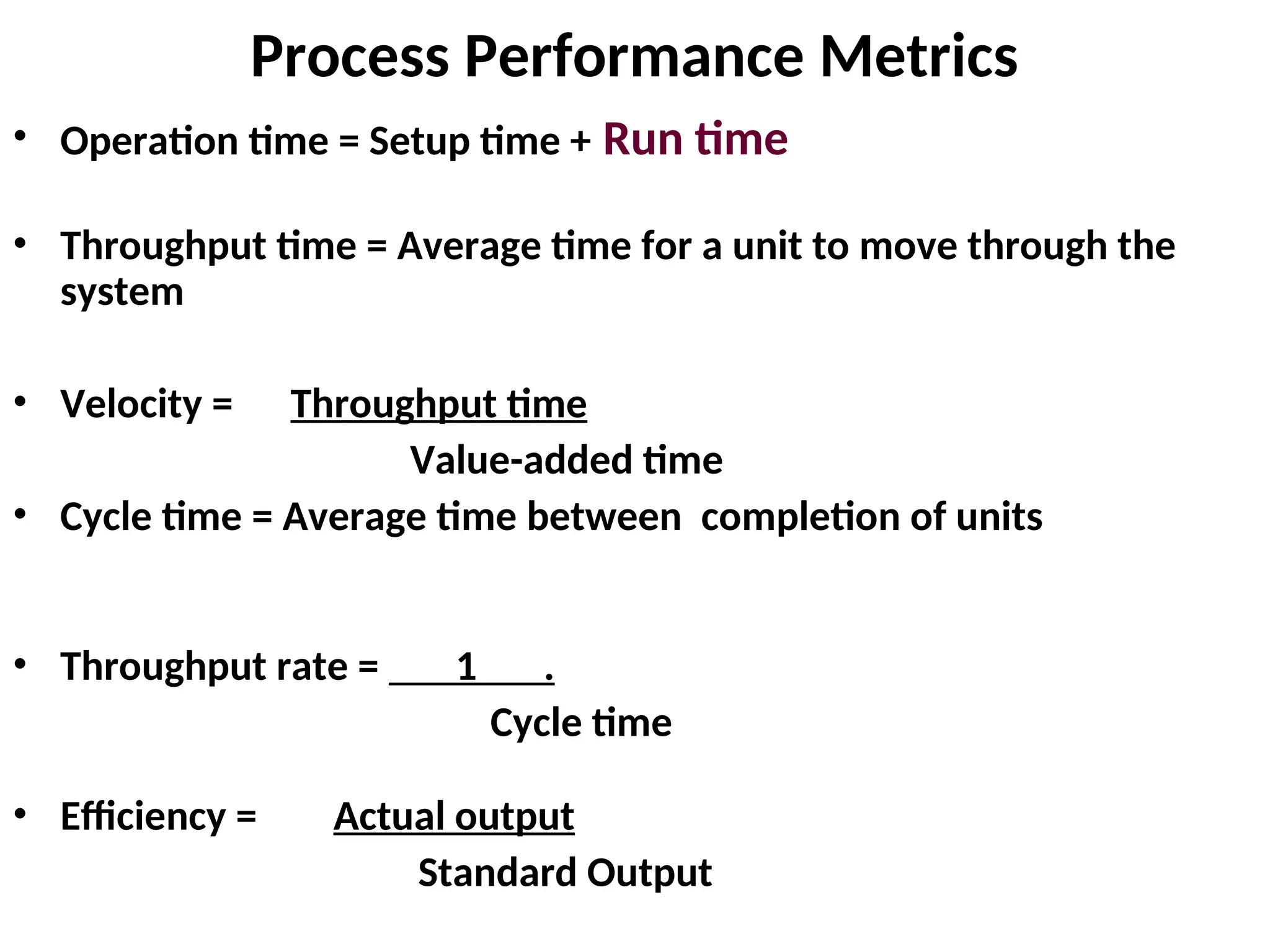
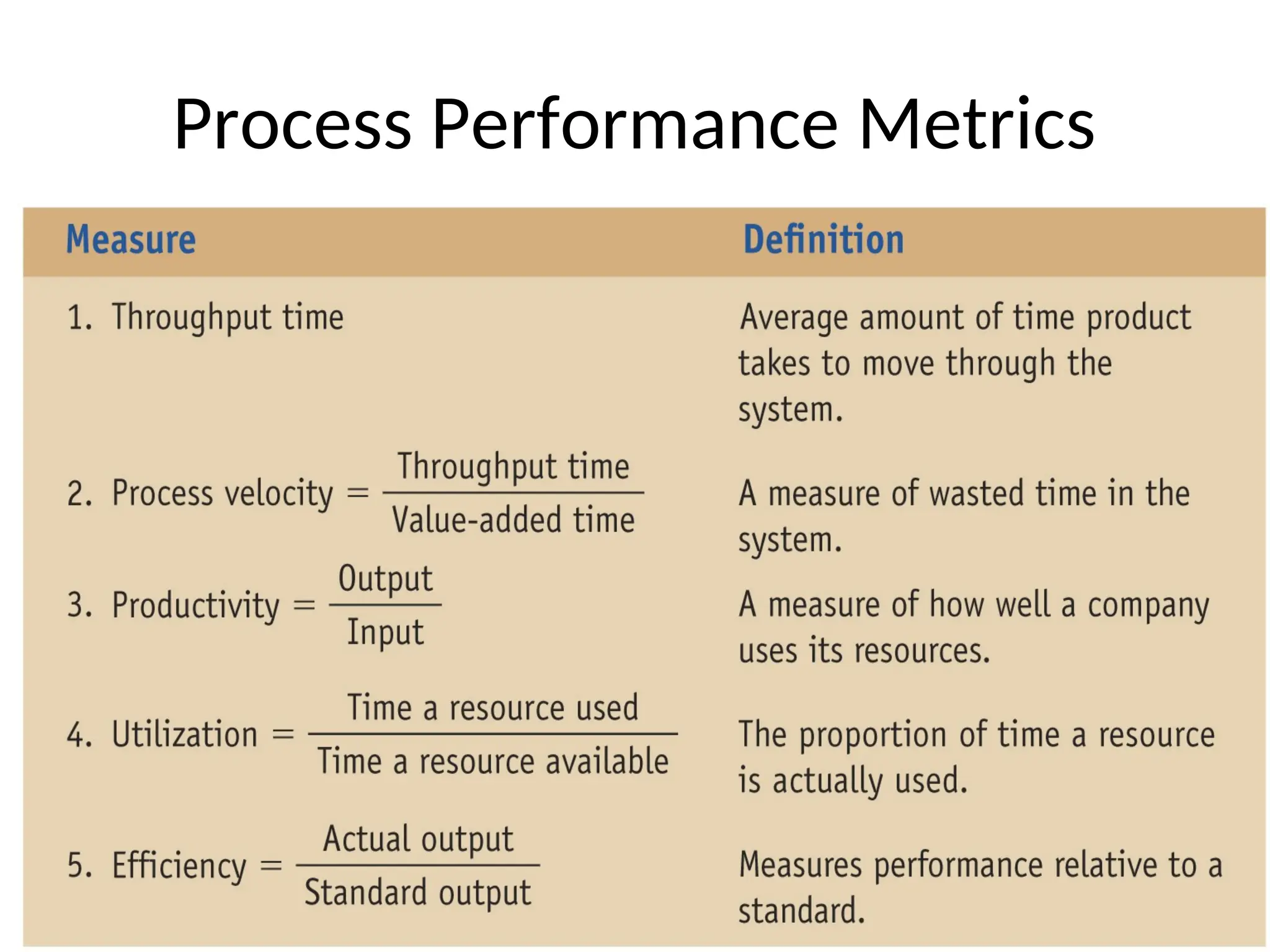
Process Performance Metrics
• Operation time = Setup time + Run time
• Throughput time = Average time for a unit to move through the
system
• Velocity = Throughput time
Value-added time
• Cycle time = Average time between completion of units
• Throughput rate = 1 .
Cycle time
• Efficiency = Actual output
Standard Output
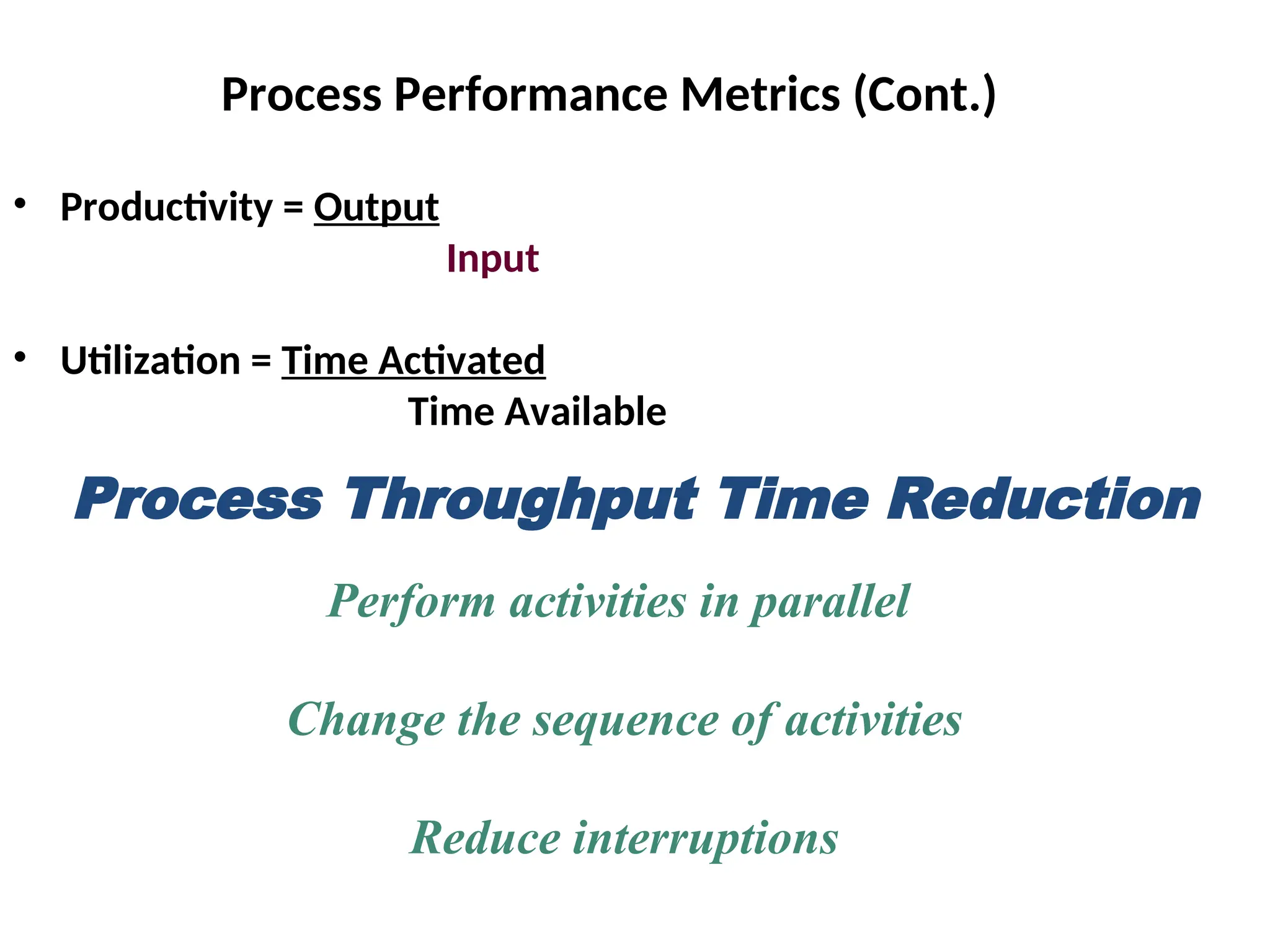
Process Performance Metrics (Cont.)
• Productivity = Output
Input
• Utilization = Time Activated
Time Available
Process Throughput Time Reduction
Perform activities in parallel
Change the sequence of activities
Reduce interruptions
Process Performance Metrics

Unit 1 II.ppt about quality management and operations

  • 1.
  • 2.
    Basic Concepts: Introduction,Operations Management Basics Product and Process Design: The Product Development Process, Analyzing a Process, Process Decision Facility Location Planning & Facility Layout: Facility Planning, Location Decisions, Facility Layout Capacity Design and Planning: Introduction - Capacity Planning, Managing Supply and Demand Production Planning: Introduction, Scheduling Productivity and Work Study: The Organization and Productivity, Job Design Materials, Purchasing & Stores Management: Materials Management, The Supply Chain,Supply Chain Performance Inventory Management: Introduction - Inventory Management, Elementary Inventory Models,Inventory Control Managing for Quality: Introduction, Statistical Control Maintenance Management: Introduction-The Maintenance Function, Maintenance Strategies, Maintenance Performance Course Outline
  • 3.
    Operations Management Organization Finance Production/ Operations Marketing  Operationsfunction consists of all activities directly related to producing goods or providing services.
  • 4.
  • 5.
    Examples of operations: Operations Goods Production  Storage / Transportation  Exchange  Entertainment  Communication Examples  Farming, Mining, Construction, Manufacturing, Power Generation  Warehousing, Trucking, Mail Service, Moving, Taxis, Buses, Hotels, Airlines  Retailing, Wholesaling, Banking, Renting, Leasing, Library, Loans  Films, Radio, Television, Concerts, Recordings  Newspapers, Radio and Television, Newscasts, Telephone, Satellites
  • 6.
    Definitions • Operations managementis the management of an organization’s productive resources or its production system. • A production system takes inputs and converts them into outputs. • The conversion process is the predominant activity of a production system. • The primary concern of an operations manager is the activities of the conversion process.
  • 7.
    Value added The differencebetween the cost of inputs and the value or price of outputs. Value added Inputs Material Labor Capital Outputs Goods Services Transformation / Conversion Process Control Feedback Feedback Feedback
  • 8.
    What is OperationsManagement? Defined Operations management (OM) is defined as the design, operation, and improvement of the systems that create and deliver the firm’s primary products and services
  • 9.
    The Importance ofOperations Management • Synergies must exist with other functional areas of the organization • Operations account for 60-80% of the direct expenses that burden a firm’s profit.
  • 10.
    The historical developmentof operations management • Operations in some form has been around as long as human endeavor itself but, in manufacturing at least, it has changed dramatically over time
  • 11.
    Three Major Phases Craftmanufacturing • Craft manufacturing describes the process by which skilled craftspeople produce goods in low volume, with a high degree of variety, to meet the requirements of their individual customers.
  • 12.
    Mass production • Inmany industries, craft manufacturing began to be replaced by mass production in the 19th century. Mass production involves producing goods in high volume with low variety – the opposite of craft manufacturing.
  • 13.
    Mass Production(Innovations 1) •Standardization: • An important innovation in operations that made mass production possible was the system of standardised and interchangeable parts known as the ‘American system of manufacture’, which developed in the United States and spread to the United Kingdom and other countries.
  • 14.
    Mass production(Innovations 2) ScientificManagement: • A second innovation was the development by Frederick Taylor (1911) of the system of 'scientific management’, which sought to redesign jobs using similar principles to those used in designing machines.
  • 15.
    Mass Production(Innovations 3) MovingAssembly Line: • A third innovation was the development of the moving assembly line by Henry Ford. Instead of workers bringing all the parts and tools to a fixed location where one car was put together at a time, the assembly line brought the cars to the workers.
  • 16.
    Mass Production (innut shell) • A system through which large volumes of standardized products could be assembled by unskilled workers at constantly decreasing costs .
  • 17.
    Modern Period • Duringthe 1970s, markets became highly fragmented, product life cycles reduced dramatically and consumers had far greater choice than ever before. • TQM • JIT • SCM
  • 18.
    Modern Period(Different Approaches) •Flexible specialization • Lean production • Mass customization • Agile manufacturing
  • 19.
    Modern Period(in anutshell) • These approaches all seek to combine the high volume and low cost associated with mass production with the craft production.
  • 20.
  • 21.
  • 22.
    Input Some inputs areused up in the process of creating goods or services; others play a part in the creation process but are not used up. To distinguish between these, input resources are usually classified as: • Transformed Resources • Transforming Resources
  • 23.
    Input Three types ofresource that may be transformed in operations are: • Materials • Information • customers
  • 24.
    Input The two typesof transforming resource are: • staff • facilities
  • 25.
    Output • The principaloutputs of a doctor's surgery are cured patients; the outputs of a nuclear reprocessing plant include reprocessed fuel and nuclear waste. Many transformation processes produce both goods and services. For example, a restaurant provides a service, but also produces goods such as food and drinks. • Transformation processes may result in some undesirable outputs (such as nuclear waste)
  • 26.
  • 27.
    Transformations • Physical--manufacturing • Locational--transportation •Exchange--retailing • Storage--warehousing • Physiological--health care • Informational--telecommunications Transformation Process A transformation process is defined as a user of resources to transform inputs into some desired outputs
  • 28.
    Transformation Process One usefulway of categorising different types of transformation is into: • manufacture • transport • supply • service
  • 29.
    Feedback Feedback information isused to control the operations system, by adjusting the inputs and transformation processes that are used to achieve desired outputs.
  • 30.
    Random Disturbances • Itis unplanned or uncontrollable environmental influences. • It causes planned and actual output to differ. Examples:- Weather Inflation Equipment breakdown Government controls
  • 31.
    Activity Organisation Inputs OutputsRandom Feedback Disturbances Restaurant MBA Institute Refrigerator Mfc.
  • 32.
    Boundary Of Operations •suppliers • customers • the environment.
  • 33.
  • 34.
    Product • People buy,want satisfaction, not objects. • Example: Consumers buy televisions because they want entertainment, not because they want a box with a screen. • Product Bundle of physical, service, and symbolic attributes designed to satisfy a customer’s wants and needs
  • 35.
    Goods & Services •Services Intangible tasks that satisfy the needs of consumer and business users. • Goods Tangible products that customers can see, hear, smell, taste, or touch.
  • 36.
    Products & Services •Purely Manufacturing organizations do not just sell a product but provides services also. • Pure service industries such as banks , hospitals , education and consultancies also often provides a product.
  • 37.
    Product & Services •In manufacturing we get a tangible or identifiable product, which is obtained as a series of transformation process. • In service industry end product is often intangible. Here it is the customer that has been processed. • In services it is often the process that are bought rather than the product. • Some organizations may be considered as hybrid. Example :Restaurant Flying in an aeroplane.
  • 39.
    Role of aoperations manager
  • 40.
    Human resource management Thepeople employed by an organization either work directly to create a good or service or provide support to those who do. People and the way they are managed are a key resource of all organizations.
  • 41.
    Asset management • Anorganization's buildings, facilities, equipment and stock are directly involved in or support the operations function
  • 42.
    Break Even Analysis BreakEven Analysis is the concept that links capacity to cost.It explains the significance of having greater productive capacity to lower cost and maximize profit or contribution. Breakeven point is that at which the contribution margin is able to cover total fixed cost.
  • 43.
    Break Even Analysis Let: F-Fixedcost of production v-variable cost of production per unit. p-selling price of per unit of the product. c-contribution of one unit of product towards fixed cost. S-sales volume required to achieve break even. Contibution margin c=p-v BEP S=F/c
  • 44.
    Cost management Most ofthe costs of producing goods or services are directly related to the costs of acquiring resources, transforming them or delivering them to customers
  • 45.
    Decision making Decisions needto be made in: • designing the operations system • managing the operations system • improving the operations system.
  • 46.
    Decision making The fivemain kinds of decision in each of these relate to: • the processes by which goods and services are produced • the quality of goods or services • the quantity of goods or services (the capacity of operations) • the stock of materials (inventory) needed to produce goods or services • the management of human resources.
  • 47.
  • 48.
    PURPOSE OF DESIGN •Produce a technological solution to a need! – Create a physically recognizable object. – Create an object with economic worth and financial feasibility. – Choose an optimum alternative solution. – Develop a new way to do something. – Reduce cost, inconvenience, improve safety. – Produce convenience, service, value.
  • 49.
    Product Design – Productdesign must support product manufacturability (the ease with which a product can be made) – Product design defines a product’s characteristics of; • appearance, • materials, • dimensions, • tolerances, and • performance standards
  • 50.
    Design of Servicesversus Goods • Service design is unique in that the service and entire service concept are being designed – must define both the service and concept - Physical elements, aesthetic & psychological benefits e.g. promptness, friendliness, ambiance
  • 51.
    The four “C’sof Design • Creativity – Requires creation of something that has not existed or not existed in the proposed state. • Complexity – Requires decisions on many variables & parameters • Choice – Requires making choices between many possible solutions at all levels, from basic concept to small details. • Compromise – Requires balancing multiple and sometimes conflicting requirements.
  • 52.
  • 53.
    Factors Influencing Process Choices Volume: Average quantity of the products produced in a manufacturing system – Low volume: Turnkey project management firms such as L&T and BHEL – High volume: Consumer non-durable and FMCG sector firms, Automobile, Chemical Processing – Mid-volume: Consumer durables, white goods and several industrial products  Variety: Number of alternative products and variants of each product that is offered by a manufacturing system – Variety of product offerings is likely to introduce variety at various processes in the system; alternative production resources, materials, and skill of workers  Flow: Flow indicates the nature and intensity of activities involved in conversion of components and material from raw material stage to finished goods stage
  • 54.
    Relationship between volume andvariety Volume Variety Mass Production Petrochemicals, Automobile Project Organisations Turnkey Project Execution Mid volume Mid variety Motor Manufacturing Pharmaceuticals High High
  • 55.
    Processes & Operations Systems AvailableAlternatives Two broad process classifications include Intermittent operations – produce a variety of products in lower volumes Repetitive operations – produce one or a few standardized products in high volume
  • 56.
    Process Selection • Processselection is based on five considerations – Type of process; range from intermittent to continuous – Degree of vertical integration – Flexibility of resources – Mix between capital & human resources – Degree of customer contact
  • 57.
    Process Selection • Processtypes can be: – Project process /Job Shop– make a one-at-a-time product exactly to customer specifications – Batch process – small quantities of product in groups or batches based on customer orders or specifications
  • 58.
    Process Selection – Lineprocess – large quantities of a standard product – Continuous process – very high volumes of a fully standard product
  • 59.
  • 60.
  • 61.
  • 62.
  • 63.
  • 64.
    Underlying Process RelationshipBetween Volume and Standardization Continuum
  • 65.
    Differences between Intermittentand Repetitive Operations Decision Intermittent Operation Repetitive Operation Product variety Great Small Degree of standardization Low High Organization of resources Grouped by Function Line flow Path of products Varied, depends on product Line flow Factor driving production Customer orders Forecast of demand Critical resource Labor Capital Type of equipment General purpose Specialized Degree of automation Low High Throughput time Longer Shorter Work-in-process inventory More Less
  • 66.
    Designing Processes • Processdesign tools include – Process flow analysis – Process flowchart (Also used to evaluate and improve processes.) • Design considerations include – Make-to-stock strategy – Assemble-to-order strategy – Make-to-order strategy
  • 67.
    Process Design Tools •Process flow analysis is a tool used to analyze and document the sequence of steps within a total process. Usually first step in Process Reengineering. • Process Re-engineering is a structured approach used when major business changes are required as a result of: – Major new products – Quality improvement needed – Better competitors – Inadequate performance
  • 68.
    Flowchart Symbols Tasks oroperations Examples: Giving an admission ticket to a customer, installing a engine in a car, etc. Decision Points Examples: How much change should be given to a customer, which wrench should be used, etc. Process Analysis Terms Process: Is any part of an organization that takes inputs and transforms them into outputs
  • 69.
    Examples: Sheds, linesof people waiting for a service, etc. Examples: Customers moving to a seat, mechanic getting a tool, etc. Storage areas or queues Flows of materials or customers Flowchart Symbols Process Analysis Terms Cycle Time: Is the average successive time between completions of successive units
  • 70.
    Example: Flowchart ofStudent Going to School Yes No Goof off Go to school today? Walk to class Drive to school Process Analysis Terms Utilization: Is the ratio of the time that a resource is actually activated relative to the time that it is available for use
  • 71.
    Types of Processes Single-stageProcess Stage 1 Stage 1 Stage 2 Stage 3 Multi-stage Process Other Process Terminology Blocking Occurs when the activities in a stage must stop because there is no place to deposit the item just completed Starving If an employee is waiting at a work station and no work is coming to the employee to process.
  • 72.
    Other Process Terminology •Bottleneck – If an employee works too slow in a multi-stage process, work will begin to pile up in front of that employee. In this is case the employee represents the limited capacity causing the bottleneck. • Pacing – Refers to the fixed timing of the movement of items through the process A buffer refers to a storage area between stages where the output of a stage is placed prior to being used in a downstream stage • Make-to-order – Only activated in response to an actual order • Make-to-stock – Customer orders are served from target stocking level
  • 73.
  • 74.
    Process Performance Metrics •Operation time = Setup time + Run time • Throughput time = Average time for a unit to move through the system • Velocity = Throughput time Value-added time • Cycle time = Average time between completion of units • Throughput rate = 1 . Cycle time • Efficiency = Actual output Standard Output
  • 75.
    Process Performance Metrics(Cont.) • Productivity = Output Input • Utilization = Time Activated Time Available Process Throughput Time Reduction Perform activities in parallel Change the sequence of activities Reduce interruptions
  • 76.