Operation
       in
Service Industry


                          By
                   Praveen Sidola
Role of Services in an
Economy
 Services are deeds, processes, and performances.
                           Valarie Zeithaml & Mary Jo Bitner

  A service is a time-perishable, intangible experience
 performed for a customer acting in the role of a co-producer.
                                      James Fitzsimmons


   Service enterprises are organizations that facilitate the production
   and distribution of goods, support other firms in meeting their goals,
   and add value to our personal lives.
                                                      James Fitzsimmons
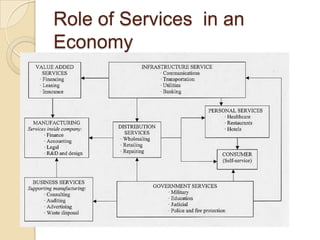
Role of Services in an
Economy
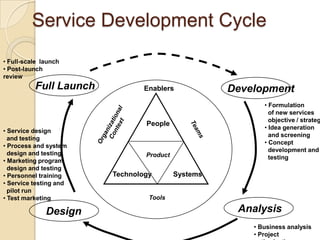
Service Development Cycle
• Full-scale launch
• Post-launch
review
          Full Launch           Enablers            Development
                                                           • Formulation
                                                             of new services
                                                             objective / strateg
                                People
                                                           • Idea generation
• Service design
                                                             and screening
  and testing
                                                           • Concept
• Process and system
                                                             development and
  design and testing            Product                      testing
• Marketing program
  design and testing
• Personnel training    Technology        Systems
• Service testing and
  pilot run
• Test marketing                 Tools

              Design                                 Analysis
                                                        • Business analysis
                                                        • Project
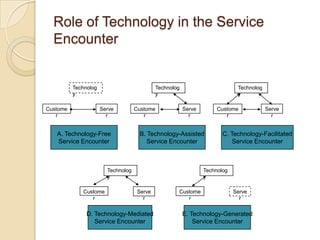
Role of Technology in the Service
  Encounter


          Technolog                          Technolog                        Technolog
          y                                  y                                y

Custome               Serve         Custome              Serve        Custome             Serve
   r                    r              r                   r             r                  r


   A. Technology-Free                B. Technology-Assisted             C. Technology-Facilitated
   Service Encounter                    Service Encounter                   Service Encounter


                        Technolog                                Technolog
                        y                                        y

             Custome                 Serve           Custome                 Serve
                r                      r                r                      r


               D. Technology-Mediated                    E. Technology-Generated
                  Service Encounter                          Service Encounter
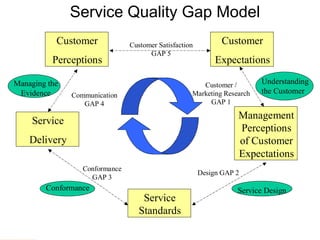
Service Quality Gap Model
          Service Quality GapCustomer
          Customer
                              Model
                                Customer Satisfaction
                                      GAP 5
          Perceptions                                        Expectations

Managing the                                           Customer /        Understanding
 Evidence                                           Marketing Research   the Customer
               Communication
                  GAP 4                                  GAP 1

                                                                   Management
    Service
                                                                   Perceptions
    Delivery                                                       of Customer
                                                                   Expectations
                  Conformance
                                                        Design GAP 2
                    GAP 3
        Conformance                                                Service Design
                                    Service
                                   Standards
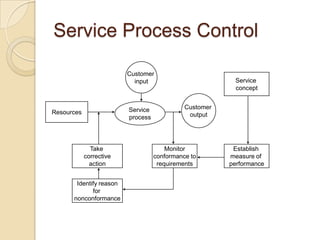
Service Process Control

                         Customer
                           input                         Service
                                                         concept


                         Service             Customer
Resources                                     output
                         process


              Take                     Monitor           Establish
            corrective             conformance to       measure of
              action                requirements        performance


       Identify reason
             for
      nonconformance
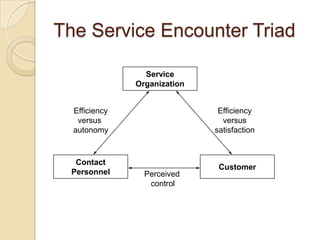
The Service Encounter Triad

                 Service
               Organization


  Efficiency                   Efficiency
   versus                       versus
  autonomy                    satisfaction


  Contact
                               Customer
 Personnel       Perceived
                  control
Process Analysis Terminology
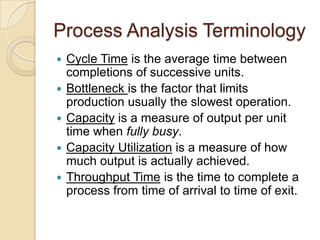
   Cycle Time is the average time between
    completions of successive units.
   Bottleneck is the factor that limits
    production usually the slowest operation.
   Capacity is a measure of output per unit
    time when fully busy.
   Capacity Utilization is a measure of how
    much output is actually achieved.
   Throughput Time is the time to complete a
    process from time of arrival to time of exit.
Process Analysis Terminology
(cont.)
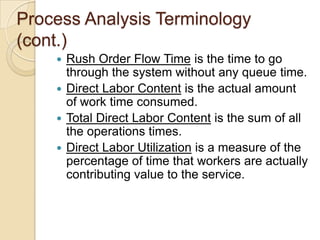
     Rush Order Flow Time is the time to go
      through the system without any queue time.
     Direct Labor Content is the actual amount
      of work time consumed.
     Total Direct Labor Content is the sum of all
      the operations times.
     Direct Labor Utilization is a measure of the
      percentage of time that workers are actually
      contributing value to the service.
Forecasting Models
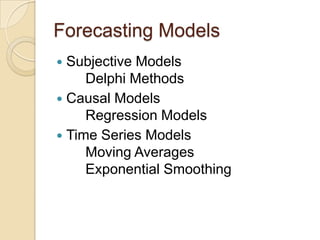
 Subjective Models
     Delphi Methods
 Causal Models
     Regression Models
 Time Series Models
     Moving Averages
     Exponential Smoothing
Strategies for Matching Supply
        and Demand for Services

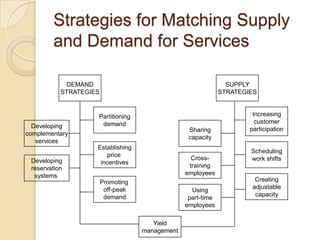
            DEMAND                                              SUPPLY
           STRATEGIES                                         STRATEGIES


                    Partitioning                                       Increasing
                     demand                                             customer
  Developing                                                          participation
                                                  Sharing
complementary
                                                  capacity
   services
                    Establishing
                                                                      Scheduling
                       price
 Developing                                        Cross-             work shifts
                     incentives
 reservation                                      training
  systems                                        employees
                        Promoting                                       Creating
                         off-peak                                      adjustable
                                                   Using
                         demand                                         capacity
                                                  part-time
                                                 employees

                                       Yield
                                    management
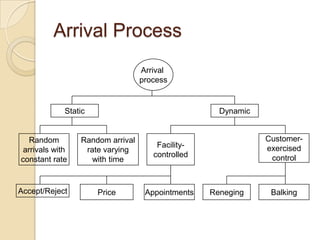
Arrival Process
                                  Arrival
                                  process


             Static                                 Dynamic


   Random        Random arrival                               Customer-
                                      Facility-               exercised
 arrivals with    rate varying
                                     controlled                control
constant rate       with time


Accept/Reject         Price        Appointments   Reneging     Balking
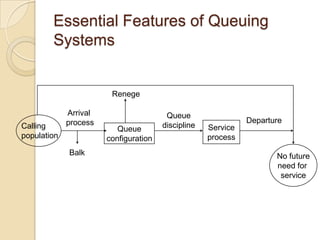
Essential Features of Queuing
        Systems


                        Renege

             Arrival                    Queue
             process                                          Departure
Calling                   Queue        discipline   Service
population             configuration                process
             Balk                                                    No future
                                                                     need for
                                                                      service
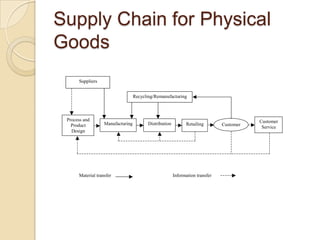
Supply Chain for Physical
Goods
      Suppliers


                                   Recycling/Remanufacturing


 Process and                                                                               Customer
   Product         Manufacturing          Distribution         Retailing        Customer
                                                                                            Service
   Design


      Material transfer                                  Information transfer
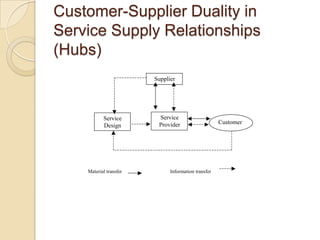
Customer-Supplier Duality in
Service Supply Relationships
(Hubs)
                        Supplier


           Service       Service
                         Provider                    Customer
           Design


    Material transfer         Information transfer
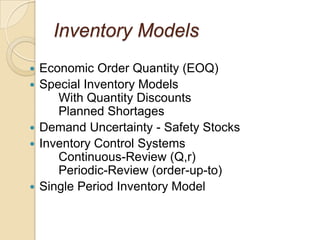
Inventory Models
   Economic Order Quantity (EOQ)
   Special Inventory Models
       With Quantity Discounts
       Planned Shortages
   Demand Uncertainty - Safety Stocks
   Inventory Control Systems
       Continuous-Review (Q,r)
       Periodic-Review (order-up-to)
   Single Period Inventory Model
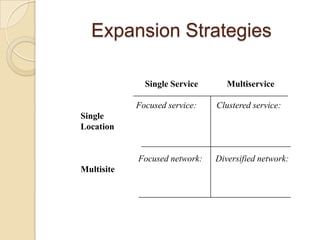
Expansion Strategies

              Single Service      Multiservice

            Focused service:   Clustered service:
Single
Location


            Focused network:   Diversified network:
Multisite
Reference
 Service Management: Operations, Strategy,
  Information Technology
  By - James Fitzsimmons
 Service Management—Academic Issues and
  Scholarly Reflections from Operations
  Management Researchers.
  By - Metters, Richard, Marucheck, Ann1
Operation in service sector

Operation in service sector

  • 1.
    Operation in Service Industry By Praveen Sidola
  • 2.
    Role of Servicesin an Economy Services are deeds, processes, and performances. Valarie Zeithaml & Mary Jo Bitner A service is a time-perishable, intangible experience performed for a customer acting in the role of a co-producer. James Fitzsimmons Service enterprises are organizations that facilitate the production and distribution of goods, support other firms in meeting their goals, and add value to our personal lives. James Fitzsimmons
  • 3.
    Role of Servicesin an Economy
  • 4.
    Service Development Cycle •Full-scale launch • Post-launch review Full Launch Enablers Development • Formulation of new services objective / strateg People • Idea generation • Service design and screening and testing • Concept • Process and system development and design and testing Product testing • Marketing program design and testing • Personnel training Technology Systems • Service testing and pilot run • Test marketing Tools Design Analysis • Business analysis • Project
  • 5.
    Role of Technologyin the Service Encounter Technolog Technolog Technolog y y y Custome Serve Custome Serve Custome Serve r r r r r r A. Technology-Free B. Technology-Assisted C. Technology-Facilitated Service Encounter Service Encounter Service Encounter Technolog Technolog y y Custome Serve Custome Serve r r r r D. Technology-Mediated E. Technology-Generated Service Encounter Service Encounter
  • 6.
    Service Quality GapModel Service Quality GapCustomer Customer Model Customer Satisfaction GAP 5 Perceptions Expectations Managing the Customer / Understanding Evidence Marketing Research the Customer Communication GAP 4 GAP 1 Management Service Perceptions Delivery of Customer Expectations Conformance Design GAP 2 GAP 3 Conformance Service Design Service Standards
  • 7.
    Service Process Control Customer input Service concept Service Customer Resources output process Take Monitor Establish corrective conformance to measure of action requirements performance Identify reason for nonconformance
  • 8.
    The Service EncounterTriad Service Organization Efficiency Efficiency versus versus autonomy satisfaction Contact Customer Personnel Perceived control
  • 9.
    Process Analysis Terminology  Cycle Time is the average time between completions of successive units.  Bottleneck is the factor that limits production usually the slowest operation.  Capacity is a measure of output per unit time when fully busy.  Capacity Utilization is a measure of how much output is actually achieved.  Throughput Time is the time to complete a process from time of arrival to time of exit.
  • 10.
    Process Analysis Terminology (cont.)  Rush Order Flow Time is the time to go through the system without any queue time.  Direct Labor Content is the actual amount of work time consumed.  Total Direct Labor Content is the sum of all the operations times.  Direct Labor Utilization is a measure of the percentage of time that workers are actually contributing value to the service.
  • 11.
    Forecasting Models  SubjectiveModels Delphi Methods  Causal Models Regression Models  Time Series Models Moving Averages Exponential Smoothing
  • 12.
    Strategies for MatchingSupply and Demand for Services DEMAND SUPPLY STRATEGIES STRATEGIES Partitioning Increasing demand customer Developing participation Sharing complementary capacity services Establishing Scheduling price Developing Cross- work shifts incentives reservation training systems employees Promoting Creating off-peak adjustable Using demand capacity part-time employees Yield management
  • 13.
    Arrival Process Arrival process Static Dynamic Random Random arrival Customer- Facility- exercised arrivals with rate varying controlled control constant rate with time Accept/Reject Price Appointments Reneging Balking
  • 14.
    Essential Features ofQueuing Systems Renege Arrival Queue process Departure Calling Queue discipline Service population configuration process Balk No future need for service
  • 15.
    Supply Chain forPhysical Goods Suppliers Recycling/Remanufacturing Process and Customer Product Manufacturing Distribution Retailing Customer Service Design Material transfer Information transfer
  • 16.
    Customer-Supplier Duality in ServiceSupply Relationships (Hubs) Supplier Service Service Provider Customer Design Material transfer Information transfer
  • 17.
    Inventory Models  Economic Order Quantity (EOQ)  Special Inventory Models With Quantity Discounts Planned Shortages  Demand Uncertainty - Safety Stocks  Inventory Control Systems Continuous-Review (Q,r) Periodic-Review (order-up-to)  Single Period Inventory Model
  • 18.
    Expansion Strategies Single Service Multiservice Focused service: Clustered service: Single Location Focused network: Diversified network: Multisite
  • 19.
    Reference  Service Management:Operations, Strategy, Information Technology By - James Fitzsimmons  Service Management—Academic Issues and Scholarly Reflections from Operations Management Researchers. By - Metters, Richard, Marucheck, Ann1