Introduction to Operations Management
Operations Management is: The  business function  responsible for  planning ,  coordinating , and  controlling  the  resources  needed to  produce   products  and services for a company © Wiley 2010
Operations Management is: A management function An organization’s core function In  every  organization whether Service or Manufacturing, profit or Not for profit © Wiley 2010
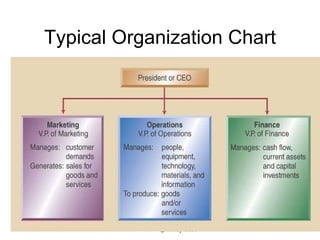
Typical Organization Chart © Wiley 2010
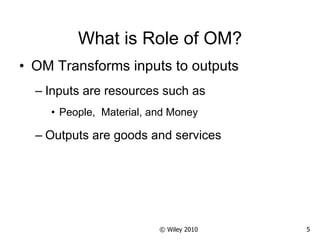
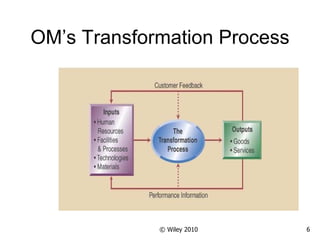
What is Role of OM? OM Transforms inputs to outputs Inputs are resources such as People,  Material, and Money Outputs are goods and services © Wiley 2010
OM’s Transformation Process © Wiley 2010
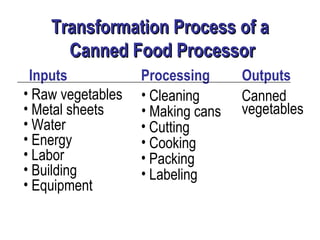
Transformation Process of a Canned  Food Processor Inputs Processing Outputs Raw vegetables Metal sheets  Water Energy Labor Building Equipment  Cleaning Canned  vegetables Making cans Cutting Cooking Packing Labeling
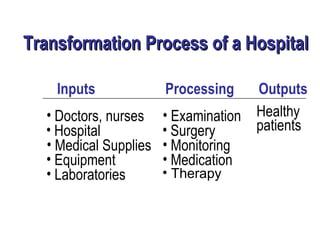
Transformation Process of a  Hospita l Inputs Processing Outputs Doctors, nurses Examination Healthy  patients Hospital Surgery Medical Supplies Monitoring Equipment Medication Laboratories Therapy
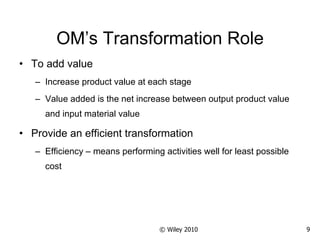
OM’s Transformation Role To add value Increase product value at each stage Value added is the net increase between output product value and input material value Provide an efficient transformation Efficiency – means performing activities well for least possible cost © Wiley 2010
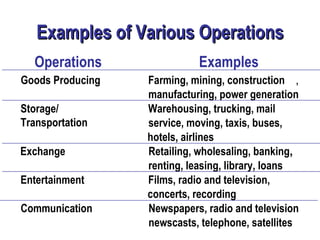
Examples  of  Various  Operations Operations Examples Goods Producing Farming, mining, construction , manufacturing, power generation Storage/ Transportation Warehousing, trucking, mail service, moving, taxis, buses, hotels, airlines Exchange Retailing, wholesaling, banking , renting, leasing, library, loans Entertainment Films, radio and television, concerts, recording Communication Newspapers, radio and television newscasts, telephone, satellites
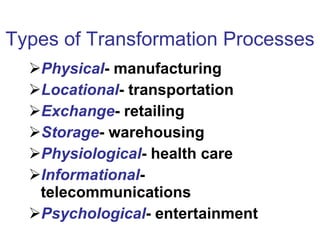
Types of Transformation Processes Physical - manufacturing Locational - transportation Exchange - retailing Storage - warehousing Physiological - health care Informational - telecommunications Psychological - entertainment
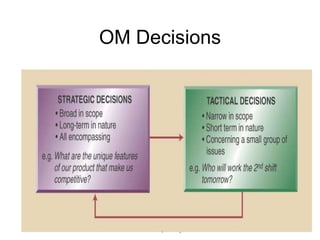
OM Decisions © Wiley 2010
The H istorical Evolution of   Operations Management
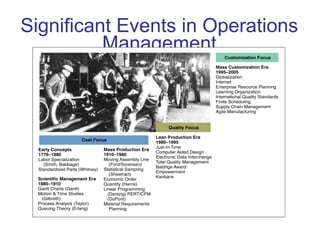
Significant Events in Operations Management
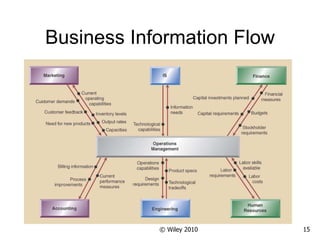
Business Information Flow © Wiley 2010
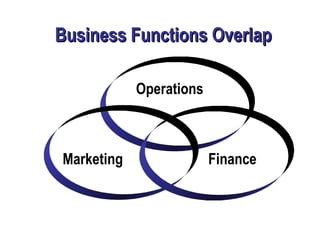
Business  Functions  Overlap Operations Finance Marketing
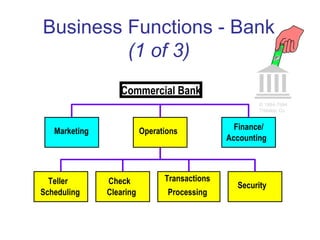
Business  Functions  -  Bank (1 of 3) Operations Finance/ Accounting Marketing Check Clearing Teller Scheduling Transactions Processing Security Commercial Bank © 1984-1994 T/Maker Co.
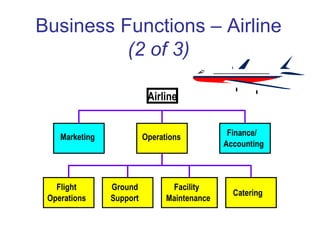
Business  Functions – Airline (2 of 3) Operations Finance/ Accounting Marketing Ground Support Flight Operations Facility Maintenance Catering Airline
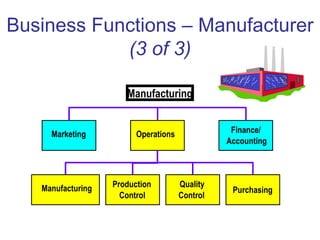
Business  Functions – Manufacturer (3 of 3) Operations Finance/ Accounting Marketing Production Control Manufacturing Quality Control Purchasing Manufacturing
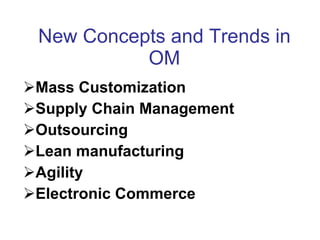
New Concepts and Trends in OM Mass Customization  Supply Chain Management Outsourcing Lean manufacturing Agility Electronic Commerce
New Concepts and Trends(1 of 6):  Mass Customization The rapid, low cost production of goods and services that fulfill constantly changing and increasingly unique customer desires.
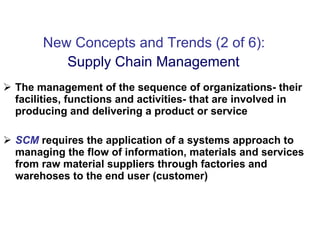
New Concepts and Trends (2 of 6):  Supply Chain Management   The management of the sequence of organizations- their facilities, functions and activities- that are involved in producing and delivering a product or service SCM   requires the application of a systems approach to managing the flow of information, materials and services from raw material suppliers through factories and warehoses to the end user (customer)
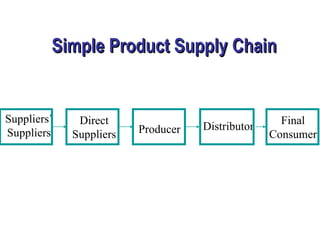
Simple Product Supply Chain Suppliers’ Suppliers Direct Suppliers Producer Distributor Final Consumer
New Concepts and Trends  (3 of 6)  :  Outsourcing Buying goods or services rather than producing goods or performing services within the organization
New Concepts and Trends  (4 of 6):   Lean Manufacturing   Systems that use minimal amounts of resources - less space, less inventory, fewer workers, fewer levels of management- to produce a high volume of high-quality goods with some variety
New Concepts and Trends  (5 of 6):   Agility   The ability of an organization to respond quickly to demands or opportunities. Involves maintaining a flexible system that can quickly respond to changes in either the volume of demand or changes in product/service offerings
New Concepts and Trends  (6 of 6):   Electronic Commerce The use of computer networks, primarily the internet, to buy and sell products, services, and information.
Other Trends  Project Management (PERT, CPM) Management of Technology  and Information Systems (GPS, ERP) Quality and Process Improvements  (Six Sigma)
Social Responsibility & Ethics
Law and Ethics Ethics –  A set of moral principles or values that governs the conduct of an individual or a group. What is lawful conduct is not always ethical conduct. The law may permit something that would be ethically wrong.
What is ethical? Is it legal? Does it cause physical/psychological harm to anyone? Is it ok if everyone knows about it? Can “I” live with it for my whole life??
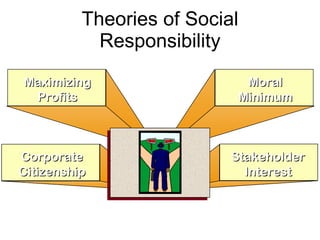
Theories of Social Responsibility Maximizing Profits Moral Minimum Stakeholder Interest Corporate Citizenship
Maximizing Profits A theory of social responsibility that says a corporation owes a duty to take actions that maximize profits for shareholders. The interests of other constituencies are not important in and of themselves.
Moral Minimum A theory of social responsibility that says a corporation’s duty is to make a profit while  avoiding harm to others . As long as business avoids or corrects the social injury it causes, it has met its duty of social responsibility.
Moral Minimum The legislative and judicial branches of government have established laws that enforce the moral minimum of social responsibility on corporations. e.g., Occupational safety laws e.g., Consumer protection laws for product safety
Stakeholder Interest A theory of social responsibility that says a corporation must consider the effects its actions have on persons  other than its stockholders . This theory is criticized because it is difficult to harmonize the conflicting interests of stakeholders.
Corporate Citizenship A theory of responsibility that says a business has a responsibility to do good for the society. Business is responsible for helping to solve social problems.
Entrepreneurship & Intrapreneurship
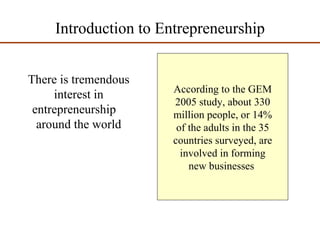
Introduction to Entrepreneurship There is tremendous interest in entrepreneurship  around the world According to the GEM 2005 study, about 330 million people, or 14% of the adults in the 35 countries surveyed, are involved in forming new businesses
What is Entrepreneurship? Capacity to take risks Ability to own and organize Desire and capability to innovate and diversify  (Stepanek, 1962)
Who is an entrepreneur? Person conducting own business  (Webster) Person who sets up business deals in order to make profits  (Collins Cobuild) Organizer of an economic venture, one who owns, organizes, manages, and assumes the risks of the business  (Chandrashekhar)
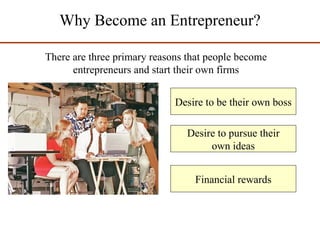
Why Become an Entrepreneur? There are three primary reasons that people become entrepreneurs and start their own firms Desire to be their own boss Financial rewards Desire to pursue their own ideas
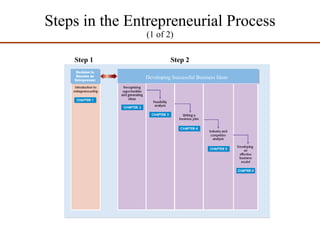
Steps in the Entrepreneurial Process (1 of 2) Step 1 Step 2 Developing Successful Business Ideas
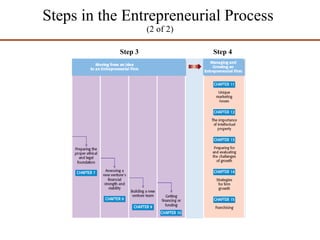
Steps in the Entrepreneurial Process  (2 of 2) Step 3 Step 4
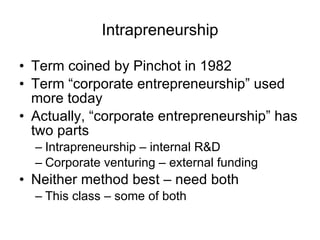
Intrapreneurship Term coined by Pinchot in 1982 Term “corporate entrepreneurship” used more today Actually, “corporate entrepreneurship” has two parts Intrapreneurship – internal R&D Corporate venturing – external funding Neither method best – need both This class – some of both
Thank You! Stay in touch: Facebook:  ProfManish Parihar Blog:  www.pariharmanish.blogspot.com E-mail:  [email_address] Cell: 9274807737

Introduction to operations management

  • 1.
  • 2.
    Operations Management is:The business function responsible for planning , coordinating , and controlling the resources needed to produce products and services for a company © Wiley 2010
  • 3.
    Operations Management is:A management function An organization’s core function In every organization whether Service or Manufacturing, profit or Not for profit © Wiley 2010
  • 4.
  • 5.
    What is Roleof OM? OM Transforms inputs to outputs Inputs are resources such as People, Material, and Money Outputs are goods and services © Wiley 2010
  • 6.
  • 7.
    Transformation Process ofa Canned Food Processor Inputs Processing Outputs Raw vegetables Metal sheets Water Energy Labor Building Equipment Cleaning Canned vegetables Making cans Cutting Cooking Packing Labeling
  • 8.
    Transformation Process ofa Hospita l Inputs Processing Outputs Doctors, nurses Examination Healthy patients Hospital Surgery Medical Supplies Monitoring Equipment Medication Laboratories Therapy
  • 9.
    OM’s Transformation RoleTo add value Increase product value at each stage Value added is the net increase between output product value and input material value Provide an efficient transformation Efficiency – means performing activities well for least possible cost © Wiley 2010
  • 10.
    Examples of Various Operations Operations Examples Goods Producing Farming, mining, construction , manufacturing, power generation Storage/ Transportation Warehousing, trucking, mail service, moving, taxis, buses, hotels, airlines Exchange Retailing, wholesaling, banking , renting, leasing, library, loans Entertainment Films, radio and television, concerts, recording Communication Newspapers, radio and television newscasts, telephone, satellites
  • 11.
    Types of TransformationProcesses Physical - manufacturing Locational - transportation Exchange - retailing Storage - warehousing Physiological - health care Informational - telecommunications Psychological - entertainment
  • 12.
    OM Decisions ©Wiley 2010
  • 13.
    The H istoricalEvolution of Operations Management
  • 14.
    Significant Events inOperations Management
  • 15.
  • 16.
    Business Functions Overlap Operations Finance Marketing
  • 17.
    Business Functions - Bank (1 of 3) Operations Finance/ Accounting Marketing Check Clearing Teller Scheduling Transactions Processing Security Commercial Bank © 1984-1994 T/Maker Co.
  • 18.
    Business Functions– Airline (2 of 3) Operations Finance/ Accounting Marketing Ground Support Flight Operations Facility Maintenance Catering Airline
  • 19.
    Business Functions– Manufacturer (3 of 3) Operations Finance/ Accounting Marketing Production Control Manufacturing Quality Control Purchasing Manufacturing
  • 20.
    New Concepts andTrends in OM Mass Customization Supply Chain Management Outsourcing Lean manufacturing Agility Electronic Commerce
  • 21.
    New Concepts andTrends(1 of 6): Mass Customization The rapid, low cost production of goods and services that fulfill constantly changing and increasingly unique customer desires.
  • 22.
    New Concepts andTrends (2 of 6): Supply Chain Management The management of the sequence of organizations- their facilities, functions and activities- that are involved in producing and delivering a product or service SCM requires the application of a systems approach to managing the flow of information, materials and services from raw material suppliers through factories and warehoses to the end user (customer)
  • 23.
    Simple Product SupplyChain Suppliers’ Suppliers Direct Suppliers Producer Distributor Final Consumer
  • 24.
    New Concepts andTrends (3 of 6) : Outsourcing Buying goods or services rather than producing goods or performing services within the organization
  • 25.
    New Concepts andTrends (4 of 6): Lean Manufacturing Systems that use minimal amounts of resources - less space, less inventory, fewer workers, fewer levels of management- to produce a high volume of high-quality goods with some variety
  • 26.
    New Concepts andTrends (5 of 6): Agility The ability of an organization to respond quickly to demands or opportunities. Involves maintaining a flexible system that can quickly respond to changes in either the volume of demand or changes in product/service offerings
  • 27.
    New Concepts andTrends (6 of 6): Electronic Commerce The use of computer networks, primarily the internet, to buy and sell products, services, and information.
  • 28.
    Other Trends Project Management (PERT, CPM) Management of Technology and Information Systems (GPS, ERP) Quality and Process Improvements (Six Sigma)
  • 29.
  • 30.
    Law and EthicsEthics – A set of moral principles or values that governs the conduct of an individual or a group. What is lawful conduct is not always ethical conduct. The law may permit something that would be ethically wrong.
  • 31.
    What is ethical?Is it legal? Does it cause physical/psychological harm to anyone? Is it ok if everyone knows about it? Can “I” live with it for my whole life??
  • 32.
    Theories of SocialResponsibility Maximizing Profits Moral Minimum Stakeholder Interest Corporate Citizenship
  • 33.
    Maximizing Profits Atheory of social responsibility that says a corporation owes a duty to take actions that maximize profits for shareholders. The interests of other constituencies are not important in and of themselves.
  • 34.
    Moral Minimum Atheory of social responsibility that says a corporation’s duty is to make a profit while avoiding harm to others . As long as business avoids or corrects the social injury it causes, it has met its duty of social responsibility.
  • 35.
    Moral Minimum Thelegislative and judicial branches of government have established laws that enforce the moral minimum of social responsibility on corporations. e.g., Occupational safety laws e.g., Consumer protection laws for product safety
  • 36.
    Stakeholder Interest Atheory of social responsibility that says a corporation must consider the effects its actions have on persons other than its stockholders . This theory is criticized because it is difficult to harmonize the conflicting interests of stakeholders.
  • 37.
    Corporate Citizenship Atheory of responsibility that says a business has a responsibility to do good for the society. Business is responsible for helping to solve social problems.
  • 38.
  • 39.
    Introduction to EntrepreneurshipThere is tremendous interest in entrepreneurship around the world According to the GEM 2005 study, about 330 million people, or 14% of the adults in the 35 countries surveyed, are involved in forming new businesses
  • 40.
    What is Entrepreneurship?Capacity to take risks Ability to own and organize Desire and capability to innovate and diversify (Stepanek, 1962)
  • 41.
    Who is anentrepreneur? Person conducting own business (Webster) Person who sets up business deals in order to make profits (Collins Cobuild) Organizer of an economic venture, one who owns, organizes, manages, and assumes the risks of the business (Chandrashekhar)
  • 42.
    Why Become anEntrepreneur? There are three primary reasons that people become entrepreneurs and start their own firms Desire to be their own boss Financial rewards Desire to pursue their own ideas
  • 43.
    Steps in theEntrepreneurial Process (1 of 2) Step 1 Step 2 Developing Successful Business Ideas
  • 44.
    Steps in theEntrepreneurial Process (2 of 2) Step 3 Step 4
  • 45.
    Intrapreneurship Term coinedby Pinchot in 1982 Term “corporate entrepreneurship” used more today Actually, “corporate entrepreneurship” has two parts Intrapreneurship – internal R&D Corporate venturing – external funding Neither method best – need both This class – some of both
  • 46.
    Thank You! Stayin touch: Facebook: ProfManish Parihar Blog: www.pariharmanish.blogspot.com E-mail: [email_address] Cell: 9274807737

Editor's Notes

  • #15 You should stress that the time-based historical perspective is only one way to look at the development of Operations Management, outcome focus is another.
  • #33 3