Operations
Management
(OM)
By: Uttar Tamang
Concept or Definition
 Operations management (OM) is the set
of activities that creates value in the form
of goods and services by transforming
inputs into outputs.
 OM is that part of an organization which
is concerned with the value adding
activities as per policies that converse
the range of inputs (materials, man-
power, machinery, money or capital) into
the required product or services as per
customer need and expectation.
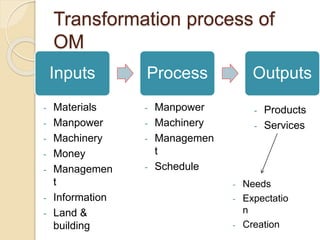
Transformation process of
OM
Inputs Process Outputs
- Materials
- Manpower
- Machinery
- Money
- Managemen
t
- Information
- Land &
building
- Manpower
- Machinery
- Managemen
t
- Schedule
- Products
- Services
- Needs
- Expectatio
n
- Creation
 Inputs
- It is the basic resources which is needed for the further
processes involved with the operations such as materials,
man-power, machinery, money or capital etc. to obtain a
desired outputs.
 Process
- It is the set of functions, procedures, policies, specific
methods, management, schedule etc. which helps to
convert inputs into the required outputs.
 Outputs
- It is the finished and final process of the inputs in the form
of goods and services to meet the customer need and
expectation.
4 rights in OM
These are the ways to accomplish the organizational operations
goals.
1. Right products for right service
2. Right time or timing
3. Right approach or method
4. Right customer
Note: Value creation:
- The organization can create a value on goods and
services through the right time and right approach
only.
Objectives of operations
management
1. Quality production
2. Fulfillment of interest of stakeholders
3. Other objectives
◦ Maximize profit and value
◦ Reduce manufacturing cost
◦ Optimum resource utilization
◦ Improving staffing
◦ Quality assessment
1. Quality Production
- The quality goods and services should produced
based on the customer needs.
- Products should be easily available, used to
standard, affordable
2. Fulfillment of interest of
stakeholders
- Some benefits to the stakeholders:
- Suppliers (cash down, long term relationship)
- Customers (quality products, quick response)
- Employees (incentives, job security, motivation)
- Society (employment, social responsibility)
- Promoters (profit, facilities, high return)
Functions of Operations
management
 Planning function
 Organizing function
 Controlling function
 Behaviour function
 Model function
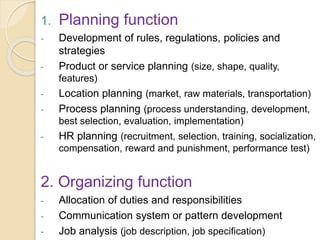
1. Planning function
- Development of rules, regulations, policies and
strategies
- Product or service planning (size, shape, quality,
features)
- Location planning (market, raw materials, transportation)
- Process planning (process understanding, development,
best selection, evaluation, implementation)
- HR planning (recruitment, selection, training, socialization,
compensation, reward and punishment, performance test)
2. Organizing function
- Allocation of duties and responsibilities
- Communication system or pattern development
- Job analysis (job description, job specification)
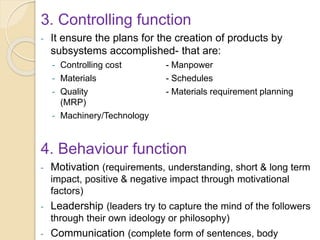
3. Controlling function
- It ensure the plans for the creation of products by
subsystems accomplished- that are:
- Controlling cost - Manpower
- Materials - Schedules
- Quality - Materials requirement planning
(MRP)
- Machinery/Technology
4. Behaviour function
- Motivation (requirements, understanding, short & long term
impact, positive & negative impact through motivational
factors)
- Leadership (leaders try to capture the mind of the followers
through their own ideology or philosophy)
- Communication (complete form of sentences, body
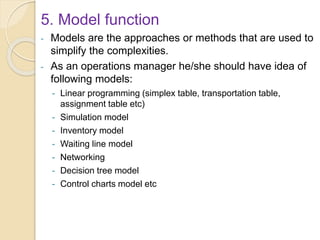
5. Model function
- Models are the approaches or methods that are used to
simplify the complexities.
- As an operations manager he/she should have idea of
following models:
- Linear programming (simplex table, transportation table,
assignment table etc)
- Simulation model
- Inventory model
- Waiting line model
- Networking
- Decision tree model
- Control charts model etc
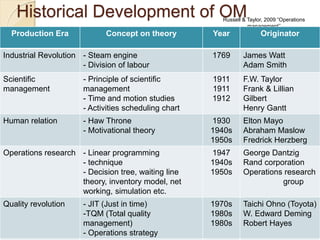
Russell & Taylor, 2009 “Operations
management’’
Historical Development of OM
Production Era Concept on theory Year Originator
Industrial Revolution - Steam engine
- Division of labour
1769 James Watt
Adam Smith
Scientific
management
- Principle of scientific
management
- Time and motion studies
- Activities scheduling chart
1911
1911
1912
F.W. Taylor
Frank & Lillian
Gilbert
Henry Gantt
Human relation - Haw Throne
- Motivational theory
1930
1940s
1950s
Elton Mayo
Abraham Maslow
Fredrick Herzberg
Operations research - Linear programming
- technique
- Decision tree, waiting line
theory, inventory model, net
working, simulation etc.
1947
1940s
1950s
George Dantzig
Rand corporation
Operations research
group
Quality revolution - JIT (Just in time)
-TQM (Total quality
management)
- Operations strategy
1970s
1980s
1980s
Taichi Ohno (Toyota)
W. Edward Deming
Robert Hayes
Trends in Operations
Management
1. Global focus
2. JIT production
3. Supply chain partnering
4. Rapid production
5. Mass customization`
6. Environmentally sensitive production
7. Empowered employees
8. Ethics
1. Global focus
- The rapid decline in communication and
transportation costs has made markets global.
- Similarly, resources in the form of material, capital,
materials, talent and labour are also now global.
- As a result, countries throughout the world are
contributing to globalization as they vie for
economic growth.
- Operations managers are rapidly seeking creative
designs, efficient production and high quality
goods via international collaboration.
2. JIT production
- Inventory throughout the supply chain requires
financial resources, hides quality issues and
constrains response to ever shorter product life
cycle.
- These forces push operations managers to work with
their supply chain to viciously cut inventories at every
level.
- Thus, the production should be activate at the time of
customer demand.
3. Supply chain partnering
- Shorter product life cycles, demanding customers and
fast changes in technology, materials and processes
requires the supply chain partnering to be in tune with
the needs of end users.
4. Rapid production
- Technology combined with rapid international
communication of news, entertainment and life styles
is dramatically chopping away at the life span of
products.
5. Mass customization
- In a world where consumers are increasingly aware of
innovation and options, substantial pressure is placed
on firms to response in a creative way.
- And operations manager must rapidly respond with
product designs and flexible production process that
cater to the individuals.
6. Empowered employees
- The knowledge explosion and a more technical
workplace have combined to require more
competence in the work setting.
- Operations manager is responding by enriching jobs
and moving more decision making to the individual
contributor.
7. Environmentally sensitive production
- Operations manager should develop the new product
and to redesign existing products or service in order
to reduce the impact on the environment.
- Product packaging, product processing, product
designing are the most visible and important elements
of an environmentally sensitive production operations.
8. Ethics
- The operations management functions or activities
are not damaging to either consumer or society.
- The manager should consider the effects of new
technologies, defective services, animal testing and
business deals have on people, safety and green
products.
Ethics in Operations
management
 Efficient production of goods and services
as per customer desire and expectation.
 Eco friendly production
 Safe and convenient working environment
 Honoring community commitments
 Legal and ethical production of product and
services maintaining quality respecting
customers
Thank
You
By: Uttar Tamang

Operations Management (OM)

  • 1.
  • 2.
    Concept or Definition Operations management (OM) is the set of activities that creates value in the form of goods and services by transforming inputs into outputs.  OM is that part of an organization which is concerned with the value adding activities as per policies that converse the range of inputs (materials, man- power, machinery, money or capital) into the required product or services as per customer need and expectation.
  • 3.
    Transformation process of OM InputsProcess Outputs - Materials - Manpower - Machinery - Money - Managemen t - Information - Land & building - Manpower - Machinery - Managemen t - Schedule - Products - Services - Needs - Expectatio n - Creation
  • 4.
     Inputs - Itis the basic resources which is needed for the further processes involved with the operations such as materials, man-power, machinery, money or capital etc. to obtain a desired outputs.  Process - It is the set of functions, procedures, policies, specific methods, management, schedule etc. which helps to convert inputs into the required outputs.  Outputs - It is the finished and final process of the inputs in the form of goods and services to meet the customer need and expectation.
  • 5.
    4 rights inOM These are the ways to accomplish the organizational operations goals. 1. Right products for right service 2. Right time or timing 3. Right approach or method 4. Right customer Note: Value creation: - The organization can create a value on goods and services through the right time and right approach only.
  • 6.
    Objectives of operations management 1.Quality production 2. Fulfillment of interest of stakeholders 3. Other objectives ◦ Maximize profit and value ◦ Reduce manufacturing cost ◦ Optimum resource utilization ◦ Improving staffing ◦ Quality assessment
  • 7.
    1. Quality Production -The quality goods and services should produced based on the customer needs. - Products should be easily available, used to standard, affordable 2. Fulfillment of interest of stakeholders - Some benefits to the stakeholders: - Suppliers (cash down, long term relationship) - Customers (quality products, quick response) - Employees (incentives, job security, motivation) - Society (employment, social responsibility) - Promoters (profit, facilities, high return)
  • 8.
    Functions of Operations management Planning function  Organizing function  Controlling function  Behaviour function  Model function
  • 9.
    1. Planning function -Development of rules, regulations, policies and strategies - Product or service planning (size, shape, quality, features) - Location planning (market, raw materials, transportation) - Process planning (process understanding, development, best selection, evaluation, implementation) - HR planning (recruitment, selection, training, socialization, compensation, reward and punishment, performance test) 2. Organizing function - Allocation of duties and responsibilities - Communication system or pattern development - Job analysis (job description, job specification)
  • 10.
    3. Controlling function -It ensure the plans for the creation of products by subsystems accomplished- that are: - Controlling cost - Manpower - Materials - Schedules - Quality - Materials requirement planning (MRP) - Machinery/Technology 4. Behaviour function - Motivation (requirements, understanding, short & long term impact, positive & negative impact through motivational factors) - Leadership (leaders try to capture the mind of the followers through their own ideology or philosophy) - Communication (complete form of sentences, body
  • 11.
    5. Model function -Models are the approaches or methods that are used to simplify the complexities. - As an operations manager he/she should have idea of following models: - Linear programming (simplex table, transportation table, assignment table etc) - Simulation model - Inventory model - Waiting line model - Networking - Decision tree model - Control charts model etc
  • 12.
    Russell & Taylor,2009 “Operations management’’ Historical Development of OM Production Era Concept on theory Year Originator Industrial Revolution - Steam engine - Division of labour 1769 James Watt Adam Smith Scientific management - Principle of scientific management - Time and motion studies - Activities scheduling chart 1911 1911 1912 F.W. Taylor Frank & Lillian Gilbert Henry Gantt Human relation - Haw Throne - Motivational theory 1930 1940s 1950s Elton Mayo Abraham Maslow Fredrick Herzberg Operations research - Linear programming - technique - Decision tree, waiting line theory, inventory model, net working, simulation etc. 1947 1940s 1950s George Dantzig Rand corporation Operations research group Quality revolution - JIT (Just in time) -TQM (Total quality management) - Operations strategy 1970s 1980s 1980s Taichi Ohno (Toyota) W. Edward Deming Robert Hayes
  • 13.
    Trends in Operations Management 1.Global focus 2. JIT production 3. Supply chain partnering 4. Rapid production 5. Mass customization` 6. Environmentally sensitive production 7. Empowered employees 8. Ethics
  • 14.
    1. Global focus -The rapid decline in communication and transportation costs has made markets global. - Similarly, resources in the form of material, capital, materials, talent and labour are also now global. - As a result, countries throughout the world are contributing to globalization as they vie for economic growth. - Operations managers are rapidly seeking creative designs, efficient production and high quality goods via international collaboration. 2. JIT production - Inventory throughout the supply chain requires financial resources, hides quality issues and constrains response to ever shorter product life cycle.
  • 15.
    - These forcespush operations managers to work with their supply chain to viciously cut inventories at every level. - Thus, the production should be activate at the time of customer demand. 3. Supply chain partnering - Shorter product life cycles, demanding customers and fast changes in technology, materials and processes requires the supply chain partnering to be in tune with the needs of end users. 4. Rapid production - Technology combined with rapid international communication of news, entertainment and life styles is dramatically chopping away at the life span of products.
  • 16.
    5. Mass customization -In a world where consumers are increasingly aware of innovation and options, substantial pressure is placed on firms to response in a creative way. - And operations manager must rapidly respond with product designs and flexible production process that cater to the individuals. 6. Empowered employees - The knowledge explosion and a more technical workplace have combined to require more competence in the work setting. - Operations manager is responding by enriching jobs and moving more decision making to the individual contributor.
  • 17.
    7. Environmentally sensitiveproduction - Operations manager should develop the new product and to redesign existing products or service in order to reduce the impact on the environment. - Product packaging, product processing, product designing are the most visible and important elements of an environmentally sensitive production operations. 8. Ethics - The operations management functions or activities are not damaging to either consumer or society. - The manager should consider the effects of new technologies, defective services, animal testing and business deals have on people, safety and green products.
  • 18.
    Ethics in Operations management Efficient production of goods and services as per customer desire and expectation.  Eco friendly production  Safe and convenient working environment  Honoring community commitments  Legal and ethical production of product and services maintaining quality respecting customers
  • 19.