Operations management 
MARÍA GONZÁLEZ BLÁZQUEZ 
ÁLVARO TERRY ÁLVAREZ 
FELISA DEL VIEJO NÚÑEZ
Index 
 What is Operations Management? 
 Why Study OM? 
 What Operations Managers Do? 
 Organizing to Produce Goods and Services 
• Goods .Definition and characteristics 
• Services. Definition and characteristics 
 The Heritage of OM 
 Operations as a Service
What is Operations Management? 
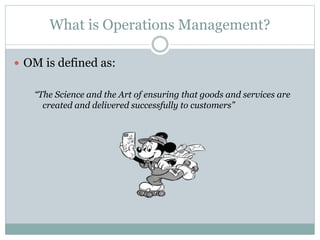
 OM is defined as: 
“The Science and the Art of ensuring that goods and services are 
created and delivered successfully to customers”
What is Operations Management? 
 Deals with : 
 The design and management of 
 products 
 processes 
 services 
 supply chains 
 It considers the acquisition, development, and utilization 
of resources that firms need to deliver the goods and 
services their clients want.
Why Study OM? 
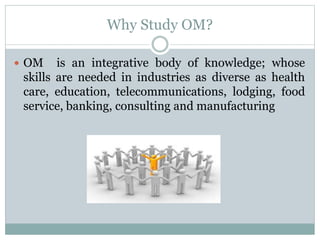
 OM is an integrative body of knowledge; whose 
skills are needed in industries as diverse as health 
care, education, telecommunications, lodging, food 
service, banking, consulting and manufacturing
Why Study OM? 
 OM is one of the three major functions of any organization, 
and its integrally related to all the other business functions. 
 We study OM because we want to know how goods and 
services are produce. 
 We study OM to understand what operations managers do. 
 We study OM because it is such a costly part of an 
organization.
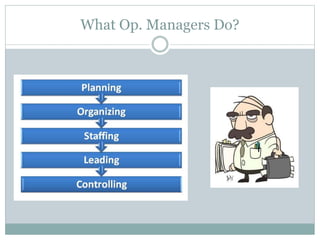
What Op. Managers Do?
What Op. Managers Do? 
 Key activities; 
 Helping organizations to do more with less 
 Exploiting technology to improve productivity 
 Building quality into goods, services, and processes 
 Determining Schedules 
 Creating a high-performance workplace 
 Continually learning and adapting the organization to global and 
environmental changes
Organizing to Produce Goods and Services 
 A Good is a physical product that you can see, touch, 
or possible consume 
 Durable Goods --> >= 3 years 
 Non-Durable --> <3 years 
 A Service is any primary or complementary activity
Characteristics of goods 
 Tangible product 
 Production usually separate from consumption 
 Can be inventoried 
 Low customer interaction
Characteristics of services 
 Intangible product 
 Produced & consumed at same time 
 Often unique 
 High customer interaction 
 Often knowledge-based
What is a service and a good? 
1. “If you drop it on your foot, it won´t hurt you” 
 GOOD OR SERVICE? 
2. “Services never include goods and goods never 
include services” 
1. TRUE OR FALSE 
3.
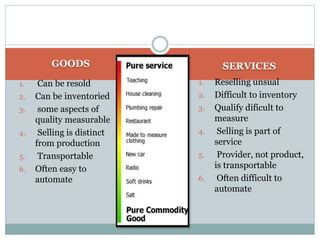
GOODS SERVICES 
1. Can be resold 
2. Can be inventoried 
3. some aspects of 
quality measurable 
4. Selling is distinct 
from production 
5. Transportable 
6. Often easy to 
automate 
1. Reselling unsual 
2. Difficult to inventory 
3. Qualify dificult to 
measure 
4. Selling is part of 
service 
5. Provider, not product, 
is transportable 
6. Often difficult to 
automate
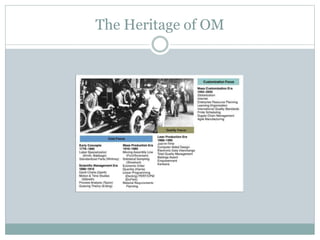
The Heritage of OM
The Heritage of OM 
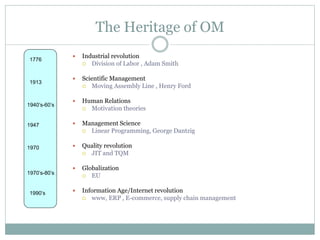
 Industrial revolution 
 Division of Labor , Adam Smith 
 Scientific Management 
 Moving Assembly Line , Henry Ford 
 Human Relations 
 Motivation theories 
 Management Science 
 Linear Programming, George Dantzig 
 Quality revolution 
 JIT and TQM 
 Globalization 
 EU 
 Information Age/Internet revolution 
 www, ERP , E-commerce, supply chain management 
1776 
1913 
1940’s-60’s 
1947 
1970 
1970’s-80’s 
1990’s
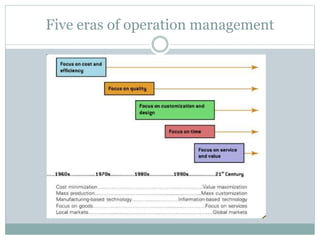
Five eras of operation management
Operations as a Service 
 Repair and Maintenance 
 Government 
 Food and Clothing 
 Transportation 
 Insurance 
 Financial 
 Education 
 Legal 
 Medical 
 Other Professional Occupation
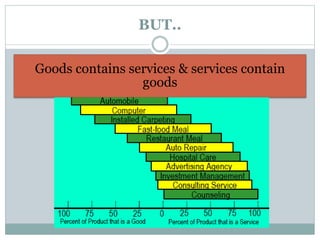
BUT.. 
Goods contains services & services contain 
goods
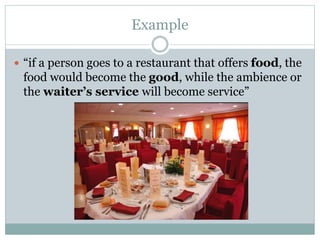
Example 
 “if a person goes to a restaurant that offers food, the 
food would become the good, while the ambience or 
the waiter’s service will become service”
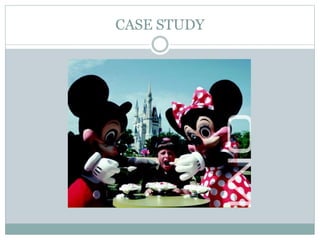
CASE STUDY
ANY QUESTIONS?

Operations Management CHAPTER 1

  • 1.
    Operations management MARÍAGONZÁLEZ BLÁZQUEZ ÁLVARO TERRY ÁLVAREZ FELISA DEL VIEJO NÚÑEZ
  • 2.
    Index  Whatis Operations Management?  Why Study OM?  What Operations Managers Do?  Organizing to Produce Goods and Services • Goods .Definition and characteristics • Services. Definition and characteristics  The Heritage of OM  Operations as a Service
  • 3.
    What is OperationsManagement?  OM is defined as: “The Science and the Art of ensuring that goods and services are created and delivered successfully to customers”
  • 4.
    What is OperationsManagement?  Deals with :  The design and management of  products  processes  services  supply chains  It considers the acquisition, development, and utilization of resources that firms need to deliver the goods and services their clients want.
  • 5.
    Why Study OM?  OM is an integrative body of knowledge; whose skills are needed in industries as diverse as health care, education, telecommunications, lodging, food service, banking, consulting and manufacturing
  • 6.
    Why Study OM?  OM is one of the three major functions of any organization, and its integrally related to all the other business functions.  We study OM because we want to know how goods and services are produce.  We study OM to understand what operations managers do.  We study OM because it is such a costly part of an organization.
  • 7.
  • 8.
    What Op. ManagersDo?  Key activities;  Helping organizations to do more with less  Exploiting technology to improve productivity  Building quality into goods, services, and processes  Determining Schedules  Creating a high-performance workplace  Continually learning and adapting the organization to global and environmental changes
  • 9.
    Organizing to ProduceGoods and Services  A Good is a physical product that you can see, touch, or possible consume  Durable Goods --> >= 3 years  Non-Durable --> <3 years  A Service is any primary or complementary activity
  • 10.
    Characteristics of goods  Tangible product  Production usually separate from consumption  Can be inventoried  Low customer interaction
  • 11.
    Characteristics of services  Intangible product  Produced & consumed at same time  Often unique  High customer interaction  Often knowledge-based
  • 12.
    What is aservice and a good? 1. “If you drop it on your foot, it won´t hurt you”  GOOD OR SERVICE? 2. “Services never include goods and goods never include services” 1. TRUE OR FALSE 3.
  • 13.
    GOODS SERVICES 1.Can be resold 2. Can be inventoried 3. some aspects of quality measurable 4. Selling is distinct from production 5. Transportable 6. Often easy to automate 1. Reselling unsual 2. Difficult to inventory 3. Qualify dificult to measure 4. Selling is part of service 5. Provider, not product, is transportable 6. Often difficult to automate
  • 14.
  • 15.
    The Heritage ofOM  Industrial revolution  Division of Labor , Adam Smith  Scientific Management  Moving Assembly Line , Henry Ford  Human Relations  Motivation theories  Management Science  Linear Programming, George Dantzig  Quality revolution  JIT and TQM  Globalization  EU  Information Age/Internet revolution  www, ERP , E-commerce, supply chain management 1776 1913 1940’s-60’s 1947 1970 1970’s-80’s 1990’s
  • 16.
    Five eras ofoperation management
  • 17.
    Operations as aService  Repair and Maintenance  Government  Food and Clothing  Transportation  Insurance  Financial  Education  Legal  Medical  Other Professional Occupation
  • 18.
    BUT.. Goods containsservices & services contain goods
  • 19.
    Example  “ifa person goes to a restaurant that offers food, the food would become the good, while the ambience or the waiter’s service will become service”
  • 20.
  • 21.