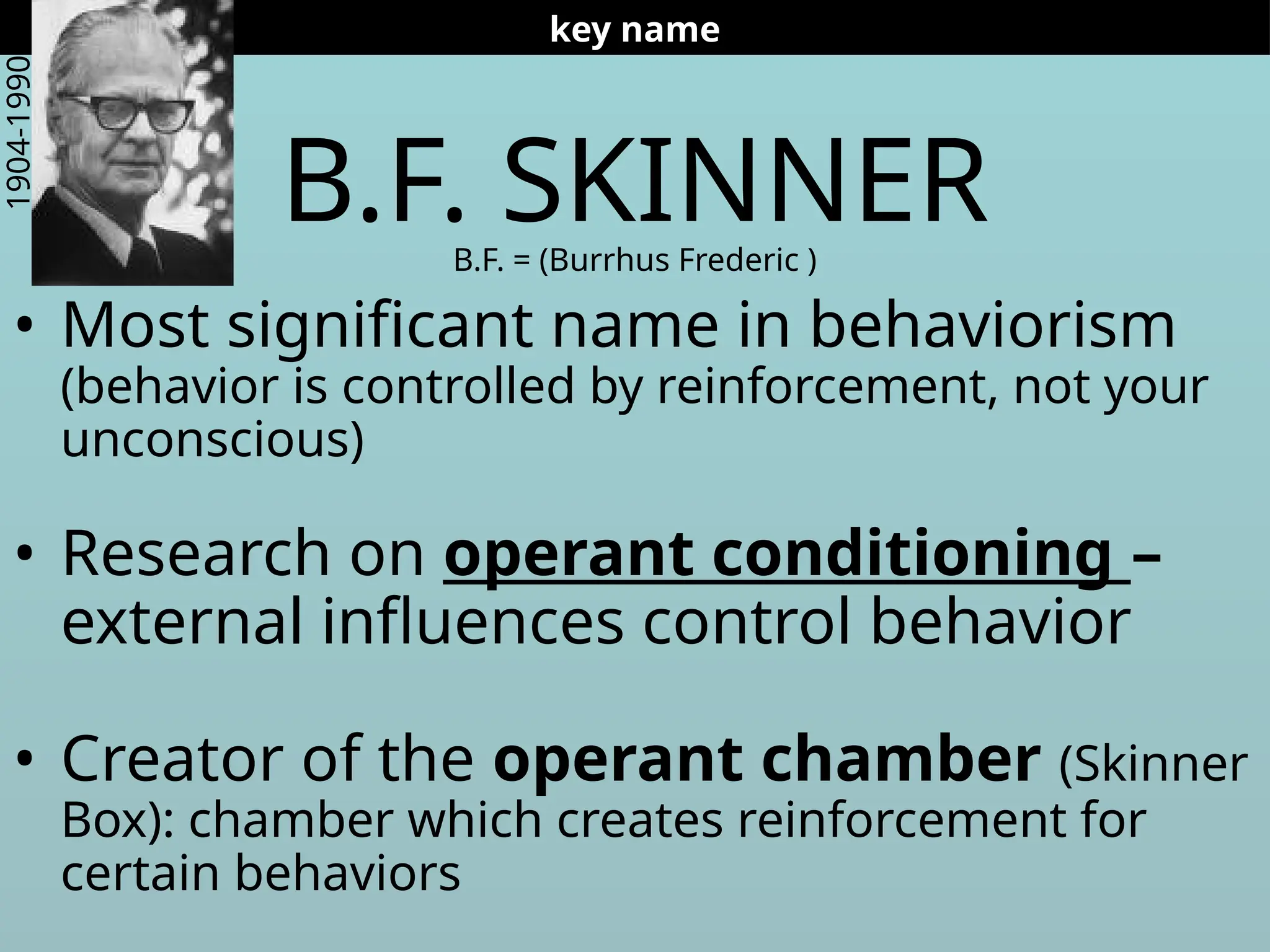
B.F. SKINNER
• Most significant name in behaviorism
(behavior is controlled by reinforcement, not your
unconscious)
• Research on operant conditioning –
external influences control behavior
• Creator of the operant chamber (Skinner
Box): chamber which creates reinforcement for
certain behaviors
key name
B.F. = (Burrhus Frederic )
1904-1990
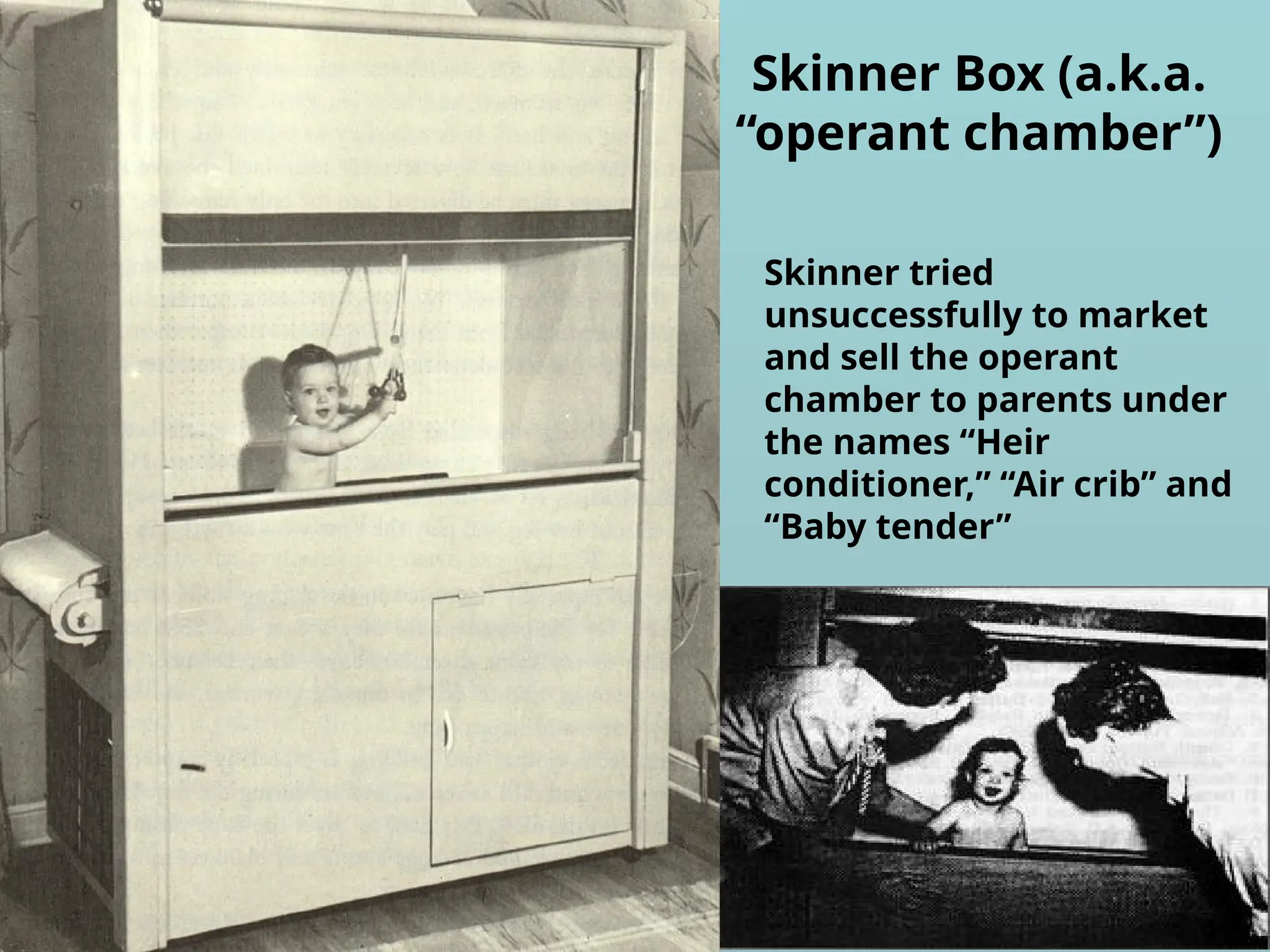
Skinner Box (a.k.a.
“operant chamber”)
Skinner tried
unsuccessfully to market
and sell the operant
chamber to parents under
the names “Heir
conditioner,” “Air crib” and
“Baby tender”
Associative Learning Continued
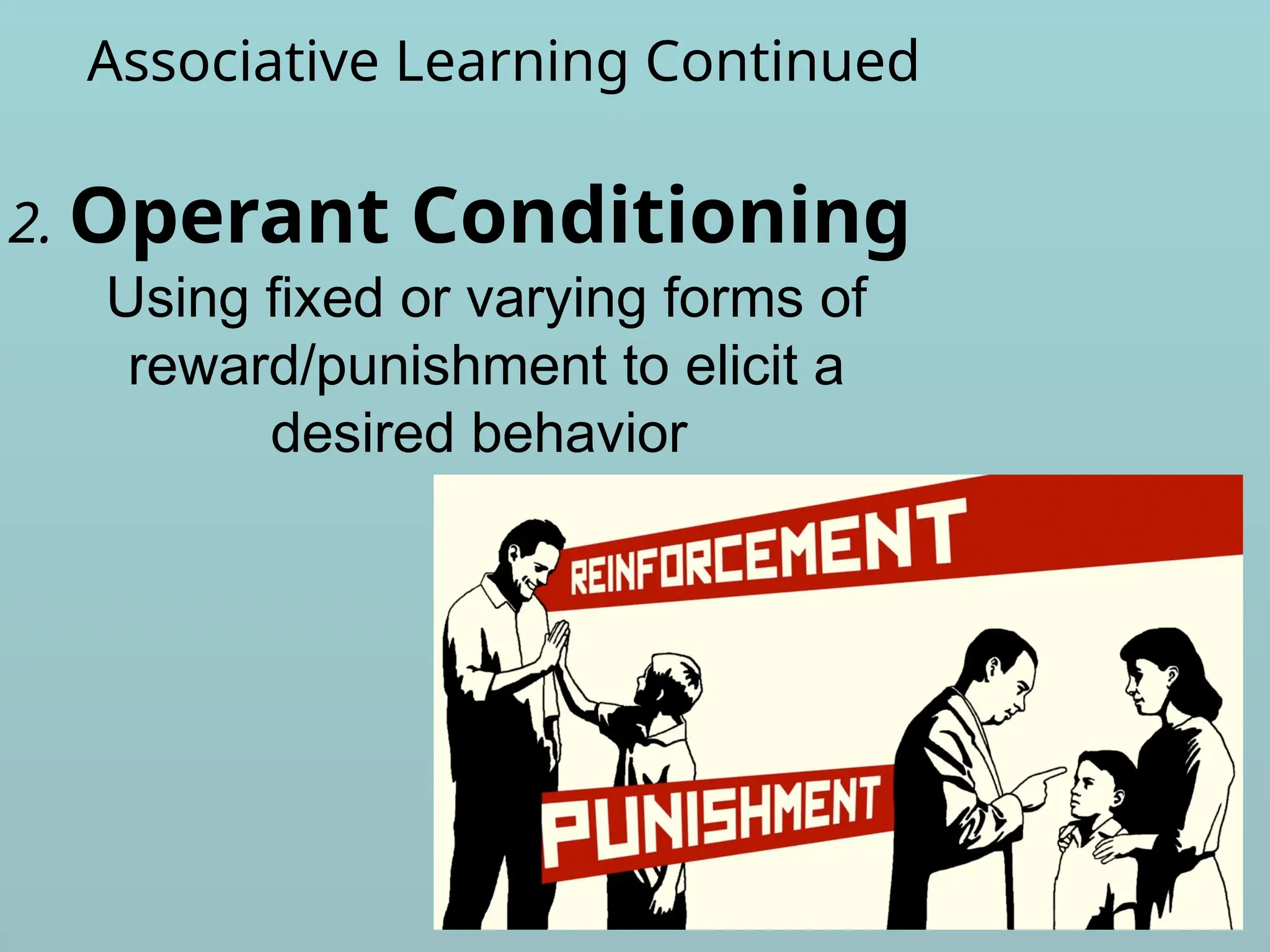
Using fixed or varying forms of
reward/punishment to elicit a
desired behavior
2. Operant Conditioning
Reinforcement
• 2 types:
1. Positive reinforcement
2. Negative
Reinforcement (beeping
when you haven’t buckled
your seatbelt OR running
to get rid of stress)
• INCREASES THE
LIKELYHOOD that a
particular behavior will occur.
Reinforcement (encourages)
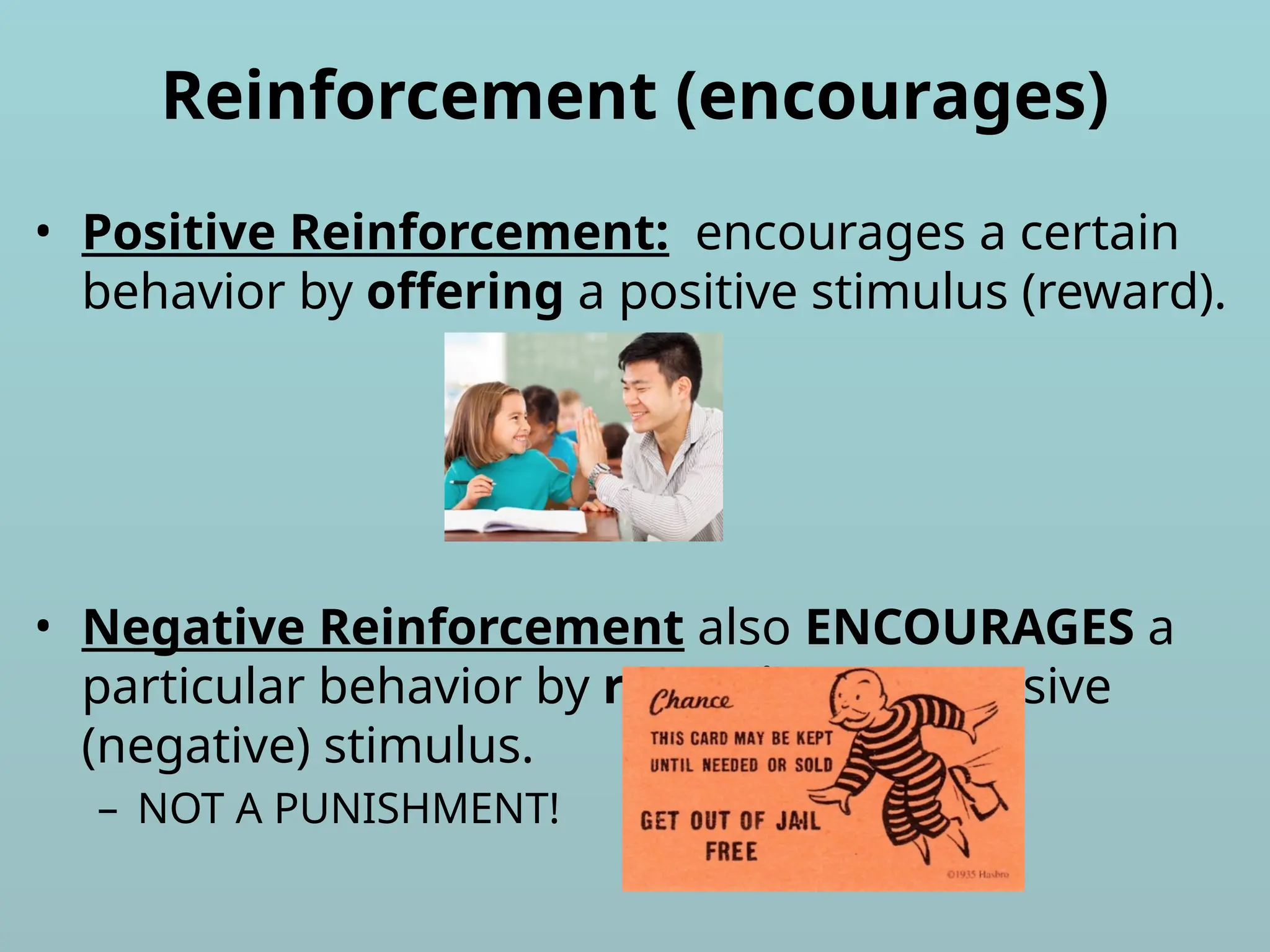
• Positive Reinforcement: encourages a certain
behavior by offering a positive stimulus (reward).
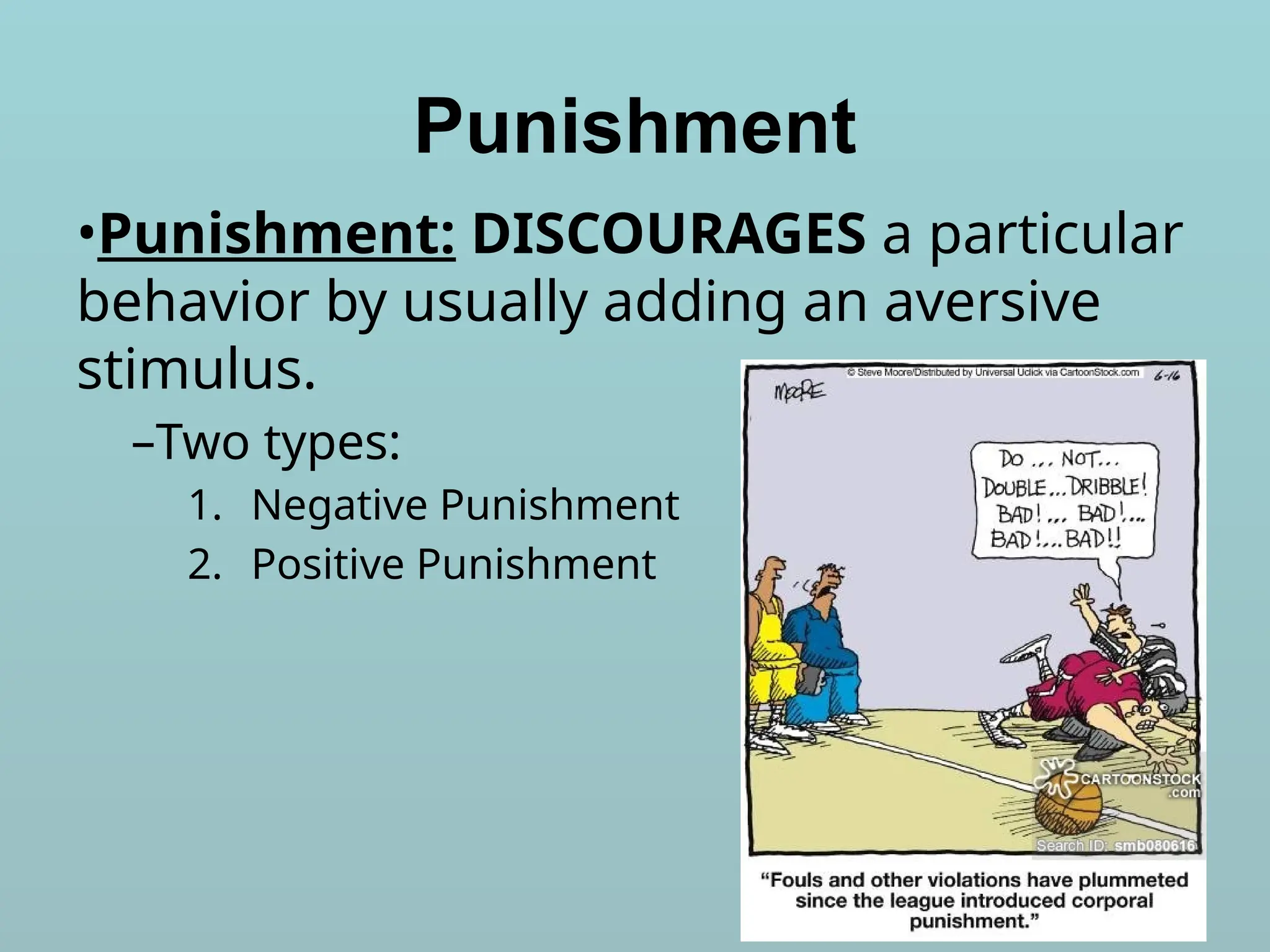
• Negative Reinforcement also ENCOURAGES a
particular behavior by removing an aversive
(negative) stimulus.
– NOT A PUNISHMENT!
Punishment
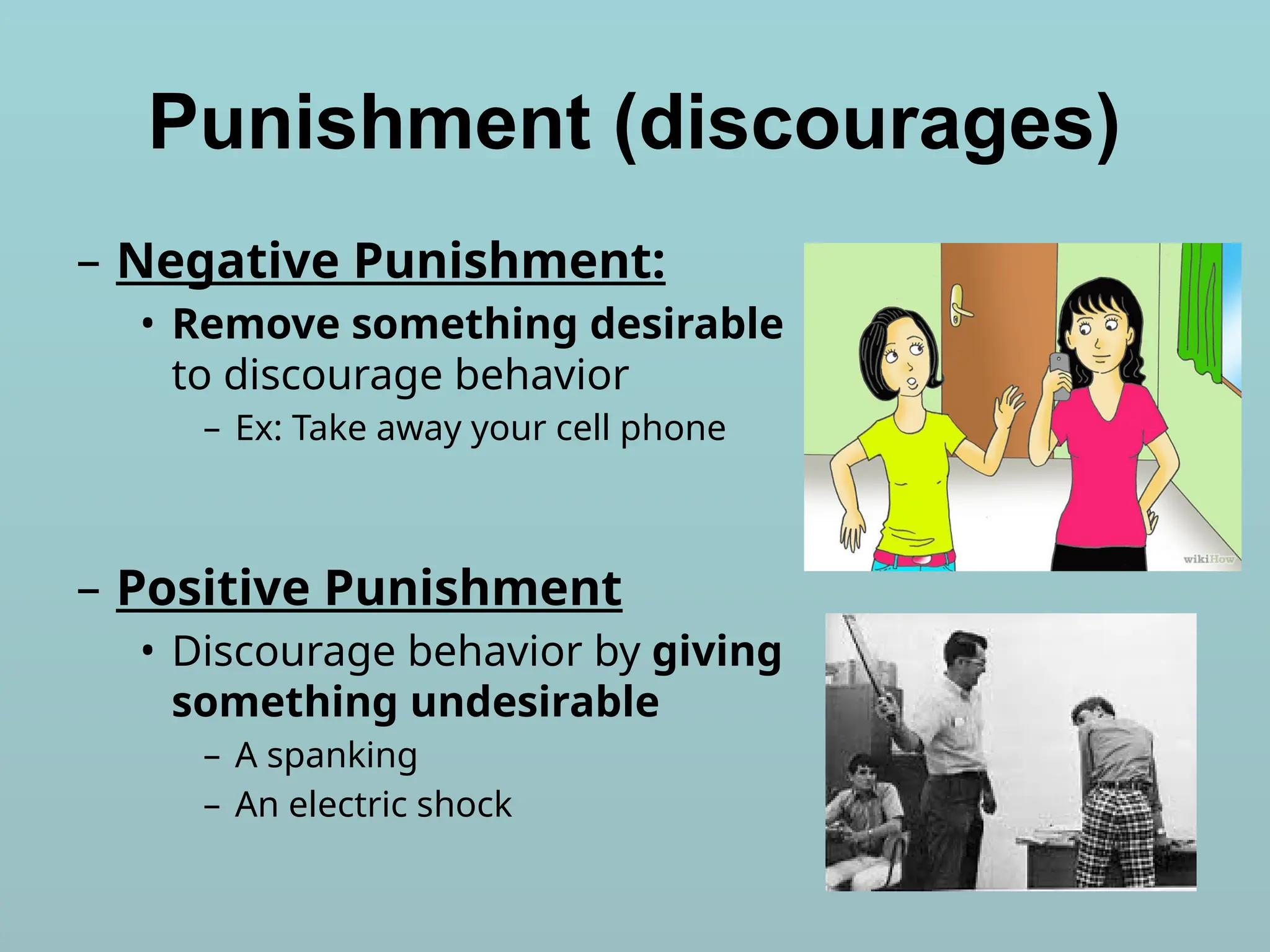
•Punishment: DISCOURAGES a particular
behavior by usually adding an aversive
stimulus.
–Two types:
1. Negative Punishment
2. Positive Punishment
Punishment (discourages)
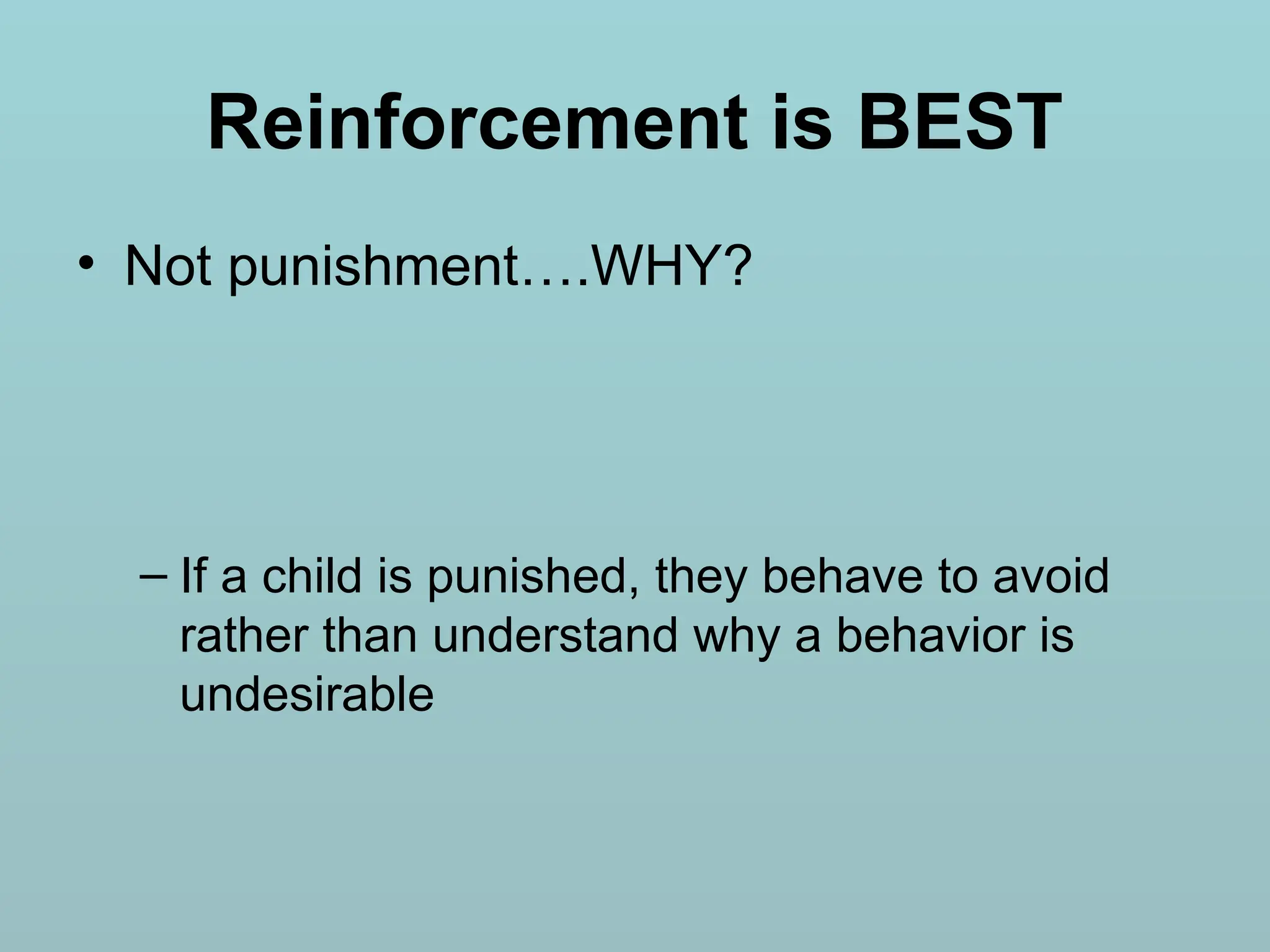
– Negative Punishment:
• Remove something desirable
to discourage behavior
– Ex: Take away your cell phone
– Positive Punishment
• Discourage behavior by giving
something undesirable
– A spanking
– An electric shock
Reinforcement is BEST
• Not punishment….WHY?
– If a child is punished, they behave to avoid
rather than understand why a behavior is
undesirable
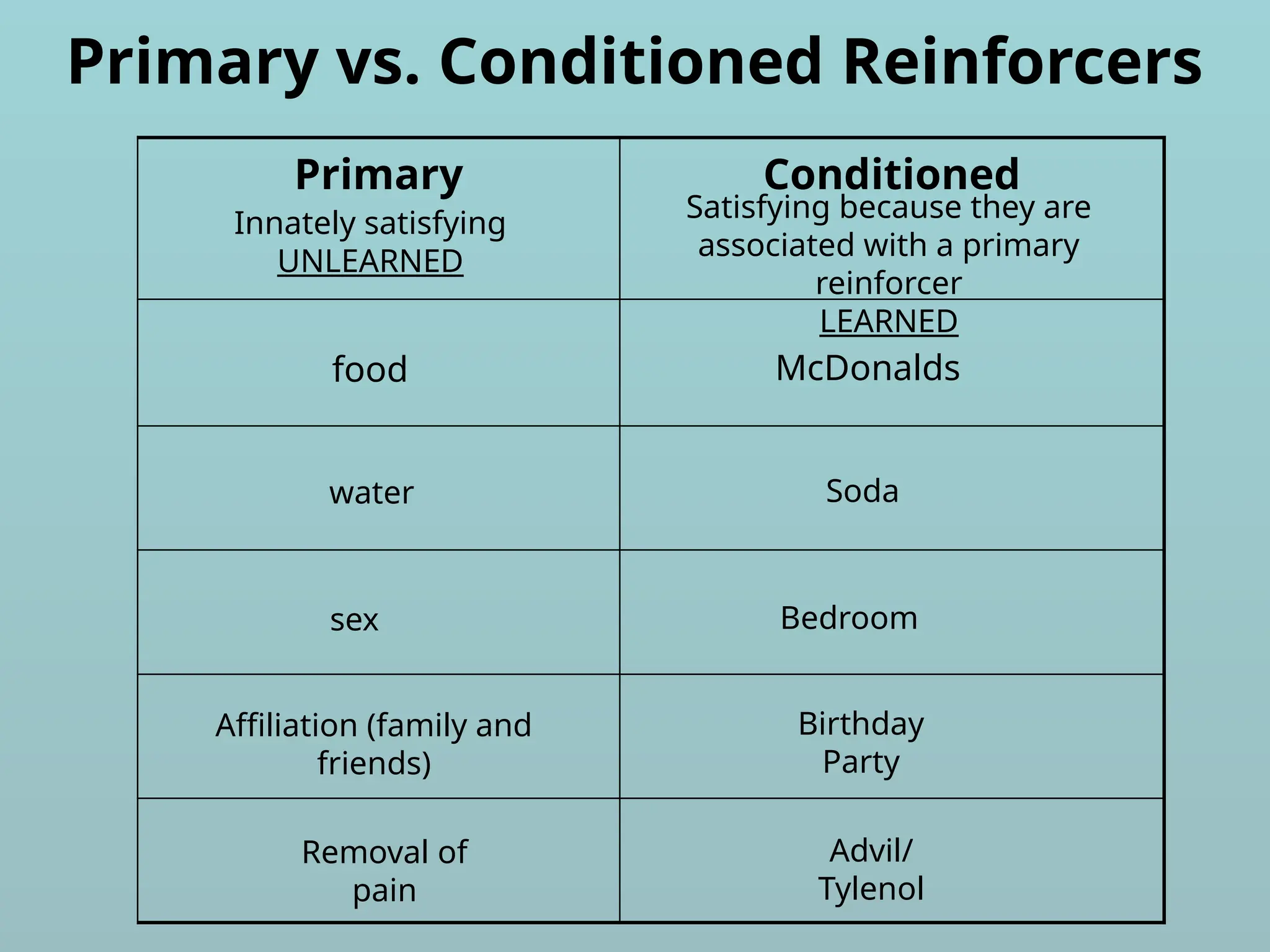
Primary vs. Conditioned Reinforcers
Primary Conditioned
Innately satisfying
UNLEARNED
Satisfying because they are
associated with a primary
reinforcer
LEARNED
food
water
sex
Affiliation (family and
friends)
Removal of
pain
McDonalds
Soda
Bedroom
Birthday
Party
Advil/
Tylenol
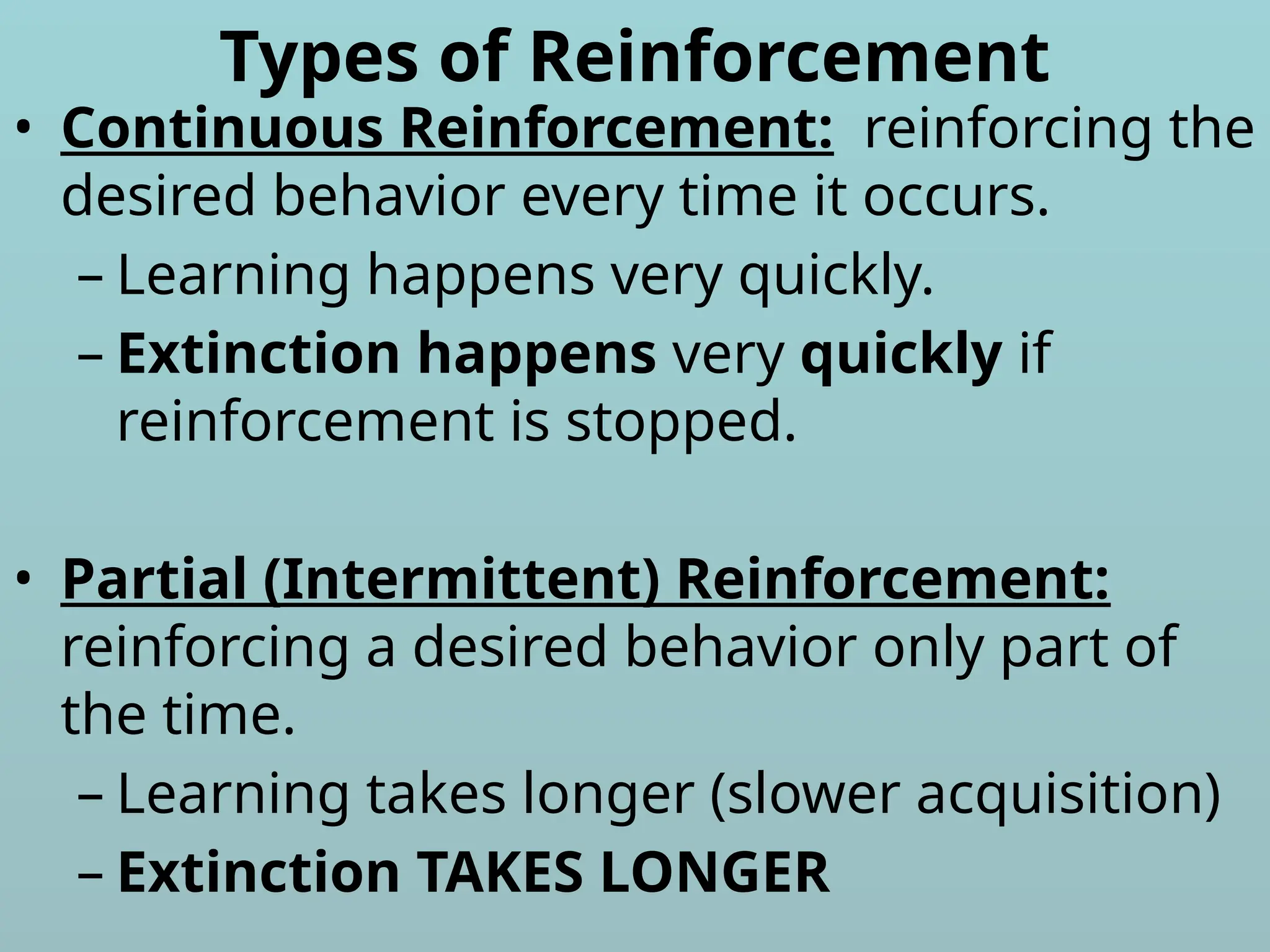
Types of Reinforcement
• Continuous Reinforcement: reinforcing the
desired behavior every time it occurs.
– Learning happens very quickly.
– Extinction happens very quickly if
reinforcement is stopped.
• Partial (Intermittent) Reinforcement:
reinforcing a desired behavior only part of
the time.
– Learning takes longer (slower acquisition)
– Extinction TAKES LONGER
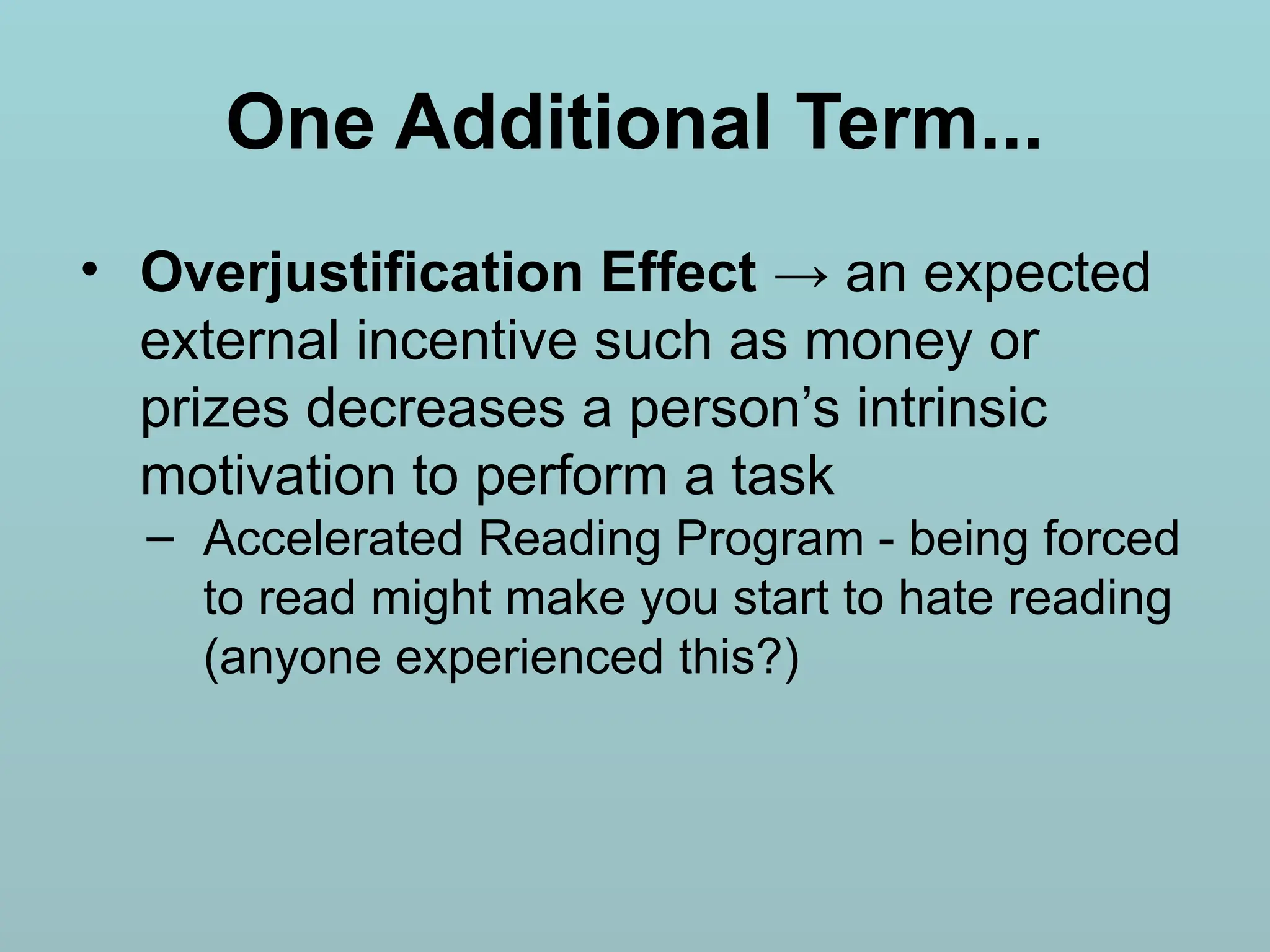
One Additional Term...
• Overjustification Effect → an expected
external incentive such as money or
prizes decreases a person’s intrinsic
motivation to perform a task
– Accelerated Reading Program - being forced
to read might make you start to hate reading
(anyone experienced this?)
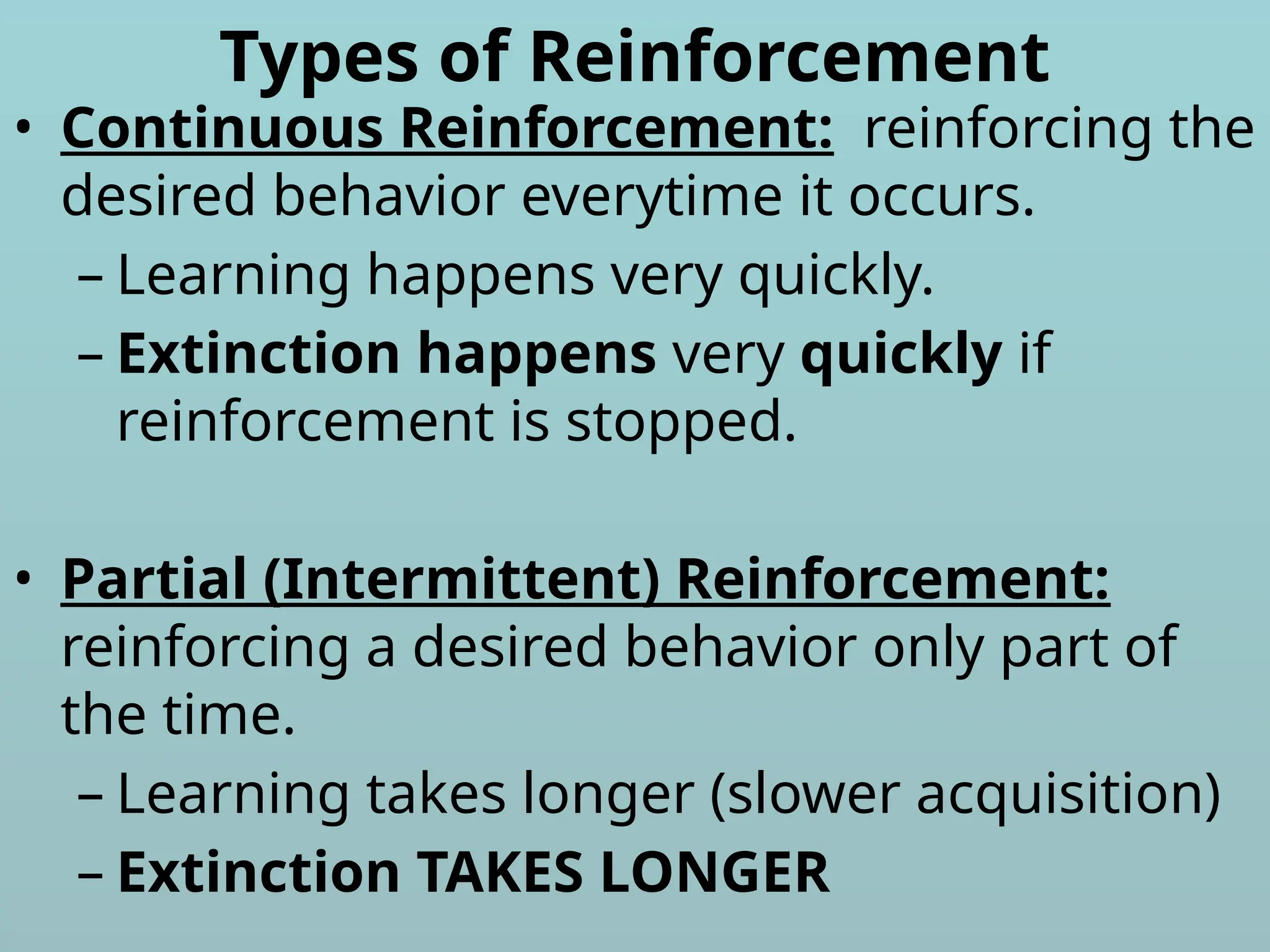
Types of Reinforcement
• Continuous Reinforcement: reinforcing the
desired behavior everytime it occurs.
– Learning happens very quickly.
– Extinction happens very quickly if
reinforcement is stopped.
• Partial (Intermittent) Reinforcement:
reinforcing a desired behavior only part of
the time.
– Learning takes longer (slower acquisition)
– Extinction TAKES LONGER
Schedules of Reinforcement
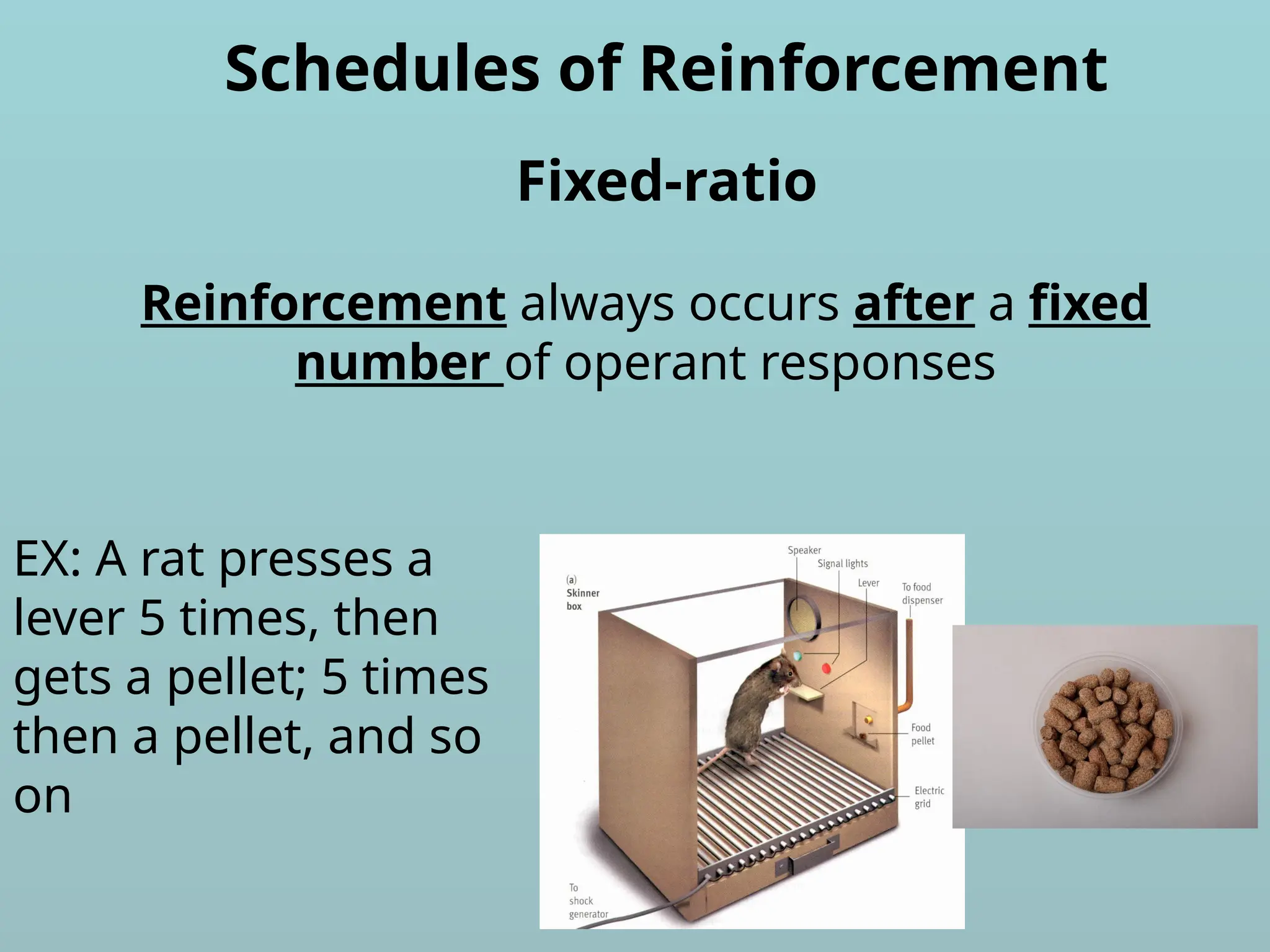
Reinforcement always occurs after a fixed
number of operant responses
Fixed-ratio
EX: A rat presses a
lever 5 times, then
gets a pellet; 5 times
then a pellet, and so
on
Schedules of Reinforcement
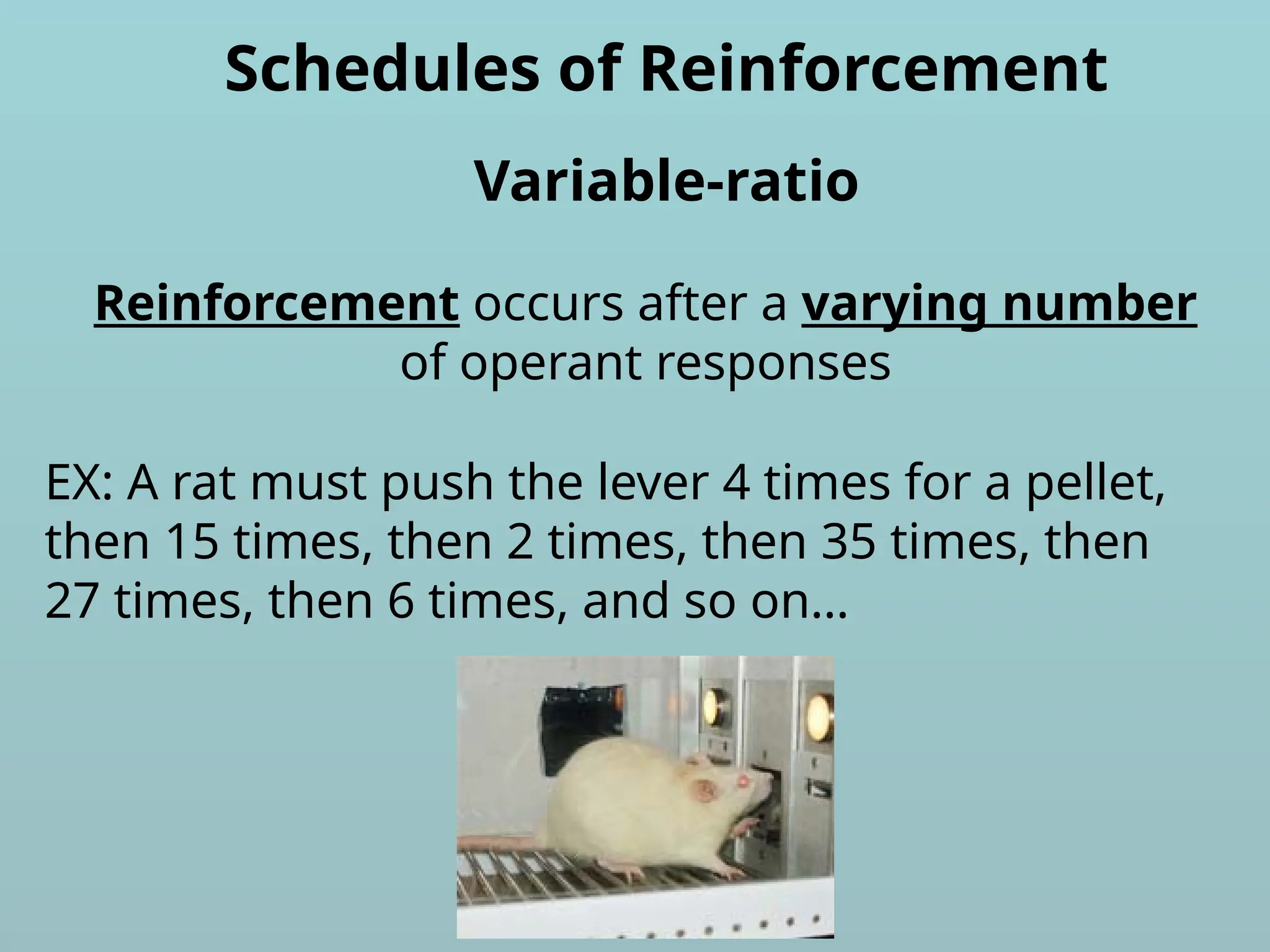
Reinforcement occurs after a varying number
of operant responses
Variable-ratio
EX: A rat must push the lever 4 times for a pellet,
then 15 times, then 2 times, then 35 times, then
27 times, then 6 times, and so on…
Schedules of Reinforcement
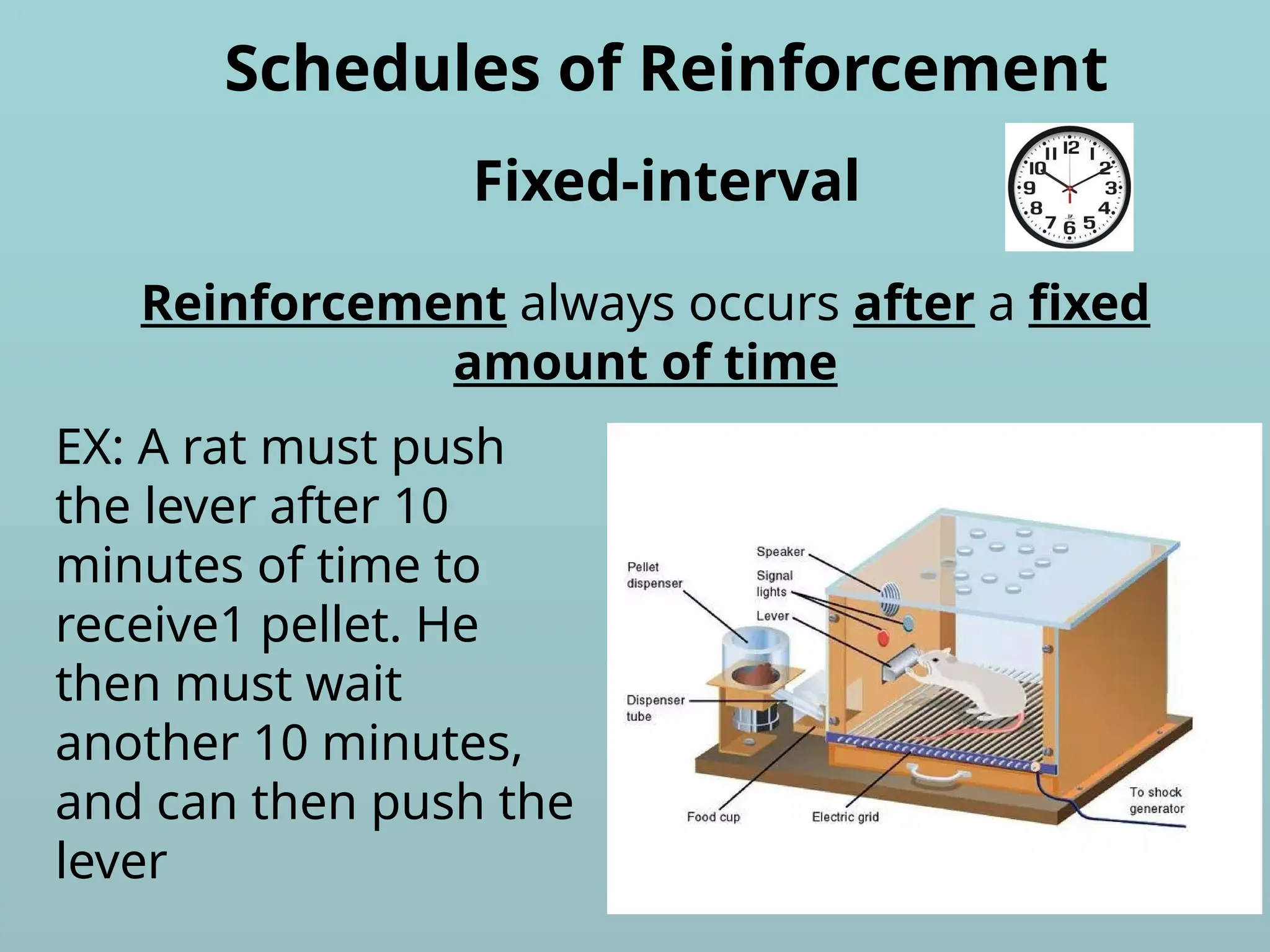
Reinforcement always occurs after a fixed
amount of time
Fixed-interval
EX: A rat must push
the lever after 10
minutes of time to
receive1 pellet. He
then must wait
another 10 minutes,
and can then push the
lever
Schedules of Reinforcement
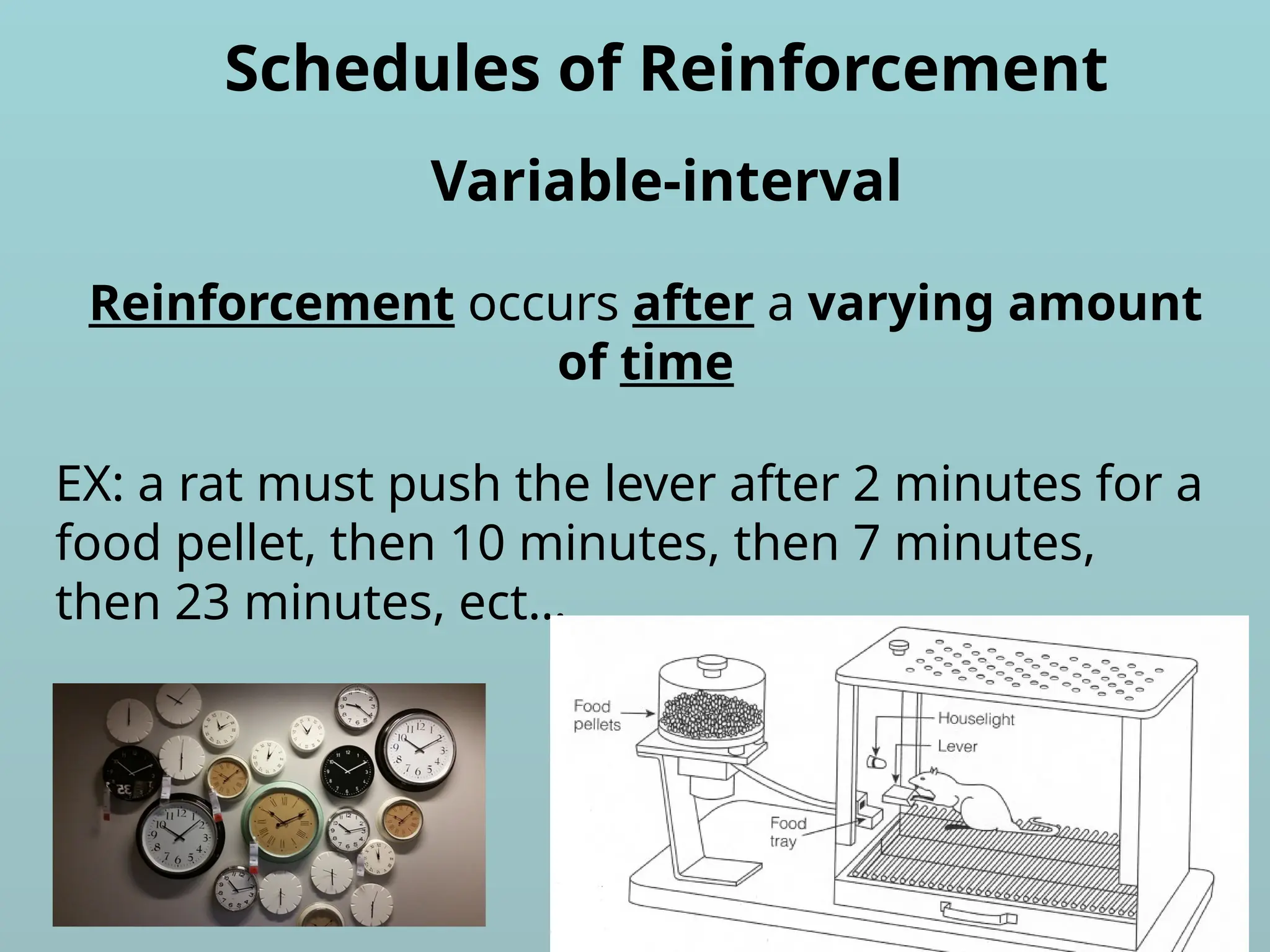
Reinforcement occurs after a varying amount
of time
Variable-interval
EX: a rat must push the lever after 2 minutes for a
food pellet, then 10 minutes, then 7 minutes,
then 23 minutes, ect…
Immediate vs. Delayed
Reinforcement*
• In rats, if you delay reinforcement,
virtually no learning will occur.
• Although humans do recognize delayed
reinforcement, immediate gratification
sometimes move us into risky behavior.
EX: smoking, drinking, unprotected
sex.
Comparing
Classical Conditioning & Operant Conditioning
• Behavior affected is usually
INVOLUNTARY
• Behavior affected is usually
VOLUNTARY
• Key events are PRESENTED to
the learner
• Key events are PRODUCED by
the learner
• Events CAUSE the behavior • Events CONTROL the
behavior
• The learner does
not have a choice
• The learner has a
choice
• Two stimuli (the NS and UCS)
are associated
• A behavior and a
consequence (reinforcement
or punishment) is associated
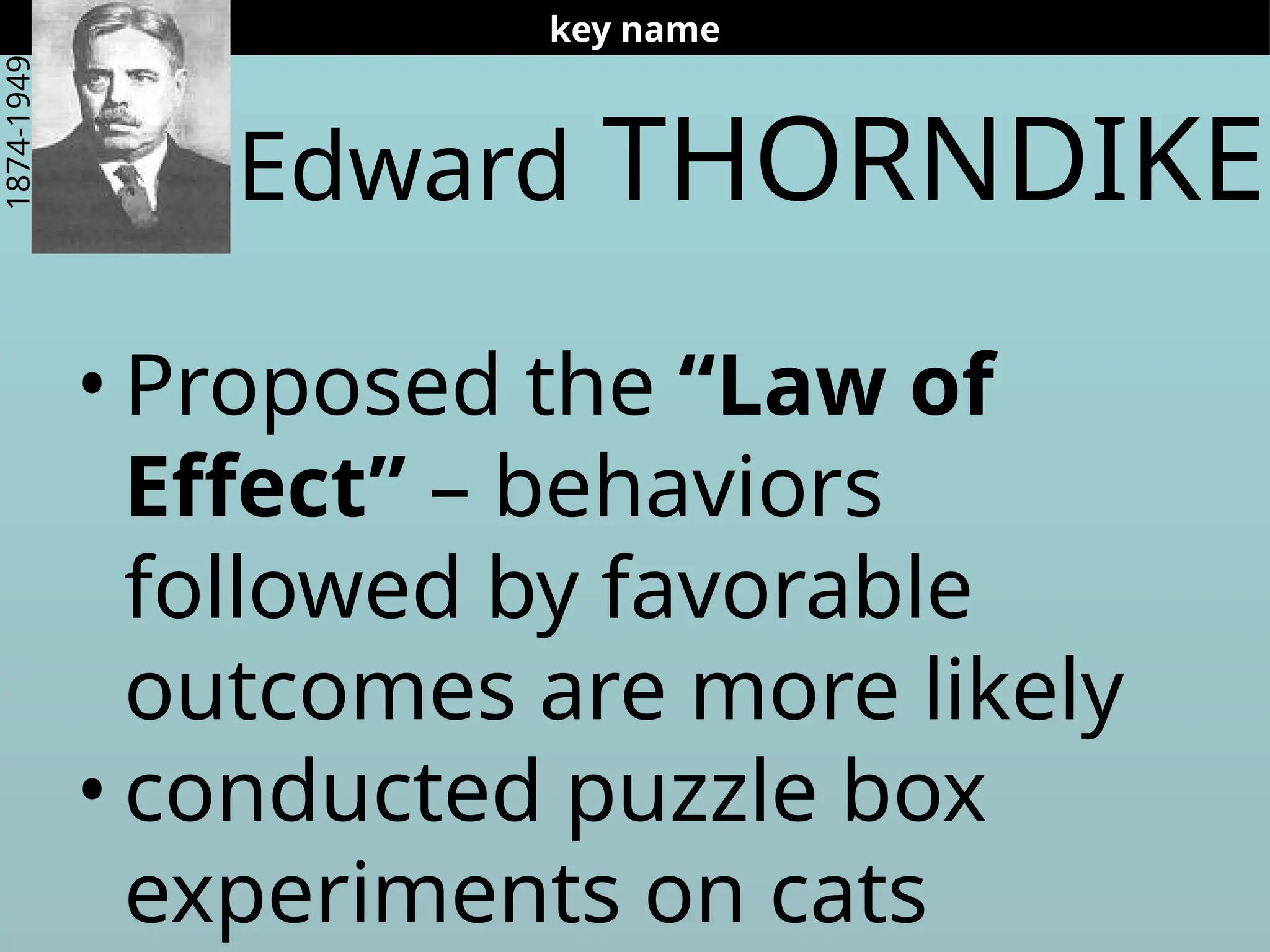
Edward THORNDIKE
• Proposed the “Law of
Effect” – behaviors
followed by favorable
outcomes are more likely
• conducted puzzle box
experiments on cats
key name
1874-1949
Shaping*
• Shaping refers to an
operant conditioning
technique in which
reinforcers guide
behavior closer and
closer towards a desired
goal.
– Uses successive
approximations.
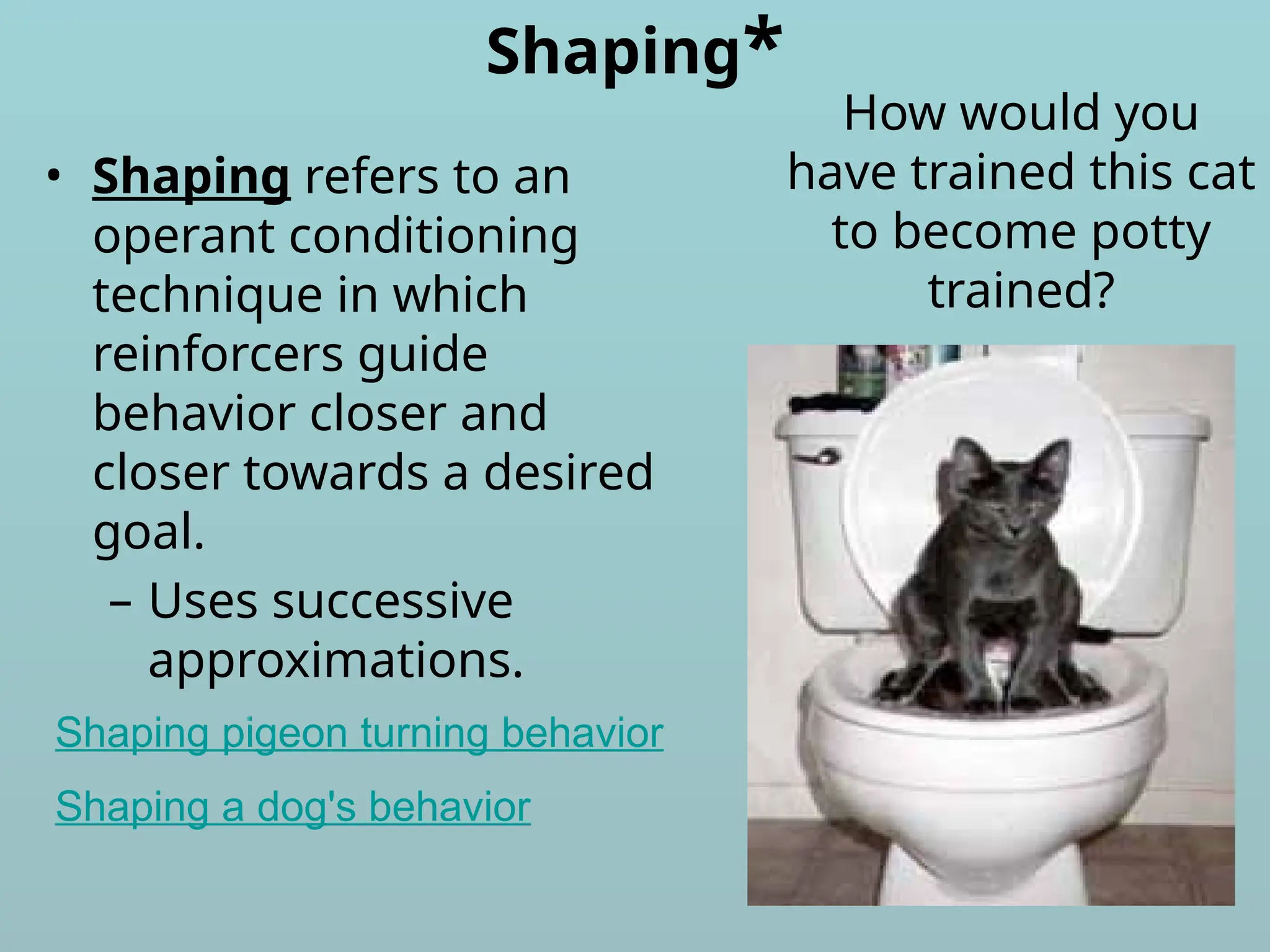
How would you
have trained this cat
to become potty
trained?
Shaping a dog's behavior
Shaping pigeon turning behavior
Behaviorist vs Cognitivist Theories
Behaviorist: Only cares about behavior – what a person
does – what can be observed or proven
Learning is mechanical – you behave the way
you do because of external stimuli – no
internal processes are required (learning by
thinking about something or watching it)
Cognitivist: Care about what a person knows (instead of
does). Learning serves a purpose.
Cognition’s Effect on
Operant Conditioning
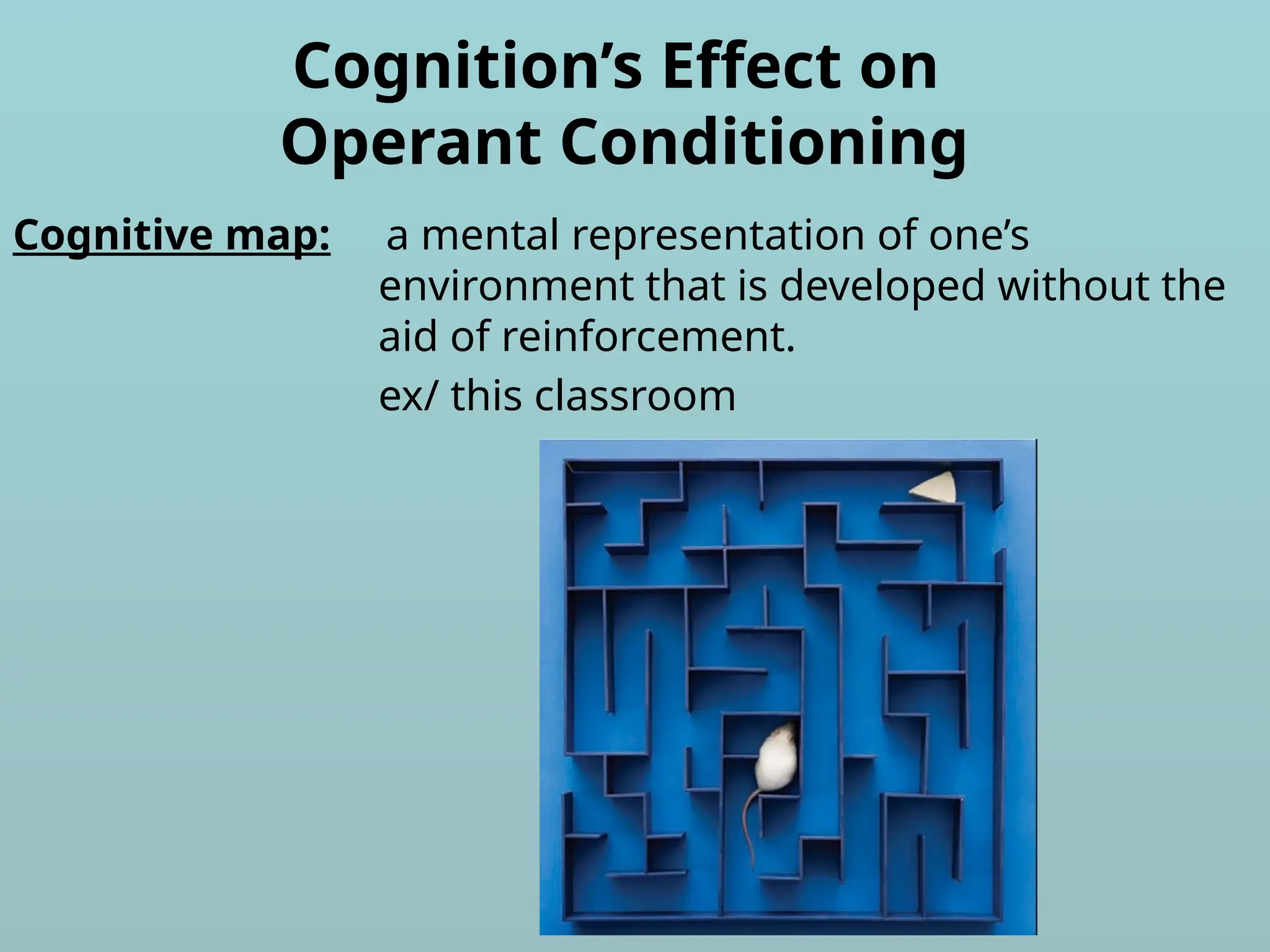
Cognitive map: a mental representation of one’s
environment that is developed without the
aid of reinforcement.
ex/ this classroom
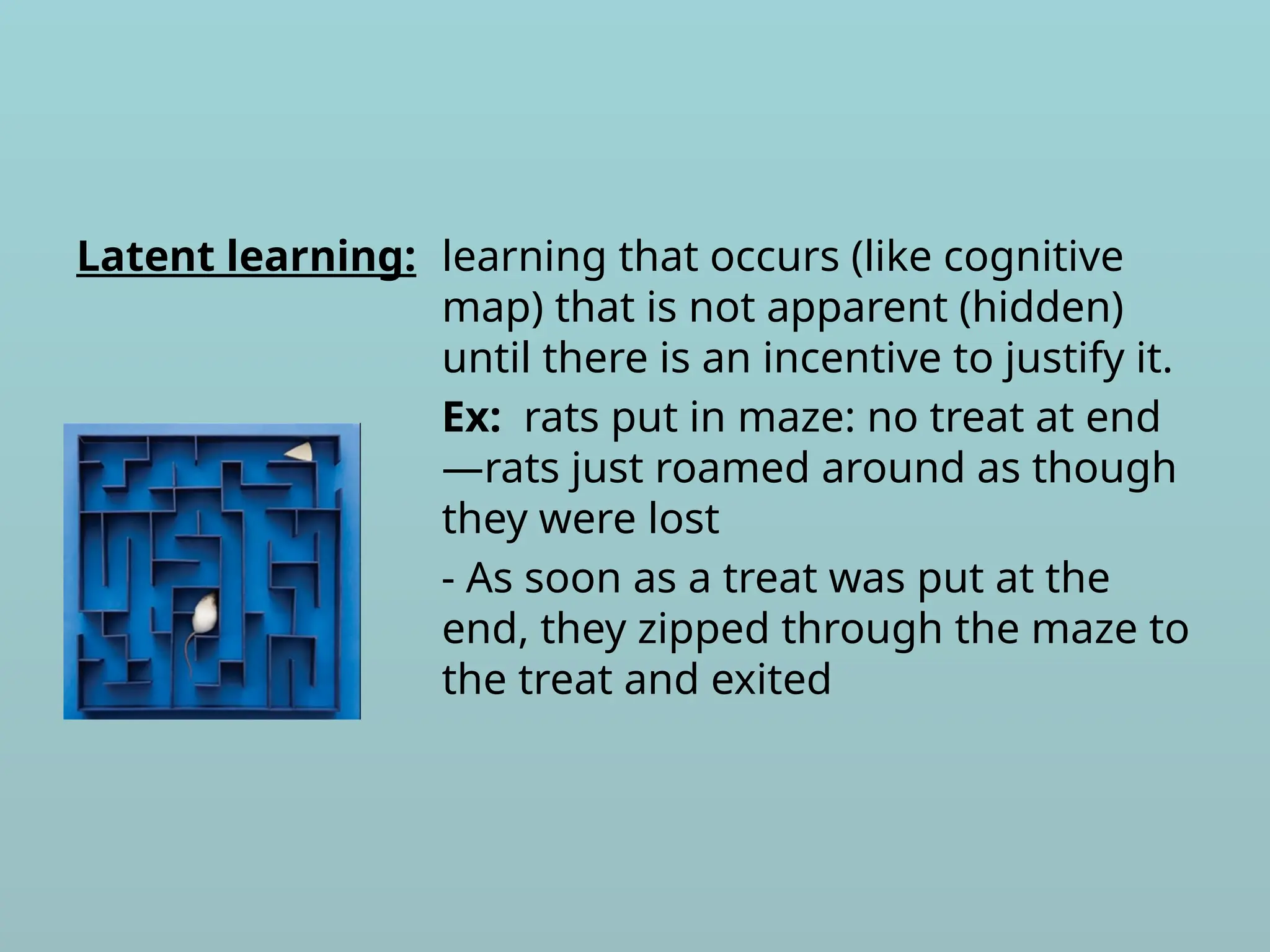
Latent learning: learning that occurs (like cognitive
map) that is not apparent (hidden)
until there is an incentive to justify it.
Ex: rats put in maze: no treat at end
—rats just roamed around as though
they were lost
- As soon as a treat was put at the
end, they zipped through the maze to
the treat and exited
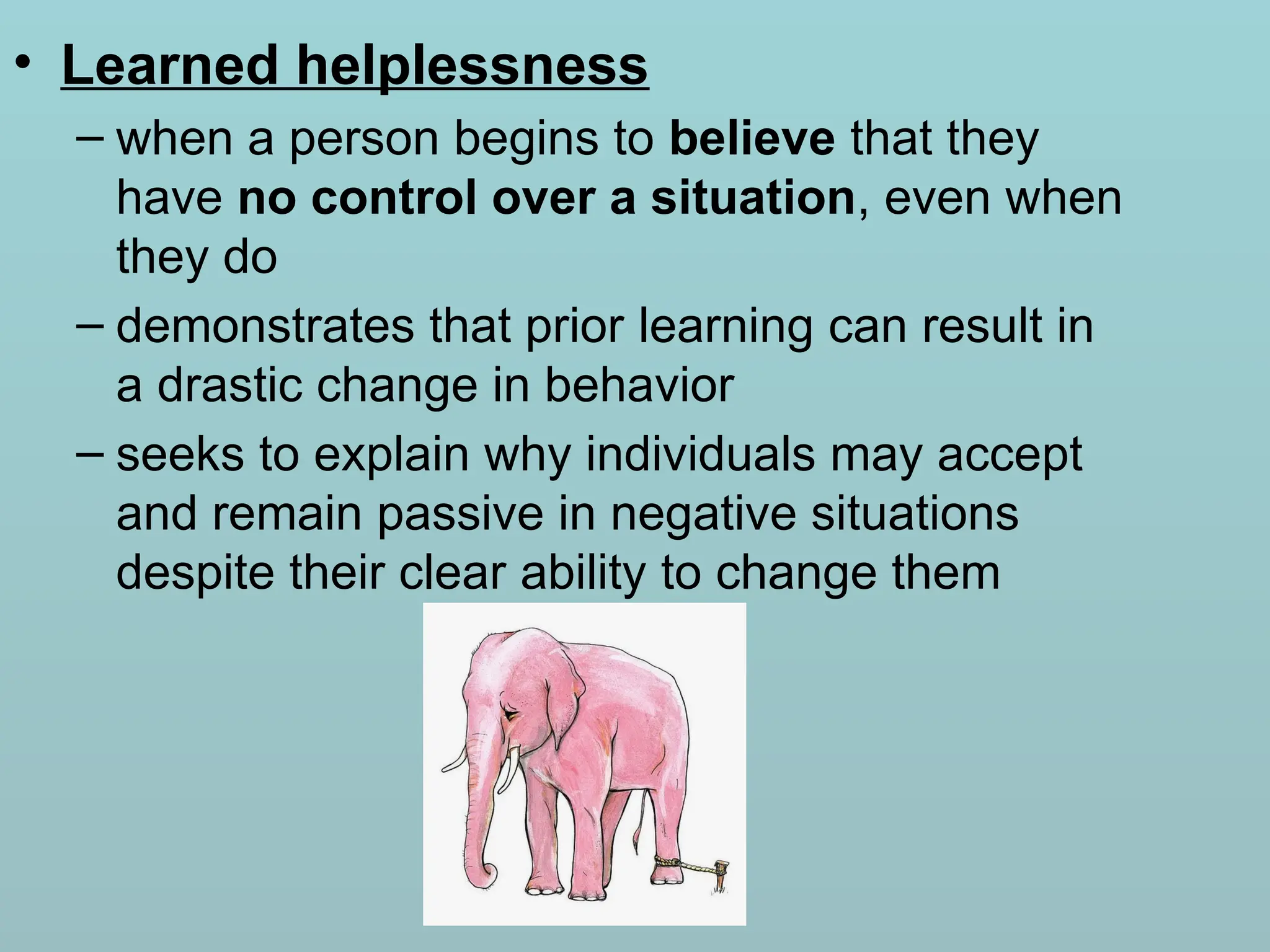
• Learned helplessness
– when a person begins to believe that they
have no control over a situation, even when
they do
– demonstrates that prior learning can result in
a drastic change in behavior
– seeks to explain why individuals may accept
and remain passive in negative situations
despite their clear ability to change them
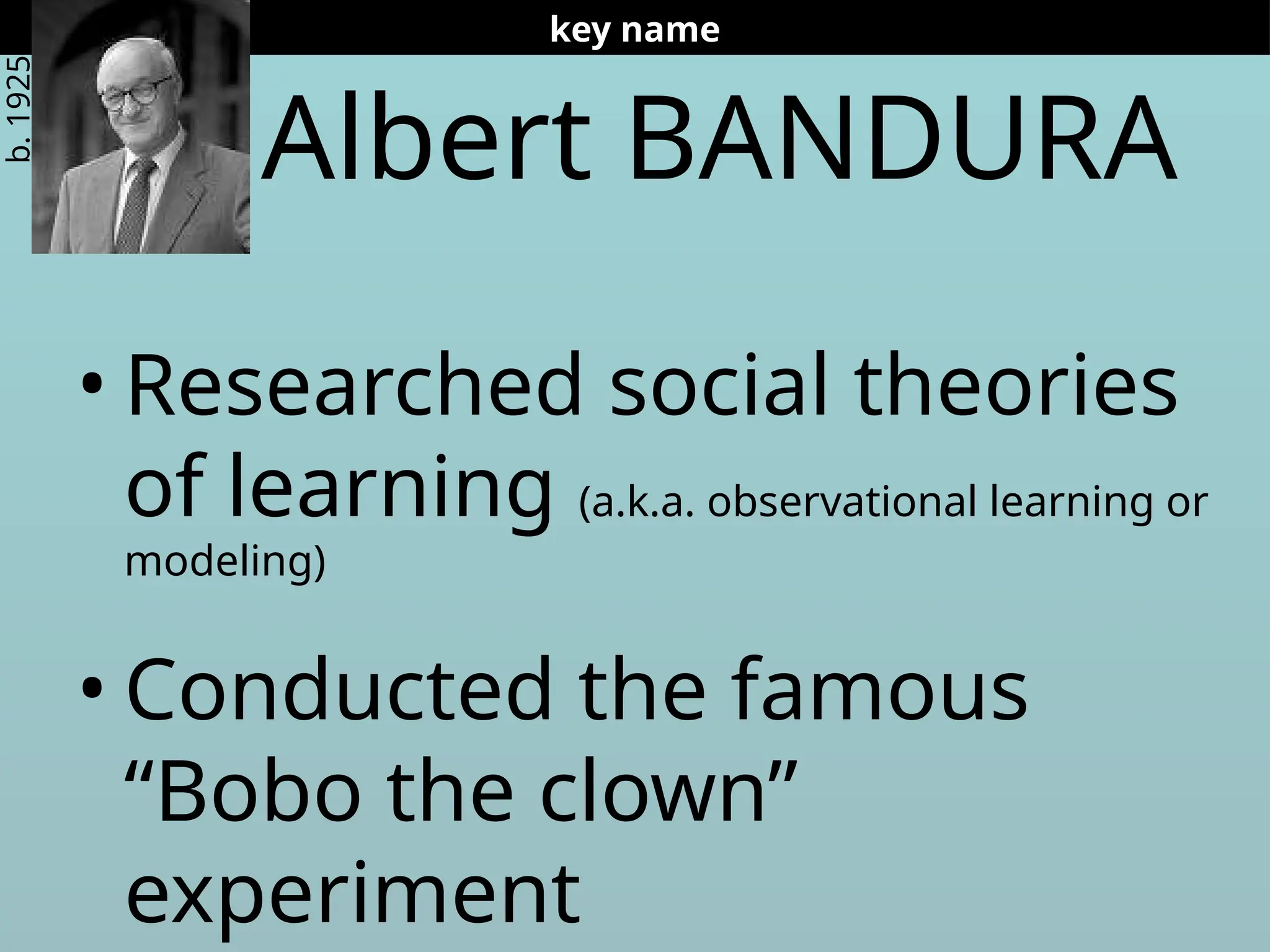
Albert BANDURA
• Researched social theories
of learning (a.k.a. observational learning or
modeling)
• Conducted the famous
“Bobo the clown”
experiment
key name
b.
1925
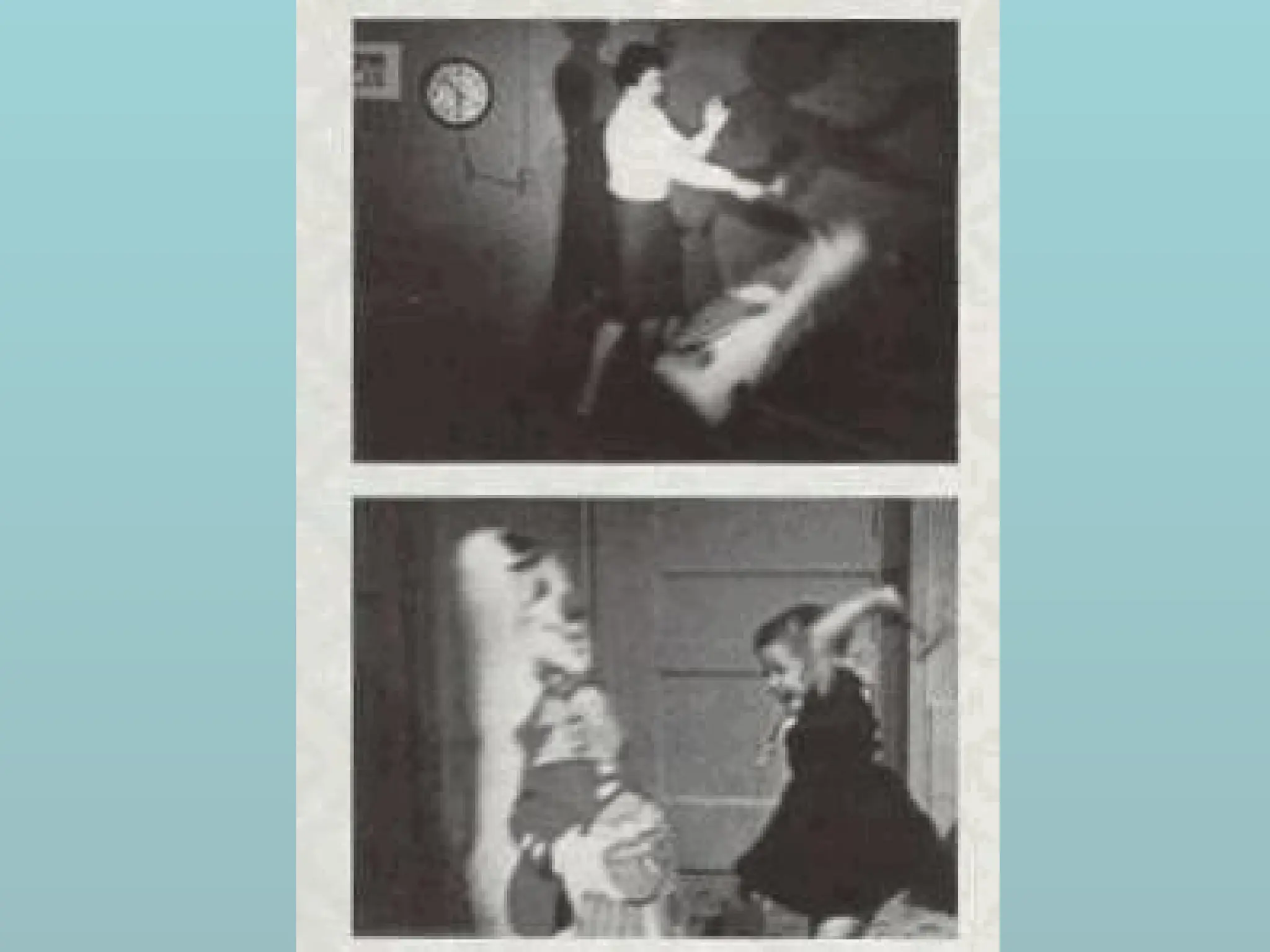
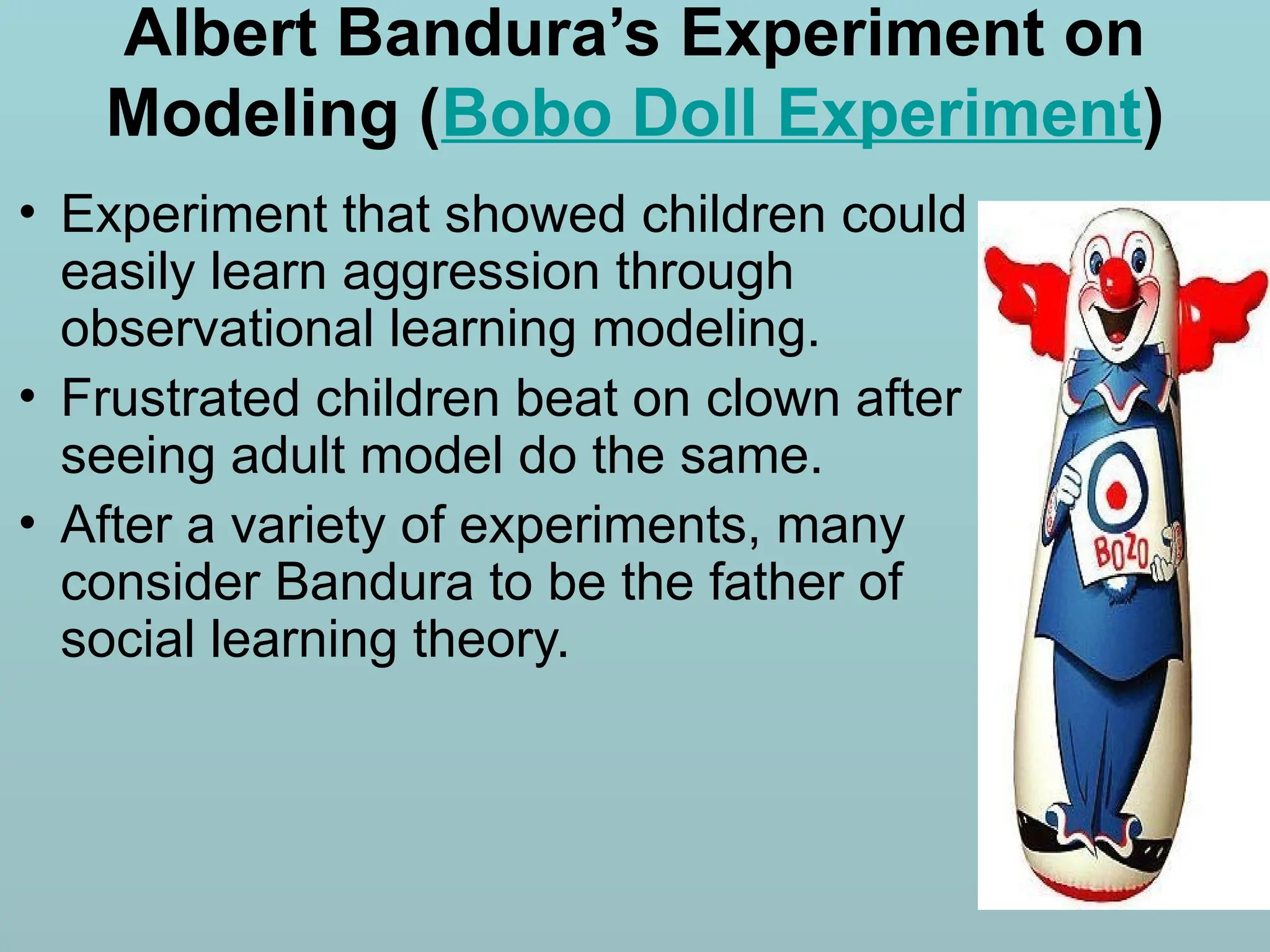
Albert Bandura’s Experiment on
Modeling (Bobo Doll Experiment)
• Experiment that showed children could
easily learn aggression through
observational learning modeling.
• Frustrated children beat on clown after
seeing adult model do the same.
• After a variety of experiments, many
consider Bandura to be the father of
social learning theory.
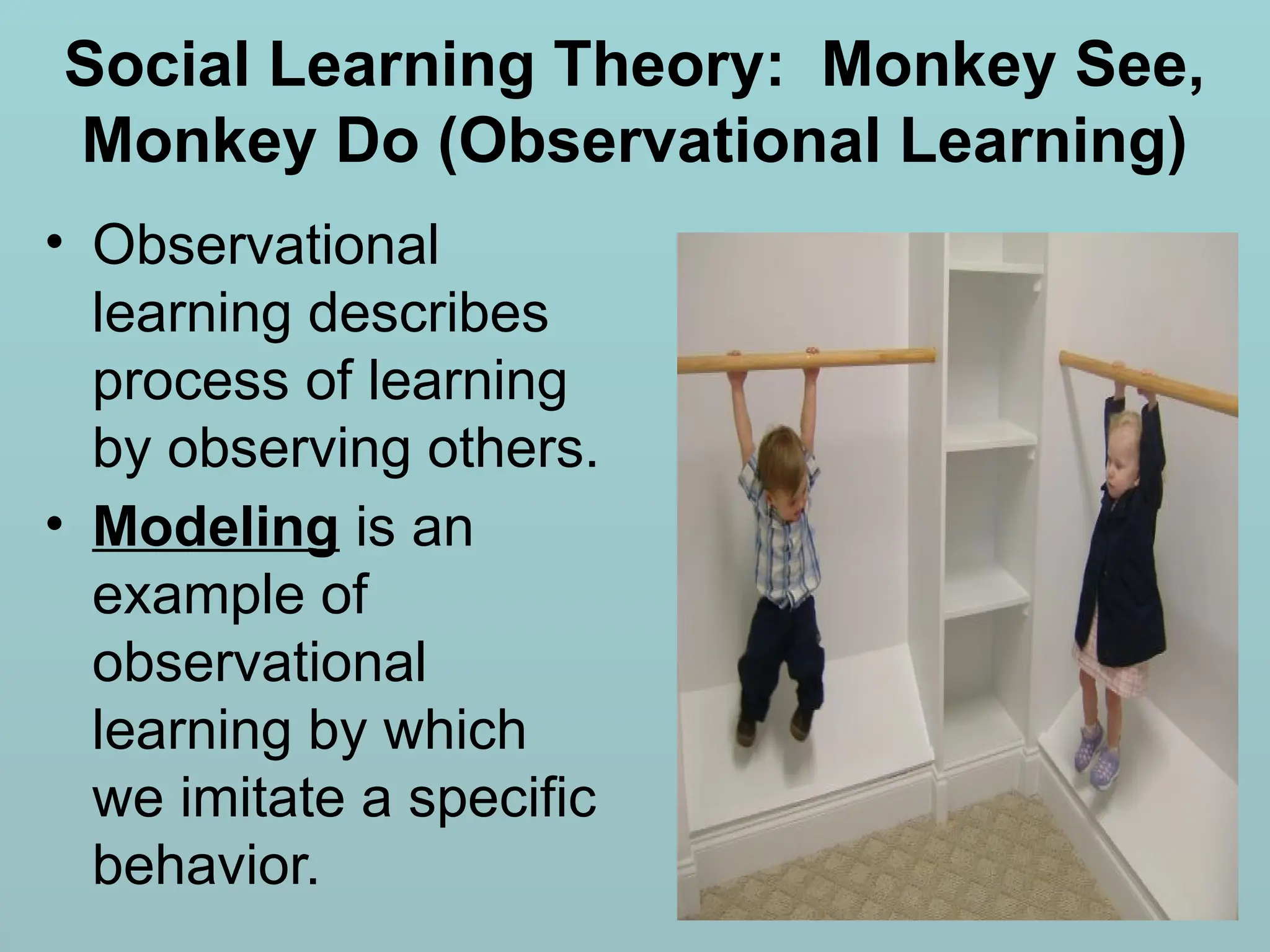
Social Learning Theory: Monkey See,
Monkey Do (Observational Learning)
• Observational
learning describes
process of learning
by observing others.
• Modeling is an
example of
observational
learning by which
we imitate a specific
behavior.
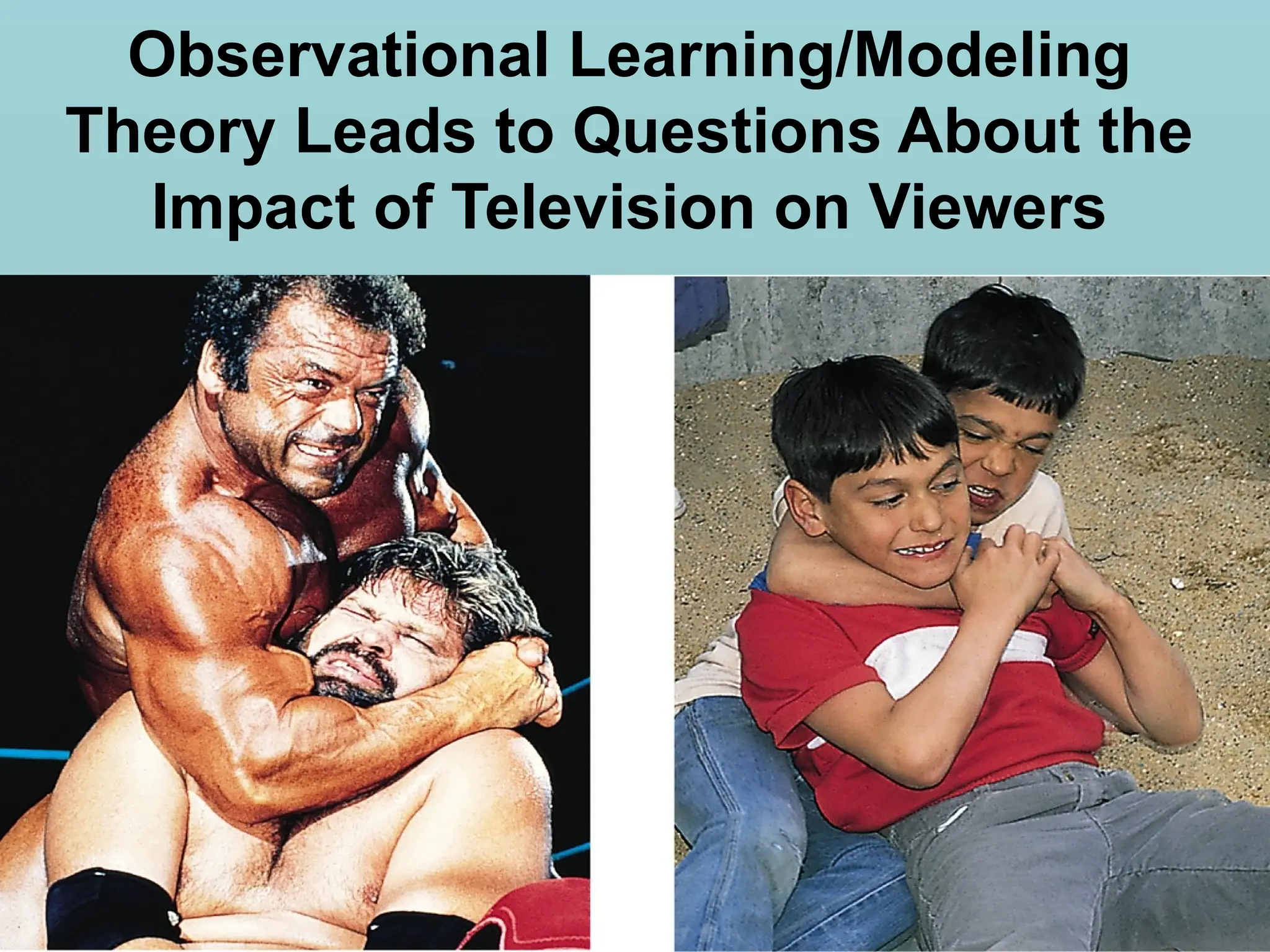
Observational Learning/Modeling
Theory Leads to Questions About the
Impact of Television on Viewers
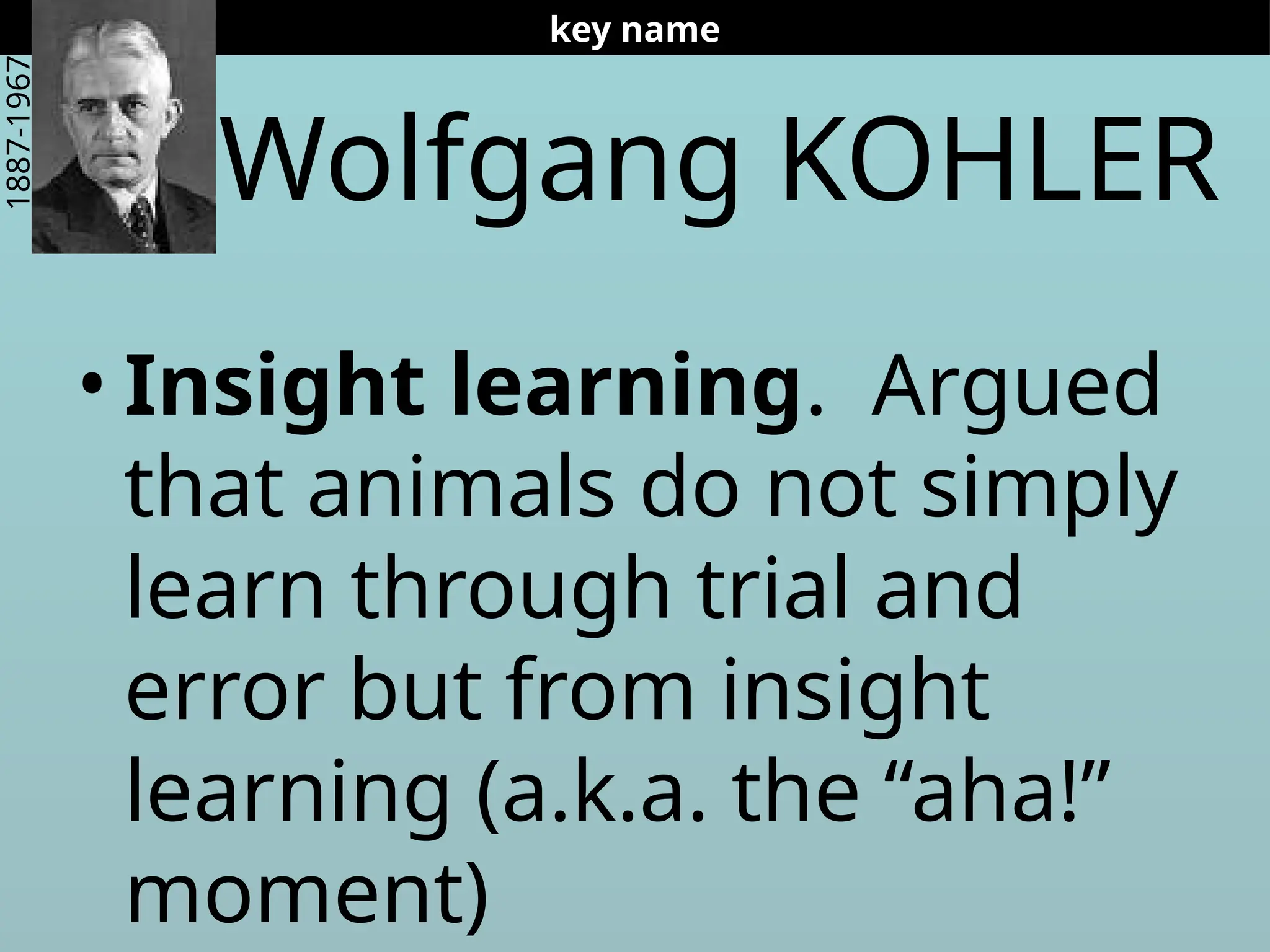
Wolfgang KOHLER
• Insight learning. Argued
that animals do not simply
learn through trial and
error but from insight
learning (a.k.a. the “aha!”
moment)
key name
1887-1967
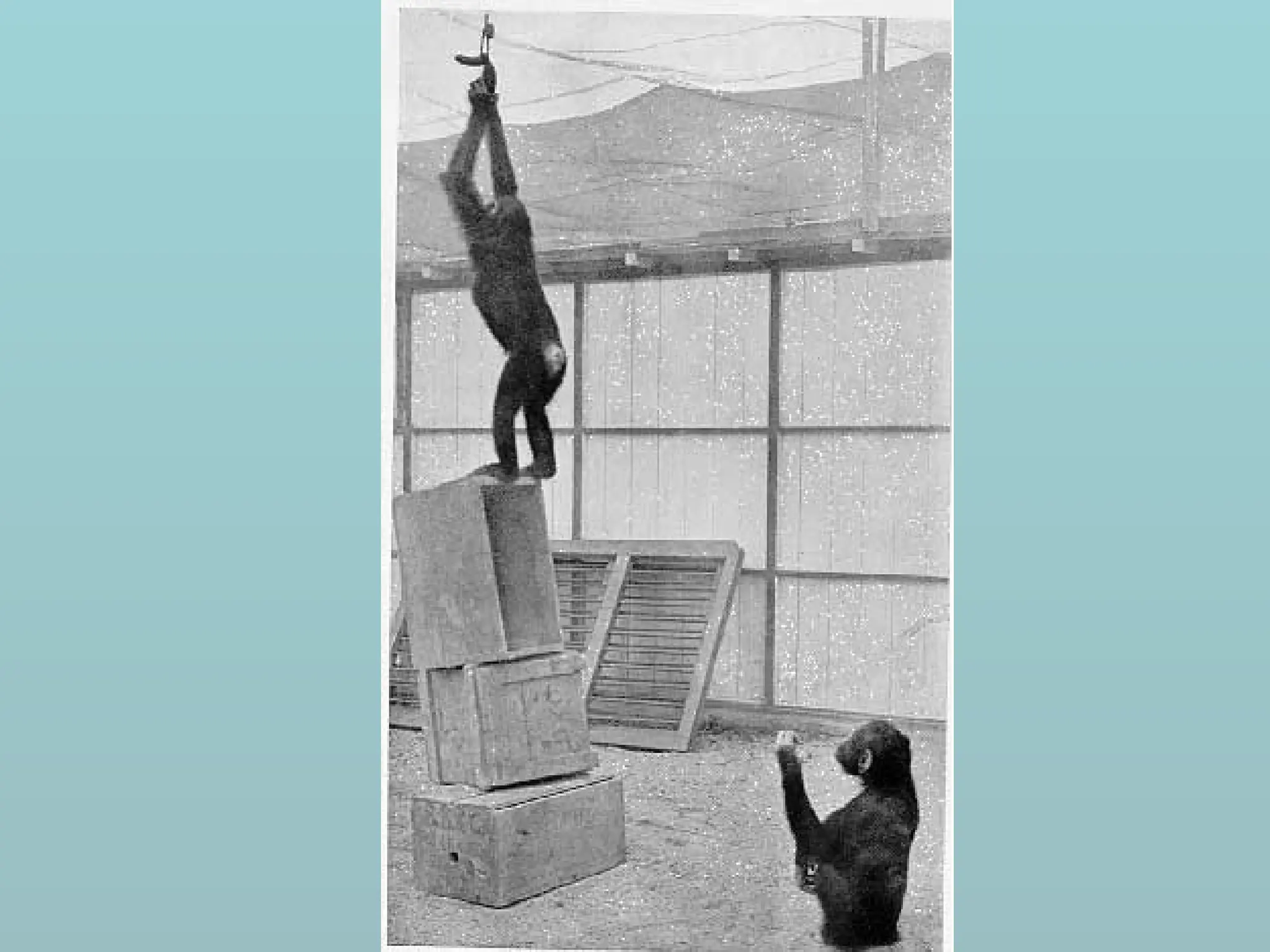
Kohler’s Experiment
PROBLEM: Food has been placed beyond the
reach of the chimps, outside a closed pen.
1. failure
2. pause
3. look at the potential tools
4. the attempt
The chimps behavior all seemed to follow a
similar pattern that suggested to Kohler that
the chimps were demonstrating insight and
planning
the chimp jumps fruitlessly at bananas that have been hung out
of reach
after a period of unsuccessful jumping, the chimp apparently
becomes angry or frustrated, walks away in seeming disgust,
pauses
the chimp looks at the food in what might be a more reflective
way, then at the toys in the enclosure, then back at the food, and
then at the toys again.
the animal begins to use the toys to get at the food
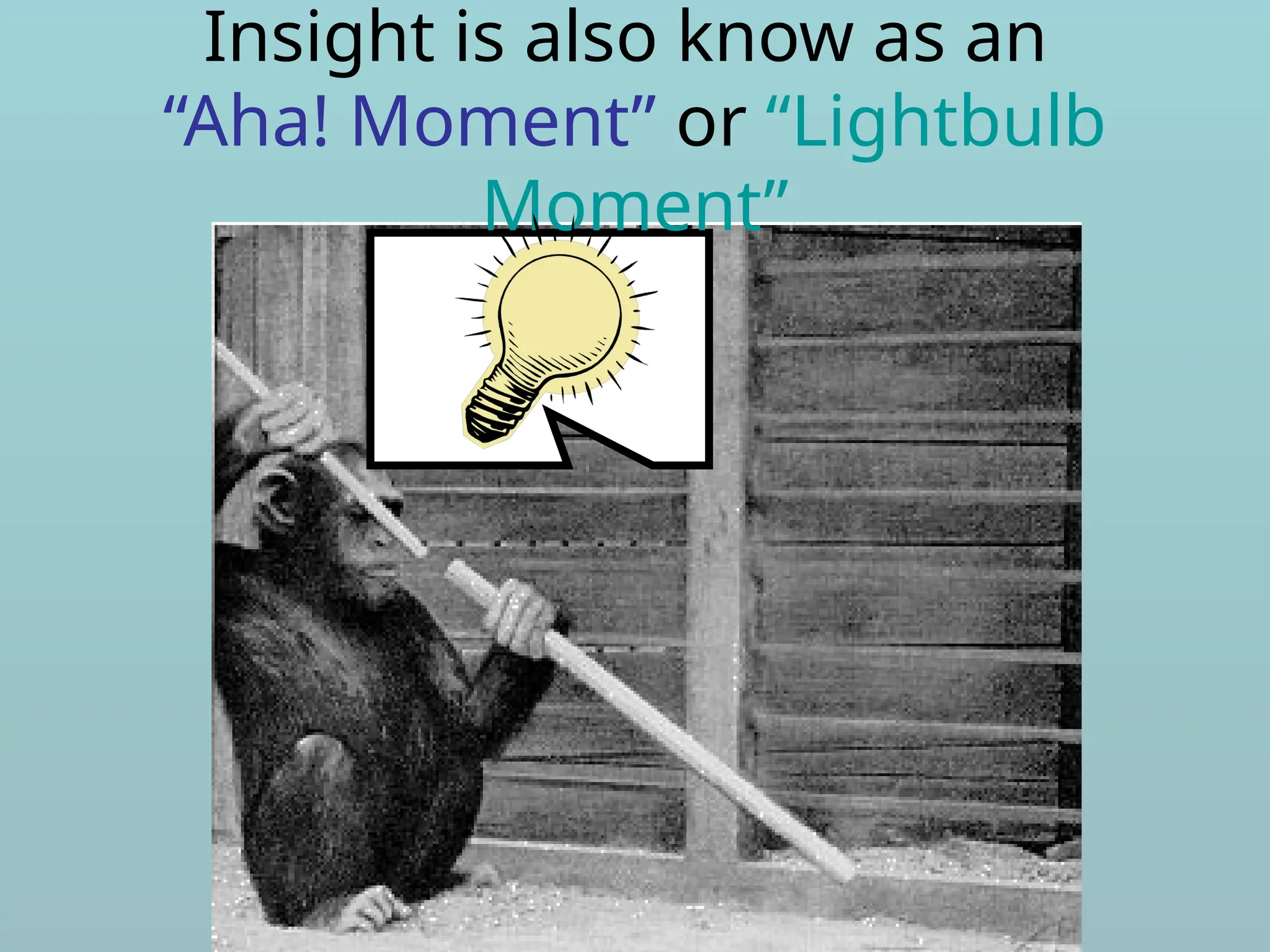
Insight is also know as an
“Aha! Moment” or “Lightbulb
Moment”

Operant Conditioning_Student Learning Day

  • 1.
    B.F. SKINNER • Mostsignificant name in behaviorism (behavior is controlled by reinforcement, not your unconscious) • Research on operant conditioning – external influences control behavior • Creator of the operant chamber (Skinner Box): chamber which creates reinforcement for certain behaviors key name B.F. = (Burrhus Frederic ) 1904-1990
  • 2.
    Skinner Box (a.k.a. “operantchamber”) Skinner tried unsuccessfully to market and sell the operant chamber to parents under the names “Heir conditioner,” “Air crib” and “Baby tender”
  • 3.
    Associative Learning Continued Usingfixed or varying forms of reward/punishment to elicit a desired behavior 2. Operant Conditioning
  • 4.
    Reinforcement • 2 types: 1.Positive reinforcement 2. Negative Reinforcement (beeping when you haven’t buckled your seatbelt OR running to get rid of stress) • INCREASES THE LIKELYHOOD that a particular behavior will occur.
  • 5.
    Reinforcement (encourages) • PositiveReinforcement: encourages a certain behavior by offering a positive stimulus (reward). • Negative Reinforcement also ENCOURAGES a particular behavior by removing an aversive (negative) stimulus. – NOT A PUNISHMENT!
  • 6.
    Punishment •Punishment: DISCOURAGES aparticular behavior by usually adding an aversive stimulus. –Two types: 1. Negative Punishment 2. Positive Punishment
  • 7.
    Punishment (discourages) – NegativePunishment: • Remove something desirable to discourage behavior – Ex: Take away your cell phone – Positive Punishment • Discourage behavior by giving something undesirable – A spanking – An electric shock
  • 8.
    Reinforcement is BEST •Not punishment….WHY? – If a child is punished, they behave to avoid rather than understand why a behavior is undesirable
  • 9.
    Primary vs. ConditionedReinforcers Primary Conditioned Innately satisfying UNLEARNED Satisfying because they are associated with a primary reinforcer LEARNED food water sex Affiliation (family and friends) Removal of pain McDonalds Soda Bedroom Birthday Party Advil/ Tylenol
  • 10.
    Types of Reinforcement •Continuous Reinforcement: reinforcing the desired behavior every time it occurs. – Learning happens very quickly. – Extinction happens very quickly if reinforcement is stopped. • Partial (Intermittent) Reinforcement: reinforcing a desired behavior only part of the time. – Learning takes longer (slower acquisition) – Extinction TAKES LONGER
  • 11.
    One Additional Term... •Overjustification Effect → an expected external incentive such as money or prizes decreases a person’s intrinsic motivation to perform a task – Accelerated Reading Program - being forced to read might make you start to hate reading (anyone experienced this?)
  • 12.
    Types of Reinforcement •Continuous Reinforcement: reinforcing the desired behavior everytime it occurs. – Learning happens very quickly. – Extinction happens very quickly if reinforcement is stopped. • Partial (Intermittent) Reinforcement: reinforcing a desired behavior only part of the time. – Learning takes longer (slower acquisition) – Extinction TAKES LONGER
  • 13.
    Schedules of Reinforcement Reinforcementalways occurs after a fixed number of operant responses Fixed-ratio EX: A rat presses a lever 5 times, then gets a pellet; 5 times then a pellet, and so on
  • 14.
    Schedules of Reinforcement Reinforcementoccurs after a varying number of operant responses Variable-ratio EX: A rat must push the lever 4 times for a pellet, then 15 times, then 2 times, then 35 times, then 27 times, then 6 times, and so on…
  • 15.
    Schedules of Reinforcement Reinforcementalways occurs after a fixed amount of time Fixed-interval EX: A rat must push the lever after 10 minutes of time to receive1 pellet. He then must wait another 10 minutes, and can then push the lever
  • 16.
    Schedules of Reinforcement Reinforcementoccurs after a varying amount of time Variable-interval EX: a rat must push the lever after 2 minutes for a food pellet, then 10 minutes, then 7 minutes, then 23 minutes, ect…
  • 17.
    Immediate vs. Delayed Reinforcement* •In rats, if you delay reinforcement, virtually no learning will occur. • Although humans do recognize delayed reinforcement, immediate gratification sometimes move us into risky behavior. EX: smoking, drinking, unprotected sex.
  • 18.
    Comparing Classical Conditioning &Operant Conditioning • Behavior affected is usually INVOLUNTARY • Behavior affected is usually VOLUNTARY • Key events are PRESENTED to the learner • Key events are PRODUCED by the learner • Events CAUSE the behavior • Events CONTROL the behavior • The learner does not have a choice • The learner has a choice • Two stimuli (the NS and UCS) are associated • A behavior and a consequence (reinforcement or punishment) is associated
  • 19.
    Edward THORNDIKE • Proposedthe “Law of Effect” – behaviors followed by favorable outcomes are more likely • conducted puzzle box experiments on cats key name 1874-1949
  • 20.
    Shaping* • Shaping refersto an operant conditioning technique in which reinforcers guide behavior closer and closer towards a desired goal. – Uses successive approximations. How would you have trained this cat to become potty trained? Shaping a dog's behavior Shaping pigeon turning behavior
  • 21.
    Behaviorist vs CognitivistTheories Behaviorist: Only cares about behavior – what a person does – what can be observed or proven Learning is mechanical – you behave the way you do because of external stimuli – no internal processes are required (learning by thinking about something or watching it) Cognitivist: Care about what a person knows (instead of does). Learning serves a purpose.
  • 22.
    Cognition’s Effect on OperantConditioning Cognitive map: a mental representation of one’s environment that is developed without the aid of reinforcement. ex/ this classroom
  • 23.
    Latent learning: learningthat occurs (like cognitive map) that is not apparent (hidden) until there is an incentive to justify it. Ex: rats put in maze: no treat at end —rats just roamed around as though they were lost - As soon as a treat was put at the end, they zipped through the maze to the treat and exited
  • 24.
    • Learned helplessness –when a person begins to believe that they have no control over a situation, even when they do – demonstrates that prior learning can result in a drastic change in behavior – seeks to explain why individuals may accept and remain passive in negative situations despite their clear ability to change them
  • 25.
    Albert BANDURA • Researchedsocial theories of learning (a.k.a. observational learning or modeling) • Conducted the famous “Bobo the clown” experiment key name b. 1925
  • 27.
    Albert Bandura’s Experimenton Modeling (Bobo Doll Experiment) • Experiment that showed children could easily learn aggression through observational learning modeling. • Frustrated children beat on clown after seeing adult model do the same. • After a variety of experiments, many consider Bandura to be the father of social learning theory.
  • 28.
    Social Learning Theory:Monkey See, Monkey Do (Observational Learning) • Observational learning describes process of learning by observing others. • Modeling is an example of observational learning by which we imitate a specific behavior.
  • 29.
    Observational Learning/Modeling Theory Leadsto Questions About the Impact of Television on Viewers
  • 30.
    Wolfgang KOHLER • Insightlearning. Argued that animals do not simply learn through trial and error but from insight learning (a.k.a. the “aha!” moment) key name 1887-1967
  • 31.
    Kohler’s Experiment PROBLEM: Foodhas been placed beyond the reach of the chimps, outside a closed pen.
  • 32.
    1. failure 2. pause 3.look at the potential tools 4. the attempt The chimps behavior all seemed to follow a similar pattern that suggested to Kohler that the chimps were demonstrating insight and planning the chimp jumps fruitlessly at bananas that have been hung out of reach after a period of unsuccessful jumping, the chimp apparently becomes angry or frustrated, walks away in seeming disgust, pauses the chimp looks at the food in what might be a more reflective way, then at the toys in the enclosure, then back at the food, and then at the toys again. the animal begins to use the toys to get at the food
  • 34.
    Insight is alsoknow as an “Aha! Moment” or “Lightbulb Moment”