The Emergence of Radical Behaviorism:
“Operant Conditioning”
• Developed at the end of the 19th century
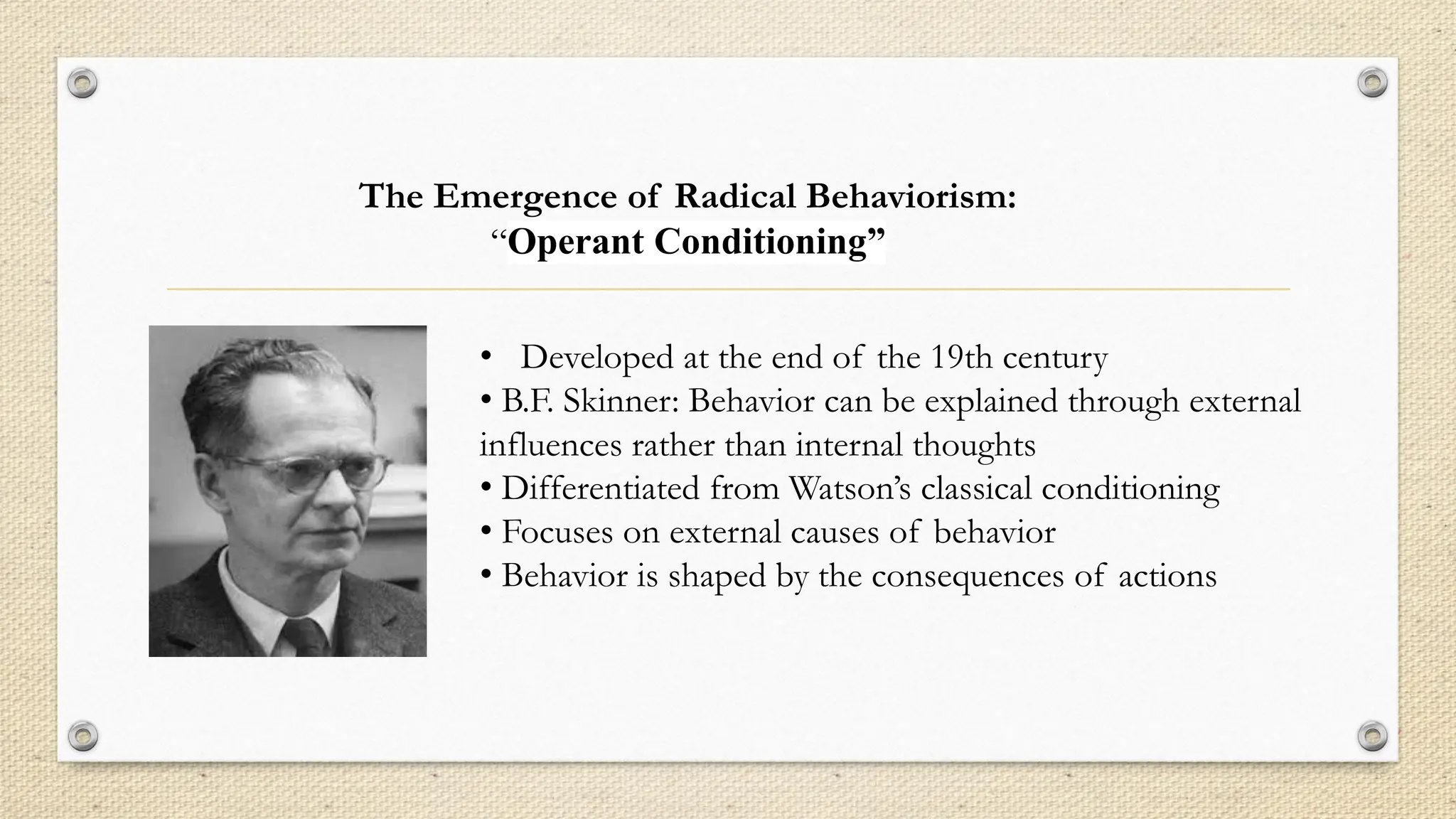
• B.F. Skinner: Behavior can be explained through external
influences rather than internal thoughts
• Differentiated from Watson’s classical conditioning
• Focuses on external causes of behavior
• Behavior is shaped by the consequences of actions
What is Operant Conditioning?
• Unlike classical conditioning, which emphasizes reflexive responses to
stimuli, operant conditioning looks at voluntary behaviors and how
they are shaped by external rewards or punishments. According to
Skinner, behavior is determined by the outcomes it produces,
meaning that positive consequences reinforce a behavior, making it
more likely to occur again, while negative consequences reduce the
likelihood of that behavior being repeated.
Consequences of Behaviour
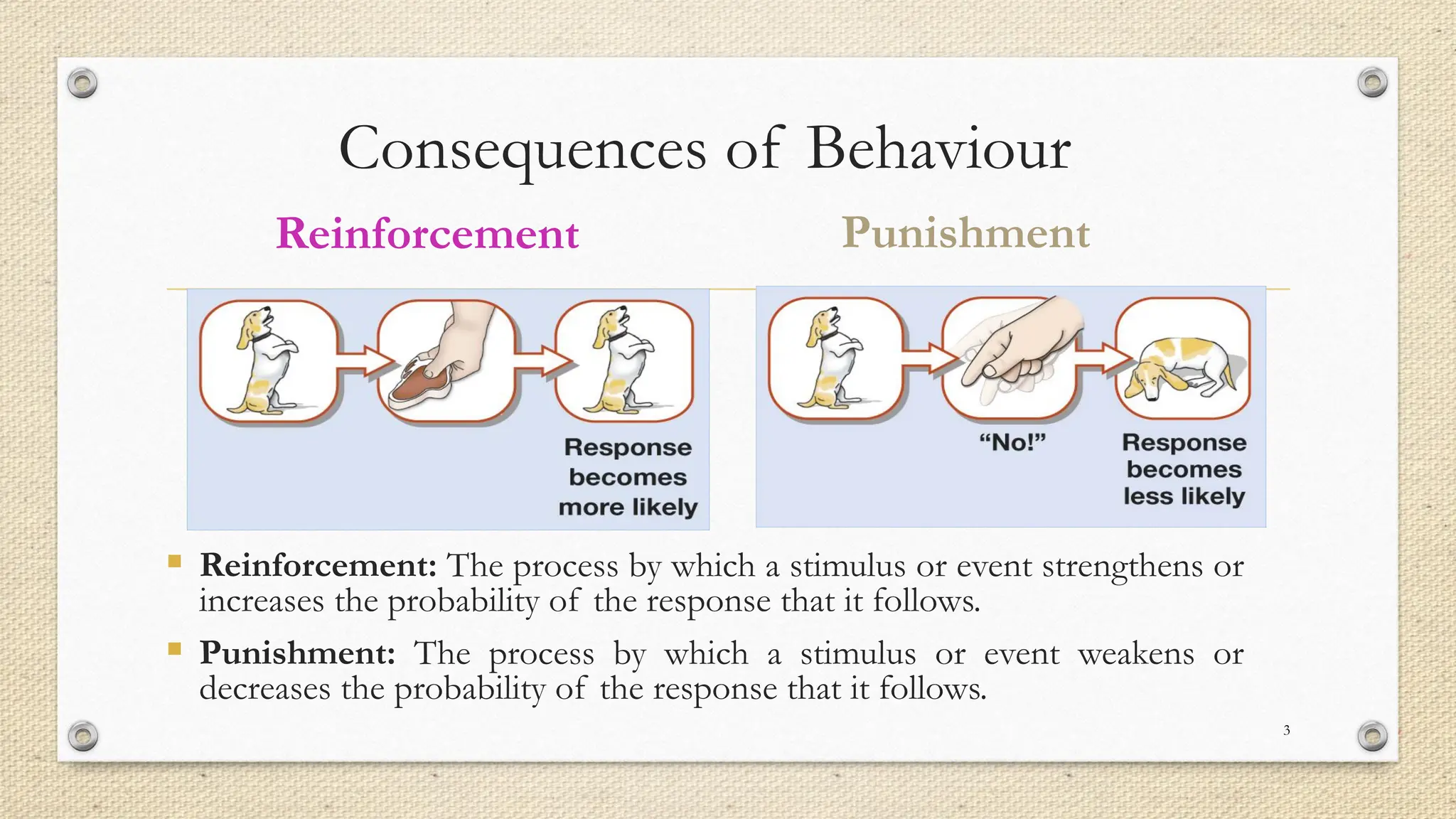
▪ Reinforcement: The process by which a stimulus or event strengthens or
increases the probability of the response that it follows.
▪ Punishment: The process by which a stimulus or event weakens or
decreases the probability of the response that it follows.
3
Punishment
Reinforcement
Types of Reinforcement and Punishment
• Reinforcement
• Punishment
Positive
Negative
Positive
Negative
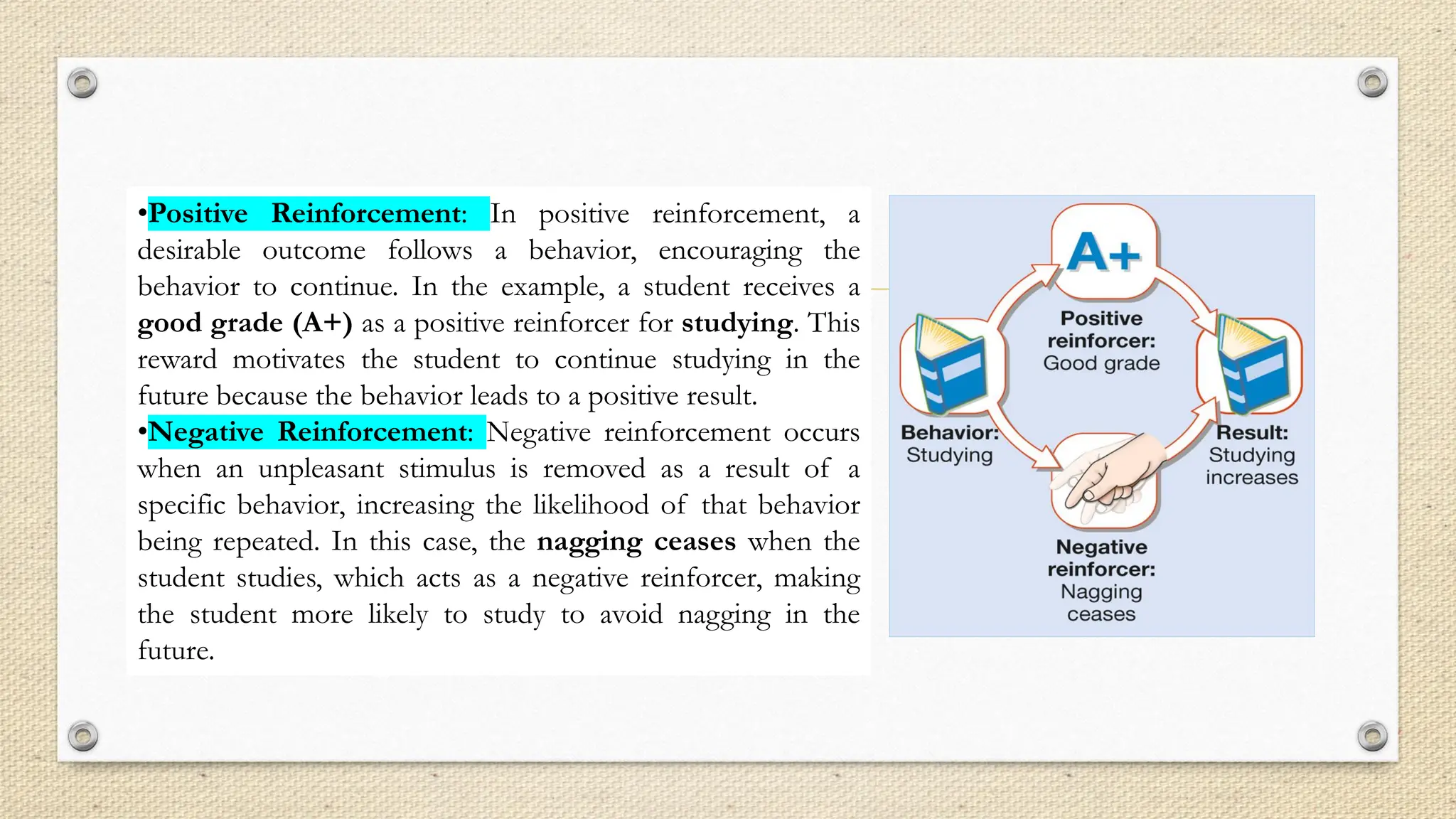
•Positive Reinforcement: In positive reinforcement, a
desirable outcome follows a behavior, encouraging the
behavior to continue. In the example, a student receives a
good grade (A+) as a positive reinforcer for studying. This
reward motivates the student to continue studying in the
future because the behavior leads to a positive result.
•Negative Reinforcement: Negative reinforcement occurs
when an unpleasant stimulus is removed as a result of a
specific behavior, increasing the likelihood of that behavior
being repeated. In this case, the nagging ceases when the
student studies, which acts as a negative reinforcer, making
the student more likely to study to avoid nagging in the
future.
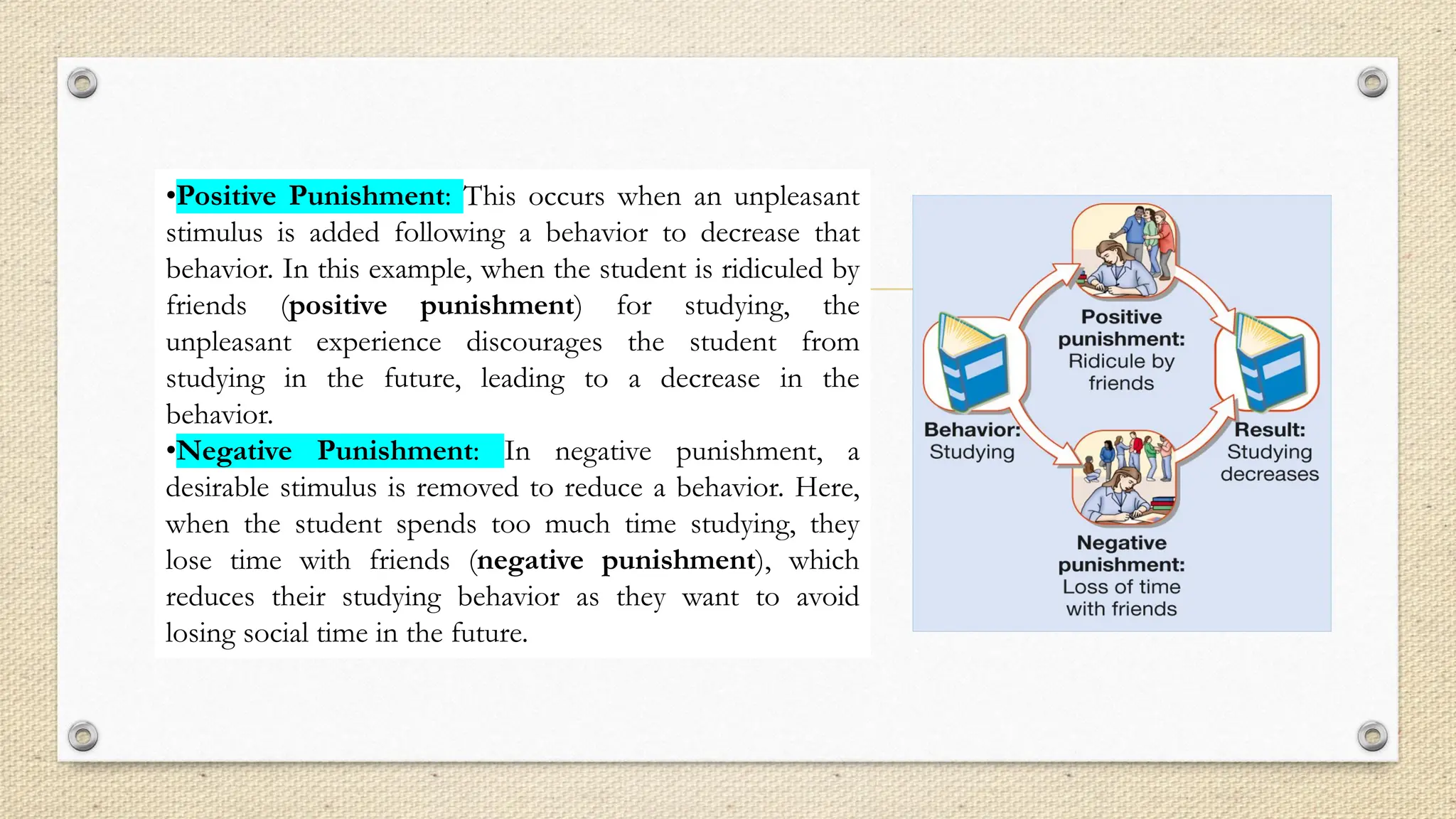
•Positive Punishment: This occurs when an unpleasant
stimulus is added following a behavior to decrease that
behavior. In this example, when the student is ridiculed by
friends (positive punishment) for studying, the
unpleasant experience discourages the student from
studying in the future, leading to a decrease in the
behavior.
•Negative Punishment: In negative punishment, a
desirable stimulus is removed to reduce a behavior. Here,
when the student spends too much time studying, they
lose time with friends (negative punishment), which
reduces their studying behavior as they want to avoid
losing social time in the future.
• Example 1: Positive Reinforcement
• Example: A manager gives an employee a bonus for completing a project
ahead of schedule, encouraging the employee to continue working efficiently
in the future.
• Example 2: Negative Reinforcement
• Example: A student is allowed to skip doing extra homework for a week if
they perform well on a test. This removal of extra homework increases the
likelihood that the student will continue studying hard.
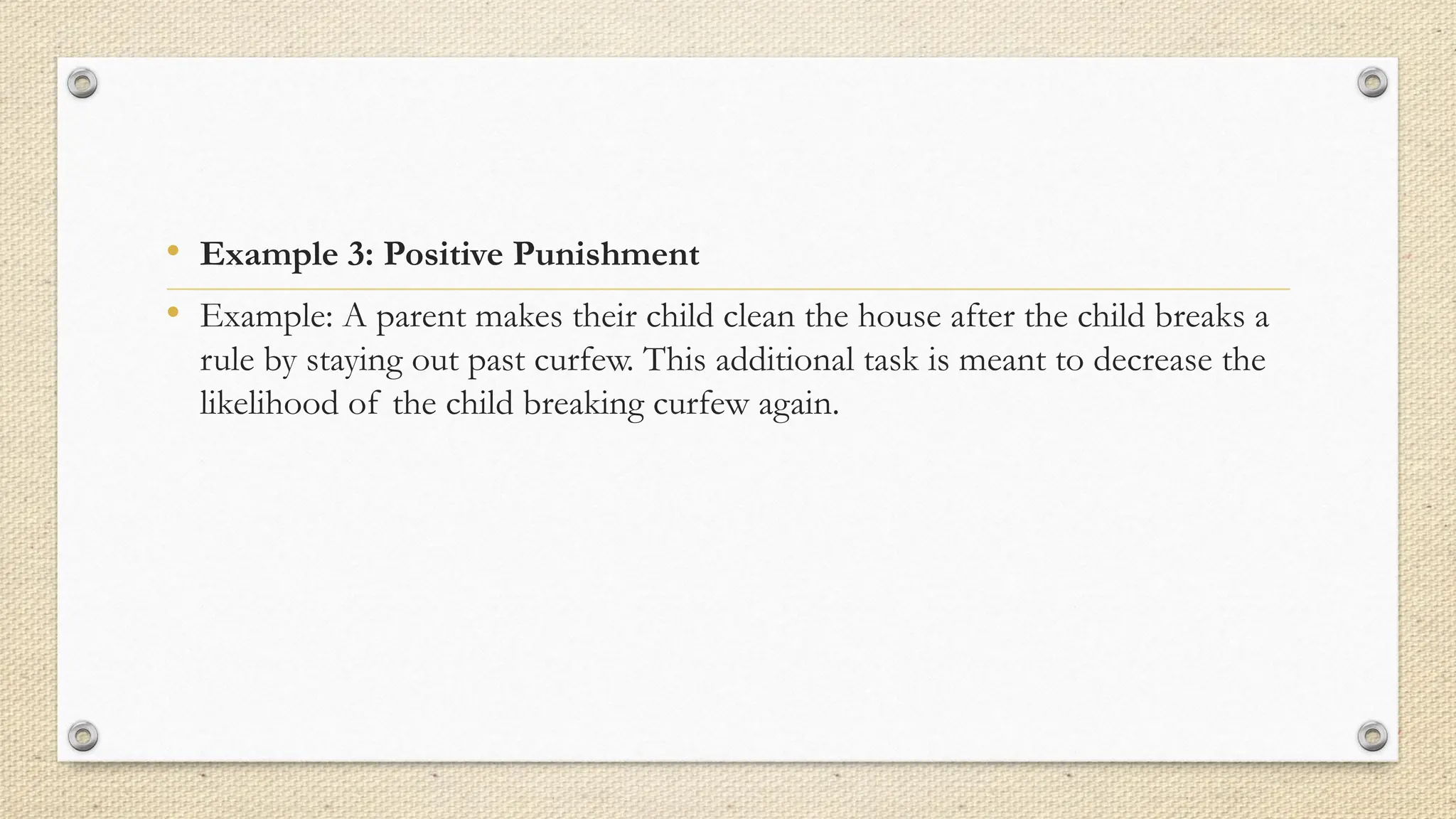
• Example 3: Positive Punishment
• Example: A parent makes their child clean the house after the child breaks a
rule by staying out past curfew. This additional task is meant to decrease the
likelihood of the child breaking curfew again.
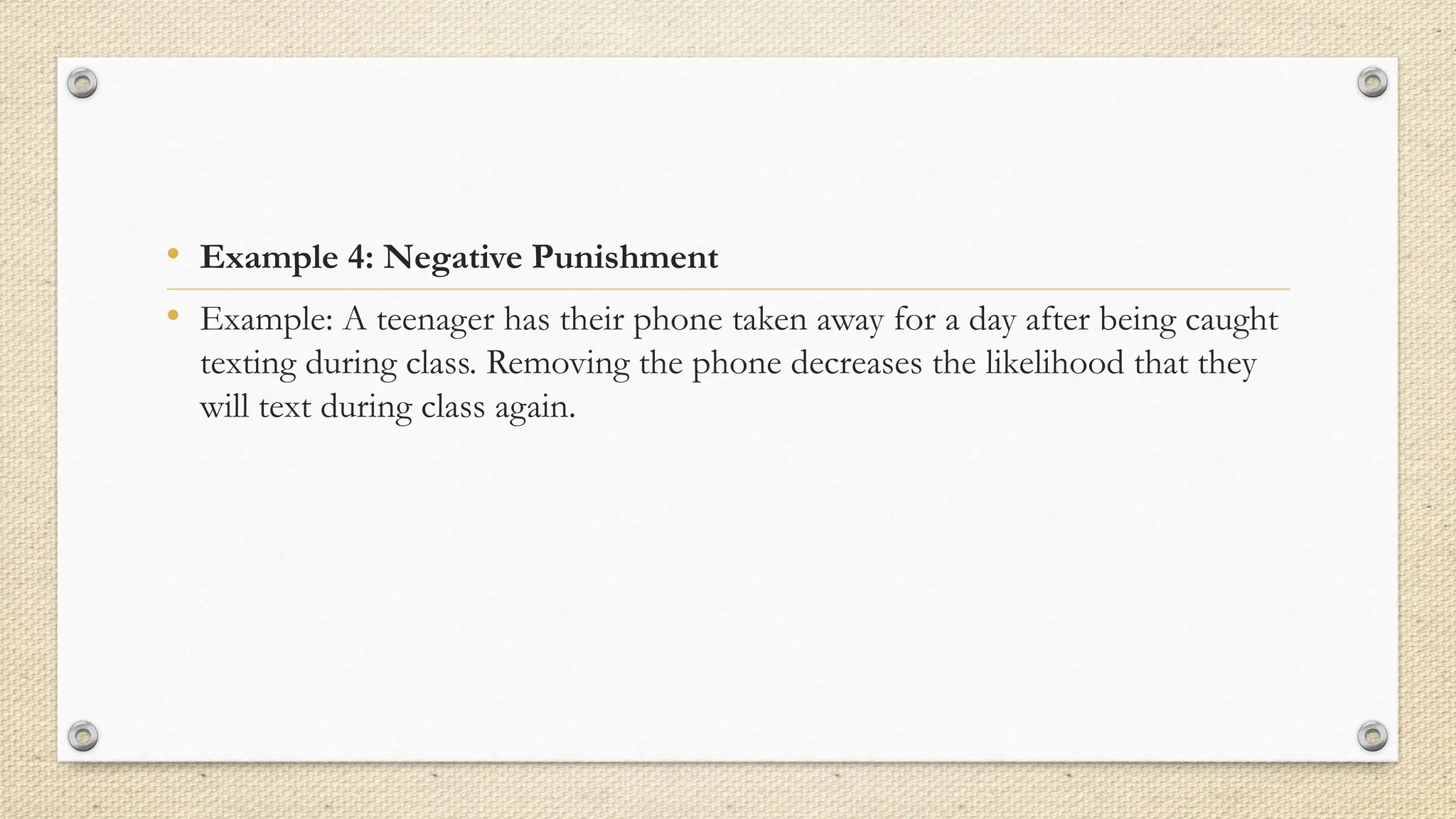
• Example 4: Negative Punishment
• Example: A teenager has their phone taken away for a day after being caught
texting during class. Removing the phone decreases the likelihood that they
will text during class again.
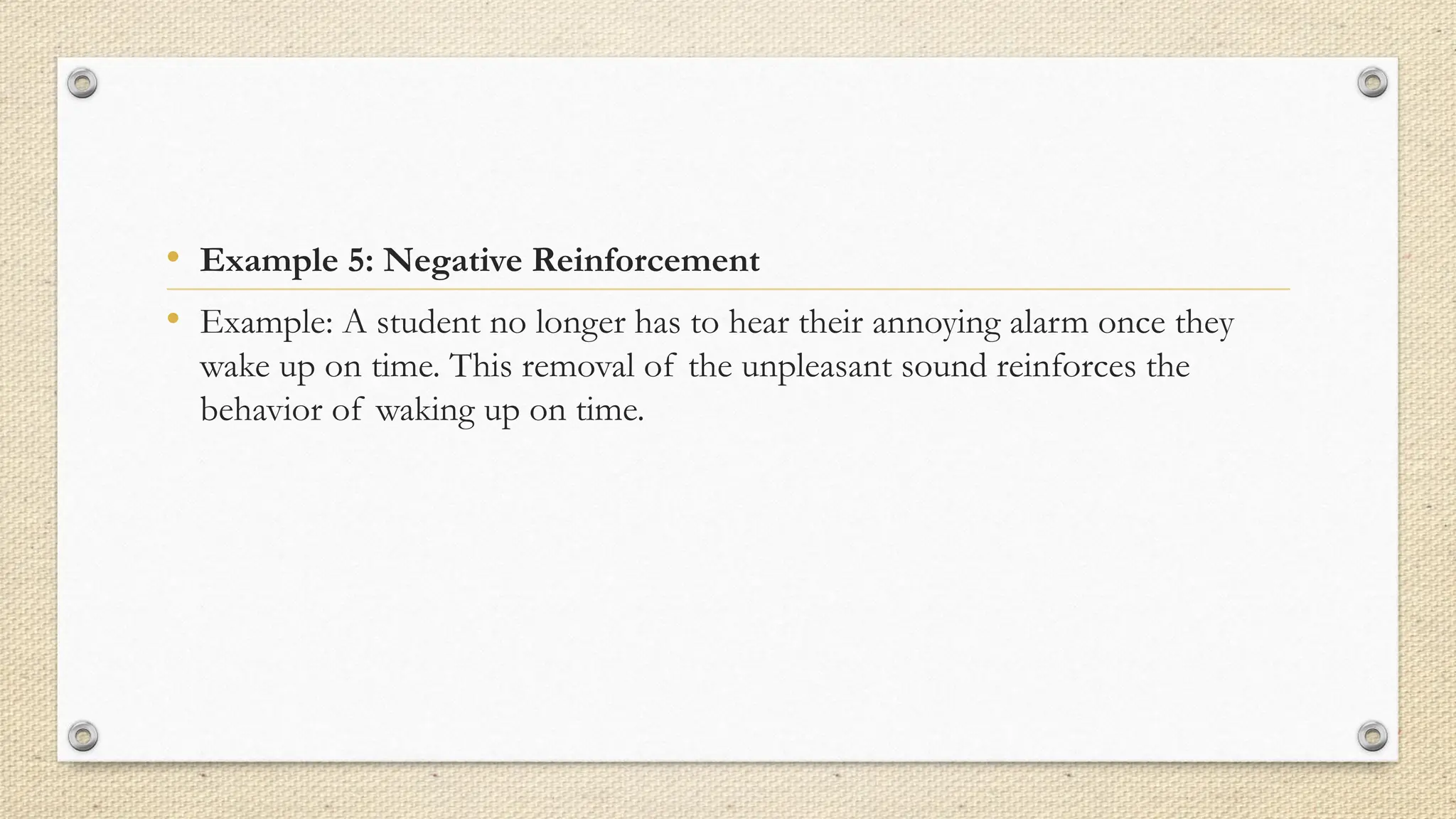
• Example 5: Negative Reinforcement
• Example: A student no longer has to hear their annoying alarm once they
wake up on time. This removal of the unpleasant sound reinforces the
behavior of waking up on time.
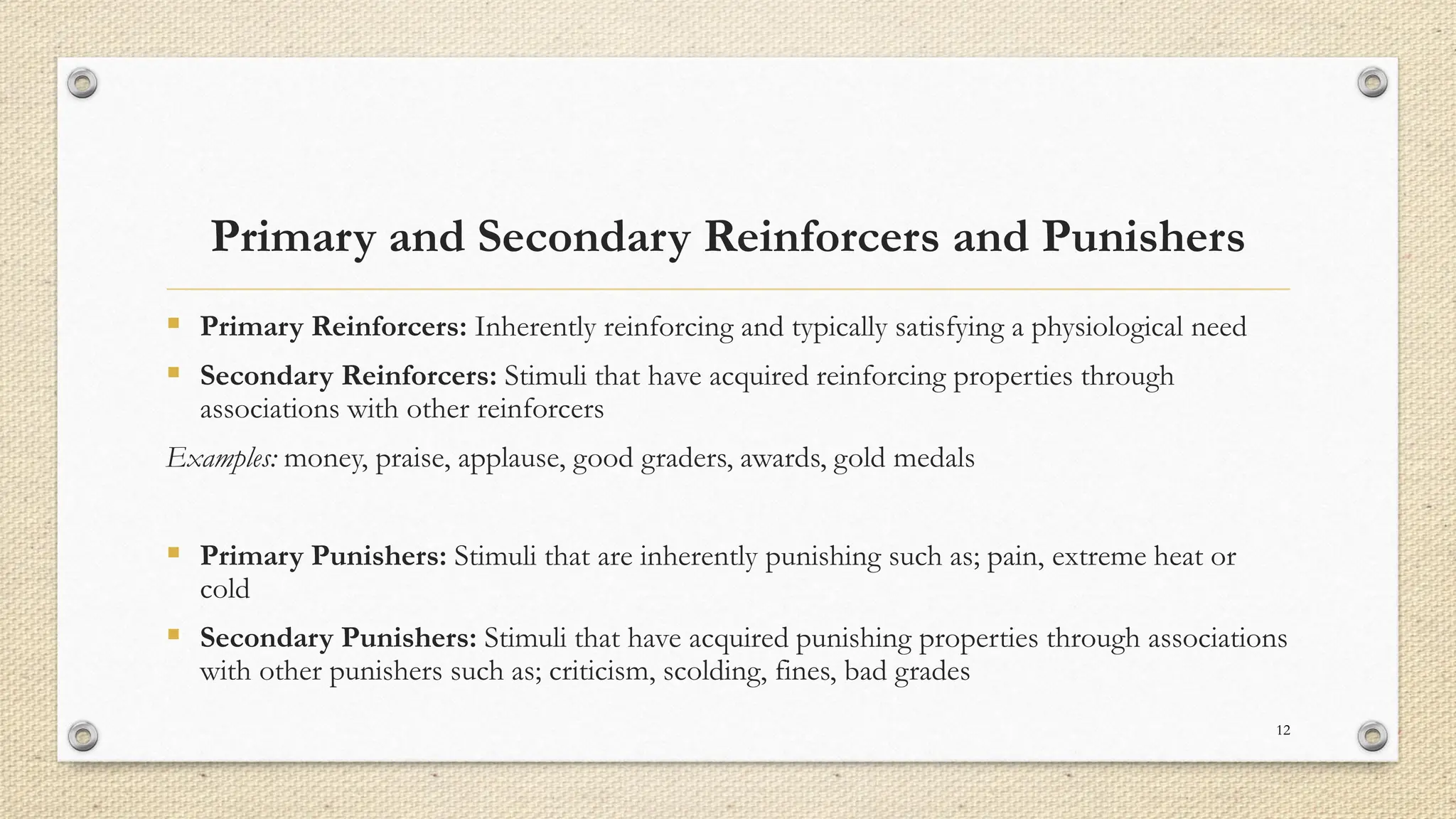
Primary and Secondary Reinforcers and Punishers
▪ Primary Reinforcers: Inherently reinforcing and typically satisfying a physiological need
▪ Secondary Reinforcers: Stimuli that have acquired reinforcing properties through
associations with other reinforcers
Examples: money, praise, applause, good graders, awards, gold medals
▪ Primary Punishers: Stimuli that are inherently punishing such as; pain, extreme heat or
cold
▪ Secondary Punishers: Stimuli that have acquired punishing properties through associations
with other punishers such as; criticism, scolding, fines, bad grades
12
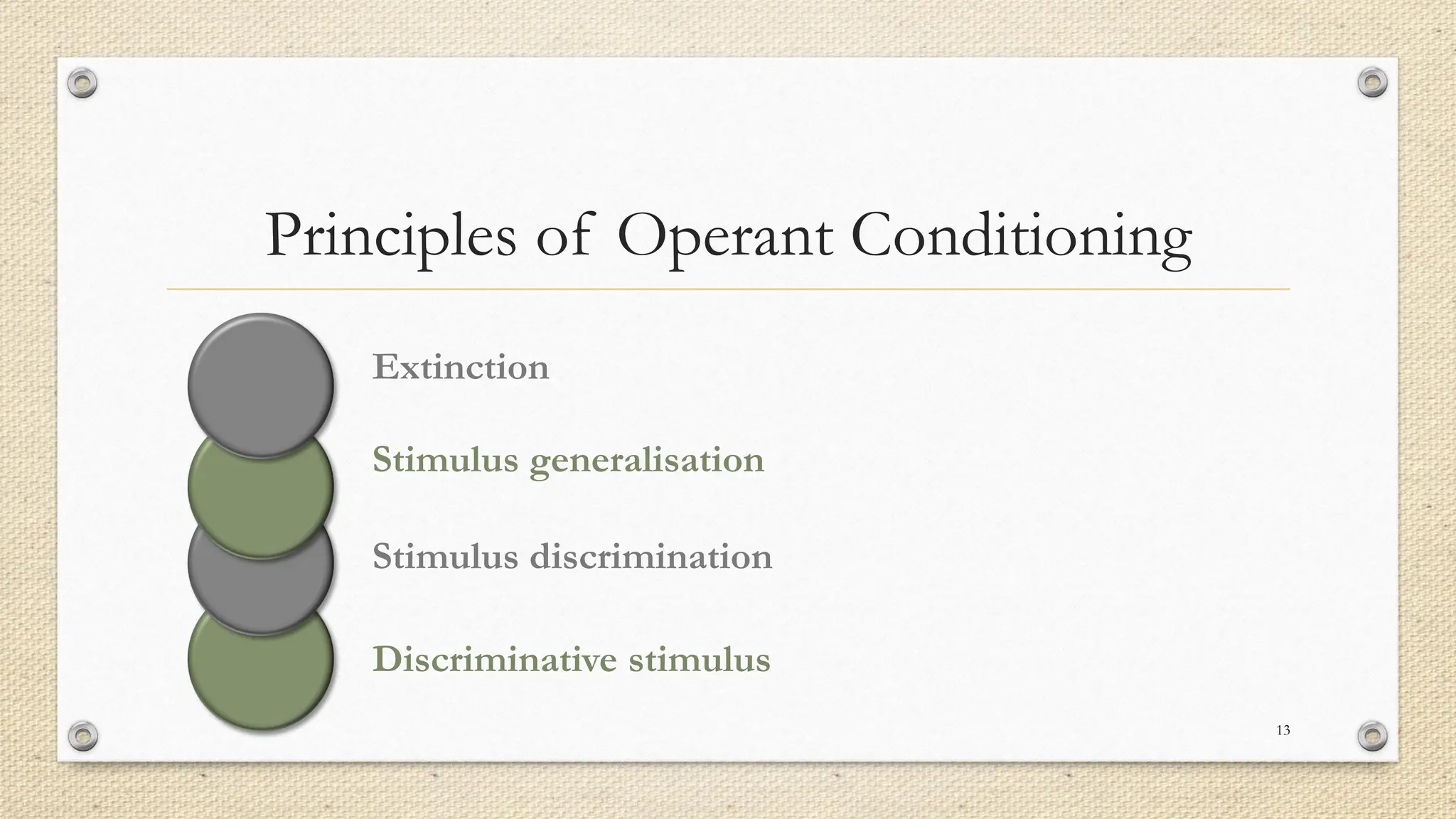
Principles of Operant Conditioning
13
Extinction
Stimulus generalisation
Stimulus discrimination
Discriminative stimulus
The Importance of Responses
▪ Extinction: The weakening and eventual disappearance of a learned response; in operant
conditioning, it occurs when a response is no longer followed by a reinforcer.
▪ Stimulus generalisation: In operant conditioning, the tendency for a response that has
been reinforced (or punished) in the presence of one stimulus to occur (or be suppressed) in
the presence of other similar stimuli.
▪ Stimulus discrimination: In operant conditioning, the tendency of a response to occur in
the presence of one stimulus but not in the presence of other similar stimuli that differ
from it on some dimension.
▪ Discriminative stimulus: A stimulus that signals when a particular response is likely to be
followed by a certain type of consequence.
14
Learning on Schedule
▪ Intermittent (Partial) Reinforcement: A reinforcement schedule in which a particular
response is sometimes but not always reinforced.
▪ Continuous Reinforcement: A reinforcement schedule in which a particular response is
always reinforced.
▪ Shaping: An operant-conditioning procedure in which successive approximations of a
desired response are reinforced.
▪ Getting a response to occur by reinforcing successive approximations of a desires response
▪ Successive Approximations: In the operant-conditioning procedure of shaping,
behaviours that are ordered in terms of increasing similarity or closeness to the desired
response.
15
Skinner: The Man and The Myth
▪ Skinner`s beliefs:
• Private internal events are real and can be studied, but they can not explain behaviour.
• Maintained that private internal events – perceptions, emotions, and thoughts – are as real as
any others, and we can study them by studying our own sensory experiences.
•He insisted, however, that thoughts and feelings cannot explain behavior.
•These components of consciousness are themselves simply behaviors that occur because of reinforcement and
punishment.
•He promoted the determinist view, saying that actions are determined by environment and genetics.
•Free will is an illusion.
16
Operant Conditioning in Real Life
• Behaviour Modification (Applied Behaviour Analysis)
▪ Application of operant conditioning techniques to teach new responses or to
reduce and eliminate maladaptive or problematic behaviour
▪ By using a system of positive or negative consequences, an individual learns
the correct set of responses for any given stimulus.
17
Why Punishment is Ineffective and Should be Avoided?
▪ Decreased intrinsic motivation
▪ Increased fear and anxiety
▪ Promotes hostility and resistance
▪ Lowers self-esteem
▪ Lack of learning appropriate behaviors
▪ Dependency on external control
Alternatives to Punishment
▪ Teach children problem-solving skills
▪ Reward good behaviour
▪ Ignore behaviour to extinguish it
▪ Use extinction and reinforcement
The problems with reward:
▪ Misuse of rewards
▪ Grade inflation
▪ Self-esteem approach appears misguided; A Cheater`s Mantra
“Given the choice between distorting the world to feel good about themselves and representing the world
accurately, people often take the first option" (Aronson, 2010)
19
Observational Learning (Social Learning
Theory)
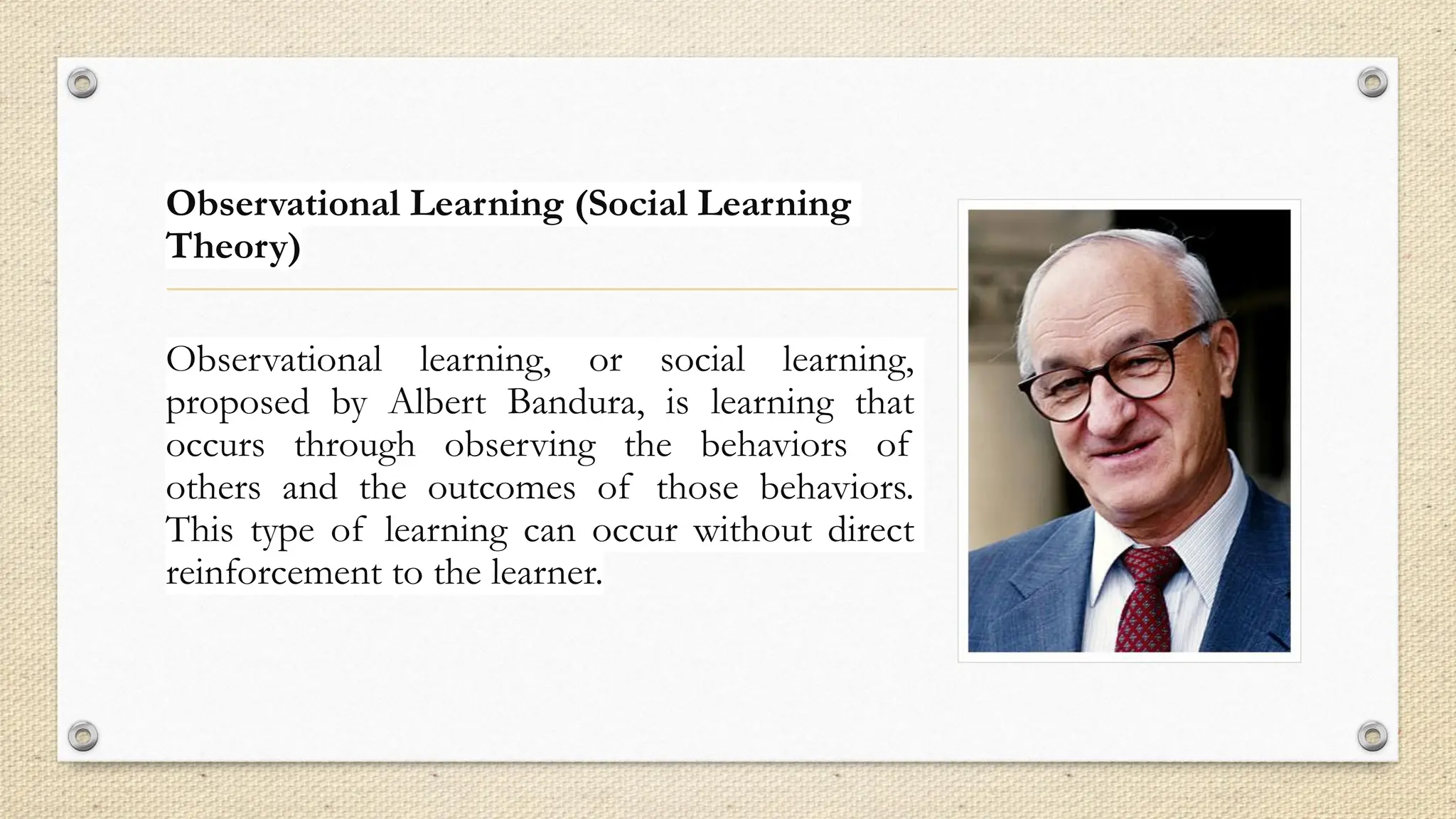
Observational learning, or social learning,
proposed by Albert Bandura, is learning that
occurs through observing the behaviors of
others and the outcomes of those behaviors.
This type of learning can occur without direct
reinforcement to the learner.
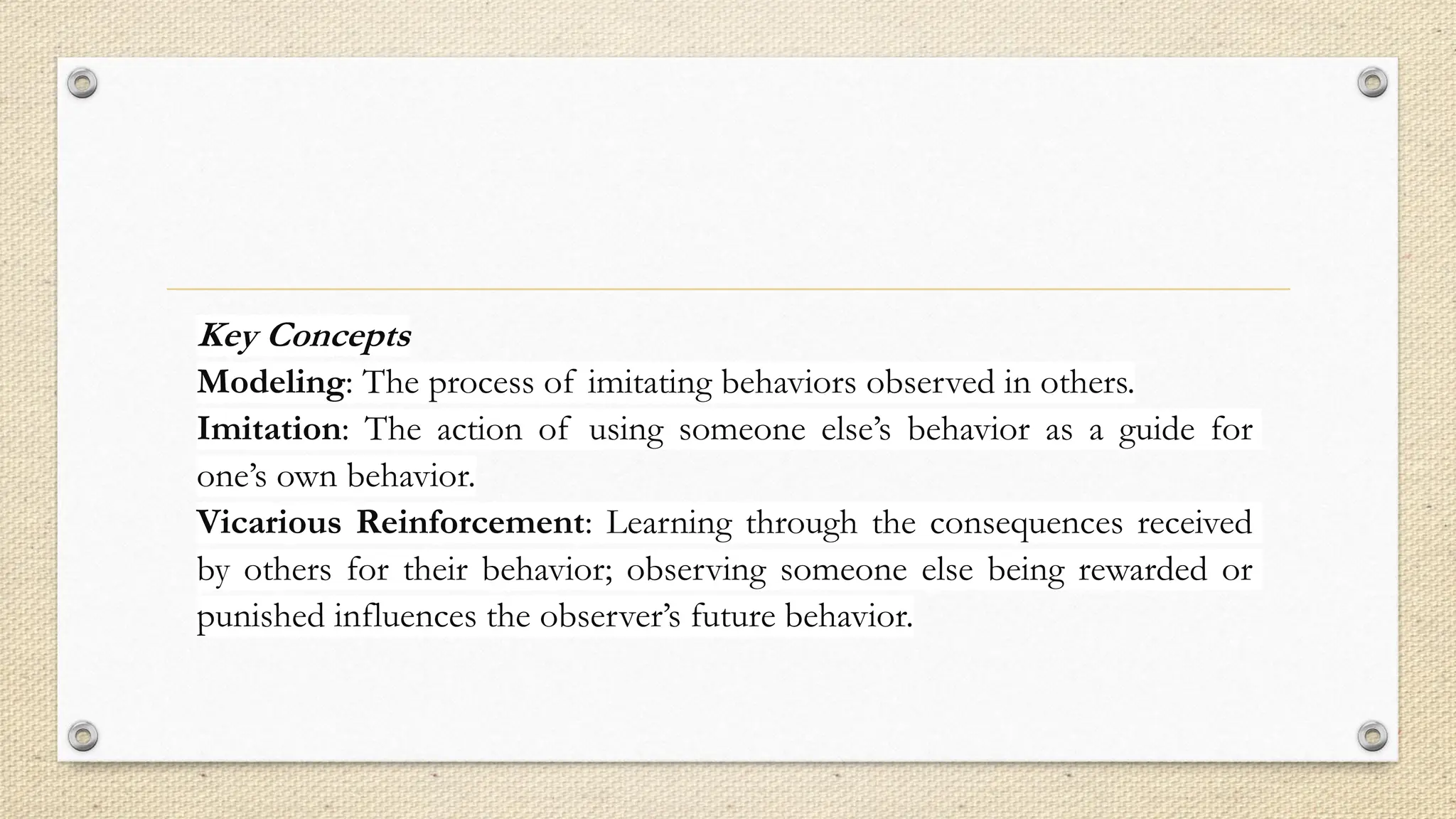
Key Concepts
Modeling: The process of imitating behaviors observed in others.
Imitation: The action of using someone else’s behavior as a guide for
one’s own behavior.
Vicarious Reinforcement: Learning through the consequences received
by others for their behavior; observing someone else being rewarded or
punished influences the observer’s future behavior.
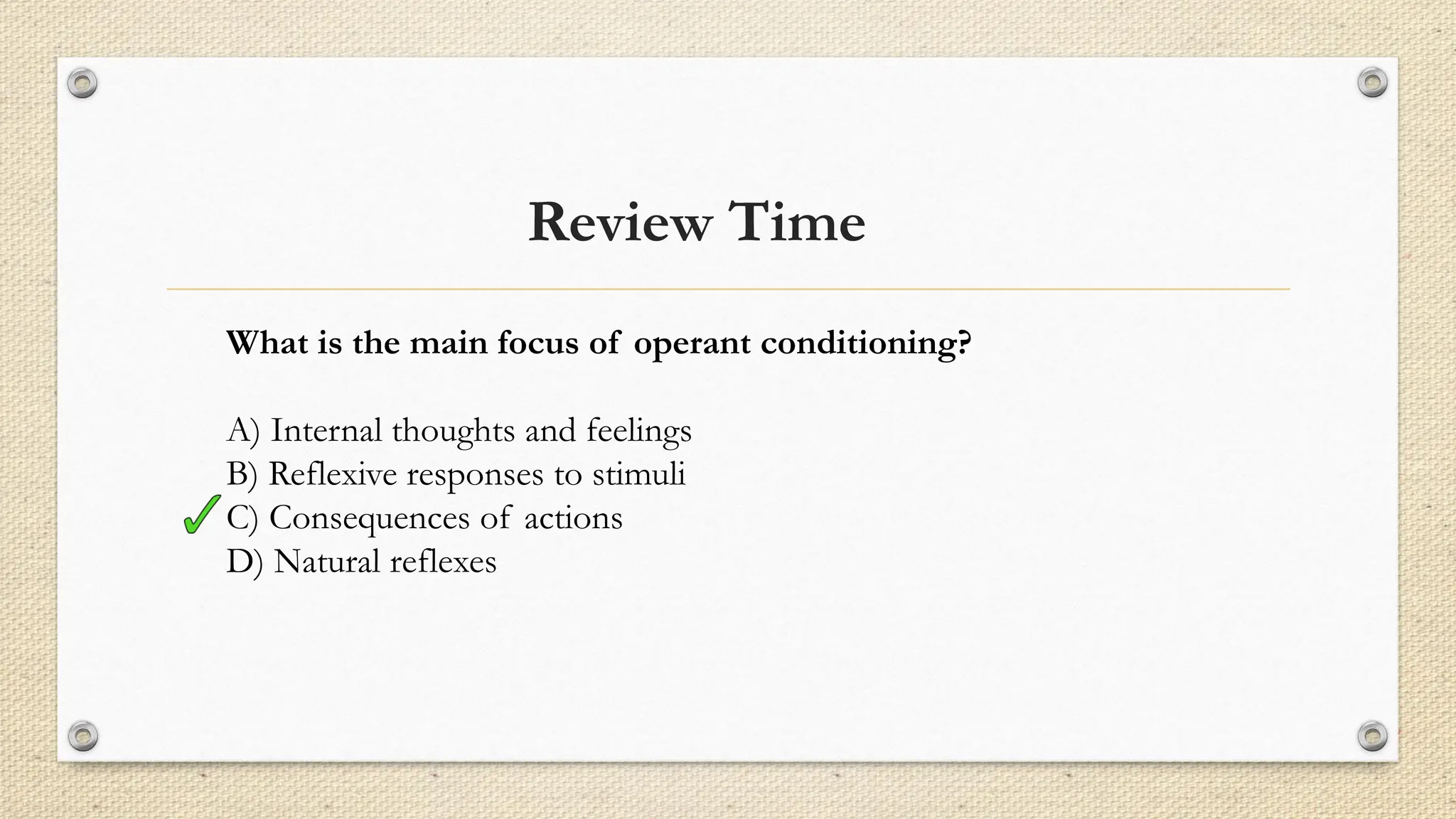
Review Time
What is the main focus of operant conditioning?
A) Internal thoughts and feelings
B) Reflexive responses to stimuli
C) Consequences of actions
D) Natural reflexes
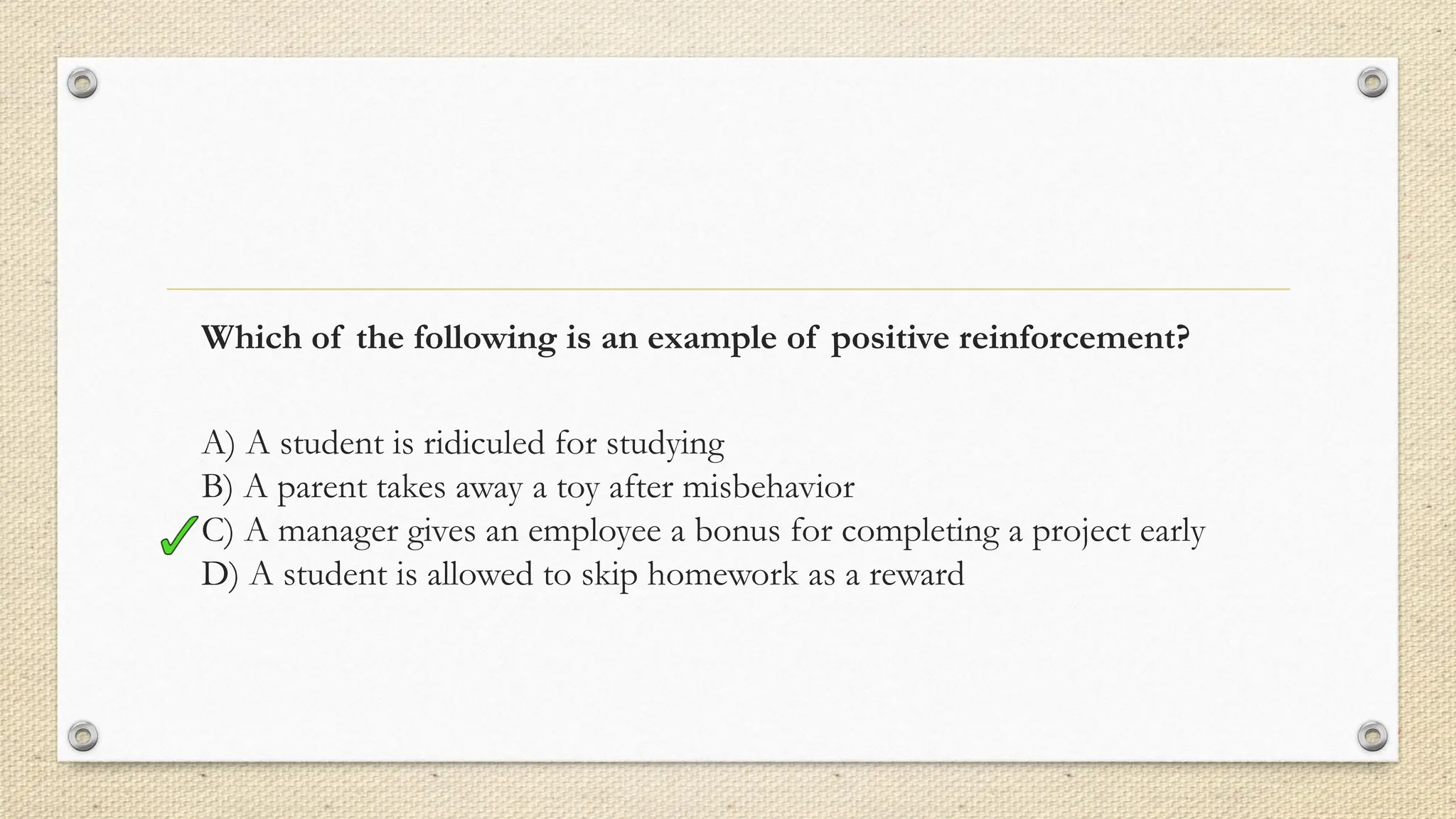
Which of the following is an example of positive reinforcement?
A) A student is ridiculed for studying
B) A parent takes away a toy after misbehavior
C) A manager gives an employee a bonus for completing a project early
D) A student is allowed to skip homework as a reward
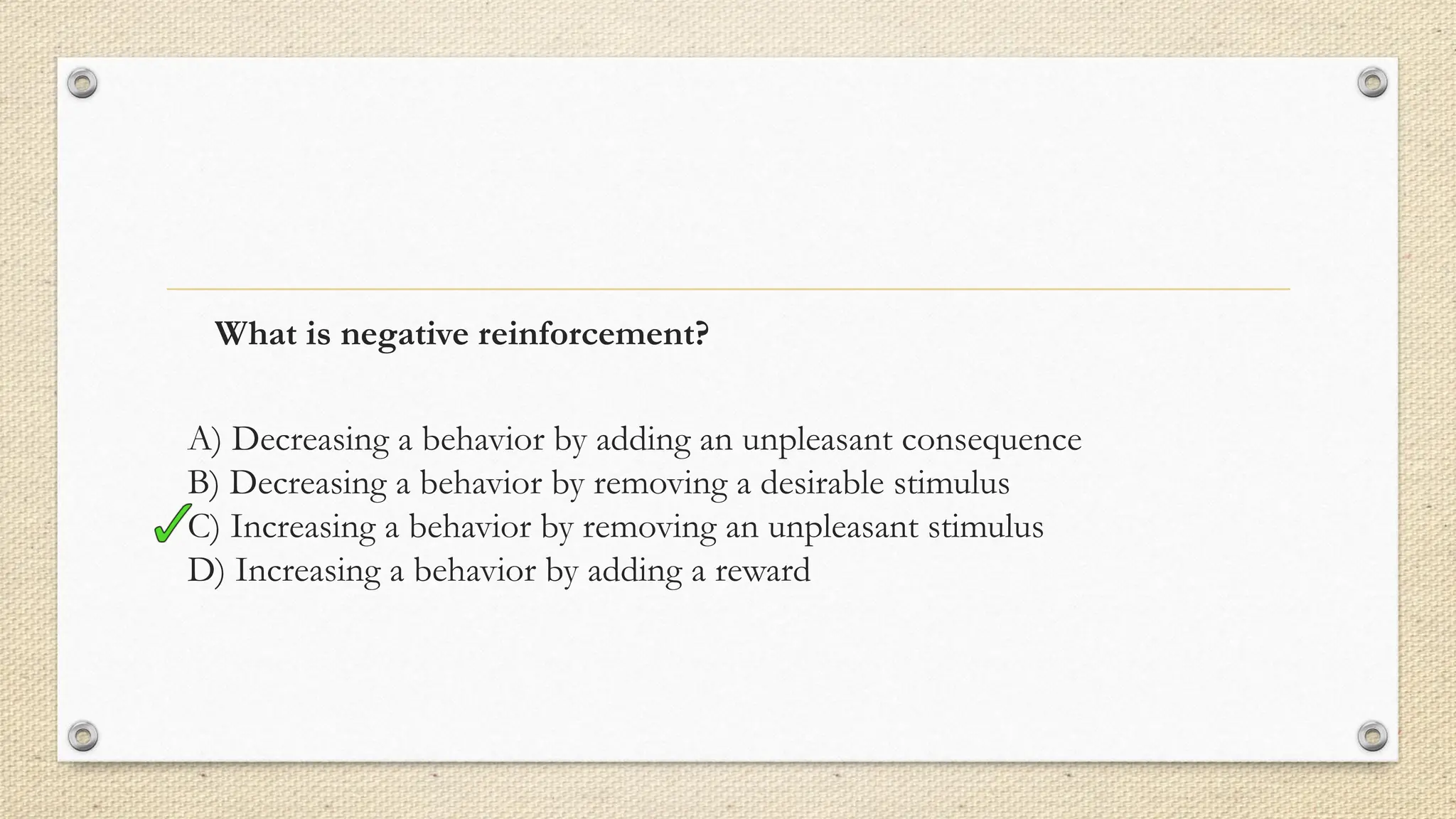
What is negative reinforcement?
A) Decreasing a behavior by adding an unpleasant consequence
B) Decreasing a behavior by removing a desirable stimulus
C) Increasing a behavior by removing an unpleasant stimulus
D) Increasing a behavior by adding a reward
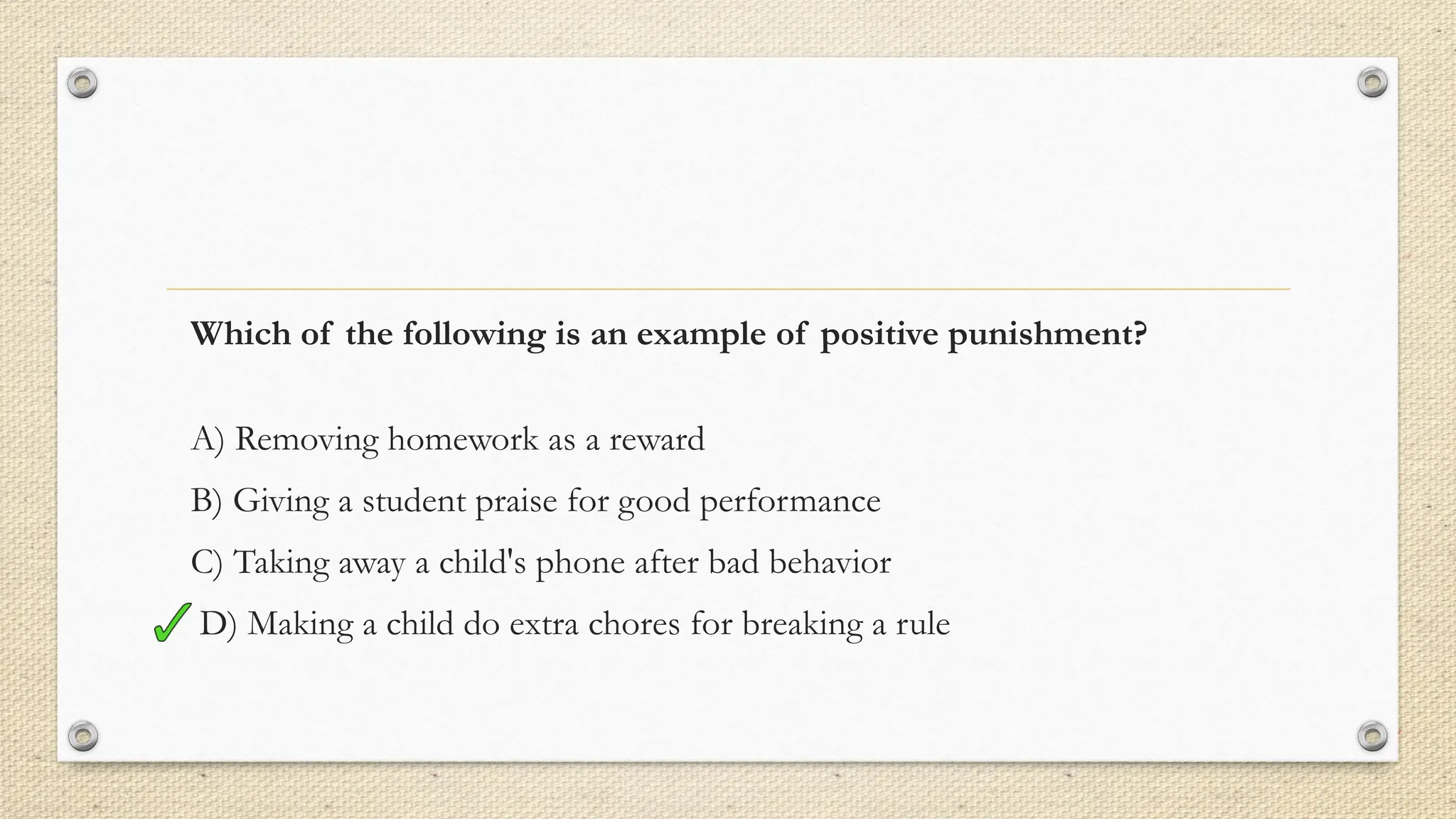
Which of the following is an example of positive punishment?
A) Removing homework as a reward
B) Giving a student praise for good performance
C) Taking away a child's phone after bad behavior
D) Making a child do extra chores for breaking a rule
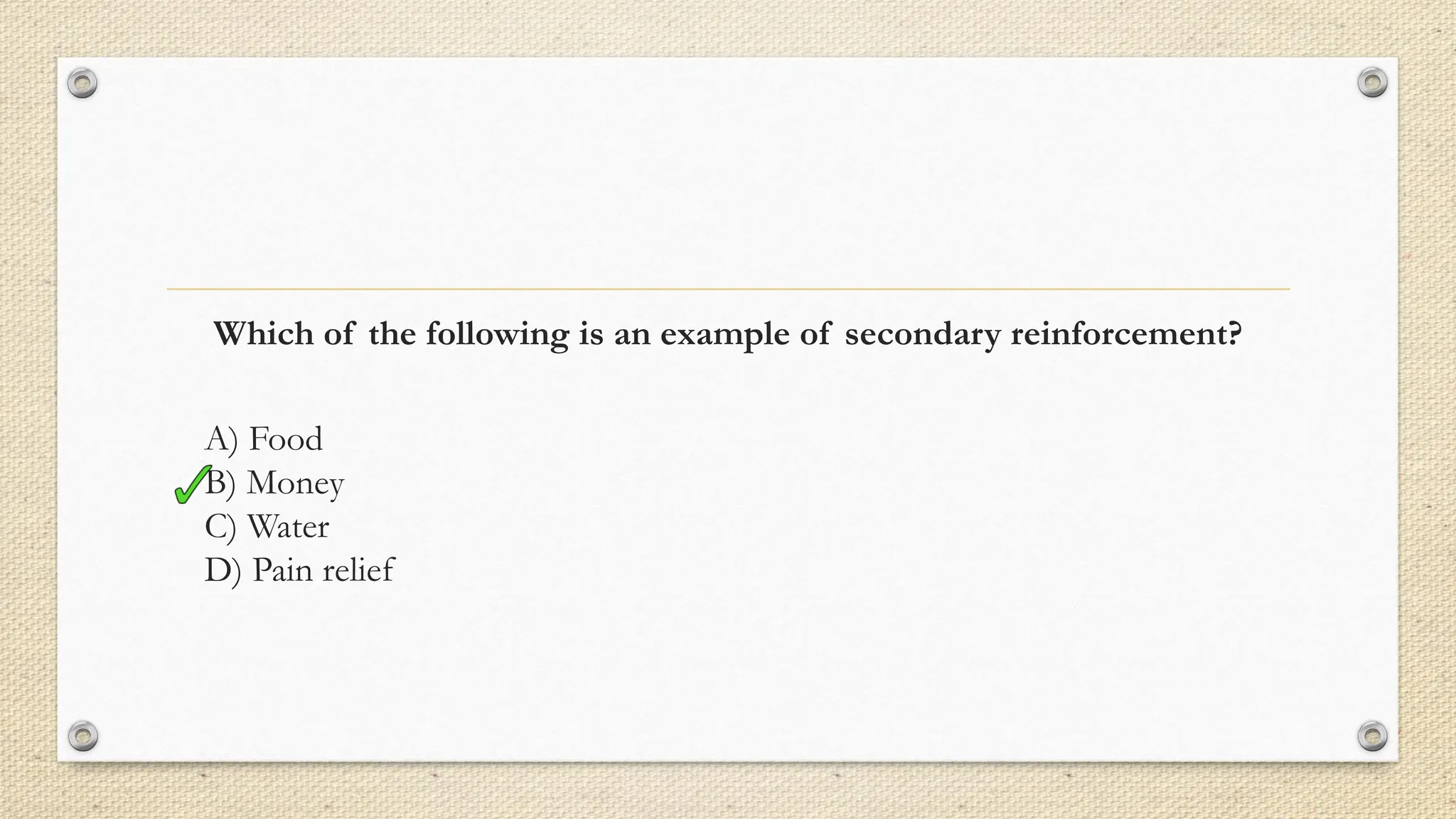
Which of the following is an example of secondary reinforcement?
A) Food
B) Money
C) Water
D) Pain relief
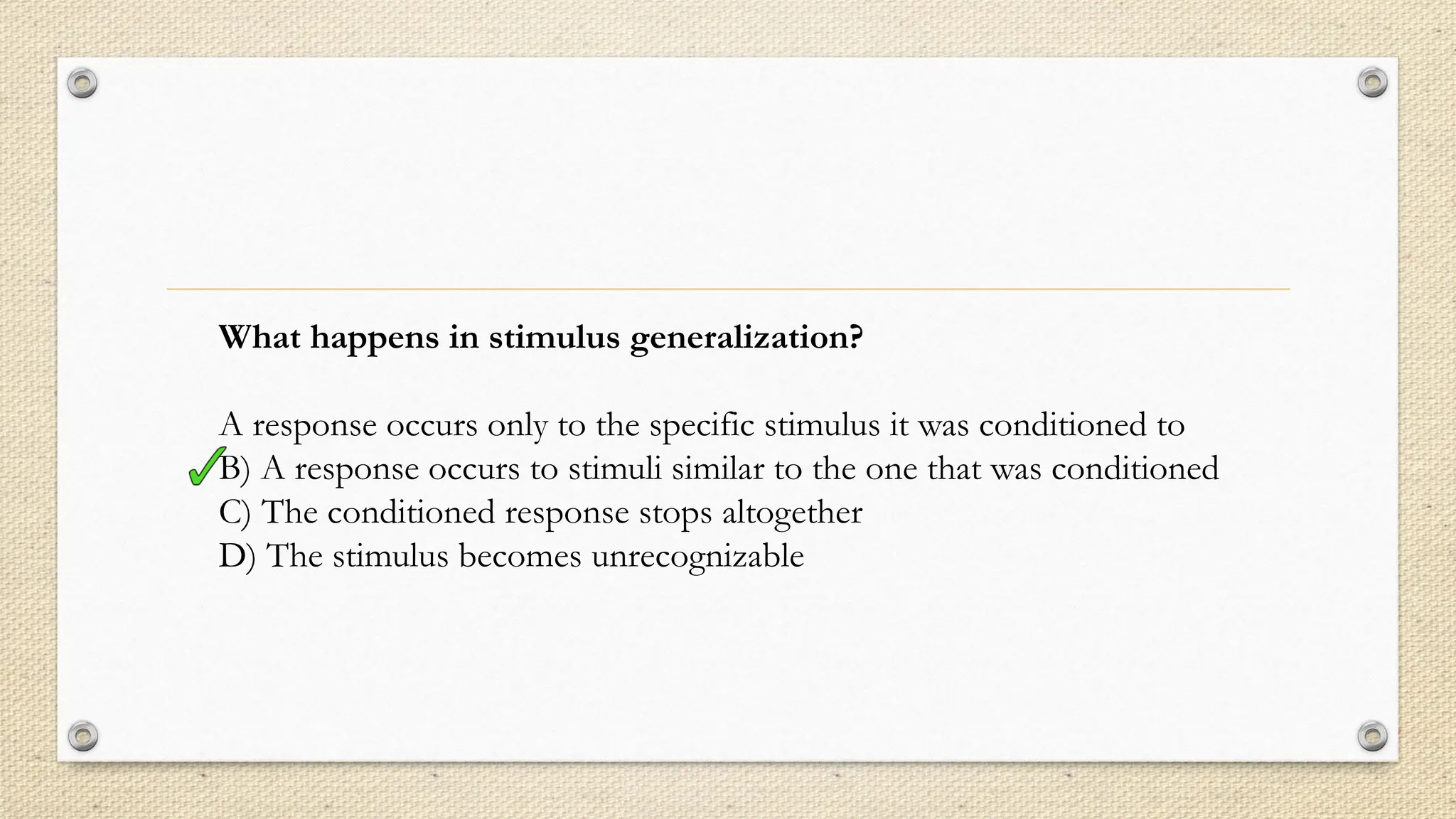
What happens in stimulus generalization?
A response occurs only to the specific stimulus it was conditioned to
B) A response occurs to stimuli similar to the one that was conditioned
C) The conditioned response stops altogether
D) The stimulus becomes unrecognizable
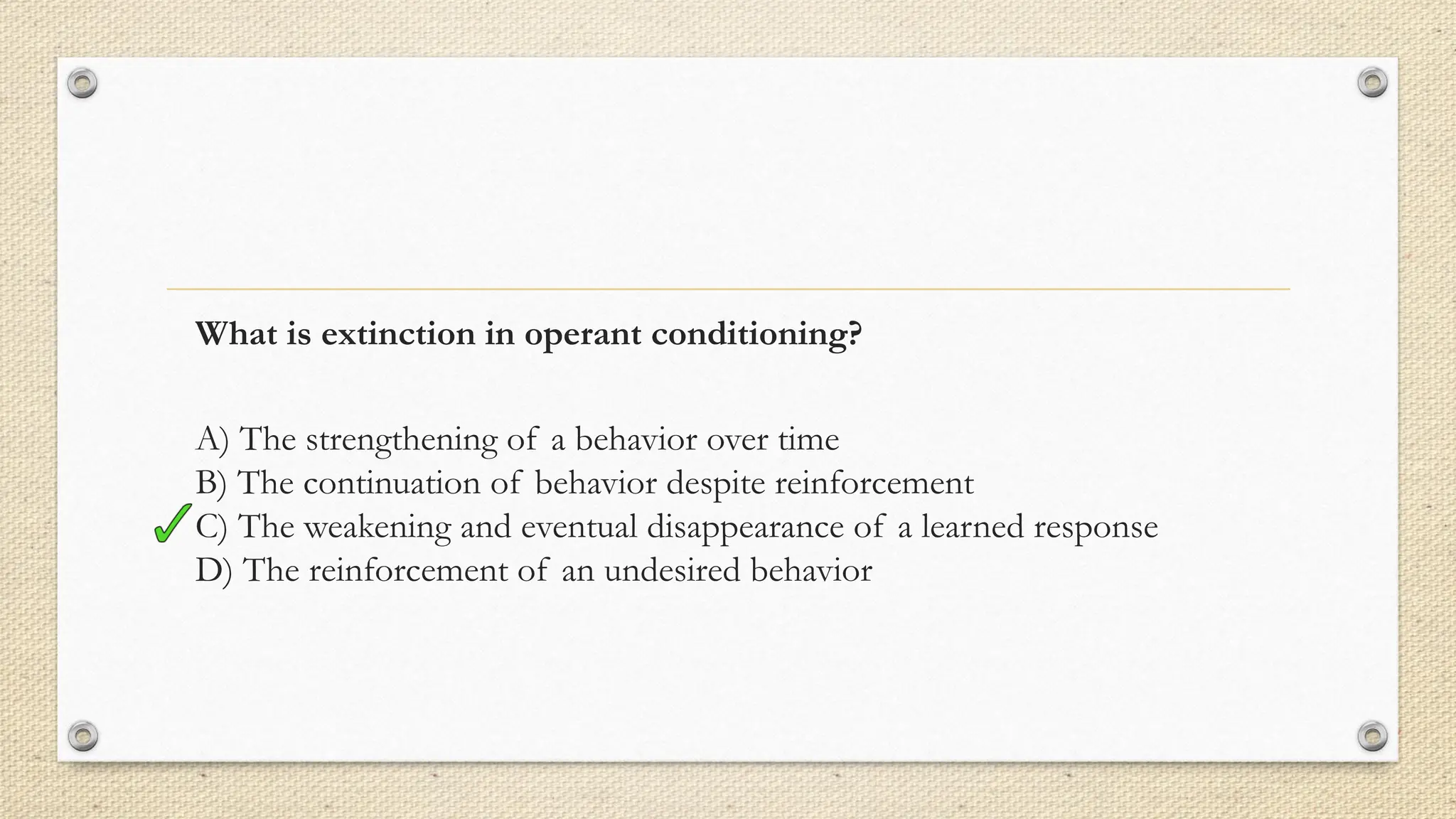
What is extinction in operant conditioning?
A) The strengthening of a behavior over time
B) The continuation of behavior despite reinforcement
C) The weakening and eventual disappearance of a learned response
D) The reinforcement of an undesired behavior
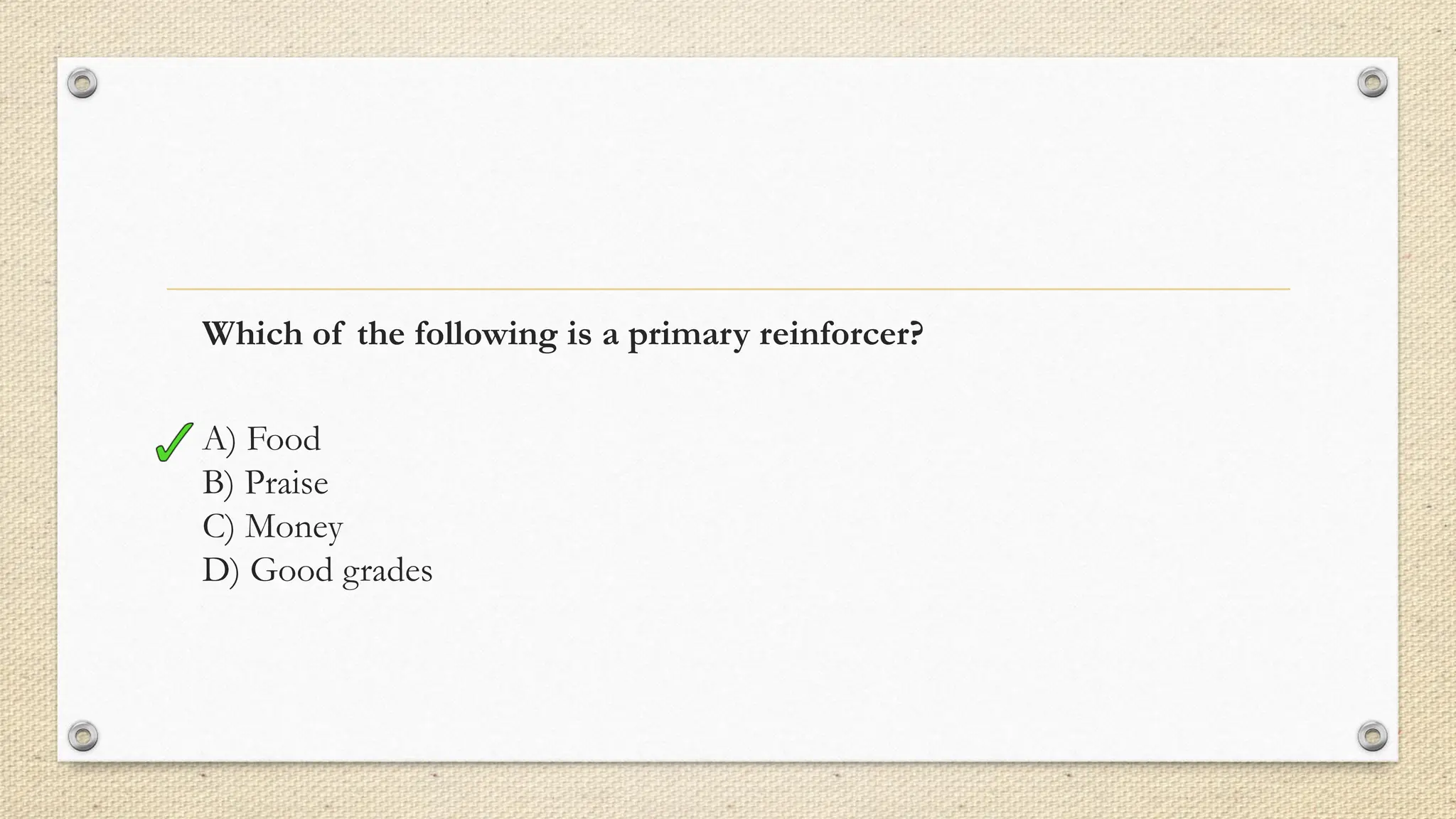
Which of the following is a primary reinforcer?
A) Food
B) Praise
C) Money
D) Good grades
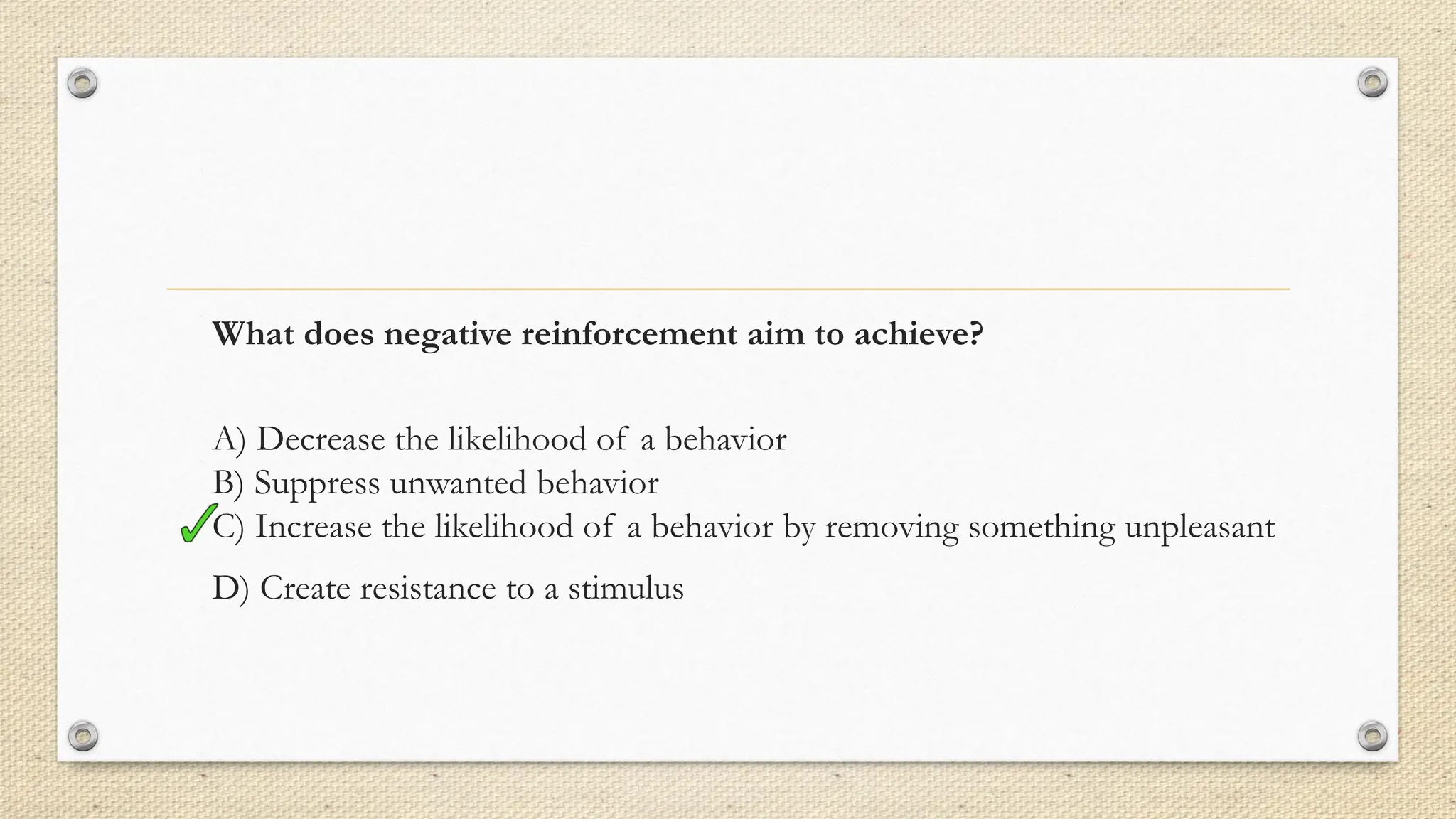
What does negative reinforcement aim to achieve?
A) Decrease the likelihood of a behavior
B) Suppress unwanted behavior
C) Increase the likelihood of a behavior by removing something unpleasant
D) Create resistance to a stimulus

Behaviorism emphasizes that all behaviors are learned through interactions with the environment and can be shaped through conditioning.

  • 1.
    The Emergence ofRadical Behaviorism: “Operant Conditioning” • Developed at the end of the 19th century • B.F. Skinner: Behavior can be explained through external influences rather than internal thoughts • Differentiated from Watson’s classical conditioning • Focuses on external causes of behavior • Behavior is shaped by the consequences of actions
  • 2.
    What is OperantConditioning? • Unlike classical conditioning, which emphasizes reflexive responses to stimuli, operant conditioning looks at voluntary behaviors and how they are shaped by external rewards or punishments. According to Skinner, behavior is determined by the outcomes it produces, meaning that positive consequences reinforce a behavior, making it more likely to occur again, while negative consequences reduce the likelihood of that behavior being repeated.
  • 3.
    Consequences of Behaviour ▪Reinforcement: The process by which a stimulus or event strengthens or increases the probability of the response that it follows. ▪ Punishment: The process by which a stimulus or event weakens or decreases the probability of the response that it follows. 3 Punishment Reinforcement
  • 4.
    Types of Reinforcementand Punishment • Reinforcement • Punishment Positive Negative Positive Negative
  • 5.
    •Positive Reinforcement: Inpositive reinforcement, a desirable outcome follows a behavior, encouraging the behavior to continue. In the example, a student receives a good grade (A+) as a positive reinforcer for studying. This reward motivates the student to continue studying in the future because the behavior leads to a positive result. •Negative Reinforcement: Negative reinforcement occurs when an unpleasant stimulus is removed as a result of a specific behavior, increasing the likelihood of that behavior being repeated. In this case, the nagging ceases when the student studies, which acts as a negative reinforcer, making the student more likely to study to avoid nagging in the future.
  • 6.
    •Positive Punishment: Thisoccurs when an unpleasant stimulus is added following a behavior to decrease that behavior. In this example, when the student is ridiculed by friends (positive punishment) for studying, the unpleasant experience discourages the student from studying in the future, leading to a decrease in the behavior. •Negative Punishment: In negative punishment, a desirable stimulus is removed to reduce a behavior. Here, when the student spends too much time studying, they lose time with friends (negative punishment), which reduces their studying behavior as they want to avoid losing social time in the future.
  • 7.
    • Example 1:Positive Reinforcement • Example: A manager gives an employee a bonus for completing a project ahead of schedule, encouraging the employee to continue working efficiently in the future.
  • 8.
    • Example 2:Negative Reinforcement • Example: A student is allowed to skip doing extra homework for a week if they perform well on a test. This removal of extra homework increases the likelihood that the student will continue studying hard.
  • 9.
    • Example 3:Positive Punishment • Example: A parent makes their child clean the house after the child breaks a rule by staying out past curfew. This additional task is meant to decrease the likelihood of the child breaking curfew again.
  • 10.
    • Example 4:Negative Punishment • Example: A teenager has their phone taken away for a day after being caught texting during class. Removing the phone decreases the likelihood that they will text during class again.
  • 11.
    • Example 5:Negative Reinforcement • Example: A student no longer has to hear their annoying alarm once they wake up on time. This removal of the unpleasant sound reinforces the behavior of waking up on time.
  • 12.
    Primary and SecondaryReinforcers and Punishers ▪ Primary Reinforcers: Inherently reinforcing and typically satisfying a physiological need ▪ Secondary Reinforcers: Stimuli that have acquired reinforcing properties through associations with other reinforcers Examples: money, praise, applause, good graders, awards, gold medals ▪ Primary Punishers: Stimuli that are inherently punishing such as; pain, extreme heat or cold ▪ Secondary Punishers: Stimuli that have acquired punishing properties through associations with other punishers such as; criticism, scolding, fines, bad grades 12
  • 13.
    Principles of OperantConditioning 13 Extinction Stimulus generalisation Stimulus discrimination Discriminative stimulus
  • 14.
    The Importance ofResponses ▪ Extinction: The weakening and eventual disappearance of a learned response; in operant conditioning, it occurs when a response is no longer followed by a reinforcer. ▪ Stimulus generalisation: In operant conditioning, the tendency for a response that has been reinforced (or punished) in the presence of one stimulus to occur (or be suppressed) in the presence of other similar stimuli. ▪ Stimulus discrimination: In operant conditioning, the tendency of a response to occur in the presence of one stimulus but not in the presence of other similar stimuli that differ from it on some dimension. ▪ Discriminative stimulus: A stimulus that signals when a particular response is likely to be followed by a certain type of consequence. 14
  • 15.
    Learning on Schedule ▪Intermittent (Partial) Reinforcement: A reinforcement schedule in which a particular response is sometimes but not always reinforced. ▪ Continuous Reinforcement: A reinforcement schedule in which a particular response is always reinforced. ▪ Shaping: An operant-conditioning procedure in which successive approximations of a desired response are reinforced. ▪ Getting a response to occur by reinforcing successive approximations of a desires response ▪ Successive Approximations: In the operant-conditioning procedure of shaping, behaviours that are ordered in terms of increasing similarity or closeness to the desired response. 15
  • 16.
    Skinner: The Manand The Myth ▪ Skinner`s beliefs: • Private internal events are real and can be studied, but they can not explain behaviour. • Maintained that private internal events – perceptions, emotions, and thoughts – are as real as any others, and we can study them by studying our own sensory experiences. •He insisted, however, that thoughts and feelings cannot explain behavior. •These components of consciousness are themselves simply behaviors that occur because of reinforcement and punishment. •He promoted the determinist view, saying that actions are determined by environment and genetics. •Free will is an illusion. 16
  • 17.
    Operant Conditioning inReal Life • Behaviour Modification (Applied Behaviour Analysis) ▪ Application of operant conditioning techniques to teach new responses or to reduce and eliminate maladaptive or problematic behaviour ▪ By using a system of positive or negative consequences, an individual learns the correct set of responses for any given stimulus. 17
  • 18.
    Why Punishment isIneffective and Should be Avoided? ▪ Decreased intrinsic motivation ▪ Increased fear and anxiety ▪ Promotes hostility and resistance ▪ Lowers self-esteem ▪ Lack of learning appropriate behaviors ▪ Dependency on external control
  • 19.
    Alternatives to Punishment ▪Teach children problem-solving skills ▪ Reward good behaviour ▪ Ignore behaviour to extinguish it ▪ Use extinction and reinforcement The problems with reward: ▪ Misuse of rewards ▪ Grade inflation ▪ Self-esteem approach appears misguided; A Cheater`s Mantra “Given the choice between distorting the world to feel good about themselves and representing the world accurately, people often take the first option" (Aronson, 2010) 19
  • 20.
    Observational Learning (SocialLearning Theory) Observational learning, or social learning, proposed by Albert Bandura, is learning that occurs through observing the behaviors of others and the outcomes of those behaviors. This type of learning can occur without direct reinforcement to the learner.
  • 21.
    Key Concepts Modeling: Theprocess of imitating behaviors observed in others. Imitation: The action of using someone else’s behavior as a guide for one’s own behavior. Vicarious Reinforcement: Learning through the consequences received by others for their behavior; observing someone else being rewarded or punished influences the observer’s future behavior.
  • 22.
    Review Time What isthe main focus of operant conditioning? A) Internal thoughts and feelings B) Reflexive responses to stimuli C) Consequences of actions D) Natural reflexes
  • 23.
    Which of thefollowing is an example of positive reinforcement? A) A student is ridiculed for studying B) A parent takes away a toy after misbehavior C) A manager gives an employee a bonus for completing a project early D) A student is allowed to skip homework as a reward
  • 24.
    What is negativereinforcement? A) Decreasing a behavior by adding an unpleasant consequence B) Decreasing a behavior by removing a desirable stimulus C) Increasing a behavior by removing an unpleasant stimulus D) Increasing a behavior by adding a reward
  • 25.
    Which of thefollowing is an example of positive punishment? A) Removing homework as a reward B) Giving a student praise for good performance C) Taking away a child's phone after bad behavior D) Making a child do extra chores for breaking a rule
  • 26.
    Which of thefollowing is an example of secondary reinforcement? A) Food B) Money C) Water D) Pain relief
  • 27.
    What happens instimulus generalization? A response occurs only to the specific stimulus it was conditioned to B) A response occurs to stimuli similar to the one that was conditioned C) The conditioned response stops altogether D) The stimulus becomes unrecognizable
  • 28.
    What is extinctionin operant conditioning? A) The strengthening of a behavior over time B) The continuation of behavior despite reinforcement C) The weakening and eventual disappearance of a learned response D) The reinforcement of an undesired behavior
  • 29.
    Which of thefollowing is a primary reinforcer? A) Food B) Praise C) Money D) Good grades
  • 30.
    What does negativereinforcement aim to achieve? A) Decrease the likelihood of a behavior B) Suppress unwanted behavior C) Increase the likelihood of a behavior by removing something unpleasant D) Create resistance to a stimulus