PSYCHOLOGY PRESENTATION
OPERANT CONDITIONING
3/4/2014PSYCHOLOGY (OPERANT CONDITIONING) 1
WHAT IS OPERANT CONDITIONING
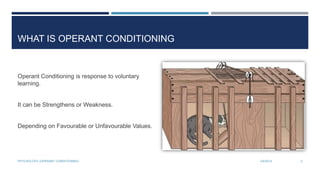
Operant Conditioning is response to voluntary
learning.
It can be Strengthens or Weakness.
Depending on Favourable or Unfavourable Values.
3/4/2014PSYCHOLOGY (OPERANT CONDITIONING) 2
OPERANT & OPERANT CONDITIONING
Operant:
• Any active behavior that operates upon the environment to generate consequences.
Operant Conditioning:
• The behavior is followed by a consequence, and the nature of the consequence modifies the organism’s
tendency to repeat the behavior in the future.
3/4/2014PSYCHOLOGY (OPERANT CONDITIONING) 3
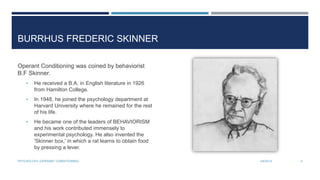
BURRHUS FREDERIC SKINNER
Operant Conditioning was coined by behaviorist
B.F Skinner.
• He received a B.A. in English literature in 1926
from Hamilton College.
• In 1948, he joined the psychology department at
Harvard University where he remained for the rest
of his life.
• He became one of the leaders of BEHAVIORISM
and his work contributed immensely to
experimental psychology. He also invented the
'Skinner box,' in which a rat learns to obtain food
by pressing a lever.
3/4/2014PSYCHOLOGY (OPERANT CONDITIONING) 4
SKINNER (1948) EXPERIMENT
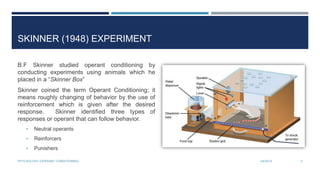
B.F Skinner studied operant conditioning by
conducting experiments using animals which he
placed in a “Skinner Box”
Skinner coined the term Operant Conditioning; it
means roughly changing of behavior by the use of
reinforcement which is given after the desired
response. Skinner identified three types of
responses or operant that can follow behavior.
• Neutral operants
• Reinforcers
• Punishers
3/4/2014PSYCHOLOGY (OPERANT CONDITIONING) 5
METHOD OPERANT CONDITIONING
Operant conditioning is a method of:
• Learning that occurs though rewards and punishment for behavior.
• Through operant conditioning and association is made between a behavior and a consequence for that behavior.
Example:
• Consider the case of child completing homework to earn a reward from his/her teacher or parent.
3/4/2014PSYCHOLOGY (OPERANT CONDITIONING) 6
OPERANT CONDITIONING & LAW OF EFFECTS
Operant Conditioning:
• Learning in which a voluntary response is strengthens or weakness, depending on its favourable or unfavourable
consequences.
Law of Effects:
• Responses that lead to satisfying consequences are more likely to be repeated, and responses followed by
negative outcomes are less likely to be repeated.
3/4/2014PSYCHOLOGY (OPERANT CONDITIONING) 7
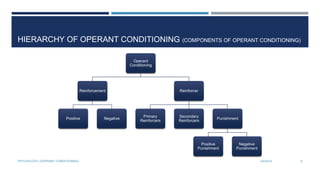
HIERARCHY OF OPERANT CONDITIONING (COMPONENTS OF OPERANT CONDITIONING)
Operant
Conditioning
Reinforcement
Positive Negative
Reinforcer
Primary
Reinforcers
Secondary
Reinforcers
Punishment
Positive
Punishment
Negative
Punishment
3/4/2014PSYCHOLOGY (OPERANT CONDITIONING) 8
REINFORCEMENT & REINFORCER
Reinforcement:
• The process by which a stimulus increases the probability that a preceding behaviour will be repeated.
Reinforcer:
• Any stimulus that increases the probability that a preceding behaviour will occur again.
3/4/2014PSYCHOLOGY (OPERANT CONDITIONING) 9
POSITIVE & NEGATIVE REINFORCEMENT
Positive Reinforcers:
• A stimulus added to the environment that brings about an increase in a preceding response
Negative Reinforcers:
• Unpleasant stimulus whose removal from the environment leads to an increase in the probability that a preceding
response will occur again in the future.
3/4/2014PSYCHOLOGY (OPERANT CONDITIONING) 10
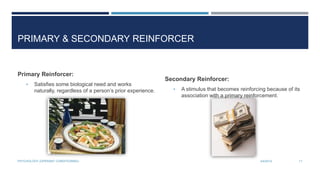
PRIMARY & SECONDARY REINFORCER
Primary Reinforcer:
• Satisfies some biological need and works
naturally, regardless of a person’s prior experience.
Secondary Reinforcer:
• A stimulus that becomes reinforcing because of its
association with a primary reinforcement.
3/4/2014PSYCHOLOGY (OPERANT CONDITIONING) 11
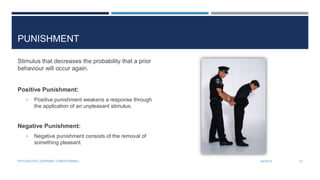
PUNISHMENT
Stimulus that decreases the probability that a prior
behaviour will occur again.
Positive Punishment:
• Positive punishment weakens a response through
the application of an unpleasant stimulus.
Negative Punishment:
• Negative punishment consists of the removal of
something pleasant.
3/4/2014PSYCHOLOGY (OPERANT CONDITIONING) 12
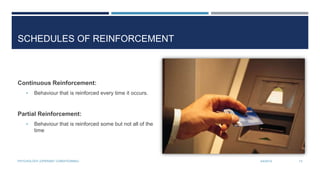
SCHEDULES OF REINFORCEMENT
Continuous Reinforcement:
• Behaviour that is reinforced every time it occurs.
Partial Reinforcement:
• Behaviour that is reinforced some but not all of the
time
3/4/2014PSYCHOLOGY (OPERANT CONDITIONING) 13
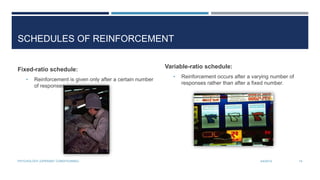
SCHEDULES OF REINFORCEMENT
Fixed-ratio schedule:
• Reinforcement is given only after a certain number
of responses.
Variable-ratio schedule:
• Reinforcement occurs after a varying number of
responses rather than after a fixed number.
3/4/2014PSYCHOLOGY (OPERANT CONDITIONING) 14
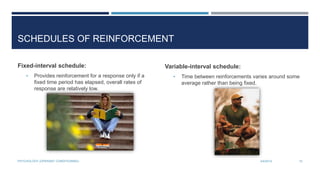
SCHEDULES OF REINFORCEMENT
Fixed-interval schedule:
• Provides reinforcement for a response only if a
fixed time period has elapsed, overall rates of
response are relatively low.
Variable-interval schedule:
• Time between reinforcements varies around some
average rather than being fixed.
3/4/2014PSYCHOLOGY (OPERANT CONDITIONING) 15
THANKS FOR YOUR TIME
PRESENTED BY:
• SYED IBRAHIM SHAMS
• RABIA
MEMBERS:
• MIAN JAWAD SHAH
• UZMA SARBARAZ
• M.YAHYA
• MATIULLAH
• ABDAL KHAN
• ALI HAIDER
• IBRAHIM ROMAN
• AHMED HASSAN
• M.YASIN AKTHAR
• ABRAR ALI
• SHAHZAIB SAIF
• ABID RAZA
3/4/2014PSYCHOLOGY (OPERANT CONDITIONING) 16

Operand Conditioning

  • 1.
  • 2.
    WHAT IS OPERANTCONDITIONING Operant Conditioning is response to voluntary learning. It can be Strengthens or Weakness. Depending on Favourable or Unfavourable Values. 3/4/2014PSYCHOLOGY (OPERANT CONDITIONING) 2
  • 3.
    OPERANT & OPERANTCONDITIONING Operant: • Any active behavior that operates upon the environment to generate consequences. Operant Conditioning: • The behavior is followed by a consequence, and the nature of the consequence modifies the organism’s tendency to repeat the behavior in the future. 3/4/2014PSYCHOLOGY (OPERANT CONDITIONING) 3
  • 4.
    BURRHUS FREDERIC SKINNER OperantConditioning was coined by behaviorist B.F Skinner. • He received a B.A. in English literature in 1926 from Hamilton College. • In 1948, he joined the psychology department at Harvard University where he remained for the rest of his life. • He became one of the leaders of BEHAVIORISM and his work contributed immensely to experimental psychology. He also invented the 'Skinner box,' in which a rat learns to obtain food by pressing a lever. 3/4/2014PSYCHOLOGY (OPERANT CONDITIONING) 4
  • 5.
    SKINNER (1948) EXPERIMENT B.FSkinner studied operant conditioning by conducting experiments using animals which he placed in a “Skinner Box” Skinner coined the term Operant Conditioning; it means roughly changing of behavior by the use of reinforcement which is given after the desired response. Skinner identified three types of responses or operant that can follow behavior. • Neutral operants • Reinforcers • Punishers 3/4/2014PSYCHOLOGY (OPERANT CONDITIONING) 5
  • 6.
    METHOD OPERANT CONDITIONING Operantconditioning is a method of: • Learning that occurs though rewards and punishment for behavior. • Through operant conditioning and association is made between a behavior and a consequence for that behavior. Example: • Consider the case of child completing homework to earn a reward from his/her teacher or parent. 3/4/2014PSYCHOLOGY (OPERANT CONDITIONING) 6
  • 7.
    OPERANT CONDITIONING &LAW OF EFFECTS Operant Conditioning: • Learning in which a voluntary response is strengthens or weakness, depending on its favourable or unfavourable consequences. Law of Effects: • Responses that lead to satisfying consequences are more likely to be repeated, and responses followed by negative outcomes are less likely to be repeated. 3/4/2014PSYCHOLOGY (OPERANT CONDITIONING) 7
  • 8.
    HIERARCHY OF OPERANTCONDITIONING (COMPONENTS OF OPERANT CONDITIONING) Operant Conditioning Reinforcement Positive Negative Reinforcer Primary Reinforcers Secondary Reinforcers Punishment Positive Punishment Negative Punishment 3/4/2014PSYCHOLOGY (OPERANT CONDITIONING) 8
  • 9.
    REINFORCEMENT & REINFORCER Reinforcement: •The process by which a stimulus increases the probability that a preceding behaviour will be repeated. Reinforcer: • Any stimulus that increases the probability that a preceding behaviour will occur again. 3/4/2014PSYCHOLOGY (OPERANT CONDITIONING) 9
  • 10.
    POSITIVE & NEGATIVEREINFORCEMENT Positive Reinforcers: • A stimulus added to the environment that brings about an increase in a preceding response Negative Reinforcers: • Unpleasant stimulus whose removal from the environment leads to an increase in the probability that a preceding response will occur again in the future. 3/4/2014PSYCHOLOGY (OPERANT CONDITIONING) 10
  • 11.
    PRIMARY & SECONDARYREINFORCER Primary Reinforcer: • Satisfies some biological need and works naturally, regardless of a person’s prior experience. Secondary Reinforcer: • A stimulus that becomes reinforcing because of its association with a primary reinforcement. 3/4/2014PSYCHOLOGY (OPERANT CONDITIONING) 11
  • 12.
    PUNISHMENT Stimulus that decreasesthe probability that a prior behaviour will occur again. Positive Punishment: • Positive punishment weakens a response through the application of an unpleasant stimulus. Negative Punishment: • Negative punishment consists of the removal of something pleasant. 3/4/2014PSYCHOLOGY (OPERANT CONDITIONING) 12
  • 13.
    SCHEDULES OF REINFORCEMENT ContinuousReinforcement: • Behaviour that is reinforced every time it occurs. Partial Reinforcement: • Behaviour that is reinforced some but not all of the time 3/4/2014PSYCHOLOGY (OPERANT CONDITIONING) 13
  • 14.
    SCHEDULES OF REINFORCEMENT Fixed-ratioschedule: • Reinforcement is given only after a certain number of responses. Variable-ratio schedule: • Reinforcement occurs after a varying number of responses rather than after a fixed number. 3/4/2014PSYCHOLOGY (OPERANT CONDITIONING) 14
  • 15.
    SCHEDULES OF REINFORCEMENT Fixed-intervalschedule: • Provides reinforcement for a response only if a fixed time period has elapsed, overall rates of response are relatively low. Variable-interval schedule: • Time between reinforcements varies around some average rather than being fixed. 3/4/2014PSYCHOLOGY (OPERANT CONDITIONING) 15
  • 16.
    THANKS FOR YOURTIME PRESENTED BY: • SYED IBRAHIM SHAMS • RABIA MEMBERS: • MIAN JAWAD SHAH • UZMA SARBARAZ • M.YAHYA • MATIULLAH • ABDAL KHAN • ALI HAIDER • IBRAHIM ROMAN • AHMED HASSAN • M.YASIN AKTHAR • ABRAR ALI • SHAHZAIB SAIF • ABID RAZA 3/4/2014PSYCHOLOGY (OPERANT CONDITIONING) 16