Finite Element Based, FPGA-Implemented Electric
Machine Model for Hardware-in-the-Loop (HIL)
Simulation
Leveraging Simulation for Hybrid and Electric Powertrain Design in the Automotive,
2
Presentation Agenda
1. HIL Simulation by OPAL-RT – Introduction & Context
2. E-drive simulation - Why FPGA?
3. PMSM solver on FPGA
4. Integration of Maxwell FEA models and eDRIVEsim
5. Conclusion
6. Q&A
Leveraging Simulation for Hybrid and Electric Powertrain Design in the Automotive,
Transportation, and Aerospace Industries
3
OPAL-RT Introduction
We supply real-time digital simulators to
industry, research labs and educational
institutions for hardware-in-the-loop (HIL), rapid
control prototyping and accelerated non-
realtime (number crunching) applications
4
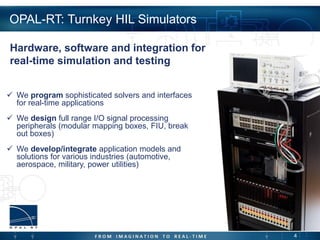
OPAL-RT: Turnkey HIL Simulators
 We program sophisticated solvers and interfaces
for real-time applications
 We design full range I/O signal processing
peripherals (modular mapping boxes, FIU, break
out boxes)
 We develop/integrate application models and
solutions for various industries (automotive,
aerospace, military, power utilities)
Hardware, software and integration for
real-time simulation and testing
5
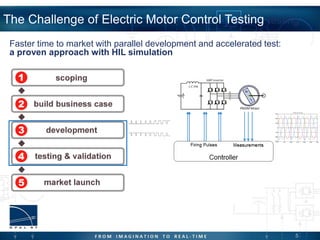
The Challenge of Electric Motor Control Testing testing
Faster time to market with parallel development and accelerated test:
a proven approach with HIL simulation
6
The Challenge of Electric Motor Control Testing testing
Motor control engineers want :
 To test the motor controller with non-ideal behavior.
 To test the motor controller with different points of
operation, such a saturated states
 To insert fault conditions
 To rapidly simulate different types of motors
High-fidelity and flexible motor simulation
7
The Challenge of Electric Motor Control Testing testing
• increase test case coverage
• reduce costs
• accelerate time to market
 By reducing testing time on real dynamometer
 By detecting errors at earlier stages of the design
 Faster improvement of complex control strategies
Managers want to:
Creation of a technical link between motor designer
and control engineer – HIL model IS the design
8
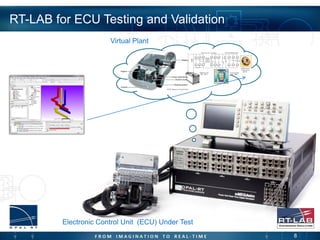
RT-LAB for ECU Testing and Validation
Virtual Plant
Electronic Control Unit (ECU) Under Test
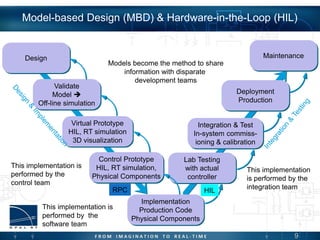
Model-based Design (MBD) & Hardware-in-the-Loop (HIL)
Validate
Model 
Off-line simulation
Virtual Prototype
HIL, RT simulation
3D visualization
Control Prototype
HIL, RT simulation,
Physical Components
Design
Implementation
Production Code
Physical Components
Lab Testing
with actual
controller
Integration & Test
In-system commiss-
ioning & calibration
Deployment
Production
Maintenance
9
This implementation is
performed by the
software team
This implementation is
performed by the
control team
This implementation
is performed by the
integration team
Models become the method to share
information with disparate
development teams
RPC HIL
10
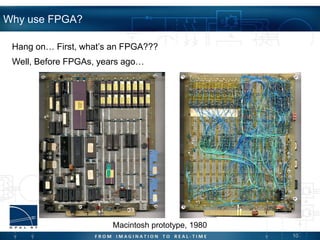
Why use FPGA?
Macintosh prototype, 1980
Hang on… First, what’s an FPGA???
Well, Before FPGAs, years ago…
11
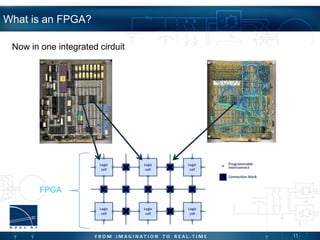
What is an FPGA?
Logic
cell
Logic
cell
Logic
cell
Logic
cell
Logic
cell
Logic
cell
Programmable
interconnect
Connection block
FPGA
Now in one integrated cirduit
12
What is an FPGA?
Logic
cell
Logic
cell
Logic
cell
Logic
cell
Programmable
interconnect
Connection block
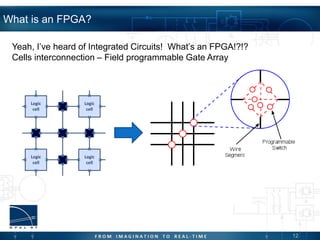
Yeah, I’ve heard of Integrated Circuits! What’s an FPGA!?!?
Cells interconnection – Field programmable Gate Array
13
What is an FPGA?
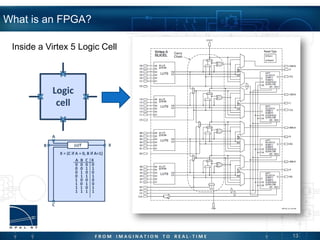
Logic
cell
LUT
A
B
C
X
XA B C
0
1
0
0
0
0
0
0
0
0
0
00
1
1 1
1
1
1
1
1 11
1
1
1
1
1
0
0
0
0
X = (C if A = 0, B if A=1)
Logic
cell
Logic
cell
Logic
cell
Logic
cell
Programma
interconnec
Connection
Inside a Virtex 5 Logic Cell
14
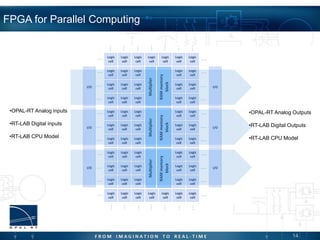
FPGA for Parallel Computing
Logic
cell
Logic
cell
Logic
cell
Logic
cell
Logic
cell
Logic
cell
Logic
cell
Logic
cell
Logic
cell
Logic
cell
Logic
cell
Logic
cell
Logic
cell
Logic
cell
Logic
cell
Logic
cell
Logic
cell
Logic
cell
MultiplierMultiplier
RAMmemory
block
RAMmemory
block
Logic
cell
Logic
cell
Logic
cell
Logic
cell
Logic
cell
Logic
cell
Logic
cell
Logic
cell
Logic
cell
Logic
cell
Logic
cell
Logic
cell
Logic
cell
Logic
cell
Logic
cell
Logic
cell
Logic
cell
Logic
cell
Logic
cell
Logic
cell
Logic
cell
Logic
cell
Logic
cell
Logic
cell
Logic
cell
Logic
cell
Logic
cell
Logic
cell
Multiplier
RAMmemory
block
Logic
cell
Logic
cell
Logic
cell
Logic
cell
Logic
cell
Logic
cell
Logic
cell
Logic
cell
Logic
cell
Logic
cell
Logic
cell
Logic
cell
Logic
cell
I/O
I/O
I/O
I/O
I/O
I/O
•OPAL-RT Analog inputs
•RT-LAB Digital inputs
•RT-LAB CPU Model
•OPAL-RT Analog Outputs
•RT-LAB Digital Outputs
•RT-LAB CPU Model
15
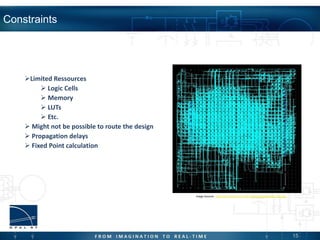
Constraints
Limited Ressources
 Logic Cells
 Memory
 LUTs
 Etc.
 Might not be possible to route the design
 Propagation delays
 Fixed Point calculation
Image Sourcre: http://www.student.uni-kl.de/~alles/fpga/pics/fpga-layout.jpg
16
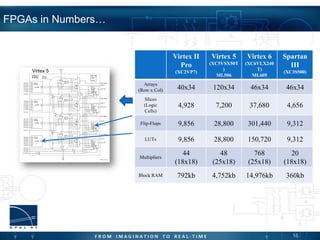
FPGAs in Numbers…
Virtex II
Pro
(XC2VP7)
Virtex 5
(XC5VSX50T
)
ML506
Virtex 6
(XC6VLX240
T)
ML605
Spartan
III
(XC3S500)
Arrays
(Row x Col) 40x34 120x34 46x34 46x34
Slices
(Logic
Cells)
4,928 7,200 37,680 4,656
Flip-Flops 9,856 28,800 301,440 9,312
LUTs 9,856 28,800 150,720 9,312
Multipliers
44
(18x18)
48
(25x18)
768
(25x18)
20
(18x18)
Block RAM 792kb 4,752kb 14,976kb 360kb
Virtex 5
17
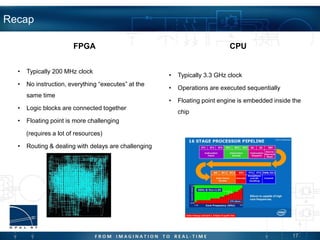
• Typically 3.3 GHz clock
• Operations are executed sequentially
• Floating point engine is embedded inside the
chip
• Typically 200 MHz clock
• No instruction, everything “executes” at the
same time
• Logic blocks are connected together
• Floating point is more challenging
(requires a lot of resources)
• Routing & dealing with delays are challenging
Recap
FPGA CPU
18
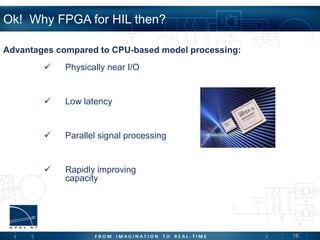
Ok! Why FPGA for HIL then?
 Physically near I/O
 Low latency
 Parallel signal processing
 Rapidly improving
capacity
Advantages compared to CPU-based model processing:
19
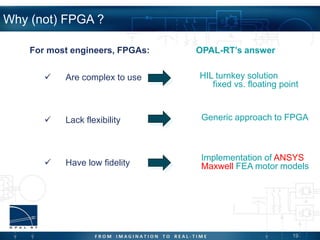
Why (not) FPGA ?
 Are complex to use
 Lack flexibility
 Have low fidelity
For most engineers, FPGAs:
HIL turnkey solution
fixed vs. floating point
Generic approach to FPGA
Implementation of ANSYS
Maxwell FEA motor models
OPAL-RT’s answer
20
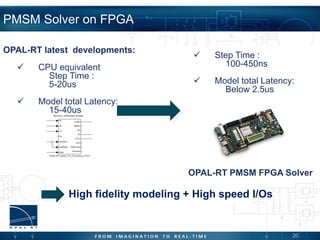
PMSM Solver on FPGA
OPAL-RT latest developments:
 CPU equivalent
Step Time :
5-20us
 Model total Latency:
15-40us
 Step Time :
100-450ns
 Model total Latency:
Below 2.5us
High fidelity modeling + High speed I/Os
OPAL-RT PMSM FPGA Solver
21
PMSM Solver on FPGA
 Upgrade of motor solver to latest FEA software levels
 Streamlining of integration steps
 Improvement of solver accuracy
OPAL-RT latest developments:
Solver compatible with PMSM spatial harmonics
and VarDQ approach
Solver configuration ready in a few clicks with
online reconfiguration of I/O mapping
Model entirely computed in floating point
22
PMSM Solver on FPGA
 Export Netlist from ANSYS Maxwell Software
 Import Netlist into RT-LAB environment
 Ready-for-Realtime
Implementation:
Precalculation of multiple operating points
Use RT-LAB to build your realtime simulation
Integrate I/O and any other required application
peripherals
OPAL-RT Benchmark Simulation
Maxwell 16.0
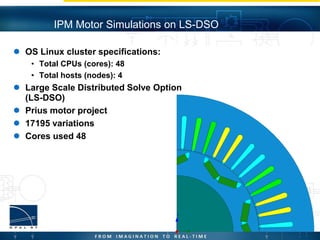
 OS Linux cluster specifications:
• Total CPUs (cores): 48
• Total hosts (nodes): 4
 Large Scale Distributed Solve Option
(LS-DSO)
 Prius motor project
 17195 variations
 Cores used 48
IPM Motor Simulations on LS-DSO
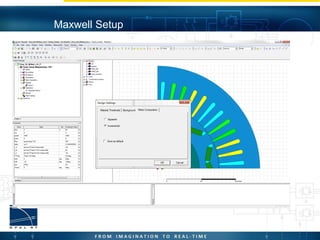
Maxwell Setup
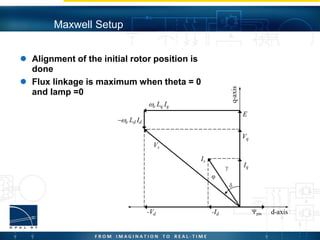
Maxwell Setup
 Alignment of the initial rotor position is
done
 Flux linkage is maximum when theta = 0
and Iamp =0
 Parametric sweep table of 17195 rows:
• Beta = 0:20:360
• Theta = 0:0.25:45
• Iamp = 0:50:200
 Parametric table was run on (LS-DSO)
 Results post-processed using Matlab
 Final Table:
• Beta = 0:5:360
• Theta = 0:0.25:45
• Iamp =
[0,2.5,5,8,11,18,25,37.50,50,75,100,125,150,17
5,20]
 Note: Results were post-processed using
spline interpolation in Matlab
IPM Motor Simulations on LS-DSO
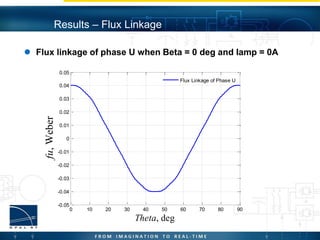
Results – Flux Linkage
 Flux linkage of phase U when Beta = 0 deg and Iamp = 0A
0 10 20 30 40 50 60 70 80 90
-0.05
-0.04
-0.03
-0.02
-0.01
0
0.01
0.02
0.03
0.04
0.05
Theta, deg
fu,Weber
Flux Linkage of Phase U
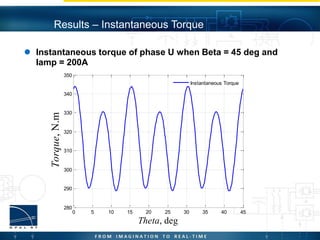
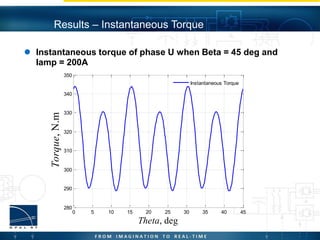
Results – Instantaneous Torque
 Instantaneous torque of phase U when Beta = 45 deg and
Iamp = 200A
0 5 10 15 20 25 30 35 40 45
280
290
300
310
320
330
340
350
Theta, deg
Torque,N.m
Instantaneous Torque
Results – Instantaneous Torque
 Instantaneous torque of phase U when Beta = 45 deg and
Iamp = 200A
0 5 10 15 20 25 30 35 40 45
280
290
300
310
320
330
340
350
Theta, deg
Torque,N.m
Instantaneous Torque
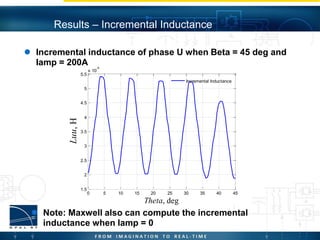
Results – Incremental Inductance
 Incremental inductance of phase U when Beta = 45 deg and
Iamp = 200A
0 5 10 15 20 25 30 35 40 45
1.5
2
2.5
3
3.5
4
4.5
5
5.5
x 10
-5
Theta, deg
Luu,H
Incremental Inductance
 Note: Maxwell also can compute the incremental
inductance when Iamp = 0
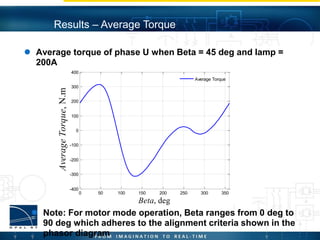
Results – Average Torque
 Average torque of phase U when Beta = 45 deg and Iamp =
200A
 Note: For motor mode operation, Beta ranges from 0 deg to
90 deg which adheres to the alignment criteria shown in the
phasor diagram
0 50 100 150 200 250 300 350
-400
-300
-200
-100
0
100
200
300
400
Beta, deg
AverageTorque,N.m
Average Torque
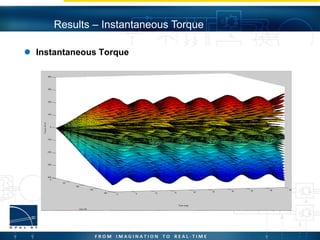
Results – Instantaneous Torque
 Instantaneous Torque
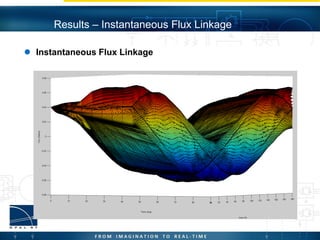
Results – Instantaneous Flux Linkage
 Instantaneous Flux Linkage
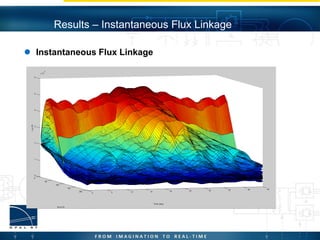
Results – Instantaneous Flux Linkage
 Instantaneous Flux Linkage
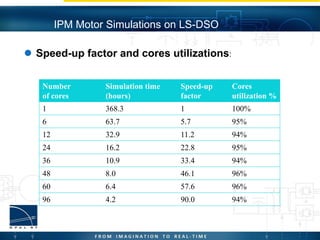
 Speed-up factor and cores utilizations:
IPM Motor Simulations on LS-DSO
Number
of cores
Simulation time
(hours)
Speed-up
factor
Cores
utilization %
1 368.3 1 100%
6 63.7 5.7 95%
12 32.9 11.2 94%
24 16.2 22.8 95%
36 10.9 33.4 94%
48 8.0 46.1 96%
60 6.4 57.6 96%
96 4.2 90.0 94%
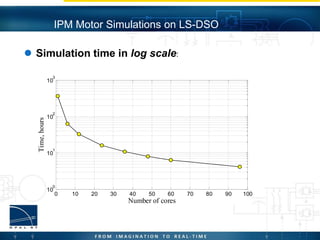
 Simulation time in log scale:
IPM Motor Simulations on LS-DSO
0 10 20 30 40 50 60 70 80 90 100
10
0
10
1
10
2
10
3
Number of cores
Time,hours
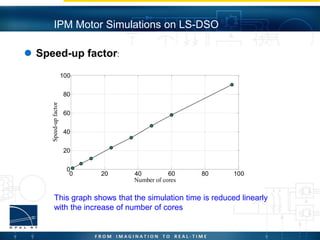
 Speed-up factor:
IPM Motor Simulations on LS-DSO
This graph shows that the simulation time is reduced linearly
with the increase of number of cores
0 20 40 60 80 100
0
20
40
60
80
100
Number of cores
Speed-upfactor
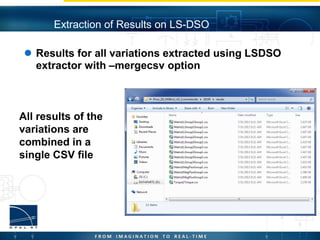
 Results for all variations extracted using LSDSO
extractor with –mergecsv option
Extraction of Results on LS-DSO
All results of the
variations are
combined in a
single CSV file
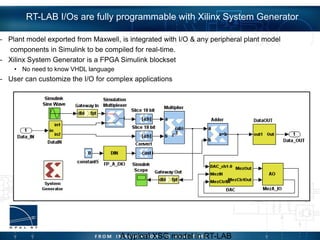
– Plant model exported from Maxwell, is integrated with I/O & any peripheral plant model
components in Simulink to be compiled for real-time.
– Xilinx System Generator is a FPGA Simulink blockset
• No need to know VHDL language
– User can customize the I/O for complex applications
RT-LAB I/Os are fully programmable with Xilinx System Generator
A typical XSG model in RT-LAB
41
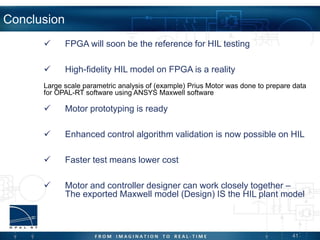
Conclusion
 FPGA will soon be the reference for HIL testing
 High-fidelity HIL model on FPGA is a reality
Large scale parametric analysis of (example) Prius Motor was done to prepare data
for OPAL-RT software using ANSYS Maxwell software
 Motor prototyping is ready
 Enhanced control algorithm validation is now possible on HIL
 Faster test means lower cost
 Motor and controller designer can work closely together –
The exported Maxwell model (Design) IS the HIL plant model

OPAL-RT and ANSYS - HIL simulation

  • 1.
    Finite Element Based,FPGA-Implemented Electric Machine Model for Hardware-in-the-Loop (HIL) Simulation Leveraging Simulation for Hybrid and Electric Powertrain Design in the Automotive,
  • 2.
    2 Presentation Agenda 1. HILSimulation by OPAL-RT – Introduction & Context 2. E-drive simulation - Why FPGA? 3. PMSM solver on FPGA 4. Integration of Maxwell FEA models and eDRIVEsim 5. Conclusion 6. Q&A Leveraging Simulation for Hybrid and Electric Powertrain Design in the Automotive, Transportation, and Aerospace Industries
  • 3.
    3 OPAL-RT Introduction We supplyreal-time digital simulators to industry, research labs and educational institutions for hardware-in-the-loop (HIL), rapid control prototyping and accelerated non- realtime (number crunching) applications
  • 4.
    4 OPAL-RT: Turnkey HILSimulators  We program sophisticated solvers and interfaces for real-time applications  We design full range I/O signal processing peripherals (modular mapping boxes, FIU, break out boxes)  We develop/integrate application models and solutions for various industries (automotive, aerospace, military, power utilities) Hardware, software and integration for real-time simulation and testing
  • 5.
    5 The Challenge ofElectric Motor Control Testing testing Faster time to market with parallel development and accelerated test: a proven approach with HIL simulation
  • 6.
    6 The Challenge ofElectric Motor Control Testing testing Motor control engineers want :  To test the motor controller with non-ideal behavior.  To test the motor controller with different points of operation, such a saturated states  To insert fault conditions  To rapidly simulate different types of motors High-fidelity and flexible motor simulation
  • 7.
    7 The Challenge ofElectric Motor Control Testing testing • increase test case coverage • reduce costs • accelerate time to market  By reducing testing time on real dynamometer  By detecting errors at earlier stages of the design  Faster improvement of complex control strategies Managers want to: Creation of a technical link between motor designer and control engineer – HIL model IS the design
  • 8.
    8 RT-LAB for ECUTesting and Validation Virtual Plant Electronic Control Unit (ECU) Under Test
  • 9.
    Model-based Design (MBD)& Hardware-in-the-Loop (HIL) Validate Model  Off-line simulation Virtual Prototype HIL, RT simulation 3D visualization Control Prototype HIL, RT simulation, Physical Components Design Implementation Production Code Physical Components Lab Testing with actual controller Integration & Test In-system commiss- ioning & calibration Deployment Production Maintenance 9 This implementation is performed by the software team This implementation is performed by the control team This implementation is performed by the integration team Models become the method to share information with disparate development teams RPC HIL
  • 10.
    10 Why use FPGA? Macintoshprototype, 1980 Hang on… First, what’s an FPGA??? Well, Before FPGAs, years ago…
  • 11.
    11 What is anFPGA? Logic cell Logic cell Logic cell Logic cell Logic cell Logic cell Programmable interconnect Connection block FPGA Now in one integrated cirduit
  • 12.
    12 What is anFPGA? Logic cell Logic cell Logic cell Logic cell Programmable interconnect Connection block Yeah, I’ve heard of Integrated Circuits! What’s an FPGA!?!? Cells interconnection – Field programmable Gate Array
  • 13.
    13 What is anFPGA? Logic cell LUT A B C X XA B C 0 1 0 0 0 0 0 0 0 0 0 00 1 1 1 1 1 1 1 1 11 1 1 1 1 1 0 0 0 0 X = (C if A = 0, B if A=1) Logic cell Logic cell Logic cell Logic cell Programma interconnec Connection Inside a Virtex 5 Logic Cell
  • 14.
    14 FPGA for ParallelComputing Logic cell Logic cell Logic cell Logic cell Logic cell Logic cell Logic cell Logic cell Logic cell Logic cell Logic cell Logic cell Logic cell Logic cell Logic cell Logic cell Logic cell Logic cell MultiplierMultiplier RAMmemory block RAMmemory block Logic cell Logic cell Logic cell Logic cell Logic cell Logic cell Logic cell Logic cell Logic cell Logic cell Logic cell Logic cell Logic cell Logic cell Logic cell Logic cell Logic cell Logic cell Logic cell Logic cell Logic cell Logic cell Logic cell Logic cell Logic cell Logic cell Logic cell Logic cell Multiplier RAMmemory block Logic cell Logic cell Logic cell Logic cell Logic cell Logic cell Logic cell Logic cell Logic cell Logic cell Logic cell Logic cell Logic cell I/O I/O I/O I/O I/O I/O •OPAL-RT Analog inputs •RT-LAB Digital inputs •RT-LAB CPU Model •OPAL-RT Analog Outputs •RT-LAB Digital Outputs •RT-LAB CPU Model
  • 15.
    15 Constraints Limited Ressources  LogicCells  Memory  LUTs  Etc.  Might not be possible to route the design  Propagation delays  Fixed Point calculation Image Sourcre: http://www.student.uni-kl.de/~alles/fpga/pics/fpga-layout.jpg
  • 16.
    16 FPGAs in Numbers… VirtexII Pro (XC2VP7) Virtex 5 (XC5VSX50T ) ML506 Virtex 6 (XC6VLX240 T) ML605 Spartan III (XC3S500) Arrays (Row x Col) 40x34 120x34 46x34 46x34 Slices (Logic Cells) 4,928 7,200 37,680 4,656 Flip-Flops 9,856 28,800 301,440 9,312 LUTs 9,856 28,800 150,720 9,312 Multipliers 44 (18x18) 48 (25x18) 768 (25x18) 20 (18x18) Block RAM 792kb 4,752kb 14,976kb 360kb Virtex 5
  • 17.
    17 • Typically 3.3GHz clock • Operations are executed sequentially • Floating point engine is embedded inside the chip • Typically 200 MHz clock • No instruction, everything “executes” at the same time • Logic blocks are connected together • Floating point is more challenging (requires a lot of resources) • Routing & dealing with delays are challenging Recap FPGA CPU
  • 18.
    18 Ok! Why FPGAfor HIL then?  Physically near I/O  Low latency  Parallel signal processing  Rapidly improving capacity Advantages compared to CPU-based model processing:
  • 19.
    19 Why (not) FPGA?  Are complex to use  Lack flexibility  Have low fidelity For most engineers, FPGAs: HIL turnkey solution fixed vs. floating point Generic approach to FPGA Implementation of ANSYS Maxwell FEA motor models OPAL-RT’s answer
  • 20.
    20 PMSM Solver onFPGA OPAL-RT latest developments:  CPU equivalent Step Time : 5-20us  Model total Latency: 15-40us  Step Time : 100-450ns  Model total Latency: Below 2.5us High fidelity modeling + High speed I/Os OPAL-RT PMSM FPGA Solver
  • 21.
    21 PMSM Solver onFPGA  Upgrade of motor solver to latest FEA software levels  Streamlining of integration steps  Improvement of solver accuracy OPAL-RT latest developments: Solver compatible with PMSM spatial harmonics and VarDQ approach Solver configuration ready in a few clicks with online reconfiguration of I/O mapping Model entirely computed in floating point
  • 22.
    22 PMSM Solver onFPGA  Export Netlist from ANSYS Maxwell Software  Import Netlist into RT-LAB environment  Ready-for-Realtime Implementation: Precalculation of multiple operating points Use RT-LAB to build your realtime simulation Integrate I/O and any other required application peripherals
  • 23.
  • 24.
     OS Linuxcluster specifications: • Total CPUs (cores): 48 • Total hosts (nodes): 4  Large Scale Distributed Solve Option (LS-DSO)  Prius motor project  17195 variations  Cores used 48 IPM Motor Simulations on LS-DSO
  • 25.
  • 26.
    Maxwell Setup  Alignmentof the initial rotor position is done  Flux linkage is maximum when theta = 0 and Iamp =0
  • 27.
     Parametric sweeptable of 17195 rows: • Beta = 0:20:360 • Theta = 0:0.25:45 • Iamp = 0:50:200  Parametric table was run on (LS-DSO)  Results post-processed using Matlab  Final Table: • Beta = 0:5:360 • Theta = 0:0.25:45 • Iamp = [0,2.5,5,8,11,18,25,37.50,50,75,100,125,150,17 5,20]  Note: Results were post-processed using spline interpolation in Matlab IPM Motor Simulations on LS-DSO
  • 28.
    Results – FluxLinkage  Flux linkage of phase U when Beta = 0 deg and Iamp = 0A 0 10 20 30 40 50 60 70 80 90 -0.05 -0.04 -0.03 -0.02 -0.01 0 0.01 0.02 0.03 0.04 0.05 Theta, deg fu,Weber Flux Linkage of Phase U
  • 29.
    Results – InstantaneousTorque  Instantaneous torque of phase U when Beta = 45 deg and Iamp = 200A 0 5 10 15 20 25 30 35 40 45 280 290 300 310 320 330 340 350 Theta, deg Torque,N.m Instantaneous Torque
  • 30.
    Results – InstantaneousTorque  Instantaneous torque of phase U when Beta = 45 deg and Iamp = 200A 0 5 10 15 20 25 30 35 40 45 280 290 300 310 320 330 340 350 Theta, deg Torque,N.m Instantaneous Torque
  • 31.
    Results – IncrementalInductance  Incremental inductance of phase U when Beta = 45 deg and Iamp = 200A 0 5 10 15 20 25 30 35 40 45 1.5 2 2.5 3 3.5 4 4.5 5 5.5 x 10 -5 Theta, deg Luu,H Incremental Inductance  Note: Maxwell also can compute the incremental inductance when Iamp = 0
  • 32.
    Results – AverageTorque  Average torque of phase U when Beta = 45 deg and Iamp = 200A  Note: For motor mode operation, Beta ranges from 0 deg to 90 deg which adheres to the alignment criteria shown in the phasor diagram 0 50 100 150 200 250 300 350 -400 -300 -200 -100 0 100 200 300 400 Beta, deg AverageTorque,N.m Average Torque
  • 33.
    Results – InstantaneousTorque  Instantaneous Torque
  • 34.
    Results – InstantaneousFlux Linkage  Instantaneous Flux Linkage
  • 35.
    Results – InstantaneousFlux Linkage  Instantaneous Flux Linkage
  • 36.
     Speed-up factorand cores utilizations: IPM Motor Simulations on LS-DSO Number of cores Simulation time (hours) Speed-up factor Cores utilization % 1 368.3 1 100% 6 63.7 5.7 95% 12 32.9 11.2 94% 24 16.2 22.8 95% 36 10.9 33.4 94% 48 8.0 46.1 96% 60 6.4 57.6 96% 96 4.2 90.0 94%
  • 37.
     Simulation timein log scale: IPM Motor Simulations on LS-DSO 0 10 20 30 40 50 60 70 80 90 100 10 0 10 1 10 2 10 3 Number of cores Time,hours
  • 38.
     Speed-up factor: IPMMotor Simulations on LS-DSO This graph shows that the simulation time is reduced linearly with the increase of number of cores 0 20 40 60 80 100 0 20 40 60 80 100 Number of cores Speed-upfactor
  • 39.
     Results forall variations extracted using LSDSO extractor with –mergecsv option Extraction of Results on LS-DSO All results of the variations are combined in a single CSV file
  • 40.
    – Plant modelexported from Maxwell, is integrated with I/O & any peripheral plant model components in Simulink to be compiled for real-time. – Xilinx System Generator is a FPGA Simulink blockset • No need to know VHDL language – User can customize the I/O for complex applications RT-LAB I/Os are fully programmable with Xilinx System Generator A typical XSG model in RT-LAB
  • 41.
    41 Conclusion  FPGA willsoon be the reference for HIL testing  High-fidelity HIL model on FPGA is a reality Large scale parametric analysis of (example) Prius Motor was done to prepare data for OPAL-RT software using ANSYS Maxwell software  Motor prototyping is ready  Enhanced control algorithm validation is now possible on HIL  Faster test means lower cost  Motor and controller designer can work closely together – The exported Maxwell model (Design) IS the HIL plant model