

An Induction Machine and Power
Electronic Test System on FPGA
Christian Dufour Sébastien Cense Jean Bélanger
OPAL-RT TECHNOLOGIES, Montréal, Québec, Canada
Objective of the work
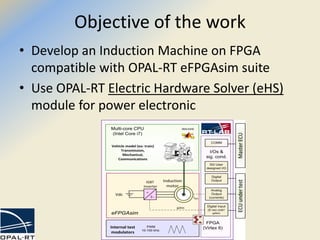
• Develop an Induction Machine on FPGA
compatible with OPAL-RT eFPGAsim suite
• Use OPAL-RT Electric Hardware Solver (eHS)
module for power electronic
Advantages of FPGA simulation
• Excellent resolution for high frequency IGBT gating
(up to 50-100 kHz)
• Excellent latency (typ. 1 µs) for direct current-control
motor applications or FODP (Fast On-board Drive Protection)
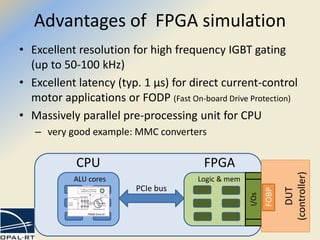
• Massively parallel pre-processing unit for CPU
– very good example: MMC converters
ALU cores
I/Os
DUT
(controller)
Logic & mem
CPU FPGA
PCIe bus
FOBP
Disadvantages of FPGA simulation
• Higher coding complexity than CPU counterparts.
– User has more control over lower level abstraction levels but
this increases the complexity of the designs
– Many basic CPU coding schemes must be explicited in the FPGA
design. Ex: ‘for’ loops in matrix multiplications.
• Very long compilation time
– Generating a new FPGA bitstream from FPGA code can take 1-2
hours on big FPGA chips like Virtex-6 or Virtex-7
• Increased debugging/probing difficulty
 OPAL-RT designed eFPGAsim and eHS to solve these
problems
General eFPGAsim structure
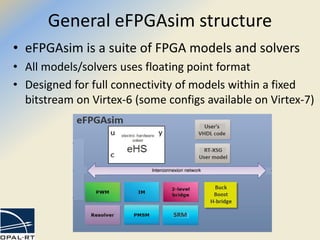
• eFPGAsim is a suite of FPGA models and solvers
• All models/solvers uses floating point format
• Designed for full connectivity of models within a fixed
bitstream on Virtex-6 (some configs available on Virtex-7)
Example eFPGAsim configuration (1)
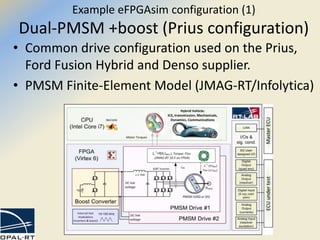
Dual-PMSM +boost (Prius configuration)
• Common drive configuration used on the Prius,
Ford Fusion Hybrid and Denso supplier.
• PMSM Finite-Element Model (JMAG-RT/Infolytica)
Example eFPGAsim configuration(2)
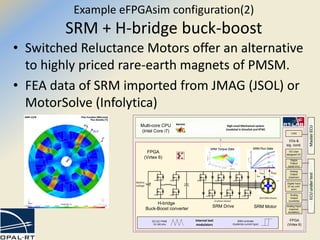
SRM + H-bridge buck-boost
• Switched Reluctance Motors offer an alternative
to highly priced rare-earth magnets of PMSM.
• FEA data of SRM imported from JMAG (JSOL) or
MotorSolve (Infolytica)
(3-phase shown)
L-1
(θ,iabc)
θrotor
FPGA
(Virtex 6)
Digital Input
(5 ns) (IGBT
gates)
Multi-core CPU
(Intel Core i7)
Internal test
modulators
DC-DC PWM
10-100 kHz
SRM Drive
Analog
Output
(currents)
Analog
Output
(resolver)
Digital
Output
(quad enc)
I/Os &
sig. cond.
Analog Input
(resolver
excitation)
High-Level Mechanical system
(modeled in Simulink and RTW)
MasterECU
Battery
voltage
H-bridge
Buck-Boost converter
SG User
designed I/O
ECUundertest
CAN
(6/4 SRM shown)
SRM Motor
SRM Flux Data
Labc
SRM controller
(hysterisis current type)
SRM Torque Data
iabc
FPGA
(Virtex 6)
New eFPGAsim model in this paper
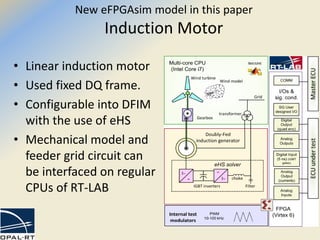
Induction Motor
• Linear induction motor
• Used fixed DQ frame.
• Configurable into DFIM
with the use of eHS
• Mechanical model and
feeder grid circuit can
be interfaced on regular
CPUs of RT-LAB
Automated Nodal Electric Circuit Solver
eHS: ‘Electric Hardware Solver’
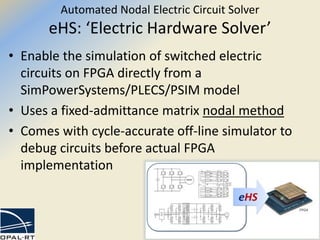
• Enable the simulation of switched electric
circuits on FPGA directly from a
SimPowerSystems/PLECS/PSIM model
• Uses a fixed-admittance matrix nodal method
• Comes with cycle-accurate off-line simulator to
debug circuits before actual FPGA
implementation
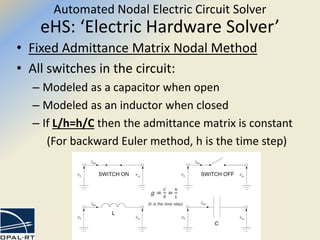
• Fixed Admittance Matrix Nodal Method
• All switches in the circuit:
– Modeled as a capacitor when open
– Modeled as an inductor when closed
– If L/h=h/C then the admittance matrix is constant
(For backward Euler method, h is the time step)
Automated Nodal Electric Circuit Solver
eHS: ‘Electric Hardware Solver’
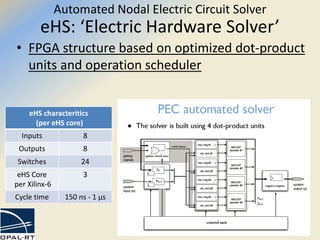
• FPGA structure based on optimized dot-product
units and operation scheduler
Automated Nodal Electric Circuit Solver
eHS: ‘Electric Hardware Solver’
eHS characteritics
(per eHS core)
Inputs 8
Outputs 8
Switches 24
eHS Core
per Xilinx-6
3
Cycle time 150 ns - 1 µs
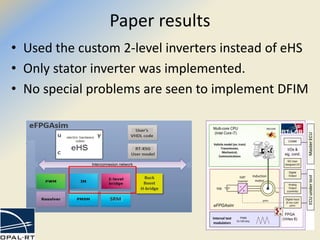
• Used the custom 2-level inverters instead of eHS
• Only stator inverter was implemented.
• No special problems are seen to implement DFIM
Paper results
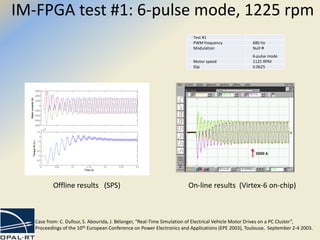
Offline results (SPS) On-line results (Virtex-6 on-chip)
IM-FPGA test #1: 6-pulse mode, 1225 rpm
Test #1
PWM frequency 680 Hz
Modulation Null
6-pulse mode
Motor speed 1125 RPM
Slip 0.0625
Case from: C. Dufour, S. Abourida, J. Bélanger, “Real-Time Simulation of Electrical Vehicle Motor Drives on a PC Cluster”,
Proceedings of the 10th European Conference on Power Electronics and Applications (EPE 2003), Toulouse, September 2-4 2003.
IM-FPGA test #2: PWM mode, 3000 rpm
• Torque computed on CPU with
mechanical model
Test #2
PWM frequency 1200 Hz
Modulation 0.7  0.8
Motor speed 3000 RPM
Slip 0.1
Offline results (SPS) On-line results (Virtex-6 on-chip)
Summary
• A new induction machine model was implemented on the
eFPGAsim solver suite.
– avoid very long ‘Place And Route’ time of modern, large FPGAs.
– non-flashing, variable parameter and variable topology methodology
• Induction machine using standard fixed referential DQ model
– Models with saturation and core loss will be developed next.
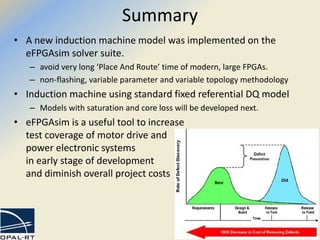
• eFPGAsim is a useful tool to increase
test coverage of motor drive and
power electronic systems
in early stage of development
and diminish overall project costs
www.opal-rt.com

OPAL-RT Induction machine & power electronic test system on FPGA

  • 1.
    An Induction Machineand Power Electronic Test System on FPGA Christian Dufour Sébastien Cense Jean Bélanger OPAL-RT TECHNOLOGIES, Montréal, Québec, Canada
  • 2.
    Objective of thework • Develop an Induction Machine on FPGA compatible with OPAL-RT eFPGAsim suite • Use OPAL-RT Electric Hardware Solver (eHS) module for power electronic
  • 3.
    Advantages of FPGAsimulation • Excellent resolution for high frequency IGBT gating (up to 50-100 kHz) • Excellent latency (typ. 1 µs) for direct current-control motor applications or FODP (Fast On-board Drive Protection) • Massively parallel pre-processing unit for CPU – very good example: MMC converters ALU cores I/Os DUT (controller) Logic & mem CPU FPGA PCIe bus FOBP
  • 4.
    Disadvantages of FPGAsimulation • Higher coding complexity than CPU counterparts. – User has more control over lower level abstraction levels but this increases the complexity of the designs – Many basic CPU coding schemes must be explicited in the FPGA design. Ex: ‘for’ loops in matrix multiplications. • Very long compilation time – Generating a new FPGA bitstream from FPGA code can take 1-2 hours on big FPGA chips like Virtex-6 or Virtex-7 • Increased debugging/probing difficulty  OPAL-RT designed eFPGAsim and eHS to solve these problems
  • 5.
    General eFPGAsim structure •eFPGAsim is a suite of FPGA models and solvers • All models/solvers uses floating point format • Designed for full connectivity of models within a fixed bitstream on Virtex-6 (some configs available on Virtex-7)
  • 6.
    Example eFPGAsim configuration(1) Dual-PMSM +boost (Prius configuration) • Common drive configuration used on the Prius, Ford Fusion Hybrid and Denso supplier. • PMSM Finite-Element Model (JMAG-RT/Infolytica)
  • 7.
    Example eFPGAsim configuration(2) SRM+ H-bridge buck-boost • Switched Reluctance Motors offer an alternative to highly priced rare-earth magnets of PMSM. • FEA data of SRM imported from JMAG (JSOL) or MotorSolve (Infolytica) (3-phase shown) L-1 (θ,iabc) θrotor FPGA (Virtex 6) Digital Input (5 ns) (IGBT gates) Multi-core CPU (Intel Core i7) Internal test modulators DC-DC PWM 10-100 kHz SRM Drive Analog Output (currents) Analog Output (resolver) Digital Output (quad enc) I/Os & sig. cond. Analog Input (resolver excitation) High-Level Mechanical system (modeled in Simulink and RTW) MasterECU Battery voltage H-bridge Buck-Boost converter SG User designed I/O ECUundertest CAN (6/4 SRM shown) SRM Motor SRM Flux Data Labc SRM controller (hysterisis current type) SRM Torque Data iabc FPGA (Virtex 6)
  • 8.
    New eFPGAsim modelin this paper Induction Motor • Linear induction motor • Used fixed DQ frame. • Configurable into DFIM with the use of eHS • Mechanical model and feeder grid circuit can be interfaced on regular CPUs of RT-LAB
  • 9.
    Automated Nodal ElectricCircuit Solver eHS: ‘Electric Hardware Solver’ • Enable the simulation of switched electric circuits on FPGA directly from a SimPowerSystems/PLECS/PSIM model • Uses a fixed-admittance matrix nodal method • Comes with cycle-accurate off-line simulator to debug circuits before actual FPGA implementation
  • 10.
    • Fixed AdmittanceMatrix Nodal Method • All switches in the circuit: – Modeled as a capacitor when open – Modeled as an inductor when closed – If L/h=h/C then the admittance matrix is constant (For backward Euler method, h is the time step) Automated Nodal Electric Circuit Solver eHS: ‘Electric Hardware Solver’
  • 11.
    • FPGA structurebased on optimized dot-product units and operation scheduler Automated Nodal Electric Circuit Solver eHS: ‘Electric Hardware Solver’ eHS characteritics (per eHS core) Inputs 8 Outputs 8 Switches 24 eHS Core per Xilinx-6 3 Cycle time 150 ns - 1 µs
  • 12.
    • Used thecustom 2-level inverters instead of eHS • Only stator inverter was implemented. • No special problems are seen to implement DFIM Paper results
  • 13.
    Offline results (SPS)On-line results (Virtex-6 on-chip) IM-FPGA test #1: 6-pulse mode, 1225 rpm Test #1 PWM frequency 680 Hz Modulation Null 6-pulse mode Motor speed 1125 RPM Slip 0.0625 Case from: C. Dufour, S. Abourida, J. Bélanger, “Real-Time Simulation of Electrical Vehicle Motor Drives on a PC Cluster”, Proceedings of the 10th European Conference on Power Electronics and Applications (EPE 2003), Toulouse, September 2-4 2003.
  • 14.
    IM-FPGA test #2:PWM mode, 3000 rpm • Torque computed on CPU with mechanical model Test #2 PWM frequency 1200 Hz Modulation 0.7  0.8 Motor speed 3000 RPM Slip 0.1 Offline results (SPS) On-line results (Virtex-6 on-chip)
  • 15.
    Summary • A newinduction machine model was implemented on the eFPGAsim solver suite. – avoid very long ‘Place And Route’ time of modern, large FPGAs. – non-flashing, variable parameter and variable topology methodology • Induction machine using standard fixed referential DQ model – Models with saturation and core loss will be developed next. • eFPGAsim is a useful tool to increase test coverage of motor drive and power electronic systems in early stage of development and diminish overall project costs
  • 16.