Real-Time Simulation of A Modular Multilevel
Converter Based Hybrid Energy Storage System
Feng Guo, PhD
NEC Laboratories America, Inc.
Cupertino, CA
5/13/2015
2
Outline
• Introduction
• Proposed MMC for Hybrid Energy Storage System
• Real-Time Simulation Results
• Conclusions
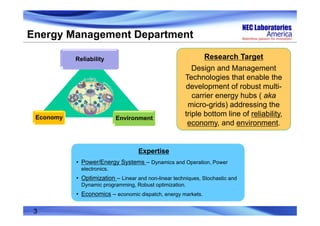
Research Target
Design and Management
Technologies that enable the
development of robust multi-
carrier energy hubs ( aka
micro-grids) addressing the
triple bottom line of reliability,
economy, and environment.
• Power/Energy Systems – Dynamics and Operation, Power
electronics.
• Optimization – Linear and non-linear techniques, Stochastic and
Dynamic programming, Robust optimization.
• Economics – economic dispatch, energy markets.
ExpertiseExpertise
Reliability
EnvironmentEconomy
Energy Management Department
3
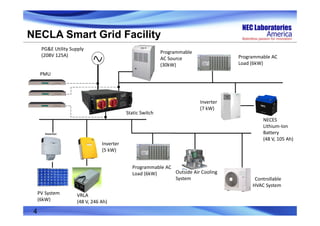
Outside Air Cooling 
System
PG&E Utility Supply 
(208V 125A)
Controllable
HVAC System
NECLA Smart Grid Facility
Static Switch
Programmable 
AC Source
(30kW)
Programmable AC 
Load (6kW)
NECES 
Lithium‐Ion 
Battery 
(48 V, 105 Ah)
PV System
(6kW)
Programmable AC 
Load (6kW)
VRLA
(48 V, 246 Ah)
Inverter 
(7 kW)
Inverter 
(5 kW)
PMU
4
5
Motivation
 The fluctuation of PV output power makes the 
use of Energy Storage System (ESS) necessary:
• Stabilize plant output power.
• Shave grid peak power.
• Compensate grid reactive power.
 The existing Battery‐Only ESS has the following 
issues:
• Limited battery life cycle < 4000 cycles.
• Reduced battery lifetime as much as 50% under high 
charging power.
 Hybrid ESS with battery and Ultracapacitor (UC) 
is a better candidate for this application [2]:
• Improved battery lifetime.
• Reduced battery size.
• Improved energy efficiency.
[1]
Battery UltraCap
Utility Grid
Existing Circuit Topologies
 However, current Power Conversion System (PCS) of the HESS has the 
following issues:
• Extra dc/dc converters are needed.
• Not suitable for high power systems (>100 kW).
• Lower reliability.
Battery
UltraCap
Utility Grid
Utility Grid
Battery
UltraCap
One dc/ac inverter [3] One dc/dc converter and one dc/ac inverter [4]
Two dc/dc converters and one dc/ac inverter [5]
6
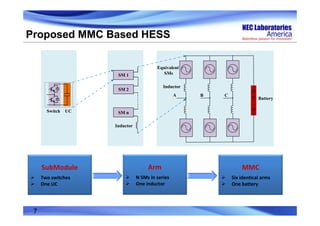
Proposed MMC Based HESS
SubModule
 Two switches
 One UC
Arm
 N SMs in series
 One inductor
MMC
 Six identical arms
 One battery
UCSwitch
SM 1
Inductor
SM 2
SM n
Battery
A B C
Equivalent
SMs
Inductor
7
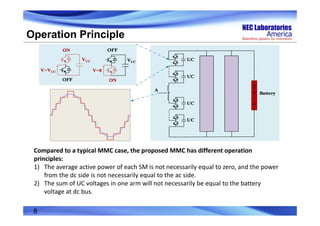
Operation Principle
Compared to a typical MMC case, the proposed MMC has different operation 
principles: 
1) The average active power of each SM is not necessarily equal to zero, and the power 
from the dc side is not necessarily equal to the ac side.
2) The sum of UC voltages in one arm will not necessarily be equal to the battery 
voltage at dc bus.
8
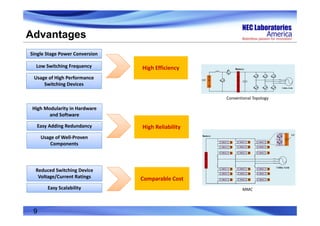
Advantages
Single Stage Power Conversion
Low Switching Frequency High EfficiencyHigh Efficiency
Reduced Switching Device 
Voltage/Current Ratings Comparable CostComparable Cost
Easy Scalability
Easy Adding Redundancy High ReliabilityHigh Reliability
High Modularity in Hardware 
and Software
MMC
Conventional Topology
Usage of Well‐Proven 
Components
Usage of High Performance 
Switching Devices
SM 5.n
SM 5.1
Utility Grid
Battery
SM 6.1
SM 6.n
SM 4.1
SM 4.n
SM 2.1
SM 2.n
SM 3.n
SM 3.1
SM 1.n
SM 1.1
SM 5.2SM 3.2SM 1.2
SM 6.2SM 4.2SM 2.2
UC
Battery
UC
Utility Grid
9
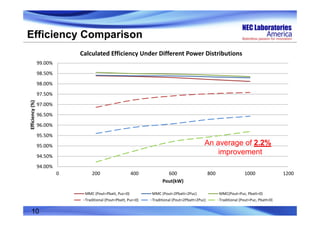
Efficiency Comparison
94.00%
94.50%
95.00%
95.50%
96.00%
96.50%
97.00%
97.50%
98.00%
98.50%
99.00%
0 200 400 600 800 1000 1200
Efficiency (%)
Pout(kW)
Calculated Efficiency Under Different Power Distributions
MMC (Pout=Pbatt, Puc=0) MMC (Pout=2Pbatt=2Puc) MMC(Pout=Puc, Pbatt=0)
Traditional (Pout=Pbatt, Puc=0) Traditional (Pout=2Pbatt=2Puc) Traditional (Pout=Puc, Pbatt=0)
An average of 2.2%
improvement
10
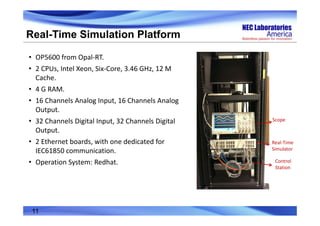
Real-Time Simulation Platform
Real‐Time 
Simulator
Scope
Control 
Station
• OP5600 from Opal‐RT.
• 2 CPUs, Intel Xeon, Six‐Core, 3.46 GHz, 12 M 
Cache.
• 4 G RAM.
• 16 Channels Analog Input, 16 Channels Analog 
Output.
• 32 Channels Digital Input, 32 Channels Digital 
Output.
• 2 Ethernet boards, with one dedicated for 
IEC61850 communication.
• Operation System: Redhat.
11
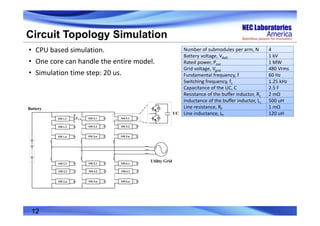
Circuit Topology Simulation
• CPU based simulation.
• One core can handle the entire model.
• Simulation time step: 20 us.
Number of submodules per arm, N 4
Battery voltage, VBatt 1 kV
Rated power, Pout 1 MW
Grid voltage, Vgrid 480 Vrms
Fundamental frequency, f 60 Hz
Switching frequency, fs 1.25 kHz
Capacitance of the UC, C 2.5 F
Resistance of the buffer inductor, Rc 2 mΩ
Inductance of the buffer inductor, Lc 500 uH
Line resistance, Rf 1 mΩ
Line inductance, Lf 120 uH
SM 5.n
SM 5.1
Utility Grid
Battery
SM 6.1
SM 6.n
SM 4.1
SM 4.n
SM 2.1
SM 2.n
SM 3.n
SM 3.1
SM 1.n
SM 1.1
SM 5.2SM 3.2SM 1.2
SM 6.2SM 4.2SM 2.2
UC
VC11
12
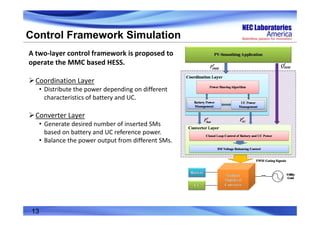
Control Framework Simulation
A two‐layer control framework is proposed to 
operate the MMC based HESS.
Coordination Layer
• Distribute the power depending on different  
characteristics of battery and UC.
Converter Layer
• Generate desired number of inserted SMs 
based on battery and UC reference power.
• Balance the power output from different SMs.
13
Real-Time Simulation Results
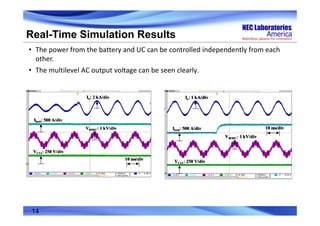
• The power from the battery and UC can be controlled independently from each 
other.
• The multilevel AC output voltage can be seen clearly.
14
Real-Time Simulation Results (Cont’d)
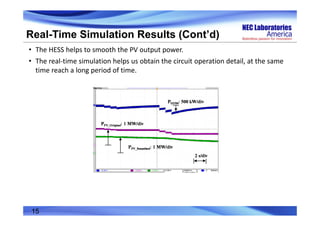
• The HESS helps to smooth the PV output power.
• The real‐time simulation helps us obtain the circuit operation detail, at the same 
time reach a long period of time.
15
Conclusions
 In this presentation, a Modular Multilevel Converter based Battery‐
UltraCapacitor Hybrid Energy Storage System is proposed for Photovoltaic 
applications.
 Compared to the traditional HESS topologies,  the proposed system features 
high efficiency, high reliability, and comparable cost.
 A two‐layer control framework is proposed to operate the MMC based HESS.
 Real‐time simulation results validate the effectiveness of the proposed 
control framework.
16
References
[1] A. Omran, M. Kazerani, and M.M.A. Salama, “Investigation of methods for reduction of power fluctuations
generated from large grid-connected Photovoltaic systems,” IEEE Trans. Energy Conversion, vol. 26, no.
1, pp. 318-327, Mar. 2011.
[2] Y. Ye, P. Garg, and R. Sharma, “An Integrated Power Management Strategy of Hybrid Energy Storage for
Renewable Application,” Proceedings of IECON 2014 -- The 40th Annual Conference of the IEEE Industrial
Electronics Society, 2014, pp. 3088-3093.
[3] R. Dougal, S. Liu, and R. White, “Power and life extension of battery-ultracapacitor hybrids,” IEEE Trans.
Components and Packaging Technologies, vol. 25, no. 1, pp. 120-131, Mar. 2002.
[4] L. Gao, R. Dougal, and S. Liu, “Power enhancement of an actively controlled battery/ultracapacitor hybrid,”
IEEE Trans. Power Electronics, vol. 20, no. 1, pp. 236-243, Jan. 2005.
[5] B. Hredzak, V. Agelidis, and G. Demetriades, “A Low Complexity Control System for a Hybrid DC Power
Source Based on Ultracapacitor–Lead–Acid Battery Configuration,” IEEE Trans. Power Electronics, vol. 29,
no. 6, June 2014.

RT15 Berkeley | Real-Time Simulation of A Modular Multilevel Converter Based Hybrid Energy Storage System - NEC