1
Alan Soltis
OPAL-RT
alan.soltis@opal-rt.com
FPGA Power Electronic & Electric Machine
real-time simulation for HIL - Introduction
2
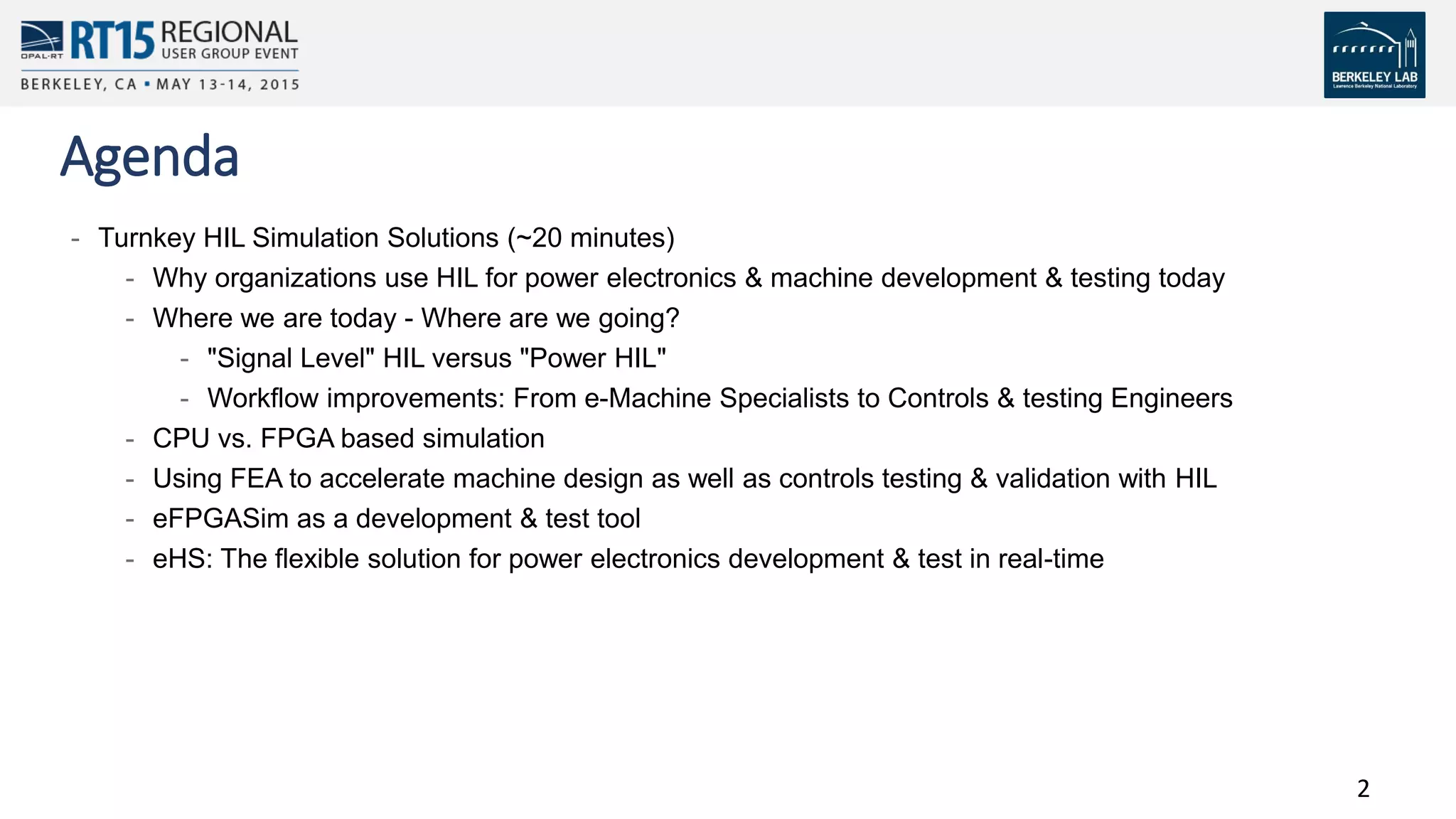
- Turnkey HIL Simulation Solutions (~20 minutes)
- Why organizations use HIL for power electronics & machine development & testing today
- Where we are today - Where are we going?
- "Signal Level" HIL versus "Power HIL"
- Workflow improvements: From e-Machine Specialists to Controls & testing Engineers
- CPU vs. FPGA based simulation
- Using FEA to accelerate machine design as well as controls testing & validation with HIL
- eFPGASim as a development & test tool
- eHS: The flexible solution for power electronics development & test in real-time
Agenda
3
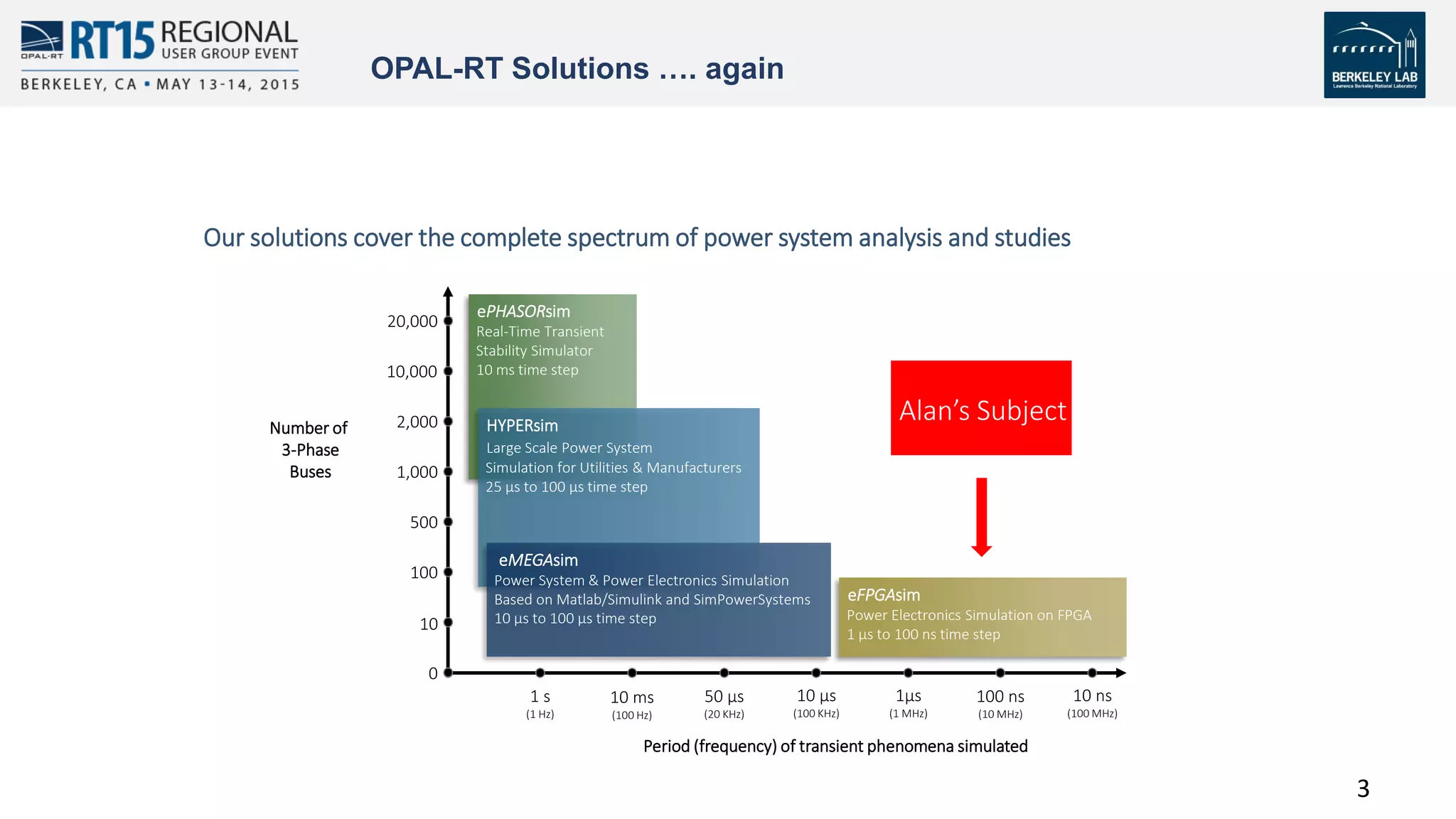
Our solutions cover the complete spectrum of power system analysis and studies
ePHASORsim
Real-Time Transient
Stability Simulator
10 ms time step
HYPERsim
Large Scale Power System
Simulation for Utilities & Manufacturers
25 µs to 100 µs time step
eFPGAsim
Power Electronics Simulation on FPGA
1 µs to 100 ns time step
1 s
(1 Hz)
10,000
2,000
1,000
500
100
10
0
10 ms
(100 Hz)
50 µs
(20 KHz)
10 µs
(100 KHz)
1µs
(1 MHz)
100 ns
(10 MHz)
10 ns
(100 MHz)
20,000
Period (frequency) of transient phenomena simulated
Number of
3-Phase
Buses
eMEGAsim
Power System & Power Electronics Simulation
Based on Matlab/Simulink and SimPowerSystems
10 µs to 100 µs time step
Alan’s Subject
OPAL-RT Solutions …. again
44
The Challenge of Electric Motor & Power Electronics
Control Testing
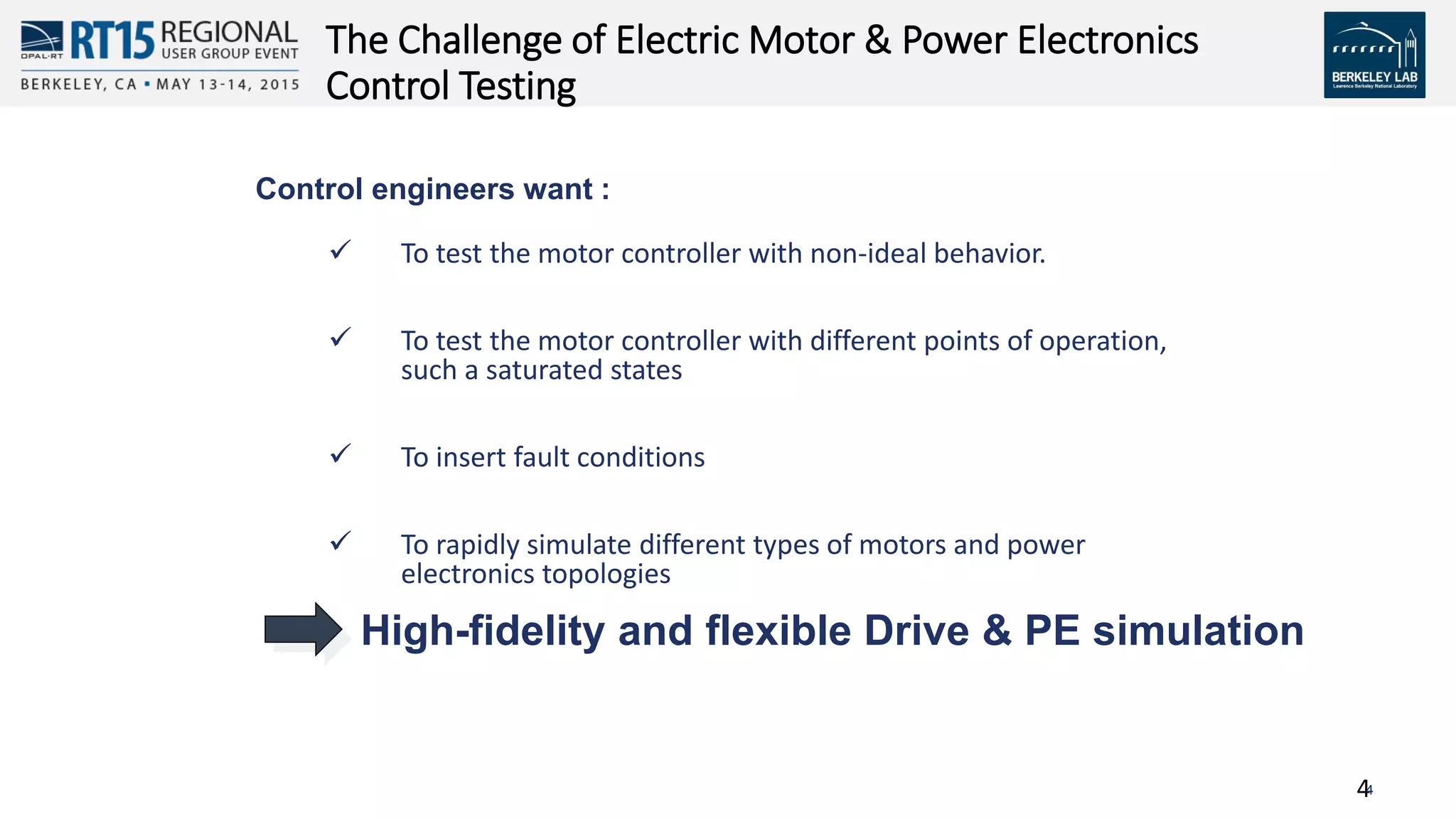
Control engineers want :
 To test the motor controller with non-ideal behavior.
 To test the motor controller with different points of operation,
such a saturated states
 To insert fault conditions
 To rapidly simulate different types of motors and power
electronics topologies
High-fidelity and flexible Drive & PE simulation
55
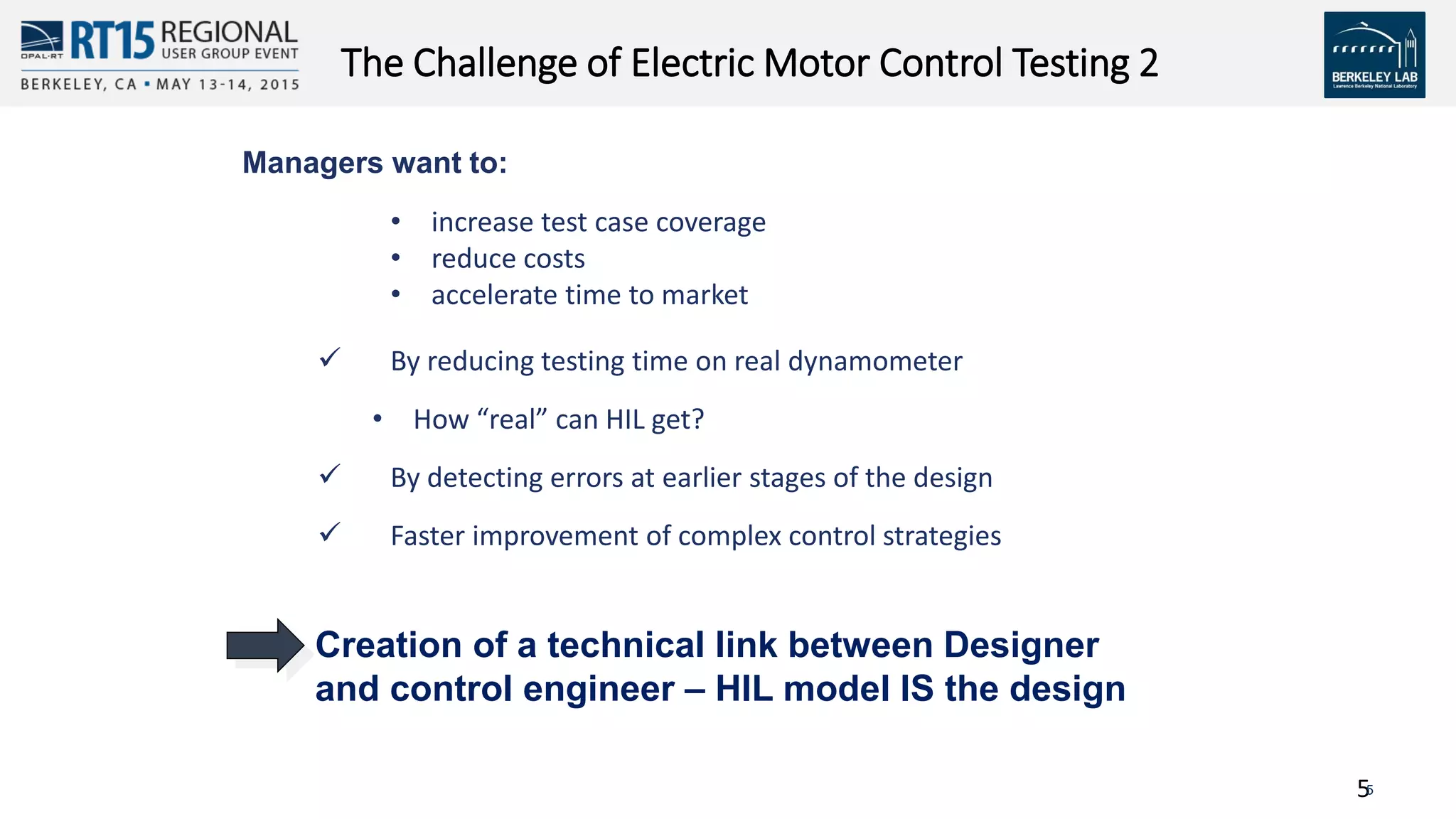
The Challenge of Electric Motor Control Testing 2
• increase test case coverage
• reduce costs
• accelerate time to market
 By reducing testing time on real dynamometer
• How “real” can HIL get?
 By detecting errors at earlier stages of the design
 Faster improvement of complex control strategies
Managers want to:
Creation of a technical link between Designer
and control engineer – HIL model IS the design
6
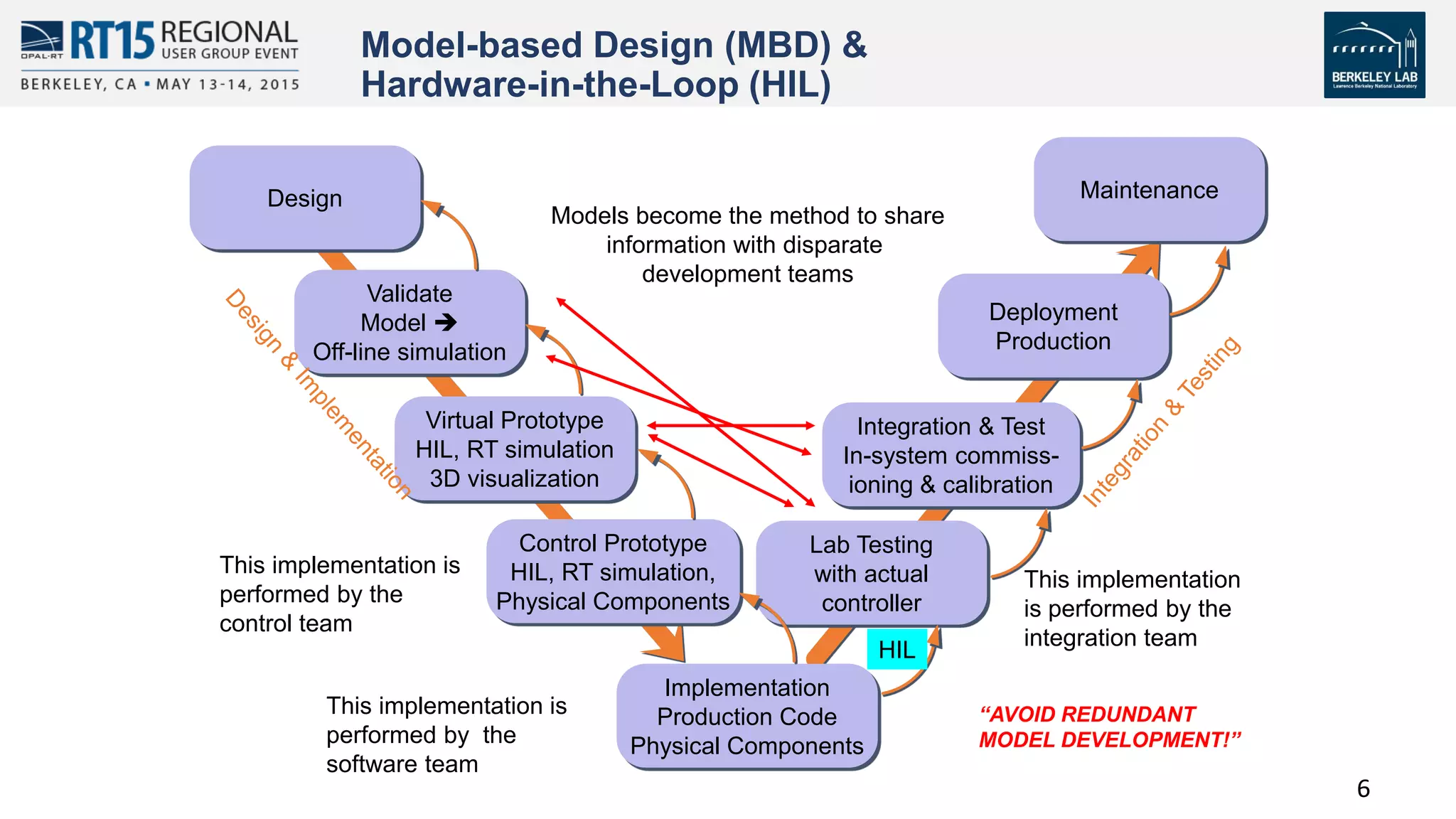
Model-based Design (MBD) &
Hardware-in-the-Loop (HIL)
Validate
Model 
Off-line simulation
Virtual Prototype
HIL, RT simulation
3D visualization
Control Prototype
HIL, RT simulation,
Physical Components
Design
Implementation
Production Code
Physical Components
Lab Testing
with actual
controller
Integration & Test
In-system commiss-
ioning & calibration
Deployment
Production
Maintenance
This implementation is
performed by the
software team
This implementation is
performed by the
control team
This implementation
is performed by the
integration team
Models become the method to share
information with disparate
development teams
HIL
“AVOID REDUNDANT
MODEL DEVELOPMENT!”
7
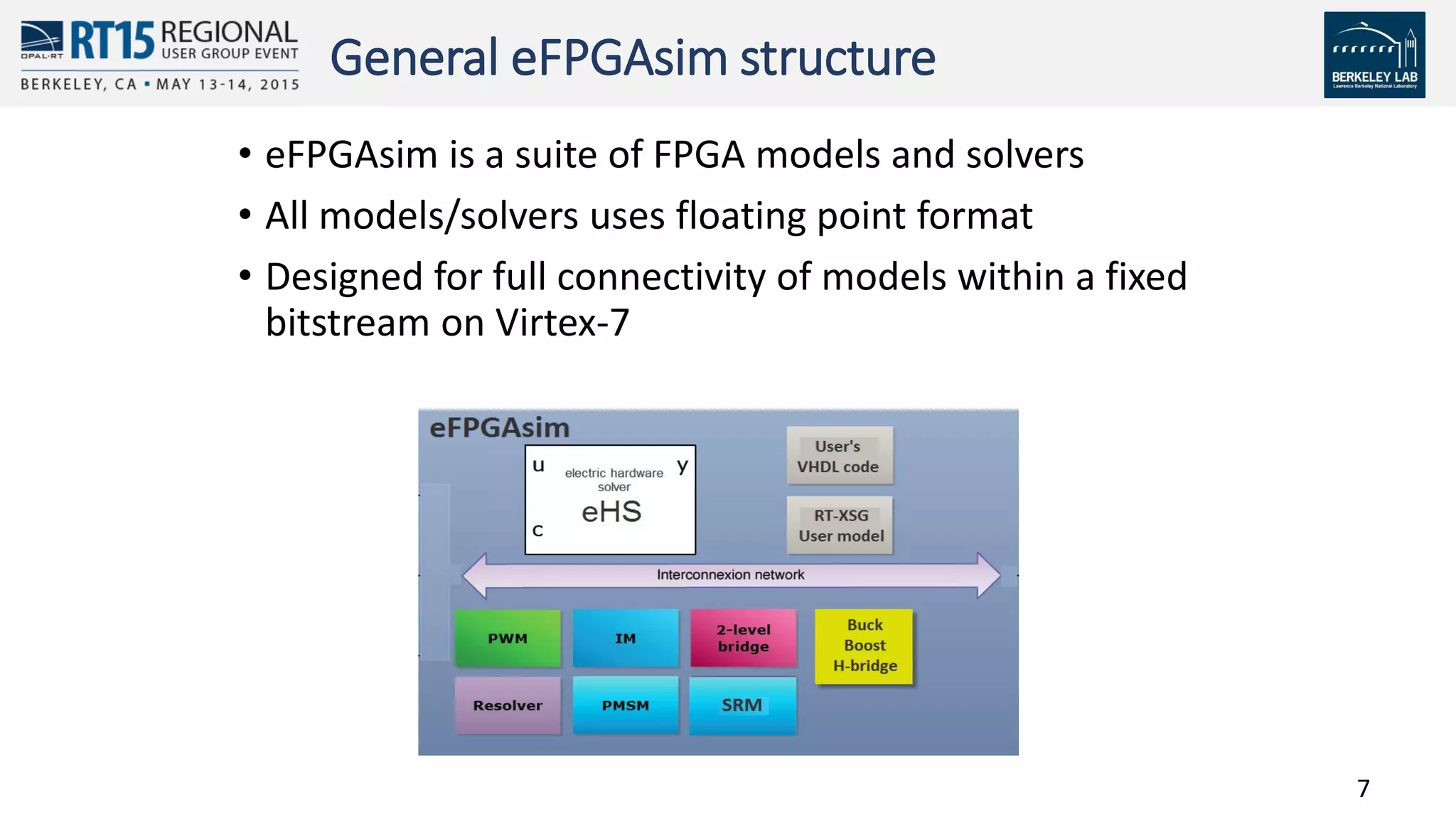
General eFPGAsim structure
• eFPGAsim is a suite of FPGA models and solvers
• All models/solvers uses floating point format
• Designed for full connectivity of models within a fixed
bitstream on Virtex-7
8
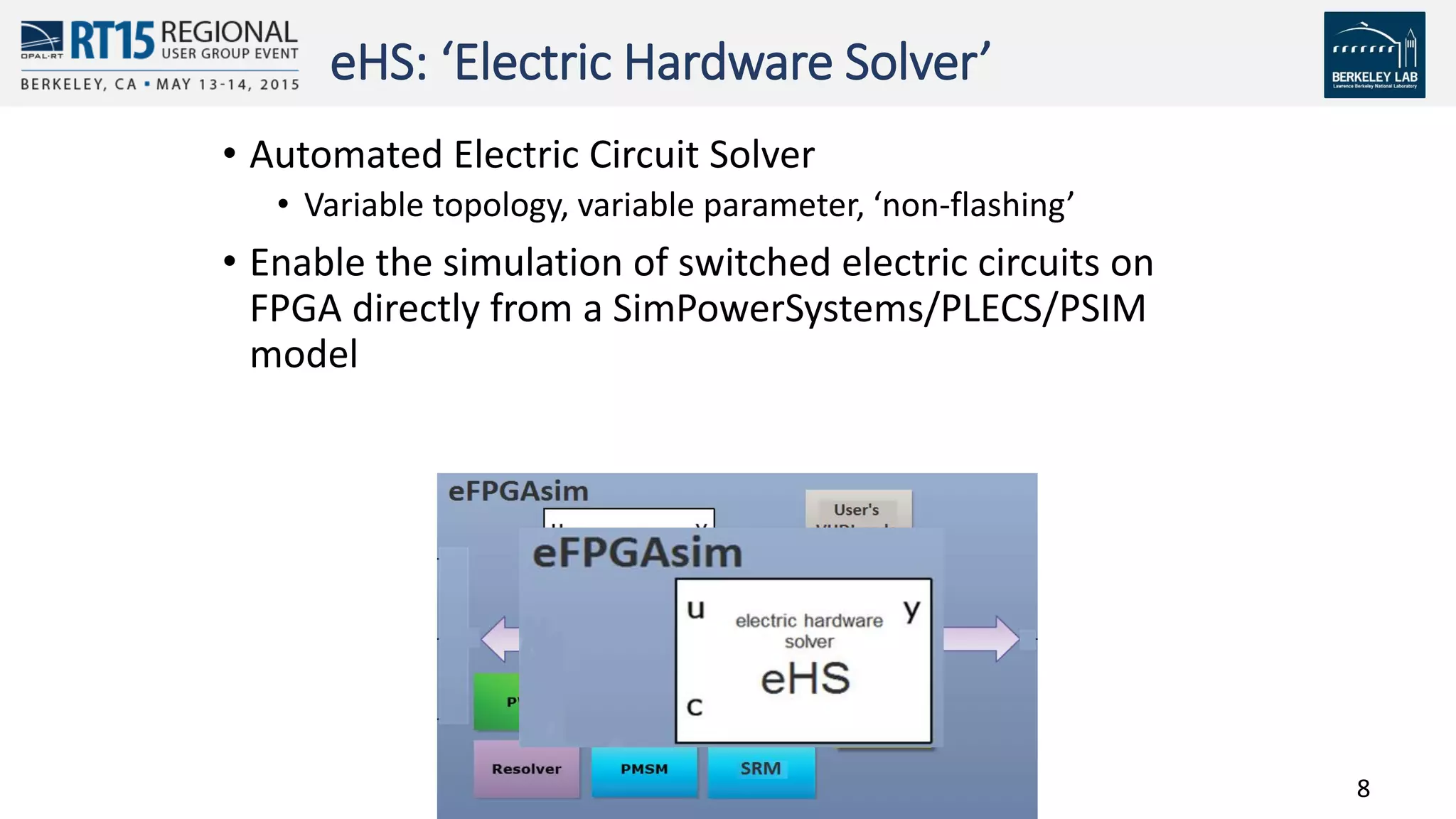
eHS: ‘Electric Hardware Solver’
• Automated Electric Circuit Solver
• Variable topology, variable parameter, ‘non-flashing’
• Enable the simulation of switched electric circuits on
FPGA directly from a SimPowerSystems/PLECS/PSIM
model
9
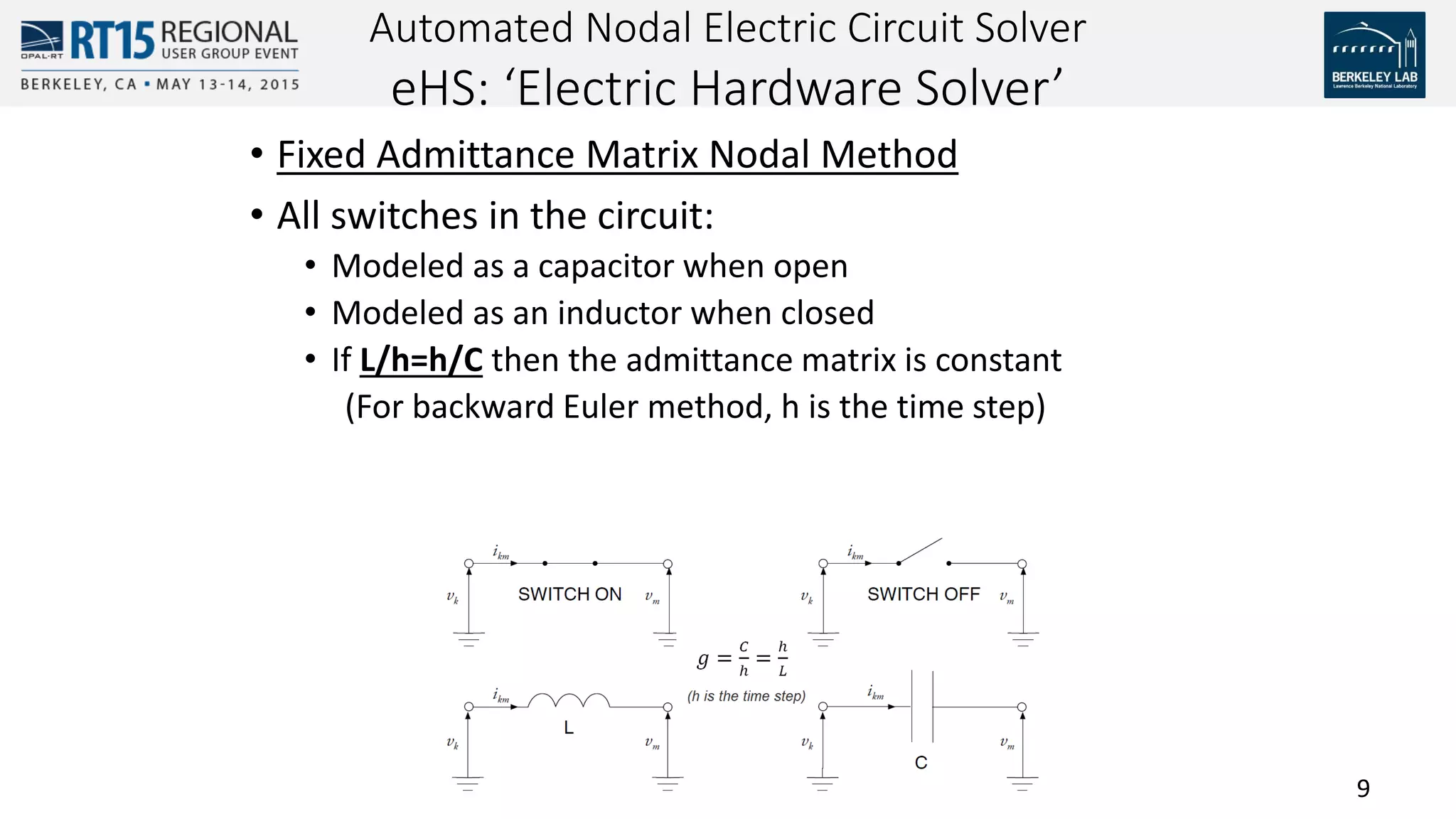
• Fixed Admittance Matrix Nodal Method
• All switches in the circuit:
• Modeled as a capacitor when open
• Modeled as an inductor when closed
• If L/h=h/C then the admittance matrix is constant
(For backward Euler method, h is the time step)
Automated Nodal Electric Circuit Solver
eHS: ‘Electric Hardware Solver’
10
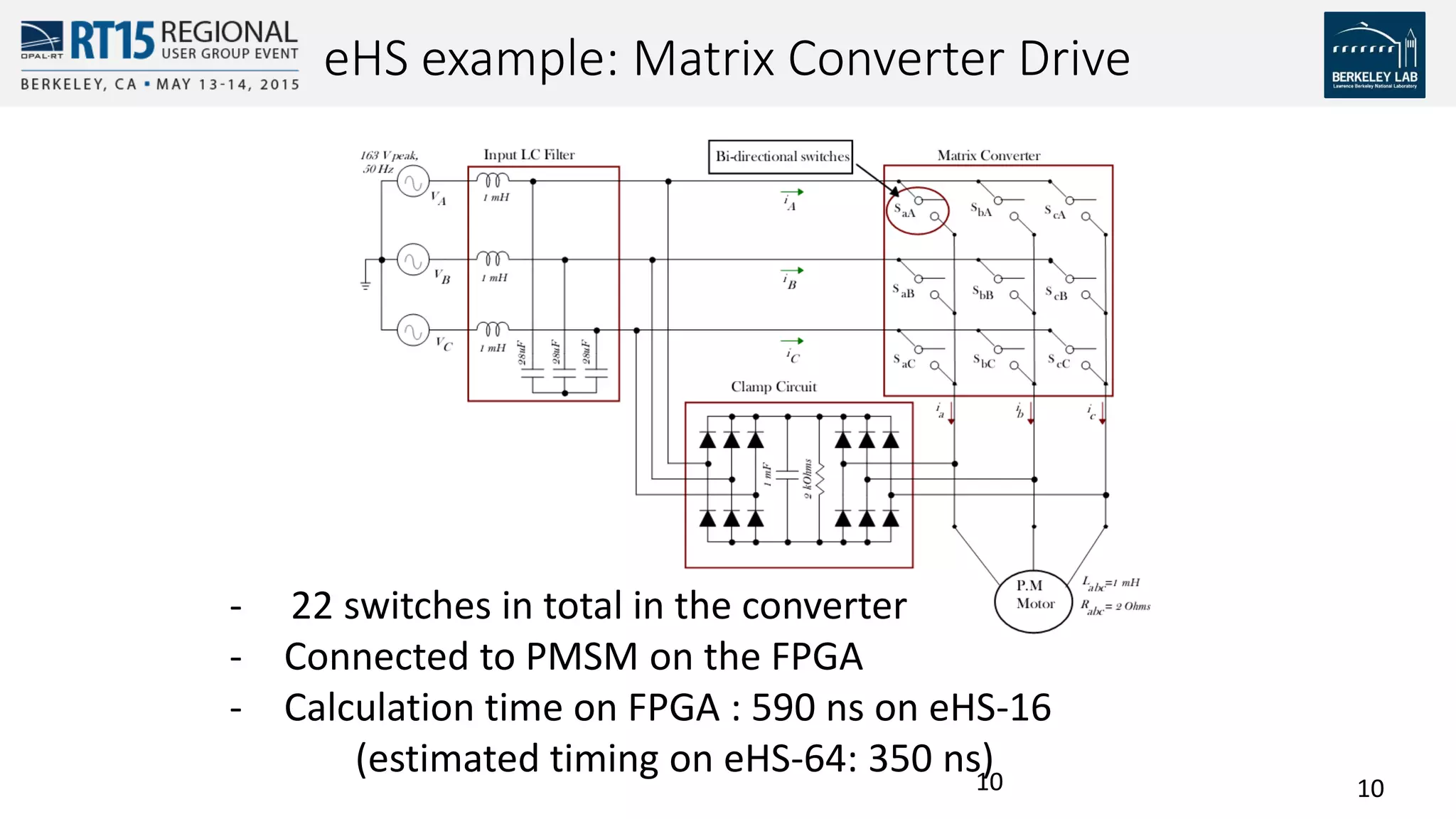
eHS example: Matrix Converter Drive
10
- 22 switches in total in the converter
- Connected to PMSM on the FPGA
- Calculation time on FPGA : 590 ns on eHS-16
(estimated timing on eHS-64: 350 ns)
11
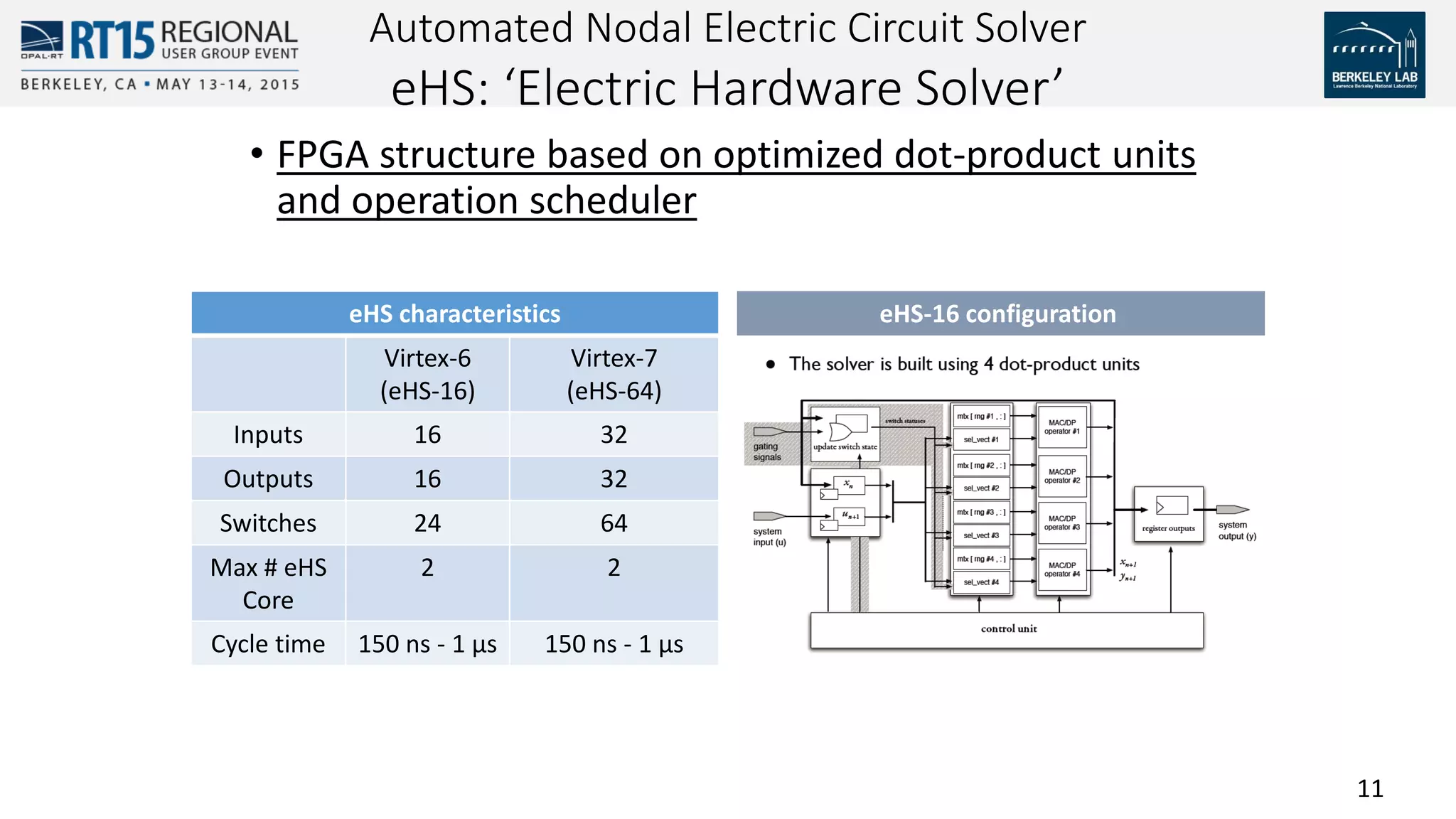
• FPGA structure based on optimized dot-product units
and operation scheduler
Automated Nodal Electric Circuit Solver
eHS: ‘Electric Hardware Solver’
eHS characteristics
Virtex-6
(eHS-16)
Virtex-7
(eHS-64)
Inputs 16 32
Outputs 16 32
Switches 24 64
Max # eHS
Core
2 2
Cycle time 150 ns - 1 µs 150 ns - 1 µs
eHS-16 configuration
12
Why FPGA simulation?
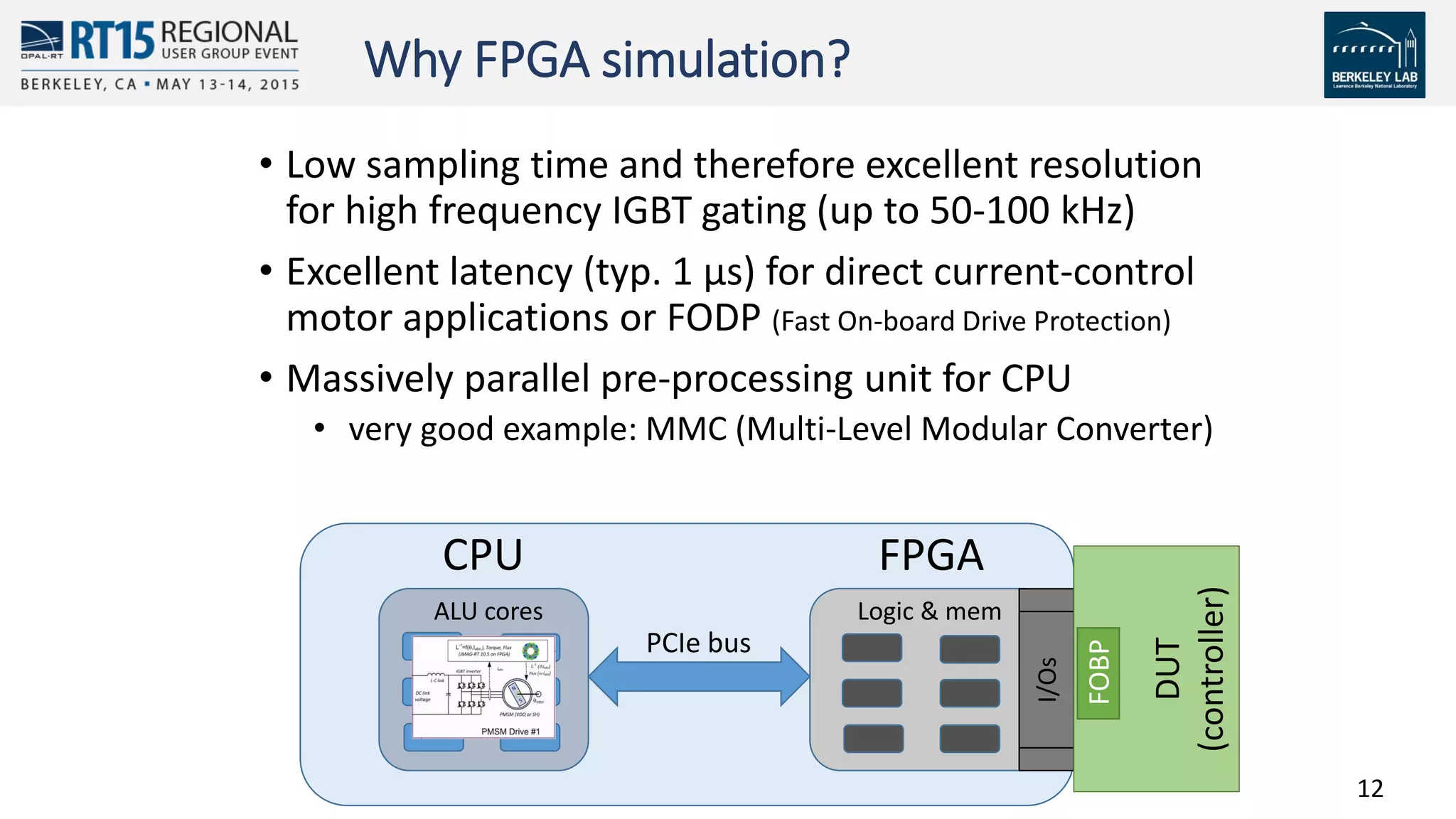
• Low sampling time and therefore excellent resolution
for high frequency IGBT gating (up to 50-100 kHz)
• Excellent latency (typ. 1 µs) for direct current-control
motor applications or FODP (Fast On-board Drive Protection)
• Massively parallel pre-processing unit for CPU
• very good example: MMC (Multi-Level Modular Converter)
ALU cores
I/Os
DUT
(controller)
Logic & mem
CPU FPGA
PCIe bus
FOBP
13
Disadvantages of FPGA simulation
• Higher coding complexity than CPU counterparts.
• User has more control over lower level abstraction levels but this
increases the complexity of the designs
• Many basic CPU coding schemes must be verbosely expressed in
the FPGA design, which can be cumbersome. Ex: ‘for’ loops in
matrix multiplications.
• Very long compilation time
• Generating a new FPGA bitstream from FPGA code can take 1-2
hours on big FPGA chips like Virtex-6 or Virtex-7
• Increased debugging/probing difficulty
eFPGAsim is designed to avoid these problems
1414
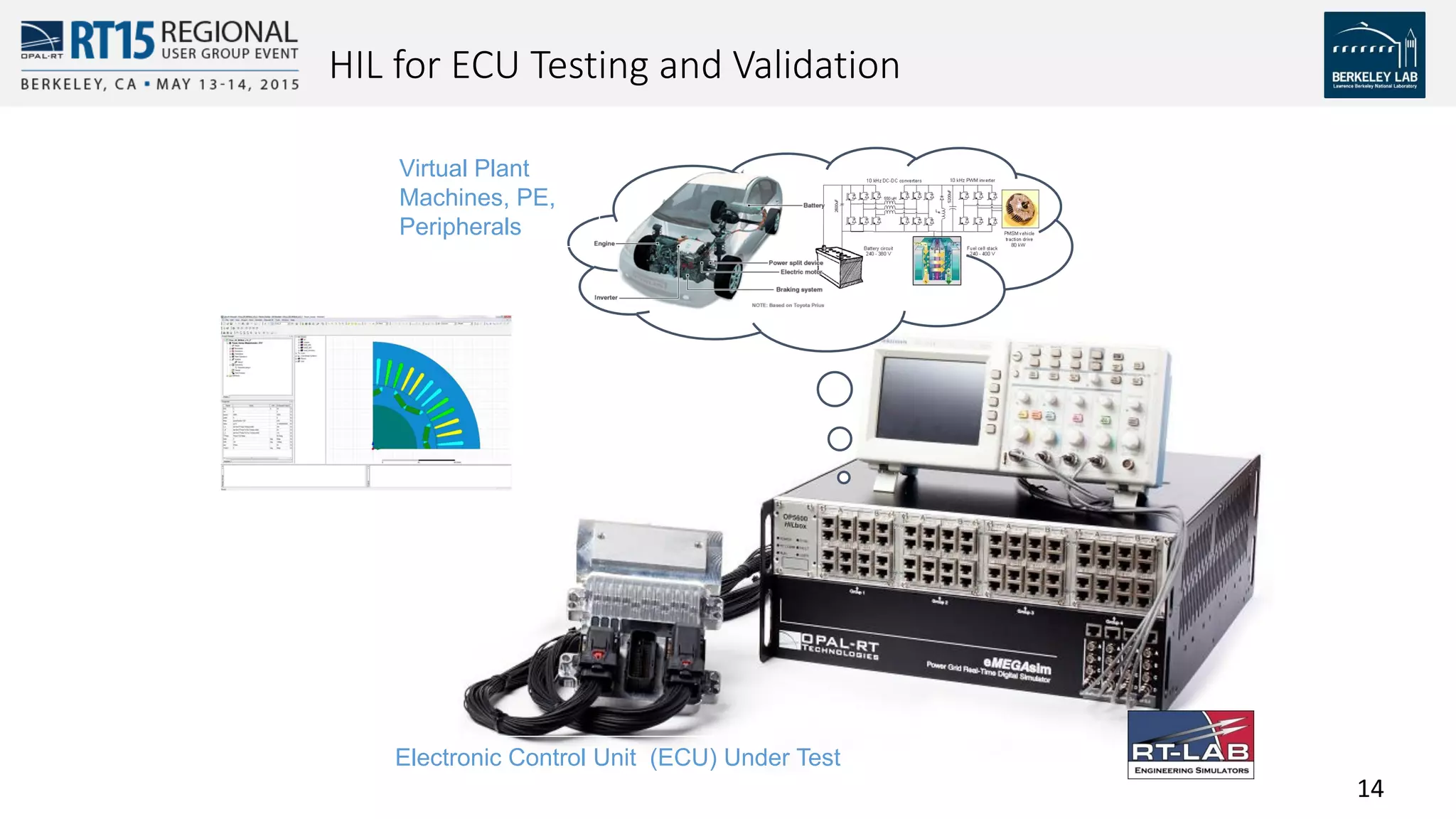
HIL for ECU Testing and Validation
Virtual Plant
Machines, PE,
Peripherals
Electronic Control Unit (ECU) Under Test
1515
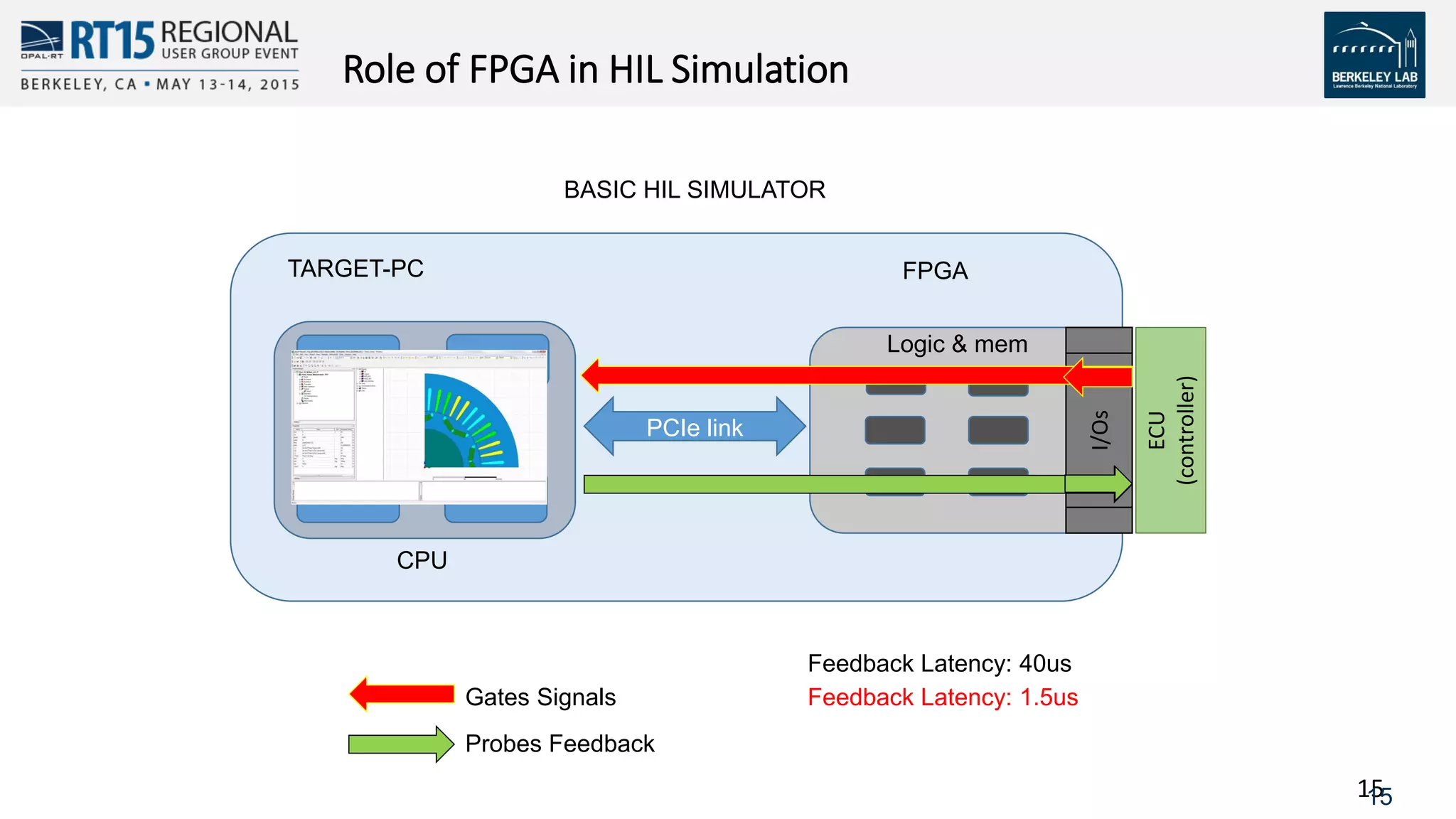
Role of FPGA in HIL Simulation
CPU
I/Os
ECU
(controller)
Logic & mem
TARGET-PC FPGA
PCIe link
BASIC HIL SIMULATOR
Gates Signals
Probes Feedback
Feedback Latency: 1.5us
Feedback Latency: 40us
1616
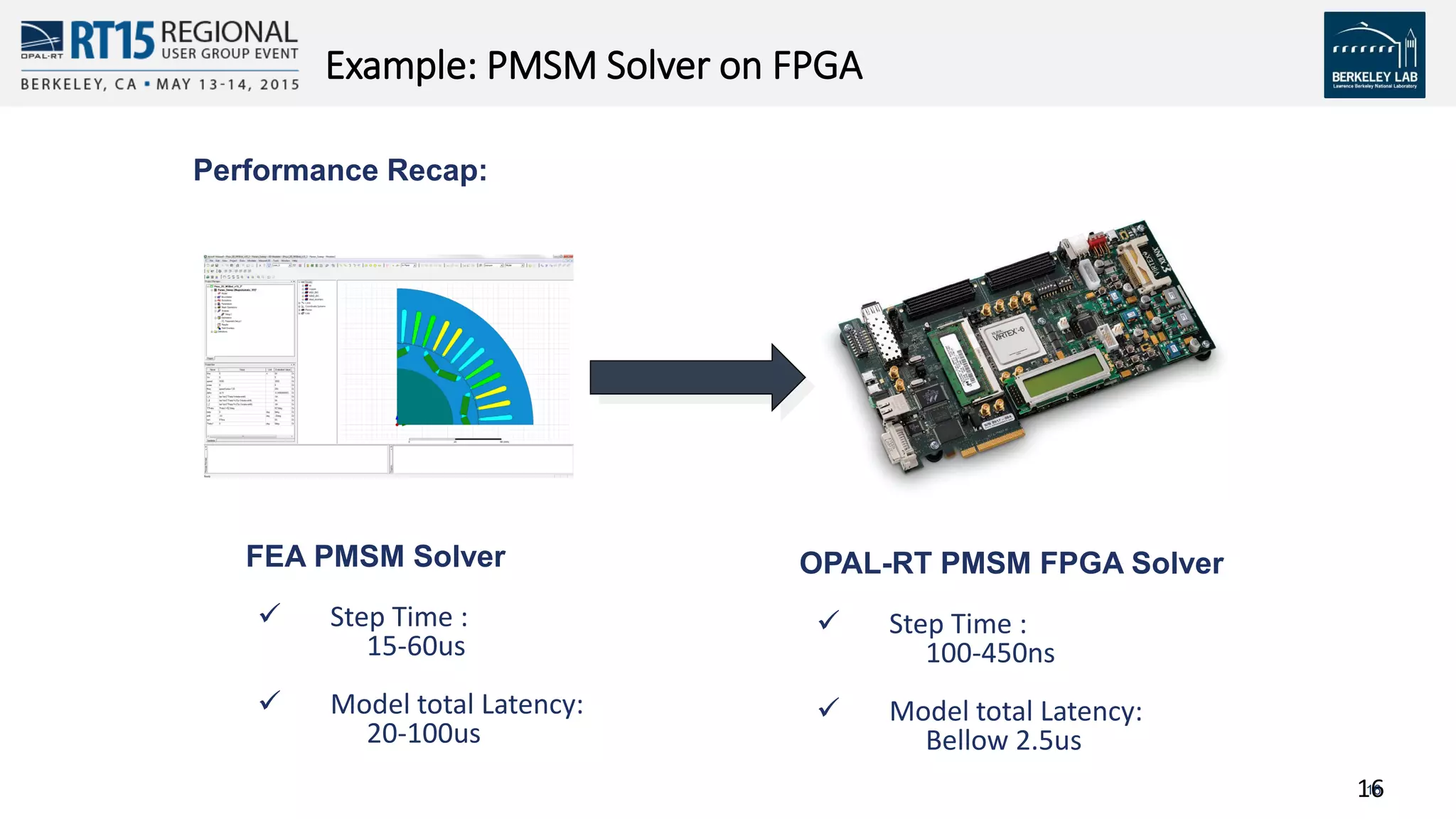
Example: PMSM Solver on FPGA
Performance Recap:
 Step Time :
15-60us
 Model total Latency:
20-100us
 Step Time :
100-450ns
 Model total Latency:
Bellow 2.5us
FEA PMSM Solver OPAL-RT PMSM FPGA Solver
17
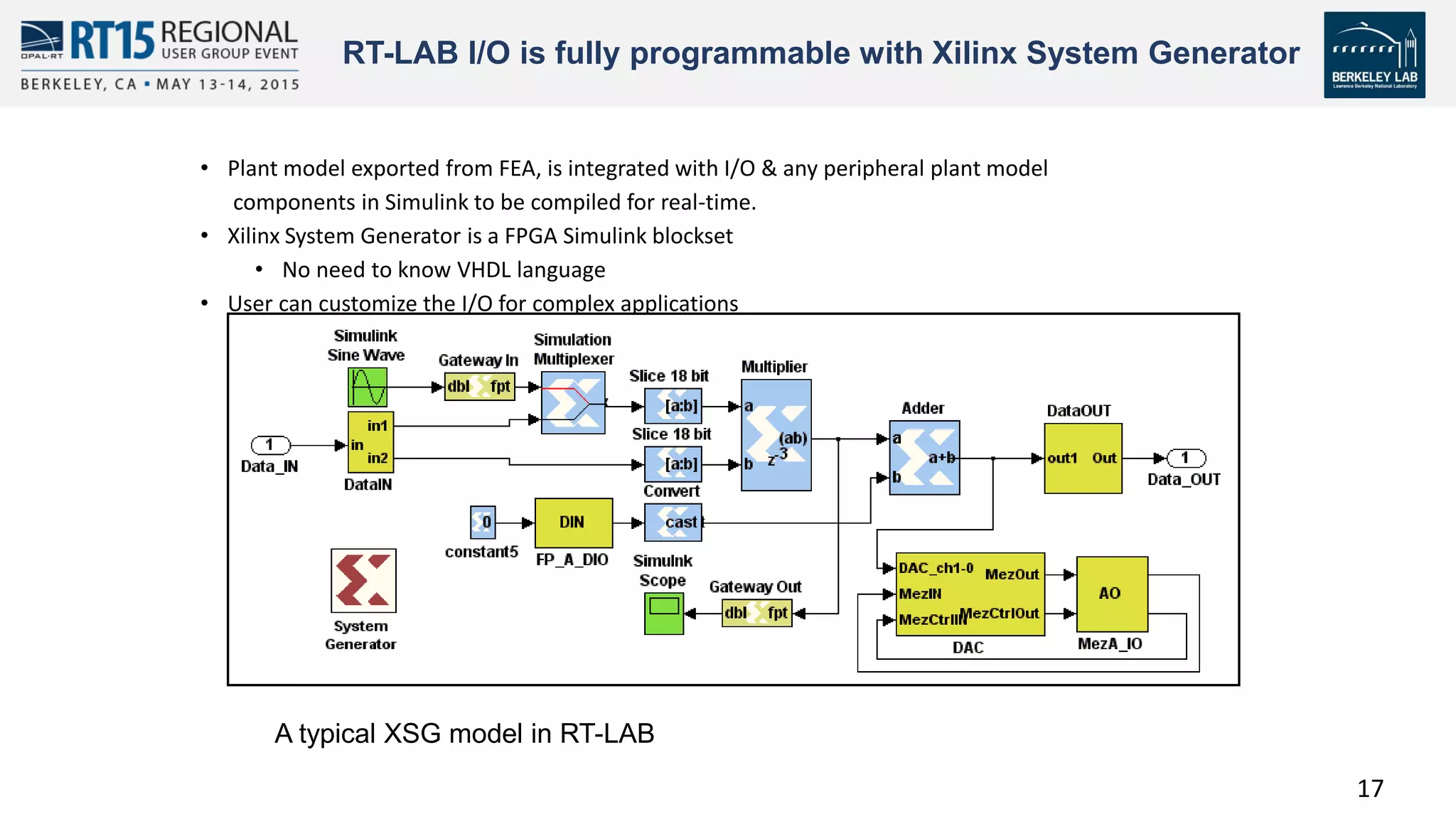
• Plant model exported from FEA, is integrated with I/O & any peripheral plant model
components in Simulink to be compiled for real-time.
• Xilinx System Generator is a FPGA Simulink blockset
• No need to know VHDL language
• User can customize the I/O for complex applications
RT-LAB I/O is fully programmable with Xilinx System Generator
A typical XSG model in RT-LAB
18
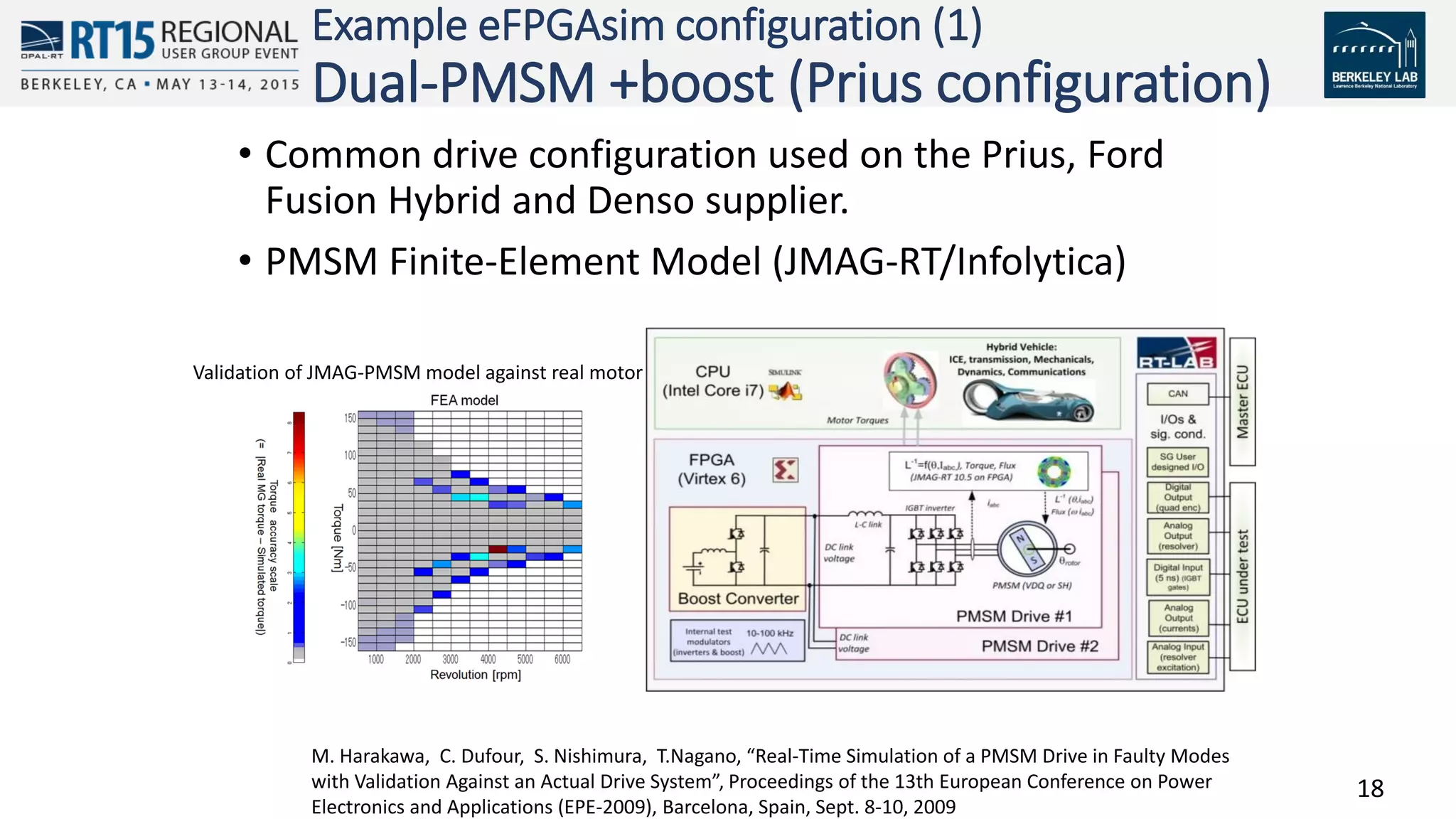
Example eFPGAsim configuration (1)
Dual-PMSM +boost (Prius configuration)
• Common drive configuration used on the Prius, Ford
Fusion Hybrid and Denso supplier.
• PMSM Finite-Element Model (JMAG-RT/Infolytica)
M. Harakawa, C. Dufour, S. Nishimura, T.Nagano, “Real-Time Simulation of a PMSM Drive in Faulty Modes
with Validation Against an Actual Drive System”, Proceedings of the 13th European Conference on Power
Electronics and Applications (EPE-2009), Barcelona, Spain, Sept. 8-10, 2009
Validation of JMAG-PMSM model against real motor
19
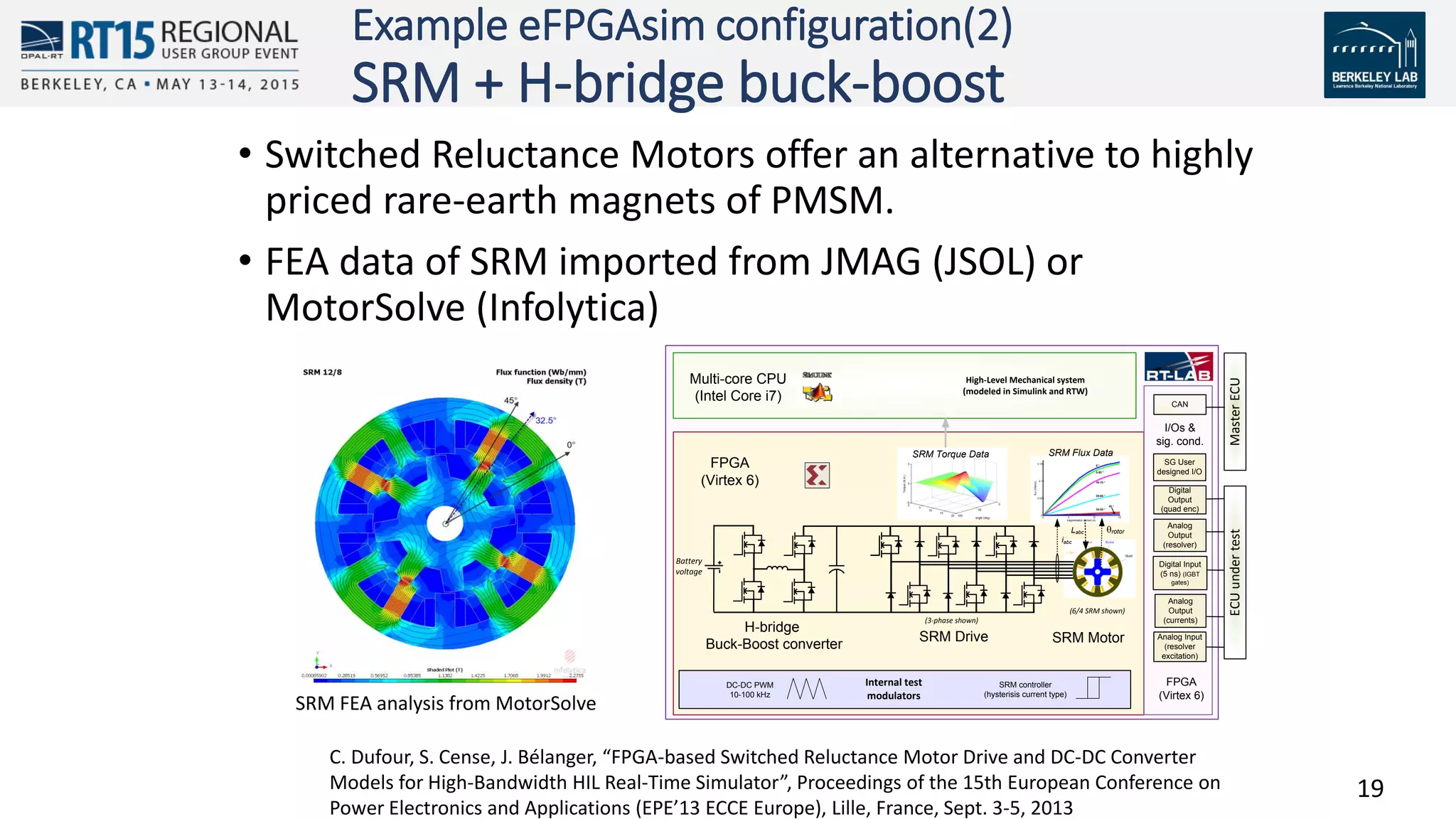
Example eFPGAsim configuration(2)
SRM + H-bridge buck-boost
• Switched Reluctance Motors offer an alternative to highly
priced rare-earth magnets of PMSM.
• FEA data of SRM imported from JMAG (JSOL) or
MotorSolve (Infolytica)
(3-phase shown)
L-1
(,iabc)
rotor
FPGA
(Virtex 6)
Digital Input
(5 ns) (IGBT
gates)
Multi-core CPU
(Intel Core i7)
Internal test
modulators
DC-DC PWM
10-100 kHz
SRM Drive
Analog
Output
(currents)
Analog
Output
(resolver)
Digital
Output
(quad enc)
I/Os &
sig. cond.
Analog Input
(resolver
excitation)
High-Level Mechanical system
(modeled in Simulink and RTW)
MasterECU
Battery
voltage
H-bridge
Buck-Boost converter
SG User
designed I/O
ECUundertest
CAN
(6/4 SRM shown)
SRM Motor
SRM Flux Data
Labc
SRM controller
(hysterisis current type)
SRM Torque Data
iabc
FPGA
(Virtex 6)
C. Dufour, S. Cense, J. Bélanger, “FPGA-based Switched Reluctance Motor Drive and DC-DC Converter
Models for High-Bandwidth HIL Real-Time Simulator”, Proceedings of the 15th European Conference on
Power Electronics and Applications (EPE’13 ECCE Europe), Lille, France, Sept. 3-5, 2013
SRM FEA analysis from MotorSolve
20
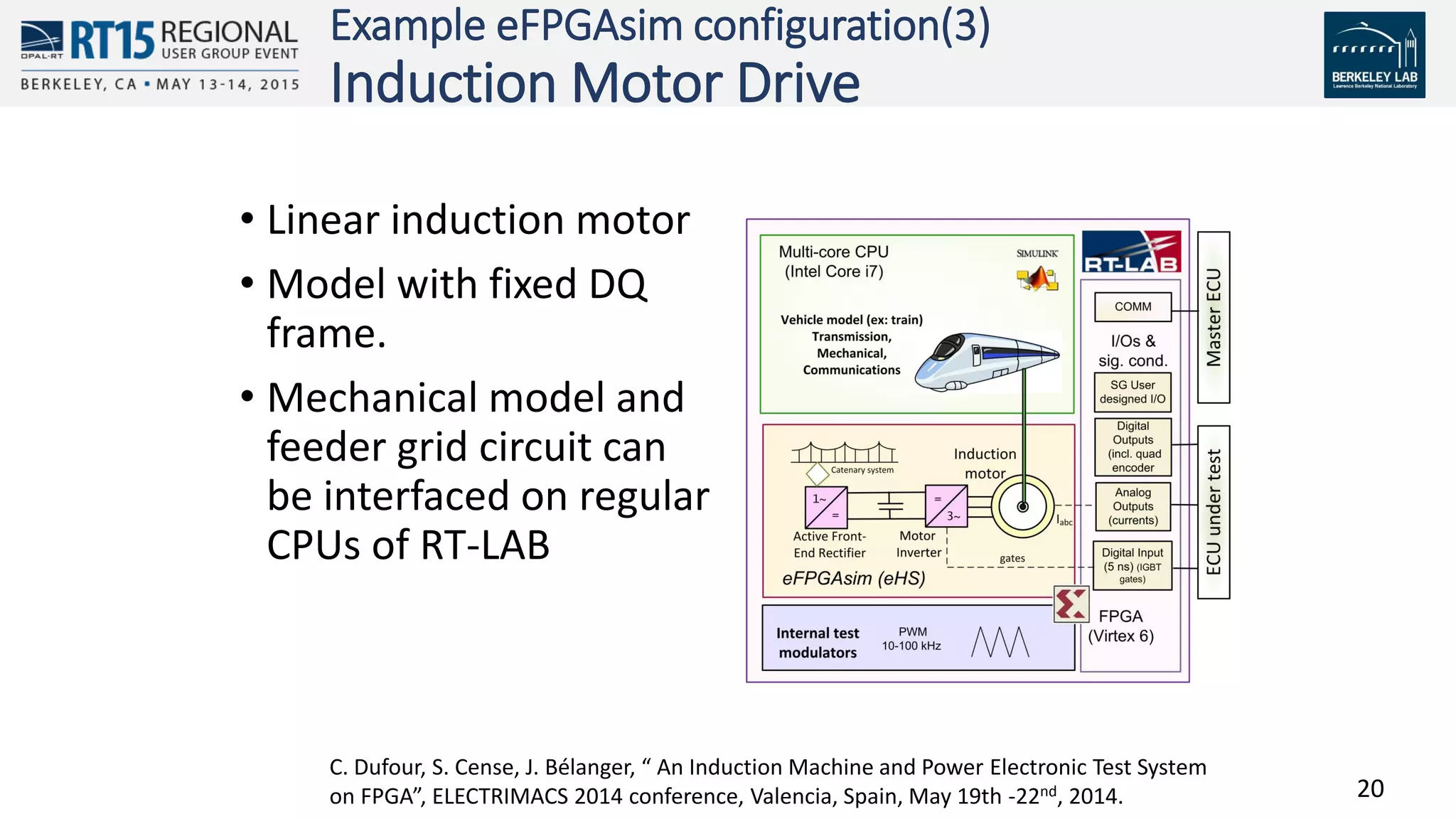
Example eFPGAsim configuration(3)
Induction Motor Drive
• Linear induction motor
• Model with fixed DQ
frame.
• Mechanical model and
feeder grid circuit can
be interfaced on regular
CPUs of RT-LAB
C. Dufour, S. Cense, J. Bélanger, “ An Induction Machine and Power Electronic Test System
on FPGA”, ELECTRIMACS 2014 conference, Valencia, Spain, May 19th -22nd, 2014.
21
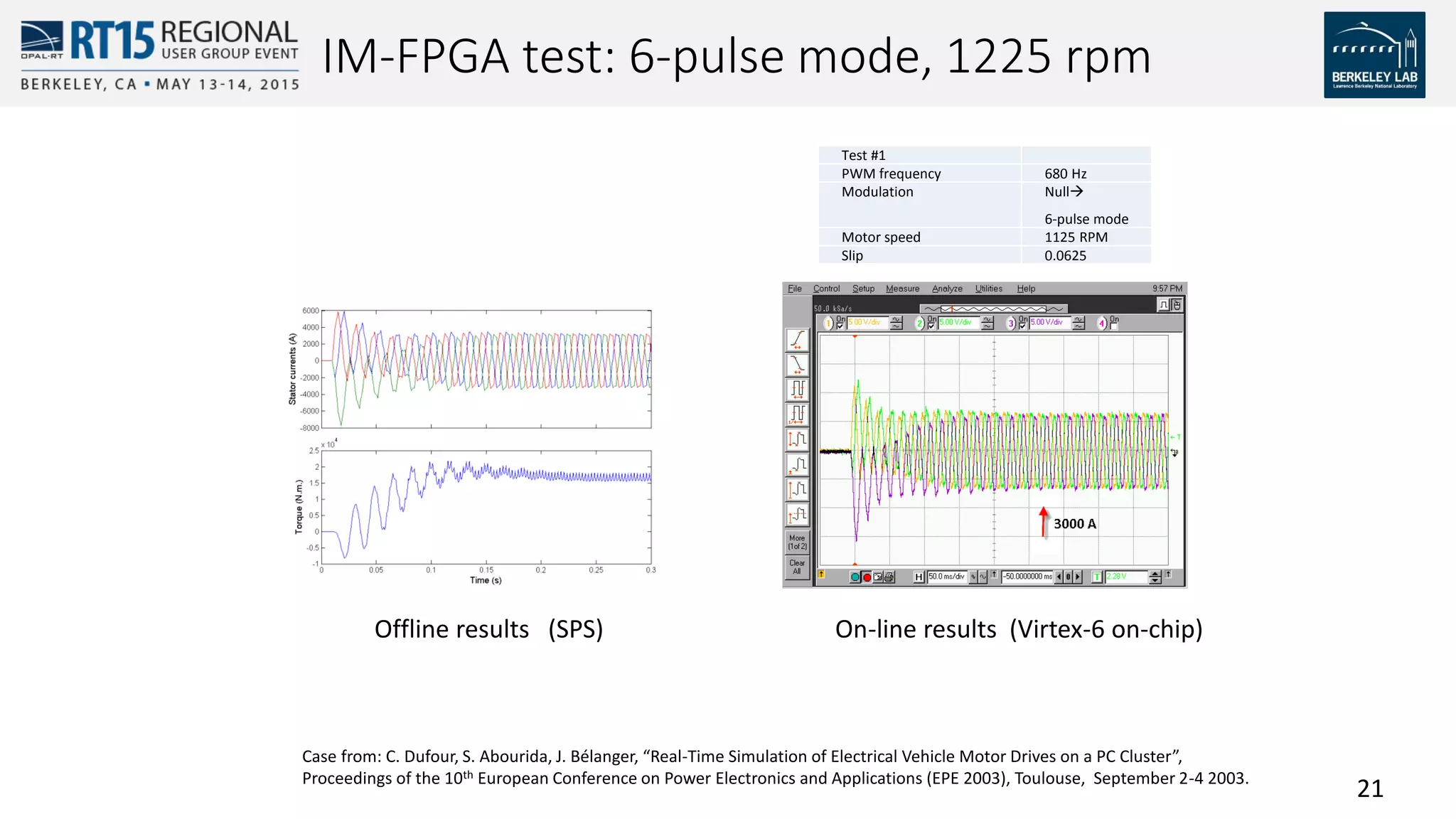
Offline results (SPS) On-line results (Virtex-6 on-chip)
IM-FPGA test: 6-pulse mode, 1225 rpm
Test #1
PWM frequency 680 Hz
Modulation Null
6-pulse mode
Motor speed 1125 RPM
Slip 0.0625
Case from: C. Dufour, S. Abourida, J. Bélanger, “Real-Time Simulation of Electrical Vehicle Motor Drives on a PC Cluster”,
Proceedings of the 10th European Conference on Power Electronics and Applications (EPE 2003), Toulouse, September 2-4 2003.
22
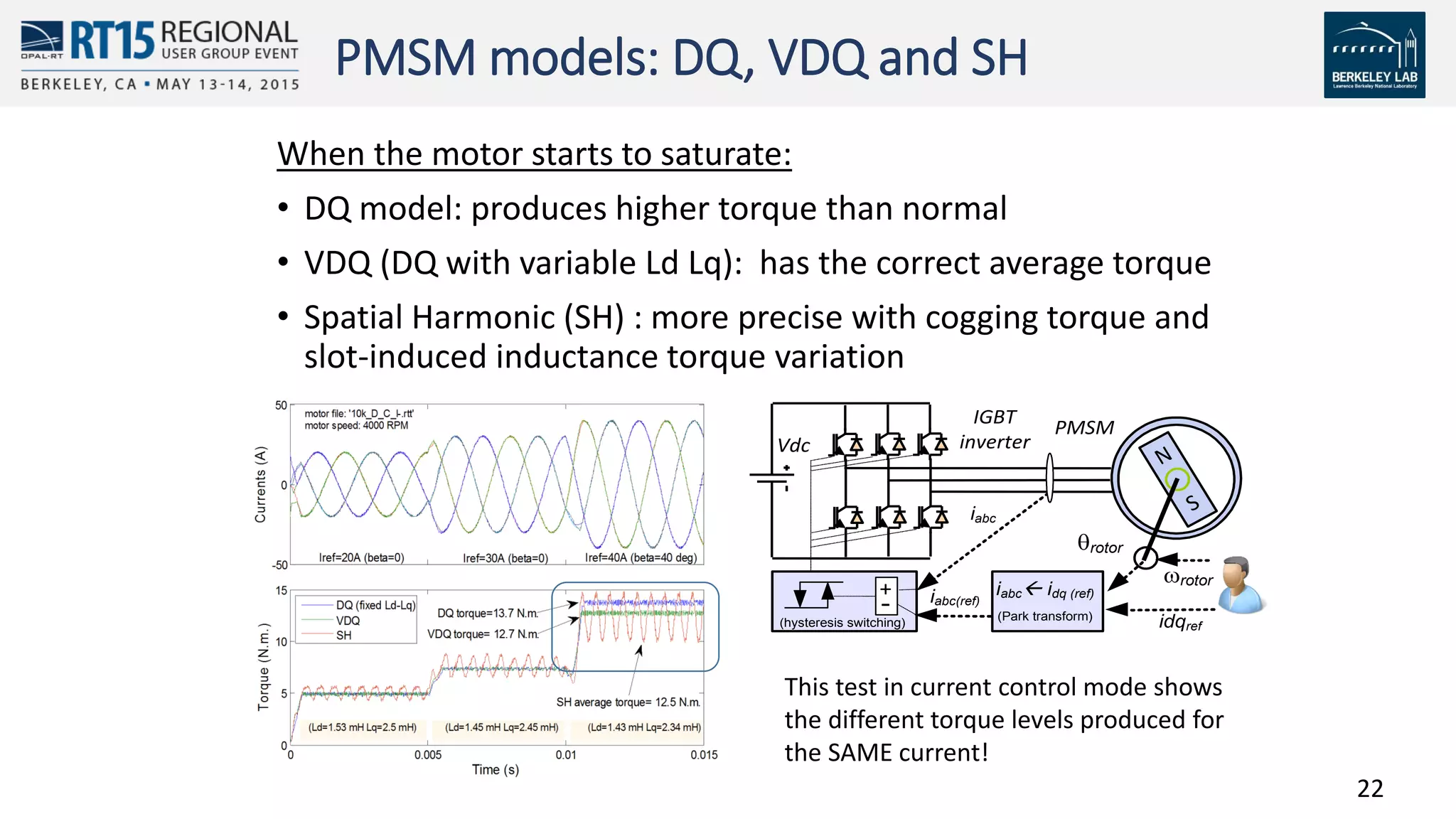
PMSM models: DQ, VDQ and SH
N
Siabc
rotor
PMSM
rotor
idqref
iabc idq (ref)
(Park transform)
(hysteresis switching)
+
- iabc(ref)
IGBT
inverterVdc
When the motor starts to saturate:
• DQ model: produces higher torque than normal
• VDQ (DQ with variable Ld Lq): has the correct average torque
• Spatial Harmonic (SH) : more precise with cogging torque and
slot-induced inductance torque variation
This test in current control mode shows
the different torque levels produced for
the SAME current!
2323
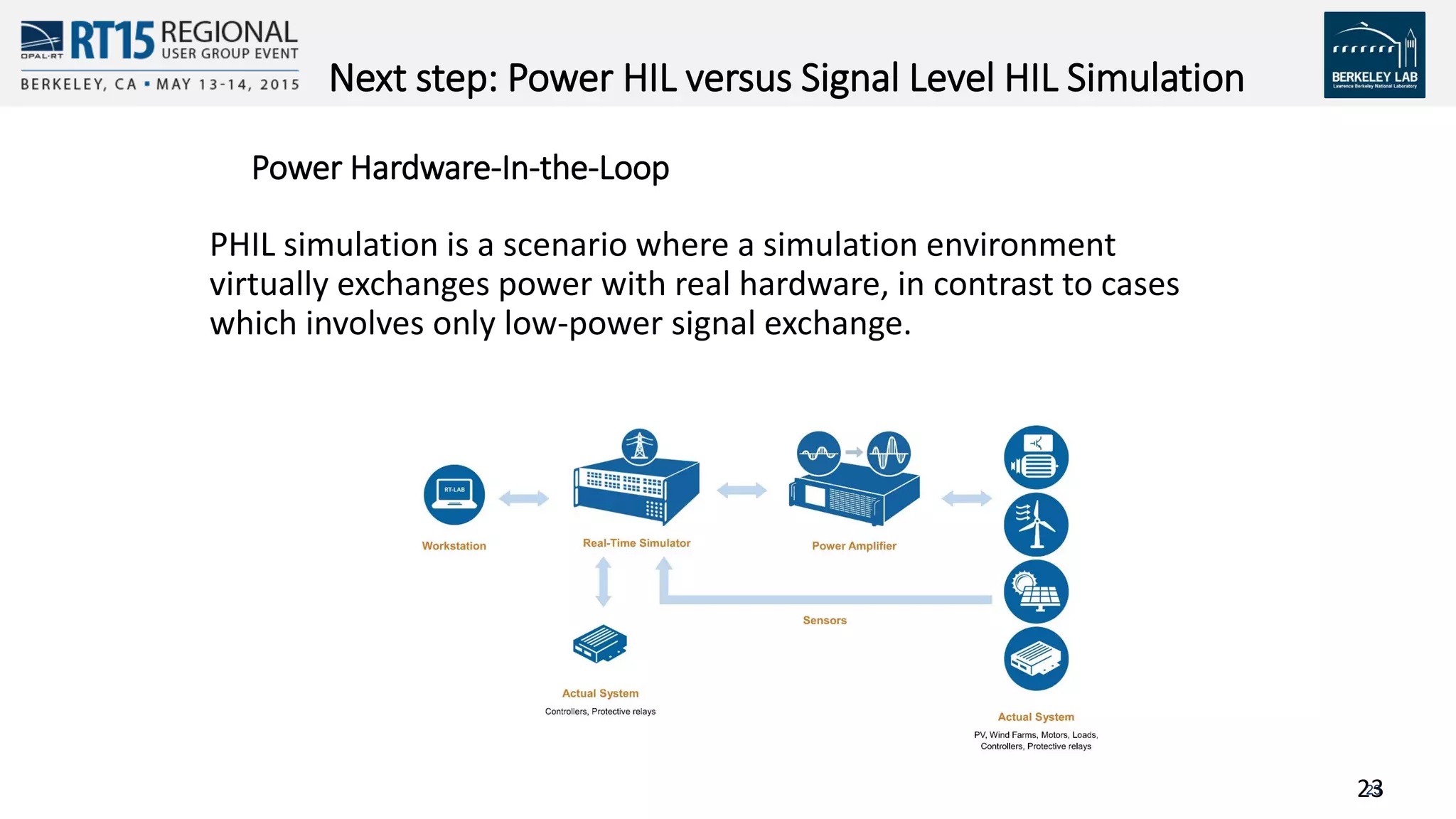
Next step: Power HIL versus Signal Level HIL Simulation
PHIL simulation is a scenario where a simulation environment
virtually exchanges power with real hardware, in contrast to cases
which involves only low-power signal exchange.
Power Hardware-In-the-Loop
2424
Power HIL: Why, How, Where?
• Join the real-time simulator capabilities to the power
equipment
• Power systems, power electronic, protection equipement,
controller logic, etc.
• Requires high quality amplifier
• High accuracy, low distorsion, high bandwith, low phase lag,
etc.
• Connect a real power device under test
• Wind turbine, solar panel, motors/generators, protection
relays, gate drives, etc.
• $ trade-off
2525
Power HIL: Why, How, Where?
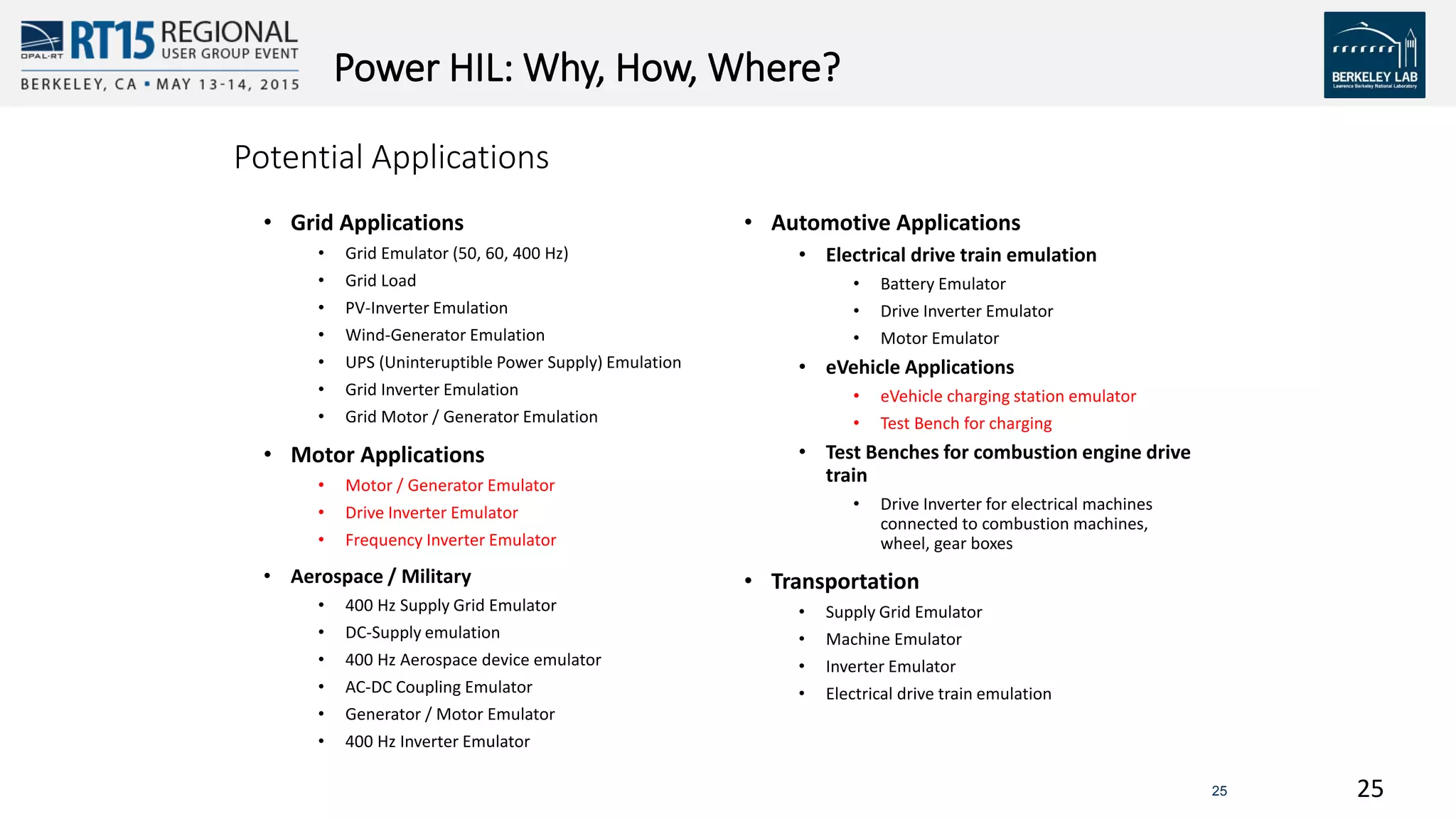
Potential Applications
• Grid Applications
• Grid Emulator (50, 60, 400 Hz)
• Grid Load
• PV-Inverter Emulation
• Wind-Generator Emulation
• UPS (Uninteruptible Power Supply) Emulation
• Grid Inverter Emulation
• Grid Motor / Generator Emulation
• Motor Applications
• Motor / Generator Emulator
• Drive Inverter Emulator
• Frequency Inverter Emulator
• Aerospace / Military
• 400 Hz Supply Grid Emulator
• DC-Supply emulation
• 400 Hz Aerospace device emulator
• AC-DC Coupling Emulator
• Generator / Motor Emulator
• 400 Hz Inverter Emulator
• Automotive Applications
• Electrical drive train emulation
• Battery Emulator
• Drive Inverter Emulator
• Motor Emulator
• eVehicle Applications
• eVehicle charging station emulator
• Test Bench for charging
• Test Benches for combustion engine drive
train
• Drive Inverter for electrical machines
connected to combustion machines,
wheel, gear boxes
• Transportation
• Supply Grid Emulator
• Machine Emulator
• Inverter Emulator
• Electrical drive train emulation
2626
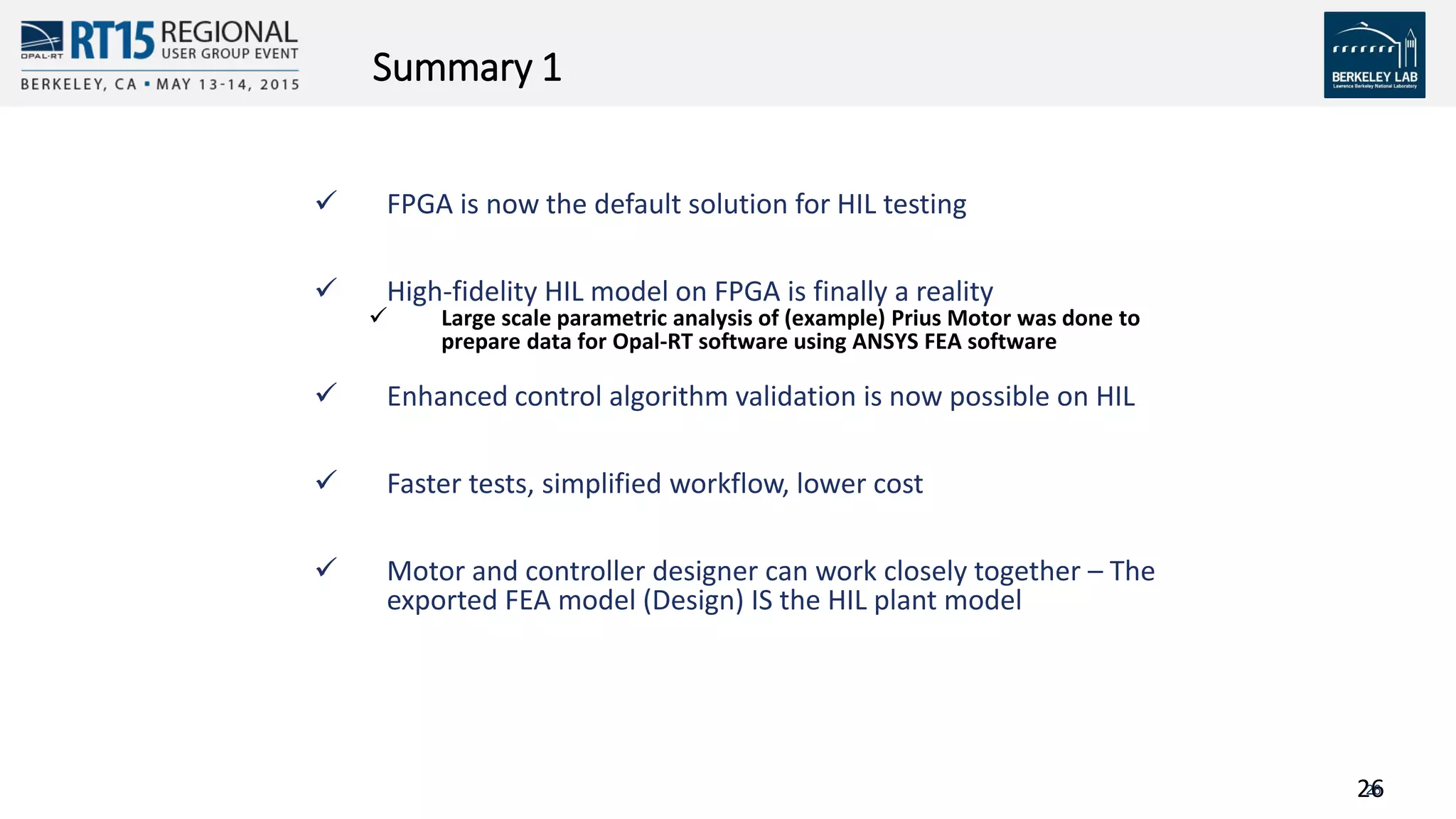
Summary 1
 FPGA is now the default solution for HIL testing
 High-fidelity HIL model on FPGA is finally a reality
 Large scale parametric analysis of (example) Prius Motor was done to
prepare data for Opal-RT software using ANSYS FEA software
 Enhanced control algorithm validation is now possible on HIL
 Faster tests, simplified workflow, lower cost
 Motor and controller designer can work closely together – The
exported FEA model (Design) IS the HIL plant model
27
Summary 2
• eFPGAsim is designed to ease the use of FPGA technologies for
motor drive and power electronic HIL testing
• avoid very long ‘Place And Route’ time of modern, large FPGAs.
• non-flashing, variable parameter and variable topology methodology
• Available motor models as of today: PMSM, SRM, IM . . .
• eHS can be used to build exotic power converter topologies
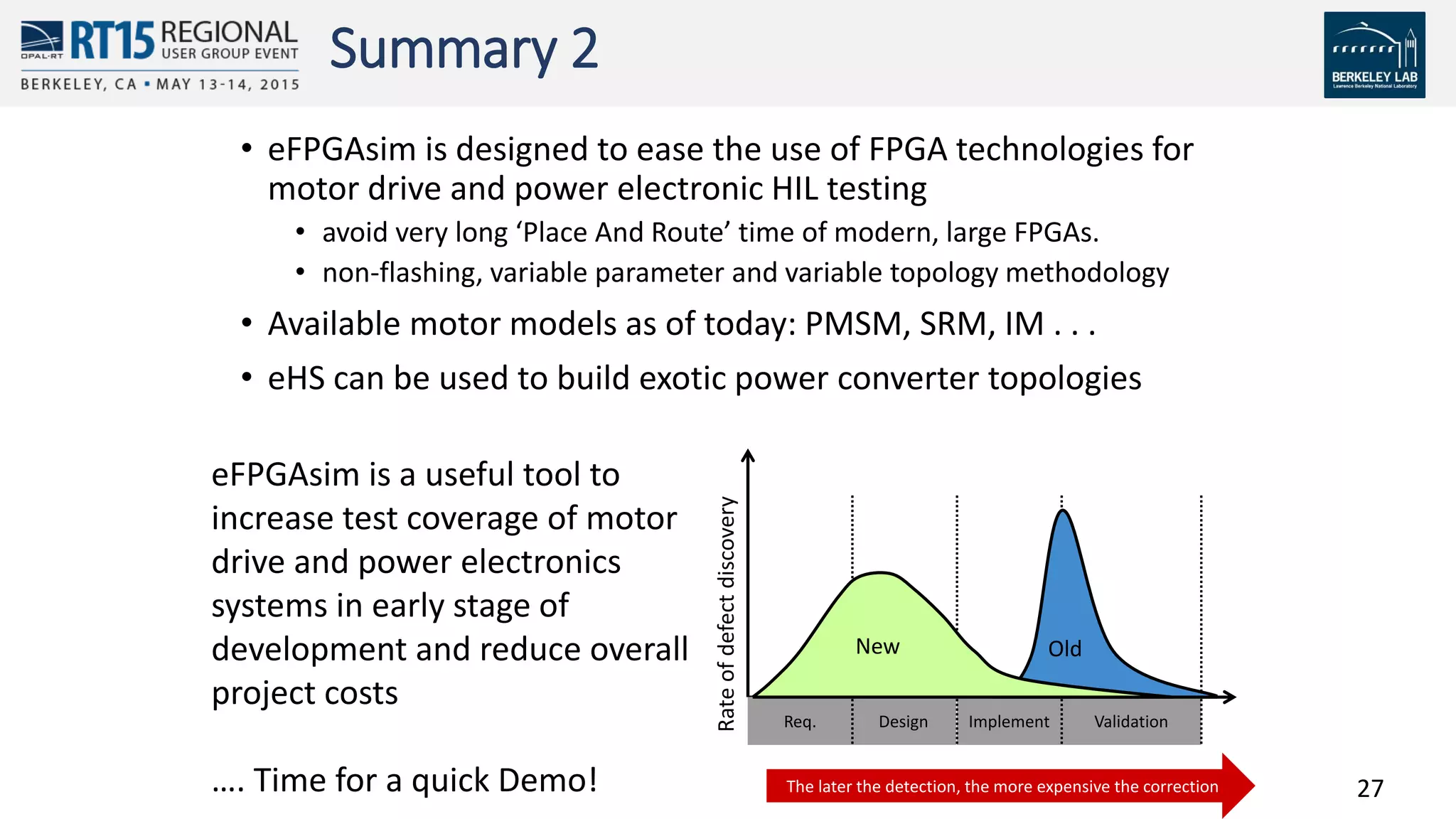
eFPGAsim is a useful tool to
increase test coverage of motor
drive and power electronics
systems in early stage of
development and reduce overall
project costs
…. Time for a quick Demo!
Req. Design Implement ValidationRateofdefectdiscovery
OldNew
The later the detection, the more expensive the correction

RT15 Berkeley | Introduction to FPGA Power Electronic & Electric Machine real-time simulation for HIL-OPAL-RT

  • 1.
    1 Alan Soltis OPAL-RT alan.soltis@opal-rt.com FPGA PowerElectronic & Electric Machine real-time simulation for HIL - Introduction
  • 2.
    2 - Turnkey HILSimulation Solutions (~20 minutes) - Why organizations use HIL for power electronics & machine development & testing today - Where we are today - Where are we going? - "Signal Level" HIL versus "Power HIL" - Workflow improvements: From e-Machine Specialists to Controls & testing Engineers - CPU vs. FPGA based simulation - Using FEA to accelerate machine design as well as controls testing & validation with HIL - eFPGASim as a development & test tool - eHS: The flexible solution for power electronics development & test in real-time Agenda
  • 3.
    3 Our solutions coverthe complete spectrum of power system analysis and studies ePHASORsim Real-Time Transient Stability Simulator 10 ms time step HYPERsim Large Scale Power System Simulation for Utilities & Manufacturers 25 µs to 100 µs time step eFPGAsim Power Electronics Simulation on FPGA 1 µs to 100 ns time step 1 s (1 Hz) 10,000 2,000 1,000 500 100 10 0 10 ms (100 Hz) 50 µs (20 KHz) 10 µs (100 KHz) 1µs (1 MHz) 100 ns (10 MHz) 10 ns (100 MHz) 20,000 Period (frequency) of transient phenomena simulated Number of 3-Phase Buses eMEGAsim Power System & Power Electronics Simulation Based on Matlab/Simulink and SimPowerSystems 10 µs to 100 µs time step Alan’s Subject OPAL-RT Solutions …. again
  • 4.
    44 The Challenge ofElectric Motor & Power Electronics Control Testing Control engineers want :  To test the motor controller with non-ideal behavior.  To test the motor controller with different points of operation, such a saturated states  To insert fault conditions  To rapidly simulate different types of motors and power electronics topologies High-fidelity and flexible Drive & PE simulation
  • 5.
    55 The Challenge ofElectric Motor Control Testing 2 • increase test case coverage • reduce costs • accelerate time to market  By reducing testing time on real dynamometer • How “real” can HIL get?  By detecting errors at earlier stages of the design  Faster improvement of complex control strategies Managers want to: Creation of a technical link between Designer and control engineer – HIL model IS the design
  • 6.
    6 Model-based Design (MBD)& Hardware-in-the-Loop (HIL) Validate Model  Off-line simulation Virtual Prototype HIL, RT simulation 3D visualization Control Prototype HIL, RT simulation, Physical Components Design Implementation Production Code Physical Components Lab Testing with actual controller Integration & Test In-system commiss- ioning & calibration Deployment Production Maintenance This implementation is performed by the software team This implementation is performed by the control team This implementation is performed by the integration team Models become the method to share information with disparate development teams HIL “AVOID REDUNDANT MODEL DEVELOPMENT!”
  • 7.
    7 General eFPGAsim structure •eFPGAsim is a suite of FPGA models and solvers • All models/solvers uses floating point format • Designed for full connectivity of models within a fixed bitstream on Virtex-7
  • 8.
    8 eHS: ‘Electric HardwareSolver’ • Automated Electric Circuit Solver • Variable topology, variable parameter, ‘non-flashing’ • Enable the simulation of switched electric circuits on FPGA directly from a SimPowerSystems/PLECS/PSIM model
  • 9.
    9 • Fixed AdmittanceMatrix Nodal Method • All switches in the circuit: • Modeled as a capacitor when open • Modeled as an inductor when closed • If L/h=h/C then the admittance matrix is constant (For backward Euler method, h is the time step) Automated Nodal Electric Circuit Solver eHS: ‘Electric Hardware Solver’
  • 10.
    10 eHS example: MatrixConverter Drive 10 - 22 switches in total in the converter - Connected to PMSM on the FPGA - Calculation time on FPGA : 590 ns on eHS-16 (estimated timing on eHS-64: 350 ns)
  • 11.
    11 • FPGA structurebased on optimized dot-product units and operation scheduler Automated Nodal Electric Circuit Solver eHS: ‘Electric Hardware Solver’ eHS characteristics Virtex-6 (eHS-16) Virtex-7 (eHS-64) Inputs 16 32 Outputs 16 32 Switches 24 64 Max # eHS Core 2 2 Cycle time 150 ns - 1 µs 150 ns - 1 µs eHS-16 configuration
  • 12.
    12 Why FPGA simulation? •Low sampling time and therefore excellent resolution for high frequency IGBT gating (up to 50-100 kHz) • Excellent latency (typ. 1 µs) for direct current-control motor applications or FODP (Fast On-board Drive Protection) • Massively parallel pre-processing unit for CPU • very good example: MMC (Multi-Level Modular Converter) ALU cores I/Os DUT (controller) Logic & mem CPU FPGA PCIe bus FOBP
  • 13.
    13 Disadvantages of FPGAsimulation • Higher coding complexity than CPU counterparts. • User has more control over lower level abstraction levels but this increases the complexity of the designs • Many basic CPU coding schemes must be verbosely expressed in the FPGA design, which can be cumbersome. Ex: ‘for’ loops in matrix multiplications. • Very long compilation time • Generating a new FPGA bitstream from FPGA code can take 1-2 hours on big FPGA chips like Virtex-6 or Virtex-7 • Increased debugging/probing difficulty eFPGAsim is designed to avoid these problems
  • 14.
    1414 HIL for ECUTesting and Validation Virtual Plant Machines, PE, Peripherals Electronic Control Unit (ECU) Under Test
  • 15.
    1515 Role of FPGAin HIL Simulation CPU I/Os ECU (controller) Logic & mem TARGET-PC FPGA PCIe link BASIC HIL SIMULATOR Gates Signals Probes Feedback Feedback Latency: 1.5us Feedback Latency: 40us
  • 16.
    1616 Example: PMSM Solveron FPGA Performance Recap:  Step Time : 15-60us  Model total Latency: 20-100us  Step Time : 100-450ns  Model total Latency: Bellow 2.5us FEA PMSM Solver OPAL-RT PMSM FPGA Solver
  • 17.
    17 • Plant modelexported from FEA, is integrated with I/O & any peripheral plant model components in Simulink to be compiled for real-time. • Xilinx System Generator is a FPGA Simulink blockset • No need to know VHDL language • User can customize the I/O for complex applications RT-LAB I/O is fully programmable with Xilinx System Generator A typical XSG model in RT-LAB
  • 18.
    18 Example eFPGAsim configuration(1) Dual-PMSM +boost (Prius configuration) • Common drive configuration used on the Prius, Ford Fusion Hybrid and Denso supplier. • PMSM Finite-Element Model (JMAG-RT/Infolytica) M. Harakawa, C. Dufour, S. Nishimura, T.Nagano, “Real-Time Simulation of a PMSM Drive in Faulty Modes with Validation Against an Actual Drive System”, Proceedings of the 13th European Conference on Power Electronics and Applications (EPE-2009), Barcelona, Spain, Sept. 8-10, 2009 Validation of JMAG-PMSM model against real motor
  • 19.
    19 Example eFPGAsim configuration(2) SRM+ H-bridge buck-boost • Switched Reluctance Motors offer an alternative to highly priced rare-earth magnets of PMSM. • FEA data of SRM imported from JMAG (JSOL) or MotorSolve (Infolytica) (3-phase shown) L-1 (,iabc) rotor FPGA (Virtex 6) Digital Input (5 ns) (IGBT gates) Multi-core CPU (Intel Core i7) Internal test modulators DC-DC PWM 10-100 kHz SRM Drive Analog Output (currents) Analog Output (resolver) Digital Output (quad enc) I/Os & sig. cond. Analog Input (resolver excitation) High-Level Mechanical system (modeled in Simulink and RTW) MasterECU Battery voltage H-bridge Buck-Boost converter SG User designed I/O ECUundertest CAN (6/4 SRM shown) SRM Motor SRM Flux Data Labc SRM controller (hysterisis current type) SRM Torque Data iabc FPGA (Virtex 6) C. Dufour, S. Cense, J. Bélanger, “FPGA-based Switched Reluctance Motor Drive and DC-DC Converter Models for High-Bandwidth HIL Real-Time Simulator”, Proceedings of the 15th European Conference on Power Electronics and Applications (EPE’13 ECCE Europe), Lille, France, Sept. 3-5, 2013 SRM FEA analysis from MotorSolve
  • 20.
    20 Example eFPGAsim configuration(3) InductionMotor Drive • Linear induction motor • Model with fixed DQ frame. • Mechanical model and feeder grid circuit can be interfaced on regular CPUs of RT-LAB C. Dufour, S. Cense, J. Bélanger, “ An Induction Machine and Power Electronic Test System on FPGA”, ELECTRIMACS 2014 conference, Valencia, Spain, May 19th -22nd, 2014.
  • 21.
    21 Offline results (SPS)On-line results (Virtex-6 on-chip) IM-FPGA test: 6-pulse mode, 1225 rpm Test #1 PWM frequency 680 Hz Modulation Null 6-pulse mode Motor speed 1125 RPM Slip 0.0625 Case from: C. Dufour, S. Abourida, J. Bélanger, “Real-Time Simulation of Electrical Vehicle Motor Drives on a PC Cluster”, Proceedings of the 10th European Conference on Power Electronics and Applications (EPE 2003), Toulouse, September 2-4 2003.
  • 22.
    22 PMSM models: DQ,VDQ and SH N Siabc rotor PMSM rotor idqref iabc idq (ref) (Park transform) (hysteresis switching) + - iabc(ref) IGBT inverterVdc When the motor starts to saturate: • DQ model: produces higher torque than normal • VDQ (DQ with variable Ld Lq): has the correct average torque • Spatial Harmonic (SH) : more precise with cogging torque and slot-induced inductance torque variation This test in current control mode shows the different torque levels produced for the SAME current!
  • 23.
    2323 Next step: PowerHIL versus Signal Level HIL Simulation PHIL simulation is a scenario where a simulation environment virtually exchanges power with real hardware, in contrast to cases which involves only low-power signal exchange. Power Hardware-In-the-Loop
  • 24.
    2424 Power HIL: Why,How, Where? • Join the real-time simulator capabilities to the power equipment • Power systems, power electronic, protection equipement, controller logic, etc. • Requires high quality amplifier • High accuracy, low distorsion, high bandwith, low phase lag, etc. • Connect a real power device under test • Wind turbine, solar panel, motors/generators, protection relays, gate drives, etc. • $ trade-off
  • 25.
    2525 Power HIL: Why,How, Where? Potential Applications • Grid Applications • Grid Emulator (50, 60, 400 Hz) • Grid Load • PV-Inverter Emulation • Wind-Generator Emulation • UPS (Uninteruptible Power Supply) Emulation • Grid Inverter Emulation • Grid Motor / Generator Emulation • Motor Applications • Motor / Generator Emulator • Drive Inverter Emulator • Frequency Inverter Emulator • Aerospace / Military • 400 Hz Supply Grid Emulator • DC-Supply emulation • 400 Hz Aerospace device emulator • AC-DC Coupling Emulator • Generator / Motor Emulator • 400 Hz Inverter Emulator • Automotive Applications • Electrical drive train emulation • Battery Emulator • Drive Inverter Emulator • Motor Emulator • eVehicle Applications • eVehicle charging station emulator • Test Bench for charging • Test Benches for combustion engine drive train • Drive Inverter for electrical machines connected to combustion machines, wheel, gear boxes • Transportation • Supply Grid Emulator • Machine Emulator • Inverter Emulator • Electrical drive train emulation
  • 26.
    2626 Summary 1  FPGAis now the default solution for HIL testing  High-fidelity HIL model on FPGA is finally a reality  Large scale parametric analysis of (example) Prius Motor was done to prepare data for Opal-RT software using ANSYS FEA software  Enhanced control algorithm validation is now possible on HIL  Faster tests, simplified workflow, lower cost  Motor and controller designer can work closely together – The exported FEA model (Design) IS the HIL plant model
  • 27.
    27 Summary 2 • eFPGAsimis designed to ease the use of FPGA technologies for motor drive and power electronic HIL testing • avoid very long ‘Place And Route’ time of modern, large FPGAs. • non-flashing, variable parameter and variable topology methodology • Available motor models as of today: PMSM, SRM, IM . . . • eHS can be used to build exotic power converter topologies eFPGAsim is a useful tool to increase test coverage of motor drive and power electronics systems in early stage of development and reduce overall project costs …. Time for a quick Demo! Req. Design Implement ValidationRateofdefectdiscovery OldNew The later the detection, the more expensive the correction