www.opal-rt.com
Alexandre Leboeuf, Carl Bisaillon, Pierre-François Allaire
01-22-2015
Power HIL (P-HIL):
A Revolution in the Industry
22
Your Hosts
Presenter
Pierre-François Allaire
Sales & Marketing Director
OPAL-RT TECHNOLOGIES
Presenter
Alexandre Leboeuf
Integration Team Leader
OPAL-RT TECHNOLOGIES
photo
photo
Presenter
Carl Bisaillon
Support Team Leader
OPAL-RT TECHNOLOGIES
photo
33
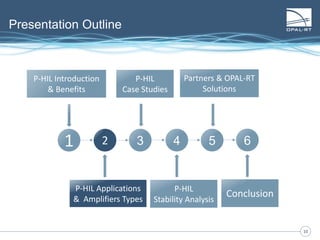
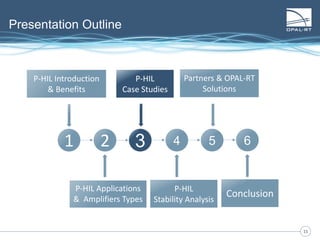
Presentation Outline
1 2 3 4 5
P-HIL Introduction
& Benefits
P-HIL Applications
& Amplifiers Types
P-HIL
Case Studies
6
Partners & OPAL-RT
Solutions
P-HIL
Stability Analysis
Partners & OPAL-RT
Solutions
Conclusion
44
Presentation Outline
1 2 3 4 5
P-HIL Introduction
& Benefits
P-HIL Applications
& Amplifiers Types
P-HIL
Case Studies
6
Partners & OPAL-RT
Solutions
P-HIL
Stability Analysis
Partners & OPAL-RT
Solutions
Conclusion
55
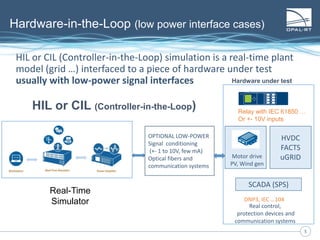
HIL or CIL (Controller-in-the-Loop) simulation is a real-time plant
model (grid …) interfaced to a piece of hardware under test
usually with low-power signal interfaces
Hardware-in-the-Loop (low power interface cases)
HIL or CIL (Controller-in-the-Loop) Relay with IEC 61850 …
Or +- 10V inputs
Hardware under test
Real control,
protection devices and
communication systems
SCADA (SPS)
DNP3, IEC …104
OPTIONAL LOW-POWER
Signal conditioning
(+- 1 to 10V, few mA)
Optical fibers and
communication systems
Real-Time
Simulator
HVDC
FACTS
uGRIDMotor drive
PV, Wind gen
66
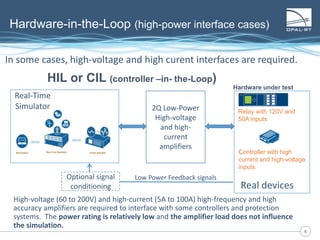
In some cases, high-voltage and high curent interfaces are required.
Hardware-in-the-Loop (high-power interface cases)
HIL or CIL (controller –in- the-Loop)
Relay with 120V and
50A inputs
Hardware under test
Controller with high
current and high-voltage
inputs
Real devices
2Q Low-Power
High-voltage
and high-
current
amplifiers
High-voltage (60 to 200V) and high-current (5A to 100A) high-frequency and high
accuracy amplifiers are required to interface with some controllers and protection
systems. The power rating is relatively low and the amplifier load does not influence
the simulation.
Low Power Feedback signalsOptional signal
conditioning
Real-Time
Simulator
77
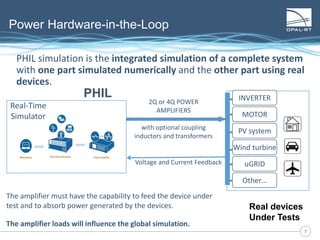
PHIL simulation is the integrated simulation of a complete system
with one part simulated numerically and the other part using real
devices.
Power Hardware-in-the-Loop
Real devices
Under Tests
The amplifier must have the capability to feed the device under
test and to absorb power generated by the devices.
The amplifier loads will influence the global simulation.
PHIL
2Q or 4Q POWER
AMPLIFIERS
with optional coupling
inductors and transformers
Voltage and Current Feedback
INVERTER
MOTOR
PV system
Wind turbine
uGRID
Other…
Real-Time
Simulator
88
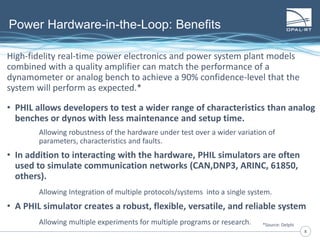
High-fidelity real-time power electronics and power system plant models
combined with a quality amplifier can match the performance of a
dynamometer or analog bench to achieve a 90% confidence-level that the
system will perform as expected.*
• PHIL allows developers to test a wider range of characteristics than analog
benches or dynos with less maintenance and setup time.
Allowing robustness of the hardware under test over a wider variation of
parameters, characteristics and faults.
• In addition to interacting with the hardware, PHIL simulators are often
used to simulate communication networks (CAN,DNP3, ARINC, 61850,
others).
Allowing Integration of multiple protocols/systems into a single system.
• A PHIL simulator creates a robust, flexible, versatile, and reliable system
Allowing multiple experiments for multiple programs or research.
Power Hardware-in-the-Loop: Benefits
*Source: Delphi
99
Power Hardware-in-the-Loop: Benefits:
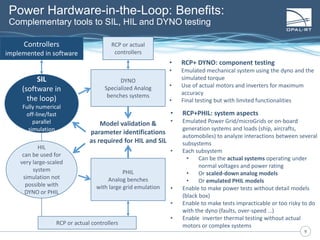
Complementary tools to SIL, HIL and DYNO testing
SIL
(software in
the loop)
Fully numerical
off-line/fast
parallel
simulation
HIL
can be used for
very large-scaled
system
simulation not
possible with
DYNO or PHIL
RCP or actual controllers
DYNO
Specialized Analog
benches systems
RCP or actual
controllers
• RCP+ DYNO: component testing
• Emulated mechanical system using the dyno and the
simulated torque
• Use of actual motors and inverters for maximum
accuracy
• Final testing but with limited functionalities
Controllers
implemented in software
• RCP+PHIL: system aspects
• Emulated Power Grid/microGrids or on-board
generation systems and loads (ship, aircrafts,
automobiles) to analyze interactions between several
subsystems
• Each subsystem
• Can be the actual systems operating under
normal voltages and power rating
• Or scaled-down analog models
• Or emulated PHIL models
• Enable to make power tests without detail models
(black box)
• Enable to make tests impracticable or too risky to do
with the dyno (faults, over-speed …)
• Enable inverter thermal testing without actual
motors or complex systems
PHIL
Analog benches
with large grid emulation
Model validation &
parameter identifications
as required for HIL and SIL
1010
Presentation Outline
1 2 3 4 5
P-HIL Introduction
& Benefits
P-HIL Applications
& Amplifiers Types
P-HIL
Case Studies
6
Partners & OPAL-RT
Solutions
P-HIL
Stability Analysis
Partners & OPAL-RT
Solutions
Conclusion
1111
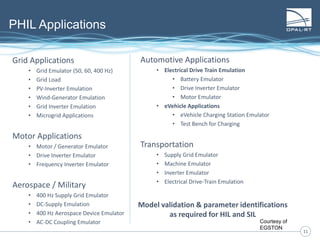
PHIL Applications
Grid Applications
• Grid Emulator (50, 60, 400 Hz)
• Grid Load
• PV-Inverter Emulation
• Wind-Generator Emulation
• Grid Inverter Emulation
• Microgrid Applications
Motor Applications
• Motor / Generator Emulator
• Drive Inverter Emulator
• Frequency Inverter Emulator
Aerospace / Military
• 400 Hz Supply Grid Emulator
• DC-Supply Emulation
• 400 Hz Aerospace Device Emulator
• AC-DC Coupling Emulator
Automotive Applications
• Electrical Drive Train Emulation
• Battery Emulator
• Drive Inverter Emulator
• Motor Emulator
• eVehicle Applications
• eVehicle Charging Station Emulator
• Test Bench for Charging
Transportation
• Supply Grid Emulator
• Machine Emulator
• Inverter Emulator
• Electrical Drive-Train Emulation
Courtesy of
EGSTON
Model validation & parameter identifications
as required for HIL and SIL
1212
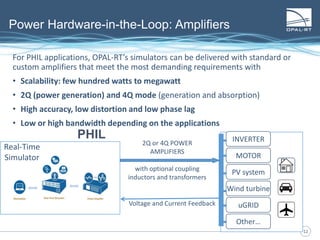
Power Hardware-in-the-Loop: Amplifiers
PHIL
2Q or 4Q POWER
AMPLIFIERS
with optional coupling
inductors and transformers
Voltage and Current Feedback
INVERTER
MOTOR
PV system
Wind turbine
uGRID
Other…
For PHIL applications, OPAL-RT’s simulators can be delivered with standard or
custom amplifiers that meet the most demanding requirements with
• Scalability: few hundred watts to megawatt
• 2Q (power generation) and 4Q mode (generation and absorption)
• High accuracy, low distortion and low phase lag
• Low or high bandwidth depending on the applications
Real-Time
Simulator
1313
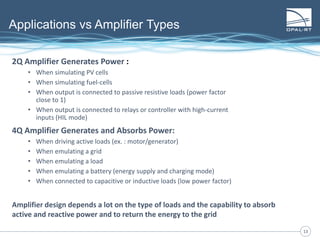
Applications vs Amplifier Types
2Q Amplifier Generates Power :
• When simulating PV cells
• When simulating fuel-cells
• When output is connected to passive resistive loads (power factor
close to 1)
• When output is connected to relays or controller with high-current
inputs (HIL mode)
4Q Amplifier Generates and Absorbs Power:
• When driving active loads (ex. : motor/generator)
• When emulating a grid
• When emulating a load
• When emulating a battery (energy supply and charging mode)
• When connected to capacitive or inductive loads (low power factor)
Amplifier design depends a lot on the type of loads and the capability to absorb
active and reactive power and to return the energy to the grid
1414
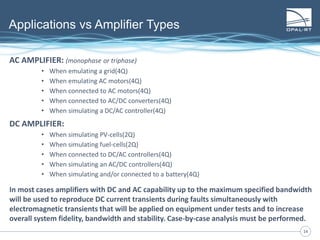
Applications vs Amplifier Types
AC AMPLIFIER: (monophase or triphase)
• When emulating a grid(4Q)
• When emulating AC motors(4Q)
• When connected to AC motors(4Q)
• When connected to AC/DC converters(4Q)
• When simulating a DC/AC controller(4Q)
DC AMPLIFIER:
• When simulating PV-cells(2Q)
• When simulating fuel-cells(2Q)
• When connected to DC/AC controllers(4Q)
• When simulating an AC/DC controllers(4Q)
• When simulating and/or connected to a battery(4Q)
In most cases amplifiers with DC and AC capability up to the maximum specified bandwidth
will be used to reproduce DC current transients during faults simultaneously with
electromagnetic transients that will be applied on equipment under tests and to increase
overall system fidelity, bandwidth and stability. Case-by-case analysis must be performed.
1515
Presentation Outline
1 2 3 4 5
P-HIL Introduction
& Benefits
P-HIL Applications
& Amplifiers Types
P-HIL
Case Studies
6
Partners & OPAL-RT
Solutions
P-HIL
Stability Analysis
Partners & OPAL-RT
Solutions
Conclusion
1616
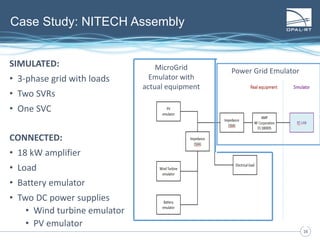
Case Study: NITECH Assembly
SIMULATED:
• 3-phase grid with loads
• Two SVRs
• One SVC
CONNECTED:
• 18 kW amplifier
• Load
• Battery emulator
• Two DC power supplies
• Wind turbine emulator
• PV emulator
Power Grid EmulatorMicroGrid
Emulator with
actual equipment
1717
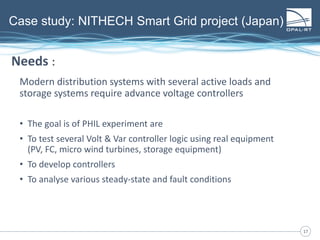
Case study: NITHECH Smart Grid project (Japan)
Modern distribution systems with several active loads and
storage systems require advance voltage controllers
• The goal is of PHIL experiment are
• To test several Volt & Var controller logic using real equipment
(PV, FC, micro wind turbines, storage equipment)
• To develop controllers
• To analyse various steady-state and fault conditions
Needs :
1818
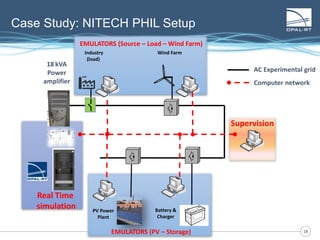
Case Study: NITECH PHIL Setup
Supervision
PV Power
Plant
EMULATORS (Source – Load – Wind Farm)
Wind FarmIndustry
(load)
AC Experimental grid
Real Time
simulation
Computer network
18 kVA
Power
amplifier
EMULATORS (PV – Storage)
Battery &
Charger
1919
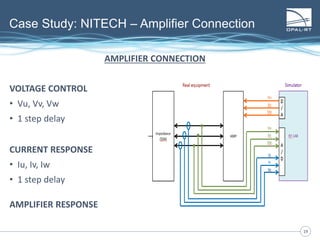
Case Study: NITECH – Amplifier Connection
AMPLIFIER CONNECTION
VOLTAGE CONTROL
• Vu, Vv, Vw
• 1 step delay
CURRENT RESPONSE
• Iu, Iv, Iw
• 1 step delay
AMPLIFIER RESPONSE
2020
Case Study: Japanese Smart House Project
In a Smart House, the energy generation, energy consumption
control and energy storage are all integrated, with individual
components.
The goal of PHIL experiment is
• To ensure control logics for an adequate energy supply at all times
and also minimize the number of storage units needed, because
rechargeable batteries are still a high cost factor
• To analyse the effect of power grid transients on house electronic
• To analyse interactions between houses
Needs :
2121
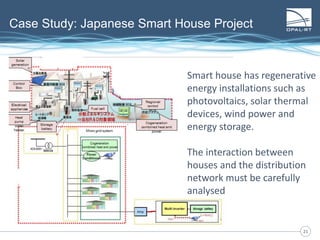
Case Study: Japanese Smart House Project
Smart house has regenerative
energy installations such as
photovoltaics, solar thermal
devices, wind power and
energy storage.
The interaction between
houses and the distribution
network must be carefully
analysed
2222
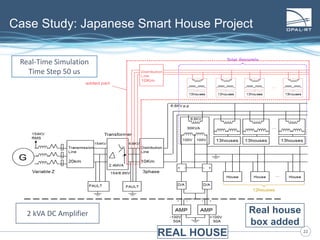
Case Study: Japanese Smart House Project
2 kVA DC Amplifier
Real-Time Simulation
Time Step 50 us
REAL HOUSE
Real house
box added
2323
Needs:
• To test a 3-Phase BLDC motor sensorless controller with trapezoidal
back EMF at power levels lower than 100W in steady state.
• The PHIL bench needs to generate and absorb power like a real DC
motor.
• Open-Circuit and Short Circuit faults required.
• Possibility to reuse the hardware in future application (versatility and
upgradability).
Case Study: Plastic Omnium - France
3-Phase Electrical Motor PHIL – 1200 W Setup
2424
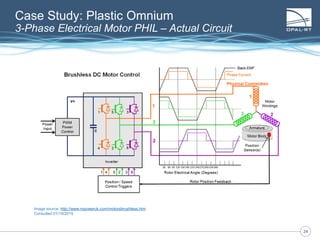
Image source: http://www.mpoweruk.com/motorsbrushless.htm
Consulted 01/19/2015
Case Study: Plastic Omnium
3-Phase Electrical Motor PHIL – Actual Circuit
2525
Image source: http://www.mpoweruk.com/motorsbrushless.htm
Consulted 01/19/2015
Case Study: Plastic Omnium
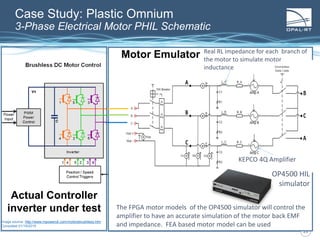
3-Phase Electrical Motor PHIL Schematic
OP4500 HIL
simulator
The FPGA motor models of the OP4500 simulator will control the
amplifier to have an accurate simulation of the motor back EMF
and impedance. FEA based motor model can be used
Actual Controller
inverter under test
Motor Emulator Real RL impedance for each branch of
the motor to simulate motor
inductance
KEPCO 4Q Amplifier
2626
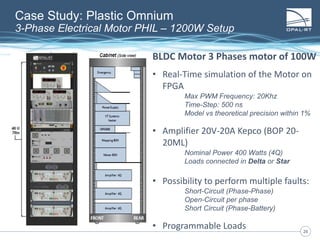
BLDC Motor 3 Phases motor of 100W
• Real-Time simulation of the Motor on
FPGA
Max PWM Frequency: 20Khz
Time-Step: 500 ns
Model vs theoretical precision within 1%
• Amplifier 20V-20A Kepco (BOP 20-
20ML)
Nominal Power 400 Watts (4Q)
Loads connected in Delta or Star
• Possibility to perform multiple faults:
Short-Circuit (Phase-Phase)
Open-Circuit per phase
Short Circuit (Phase-Battery)
• Programmable Loads
Case Study: Plastic Omnium
3-Phase Electrical Motor PHIL – 1200W Setup
2727
Case Study: L2EP
• Studies on impact of energy storage
systems, in terms of efficiency, quality
and services on the network
• Studies of new architectures :
microgrid, island networks
• Production sources & storage systems
coordination, in order to optimize
quality and stability of embedded
networks
Electrical Engineering Laboratory of Université des Sciences
et Technologies de Lille, Arts et Métiers ParisTech, Ecole
Centrale de Lille, Hautes Etudes d'Ingénieur
2828
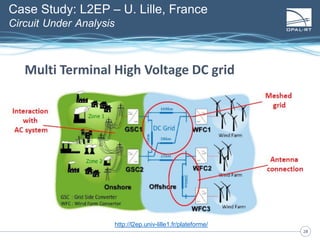
http://l2ep.univ-lille1.fr/plateforme/
Case Study: L2EP – U. Lille, France
Circuit Under Analysis
Multi Terminal High Voltage DC grid
2929
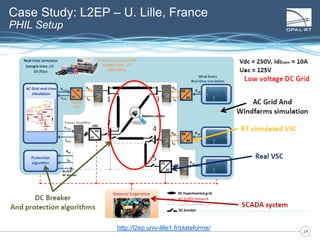
http://l2ep.univ-lille1.fr/plateforme/
Case Study: L2EP – U. Lille, France
PHIL Setup
3030
Case Study: AIT SmartEST Laboratory - Austria
For development and research, AIT offers
unique opportunities for customers and project
partners to optimize their products and control
strategies directly at this advanced facility,
accompanied by qualified experts in order to
shorten the time-to-market of new products.
• Developing and testing PV controller
• Testing overall performance of PV systems as per standards
• Analyzing interactions between systems and with the distribution system
under steady-state and fault conditions
3131
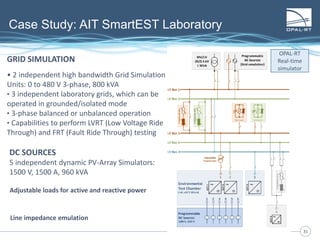
Case Study: AIT SmartEST Laboratory
OPAL-RT
Real-time
simulator
GRID SIMULATION
• 2 independent high bandwidth Grid Simulation
Units: 0 to 480 V 3-phase, 800 kVA
• 3 independent laboratory grids, which can be
operated in grounded/isolated mode
• 3-phase balanced or unbalanced operation
• Capabilities to perform LVRT (Low Voltage Ride
Through) and FRT (Fault Ride Through) testing
DC SOURCES
5 independent dynamic PV-Array Simulators:
1500 V, 1500 A, 960 kVA
Adjustable loads for active and reactive power
Line impedance emulation
3232
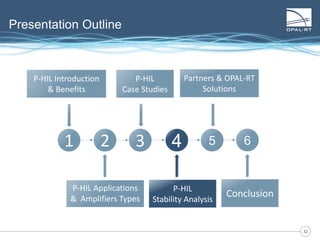
Presentation Outline
1 2 4 5
P-HIL Introduction
& Benefits
P-HIL Applications
& Amplifiers Types
P-HIL
Case Studies
6
Partners & OPAL-RT
Solutions
P-HIL
Stability Analysis
Partners & OPAL-RT
Solutions
Conclusion
3
3333
PHIL Stability Analysis
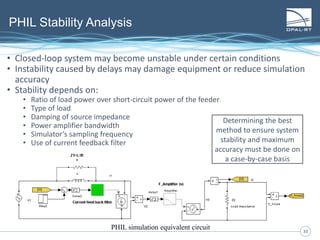
• Closed-loop system may become unstable under certain conditions
• Instability caused by delays may damage equipment or reduce simulation
accuracy
• Stability depends on:
• Ratio of load power over short-circuit power of the feeder
• Type of load
• Damping of source impedance
• Power amplifier bandwidth
• Simulator’s sampling frequency
• Use of current feedback filter
PHIL simulation equivalent circuit
Determining the best
method to ensure system
stability and maximum
accuracy must be done on
a case-by-case basis
3434
PHIL Stability Analysis
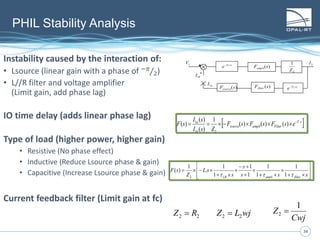
Instability caused by the interaction of:
• Lsource (linear gain with a phase of −𝜋
2)
• L//R filter and voltage amplifier
(Limit gain, add phase lag)
IO time delay (adds linear phase lag)
Type of load (higher power, higher gain)
• Resistive (No phase effect)
• Inductive (Reduce Lsource phase & gain)
• Capacitive (Increase Lsource phase & gain)
Current feedback filter (Limit gain at fc)
+
-
)(sFsource
sT
e  1
)(sFampli
2
1
Z
2I
bI1
1V
aI1
)(sFfilter
sT
e  2
 sT
Filteramplisource
b
a
esFsFsF
ZsI
sI
sF .
21
1
)()()(
1
)(
)(
)( 


















sss
s
s
sL
Z
sF
filterampliLR  1
1
1
1
1
1
1
1
.
1
)(
2
Cwj
Z
1
2 wjLZ 22 22 RZ 
3535
PHIL Stability Analysis Conclusions
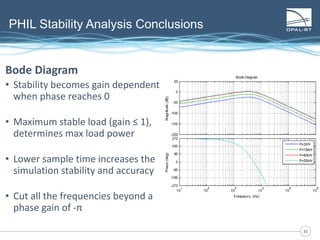
Bode Diagram
• Stability becomes gain dependent
when phase reaches 0
• Maximum stable load (gain ≤ 1),
determines max load power
• Lower sample time increases the
simulation stability and accuracy
• Cut all the frequencies beyond a
phase gain of -π
3636
Detailed Information on PHIL Stability Analysis
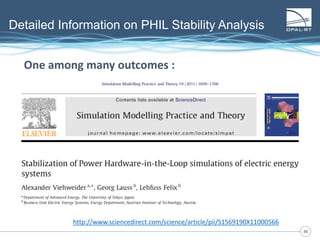
One among many outcomes :
http://www.sciencedirect.com/science/article/pii/S1569190X11000566
3737
Presentation Outline
1 2 4 5
P-HIL Introduction
& Benefits
P-HIL Applications
& Amplifiers Types
P-HIL
Case Studies
6
Partners & OPAL-RT
Solutions
P-HIL
Stability Analysis
Partners & OPAL-RT
Solutions
Conclusion
3
3838
Power Amplifier Partners
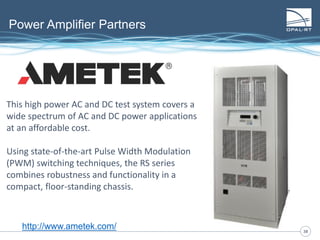
This high power AC and DC test system covers a
wide spectrum of AC and DC power applications
at an affordable cost.
Using state-of-the-art Pulse Width Modulation
(PWM) switching techniques, the RS series
combines robustness and functionality in a
compact, floor-standing chassis.
http://www.ametek.com/
3939
Power Amplifier Partners
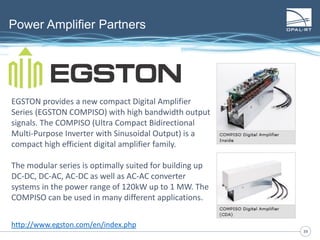
EGSTON provides a new compact Digital Amplifier
Series (EGSTON COMPISO) with high bandwidth output
signals. The COMPISO (Ultra Compact Bidirectional
Multi-Purpose Inverter with Sinusoidal Output) is a
compact high efficient digital amplifier family.
The modular series is optimally suited for building up
DC-DC, DC-AC, AC-DC as well as AC-AC converter
systems in the power range of 120kW up to 1 MW. The
COMPISO can be used in many different applications.
http://www.egston.com/en/index.php
4040
Power Amplifier Partners
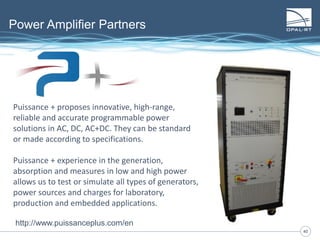
Puissance + proposes innovative, high-range,
reliable and accurate programmable power
solutions in AC, DC, AC+DC. They can be standard
or made according to specifications.
Puissance + experience in the generation,
absorption and measures in low and high power
allows us to test or simulate all types of generators,
power sources and charges for laboratory,
production and embedded applications.
http://www.puissanceplus.com/en
4141
Power Amplifier Partners
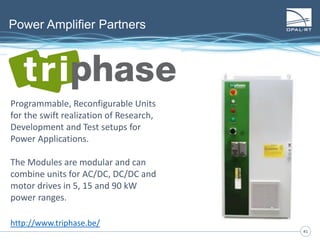
Programmable, Reconfigurable Units
for the swift realization of Research,
Development and Test setups for
Power Applications.
The Modules are modular and can
combine units for AC/DC, DC/DC and
motor drives in 5, 15 and 90 kW
power ranges.
http://www.triphase.be/
4242
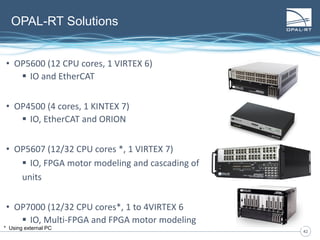
OPAL-RT Solutions
• OP5600 (12 CPU cores, 1 VIRTEX 6)
 IO and EtherCAT
• OP4500 (4 cores, 1 KINTEX 7)
 IO, EtherCAT and ORION
• OP5607 (12/32 CPU cores *, 1 VIRTEX 7)
 IO, FPGA motor modeling and cascading of
units
• OP7000 (12/32 CPU cores*, 1 to 4VIRTEX 6
 IO, Multi-FPGA and FPGA motor modeling
* Using external PC
4343
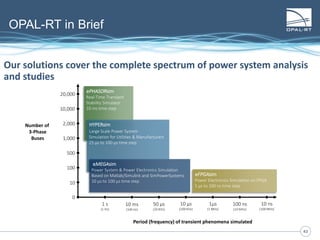
OPAL-RT in Brief
Our solutions cover the complete spectrum of power system analysis
and studies
ePHASORsim
Real-Time Transient
Stability Simulator
10 ms time step
HYPERsim
Large Scale Power System
Simulation for Utilities & Manufacturers
25 µs to 100 µs time step
eFPGAsim
Power Electronics Simulation on FPGA
1 µs to 100 ns time step
1 s
(1 Hz)
10,000
2,000
1,000
500
100
10
0
10 ms
(100 Hz)
50 µs
(20 KHz)
10 µs
(100 KHz)
1µs
(1 MHz)
100 ns
(10 MHz)
10 ns
(100 MHz)
20,000
Period (frequency) of transient phenomena simulated
Number of
3-Phase
Buses
eMEGAsim
Power System & Power Electronics Simulation
Based on Matlab/Simulink and SimPowerSystems
10 µs to 100 µs time step
Today’s
Subject
4444
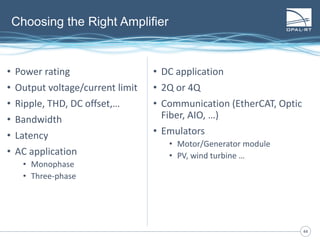
Choosing the Right Amplifier
• Power rating
• Output voltage/current limit
• Ripple, THD, DC offset,…
• Bandwidth
• Latency
• AC application
• Monophase
• Three-phase
• DC application
• 2Q or 4Q
• Communication (EtherCAT, Optic
Fiber, AIO, …)
• Emulators
• Motor/Generator module
• PV, wind turbine …
4545
Presentation Outline
1 2 4 5
P-HIL Introduction
& Benefits
P-HIL Applications &
Amplifiers Types
P-HIL
Case Studies
6
Partners & OPAL-RT
Solutions
P-HIL
Stability Analysis
Partners & OPAL-RT
Solutions
Conclusion
3
4646
Conclusion
OPAL-RT has the expertise to help you find the right tools
for your PHIL application.
Our Integration Experts can help you achieve your goal by designing
your PHIL testing bench and our Field Application Engineers can
bring their experience to the field to ensure your PHIL application
runs like a charm.
Power Hardware-in-the-Loop should be considered as a
complementary tool to SIL, HIL and DYNO testing and
not as a replacement of these tools and method.
4747
Upcoming Events
Distributech, San Diego – February 3-5, 2015 Booth 813
http://opal-rt.com/events/distributech-2015
APEC, North Carolina – March 15-19, 2015 Booth 730
http://opal-rt.com/events/apec-2015
Visit our event page to learn where to meet OPAL-RT TECHNOLOGIES
http://opal-rt.com/events
4848
Thank you for your attention
Q&A
The PDF version of the P-HIL presentation will be available shortly on
http://opal-rt.com/events/past-webinars

OPAL-RT Power Hardware-In-the-Loop presentation

  • 1.
    www.opal-rt.com Alexandre Leboeuf, CarlBisaillon, Pierre-François Allaire 01-22-2015 Power HIL (P-HIL): A Revolution in the Industry
  • 2.
    22 Your Hosts Presenter Pierre-François Allaire Sales& Marketing Director OPAL-RT TECHNOLOGIES Presenter Alexandre Leboeuf Integration Team Leader OPAL-RT TECHNOLOGIES photo photo Presenter Carl Bisaillon Support Team Leader OPAL-RT TECHNOLOGIES photo
  • 3.
    33 Presentation Outline 1 23 4 5 P-HIL Introduction & Benefits P-HIL Applications & Amplifiers Types P-HIL Case Studies 6 Partners & OPAL-RT Solutions P-HIL Stability Analysis Partners & OPAL-RT Solutions Conclusion
  • 4.
    44 Presentation Outline 1 23 4 5 P-HIL Introduction & Benefits P-HIL Applications & Amplifiers Types P-HIL Case Studies 6 Partners & OPAL-RT Solutions P-HIL Stability Analysis Partners & OPAL-RT Solutions Conclusion
  • 5.
    55 HIL or CIL(Controller-in-the-Loop) simulation is a real-time plant model (grid …) interfaced to a piece of hardware under test usually with low-power signal interfaces Hardware-in-the-Loop (low power interface cases) HIL or CIL (Controller-in-the-Loop) Relay with IEC 61850 … Or +- 10V inputs Hardware under test Real control, protection devices and communication systems SCADA (SPS) DNP3, IEC …104 OPTIONAL LOW-POWER Signal conditioning (+- 1 to 10V, few mA) Optical fibers and communication systems Real-Time Simulator HVDC FACTS uGRIDMotor drive PV, Wind gen
  • 6.
    66 In some cases,high-voltage and high curent interfaces are required. Hardware-in-the-Loop (high-power interface cases) HIL or CIL (controller –in- the-Loop) Relay with 120V and 50A inputs Hardware under test Controller with high current and high-voltage inputs Real devices 2Q Low-Power High-voltage and high- current amplifiers High-voltage (60 to 200V) and high-current (5A to 100A) high-frequency and high accuracy amplifiers are required to interface with some controllers and protection systems. The power rating is relatively low and the amplifier load does not influence the simulation. Low Power Feedback signalsOptional signal conditioning Real-Time Simulator
  • 7.
    77 PHIL simulation isthe integrated simulation of a complete system with one part simulated numerically and the other part using real devices. Power Hardware-in-the-Loop Real devices Under Tests The amplifier must have the capability to feed the device under test and to absorb power generated by the devices. The amplifier loads will influence the global simulation. PHIL 2Q or 4Q POWER AMPLIFIERS with optional coupling inductors and transformers Voltage and Current Feedback INVERTER MOTOR PV system Wind turbine uGRID Other… Real-Time Simulator
  • 8.
    88 High-fidelity real-time powerelectronics and power system plant models combined with a quality amplifier can match the performance of a dynamometer or analog bench to achieve a 90% confidence-level that the system will perform as expected.* • PHIL allows developers to test a wider range of characteristics than analog benches or dynos with less maintenance and setup time. Allowing robustness of the hardware under test over a wider variation of parameters, characteristics and faults. • In addition to interacting with the hardware, PHIL simulators are often used to simulate communication networks (CAN,DNP3, ARINC, 61850, others). Allowing Integration of multiple protocols/systems into a single system. • A PHIL simulator creates a robust, flexible, versatile, and reliable system Allowing multiple experiments for multiple programs or research. Power Hardware-in-the-Loop: Benefits *Source: Delphi
  • 9.
    99 Power Hardware-in-the-Loop: Benefits: Complementarytools to SIL, HIL and DYNO testing SIL (software in the loop) Fully numerical off-line/fast parallel simulation HIL can be used for very large-scaled system simulation not possible with DYNO or PHIL RCP or actual controllers DYNO Specialized Analog benches systems RCP or actual controllers • RCP+ DYNO: component testing • Emulated mechanical system using the dyno and the simulated torque • Use of actual motors and inverters for maximum accuracy • Final testing but with limited functionalities Controllers implemented in software • RCP+PHIL: system aspects • Emulated Power Grid/microGrids or on-board generation systems and loads (ship, aircrafts, automobiles) to analyze interactions between several subsystems • Each subsystem • Can be the actual systems operating under normal voltages and power rating • Or scaled-down analog models • Or emulated PHIL models • Enable to make power tests without detail models (black box) • Enable to make tests impracticable or too risky to do with the dyno (faults, over-speed …) • Enable inverter thermal testing without actual motors or complex systems PHIL Analog benches with large grid emulation Model validation & parameter identifications as required for HIL and SIL
  • 10.
    1010 Presentation Outline 1 23 4 5 P-HIL Introduction & Benefits P-HIL Applications & Amplifiers Types P-HIL Case Studies 6 Partners & OPAL-RT Solutions P-HIL Stability Analysis Partners & OPAL-RT Solutions Conclusion
  • 11.
    1111 PHIL Applications Grid Applications •Grid Emulator (50, 60, 400 Hz) • Grid Load • PV-Inverter Emulation • Wind-Generator Emulation • Grid Inverter Emulation • Microgrid Applications Motor Applications • Motor / Generator Emulator • Drive Inverter Emulator • Frequency Inverter Emulator Aerospace / Military • 400 Hz Supply Grid Emulator • DC-Supply Emulation • 400 Hz Aerospace Device Emulator • AC-DC Coupling Emulator Automotive Applications • Electrical Drive Train Emulation • Battery Emulator • Drive Inverter Emulator • Motor Emulator • eVehicle Applications • eVehicle Charging Station Emulator • Test Bench for Charging Transportation • Supply Grid Emulator • Machine Emulator • Inverter Emulator • Electrical Drive-Train Emulation Courtesy of EGSTON Model validation & parameter identifications as required for HIL and SIL
  • 12.
    1212 Power Hardware-in-the-Loop: Amplifiers PHIL 2Qor 4Q POWER AMPLIFIERS with optional coupling inductors and transformers Voltage and Current Feedback INVERTER MOTOR PV system Wind turbine uGRID Other… For PHIL applications, OPAL-RT’s simulators can be delivered with standard or custom amplifiers that meet the most demanding requirements with • Scalability: few hundred watts to megawatt • 2Q (power generation) and 4Q mode (generation and absorption) • High accuracy, low distortion and low phase lag • Low or high bandwidth depending on the applications Real-Time Simulator
  • 13.
    1313 Applications vs AmplifierTypes 2Q Amplifier Generates Power : • When simulating PV cells • When simulating fuel-cells • When output is connected to passive resistive loads (power factor close to 1) • When output is connected to relays or controller with high-current inputs (HIL mode) 4Q Amplifier Generates and Absorbs Power: • When driving active loads (ex. : motor/generator) • When emulating a grid • When emulating a load • When emulating a battery (energy supply and charging mode) • When connected to capacitive or inductive loads (low power factor) Amplifier design depends a lot on the type of loads and the capability to absorb active and reactive power and to return the energy to the grid
  • 14.
    1414 Applications vs AmplifierTypes AC AMPLIFIER: (monophase or triphase) • When emulating a grid(4Q) • When emulating AC motors(4Q) • When connected to AC motors(4Q) • When connected to AC/DC converters(4Q) • When simulating a DC/AC controller(4Q) DC AMPLIFIER: • When simulating PV-cells(2Q) • When simulating fuel-cells(2Q) • When connected to DC/AC controllers(4Q) • When simulating an AC/DC controllers(4Q) • When simulating and/or connected to a battery(4Q) In most cases amplifiers with DC and AC capability up to the maximum specified bandwidth will be used to reproduce DC current transients during faults simultaneously with electromagnetic transients that will be applied on equipment under tests and to increase overall system fidelity, bandwidth and stability. Case-by-case analysis must be performed.
  • 15.
    1515 Presentation Outline 1 23 4 5 P-HIL Introduction & Benefits P-HIL Applications & Amplifiers Types P-HIL Case Studies 6 Partners & OPAL-RT Solutions P-HIL Stability Analysis Partners & OPAL-RT Solutions Conclusion
  • 16.
    1616 Case Study: NITECHAssembly SIMULATED: • 3-phase grid with loads • Two SVRs • One SVC CONNECTED: • 18 kW amplifier • Load • Battery emulator • Two DC power supplies • Wind turbine emulator • PV emulator Power Grid EmulatorMicroGrid Emulator with actual equipment
  • 17.
    1717 Case study: NITHECHSmart Grid project (Japan) Modern distribution systems with several active loads and storage systems require advance voltage controllers • The goal is of PHIL experiment are • To test several Volt & Var controller logic using real equipment (PV, FC, micro wind turbines, storage equipment) • To develop controllers • To analyse various steady-state and fault conditions Needs :
  • 18.
    1818 Case Study: NITECHPHIL Setup Supervision PV Power Plant EMULATORS (Source – Load – Wind Farm) Wind FarmIndustry (load) AC Experimental grid Real Time simulation Computer network 18 kVA Power amplifier EMULATORS (PV – Storage) Battery & Charger
  • 19.
    1919 Case Study: NITECH– Amplifier Connection AMPLIFIER CONNECTION VOLTAGE CONTROL • Vu, Vv, Vw • 1 step delay CURRENT RESPONSE • Iu, Iv, Iw • 1 step delay AMPLIFIER RESPONSE
  • 20.
    2020 Case Study: JapaneseSmart House Project In a Smart House, the energy generation, energy consumption control and energy storage are all integrated, with individual components. The goal of PHIL experiment is • To ensure control logics for an adequate energy supply at all times and also minimize the number of storage units needed, because rechargeable batteries are still a high cost factor • To analyse the effect of power grid transients on house electronic • To analyse interactions between houses Needs :
  • 21.
    2121 Case Study: JapaneseSmart House Project Smart house has regenerative energy installations such as photovoltaics, solar thermal devices, wind power and energy storage. The interaction between houses and the distribution network must be carefully analysed
  • 22.
    2222 Case Study: JapaneseSmart House Project 2 kVA DC Amplifier Real-Time Simulation Time Step 50 us REAL HOUSE Real house box added
  • 23.
    2323 Needs: • To testa 3-Phase BLDC motor sensorless controller with trapezoidal back EMF at power levels lower than 100W in steady state. • The PHIL bench needs to generate and absorb power like a real DC motor. • Open-Circuit and Short Circuit faults required. • Possibility to reuse the hardware in future application (versatility and upgradability). Case Study: Plastic Omnium - France 3-Phase Electrical Motor PHIL – 1200 W Setup
  • 24.
    2424 Image source: http://www.mpoweruk.com/motorsbrushless.htm Consulted01/19/2015 Case Study: Plastic Omnium 3-Phase Electrical Motor PHIL – Actual Circuit
  • 25.
    2525 Image source: http://www.mpoweruk.com/motorsbrushless.htm Consulted01/19/2015 Case Study: Plastic Omnium 3-Phase Electrical Motor PHIL Schematic OP4500 HIL simulator The FPGA motor models of the OP4500 simulator will control the amplifier to have an accurate simulation of the motor back EMF and impedance. FEA based motor model can be used Actual Controller inverter under test Motor Emulator Real RL impedance for each branch of the motor to simulate motor inductance KEPCO 4Q Amplifier
  • 26.
    2626 BLDC Motor 3Phases motor of 100W • Real-Time simulation of the Motor on FPGA Max PWM Frequency: 20Khz Time-Step: 500 ns Model vs theoretical precision within 1% • Amplifier 20V-20A Kepco (BOP 20- 20ML) Nominal Power 400 Watts (4Q) Loads connected in Delta or Star • Possibility to perform multiple faults: Short-Circuit (Phase-Phase) Open-Circuit per phase Short Circuit (Phase-Battery) • Programmable Loads Case Study: Plastic Omnium 3-Phase Electrical Motor PHIL – 1200W Setup
  • 27.
    2727 Case Study: L2EP •Studies on impact of energy storage systems, in terms of efficiency, quality and services on the network • Studies of new architectures : microgrid, island networks • Production sources & storage systems coordination, in order to optimize quality and stability of embedded networks Electrical Engineering Laboratory of Université des Sciences et Technologies de Lille, Arts et Métiers ParisTech, Ecole Centrale de Lille, Hautes Etudes d'Ingénieur
  • 28.
    2828 http://l2ep.univ-lille1.fr/plateforme/ Case Study: L2EP– U. Lille, France Circuit Under Analysis Multi Terminal High Voltage DC grid
  • 29.
  • 30.
    3030 Case Study: AITSmartEST Laboratory - Austria For development and research, AIT offers unique opportunities for customers and project partners to optimize their products and control strategies directly at this advanced facility, accompanied by qualified experts in order to shorten the time-to-market of new products. • Developing and testing PV controller • Testing overall performance of PV systems as per standards • Analyzing interactions between systems and with the distribution system under steady-state and fault conditions
  • 31.
    3131 Case Study: AITSmartEST Laboratory OPAL-RT Real-time simulator GRID SIMULATION • 2 independent high bandwidth Grid Simulation Units: 0 to 480 V 3-phase, 800 kVA • 3 independent laboratory grids, which can be operated in grounded/isolated mode • 3-phase balanced or unbalanced operation • Capabilities to perform LVRT (Low Voltage Ride Through) and FRT (Fault Ride Through) testing DC SOURCES 5 independent dynamic PV-Array Simulators: 1500 V, 1500 A, 960 kVA Adjustable loads for active and reactive power Line impedance emulation
  • 32.
    3232 Presentation Outline 1 24 5 P-HIL Introduction & Benefits P-HIL Applications & Amplifiers Types P-HIL Case Studies 6 Partners & OPAL-RT Solutions P-HIL Stability Analysis Partners & OPAL-RT Solutions Conclusion 3
  • 33.
    3333 PHIL Stability Analysis •Closed-loop system may become unstable under certain conditions • Instability caused by delays may damage equipment or reduce simulation accuracy • Stability depends on: • Ratio of load power over short-circuit power of the feeder • Type of load • Damping of source impedance • Power amplifier bandwidth • Simulator’s sampling frequency • Use of current feedback filter PHIL simulation equivalent circuit Determining the best method to ensure system stability and maximum accuracy must be done on a case-by-case basis
  • 34.
    3434 PHIL Stability Analysis Instabilitycaused by the interaction of: • Lsource (linear gain with a phase of −𝜋 2) • L//R filter and voltage amplifier (Limit gain, add phase lag) IO time delay (adds linear phase lag) Type of load (higher power, higher gain) • Resistive (No phase effect) • Inductive (Reduce Lsource phase & gain) • Capacitive (Increase Lsource phase & gain) Current feedback filter (Limit gain at fc) + - )(sFsource sT e  1 )(sFampli 2 1 Z 2I bI1 1V aI1 )(sFfilter sT e  2  sT Filteramplisource b a esFsFsF ZsI sI sF . 21 1 )()()( 1 )( )( )(                    sss s s sL Z sF filterampliLR  1 1 1 1 1 1 1 1 . 1 )( 2 Cwj Z 1 2 wjLZ 22 22 RZ 
  • 35.
    3535 PHIL Stability AnalysisConclusions Bode Diagram • Stability becomes gain dependent when phase reaches 0 • Maximum stable load (gain ≤ 1), determines max load power • Lower sample time increases the simulation stability and accuracy • Cut all the frequencies beyond a phase gain of -π
  • 36.
    3636 Detailed Information onPHIL Stability Analysis One among many outcomes : http://www.sciencedirect.com/science/article/pii/S1569190X11000566
  • 37.
    3737 Presentation Outline 1 24 5 P-HIL Introduction & Benefits P-HIL Applications & Amplifiers Types P-HIL Case Studies 6 Partners & OPAL-RT Solutions P-HIL Stability Analysis Partners & OPAL-RT Solutions Conclusion 3
  • 38.
    3838 Power Amplifier Partners Thishigh power AC and DC test system covers a wide spectrum of AC and DC power applications at an affordable cost. Using state-of-the-art Pulse Width Modulation (PWM) switching techniques, the RS series combines robustness and functionality in a compact, floor-standing chassis. http://www.ametek.com/
  • 39.
    3939 Power Amplifier Partners EGSTONprovides a new compact Digital Amplifier Series (EGSTON COMPISO) with high bandwidth output signals. The COMPISO (Ultra Compact Bidirectional Multi-Purpose Inverter with Sinusoidal Output) is a compact high efficient digital amplifier family. The modular series is optimally suited for building up DC-DC, DC-AC, AC-DC as well as AC-AC converter systems in the power range of 120kW up to 1 MW. The COMPISO can be used in many different applications. http://www.egston.com/en/index.php
  • 40.
    4040 Power Amplifier Partners Puissance+ proposes innovative, high-range, reliable and accurate programmable power solutions in AC, DC, AC+DC. They can be standard or made according to specifications. Puissance + experience in the generation, absorption and measures in low and high power allows us to test or simulate all types of generators, power sources and charges for laboratory, production and embedded applications. http://www.puissanceplus.com/en
  • 41.
    4141 Power Amplifier Partners Programmable,Reconfigurable Units for the swift realization of Research, Development and Test setups for Power Applications. The Modules are modular and can combine units for AC/DC, DC/DC and motor drives in 5, 15 and 90 kW power ranges. http://www.triphase.be/
  • 42.
    4242 OPAL-RT Solutions • OP5600(12 CPU cores, 1 VIRTEX 6)  IO and EtherCAT • OP4500 (4 cores, 1 KINTEX 7)  IO, EtherCAT and ORION • OP5607 (12/32 CPU cores *, 1 VIRTEX 7)  IO, FPGA motor modeling and cascading of units • OP7000 (12/32 CPU cores*, 1 to 4VIRTEX 6  IO, Multi-FPGA and FPGA motor modeling * Using external PC
  • 43.
    4343 OPAL-RT in Brief Oursolutions cover the complete spectrum of power system analysis and studies ePHASORsim Real-Time Transient Stability Simulator 10 ms time step HYPERsim Large Scale Power System Simulation for Utilities & Manufacturers 25 µs to 100 µs time step eFPGAsim Power Electronics Simulation on FPGA 1 µs to 100 ns time step 1 s (1 Hz) 10,000 2,000 1,000 500 100 10 0 10 ms (100 Hz) 50 µs (20 KHz) 10 µs (100 KHz) 1µs (1 MHz) 100 ns (10 MHz) 10 ns (100 MHz) 20,000 Period (frequency) of transient phenomena simulated Number of 3-Phase Buses eMEGAsim Power System & Power Electronics Simulation Based on Matlab/Simulink and SimPowerSystems 10 µs to 100 µs time step Today’s Subject
  • 44.
    4444 Choosing the RightAmplifier • Power rating • Output voltage/current limit • Ripple, THD, DC offset,… • Bandwidth • Latency • AC application • Monophase • Three-phase • DC application • 2Q or 4Q • Communication (EtherCAT, Optic Fiber, AIO, …) • Emulators • Motor/Generator module • PV, wind turbine …
  • 45.
    4545 Presentation Outline 1 24 5 P-HIL Introduction & Benefits P-HIL Applications & Amplifiers Types P-HIL Case Studies 6 Partners & OPAL-RT Solutions P-HIL Stability Analysis Partners & OPAL-RT Solutions Conclusion 3
  • 46.
    4646 Conclusion OPAL-RT has theexpertise to help you find the right tools for your PHIL application. Our Integration Experts can help you achieve your goal by designing your PHIL testing bench and our Field Application Engineers can bring their experience to the field to ensure your PHIL application runs like a charm. Power Hardware-in-the-Loop should be considered as a complementary tool to SIL, HIL and DYNO testing and not as a replacement of these tools and method.
  • 47.
    4747 Upcoming Events Distributech, SanDiego – February 3-5, 2015 Booth 813 http://opal-rt.com/events/distributech-2015 APEC, North Carolina – March 15-19, 2015 Booth 730 http://opal-rt.com/events/apec-2015 Visit our event page to learn where to meet OPAL-RT TECHNOLOGIES http://opal-rt.com/events
  • 48.
    4848 Thank you foryour attention Q&A The PDF version of the P-HIL presentation will be available shortly on http://opal-rt.com/events/past-webinars