OPAL-RT Solution For Micro-grid
Applications Real Time Simulation
OPAL-RT Technologies
OPAL-RT Solution For Micro-grid
Applications
• Applications Description
• Challenges
 Overcome the Real time simulators limitation toward large power systems simulation
 Ensure the accuracy of the power electronics circuits simulation
• OPAL-RT Solution for Large scale power systems simulation
 State Space Nodal method (SSN)
• OPAL-RT Solution for power electronics
 Medium and low speed controllers applications (F< 10 kHz) : RT-Event/RT-Drive
 High speed controllers applications (F> 10 kHz until 100kHz) : EFPGASim (eHS)
• Live Demo
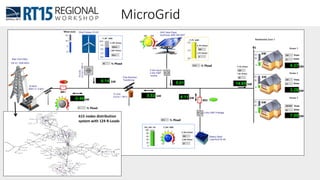
MicroGrid
615 nodes distribution
system with 124 R-Loads
Challenges
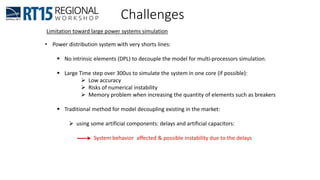
• Power distribution system with very shorts lines:
 No intrinsic elements (DPL) to decouple the model for multi-processors simulation.
 Large Time step over 300us to simulate the system in one core (if possible):
 Low accuracy
 Risks of numerical instability
 Memory problem when increasing the quantity of elements such as breakers
 Traditional method for model decoupling existing in the market:
 using some artificial components: delays and artificial capacitors:
System behavior affected & possible instability due to the delays
Limitation toward large power systems simulation
Challenges
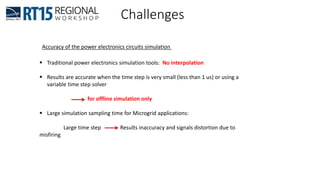
 Traditional power electronics simulation tools: No interpolation
 Results are accurate when the time step is very small (less than 1 us) or using a
variable time step solver
for offline simulation only
 Large simulation sampling time for Microgrid applications:
Large time step Results inaccuracy and signals distortion due to
misfiring
Accuracy of the power electronics circuits simulation
OPAL-RT Solution
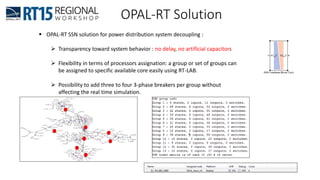
 OPAL-RT SSN solution for power distribution system decoupling :
 Transparency toward system behavior : no delay, no artificial capacitors
 Flexibility in terms of processors assignation: a group or set of groups can
be assigned to specific available core easily using RT-LAB.
 Possibility to add three to four 3-phase breakers per group without
affecting the real time simulation.
OPAL-RT Solution
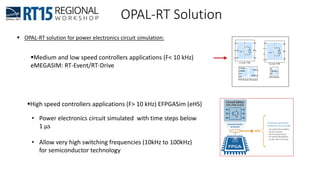
Medium and low speed controllers applications (F< 10 kHz)
eMEGASIM: RT-Event/RT-Drive
High speed controllers applications (F> 10 kHz) EFPGASim (eHS)
 OPAL-RT solution for power electronics circuit simulation:
• Power electronics circuit simulated with time steps below
1 μs
• Allow very high switching frequencies (10kHz to 100kHz)
for semiconductor technology
Live Demo
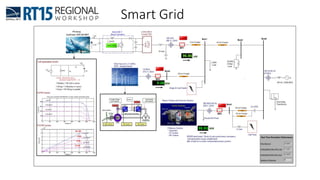
Smart Grid
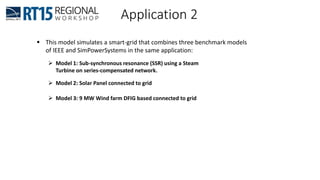
Application 2
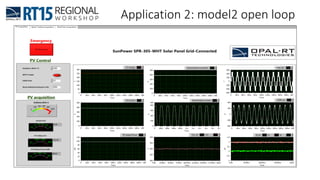
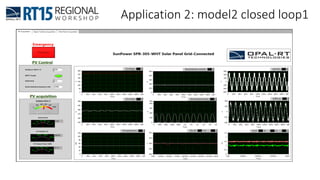
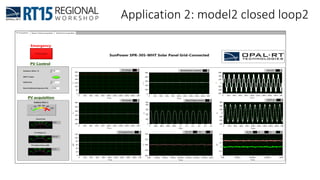
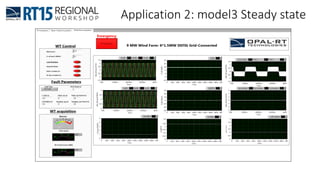
 This model simulates a smart-grid that combines three benchmark models
of IEEE and SimPowerSystems in the same application:
 Model 1: Sub-synchronous resonance (SSR) using a Steam
Turbine on series-compensated network.
 Model 2: Solar Panel connected to grid
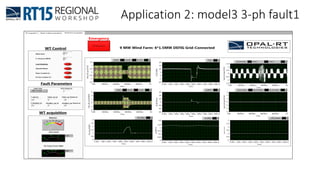
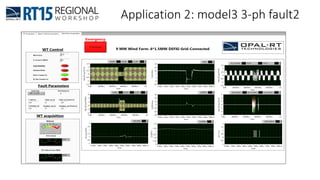
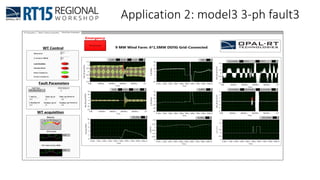
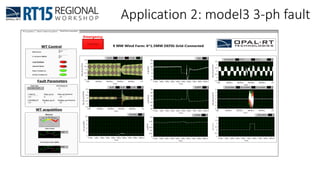
 Model 3: 9 MW Wind farm DFIG based connected to grid
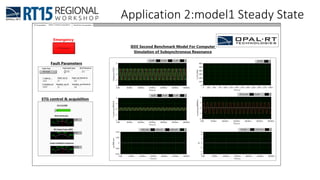
Application 2:model1 Steady State
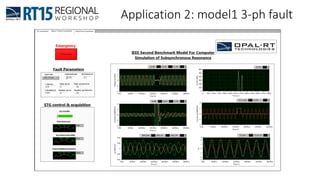
Application 2: model1 3-ph fault
Application 2: model2 open loop
Application 2: model2 closed loop1
Application 2: model2 closed loop2
Application 2: model3 Steady state
Application 2: model3 3-ph fault1
Application 2: model3 3-ph fault2
Application 2: model3 3-ph fault3
Application 2: model3 3-ph fault
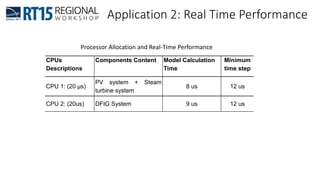
Application 2: Real Time Performance
CPUs
Descriptions
Components Content Model Calculation
Time
Minimum
time step
CPU 1: (20 µs)
PV system + Steam
turbine system
8 us 12 us
CPU 2: (20us) DFIG System 9 us 12 us
Processor Allocation and Real-Time Performance
Live Demo

RT15 Berkeley | OPAL-RT Solutions for Microgrid Applications

  • 1.
    OPAL-RT Solution ForMicro-grid Applications Real Time Simulation OPAL-RT Technologies
  • 2.
    OPAL-RT Solution ForMicro-grid Applications • Applications Description • Challenges  Overcome the Real time simulators limitation toward large power systems simulation  Ensure the accuracy of the power electronics circuits simulation • OPAL-RT Solution for Large scale power systems simulation  State Space Nodal method (SSN) • OPAL-RT Solution for power electronics  Medium and low speed controllers applications (F< 10 kHz) : RT-Event/RT-Drive  High speed controllers applications (F> 10 kHz until 100kHz) : EFPGASim (eHS) • Live Demo
  • 3.
  • 4.
    Challenges • Power distributionsystem with very shorts lines:  No intrinsic elements (DPL) to decouple the model for multi-processors simulation.  Large Time step over 300us to simulate the system in one core (if possible):  Low accuracy  Risks of numerical instability  Memory problem when increasing the quantity of elements such as breakers  Traditional method for model decoupling existing in the market:  using some artificial components: delays and artificial capacitors: System behavior affected & possible instability due to the delays Limitation toward large power systems simulation
  • 5.
    Challenges  Traditional powerelectronics simulation tools: No interpolation  Results are accurate when the time step is very small (less than 1 us) or using a variable time step solver for offline simulation only  Large simulation sampling time for Microgrid applications: Large time step Results inaccuracy and signals distortion due to misfiring Accuracy of the power electronics circuits simulation
  • 6.
    OPAL-RT Solution  OPAL-RTSSN solution for power distribution system decoupling :  Transparency toward system behavior : no delay, no artificial capacitors  Flexibility in terms of processors assignation: a group or set of groups can be assigned to specific available core easily using RT-LAB.  Possibility to add three to four 3-phase breakers per group without affecting the real time simulation.
  • 7.
    OPAL-RT Solution Medium andlow speed controllers applications (F< 10 kHz) eMEGASIM: RT-Event/RT-Drive High speed controllers applications (F> 10 kHz) EFPGASim (eHS)  OPAL-RT solution for power electronics circuit simulation: • Power electronics circuit simulated with time steps below 1 μs • Allow very high switching frequencies (10kHz to 100kHz) for semiconductor technology
  • 8.
  • 9.
  • 10.
    Application 2  Thismodel simulates a smart-grid that combines three benchmark models of IEEE and SimPowerSystems in the same application:  Model 1: Sub-synchronous resonance (SSR) using a Steam Turbine on series-compensated network.  Model 2: Solar Panel connected to grid  Model 3: 9 MW Wind farm DFIG based connected to grid
  • 11.
  • 12.
  • 13.
  • 14.
  • 15.
  • 16.
  • 17.
  • 18.
  • 19.
  • 20.
  • 21.
    Application 2: RealTime Performance CPUs Descriptions Components Content Model Calculation Time Minimum time step CPU 1: (20 µs) PV system + Steam turbine system 8 us 12 us CPU 2: (20us) DFIG System 9 us 12 us Processor Allocation and Real-Time Performance
  • 22.