Real-Time Simulation
of Renewable Energy Systems
Using RT-LAB
Presented by Andy Yen
andy.yen@opal-rt.com
Montréal, Canada
©2013 OPAL-RT - June 24th, 2013
From Imagination to Real-Time
IEEE COMPEL 2013
The 14th IEEE Workshop on Control and
Modeling for Power Electronics (COMPEL)
2
When we think about environment and energy, we think:
– Electric Vehicle
– Hydro Power
– Wind Power
– Photovoltaic Power
– Renewable Energies
Power Engineers think about:
– How to control
– How to bring this technology quickly to market
– How to distribute power
– How to interconnect
Introduction
3
Context
Modelling Challenges for Renewable Energy Systems
Solution
Specialized models
Summary
Outline
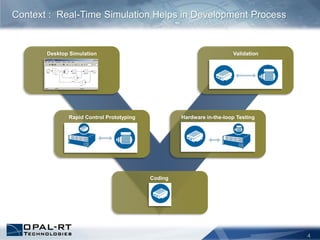
Context : Real-Time Simulation Helps in Development Process
4
Rapid Control Prototyping Hardware in-the-loop Testing
Desktop Simulation
Coding
Validation
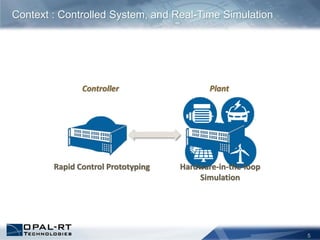
Context : Controlled System, and Real-Time Simulation
5
PlantController
Rapid Control Prototyping Hardware-in-the-loop
Simulation
6
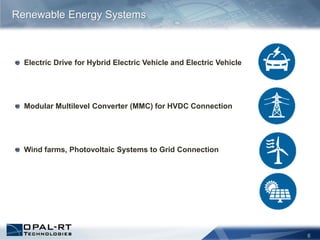
Electric Drive for Hybrid Electric Vehicle and Electric Vehicle
Modular Multilevel Converter (MMC) for HVDC Connection
Wind farms, Photovoltaic Systems to Grid Connection
Renewable Energy Systems
7
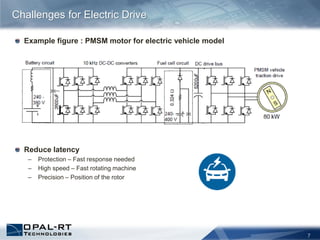
Example figure : PMSM motor for electric vehicle model
Reduce latency
– Protection – Fast response needed
– High speed – Fast rotating machine
– Precision – Position of the rotor
Challenges for Electric Drive
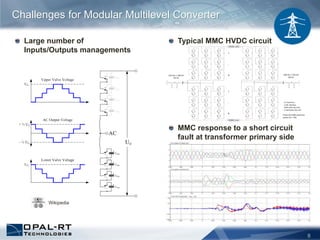
Typical MMC HVDC circuit
MMC response to a short circuit
fault at transformer primary side
8
Challenges for Modular Multilevel Converter
Large number of
Inputs/Outputs managements
Wikipedia
9
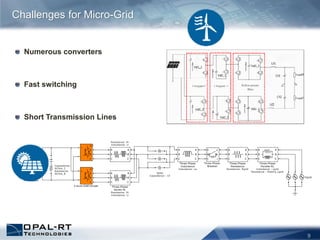
Numerous converters
Fast switching
Short Transmission Lines
Challenges for Micro-Grid
Vgrid
A
B
C
a
b
c
Three-Phase
Breaker
A
B
C
A
B
C
Resistance: Ri
Inductance: Li
A
B
C
A
B
C
Three-Phase
Series RL
Resistance: Ri
Inductance: Li
A
B
C
A
B
C
Three-Phase
Resistance
Resistance: Rgrid
A
B
C
A
B
C
Three-Phase
Parallel RL
Inductance : Lgrid
Resistance : Rdamp_Lgrid
A
B
C
A
B
C
Three-Phase
Inductance
Inductance: La
Capacitance:
DClink_C
Resistance:
DClink_R
+
-
PV Subsystem
Delta
Capacitance : Cf
g
A
B
C
+
-
g
A
B
C
+
-
2-level IGBT/Diode
10
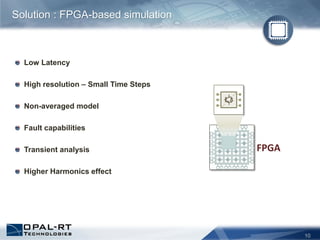
Low Latency
High resolution – Small Time Steps
Non-averaged model
Fault capabilities
Transient analysis
Higher Harmonics effect
Solution : FPGA-based simulation
FPGA
11
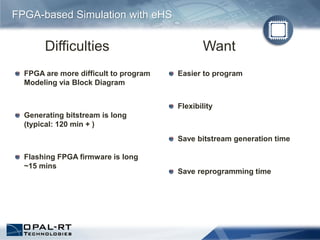
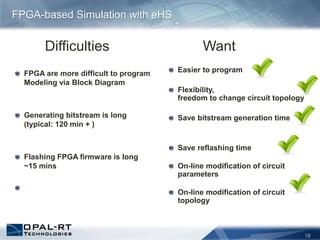
FPGA are more difficult to program
Modeling via Block Diagram
Generating bitstream is long
(typical: 120 min + )
Flashing FPGA firmware is long
~15 mins
FPGA-based Simulation with eHS
Easier to program
Flexibility
Save bitstream generation time
Save reprogramming time
Difficulties Want
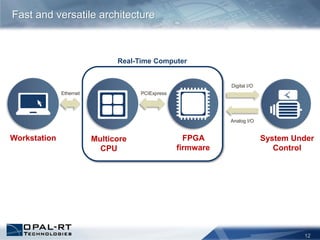
Fast and versatile architecture
12
Workstation Multicore
CPU
FPGA
firmware
System Under
Control
Ethernet PCIExpress
Analog I/O
Digital I/O
Real-Time Computer
≈ 2 μs
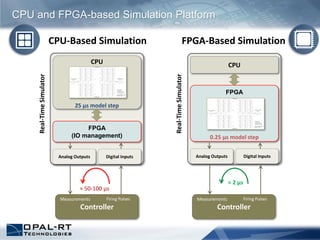
CPU and FPGA-based Simulation Platform
Real-TimeSimulator CPU-Based Simulation
Controller
Firing PulsesMeasurements
Analog Outputs Digital Inputs
FPGA
(IO management)
CPU
25 μs model step
≈ 50-100 μs
Analog Outputs Digital Inputs
FPGA
CPU
FPGA-Based Simulation
Controller
Firing PulsesMeasurements
Real-TimeSimulator
0.25 μs model step
FPGA
14
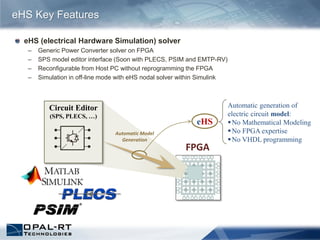
eHS (electrical Hardware Simulation) solver
– Generic Power Converter solver on FPGA
– SPS model editor interface (Soon with PLECS, PSIM and EMTP-RV)
– Reconfigurable from Host PC without reprogramming the FPGA
– Simulation in off-line mode with eHS nodal solver within Simulink
eHS Key Features
Automatic Model
Generation
eHS
Automatic generation of
electric circuit model:
No Mathematical Modeling
No FPGA expertise
No VHDL programming
Circuit Editor
(SPS, PLECS, …)
eHS uses the modified nodal analysis approach
– It solves a admittance matrix to find the voltage at each node and the current from each sources.
– The admittance matrix does not need to be re-computed for each switch status
– Simulated model topology and parameters can be modified without recompiling the bitstream
The maximum size of the circuit is determined by the number of inputs,
switches and reactive components
Currently, the maximum number of components is :
– 16 inputs (voltage/current sources)
– 16 outputs (voltage/current measurements)
– 24 switches (IGBTs, breakers, etc)
– 60 non-switching devices (ie. L and C) – unlimited resistors
eHS Nodal Solver
eHS core
Y[0:15]
24x switches control
16x Inputs
U[0:15]
S[0:23]
16 Measurements
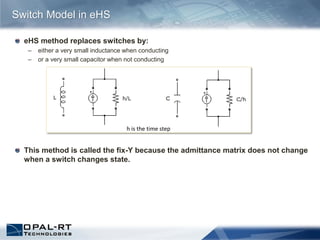
eHS method replaces switches by:
– either a very small inductance when conducting
– or a very small capacitor when not conducting
This method is called the fix-Y because the admittance matrix does not change
when a switch changes state.
Switch Model in eHS
h is the time step
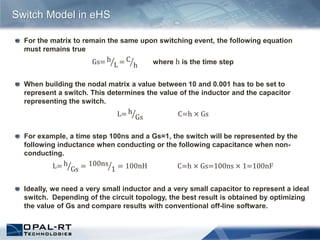
For the matrix to remain the same upon switching event, the following equation
must remains true
Gs= h
L = C
h where h is the time step
When building the nodal matrix a value between 10 and 0.001 has to be set to
represent a switch. This determines the value of the inductor and the capacitor
representing the switch.
L= h
Gs C=h × Gs
For example, a time step 100ns and a Gs=1, the switch will be represented by the
following inductance when conducting or the following capacitance when non-
conducting.
L= h
Gs = 100ns
1 = 100nH C=h × Gs=100ns × 1=100nF
Ideally, we need a very small inductor and a very small capacitor to represent a ideal
switch. Depending of the circuit topology, the best result is obtained by optimizing
the value of Gs and compare results with conventional off-line software.
Switch Model in eHS
18
FPGA are more difficult to program
Modeling via Block Diagram
Generating bitstream is long
(typical: 120 min + )
Flashing FPGA firmware is long
~15 mins
FPGA-based Simulation with eHS
Easier to program
Flexibility,
freedom to change circuit topology
Save bitstream generation time
Save reflashing time
On-line modification of circuit
parameters
On-line modification of circuit
topology
Difficulties Want
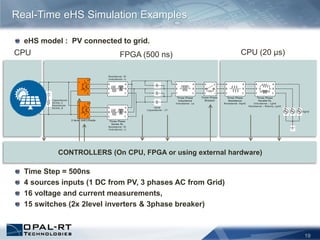
eHS model : PV connected to grid.
Time Step = 500ns
4 sources inputs (1 DC from PV, 3 phases AC from Grid)
16 voltage and current measurements,
15 switches (2x 2level inverters & 3phase breaker)
CPU (20 μs)FPGA (500 ns)CPU
Vgrid
A
B
C
a
b
c
Three-Phase
Breaker
A
B
C
A
B
C
Resistance: Ri
Inductance: Li
A
B
C
A
B
C
Three-Phase
Series RL
Resistance: Ri
Inductance: Li
A
B
C
A
B
C
Three-Phase
Resistance
Resistance: Rgrid
A
B
C
A
B
C
Three-Phase
Parallel RL
Inductance : Lgrid
Resistance : Rdamp_Lgrid
A
B
C
A
B
C
Three-Phase
Inductance
Inductance: La
Capacitance:
DClink_C
Resistance:
DClink_R
+
-
PV Subsystem
Delta
Capacitance : Cf
g
A
B
C
+
-
g
A
B
C
+
-
2-level IGBT/Diode
19
Real-Time eHS Simulation Examples
CONTROLLERS (On CPU, FPGA or using external hardware)
20
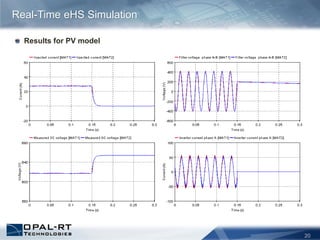
Results for PV model
Real-Time eHS Simulation
21
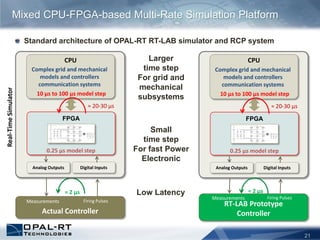
Standard architecture of OPAL-RT RT-LAB simulator and RCP system
Mixed CPU-FPGA-based Multi-Rate Simulation Platform
≈ 2 μs
Analog Outputs Digital Inputs
FPGA
CPU
Actual Controller
Firing PulsesMeasurements
Real-TimeSimulator
0.25 μs model step
10 μs to 100 μs model step
≈ 20-30 μs
Complex grid and mechanical
models and controllers
communication systems
≈ 2 μs
Analog Outputs Digital Inputs
FPGA
CPU
RT-LAB Prototype
Controller
Firing PulsesMeasurements
0.25 μs model step
10 μs to 100 μs model step
≈ 20-30 μs
Complex grid and mechanical
models and controllers
communication systems
Low Latency
Small
time step
For fast Power
Electronic
Larger
time step
For grid and
mechanical
subsystems
22
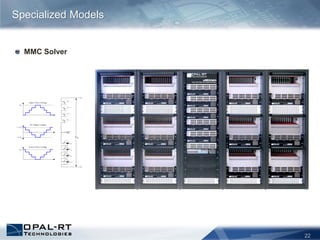
MMC Solver
Specialized Models
23
Motor model on FPGA
– Using Finite Element Analysis (FEA) modeling approach:
• Such as JMAG-RT and MotorSolve
Specialized Models
Flux, impedance values according to
the mechanical angles of the motors
24
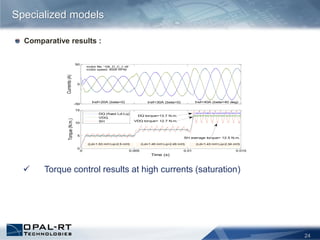
Comparative results :
Specialized models
 Torque control results at high currents (saturation)
-50
0
50
Currents(A)
0 0.005 0.01 0.015
0
5
10
15
Time (s)
Torque(N.m.)
DQ (fixed Ld-Lq)
VDQ
SH
(Ld=1.43 mH Lq=2.34 mH)(Ld=1.53 mH Lq=2.5 mH) (Ld=1.45 mH Lq=2.45 mH)
motor file: '10k_D_C_I-.rtt'
motor speed: 4000 RPM
VDQ torque= 12.7 N.m.
DQ torque=13.7 N.m.
SH average torque= 12.5 N.m.
Iref=20A (beta=0) Iref=40A (beta=40 deg)Iref=30A (beta=0)
CPU
25
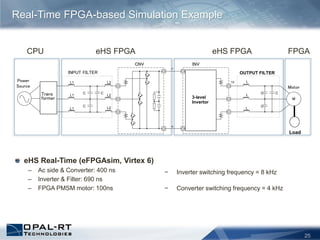
eHS Real-Time (eFPGAsim, Virtex 6)
– Ac side & Converter: 400 ns
– Inverter & Filter: 690 ns
– FPGA PMSM motor: 100ns
Real-Time FPGA-based Simulation Example
− Inverter switching frequency = 8 kHz
− Converter switching frequency = 4 kHz
eHS FPGA eHS FPGA FPGA
M
INV
P
N
TB L3_U0
L3_V0
L3_W0
C_UV
C_VW
C_WU
Sine-Wave Filter
Motor
L3_U0
L3_V0
L3_W0
C_UV
C_VW
C_WU
L3_U0
L3_V0
L3_W0
Power
Source
INPUT FILTER
CNV
3-level
Invertor
OUTPUT FILTER
M
INV
P
N
TB L3_U0
L3_V0
L3_W0
C_UV
C_VW
C_WU
Sine-Wave Filter
Motor
L3_U0
L3_V0
L3_W0
C_UV
C_VW
C_WU
L3_U0
L3_V0
L3_W0
Power
Source
INPUT FILTER
CNV
Trans
former
L1
L1
L1
L2
L2
L2
C
C
C
L
L
L
C
C
C
Load
Real-Time FPGA-based Simulation Example
26
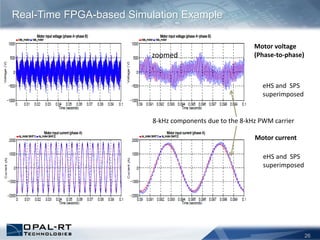
eHS and SPS
superimposed
eHS and SPS
superimposed
zoomed
Motor voltage
(Phase-to-phase)
Motor current
zoomed
8-kHz components due to the 8-kHz PWM carrier
27
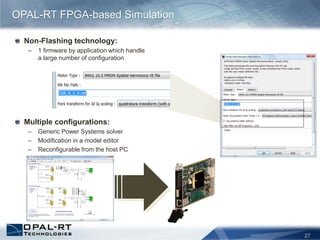
Non-Flashing technology:
– 1 firmware by application which handle
a large number of configuration
Multiple configurations:
– Generic Power Systems solver
– Modification in a model editor
– Reconfigurable from the host PC
OPAL-RT FPGA-based Simulation
28
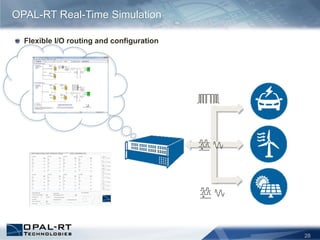
Flexible I/O routing and configuration
OPAL-RT Real-Time Simulation
29
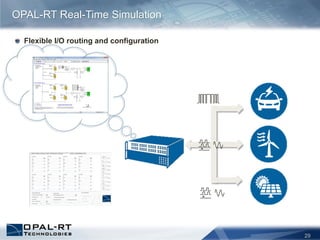
Flexible I/O routing and configuration
OPAL-RT Real-Time Simulation
30
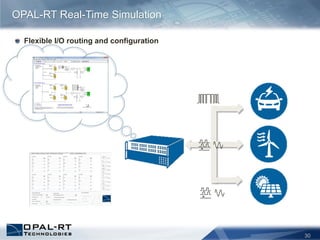
Flexible I/O routing and configuration
OPAL-RT Real-Time Simulation
31
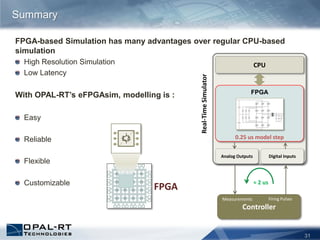
FPGA-based Simulation has many advantages over regular CPU-based
simulation
High Resolution Simulation
Low Latency
With OPAL-RT’s eFPGAsim, modelling is :
Easy
Reliable
Flexible
Customizable
Summary
FPGA
≈ 2 us
Analog Outputs Digital Inputs
FPGA
CPU
Controller
Firing PulsesMeasurements
Real-TimeSimulator
0.25 us model step
32
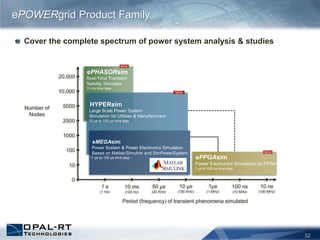
Cover the complete spectrum of power system analysis & studies
ePOWERgrid Product Family
ePHASORsim
Real-Time Transient
Stability Simulator
10 ms time step
NEW
HYPERsim
Large Scale Power System
Simulation for Utilities & Manufacturers
10 µs to 100 µs time step
NEW
eFPGAsim
Power Electronics Simulation on FPGA
1 µs to 100 ns time step
NEW
1 s
(1 Hz)
10,000
5000
2500
1000
100
10
0
10 ms
(100 Hz)
50 µs
(20 KHz)
10 µs
(100 KHz)
1µs
(1 MHz)
100 ns
(10 MHz)
10 ns
(100 MHz)
20,000
Period (frequency) of transient phenomena simulated
Number of
Nodes
eMEGAsim
Power System & Power Electronics Simulation
Based on Matlab/Simulink and SimPowerSystem
7 µs to 100 µs time step
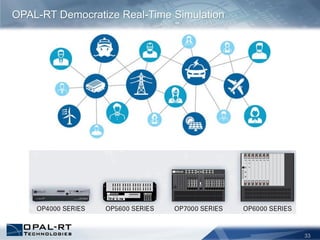
OPAL-RT Democratize Real-Time Simulation
33
Real-Time Simulation
of Renewable Energy Systems
Using RT-LAB
Presented by Andy Yen
andy.yen@opal-rt.com
Montréal, Canada
From Imagination to Real-Time
Thank you !
©2013 OPAL-RT - June 24th, 2013
IEEE COMPEL 2013
The 14th IEEE Workshop on Control and
Modeling for Power Electronics (COMPEL)

OPAL-RT Real time simulation using RT-LAB

  • 1.
    Real-Time Simulation of RenewableEnergy Systems Using RT-LAB Presented by Andy Yen andy.yen@opal-rt.com Montréal, Canada ©2013 OPAL-RT - June 24th, 2013 From Imagination to Real-Time IEEE COMPEL 2013 The 14th IEEE Workshop on Control and Modeling for Power Electronics (COMPEL)
  • 2.
    2 When we thinkabout environment and energy, we think: – Electric Vehicle – Hydro Power – Wind Power – Photovoltaic Power – Renewable Energies Power Engineers think about: – How to control – How to bring this technology quickly to market – How to distribute power – How to interconnect Introduction
  • 3.
    3 Context Modelling Challenges forRenewable Energy Systems Solution Specialized models Summary Outline
  • 4.
    Context : Real-TimeSimulation Helps in Development Process 4 Rapid Control Prototyping Hardware in-the-loop Testing Desktop Simulation Coding Validation
  • 5.
    Context : ControlledSystem, and Real-Time Simulation 5 PlantController Rapid Control Prototyping Hardware-in-the-loop Simulation
  • 6.
    6 Electric Drive forHybrid Electric Vehicle and Electric Vehicle Modular Multilevel Converter (MMC) for HVDC Connection Wind farms, Photovoltaic Systems to Grid Connection Renewable Energy Systems
  • 7.
    7 Example figure :PMSM motor for electric vehicle model Reduce latency – Protection – Fast response needed – High speed – Fast rotating machine – Precision – Position of the rotor Challenges for Electric Drive
  • 8.
    Typical MMC HVDCcircuit MMC response to a short circuit fault at transformer primary side 8 Challenges for Modular Multilevel Converter Large number of Inputs/Outputs managements Wikipedia
  • 9.
    9 Numerous converters Fast switching ShortTransmission Lines Challenges for Micro-Grid Vgrid A B C a b c Three-Phase Breaker A B C A B C Resistance: Ri Inductance: Li A B C A B C Three-Phase Series RL Resistance: Ri Inductance: Li A B C A B C Three-Phase Resistance Resistance: Rgrid A B C A B C Three-Phase Parallel RL Inductance : Lgrid Resistance : Rdamp_Lgrid A B C A B C Three-Phase Inductance Inductance: La Capacitance: DClink_C Resistance: DClink_R + - PV Subsystem Delta Capacitance : Cf g A B C + - g A B C + - 2-level IGBT/Diode
  • 10.
    10 Low Latency High resolution– Small Time Steps Non-averaged model Fault capabilities Transient analysis Higher Harmonics effect Solution : FPGA-based simulation FPGA
  • 11.
    11 FPGA are moredifficult to program Modeling via Block Diagram Generating bitstream is long (typical: 120 min + ) Flashing FPGA firmware is long ~15 mins FPGA-based Simulation with eHS Easier to program Flexibility Save bitstream generation time Save reprogramming time Difficulties Want
  • 12.
    Fast and versatilearchitecture 12 Workstation Multicore CPU FPGA firmware System Under Control Ethernet PCIExpress Analog I/O Digital I/O Real-Time Computer
  • 13.
    ≈ 2 μs CPUand FPGA-based Simulation Platform Real-TimeSimulator CPU-Based Simulation Controller Firing PulsesMeasurements Analog Outputs Digital Inputs FPGA (IO management) CPU 25 μs model step ≈ 50-100 μs Analog Outputs Digital Inputs FPGA CPU FPGA-Based Simulation Controller Firing PulsesMeasurements Real-TimeSimulator 0.25 μs model step
  • 14.
    FPGA 14 eHS (electrical HardwareSimulation) solver – Generic Power Converter solver on FPGA – SPS model editor interface (Soon with PLECS, PSIM and EMTP-RV) – Reconfigurable from Host PC without reprogramming the FPGA – Simulation in off-line mode with eHS nodal solver within Simulink eHS Key Features Automatic Model Generation eHS Automatic generation of electric circuit model: No Mathematical Modeling No FPGA expertise No VHDL programming Circuit Editor (SPS, PLECS, …)
  • 15.
    eHS uses themodified nodal analysis approach – It solves a admittance matrix to find the voltage at each node and the current from each sources. – The admittance matrix does not need to be re-computed for each switch status – Simulated model topology and parameters can be modified without recompiling the bitstream The maximum size of the circuit is determined by the number of inputs, switches and reactive components Currently, the maximum number of components is : – 16 inputs (voltage/current sources) – 16 outputs (voltage/current measurements) – 24 switches (IGBTs, breakers, etc) – 60 non-switching devices (ie. L and C) – unlimited resistors eHS Nodal Solver eHS core Y[0:15] 24x switches control 16x Inputs U[0:15] S[0:23] 16 Measurements
  • 16.
    eHS method replacesswitches by: – either a very small inductance when conducting – or a very small capacitor when not conducting This method is called the fix-Y because the admittance matrix does not change when a switch changes state. Switch Model in eHS h is the time step
  • 17.
    For the matrixto remain the same upon switching event, the following equation must remains true Gs= h L = C h where h is the time step When building the nodal matrix a value between 10 and 0.001 has to be set to represent a switch. This determines the value of the inductor and the capacitor representing the switch. L= h Gs C=h × Gs For example, a time step 100ns and a Gs=1, the switch will be represented by the following inductance when conducting or the following capacitance when non- conducting. L= h Gs = 100ns 1 = 100nH C=h × Gs=100ns × 1=100nF Ideally, we need a very small inductor and a very small capacitor to represent a ideal switch. Depending of the circuit topology, the best result is obtained by optimizing the value of Gs and compare results with conventional off-line software. Switch Model in eHS
  • 18.
    18 FPGA are moredifficult to program Modeling via Block Diagram Generating bitstream is long (typical: 120 min + ) Flashing FPGA firmware is long ~15 mins FPGA-based Simulation with eHS Easier to program Flexibility, freedom to change circuit topology Save bitstream generation time Save reflashing time On-line modification of circuit parameters On-line modification of circuit topology Difficulties Want
  • 19.
    eHS model :PV connected to grid. Time Step = 500ns 4 sources inputs (1 DC from PV, 3 phases AC from Grid) 16 voltage and current measurements, 15 switches (2x 2level inverters & 3phase breaker) CPU (20 μs)FPGA (500 ns)CPU Vgrid A B C a b c Three-Phase Breaker A B C A B C Resistance: Ri Inductance: Li A B C A B C Three-Phase Series RL Resistance: Ri Inductance: Li A B C A B C Three-Phase Resistance Resistance: Rgrid A B C A B C Three-Phase Parallel RL Inductance : Lgrid Resistance : Rdamp_Lgrid A B C A B C Three-Phase Inductance Inductance: La Capacitance: DClink_C Resistance: DClink_R + - PV Subsystem Delta Capacitance : Cf g A B C + - g A B C + - 2-level IGBT/Diode 19 Real-Time eHS Simulation Examples CONTROLLERS (On CPU, FPGA or using external hardware)
  • 20.
    20 Results for PVmodel Real-Time eHS Simulation
  • 21.
    21 Standard architecture ofOPAL-RT RT-LAB simulator and RCP system Mixed CPU-FPGA-based Multi-Rate Simulation Platform ≈ 2 μs Analog Outputs Digital Inputs FPGA CPU Actual Controller Firing PulsesMeasurements Real-TimeSimulator 0.25 μs model step 10 μs to 100 μs model step ≈ 20-30 μs Complex grid and mechanical models and controllers communication systems ≈ 2 μs Analog Outputs Digital Inputs FPGA CPU RT-LAB Prototype Controller Firing PulsesMeasurements 0.25 μs model step 10 μs to 100 μs model step ≈ 20-30 μs Complex grid and mechanical models and controllers communication systems Low Latency Small time step For fast Power Electronic Larger time step For grid and mechanical subsystems
  • 22.
  • 23.
    23 Motor model onFPGA – Using Finite Element Analysis (FEA) modeling approach: • Such as JMAG-RT and MotorSolve Specialized Models Flux, impedance values according to the mechanical angles of the motors
  • 24.
    24 Comparative results : Specializedmodels  Torque control results at high currents (saturation) -50 0 50 Currents(A) 0 0.005 0.01 0.015 0 5 10 15 Time (s) Torque(N.m.) DQ (fixed Ld-Lq) VDQ SH (Ld=1.43 mH Lq=2.34 mH)(Ld=1.53 mH Lq=2.5 mH) (Ld=1.45 mH Lq=2.45 mH) motor file: '10k_D_C_I-.rtt' motor speed: 4000 RPM VDQ torque= 12.7 N.m. DQ torque=13.7 N.m. SH average torque= 12.5 N.m. Iref=20A (beta=0) Iref=40A (beta=40 deg)Iref=30A (beta=0)
  • 25.
    CPU 25 eHS Real-Time (eFPGAsim,Virtex 6) – Ac side & Converter: 400 ns – Inverter & Filter: 690 ns – FPGA PMSM motor: 100ns Real-Time FPGA-based Simulation Example − Inverter switching frequency = 8 kHz − Converter switching frequency = 4 kHz eHS FPGA eHS FPGA FPGA M INV P N TB L3_U0 L3_V0 L3_W0 C_UV C_VW C_WU Sine-Wave Filter Motor L3_U0 L3_V0 L3_W0 C_UV C_VW C_WU L3_U0 L3_V0 L3_W0 Power Source INPUT FILTER CNV 3-level Invertor OUTPUT FILTER M INV P N TB L3_U0 L3_V0 L3_W0 C_UV C_VW C_WU Sine-Wave Filter Motor L3_U0 L3_V0 L3_W0 C_UV C_VW C_WU L3_U0 L3_V0 L3_W0 Power Source INPUT FILTER CNV Trans former L1 L1 L1 L2 L2 L2 C C C L L L C C C Load
  • 26.
    Real-Time FPGA-based SimulationExample 26 eHS and SPS superimposed eHS and SPS superimposed zoomed Motor voltage (Phase-to-phase) Motor current zoomed 8-kHz components due to the 8-kHz PWM carrier
  • 27.
    27 Non-Flashing technology: – 1firmware by application which handle a large number of configuration Multiple configurations: – Generic Power Systems solver – Modification in a model editor – Reconfigurable from the host PC OPAL-RT FPGA-based Simulation
  • 28.
    28 Flexible I/O routingand configuration OPAL-RT Real-Time Simulation
  • 29.
    29 Flexible I/O routingand configuration OPAL-RT Real-Time Simulation
  • 30.
    30 Flexible I/O routingand configuration OPAL-RT Real-Time Simulation
  • 31.
    31 FPGA-based Simulation hasmany advantages over regular CPU-based simulation High Resolution Simulation Low Latency With OPAL-RT’s eFPGAsim, modelling is : Easy Reliable Flexible Customizable Summary FPGA ≈ 2 us Analog Outputs Digital Inputs FPGA CPU Controller Firing PulsesMeasurements Real-TimeSimulator 0.25 us model step
  • 32.
    32 Cover the completespectrum of power system analysis & studies ePOWERgrid Product Family ePHASORsim Real-Time Transient Stability Simulator 10 ms time step NEW HYPERsim Large Scale Power System Simulation for Utilities & Manufacturers 10 µs to 100 µs time step NEW eFPGAsim Power Electronics Simulation on FPGA 1 µs to 100 ns time step NEW 1 s (1 Hz) 10,000 5000 2500 1000 100 10 0 10 ms (100 Hz) 50 µs (20 KHz) 10 µs (100 KHz) 1µs (1 MHz) 100 ns (10 MHz) 10 ns (100 MHz) 20,000 Period (frequency) of transient phenomena simulated Number of Nodes eMEGAsim Power System & Power Electronics Simulation Based on Matlab/Simulink and SimPowerSystem 7 µs to 100 µs time step
  • 33.
  • 34.
    Real-Time Simulation of RenewableEnergy Systems Using RT-LAB Presented by Andy Yen andy.yen@opal-rt.com Montréal, Canada From Imagination to Real-Time Thank you ! ©2013 OPAL-RT - June 24th, 2013 IEEE COMPEL 2013 The 14th IEEE Workshop on Control and Modeling for Power Electronics (COMPEL)