E - Commerce
© Ramakrishna Kongalla,
Assistant Professor
R'tist @ Tourism
E - commerce
• E-commerce, in the popular sense, can be defined as:
– the use of the Internet and the Web to conduct business
transactions.
• A more technical definition would be:
– e-commerce involves digitally enabled commercial
transactions between and among organizations and
individuals.
• E-commerce differs from e-business in that no commercial
transaction, an exchange of value across organizational or
individual boundaries, takes place in e-business.
• E-business is the digital enablement of transactions and
processes within a firm and therefore does not include
any exchange in value.
R'tist @ Tourism
• E-commerce and e-business intersect at the
business firm boundary at the point where
internal business systems link up with suppliers.
– For instance, e-business turns into e-commerce when
an exchange of value occurs across firm boundaries.
• information asymmetry
– Information asymmetry refers to any disparity in
relevant market information among the parties
involved in a transaction. It generally applies to
information about price, cost, and hidden fees.
R'tist @ Tourism
The unique features of e-commerce technology include:
– Ubiquity: It is available just about everywhere and at all
times.
– Global Reach: the potential market size is roughly equal
to the size of the online population of the world.
– Universal standards: The technical standards of the
Internet, and therefore of conducting e-commerce, are
shared by all of the nations in the world.
– Richness: Information that is complex and content rich
can be delivered without sacrificing reach.
– Interactivity: E-commerce technologies allow two-way
communication between the merchant and the
consumer.
R'tist @ Tourism
– Information density: The total amount and
quality of information available to all market
participants is vastly increased and is cheaper
to deliver.
– Personalization/Customization: E-commerce
technologies enable merchants to target their
marketing messages to a person’s
name, interests, and past purchases. They
allow a merchant to change the product or
service to suit the purchasing behavior and
preferences of a consumer.
– Social technology: User content generation
and social networking technologies
R'tist @ Tourism
a marketspace:
• A marketspace is a marketplace that is
extended beyond traditional boundaries
because it is removed from the restrictions of
geography and time. The ubiquity of e-
commerce technologies liberates the market
from these limitations.
R'tist @ Tourism
• Web 2.0 is a set of applications and technologies that
allows users to create, edit, and distribute content;
share preferences, bookmarks, and online personas;
participate in virtual lives; and build online
communities.
• Web 2.0 is the set of new, advanced applications that
have evolved along with the Web’s ability to support
larger audiences and more involved content.
• Like Facebook, MySpace, YouTube, Photobucket,
Google, Wikipedia, Second Life, Digg, and WordPress
etc.
R'tist @ Tourism
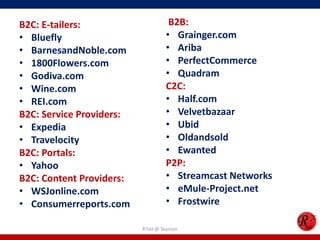
B2C: E-tailers:
• Bluefly
• BarnesandNoble.com
• 1800Flowers.com
• Godiva.com
• Wine.com
• REI.com
B2C: Service Providers:
• Expedia
• Travelocity
B2C: Portals:
• Yahoo
B2C: Content Providers:
• WSJonline.com
• Consumerreports.com
B2B:
• Grainger.com
• Ariba
• PerfectCommerce
• Quadram
C2C:
• Half.com
• Velvetbazaar
• Ubid
• Oldandsold
• Ewanted
P2P:
• Streamcast Networks
• eMule-Project.net
• Frostwire
R'tist @ Tourism
Evolution of e-commerce
• The three stages
– Innovation took place from 1995 and was characterized
by excitement and idealistic visions of markets in which
quality information was equally available to both buyers
and merchants. However, e-commerce did not fulfill
these visions during its early years.
– After 2000, consolidation : In this stage, more
traditional firms began to use the Web to enhance their
existing businesses. Less emphasis was placed on
creating new brands.
– In 2006, though, e-commerce entered its current
stage, reinvention, as social networking and Web 2.0
applications reinvigorated e-commerce and encouraged
the development of new business models.
R'tist @ Tourism
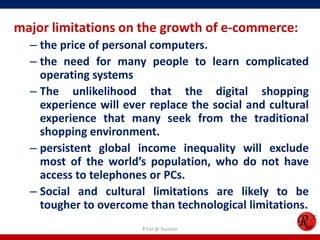
major limitations on the growth of e-commerce:
– the price of personal computers.
– the need for many people to learn complicated
operating systems
– The unlikelihood that the digital shopping
experience will ever replace the social and cultural
experience that many seek from the traditional
shopping environment.
– persistent global income inequality will exclude
most of the world’s population, who do not have
access to telephones or PCs.
– Social and cultural limitations are likely to be
tougher to overcome than technological limitations.
R'tist @ Tourism
The five primary revenue models used by e-commerce firms are:
– advertising model derives its profit by displaying paid
advertisements on a Web site. The goal is to convince advertisers
that the site has the ability to attract a sizeable viewership, or a
viewership that meets a marketing niche sought by the advertiser.
– the subscription model offer users access to some or all of
their content or services for a subscription fee.
– the transaction fee model derive profit from enabling or executing
transactions. For instance, transaction fees are paid to eBay when
a seller is successful in auctioning off a product, and E*Trade
receives a transaction fee when it executes a stock transaction for
a customer.
– the sales revenue model, companies draw profit directly from the
sale of goods, information, or services to consumers.
– the affiliate model, sites receive referral fees or a percentage of
the revenue from any sales that result from steering business to
the affiliate.
R'tist @ Tourism
Thank You…!!!
©Ramakrishna Kongalla
e-mail: artist.ramakrishna@gmail.com
R'tist @ Tourism

E-commerce

  • 1.
    E - Commerce ©Ramakrishna Kongalla, Assistant Professor R'tist @ Tourism
  • 2.
    E - commerce •E-commerce, in the popular sense, can be defined as: – the use of the Internet and the Web to conduct business transactions. • A more technical definition would be: – e-commerce involves digitally enabled commercial transactions between and among organizations and individuals. • E-commerce differs from e-business in that no commercial transaction, an exchange of value across organizational or individual boundaries, takes place in e-business. • E-business is the digital enablement of transactions and processes within a firm and therefore does not include any exchange in value. R'tist @ Tourism
  • 3.
    • E-commerce ande-business intersect at the business firm boundary at the point where internal business systems link up with suppliers. – For instance, e-business turns into e-commerce when an exchange of value occurs across firm boundaries. • information asymmetry – Information asymmetry refers to any disparity in relevant market information among the parties involved in a transaction. It generally applies to information about price, cost, and hidden fees. R'tist @ Tourism
  • 4.
    The unique featuresof e-commerce technology include: – Ubiquity: It is available just about everywhere and at all times. – Global Reach: the potential market size is roughly equal to the size of the online population of the world. – Universal standards: The technical standards of the Internet, and therefore of conducting e-commerce, are shared by all of the nations in the world. – Richness: Information that is complex and content rich can be delivered without sacrificing reach. – Interactivity: E-commerce technologies allow two-way communication between the merchant and the consumer. R'tist @ Tourism
  • 5.
    – Information density:The total amount and quality of information available to all market participants is vastly increased and is cheaper to deliver. – Personalization/Customization: E-commerce technologies enable merchants to target their marketing messages to a person’s name, interests, and past purchases. They allow a merchant to change the product or service to suit the purchasing behavior and preferences of a consumer. – Social technology: User content generation and social networking technologies R'tist @ Tourism
  • 6.
    a marketspace: • Amarketspace is a marketplace that is extended beyond traditional boundaries because it is removed from the restrictions of geography and time. The ubiquity of e- commerce technologies liberates the market from these limitations. R'tist @ Tourism
  • 7.
    • Web 2.0is a set of applications and technologies that allows users to create, edit, and distribute content; share preferences, bookmarks, and online personas; participate in virtual lives; and build online communities. • Web 2.0 is the set of new, advanced applications that have evolved along with the Web’s ability to support larger audiences and more involved content. • Like Facebook, MySpace, YouTube, Photobucket, Google, Wikipedia, Second Life, Digg, and WordPress etc. R'tist @ Tourism
  • 8.
    B2C: E-tailers: • Bluefly •BarnesandNoble.com • 1800Flowers.com • Godiva.com • Wine.com • REI.com B2C: Service Providers: • Expedia • Travelocity B2C: Portals: • Yahoo B2C: Content Providers: • WSJonline.com • Consumerreports.com B2B: • Grainger.com • Ariba • PerfectCommerce • Quadram C2C: • Half.com • Velvetbazaar • Ubid • Oldandsold • Ewanted P2P: • Streamcast Networks • eMule-Project.net • Frostwire R'tist @ Tourism
  • 9.
    Evolution of e-commerce •The three stages – Innovation took place from 1995 and was characterized by excitement and idealistic visions of markets in which quality information was equally available to both buyers and merchants. However, e-commerce did not fulfill these visions during its early years. – After 2000, consolidation : In this stage, more traditional firms began to use the Web to enhance their existing businesses. Less emphasis was placed on creating new brands. – In 2006, though, e-commerce entered its current stage, reinvention, as social networking and Web 2.0 applications reinvigorated e-commerce and encouraged the development of new business models. R'tist @ Tourism
  • 10.
    major limitations onthe growth of e-commerce: – the price of personal computers. – the need for many people to learn complicated operating systems – The unlikelihood that the digital shopping experience will ever replace the social and cultural experience that many seek from the traditional shopping environment. – persistent global income inequality will exclude most of the world’s population, who do not have access to telephones or PCs. – Social and cultural limitations are likely to be tougher to overcome than technological limitations. R'tist @ Tourism
  • 11.
    The five primaryrevenue models used by e-commerce firms are: – advertising model derives its profit by displaying paid advertisements on a Web site. The goal is to convince advertisers that the site has the ability to attract a sizeable viewership, or a viewership that meets a marketing niche sought by the advertiser. – the subscription model offer users access to some or all of their content or services for a subscription fee. – the transaction fee model derive profit from enabling or executing transactions. For instance, transaction fees are paid to eBay when a seller is successful in auctioning off a product, and E*Trade receives a transaction fee when it executes a stock transaction for a customer. – the sales revenue model, companies draw profit directly from the sale of goods, information, or services to consumers. – the affiliate model, sites receive referral fees or a percentage of the revenue from any sales that result from steering business to the affiliate. R'tist @ Tourism
  • 12.
    Thank You…!!! ©Ramakrishna Kongalla e-mail:artist.ramakrishna@gmail.com R'tist @ Tourism