Copyright © 2010 Pearson Education, Inc.E-commercebusiness. technology. society.Sixth EditionKenneth C. LaudonCarol Guercio Traver
Copyright © 2010 Pearson Education, Inc.Chapter 1The Revolution Is Just BeginningCopyright © 2007 Pearson Education, Inc.Slide 1-2
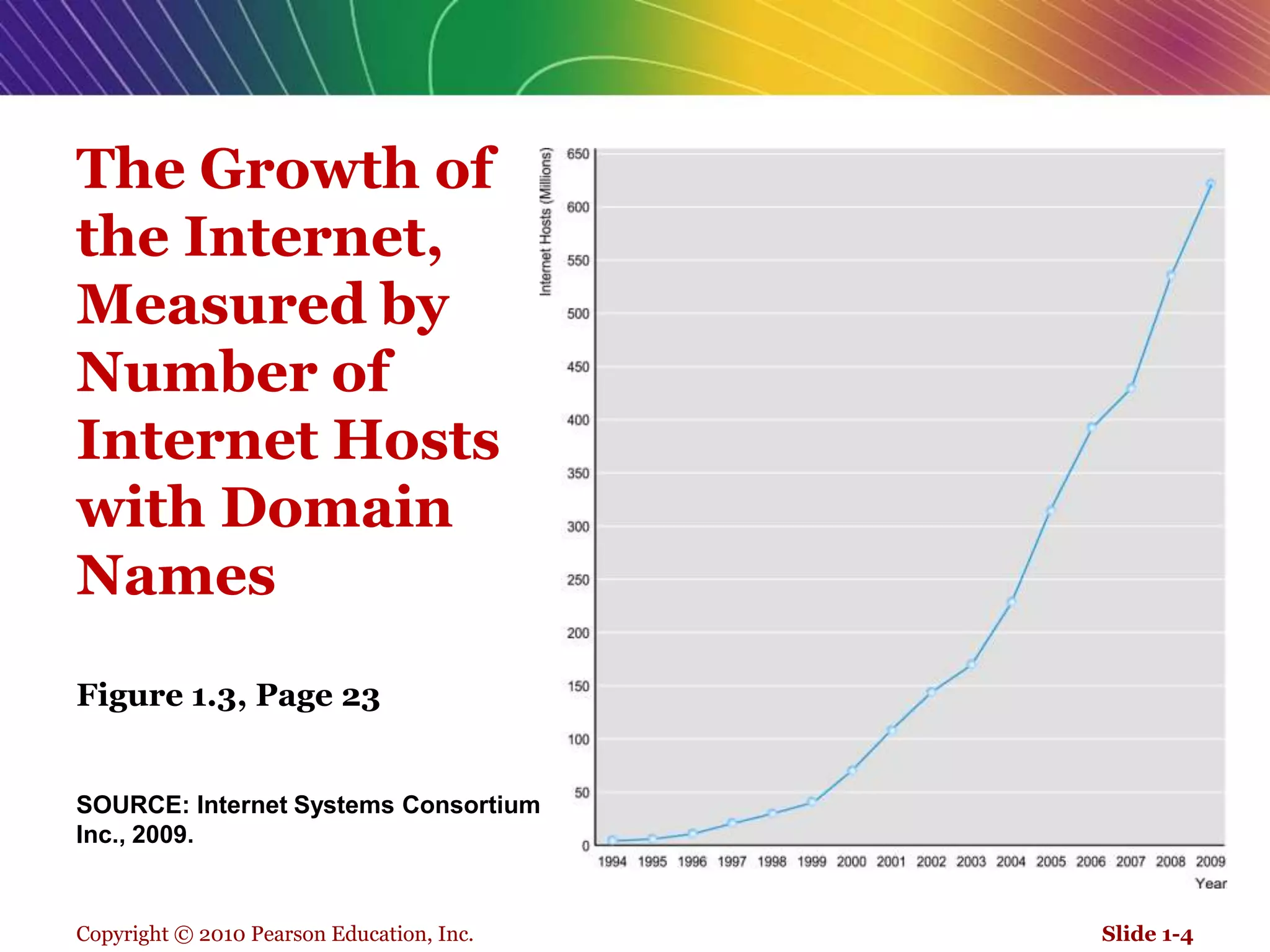
Copyright © 2010 Pearson Education, Inc.The InternetWorldwide network of computer networks built on common standardsCreated in late 1960sServices include the Web, e-mail, file transfers, etc.Can measure growth by looking at number of Internet hosts with domain namesSlide 1-3
Copyright © 2010 Pearson Education, Inc.The Growth of the Internet, Measured by Number of Internet Hosts with Domain NamesFigure 1.3, Page 23Slide 1-4SOURCE: Internet Systems Consortium, Inc., 2009.
Copyright © 2010 Pearson Education, Inc.The WebMost popular Internet serviceDeveloped in early 1990sProvides access to Web pages HTML documents that may include text, graphics, animations, music, videosWeb content has grown exponentially2 billion Web pages in 2000  At least 40–50 billion pages todaySlide 1-5
Copyright © 2010 Pearson Education, Inc.E-commerce Trends 2009–2010New business models based on social technologies,  consumer-generated content, and services 2009 a flat year, but growth expected to resume in 2010Broadband and wireless access continue to growMobile e-commerce begins to take offTraditional media losing subscribersSlide 1-6
Copyright © 2010 Pearson Education, Inc.The First 30 SecondsFirst 15 years of e-commerceJust the beginningRapid growth and changeTechnologies continue to evolve at exponential ratesDisruptive business changeNew opportunitiesSlide 1-7
Copyright © 2010 Pearson Education, Inc.What is E-commerce? Use of Internet and Web to transact businessMore formally:Digitally enabled commercial transactions between and among organizations and individualsSlide 1-8
Copyright © 2010 Pearson Education, Inc.E-commerce vs. E-businessE-business:Digital enablement of transactions and processes within a firm, involving information systems under firm’s controlDoes not include commercial transactions involving an exchange of value across organizational boundariesSlide 1-9
Copyright © 2010 Pearson Education, Inc.Why Study E-commerce?E-commerce technology  is different, more powerful than previous technologiesE-commerce bringing fundamental changes to commerceTraditional commerce:Passive consumerSales-force drivenFixed pricesInformation asymmetrySlide 1-10
Copyright © 2010 Pearson Education, Inc.Unique Features of E-commerce TechnologyUbiquity Global reach Universal standards Information richness Interactivity Information densityPersonalization/customizationSocial technologySlide 1-11
Copyright © 2010 Pearson Education, Inc.Web 2.0Applications, technologies that allow users to: Create and share content, preferences, bookmarks, and online personasParticipate in virtual livesBuild online communitiesExamplesYouTube, Photobucket, Flickr, Google, iPhoneMySpace, Facebook, LinkedInSecond LifeWikipediaSlide 1-12
Copyright © 2010 Pearson Education, Inc.Types of E-commerceClassified by market relationshipBusiness-to-Consumer (B2C)Business-to-Business (B2B)Consumer-to-Consumer (C2C)Classified by technology usedPeer-to-Peer (P2P)Mobile commerce (M-commerce)Slide 1-13
Copyright © 2010 Pearson Education, Inc.Origins & Growth of E-commercePrecursors:Baxter Healthcare Electronic Data Interchange (EDI) French Minitel (1980s videotext system)None had functionality of Internet1995: Beginning of e-commerceFirst sales of banner advertisementsSince then, e-commerce fastest growing form of commerce in the United States Slide 1-14
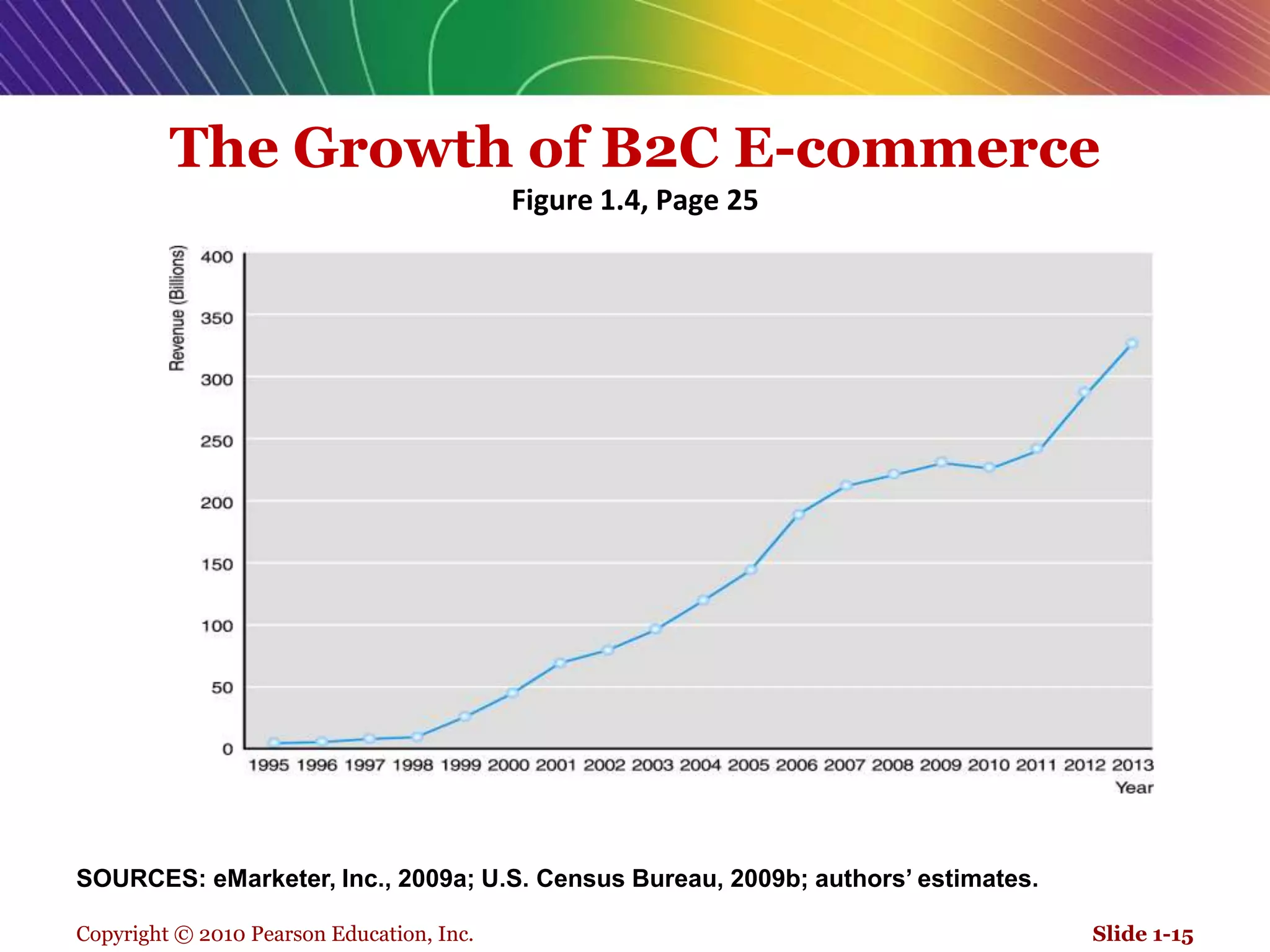
Copyright © 2010 Pearson Education, Inc.The Growth of B2C E-commerceFigure 1.4, Page 25Slide 1-15SOURCES: eMarketer, Inc., 2009a; U.S. Census Bureau, 2009b; authors’ estimates.
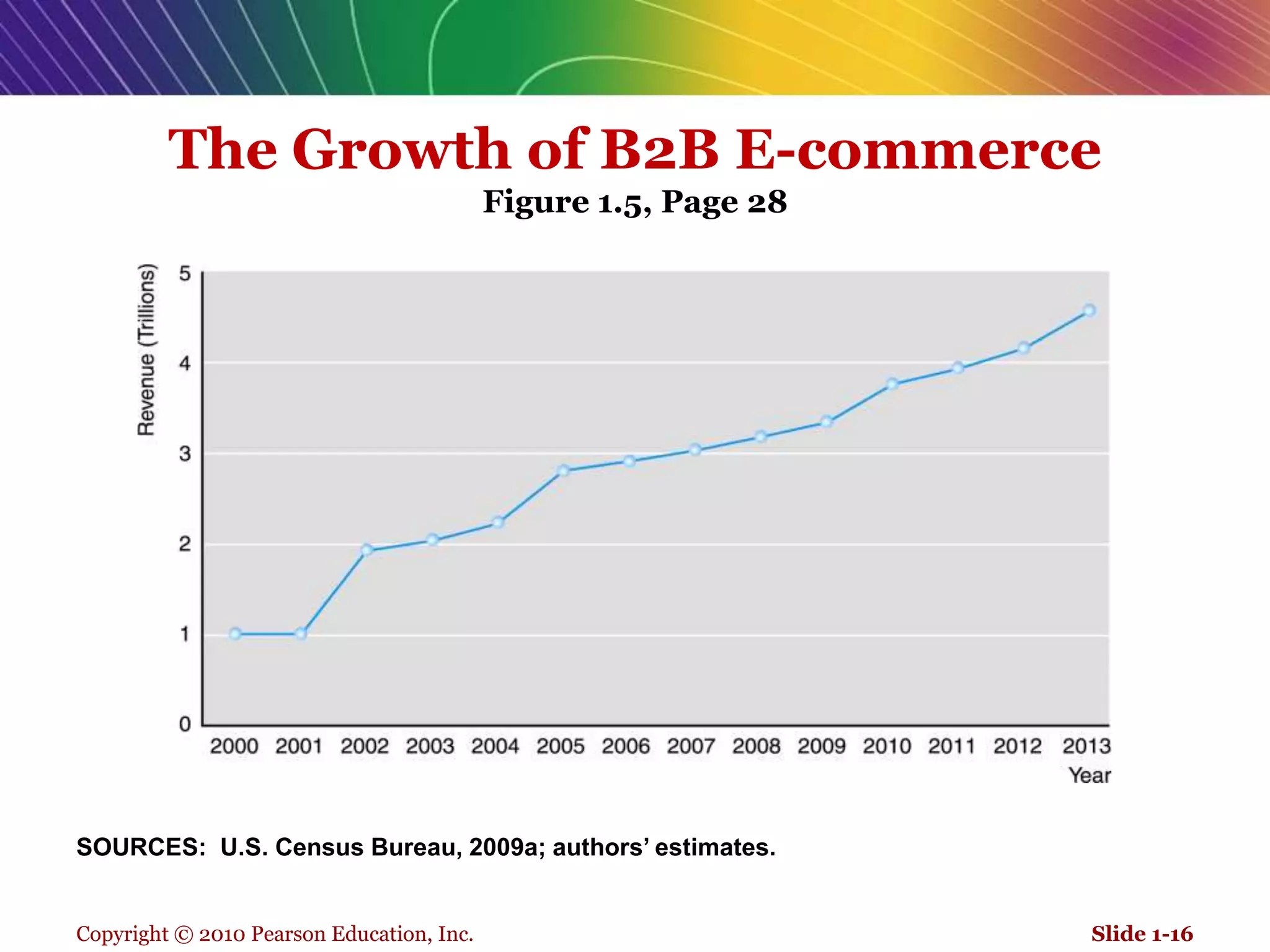
Copyright © 2010 Pearson Education, Inc.The Growth of B2B E-commerceFigure 1.5, Page 28Slide 1-16SOURCES:  U.S. Census Bureau, 2009a; authors’ estimates.
Copyright © 2010 Pearson Education, Inc.Technology and E-commerce in PerspectiveThe Internet and Web: Just two of a long list of technologies that have greatly changed commerceAutomobilesRadioE-commerce growth will eventually cap as it confronts its own fundamental limitations.Slide 1-17
Copyright © 2010 Pearson Education, Inc.Potential Limitations on the Growth of B2C E-commerceExpensive technology Sophisticated skill set Persistent cultural attraction of physical markets and traditional shopping experiencesPersistent global inequality limiting access to telephones and computersSaturation and ceiling effectsSlide 1-18
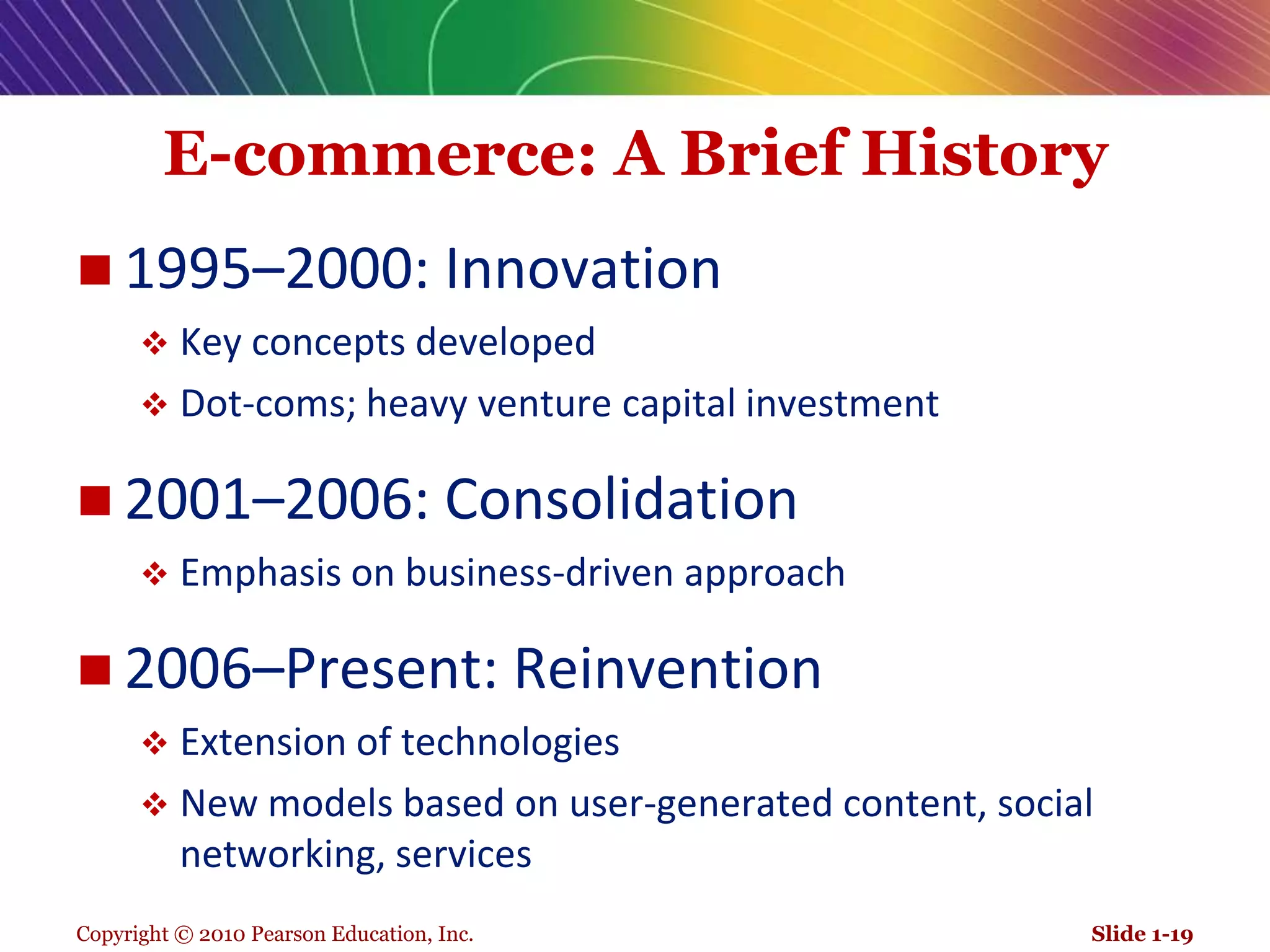
Copyright © 2010 Pearson Education, Inc.E-commerce: A Brief History1995–2000: InnovationKey concepts developedDot-coms; heavy venture capital investment2001–2006: ConsolidationEmphasis on business-driven approach2006–Present: ReinventionExtension of technologiesNew models based on user-generated content, social networking, servicesSlide 1-19
Copyright © 2010 Pearson Education, Inc.Early Visions of E-commerceComputer scientists: Inexpensive, universal communications and computing environment accessible by allEconomists: Nearly perfect competitive market and friction-free commerceLowered search costs, disintermediation, price transparency, elimination of unfair competitive advantageEntrepreneurs: Extraordinary opportunity to earn far above normal returns on investment—first mover advantageSlide 1-20
Copyright © 2010 Pearson Education, Inc.Insight on BusinessThe Internet Investment RollercoasterClass DiscussionWhat explains the rapid growth in private investment in e-commerce firms in the period 1998–2000? Was this investment irrational?What was the effect of the  big bust of March 2000 on e-commerce investment?What is the value to investors of a company such as YouTube which has yet to show profitability?Why do you think investors today would be interested in investing in or purchasing e-commerce companies?  Would you invest in an e-commerce company today? Slide 1-21
Copyright © 2010 Pearson Education, Inc.Assessing E-commerceMany early visions not fulfilledFriction-free commerceConsumers less price sensitiveConsiderable price dispersionPerfect competitionInformation asymmetries persistDisintermediationFirst mover advantageFast-followers often overtake first moversSlide 1-22
Copyright © 2010 Pearson Education, Inc.Predictions for the FutureTechnology will propagate through all commercial activityPrices will rise to cover the real cost of doing businessE-commerce margins and profits will rise to levels more typical of all retailersCast of players will changeTraditional Fortune 500 companies will play dominant roleNew startup ventures will emerge with new products, servicesNumber of successful pure online stores will remain smaller than integrated offline/online storesGrowth of regulatory activity worldwideInfluence of cost of energySlide 1-23
Copyright © 2010 Pearson Education, Inc.Understanding E-commerce: Organizing ThemesTechnology: Development and mastery of digital computing and communications technology Business: New technologies present businesses with new ways of organizing production and transacting businessSociety: Intellectual property, individual privacy, public welfare policySlide 1-24
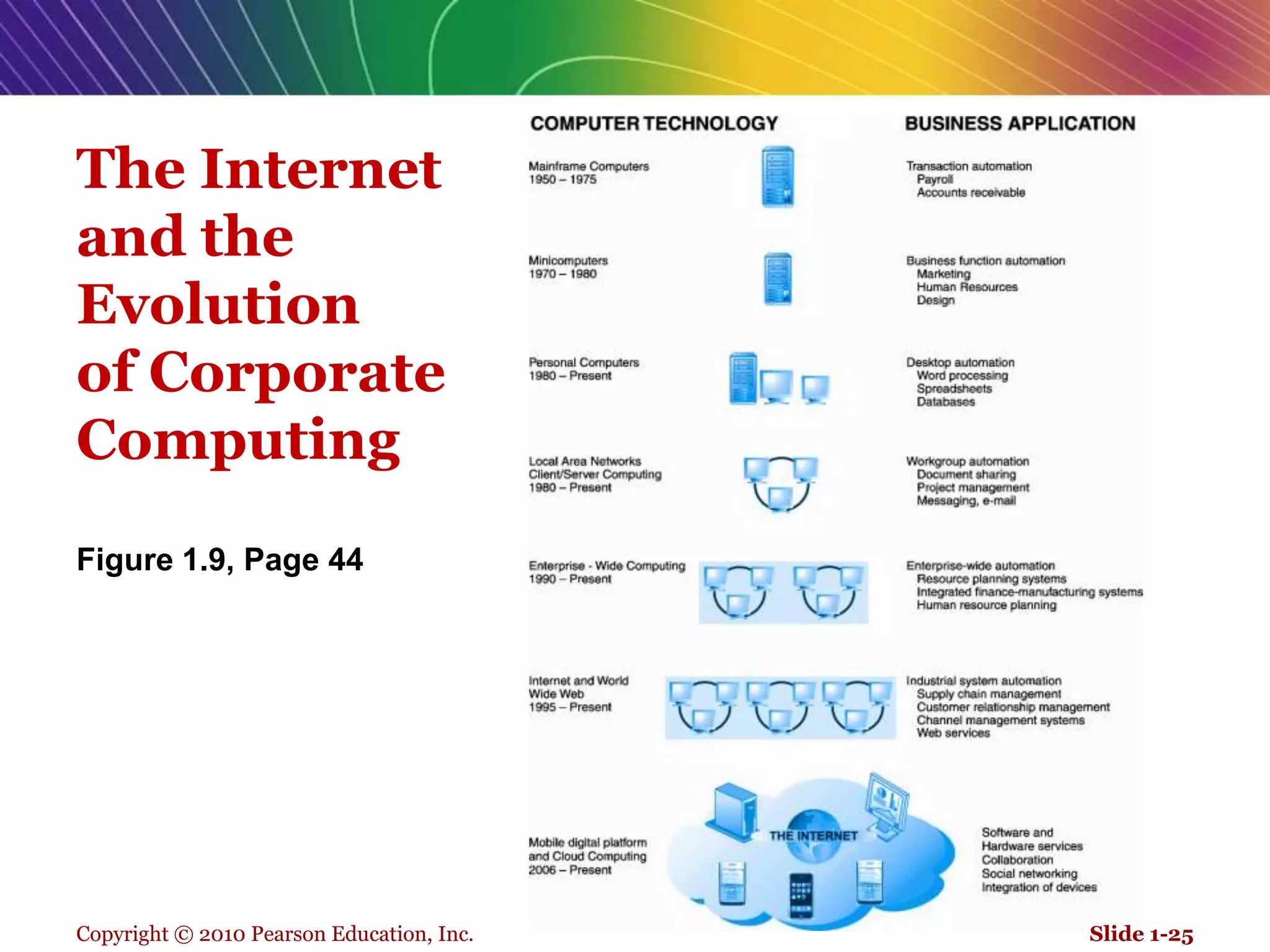
Copyright © 2010 Pearson Education, Inc.The Internet and the Evolution of Corporate ComputingFigure 1.9, Page 44Slide 1-25
Copyright © 2010 Pearson Education, Inc.Insight on SocietyPrivacy Online: Does Anybody Care?Class DiscussionWhat techniques of privacy invasion are described in the case?Which of these techniques is the most privacy-invading? Why?Is e-commerce any different than traditional markets with respect to privacy? Don’t merchants always want to know their customer?How do you protect your privacy on the Web?Slide 1-26
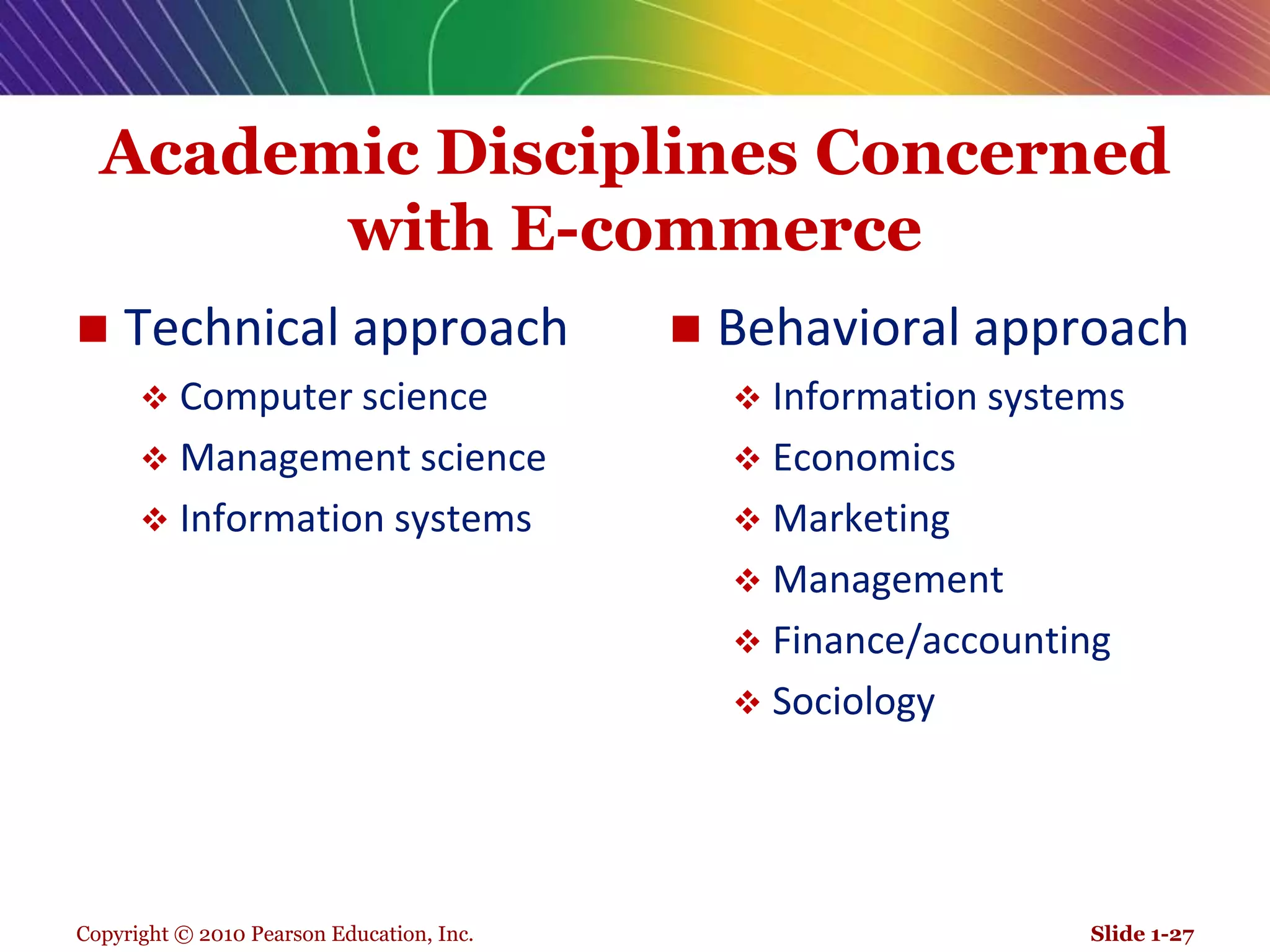
Copyright © 2010 Pearson Education, Inc.Academic Disciplines Concerned with E-commerceTechnical approachComputer scienceManagement scienceInformation systemsBehavioral approachInformation systemsEconomicsMarketingManagementFinance/accountingSociologySlide 1-27
Copyright © 2010 Pearson Education, Inc.Slide 1-28All rights reserved. No part of this publication may be reproduced, stored in a retrieval system, or transmitted, in any form or by any means, electronic, mechanical, photocopying, recording, or otherwise, without the prior written permission of the publisher. Printed in the United States of America.Copyright © 2010 Pearson Education, Inc.  Publishing as Prentice Hall

Chapter 1

  • 1.
    Copyright © 2010Pearson Education, Inc.E-commercebusiness. technology. society.Sixth EditionKenneth C. LaudonCarol Guercio Traver
  • 2.
    Copyright © 2010Pearson Education, Inc.Chapter 1The Revolution Is Just BeginningCopyright © 2007 Pearson Education, Inc.Slide 1-2
  • 3.
    Copyright © 2010Pearson Education, Inc.The InternetWorldwide network of computer networks built on common standardsCreated in late 1960sServices include the Web, e-mail, file transfers, etc.Can measure growth by looking at number of Internet hosts with domain namesSlide 1-3
  • 4.
    Copyright © 2010Pearson Education, Inc.The Growth of the Internet, Measured by Number of Internet Hosts with Domain NamesFigure 1.3, Page 23Slide 1-4SOURCE: Internet Systems Consortium, Inc., 2009.
  • 5.
    Copyright © 2010Pearson Education, Inc.The WebMost popular Internet serviceDeveloped in early 1990sProvides access to Web pages HTML documents that may include text, graphics, animations, music, videosWeb content has grown exponentially2 billion Web pages in 2000 At least 40–50 billion pages todaySlide 1-5
  • 6.
    Copyright © 2010Pearson Education, Inc.E-commerce Trends 2009–2010New business models based on social technologies, consumer-generated content, and services 2009 a flat year, but growth expected to resume in 2010Broadband and wireless access continue to growMobile e-commerce begins to take offTraditional media losing subscribersSlide 1-6
  • 7.
    Copyright © 2010Pearson Education, Inc.The First 30 SecondsFirst 15 years of e-commerceJust the beginningRapid growth and changeTechnologies continue to evolve at exponential ratesDisruptive business changeNew opportunitiesSlide 1-7
  • 8.
    Copyright © 2010Pearson Education, Inc.What is E-commerce? Use of Internet and Web to transact businessMore formally:Digitally enabled commercial transactions between and among organizations and individualsSlide 1-8
  • 9.
    Copyright © 2010Pearson Education, Inc.E-commerce vs. E-businessE-business:Digital enablement of transactions and processes within a firm, involving information systems under firm’s controlDoes not include commercial transactions involving an exchange of value across organizational boundariesSlide 1-9
  • 10.
    Copyright © 2010Pearson Education, Inc.Why Study E-commerce?E-commerce technology is different, more powerful than previous technologiesE-commerce bringing fundamental changes to commerceTraditional commerce:Passive consumerSales-force drivenFixed pricesInformation asymmetrySlide 1-10
  • 11.
    Copyright © 2010Pearson Education, Inc.Unique Features of E-commerce TechnologyUbiquity Global reach Universal standards Information richness Interactivity Information densityPersonalization/customizationSocial technologySlide 1-11
  • 12.
    Copyright © 2010Pearson Education, Inc.Web 2.0Applications, technologies that allow users to: Create and share content, preferences, bookmarks, and online personasParticipate in virtual livesBuild online communitiesExamplesYouTube, Photobucket, Flickr, Google, iPhoneMySpace, Facebook, LinkedInSecond LifeWikipediaSlide 1-12
  • 13.
    Copyright © 2010Pearson Education, Inc.Types of E-commerceClassified by market relationshipBusiness-to-Consumer (B2C)Business-to-Business (B2B)Consumer-to-Consumer (C2C)Classified by technology usedPeer-to-Peer (P2P)Mobile commerce (M-commerce)Slide 1-13
  • 14.
    Copyright © 2010Pearson Education, Inc.Origins & Growth of E-commercePrecursors:Baxter Healthcare Electronic Data Interchange (EDI) French Minitel (1980s videotext system)None had functionality of Internet1995: Beginning of e-commerceFirst sales of banner advertisementsSince then, e-commerce fastest growing form of commerce in the United States Slide 1-14
  • 15.
    Copyright © 2010Pearson Education, Inc.The Growth of B2C E-commerceFigure 1.4, Page 25Slide 1-15SOURCES: eMarketer, Inc., 2009a; U.S. Census Bureau, 2009b; authors’ estimates.
  • 16.
    Copyright © 2010Pearson Education, Inc.The Growth of B2B E-commerceFigure 1.5, Page 28Slide 1-16SOURCES: U.S. Census Bureau, 2009a; authors’ estimates.
  • 17.
    Copyright © 2010Pearson Education, Inc.Technology and E-commerce in PerspectiveThe Internet and Web: Just two of a long list of technologies that have greatly changed commerceAutomobilesRadioE-commerce growth will eventually cap as it confronts its own fundamental limitations.Slide 1-17
  • 18.
    Copyright © 2010Pearson Education, Inc.Potential Limitations on the Growth of B2C E-commerceExpensive technology Sophisticated skill set Persistent cultural attraction of physical markets and traditional shopping experiencesPersistent global inequality limiting access to telephones and computersSaturation and ceiling effectsSlide 1-18
  • 19.
    Copyright © 2010Pearson Education, Inc.E-commerce: A Brief History1995–2000: InnovationKey concepts developedDot-coms; heavy venture capital investment2001–2006: ConsolidationEmphasis on business-driven approach2006–Present: ReinventionExtension of technologiesNew models based on user-generated content, social networking, servicesSlide 1-19
  • 20.
    Copyright © 2010Pearson Education, Inc.Early Visions of E-commerceComputer scientists: Inexpensive, universal communications and computing environment accessible by allEconomists: Nearly perfect competitive market and friction-free commerceLowered search costs, disintermediation, price transparency, elimination of unfair competitive advantageEntrepreneurs: Extraordinary opportunity to earn far above normal returns on investment—first mover advantageSlide 1-20
  • 21.
    Copyright © 2010Pearson Education, Inc.Insight on BusinessThe Internet Investment RollercoasterClass DiscussionWhat explains the rapid growth in private investment in e-commerce firms in the period 1998–2000? Was this investment irrational?What was the effect of the big bust of March 2000 on e-commerce investment?What is the value to investors of a company such as YouTube which has yet to show profitability?Why do you think investors today would be interested in investing in or purchasing e-commerce companies? Would you invest in an e-commerce company today? Slide 1-21
  • 22.
    Copyright © 2010Pearson Education, Inc.Assessing E-commerceMany early visions not fulfilledFriction-free commerceConsumers less price sensitiveConsiderable price dispersionPerfect competitionInformation asymmetries persistDisintermediationFirst mover advantageFast-followers often overtake first moversSlide 1-22
  • 23.
    Copyright © 2010Pearson Education, Inc.Predictions for the FutureTechnology will propagate through all commercial activityPrices will rise to cover the real cost of doing businessE-commerce margins and profits will rise to levels more typical of all retailersCast of players will changeTraditional Fortune 500 companies will play dominant roleNew startup ventures will emerge with new products, servicesNumber of successful pure online stores will remain smaller than integrated offline/online storesGrowth of regulatory activity worldwideInfluence of cost of energySlide 1-23
  • 24.
    Copyright © 2010Pearson Education, Inc.Understanding E-commerce: Organizing ThemesTechnology: Development and mastery of digital computing and communications technology Business: New technologies present businesses with new ways of organizing production and transacting businessSociety: Intellectual property, individual privacy, public welfare policySlide 1-24
  • 25.
    Copyright © 2010Pearson Education, Inc.The Internet and the Evolution of Corporate ComputingFigure 1.9, Page 44Slide 1-25
  • 26.
    Copyright © 2010Pearson Education, Inc.Insight on SocietyPrivacy Online: Does Anybody Care?Class DiscussionWhat techniques of privacy invasion are described in the case?Which of these techniques is the most privacy-invading? Why?Is e-commerce any different than traditional markets with respect to privacy? Don’t merchants always want to know their customer?How do you protect your privacy on the Web?Slide 1-26
  • 27.
    Copyright © 2010Pearson Education, Inc.Academic Disciplines Concerned with E-commerceTechnical approachComputer scienceManagement scienceInformation systemsBehavioral approachInformation systemsEconomicsMarketingManagementFinance/accountingSociologySlide 1-27
  • 28.
    Copyright © 2010Pearson Education, Inc.Slide 1-28All rights reserved. No part of this publication may be reproduced, stored in a retrieval system, or transmitted, in any form or by any means, electronic, mechanical, photocopying, recording, or otherwise, without the prior written permission of the publisher. Printed in the United States of America.Copyright © 2010 Pearson Education, Inc.  Publishing as Prentice Hall